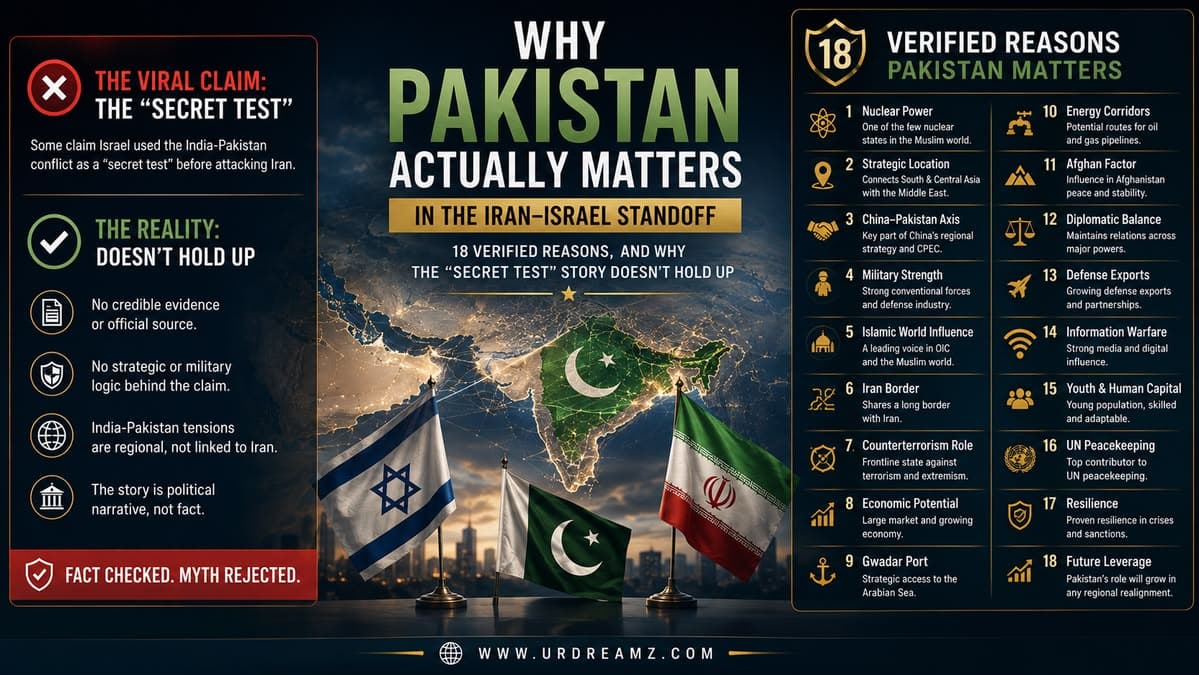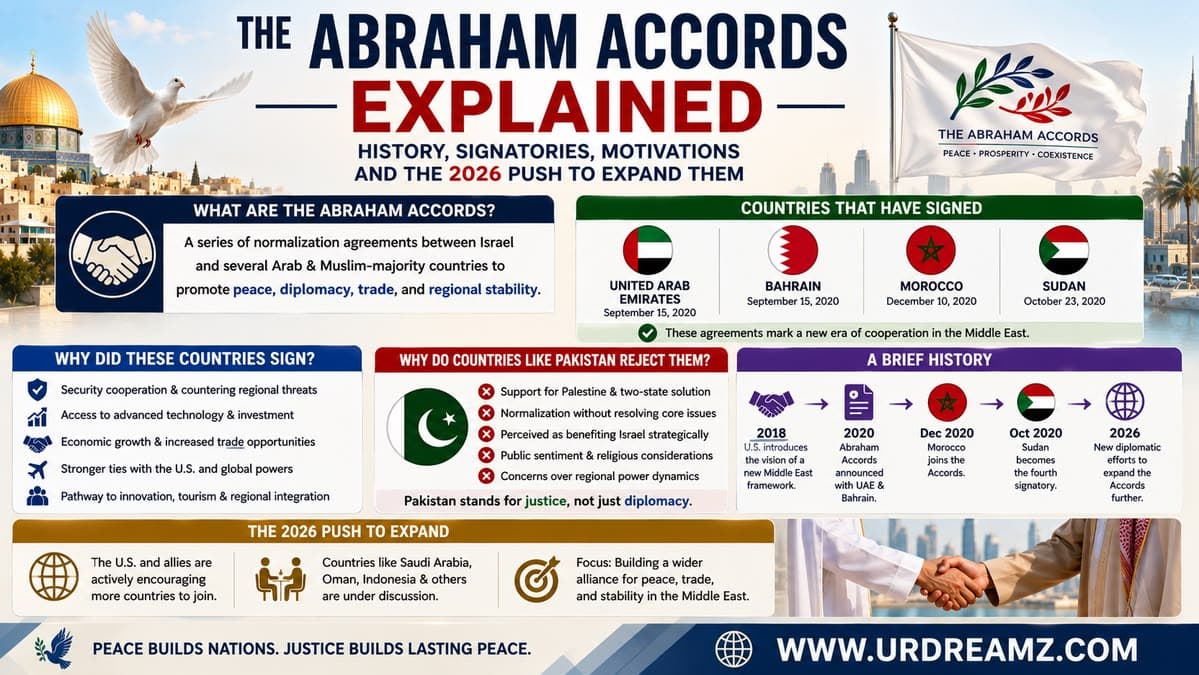
The Abraham Accords Explained: History, Signatories, Motivations and the 2026 Push to Expand Them
Few modern diplomatic agreements have generated as much genuine excitement in some capitals and as much genuine objection in others as the Abraham Accords. Brokered by the United States in 2020, this framework has already reshaped diplomatic ties across the Middle East, and in 2026 it remains one of the most actively contested pieces of ongoing international diplomacy, with the US now pushing hard for Saudi Arabia, Qatar, Pakistan, Turkey, Egypt, and Jordan to join. This guide explains, in complete and balanced detail, what the Abraham Accords actually are, why they're named the way they are, who has signed them, what signatories actually gain, why several major countries continue to reject them, and where this whole diplomatic project stands right now.
1. What Are the Abraham Accords?
The Abraham Accords are a set of US-brokered diplomatic agreements aimed at formally normalizing relations between Israel and Muslim-majority countries. Signed in Washington, D.C. on September 15, 2020, during Donald Trump's first term as US president, the accords consist of a general joint declaration alongside separate bilateral normalization agreements between Israel and each individual signing country. In simple terms, they are a framework for countries that previously had no official diplomatic relationship with Israel - and in several cases actively refused to recognize it as a legitimate state - to formally establish embassies, trade relationships, and cooperative ties with it instead.
2. Why They're Called the "Abraham" Accords
The name is a deliberate reference to the Prophet Abraham, a figure regarded as a shared patriarch across all three major Abrahamic faiths - Judaism, Christianity, and Islam. In Islamic tradition he is known as Hazrat Ibrahim (peace be upon him), a revered prophet mentioned extensively in the Quran. By naming the agreement after a figure considered a common spiritual ancestor across all three religions, the framers of the accords intended the name itself to symbolize shared heritage and the possibility of cooperation between communities that trace their religious lineage back to the same historical and spiritual root, even where their modern political relationships remain deeply strained.
3. The Historical Backdrop: Israel's Disputed Recognition
To understand why the Abraham Accords mattered so much, it helps to understand the problem they were built to solve. Since Israel's founding in 1948, a significant number of countries - particularly across the Arab and broader Muslim-majority world - have declined to formally recognize it as a legitimate state, largely tied to the unresolved status of Palestinian statehood and the decades-long Arab-Israeli conflict. Prior to the Abraham Accords, only Egypt (1979) and Jordan (1994) had signed formal peace treaties establishing diplomatic relations with Israel among Arab nations, making any further normalization a genuinely rare and politically significant diplomatic achievement.
4. How the Accords Began: The Trump Administration's Role
The Abraham Accords were a signature diplomatic initiative of Donald Trump's first presidential administration. Broader normalization with the Arab world had long been a difficult, largely unresolved goal for successive US administrations, given Washington's close alliance with Israel alongside its strategic relationships across the Arab world. The Trump administration made expanding Israel's diplomatic recognition a specific, active policy priority, framing it as a pathway to greater regional stability and economic integration across the Middle East.
5. Jared Kushner and the Diplomatic Strategy Behind the Accords
Jared Kushner, Trump's son-in-law and senior White House adviser at the time, played a central, widely reported role in negotiating the framework, working directly with officials across the Gulf states and Israel to build the diplomatic and economic package that would eventually become the Abraham Accords. The strategy centered on offering participating countries tangible economic, security, and diplomatic incentives from both the US and Israel in exchange for formal recognition - a trade-focused approach distinct from earlier peace efforts that had centered more narrowly on resolving territorial disputes first.
6. The First Signatories: UAE and Bahrain
The United Arab Emirates and Bahrain became the first two countries to formally sign the Abraham Accords in September 2020, marking the first new Arab-Israeli normalization agreements in over two decades. Both Gulf states cited shared regional security interests, economic opportunity, and a desire to reposition themselves as forward-looking, internationally connected economies as key motivations behind the decision.
7. Morocco Joins the Accords
Morocco joined the framework in December 2020, shortly after the initial signing. Morocco's decision came with a notable added dimension: as part of the arrangement, the United States formally recognized Moroccan sovereignty over the disputed Western Sahara territory, illustrating how the Abraham Accords process often involved additional, country-specific diplomatic trade-offs beyond the core Israel normalization framework itself.
8. Sudan's Complicated Signing
Sudan signed the general Abraham Accords declaration in January 2021, but its path has remained unusually complicated compared to the other signatories. Ongoing political instability within Sudan has repeatedly delayed the country from finalizing a full bilateral normalization agreement with Israel, meaning Sudan's participation remains, even years later, more symbolic and unfinished than the fully implemented agreements signed by the UAE, Bahrain, and Morocco.
9. Kazakhstan: The First Major Expansion Beyond the Middle East
In a significant development, Kazakhstan formally acceded to the Abraham Accords in November 2025, becoming the first Central Asian nation to join the framework. Notably, Kazakhstan and Israel had already maintained diplomatic relations for decades prior to this move, making Kazakhstan's accession less about establishing entirely new ties and more about formally aligning itself with the broader Abraham Accords framework and its associated economic and security cooperation structures.
10. What Countries Actually Gain From Joining: Economic Benefits
For signatory countries, the Abraham Accords have generally opened new trade relationships with Israel and, by extension, deeper economic ties with the United States - covering areas like technology cooperation, tourism, agriculture, and investment. Countries like the UAE have reported substantial growth in bilateral trade with Israel since signing, presenting the economic case for normalization as one of the clearest, most measurable benefits of participation.
11. What Countries Gain: Security and Defense Cooperation
Beyond trade, signatory countries have generally gained access to deeper security and intelligence cooperation with both the US and Israel, including in some cases advanced defense technology and shared regional security coordination. For Gulf states in particular, which have long viewed Iran's regional influence as a central security concern, this defense dimension of the Accords has been presented as a significant strategic incentive alongside the purely economic benefits.
12. What Countries Gain: Diplomatic Standing With Washington
Joining the Abraham Accords has also generally strengthened participating countries' broader diplomatic relationship with the United States, often accompanied by additional bilateral incentives - trade concessions, defense agreements, or, in Morocco's case, direct US recognition of a disputed territorial claim. For several signatories, this closer alignment with Washington has been framed as valuable in its own right, independent of the specific relationship with Israel.
13. Countering Iran: The Strategic Subtext
A significant, if less publicly emphasized, motivation behind the Abraham Accords involves shared concern among the US, Israel, and several Gulf states about Iran's regional influence and nuclear program. Analysts have widely described the Accords as functioning, in part, as the foundation of a loosely aligned regional security bloc aimed at counterbalancing Iran, even though this strategic framing is rarely stated as explicitly in official government messaging as the economic and diplomatic benefits are.
14. Countries That Have Not Joined, and Why
Despite active diplomatic pressure, several major Muslim-majority countries have not joined the Abraham Accords. Saudi Arabia, despite serious and ongoing discussions, has not signed as of mid-2026, with normalization reportedly linked in recent negotiations to a proposed US civilian nuclear cooperation agreement. Qatar, Turkey, and several other nations have similarly declined to join despite active US encouragement throughout 2026. The most commonly cited reason across these holdout nations is the unresolved status of Palestinian statehood - many governments have publicly stated that full normalization with Israel should follow, rather than precede, meaningful progress toward a two-state solution and Palestinian self-determination.
15. Pakistan's Position on the Abraham Accords
Pakistan has consistently declined to join the Abraham Accords or otherwise establish formal diplomatic relations with Israel, a position it has maintained across different governments for decades, predating the Accords themselves. Pakistani officials have repeatedly linked this position to support for Palestinian statehood and the unresolved Israeli-Palestinian conflict, framing recognition of Israel as premature without meaningful progress on Palestinian rights and sovereignty. This position reflects a broader pattern seen among several other Muslim-majority nations that have similarly withheld recognition pending resolution of the Palestinian issue, rather than being unique to Pakistan alone.
16. The Palestinian Question: The Core Criticism of the Accords
The most consistent and widely voiced criticism of the Abraham Accords, from both governments and civil society across the Muslim-majority world, is that normalizing relations with Israel without first securing meaningful progress toward Palestinian statehood risks sidelining the Palestinian cause entirely. Critics argue that the Accords allow participating Arab governments to gain tangible economic and security benefits while offering the Palestinians very little in return, potentially reducing the diplomatic pressure that might otherwise push Israel toward a broader peace settlement addressing Palestinian sovereignty and territorial disputes.
17. Common Misconceptions About the Accords
A number of misconceptions circulate about the Abraham Accords, and it's worth addressing them directly. The name refers to the shared religious heritage represented by the Prophet Abraham across Judaism, Christianity, and Islam - it is not, as some online commentary has speculated, a formal plan to merge the three religions into a single faith. No such religious-merger objective appears anywhere in the actual text of the accords, in any official US, Israeli, or signatory government statement, or in any credible reporting on the negotiations. The name is symbolic, referencing shared ancestry as a unifying framing device for a political and economic agreement, not a literal religious project.
18. The 2026 Push: Saudi Arabia, Qatar, Turkey, Egypt and Jordan
Throughout 2026, the Trump administration has actively pushed to expand the Abraham Accords framework to include Saudi Arabia, Qatar, Pakistan, Turkey, Egypt, and Jordan. As of the most recent reporting, none of these six countries has formally joined the Accords. It's worth noting that Egypt and Jordan already maintain longstanding, separate peace treaties and diplomatic relations with Israel dating back to 1979 and 1994 respectively - meaning their potential inclusion in the Abraham Accords framework would be more about formal alignment with this specific diplomatic structure than establishing entirely new relations with Israel.
19. The Saudi Arabia Nuclear Deal Linkage
One of the more notable developments in 2026 involves Saudi Arabia specifically. In July 2026, President Trump stated that a proposed civilian nuclear cooperation agreement with Saudi Arabia would be directly linked to the kingdom joining the Abraham Accords and normalizing relations with Israel. This linkage illustrates the broader pattern seen throughout the Accords' history - using significant, high-value bilateral incentives as leverage to encourage normalization, rather than relying purely on the appeal of the Accords framework itself.
20. Egypt and Jordan's Existing but Separate Peace Treaties
It's important to distinguish between Egypt and Jordan's long-standing peace treaties with Israel and formal membership in the Abraham Accords framework. Egypt signed its peace treaty with Israel in 1979, and Jordan followed in 1994 - both well before the Abraham Accords existed as a concept. While both countries maintain active diplomatic relations with Israel today, neither is formally counted among the Abraham Accords signatories under the 2020 framework, even as their potential formal inclusion has been discussed as part of the broader 2026 expansion push.
21. Long-Term Implications for the Middle East
Regardless of how the current expansion push resolves, the Abraham Accords have already measurably altered the diplomatic landscape of the Middle East, establishing a working, if still incomplete, precedent for normalization outside the traditional framework of resolving the Israeli-Palestinian conflict first. Whether this precedent ultimately encourages broader regional stability or entrenches unresolved Palestinian grievances further remains one of the most actively debated questions in current Middle East policy analysis.
22. Arguments in Favor of the Accords
Supporters argue that the Abraham Accords have delivered concrete, measurable benefits - expanded trade, deeper security cooperation, and a rare instance of tangible diplomatic progress in a region long defined by diplomatic stalemate. Proponents also argue that expanding formal ties between Israel and its neighbors can create economic incentives for long-term regional stability that decades of purely political negotiation failed to produce, and that engagement, rather than isolation, offers a more realistic path toward eventually improving conditions for Palestinians as well.
23. Arguments Against the Accords
Critics argue that the Accords allow participating governments to gain real economic and security benefits while the underlying Israeli-Palestinian conflict remains fundamentally unresolved, potentially reducing international pressure on Israel to negotiate meaningful concessions on Palestinian statehood. Some also argue that normalization agreements reached without direct, meaningful input from Palestinian representatives risk being seen as legitimizing the status quo rather than genuinely advancing regional peace, a concern voiced by both governments that have declined to join and by advocacy groups focused on Palestinian rights.
Frequently Asked Questions
What are the Abraham Accords?
A set of US-brokered agreements, signed starting in September 2020, aimed at normalizing diplomatic relations between Israel and Muslim-majority countries.
Why are they called the Abraham Accords?
They are named after the Prophet Abraham, regarded as a shared patriarch across Judaism, Christianity, and Islam, symbolizing common heritage rather than any plan to merge the religions themselves.
Which countries have signed the Abraham Accords?
The United Arab Emirates and Bahrain signed first in September 2020, followed by Morocco in December 2020, Sudan's general declaration in January 2021, and Kazakhstan's formal accession in November 2025.
Has Saudi Arabia joined the Abraham Accords?
As of mid-2026, no - though discussions are ongoing, and a proposed US-Saudi civilian nuclear agreement has been publicly linked to potential Saudi normalization with Israel.
Why hasn't Pakistan joined the Abraham Accords?
Pakistan has consistently cited the unresolved status of Palestinian statehood as its reason for not recognizing Israel or joining the Accords, a position it has held for decades independent of the Accords themselves.
Is the Abraham Accords name related to a plan to merge world religions?
No - this is a misconception. The name references shared religious heritage through the Prophet Abraham; no official document or government statement describes any plan to merge Judaism, Christianity, and Islam into a single faith.
What is the main criticism of the Abraham Accords?
Critics argue the Accords allow normalization to proceed without resolving Palestinian statehood first, potentially reducing diplomatic pressure on Israel to address Palestinian sovereignty and territorial disputes.
Conclusion
The Abraham Accords represent one of the most significant, and most contested, diplomatic developments in the modern Middle East - a framework that has genuinely reshaped formal relationships between Israel and several Muslim-majority nations while leaving the core Israeli-Palestinian conflict fundamentally unresolved. Whether the ongoing 2026 push to bring in Saudi Arabia, Qatar, and others succeeds or stalls, the Accords have already demonstrated that economic and security incentives can move diplomatic positions many assumed were fixed for good - while the sharpest, most persistent criticism remains exactly where it started in 2020: what happens to the Palestinian people while this particular diplomatic door keeps opening for everyone around them.