The Country That Built a Bunker for Every Single Citizen: Switzerland's Wild Secret
Okay, so I have to tell you about something I went down a rabbit hole on this week, because I genuinely did not expect it to check out until I dug into it myself.
You know how the world feels a little... tense right now? Every other headline is about two big powers staring each other down, ceasefires that hold for a week and then don't, and that background hum of "what if this actually goes somewhere bad." If you've thought about it even for a second, you've probably had the same dark thought I had: if the worst ever actually happened — if any of this ever turned into something bigger, something nuclear — is there anywhere on Earth that would genuinely be okay?
Turns out, there's one country that's been quietly preparing for exactly that scenario for over sixty years. Not with fear-mongering, not with panic buttons and doomsday cults. With concrete. Literally, actual poured concrete, underground, everywhere.
I'm talking about Switzerland. And once you actually look into what they've built, it stops sounding like a fun trivia fact and starts sounding like one of the most quietly serious national decisions any country has ever made.
First, the part that made me stop scrolling
Switzerland hasn't fought a war since 1847. Not "hasn't been in a major war." Hasn't fought a war, full stop, internal or external. That was the Sonderbund War, a short civil conflict between Swiss cantons over religious and political differences, and since then? Nothing. Not one war. That's roughly 179 years of a country simply not going to war, not once, not in either World War, not during the entire Cold War, not in anything since.
When you first hear that, the instinct is to assume it's just lucky geography — mountains, a small population, a country nobody particularly wanted to bother invading. That's honestly what I assumed too, at first. But the deeper I got into this, the clearer it became that this wasn't luck. This was a decision. A very specific, very deliberate, almost obsessive decision, repeated generation after generation, that eventually became something close to a national identity.
Neutral on paper is not the same as neutral in practice
Here's something people misunderstand about Swiss neutrality, and I definitely misunderstood it before I looked closer. Neutral doesn't mean unarmed, and it definitely doesn't mean unprepared. Switzerland's neutrality is what's sometimes called "armed neutrality." It means: we will not attack anyone, we will not join anyone else's war, but if you come for us, you will regret it enormously.
That mindset shows up in a few very concrete ways. Switzerland has a militia-based army, which basically means most Swiss men go through mandatory military training and then stay part of the reserve force for years afterward, often keeping their service rifle at home. It's a country where, if things ever escalated fast, a huge portion of the male population could be mobilized within days, already trained, already equipped. That's not a country hoping neutrality alone will protect it. That's a country hedging that bet as hard as it possibly can, just in case.
The World War that almost pulled Switzerland in anyway
People forget this part, but Switzerland actually came dangerously close to being swallowed up during World War II. Surrounded on essentially every side by Axis-controlled or Axis-aligned territory — Nazi Germany to the north, Fascist Italy to the south, occupied France to the west — Switzerland spent years as this tiny neutral pocket sitting directly inside hostile territory, with genuinely credible fears that Hitler could order an invasion at almost any point.
What Switzerland did in response is honestly one of the most fascinating military strategies of the entire war, and it directly set the stage for everything that came later with the bunkers. A Swiss general named Henri Guisan came up with what's now known as the National Redoubt strategy. The idea was almost brutally simple: if a full-scale invasion ever came, Switzerland would not try to defend its lowland cities and borders in a conventional way. Instead, the entire military and as much of the population and industry as possible would retreat into the Alps themselves, into a network of fortified mountain positions, and turn the country's own terrain into an impossible, grinding fortress. Let the invaders take the flat land if they wanted it. The real Switzerland, the parts that mattered, would go underground into the mountains and simply refuse to be dug out.
The Redoubt was never actually tested, because Germany, for a mix of reasons still debated by historians, never invaded. But the psychological effect of that strategy stuck around long after the war ended. Switzerland had already proven to itself, at least in planning, that "go underground and become impossible to conquer" wasn't some abstract idea. It was an actual, funded, seriously considered national defense plan. That mindset didn't go away when the war ended. If anything, it just found a new threat to attach itself to.
The moment everything changed for Switzerland
Fast forward to the Cold War at its worst. The US and the Soviet Union pointing nuclear weapons at each other across a divided Europe, and Switzerland sitting right there in the geographic middle of it, officially neutral, technically outside the conflict, but absolutely not outside the blast radius if things ever went wrong. Neutrality can protect you from being invaded. It cannot protect you from radioactive fallout drifting quietly over your border from a war you had absolutely nothing to do with.
The Swiss government looked at that reality with the same cold, practical logic they'd used during the National Redoubt planning decades earlier, and basically said: we can't control whether a nuclear war happens near us. We can control whether our own people survive it if it does.
In 1959, Swiss voters actually approved adding civil protection directly into the Federal Constitution — this wasn't just some quiet bureaucratic decision made behind closed doors, the public voted for it. Then in 1963, that principle became concrete law, in every sense of the word. It became a legal requirement that every new residential building in the country include a properly built nuclear fallout shelter, right there in the basement. If a builder genuinely couldn't fit one in for some reason, fine — but then they had to pay into a public fund that went directly toward building shared community shelters nearby instead. No exceptions, no easy workaround. Build a bunker, or pay for someone else's bunker to exist.
So how many bunkers are we actually talking about?
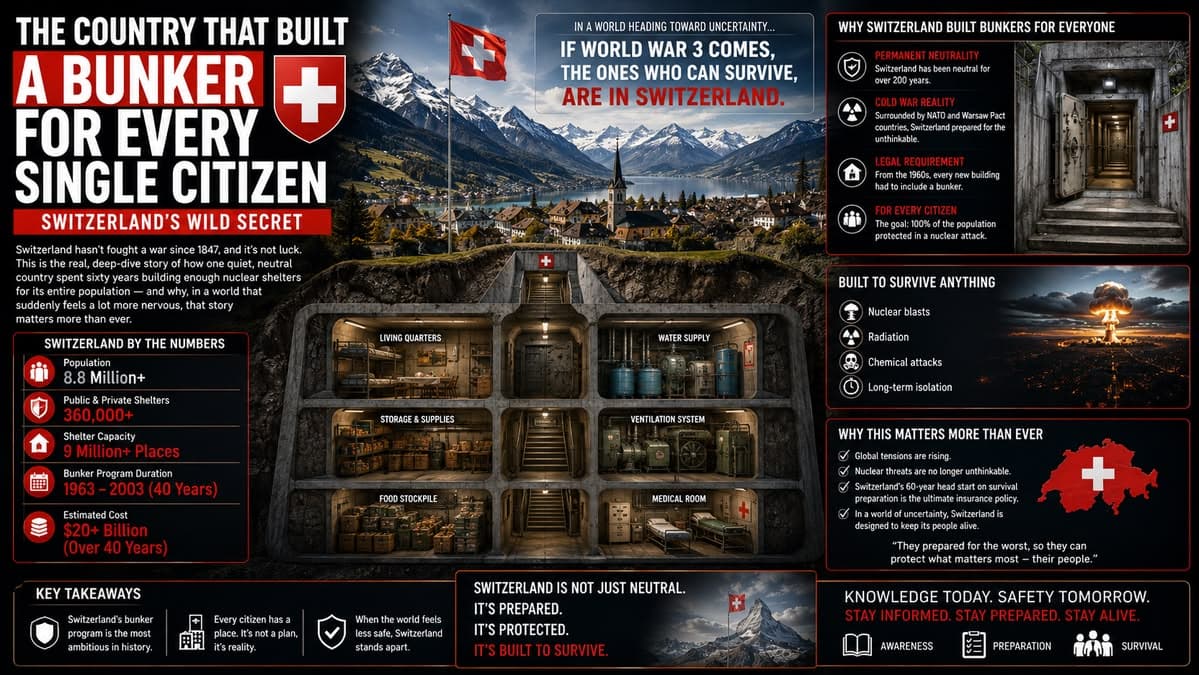
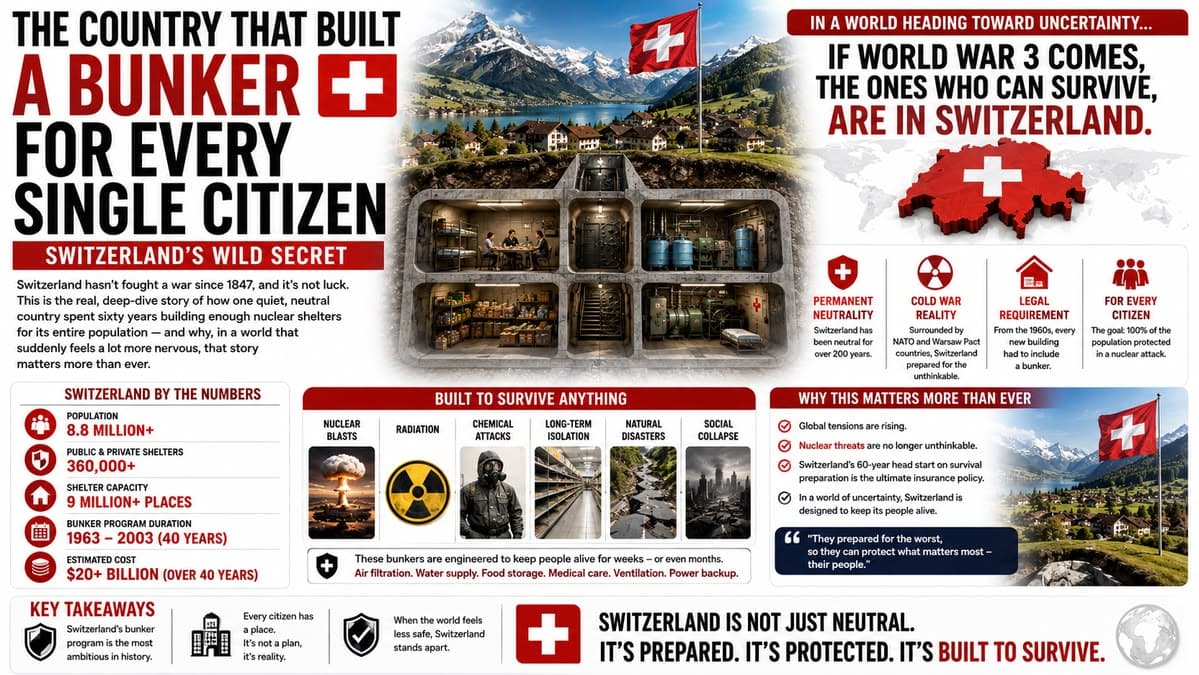
Here's where it gets almost funny in how thorough it is. Switzerland's population sits at just under 9 million people. And between all the private shelters tucked into home basements and the larger public ones — some of them literally carved straight into mountainsides, built around old road tunnels — the country has somewhere around 370,000 separate shelters. When you add up their actual total capacity, all those spaces combined can hold somewhere between about 107% and 114% of the entire population.
Read that again if you need to, because it's genuinely wild: there are more shelter spaces in Switzerland than there are people living in Switzerland. Every single Swiss resident — and this apparently includes foreign workers and refugees too, not just citizens — is legally entitled to at least one square meter of protected shelter space, reachable from their home. And it's not a vague promise. By law, if a local municipality doesn't have enough private shelters to cover everyone in the area, the local government is on the hook to build and maintain enough public ones to close that gap.
Since the program properly kicked off in the early 1960s, Switzerland has spent something in the neighborhood of 12 billion Swiss francs on building and maintaining this entire network. That's not pocket change for a country of 9 million people. That's a multi-generational national investment, made continuously, decade after decade, largely without the rest of the world paying much attention to it at all.
The mountain that swallowed a small city
Some of these places are honestly incredible feats of engineering, and my favorite example is the Sonnenberg shelter in Lucerne. In the 1970s, Switzerland was already building a motorway tunnel straight through a mountain near the city, and someone essentially looked at that half-built tunnel and thought: why don't we just also turn this into one of the biggest fallout shelters in the world while we're at it?
So they did. The finished shelter used both directions of that motorway tunnel, fitted with massive blast doors and ventilation systems, and at its original capacity it was rated to hold around 20,000 people at once — split into small, self-contained sixty-four person sections. Twenty thousand people. That's not a bunker, that's basically a small underground town, hidden inside a mountain, sitting directly beneath a motorway that tens of thousands of cars drive over every single day without a second thought.
Later inspections in the 1980s found some real operational problems with actually running a shelter that size in practice, so its official rated capacity was scaled back significantly, down to around 2,000 people. Today it mostly functions as a museum and a genuinely popular tourist attraction, which honestly might be the most Swiss ending imaginable for a doomsday bunker: eventually becoming a place where tourists take pictures of the blast doors.
The part nobody expects: what these bunkers actually look like day to day
Here's the twist that makes this whole thing feel a lot less grim than it initially sounds. Switzerland built all of this infrastructure hoping, genuinely hoping, that most of it would never actually be needed for its original purpose. So in ordinary, peaceful daily life? A huge number of these bunkers just quietly live an entirely different second life.
People use their basement shelters as wine cellars. As storage rooms for skis and camping gear. As small home gyms. As workshops. You could be standing in someone's basement in Zurich or Geneva, admiring their wine collection, and be standing inside a fully rated, government-inspected nuclear shelter without even realizing it, because it's just... part of the house. Nobody treats it as some ominous doomsday room you're not allowed to talk about. It's just extra underground square footage that happens to also be built to withstand a blast.
That's such a distinctly Swiss way to handle something this serious, honestly. Prepare for the absolute worst-case scenario with total, unglamorous seriousness — but refuse to let that preparation make everyday life feel like you're constantly bracing for disaster. Regularly inspected, kept genuinely functional, and then quietly repurposed for wine storage until the day, hopefully never, that it's actually needed.
It's not frozen in time — the law has actually evolved
One thing I found genuinely interesting is that this system hasn't just sat unchanged since 1963 like some Cold War relic nobody bothered to update. It's actually been adjusted over time as the country's needs and building patterns changed. In 2012, for example, the law shifted so that brand new buildings only need to include a dedicated shelter if they have 38 or more rooms — smaller residential buildings can instead just contribute to public shelter funding rather than being required to build their own private one from scratch every single time.
Even the enforcement side hasn't gone soft. These shelters are subject to regular government inspections to make sure they still function properly, that the ventilation systems, the blast doors, the water and air filtration all actually work the way they're supposed to, decades after being built. There's actually a Federal Office for Civil Protection whose entire job is enforcing this. It's a genuine ongoing government function, not some abandoned Cold War program nobody remembers exists.
Does every canton do it exactly the same way? Not quite
Here's a small detail that surprised me. You'd expect a national law like this to be applied identically everywhere, but Swiss governance has always leaned heavily toward local control, and this is no exception. Different cantons, which are basically Switzerland's version of states or provinces, handle the private-versus-public balance differently. In the canton of Fribourg, for instance, shelters lean almost entirely toward the public model — shared community shelters rather than private ones in every home. Meanwhile, in a canton like Appenzell Innerrhoden, it's almost the complete opposite: nearly every home has its own private shelter built in.
Same national law, same underlying goal, but two genuinely different local approaches to actually achieving it. It's a small thing, but it says something about how seriously and how locally this whole system has actually been implemented, rather than being some vague top-down mandate that only exists on paper in a government office somewhere.
How does this compare to what other countries have done?
This is where the Swiss approach starts to look genuinely unmatched. Yes, other countries built shelters during the Cold War too — the US had its "duck and cover" civil defense programs and some public fallout shelters in city basements, and the Soviet Union built extensive metro-based shelter systems in cities like Moscow, some of which are still maintained today. But almost everywhere else, that infrastructure was either fairly limited in scale, or it was allowed to quietly decay once the Cold War ended and the immediate sense of nuclear threat faded from public consciousness.
Switzerland just... didn't do that. It kept funding the system. It kept the law on the books. It kept inspecting the shelters. While most of the world treated fallout shelters as a slightly embarrassing relic of a paranoid era, Switzerland treated the whole concept as permanent infrastructure, the same way you'd treat roads or power lines — something you build once and then simply maintain forever, because the underlying risk that justified building it in the first place never actually disappeared, it just became less talked about.
And that's part of why, now that global tensions have picked back up again in a very real way, several other countries have started scrambling to rebuild exactly this kind of civil defense capacity. Germany and Norway, among others, have begun reinvesting seriously in public shelters after decades of letting that kind of infrastructure sit unused or get repurposed for other things. Switzerland never had to "start reinvesting," because it genuinely never stopped in the first place.
Okay, but is any of this actually necessary anymore?
I want to be fair here, because not everyone in Switzerland agrees this whole system still makes sense in its current form. There's a real, ongoing debate within the country itself about whether spending this much money and space on Cold War-era fallout protection is still the smartest use of resources in a modern context, especially as building costs rise and urban housing pressure grows in Swiss cities. Some critics argue that basement space used for a bunker that will, statistically, probably never be needed for its original purpose might be better used for actual living space in an era where housing affordability is a genuine national concern.
It's a completely fair argument, honestly, and it's not like Swiss citizens are naive about the tradeoff. But the system has persisted anyway, largely because of that same underlying philosophy that built the National Redoubt strategy generations earlier: the cost of being prepared and never needing it is nothing compared to the cost of needing protection and not having it. Switzerland has essentially decided, again and again, across generations and different governments, that this specific insurance policy is worth paying for indefinitely, even during the long stretches where it feels completely unnecessary.
Why this actually matters right now
I'm not going to sit here and tell you a nuclear war is coming, because honestly, nobody can tell you that with any real certainty — anyone who claims otherwise with total confidence is guessing, full stop. But it is true that global tensions have made a lot of countries nervous enough to seriously look at civil defense again after decades of quietly ignoring it.
And that's really the whole point of this story for me, the more I sat with it. It's not really about bunkers, specifically. It's about the fact that one country looked squarely at the worst thing that could possibly happen to it, decided it was worth taking seriously even during long stretches of relative peace, and then just quietly followed through on that decision for sixty-plus years without making some huge dramatic show of it. Most of us — most countries, even — only tend to take precautions after something bad has already happened. Switzerland built the precaution before the bad thing, and then never really had to use it for its intended purpose, which, in a strange, almost circular way, might be part of why it never had to.
So, is Switzerland really the "safest" place if things went badly wrong?
I'd put it this way, carefully: no country on Earth is truly "safe" in the sense of being completely untouched by a serious global catastrophe. A large-scale nuclear conflict would be devastating pretty much everywhere, and Switzerland wouldn't be magically exempt from radiation fallout, global economic collapse, disrupted trade, or any of the broader chaos that would follow, just because its basements happen to be well built. That part is important to say clearly, because it would be misleading to suggest otherwise.
But in terms of having a real, physical, legally mandated system built specifically to give its own citizens a genuine fighting chance to survive the immediate aftermath of a nuclear or chemical event? Nobody else on Earth has done what Switzerland has done, at this scale, this consistently, for this long. It's honestly not close.
What I keep thinking about after all this
What sticks with me most, after going through all of this, isn't even really the shelters themselves. It's the mindset behind them. There's something almost old-fashioned, in a good way, about a country deciding to prepare seriously for a worst-case scenario during decades when absolutely nothing bad was happening, just because the threat was theoretically possible. Most of us, individually and collectively as nations, tend to only act once something has already gone wrong. Switzerland built an entire underground insurance policy for a disaster it hoped, and still hopes, it will never actually need to use.
Whether that fact leaves you feeling reassured, a little unsettled, or honestly both at once, I think it's genuinely worth knowing. Not to be dramatic about the state of the world, and not because I think everyone should suddenly go build a bunker in their own basement. Just because it says something quietly remarkable about how seriously one small, famously calm country decided to take a threat that most of the rest of the world was, for a very long time, content to just talk about instead of actually preparing for.