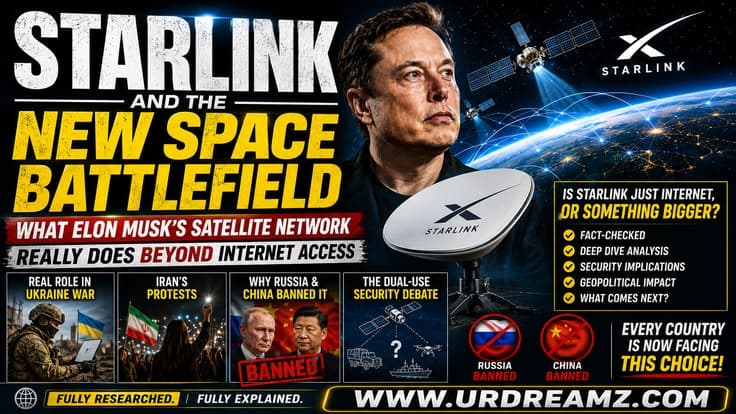
Starlink and the New Space Battlefield: What Elon Musk's Satellite Network Really Does Beyond Internet Access
"Space is the new battlefield" has become a common phrase in modern geopolitics, and whenever it comes up, one name reliably follows: Starlink. Elon Musk's satellite internet network now has well over 8,000 active satellites in low Earth orbit, with hundreds more launching every few months. SpaceX's own stated mission is simple - bring high-speed internet to every corner of the planet. But a lot of research and commentary circulating online right now claims Starlink is quietly doing something else too: enabling military coordination and even surveillance. This guide goes through that claim carefully, separates the parts that are genuinely well-documented from the parts that are exaggerated or simply incorrect, and explains what the real, evidence-based debate around Starlink actually looks like.
1. What Starlink Actually Is
Starlink is SpaceX's satellite internet constellation, made up of thousands of small satellites orbiting roughly 550 kilometers above Earth - low enough to deliver much faster, lower-latency internet than older, much higher "geostationary" satellite internet services ever could. A user connects through a compact satellite dish, commonly called a terminal, which communicates directly with the satellites passing overhead. As of 2026, Starlink operates the largest satellite constellation ever built, and it continues to grow steadily, with SpaceX regularly launching new batches of satellites to expand coverage and capacity.
2. Why Starlink Is Considered "Dual-Use" Technology
The core, well-established fact behind all the debate is this: Starlink is what's known in policy and defense circles as a dual-use technology - something originally built for a civilian purpose that also has clear, practical military applications. Any communication network resilient enough to keep working when traditional infrastructure is destroyed is inherently valuable to a military, whether or not that was the original intent. This isn't unique to Starlink or even to satellites - GPS itself started as a military system before becoming civilian infrastructure the whole world now depends on. What makes Starlink's case unusual is that it runs the other direction: a civilian product built primarily for commercial internet access has become genuinely important battlefield infrastructure in an active war, largely by circumstance rather than original design.
3. Correcting the Record: How Many Starlink Terminals Are Actually in Ukraine?
A number that circulates widely online claims the US ordered 250,000 Starlink terminals for Ukraine. That figure doesn't match the documented record. According to a USAID Inspector General report, the US government (through USAID) procured 1,508 terminals and SpaceX donated a further 3,667, totaling 5,175 terminals delivered through that specific program by mid-2022. Counting terminals delivered through other channels - the US Department of Defense, allied governments like Poland (which alone contributed around 20,000 units), and other donors - independent reporting places the real total number of Starlink terminals active in Ukraine somewhere in the range of 20,000 to 30,000 by 2023 and beyond, a very large number, but nowhere near 250,000.
4. How Starlink Is Actually Used on the Ukrainian Battlefield
What is genuinely well documented is how those tens of thousands of terminals get used. Ukrainian forces have relied on Starlink for far more than basic internet access - to pilot drones, correct artillery fire, coordinate troop movements, and maintain secure communication between units operating in areas where traditional infrastructure has been destroyed. According to the same USAID inspection, Starlink has been directly credited with restoring civilian connectivity and supporting hospitals, emergency services, and government functions, while simultaneously becoming embedded in Ukraine's military operations - exactly the blended civilian-military reality that makes dual-use technology so difficult to cleanly regulate once a war is underway.
5. The Crimea Incident: When Musk Personally Limited Military Use
One of the most revealing moments in this entire story doesn't involve secret surveillance at all - it involves Musk publicly restricting Starlink's military use himself. During a planned Ukrainian drone attack on Russia's Black Sea Fleet near Crimea, reporting indicates SpaceX limited Starlink coverage in the area, reportedly over concerns about the operation potentially escalating the wider conflict. This moment mattered less because of any hidden capability and more because of what it revealed plainly: a single private company, and effectively one individual, holds direct, real-time influence over a sovereign nation's wartime communications - a genuinely unusual amount of leverage for one private citizen to hold during an active war between nations.
6. Did Russia Also End Up Using Starlink?
Yes, and this is one of the stranger, less-discussed parts of the story. Despite US sanctions explicitly barring Starlink from being sold to or used by Russia, Ukrainian intelligence confirmed in 2024 that Russian forces had obtained and were using Starlink terminals on the battlefield, reportedly through black-market channels and captured or smuggled units, including some mounted on Russian attack drones specifically because Starlink helped those drones bypass Ukrainian jamming defenses. Ukraine and SpaceX subsequently worked together on a "whitelist" system to identify and deactivate unauthorized Russian-linked terminals, and Ukrainian officials at one point described the resulting disruption to Russian battlefield communications as significant.
7. Correcting the Record: What Actually Happened With Starlink in Iran
This is where the most significant correction needs to be made. The claim that Musk "geolocated 100 terminals in Iran and communicated with them" as a surveillance or intelligence operation is not what the documented record shows. In December 2022, amid nationwide protests following the death of Mahsa Amini in police custody, Musk tweeted that Starlink was "approaching 100 Starlinks active in Iran" - but this was in the context of activating satellite internet access specifically to help Iranian protesters bypass a government-imposed internet blackout, following the US Treasury easing sanctions specifically to allow this kind of humanitarian internet access. Musk repeated a similar activation in mid-2025 during another period of unrest following Israeli strikes on Iran. In both cases, this was about restoring civilian internet connectivity during state censorship, not about tracking or geolocating individual users for military targeting purposes.
8. Can Satellite Terminals Actually Be Tracked or Located?
Here the underlying physics genuinely does matter, and it's worth explaining clearly without exaggeration. Any device transmitting a radio signal - which is exactly what a Starlink terminal does to communicate with orbiting satellites - can, in principle, be located using radio direction-finding techniques that have existed since the earliest days of radio itself. This isn't unique or secret to Starlink; it's a basic property of radio transmission that applies to any wireless device, including ordinary Wi-Fi routers and mobile phones. In fact, it has been reported that a Russian weapons manufacturer claimed to be developing radar specifically designed to detect Starlink terminal signals on the Ukrainian battlefield - in other words, it is Russia trying to locate Ukraine's terminals, using its own detection equipment, not Starlink or SpaceX conducting surveillance on anyone's behalf.
9. So Is Starlink Itself Spying on Users?
Based on all the publicly available, credible reporting, there is no verified evidence that Starlink satellites contain cameras or that SpaceX is actively surveilling individual users' locations or communications for military or intelligence purposes. The legitimate concern isn't that Starlink itself is secretly a spy satellite network - it's the broader, more structural issue that any nation or military relying on a foreign-owned communications network is inherently trusting that network's owner with potentially sensitive information about troop positions, communication patterns, and operational timing, simply through normal usage. That's a real governance and sovereignty concern, distinct from a claim that Starlink is directly conducting espionage.
10. Why Russia and China Have Restricted or Banned Starlink
Russia and China have both effectively kept Starlink out of their domestic markets, and the reasoning lines up closely with the concerns described above rather than anything more exotic. Both governments maintain tight state control over domestic internet access and information flow, and an uncensorable, foreign-controlled satellite internet system represents a direct challenge to that control - the same reason Starlink has proven so valuable to protesters and besieged populations elsewhere is exactly why authoritarian governments see it as a threat to their own domestic information control. Add to that the demonstrated battlefield relevance of Starlink in Ukraine, and it becomes easy to understand why both nations, each with complicated security relationships with the West, have chosen to keep it out entirely rather than risk dependence on infrastructure controlled by a private American company.
11. Why Many Other Countries Have Welcomed Starlink
Meanwhile, dozens of other countries - including many across Asia, Africa, and Latin America - have licensed Starlink to operate, largely because it solves a genuinely difficult problem: connecting remote, rural, or underserved populations that traditional fiber and cellular infrastructure haven't reached, sometimes for decades. For many governments, the calculation is straightforward - the economic and social benefit of finally connecting remote regions outweighs the more abstract, longer-term sovereignty concerns that Russia and China have prioritized instead. This isn't necessarily naivety or carelessness; it reflects a genuinely different cost-benefit calculation depending on a country's existing infrastructure gaps, its relationship with the US, and how it weighs connectivity benefits against foreign infrastructure dependency.
12. The Real Debate: Sovereignty, Not Secret Surveillance
Reframed accurately, the legitimate version of this debate isn't "Starlink is secretly spying on your country" - it's a genuine and serious policy question that governments, defense planners, and telecom regulators are actively grappling with: should any country allow critical communications infrastructure, especially anything with plausible military relevance, to depend on a satellite network owned and personally controlled by a single foreign private citizen? That question doesn't require any hidden surveillance capability to be a serious one. The Crimea incident alone - where one person's decision measurably affected a sovereign nation's military operation in real time - is a compelling, entirely factual reason for any government to think carefully about this kind of dependency, regardless of where they eventually land on the decision.
13. What This Means for Asia and Other Regions With Active Tensions
Several regions around the world currently sit in periods of heightened tension where this exact question becomes more than academic - including South Asia, the broader Middle East, and East Asia, where long-standing rivalries and periodic flare-ups mean that reliable, secure, and sovereign communications infrastructure carries real strategic weight. This doesn't mean any specific future conflict is certain or imminent, and speculating confidently about exactly when or where the next war will happen isn't something this guide will do. What can be said factually is that any government operating in a region with unresolved territorial or political tensions has a legitimate, non-alarmist reason to think carefully about foreign-controlled communications infrastructure - the same reasoning that shaped Russia and China's decisions applies, in principle, to any country weighing similar trade-offs, regardless of which specific rivalry it's thinking about.
14. Balancing the Concern With Starlink's Genuine Benefits
None of this sovereignty debate should erase the other side of the story, which is just as well documented: Starlink has provided a genuine lifeline during real humanitarian crises - restoring hospital and emergency service connectivity in war-torn Ukraine, helping protesters in Iran communicate during state-imposed blackouts, and connecting remote communities that had effectively been left offline by traditional infrastructure gaps for years. A fair, accurate picture of Starlink has to hold both realities at once: it is a genuinely valuable connectivity tool with real humanitarian impact, and it is also a piece of critical infrastructure controlled by a single private company whose founder has, at least once, demonstrably used that control to shape the course of an active war.
15. How Governments Are Responding Going Forward
Beyond outright bans, several governments have begun exploring more measured responses - requiring local data routing agreements, demanding greater operational transparency from satellite providers, investing in domestic or allied alternatives to reduce single-provider dependency, and building clearer legal frameworks around how foreign satellite infrastructure can and cannot be used within their borders during a crisis. This middle path reflects a more realistic response than either uncritically welcoming the technology or banning it outright - treating Starlink as what it genuinely is: an extremely useful but also strategically significant piece of infrastructure that deserves thoughtful governance rather than either blind trust or reflexive fear.
16. Key Facts vs Common Misconceptions
| Claim | What's Actually Documented |
|---|---|
| The US sent 250,000 Starlink terminals to Ukraine | Documented figures place the real total closer to 20,000-30,000 terminals across all combined donors |
| Musk "geolocated" 100 terminals in Iran for surveillance | Musk activated roughly 100 terminals to give Iranian protesters internet access during a government blackout, not to track individuals |
| Starlink satellites contain spy cameras | No credible evidence supports this; Starlink satellites are communication relays, not imaging or surveillance satellites |
| Starlink terminals can never be tracked | Like any radio transmitter, a terminal's signal can in principle be direction-found, a basic property of radio physics rather than a secret Starlink feature |
| Russia never used Starlink because of sanctions | Ukrainian intelligence confirmed Russian forces obtained and used Starlink terminals despite the sanctions, via black-market and captured devices |
17. Why This Topic Deserves Careful, Accurate Reporting
Stories about Starlink's military role spread quickly online precisely because the real, factual version is already genuinely dramatic - a private satellite network materially shaping the outcome of an active war is a legitimately significant, newsworthy reality. That real drama is exactly why it matters to get the details right rather than inflate them further with numbers and claims that don't hold up against the documented record; exaggeration doesn't make a genuinely important story more important, it just makes it easier for skeptics to dismiss the entire topic once the inflated details get debunked.
Frequently Asked Questions
How many Starlink satellites are currently in orbit?
Starlink operates the largest satellite constellation in history, with well over 8,000 active satellites as of 2026, and SpaceX continues launching new batches regularly, so the exact figure changes frequently.
Did the US really send 250,000 Starlink terminals to Ukraine?
No - documented figures show roughly 5,175 terminals delivered through the initial USAID and SpaceX donation program, with the total number across all donors and channels estimated at 20,000 to 30,000 over the course of the war.
Did Elon Musk use Starlink to spy on people in Iran?
No - Musk activated Starlink access in Iran to help protesters bypass a government-imposed internet blackout, a documented humanitarian connectivity move rather than a surveillance operation.
Can Starlink terminals be tracked or located?
In principle, yes, in the same way any radio-transmitting device can potentially be located through radio direction-finding, a basic property of radio physics rather than a unique or secret Starlink capability.
Why did Russia and China ban Starlink?
Primarily to maintain state control over domestic internet access and information flow, and due to national security concerns about depending on a foreign-controlled communications network with demonstrated battlefield relevance.
Is Starlink dangerous for countries that allow it?
It isn't inherently dangerous, but it does raise legitimate sovereignty and infrastructure-dependency questions that governments are increasingly expected to weigh carefully, alongside its genuine, well-documented connectivity benefits.
Did Russia ever actually use Starlink despite sanctions?
Yes - Ukrainian intelligence confirmed in 2024 that Russian forces obtained and used Starlink terminals on the battlefield through black-market and captured devices, despite US sanctions barring official sales to Russia.
Conclusion
The real story of Starlink doesn't need exaggerated numbers or unverified surveillance claims to be genuinely significant - it already is. A private satellite network has materially shaped the direction of an active war, given persecuted populations a way around state censorship, and forced governments worldwide to seriously reconsider what it means to depend on privately-owned, foreign-controlled infrastructure for something as fundamental as communication. The accurate version of this story is complicated rather than simple: Starlink is neither a secret spy network nor a purely neutral internet provider - it's a powerful, genuinely dual-use technology whose true impact depends entirely on how thoughtfully governments, companies, and the public choose to understand and govern it, based on facts rather than inflated claims.