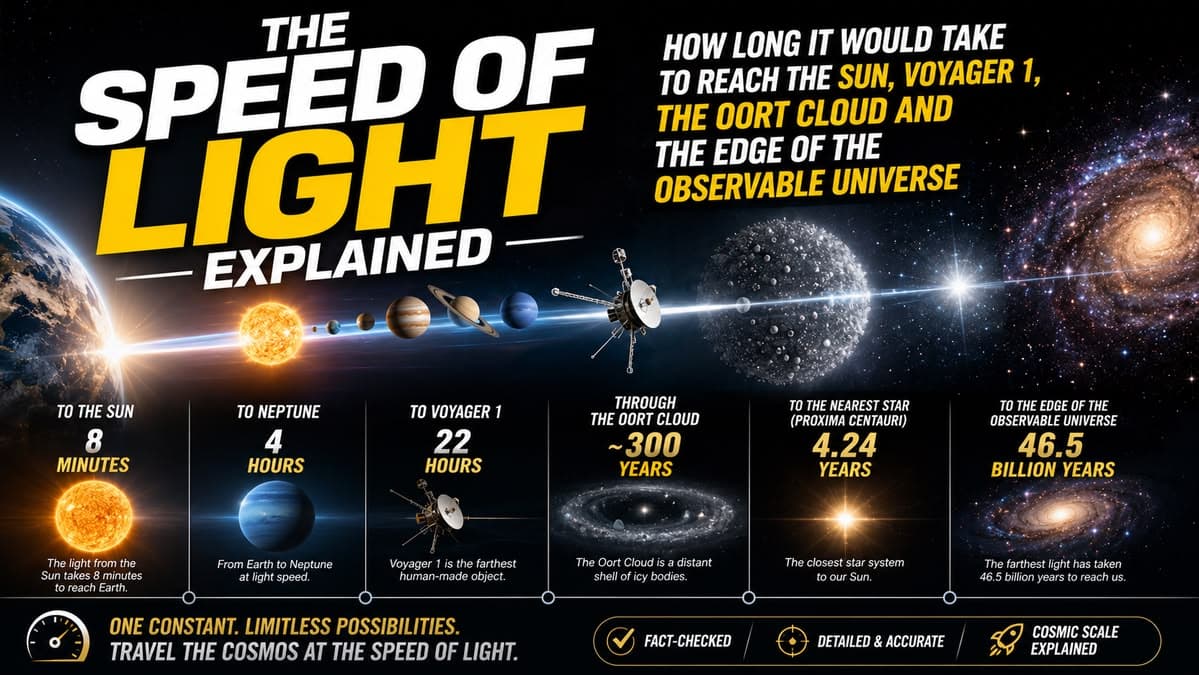
The Speed of Light Explained: How Long It Would Take to Reach the Sun, Voyager 1, the Oort Cloud and the Edge of the Observable Universe
Light travels at roughly 300,000 kilometers every single second - fast enough to circle the entire Earth about seven and a half times in the blink of an eye. And yet, even at that almost incomprehensible speed, the universe is so vast that light itself needs minutes, hours, years, and eventually billions of years just to cross it. This guide takes that exact journey step by step - from Earth to the Sun, past every planet, beyond humanity's farthest spacecraft, through a cloud of icy debris at the edge of our solar system, out to the nearest star, and finally all the way to the edge of everything we can possibly observe.
1. What Is the Speed of Light?
Light travels at approximately 299,792 kilometers per second, a figure so precise and fundamental that physicists simply refer to it as "c." At this speed, light could travel around the Earth's equator almost seven and a half times in a single second - which makes it easy to assume nothing in the universe could possibly feel far away. As this journey will show, that assumption breaks down almost immediately.
2. Why Nothing Travels Faster Than Light
According to Einstein's theory of relativity, the speed of light in a vacuum represents an absolute cosmic speed limit - not just a practical engineering challenge, but a fundamental property of space and time itself. As an object with mass approaches light speed, the energy required to keep accelerating it grows toward infinity, which is why nothing with mass can ever quite reach, let alone exceed, this limit.
3. Light Speed From Earth to the Moon
Before even reaching the Sun, it's worth noting the very first leg of this journey: light takes only about 1.3 seconds to travel from Earth to the Moon, a distance so short on a cosmic scale that it barely registers compared to everything that follows.
4. Light Speed From Earth to the Sun
Traveling at the speed of light, it takes approximately 8 minutes and 20 seconds to cross the roughly 150 million kilometers separating Earth from the Sun. This means that the sunlight warming your skin right now left the Sun's surface a little over eight minutes ago - you are always looking at the Sun very slightly in the past, never in the present moment.
5. Table: Light Travel Time Across the Solar System
| Destination | Approximate Light Travel Time From Earth |
|---|---|
| The Moon | 1.3 seconds |
| The Sun | 8 minutes, 20 seconds |
| Mars (average distance) | Approximately 12-13 minutes |
| Jupiter | Approximately 35-52 minutes |
| Saturn | Approximately 70-80 minutes |
| Neptune | Approximately 4 hours, 6 minutes |
6. Reaching Neptune, the Solar System's Farthest Planet
Continuing outward at the same unrelenting speed, light takes roughly four hours and six minutes to reach Neptune, the most distant official planet in our solar system. Think about what that actually means: even something moving at the fastest possible speed in the universe needs over four hours just to cross from our home planet to the solar system's outermost planetary neighbor.
7. Crossing the Kuiper Belt: Comets, Dwarf Planets and Icy Debris
Just beyond Neptune lies the Kuiper Belt, a vast ring of icy bodies, dwarf planets like Pluto, and countless comets left over from the solar system's formation. Continuing the journey means passing through this debris field before space finally begins to feel genuinely empty - though "empty" is relative, since even this seemingly sparse region is scattered with countless small icy objects across an enormous volume of space.
8. Voyager 1: Humanity's Farthest-Flung Object
Launched in 1977, Voyager 1 is the most distant human-made object ever sent into space, and it is still transmitting data back to Earth today, decades after its launch. Having already flown past Jupiter and Saturn, it is now traveling through interstellar space, carrying with it the famous Golden Record - a time capsule of sounds and images meant to represent humanity to any other intelligence that might one day encounter it.
9. How Long Light Takes to Reach Voyager 1 Today
At the speed of light, reaching Voyager 1's current position takes roughly 23 hours and 19 minutes - meaning a radio signal sent from Earth right now would need nearly a full day just to catch up with humanity's most distant spacecraft, and Voyager 1's own replies take that same length of time to travel back to mission control.
10. The Oort Cloud: The True Edge of Our Solar System
Beyond Voyager 1 lies the Oort Cloud, a vast, roughly spherical shell of icy debris believed to surround the entire solar system, extending outward for an enormous distance - so far, in fact, that most astronomers consider it, rather than Neptune or even Voyager 1's current position, to be the true outer boundary of our solar system.
11. How Long It Takes Light to Cross the Oort Cloud
Continuing at the same speed of light from Voyager 1's position, it takes roughly 29 more days just to reach the inner edge of the Oort Cloud - and from there, fully crossing through and out the other side of this vast shell takes an additional year and a half or so at light speed, underscoring just how enormous this outermost region of our own solar system truly is.
12. Exiting Into True Interstellar Darkness
Once light finally exits the far side of the Oort Cloud, something remarkable happens: there's essentially nothing left to see. No planets, no nearby debris, no obvious light sources - just vast, genuinely empty darkness stretching in every direction. This is the moment the journey stops feeling like it's leaving "our neighborhood" and starts feeling like true interstellar space.
13. The Local Bubble Explained
Our entire solar system, it turns out, sits inside something astronomers call the Local Bubble - a vast, relatively low-density region of space carved out roughly 14 million years ago, likely by a series of ancient supernova explosions that pushed surrounding gas outward, leaving our solar system floating inside this comparatively empty pocket of space. It's a strange thought: the Sun, Earth, and everything on it are quietly drifting through the middle of an ancient explosion's aftermath.
14. Reaching the Nearest Star: Proxima Centauri
Continuing the same relentless journey at light speed, it takes about four more years to reach Proxima Centauri, the closest known star to our own Sun. Four years might not sound overwhelming on paper - until you remember that this is the very next star over, our closest cosmic neighbor, and even light itself needs four full years just to get there.
15. The Edge of Earth's Radio Bubble
About a century after passing our nearest star, still traveling at light speed, the journey would cross something uniquely tied to human history: the edge of Earth's radio bubble - the outer boundary of every radio and television signal humanity has ever broadcast into space, expanding outward at light speed since radio broadcasting began roughly a century ago. Beyond this point, no evidence of human civilization's broadcasts has reached yet at all.
16. What Our Entire Galaxy Looks Like From Far Away
Pull back far enough, and our entire solar system - along with every star system anywhere near it - shrinks down to something almost absurdly small: a single, faint blue dot lost inside the enormous spiral structure of the Milky Way galaxy. Everything covered in this guide so far, every distance that already felt genuinely staggering, is contained within just that one tiny dot.
17. Light Speed to the Center of the Milky Way
From that same tiny blue dot, reaching the center of our own galaxy takes roughly 26,000 to 27,000 years at the speed of light - a distance so vast that it dwarfs every measurement covered up to this point combined many times over, and yet it's still only a fraction of the galaxy's total size.
18. Crossing to the Far Side of the Milky Way
Continuing that same journey in the same direction, reaching the opposite side of the Milky Way from its center takes tens of thousands of years further still, since our galaxy's full diameter spans somewhere in the range of 100,000 to 200,000 light years altogether - meaning even after 26,000-plus years just to reach the galactic center, the journey across our home galaxy alone is still far from finished.
19. Leaving the Milky Way Behind
Once light finally exits our own galaxy entirely, it enters the vast, mostly empty gulf of intergalactic space separating the Milky Way from its neighboring galaxies, including Andromeda, our nearest large galactic neighbor, itself millions of light years further away still.
20. Reaching the Edge of the Observable Universe
Continuing outward at the same unchanging speed, light would eventually reach the very edge of what's called the observable universe - a boundary sitting roughly 46.5 billion light years from Earth in every direction. That number is almost impossible to hold in your head meaningfully; it's not just large, it's large enough that it stops feeling like a distance and starts feeling more like an abstract mathematical idea.
21. Why It's Called the "Observable" Universe, Not the Whole Universe
This boundary isn't the edge of the universe itself - it's simply the furthest distance from which light has had enough time to reach us since the universe began roughly 13.8 billion years ago, factoring in the ongoing expansion of space itself, which has stretched that original distance out considerably further over time. Anything beyond this observable boundary may well exist, but its light simply hasn't had time to reach Earth yet, and depending on how the universe continues expanding, some of it may never reach us at all.
22. Table: The Full Light-Speed Journey at a Glance
| Milestone | Approximate Time at Light Speed |
|---|---|
| Earth to the Sun | 8 minutes, 20 seconds |
| Earth to Neptune | 4 hours, 6 minutes |
| Earth to Voyager 1's current position | 23 hours, 19 minutes |
| Voyager 1 to the inner Oort Cloud | About 29 more days |
| Crossing the full Oort Cloud | About 1.5 more years |
| To the nearest star (Proxima Centauri) | About 4 more years |
| To the edge of Earth's radio bubble | About 100 more years |
| To the center of the Milky Way | About 26,000-27,000 years |
| To the far edge of the Milky Way | Tens of thousands of years further |
| To the edge of the observable universe | Approximately 46.5 billion years |
23. A Moment of Reflection on Scale and Belief
Numbers this large tend to humble anyone who sits with them for long enough. It's worth noting that many religious and spiritual traditions have long described certain sacred events as taking place across distances or timescales that defy ordinary physical experience entirely. In Islamic tradition, for instance, the Isra and Mi'raj - the Prophet Muhammad's (peace be upon him) night journey and ascension - is described by believers as covering an extraordinary spiritual distance within a single night. Framed alongside the almost 46.5-billion-year light-speed distance to the edge of the observable universe covered in this guide, many find it meaningful to reflect on how such traditions describe events that transcend the ordinary limits of time and space entirely - a matter of faith and belief rather than a claim this guide is presenting as a scientifically measured equivalence, but a reflection some readers may find worth sitting with all the same.
24. What This Means for the Future of Space Travel
This entire journey is also a sobering reminder of just how far current spacecraft technology sits from making interstellar travel practical. Voyager 1, humanity's fastest and farthest spacecraft, would still need tens of thousands of years at its current speed just to reach the distance of our nearest star - meaning any realistic future of genuine interstellar travel will likely require propulsion technology fundamentally different from anything humanity has built so far, whether that eventually means nuclear propulsion, generation ships, or physics we haven't yet discovered.
25. Frequently Asked Questions
How long does it take light to travel from the Sun to Earth?
Approximately 8 minutes and 20 seconds, meaning sunlight is always slightly delayed by the time it reaches us.
How far away is Voyager 1 right now?
Far enough that a radio signal traveling at the speed of light takes roughly 23 hours and 19 minutes to reach it, and just as long for its own signals to return to Earth.
What is the Oort Cloud?
A vast shell of icy debris believed to surround the entire solar system, considered by most astronomers to be the true outer boundary of our solar system, taking roughly 1.5 years to cross at light speed.
How far is the nearest star to our solar system?
Proxima Centauri, the closest known star to our Sun, is about 4.2 light years away.
How big is the observable universe?
The observable universe extends roughly 46.5 billion light years from Earth in every direction, though this marks the limit of what light has had time to reach us from, not the edge of the universe itself.
Why can't anything travel faster than light?
According to Einstein's theory of relativity, the energy required to accelerate any object with mass grows toward infinity as it approaches light speed, making it a fundamental cosmic speed limit rather than just a technological barrier.
Conclusion
Traveling at the fastest possible speed in the universe, it takes just over eight minutes to reach the Sun, less than a day to reach humanity's farthest spacecraft, a few years to reach our nearest stellar neighbor, tens of thousands of years to cross our own galaxy, and tens of billions of years to reach the very edge of what we can observe at all. Sitting with those numbers honestly is one of the simplest, most effective ways to grasp just how vast the universe actually is - and how small, brief, and remarkable it is that we exist at all, in one tiny corner of it, capable of measuring and marveling at distances too large to ever fully imagine.