The RRR Formula: How Small Businesses Turn 1 Crore in Sales Into 125 Crore (Retain, Repeat, Refer)
Some numbers don't just surprise you - they force you to rethink how business actually works. This guide starts with one of those numbers, then walks through the exact system - the RRR formula: Retain, Repeat, Refer - that turns a modest local shop doing one crore in sales into a business capable of ten times, or a hundred times, that number over the same ten years. No large budget required, no corporate infrastructure required - just a system most small business owners have simply never been shown.
1. Why the Speed of Sales Reveals Something Deeper
Some companies generate a million dollars in less time than it takes to read this paragraph. Others take decades to reach a fraction of that. What separates them usually isn't the price of what they sell, or even how good the product is - it's how well they've engineered customers to keep coming back, and to bring others with them. That single mechanism is worth understanding in detail, because it's exactly as available to a small shop as it is to a global brand.
2. Table: How Fast Major Companies Make $1 Million
| Company | Time to Generate $1 Million in Sales |
|---|---|
| Walmart | 48 seconds |
| Amazon | 54 seconds |
| Apple | 1 minute, 26 seconds |
| Samsung | 2 minutes, 29 seconds |
| Starbucks | Approximately 15 minutes |
| McDonald's | Approximately 21 minutes |
To put this in perspective for a South Asian audience: one million dollars is roughly 8.5 crore Indian rupees, or about 28 crore Pakistani rupees. For many people, that's not just a large number - it's an amount some individuals never accumulate across an entire working lifetime, let alone in under a minute.
3. What This Really Teaches Small Business Owners
The obvious reaction to this table is to assume it's simply about scale - these are massive global corporations, so of course they move fast. But scale alone doesn't explain it. What actually explains it is a repeatable system: the same customers coming back again and again, plus a steady stream of new customers arriving specifically because someone else recommended them. Every small business owner has access to that exact same mechanism, just usually without realizing it, or without having a name for it.
4. Meet the RRR Formula
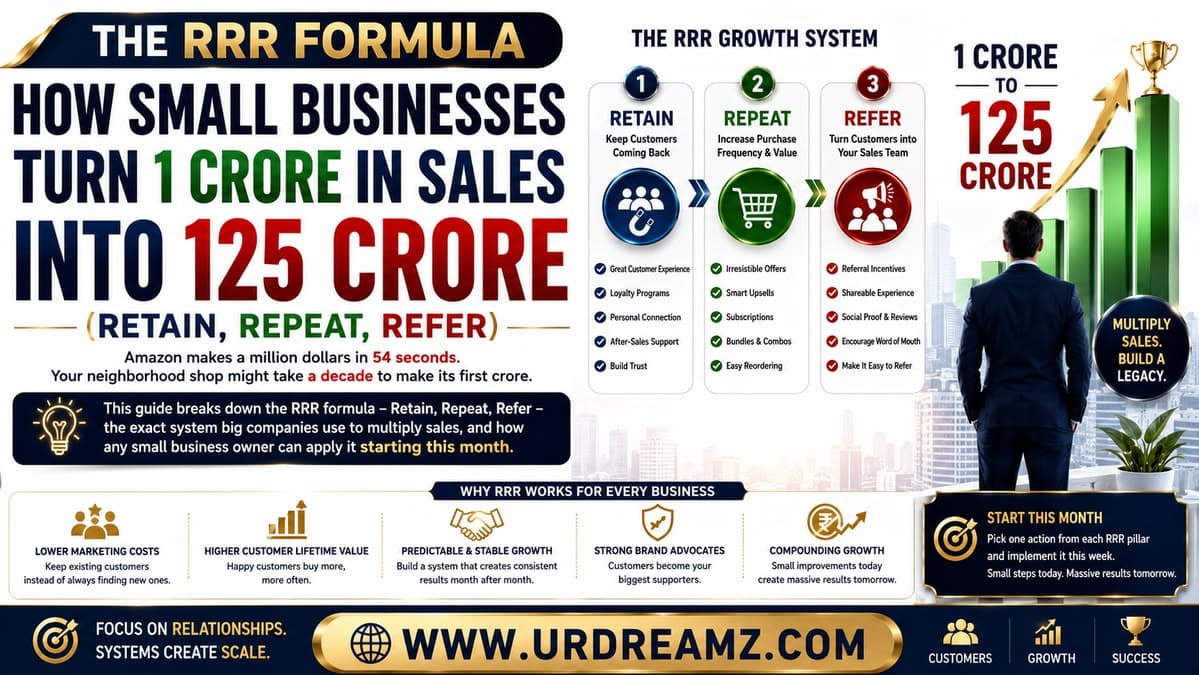
The formula behind this kind of sales multiplication has a name: RRR, standing for Retain, Repeat, and Referral. It's the invisible engine running behind every "overnight success" story that, once you look closely, was never actually overnight at all - it was years of these three mechanisms compounding quietly in the background.
5. R1: Retain
Retain means exactly what it sounds like: once a customer has come to you, you actively hold on to that relationship instead of letting it end the moment they walk out the door. This is the foundation everything else in this formula is built on - you cannot repeat or refer a customer relationship that never gets retained in the first place.
6. R2: Repeat
Repeat means that once someone becomes a customer, you deliberately give them a reason to come back and buy from you again - not the same identical item necessarily, but something new, timely, or relevant enough that a second purchase feels like an obvious next step rather than something they have to be convinced into from scratch.
7. R3: Referral
Referral means that a satisfied, retained, repeating customer eventually becomes a source of brand-new customers themselves - bringing a friend, a family member, or a colleague along, often without you ever directly asking them to.
8. The Real Math: From 1 Crore to 125 Crore
Here's where the formula stops being an abstract idea and becomes a genuinely eye-opening calculation. Imagine a small shop that, for ten straight years, brings in 1,000 new customers every single year, each spending an average of 10,000 rupees. That alone produces 1 crore in sales in a single year. Now apply the RRR formula on top of that same base.
9. Breaking Down the Calculation Step by Step
Over ten years, that same base of 1,000 customers per year becomes 10,000 total customers - and if those customers are genuinely retained, they keep repeating their purchases across those same ten years rather than disappearing after one visit. Now add referrals: if each of those 10,000 retained customers eventually brings in just four additional people over time, that's 40,000 more customers, brought in at effectively zero marketing cost. Combined, that's 50,000 total customers across the decade. If each of those customers, across their full relationship with the shop, ends up spending an average of 25,000 rupees total on smaller, everyday purchases over time, the total sales figure for that same shop across ten years comes out to roughly 125 crore - not 1 crore, but 125 crore, purely from the compounding effect of retaining, repeating, and generating referrals from the exact same original customer base.
10. Why This Isn't Just Theory
This same underlying multiplication effect is exactly what's happening inside every major retailer and brand from the table above - not because they discovered some secret product, but because they have built extremely deliberate, well-funded systems specifically to retain, repeat, and generate referrals from every single customer who walks through their doors or visits their app, at a scale most small business owners have simply never seen up close.
11. Step One: How Businesses Actually Acquire Customers
Before retention, repetition, or referral can even begin, a business first needs to bring in a new customer at all - commonly done today through a landing page, a website, or paid social media advertising. In marketing terms, this initial step is about generating leads and then converting a percentage of those leads into actual paying customers.
12. The Lead Generation Problem Small Businesses Face
For most small business owners, this is exactly where things start to break down. Leads come in from scattered, disconnected places - a phone call here, a social media message there, a walk-in customer somewhere else - and there's no single, organized place where all of it gets tracked. A call doesn't get returned, a message goes unanswered for two days, a promising in-person conversation never gets properly followed up on, and there's no clear record of how many leads came in, how many turned into calls, how many turned into meetings, or how many said yes versus no.
13. Why "I'll Remember" Doesn't Work
Almost every small business owner believes, at least at first, that they'll simply remember the important details - who called, what they wanted, when to follow up. In practice, memory alone almost never holds up once the volume of leads grows past a small handful. Some owners try to compensate with a notebook, others with a basic spreadsheet, but neither approach scales cleanly, and both are easy to fall behind on the moment business gets genuinely busy.
14. The Corporate Advantage: CRM Systems
This is precisely the gap that separates a struggling small business from a large, well-run corporation. Larger businesses almost universally rely on a CRM - a Customer Relationship Management system - specifically built to capture every single lead in one centralized place, rather than leaving that information scattered across memory, sticky notes, and disconnected chat apps.
15. What a CRM Actually Does
A CRM system centralizes every incoming lead, tracks exactly where each one came from, records every follow-up call or message, and allows month-to-month comparison - this month's total leads against last month's, this month's conversion rate against last month's. Over time, a business owner can see clearly, with real numbers instead of guesswork, exactly where their strongest leads are coming from, which marketing channels are actually working, and which parts of their sales process are leaking potential customers.
16. Small Business CRM Doesn't Have to Be Expensive
The common assumption is that a CRM system is an expensive, enterprise-only tool completely out of reach for a small shop or local service business. In reality, several affordable, even free, CRM tools exist today specifically built for small business budgets - meaning the same fundamental system large corporations rely on is genuinely accessible to a small business owner willing to set it up and use it consistently.
17. The Conversion Rate Gap: 40% vs 90%
Here's where the practical impact of having, or not having, this kind of system becomes dramatically clear. A typical small business owner without an organized system might convert around 40 percent of the leads that come in, with the remaining 60 percent simply wasted - forgotten, followed up too late, or never followed up on at all. A well-run corporate sales operation, by comparison, often converts as much as 90 percent of its incoming leads, wasting only a small 5 to 10 percent.
18. Why Corporates Convert Three Times More Leads
Run that math forward, and the implication is stark: for the exact same volume of incoming leads, a well-organized business can end up with roughly three times as many actual paying customers as a disorganized one - not because their product is three times better, but purely because they lose far less of what was already coming in the door.
19. Step Two: How to Retain a Customer
Once a lead becomes a real customer, retention begins with something deceptively simple: capturing their name and phone number at the point of payment. Many shops already do this instinctively, but the businesses that benefit most from it are the ones that deliberately store this information in an organized system rather than letting it disappear the moment the transaction ends.
20. The Power of Capturing Name and Number
Once a customer's name and number are captured and saved, a business gains the ability to reach back out directly the next time something relevant comes along - a new product, a seasonal offer, a restock of something they bought before - without needing the customer to remember to check back in on their own. The relationship no longer depends entirely on the customer's memory; the business itself can now actively maintain it.
21. Loyalty Points and Psychological Ownership
A loyalty program - where a portion of each purchase converts into points or credit toward a future purchase - adds a second, powerful layer on top of simple contact capture. Once a customer has accumulated even a modest number of points, something changes psychologically: those points start to feel like money they've already earned and don't want to leave behind.
22. Why "Sunk" Rewards Bring Customers Back
This is a well-documented pattern in consumer behavior - people are strongly motivated to avoid losing something they already feel they own, even if it's just points sitting in an account rather than cash in hand. A customer who might otherwise shop anywhere will often specifically return to redeem points they've already accumulated, effectively pulling them back to the same business purely to avoid feeling like they wasted what they'd already earned.
23. Step Three: How to Repeat a Customer's Purchase
Retention keeps the relationship alive; repetition is what actively turns that relationship into recurring sales. This starts with using the contact information and purchase history already captured to reach back out at exactly the right moment with exactly the right offer.
24. Personalized Follow-Up Messaging
A message referencing a customer's actual previous purchase - "you bought a shirt last time, we now have matching trousers in stock" - lands completely differently than a generic mass promotion sent to everyone. It signals that the business remembers them specifically, which makes the message feel like a genuine, relevant suggestion rather than another piece of impersonal advertising to ignore.
25. Seasonal and Complementary Product Offers
Layering in seasonal relevance - a summer discount, a new winter collection, an anniversary offer tied to their first purchase date - gives a business a steady, ongoing stream of genuine reasons to reach back out, rather than relying purely on hope that the customer happens to think of the business again on their own.
26. Building a Purchase History Profile
Over time, this accumulates into a genuinely valuable asset: a detailed picture of exactly what each customer has bought, when, and how often - information that lets a business tailor future offers with real precision instead of guessing, and that becomes more valuable the longer a business consistently maintains it.
27. Step Four: How to Generate Referrals
The final piece of the formula is arguably the most powerful, because it brings in entirely new customers at effectively zero direct marketing cost. Referrals happen naturally once a customer feels a genuine, ongoing connection to a business rather than viewing it as just one interchangeable option among many.
28. The Emotional Connection Behind Referrals
Once someone has shopped at the same place repeatedly - buying a shirt, then shoes, then something for a family member - a real sense of familiarity and trust develops. That familiarity is exactly what makes someone comfortable enough to casually mention the shop to a spouse, a sibling, or a close friend without needing to be asked or incentivized to do so.
29. Family and Friend Networks as Free Marketing
A spouse who needs something similar, a sibling who mentions needing new shoes, a friend planning a similar purchase - all of these become natural, organic referral opportunities generated simply through everyday conversation, entirely outside of any paid advertising or formal marketing campaign.
30. Why Multiple Referrals Per Loyal Customer Is Realistic
It's genuinely realistic for a single loyal, retained customer to bring in somewhere between four and ten additional people over the full lifetime of their relationship with a business, once family, friends, and casual word-of-mouth mentions are all accounted for - which is exactly the multiplier that turns a modest customer base into something many times larger over several years.
31. Putting All Four Steps Together
None of these four steps - acquiring, retaining, repeating, and generating referrals - works in isolation nearly as well as all four working together as a single connected system. A business that acquires well but never retains loses customers as fast as it gains them. A business that retains but never encourages repeat purchases leaves money on the table. A business that does both but never activates referrals is still leaving an enormous, essentially free growth channel completely untapped.
32. Common Mistakes Small Businesses Make
- Never capturing customer contact information at the point of sale
- Relying purely on memory instead of any organized tracking system
- Treating every promotional message as generic instead of tied to a customer's actual purchase history
- Offering no loyalty or rewards structure that gives a customer a reason to return specifically
- Never actively asking satisfied customers to refer friends or family
- Giving up on lead follow-up too early instead of maintaining a consistent, organized process
33. How to Start Implementing RRR This Month
Begin by capturing name and contact information at every single sale, no exceptions. Set up even a basic, affordable CRM or a well-organized spreadsheet to track leads and follow-ups consistently rather than relying on memory. Introduce a simple loyalty point system, even a manual one, to give customers a tangible reason to return. Start sending personalized, purchase-history-based follow-up messages on a regular schedule. And finally, don't wait passively for referrals - build a habit of genuinely, comfortably asking satisfied customers to mention your business to people they know.
34. Frequently Asked Questions
What does the RRR formula stand for?
Retain, Repeat, and Referral - the three mechanisms that turn a one-time customer into a long-term, compounding source of sales.
Do I need an expensive CRM system to use this formula?
No - several affordable and even free CRM tools exist specifically for small business budgets, making this system accessible without large upfront investment.
How much can retention and referrals really multiply my sales?
In the example used throughout this guide, a base of 1 crore in annual sales compounded, through consistent retention, repeat purchases, and referrals, into roughly 125 crore in total sales across ten years.
What's the easiest first step to start using this formula?
Simply begin capturing every customer's name and contact information at the point of sale - the entire rest of the formula depends on having that information in the first place.
Why do corporations convert so many more leads than small businesses?
Primarily because of organized systems - a CRM ensures no lead is forgotten or left unfollowed, commonly pushing corporate conversion rates as high as 90 percent compared to roughly 40 percent for businesses without such a system.
How many referrals can one loyal customer realistically bring in?
Somewhere between four and ten additional customers over the full lifetime of the relationship, once family, friends, and everyday word-of-mouth mentions are accounted for.
35. Conclusion
The gap between a business that struggles to reach its first crore and one that multiplies that same base into a hundred times more isn't luck, and it isn't some hidden product secret - it's a system. Retain the customers you already have, give them genuine reasons to repeat their purchases, and turn their loyalty into referrals that bring in new customers for free. Every business, no matter how small, already has the raw material - real customers walking through the door - to start building this exact same compounding engine today.