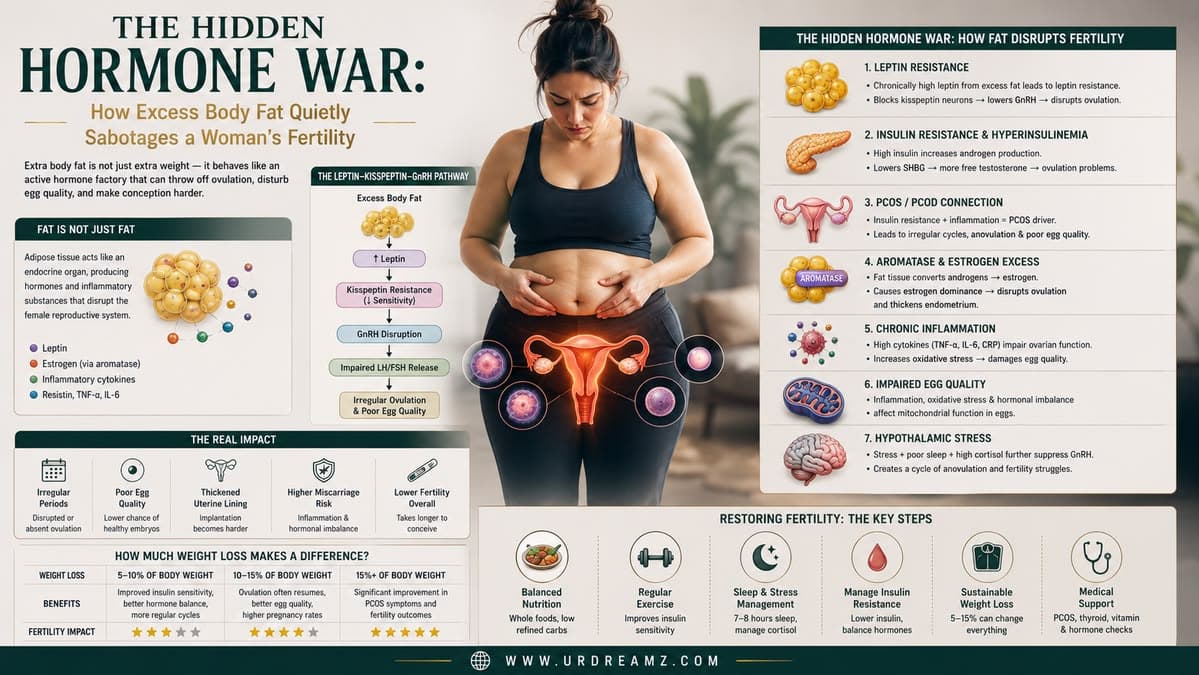
The Hidden Hormone War: How Excess Body Fat Quietly Sabotages a Woman's Fertility
When most people hear the words "obesity" and "fertility" in the same sentence, they picture a simple cause and effect — extra weight makes it harder to conceive, full stop. The real picture is far more layered and, honestly, far more interesting. Body fat is not an inert storage tank sitting quietly under the skin. It behaves like a fully active hormone-producing organ, sending out chemical messengers that talk directly to the brain, the ovaries, and the uterus. When there is too much of it, that conversation gets noisy, confused, and sometimes outright hostile to conception.
This article walks through exactly how that hormonal conversation works — from the fat cell itself, up to the brain's control centers, and back down to the ovary and uterus — and explains, in plain language, what a woman can realistically do about it. Everything here is written for education and awareness. It is not a replacement for a consultation with a qualified gynecologist or reproductive endocrinologist, especially if you are actively trying to conceive or have already been diagnosed with a fertility condition.
Table of Contents
- Why Fat Tissue Is Not "Just Storage"
- A Quick Refresher: The Female Reproductive System
- The HPO Axis — The Brain-Ovary Command Chain
- Leptin: The Hormone That Tells Your Body "It's Safe to Reproduce"
- Kisspeptin and GnRH: The Missing Link Explained
- Aromatase and the Estrogen Overload Problem
- Insulin Resistance: The Silent Fertility Disruptor
- Adiponectin: The "Good" Fat Hormone You Need More Of
- Testosterone, Hyperandrogenism, and Why Cycles Go Missing
- PCOD, PCOS, and PMOS — Untangling the Confusing Terms
- Chronic Low-Grade Inflammation and the Ovary
- Obesity and Ovulation: Why Eggs Stop Being Released on Schedule
- Does Obesity Affect Egg Quality Itself?
- The Uterus Side of the Story: Endometrial Receptivity
- Obesity and IVF / Assisted Reproduction Outcomes
- Beyond Conception: Pregnancy Risks Linked to Obesity
- Structural Causes of Infertility Worth Knowing (Not Weight-Related)
- How Much Weight Loss Actually Helps? The Numbers That Matter
- A Practical, Sustainable Approach to Diet and Lifestyle
- Exercise: Finding the Fertility-Friendly Middle Ground
- Common Myths About Weight and Fertility, Debunked
- When It's Time to See a Fertility Specialist
- Frequently Asked Questions
1. Why Fat Tissue Is Not "Just Storage"
For decades, adipose (fat) tissue was viewed simply as an energy reservoir — a place where the body parked extra calories for a rainy day. Modern endocrinology has completely overturned that idea. Fat tissue is now understood to be one of the largest endocrine organs in the human body. It manufactures and releases dozens of active signaling molecules, collectively called adipokines, along with inflammatory messengers and even enzymes that convert one hormone into another.
In a woman at a healthy weight, this fat-driven signaling system works quietly in the background, contributing to normal puberty timing, regular ovulation, and stable energy balance. But when fat mass — particularly visceral fat around the abdomen — expands significantly beyond a healthy range, the volume and balance of these signals change dramatically. The result is a system that was designed to support reproduction ending up working against it.
2. A Quick Refresher: The Female Reproductive System
Before diving into the hormone chemistry, it helps to picture the physical structures involved. The uterus sits centrally in the pelvis, connected on either side to the fallopian tubes, which reach toward the two ovaries. Each month, under hormonal instruction, one ovary matures and releases an egg (ovulation). If fertilized, that egg travels down the fallopian tube and implants into the uterine lining, the endometrium, which has been thickening in preparation.
Every step in that monthly sequence — egg maturation, ovulation, fertilization, and implantation — depends on a precisely timed sequence of hormones. Disrupt the timing or the concentration of even one of these hormones, and the entire monthly cycle can misfire, sometimes without any obvious external symptom beyond an irregular or absent period.
3. The HPO Axis — The Brain-Ovary Command Chain
The hypothalamic-pituitary-ovarian (HPO) axis is the communication chain that runs the entire reproductive cycle. The hypothalamus, a small region at the base of the brain, releases gonadotropin-releasing hormone (GnRH) in careful, rhythmic pulses. GnRH travels a short distance to the pituitary gland, instructing it to release two other hormones: follicle-stimulating hormone (FSH) and luteinizing hormone (LH). FSH stimulates the ovary to grow a follicle containing an egg, and a surge of LH mid-cycle triggers the actual release of that egg.
This entire chain is sensitive to feedback from the rest of the body, including signals coming from fat tissue. That is precisely where obesity enters the picture — not by attacking the ovary directly, but by disrupting the pulsing rhythm of GnRH at the very top of the command chain.
4. Leptin: The Hormone That Tells Your Body "It's Safe to Reproduce"
Leptin is produced almost entirely by fat cells, and its original biological job is to tell the brain how much energy is stored in the body. In evolutionary terms, leptin functions like a permission slip for reproduction: enough stored energy (enough leptin) signals to the hypothalamus that the body can afford the enormous energy cost of pregnancy, so normal GnRH pulsing and ovulation can proceed. Too little leptin, as seen in very low body fat or eating disorders, effectively shuts the system down — this is why extremely lean women often lose their periods.
Obesity flips this same mechanism the other way. When fat mass is high, leptin levels rise persistently, and over time the brain's leptin receptors become less responsive — a state known as leptin resistance. The hypothalamus stops "hearing" the leptin signal properly, which disturbs the normal pulsatile release of GnRH. The downstream result is irregular FSH and LH signaling, unpredictable follicle development, and inconsistent or absent ovulation.
5. Kisspeptin and GnRH: The Missing Link Explained
For a long time, scientists could see that leptin affected reproduction but could not fully explain how, because leptin receptors are barely present on GnRH-producing neurons themselves. The discovery of kisspeptin filled that gap. Kisspeptin neurons sit upstream of GnRH neurons, carry leptin receptors, and act as the actual go-between — leptin talks to kisspeptin neurons, and kisspeptin neurons talk to GnRH neurons.
In leptin resistance caused by obesity, this kisspeptin relay becomes unreliable. Reduced or erratic kisspeptin signaling means GnRH is no longer released in the clean, rhythmic pulses that regular ovulation depends on. Instead of a steady monthly rhythm, the system can drift into longer, irregular, or entirely absent cycles. This kisspeptin pathway is currently one of the most active areas of fertility research, and kisspeptin-based treatments are already being studied for ovulation induction in assisted reproduction.
Illustrative representation of signal disruption through the pathway, not a measured clinical scale.
6. Aromatase and the Estrogen Overload Problem
Fat tissue is not just a passive receiver of hormonal instructions — it also manufactures hormones directly. It contains an enzyme called aromatase, which converts androgens (male-type hormones present in small amounts in every woman) into estrogen. The more fat tissue a woman carries, the more aromatase activity occurs, and the more "extra" estrogen circulates in the body, largely independent of the normal ovarian cycle.
This chronic, cycle-independent estrogen exposure confuses the feedback loops that the HPO axis relies on to time ovulation correctly. It can also contribute to a thickened, less receptive uterine lining over time, and is one of the mechanisms linking obesity to conditions like endometrial hyperplasia.
7. Insulin Resistance: The Silent Fertility Disruptor
Excess fat, especially visceral fat, is strongly linked to insulin resistance — a state where the body's cells stop responding efficiently to insulin, forcing the pancreas to pump out more and more of it to keep blood sugar in a normal range. This chronic excess of circulating insulin (hyperinsulinemia) does not stay confined to blood sugar regulation; it directly affects the ovary.
High insulin levels stimulate the ovarian theca cells to produce more androgens (male-type hormones), and they also reduce the liver's production of a protein called sex hormone-binding globulin (SHBG), which normally keeps androgens in a bound, inactive form. Less SHBG means more "free," biologically active testosterone circulating in the blood — a combination that disrupts follicle development and is one of the central mechanisms behind polycystic ovary syndrome.
8. Adiponectin: The "Good" Fat Hormone You Need More Of
Not every hormone released by fat tissue works against fertility. Adiponectin is a notable exception — it improves insulin sensitivity, has anti-inflammatory effects, and supports healthier metabolic function overall. Unlike leptin, adiponectin levels tend to fall as fat mass — particularly visceral fat — increases.
This is essentially the mirror image of the leptin problem: obesity means too much of a hormone that disrupts fertility (leptin, in its resistant state) and too little of a hormone that would otherwise protect it (adiponectin). Weight reduction, even modest amounts, has been shown to raise adiponectin levels and improve insulin sensitivity — one of the clearest biological reasons weight loss can help restore ovulation.
9. Testosterone, Hyperandrogenism, and Why Cycles Go Missing
Bringing several of the previous threads together: elevated insulin stimulates ovarian androgen production, reduced SHBG frees up more active testosterone, and aromatase in fat tissue adds further hormonal noise. The combined effect in many women with obesity is a state of mild-to-moderate hyperandrogenism — higher-than-typical androgen activity.
Hyperandrogenism physically interferes with the normal maturation of ovarian follicles, often causing many small, immature follicles to accumulate on the ovary without any of them fully maturing and releasing an egg. This is the direct biological root of the irregular or absent periods so commonly reported alongside obesity and polycystic ovary syndrome.
10. PCOD, PCOS, and PMOS — Untangling the Confusing Terms
These three abbreviations are often used loosely and interchangeably online, which creates a lot of confusion. Here is a simplified, practical distinction:
| Term | What It Generally Refers To | Typical Severity |
|---|---|---|
| PCOD (Polycystic Ovarian Disease) | Ovaries release immature or partially mature eggs which accumulate as small cysts; often linked to lifestyle and weight factors | Usually milder, often improves with weight/lifestyle changes |
| PCOS (Polycystic Ovary Syndrome) | A broader metabolic and hormonal syndrome involving insulin resistance, hyperandrogenism, and ovulatory dysfunction; a recognized endocrine disorder | Can be more persistent, sometimes needs medical management |
| PMOS / PMS (used informally on some regional platforms) | Not a standardized international medical term; usage varies by region/clinic, so always clarify with your own doctor's terminology | Variable — confirm definition with treating physician |
11. Chronic Low-Grade Inflammation and the Ovary
Expanded fat tissue, especially visceral fat, releases higher levels of inflammatory messengers such as interleukin-6 (IL-6) and tumor necrosis factor-alpha (TNF-α). In a healthy body, these molecules play useful short-term roles in immune defense. But when fat mass is chronically elevated, their release becomes constant rather than occasional, creating a state of low-grade, body-wide inflammation.
This chronic inflammatory environment has been linked in research to impaired follicle development, poorer egg quality, and a less receptive uterine lining. It is also thought to worsen insulin resistance further, creating a feedback loop that reinforces the other mechanisms already described in this article.
12. Obesity and Ovulation: Why Eggs Stop Being Released on Schedule
Pulling the mechanisms above together, obesity's central effect on fertility is usually anovulation or oligo-ovulation — the complete absence, or infrequency, of egg release. This happens because the finely tuned GnRH-FSH-LH rhythm described earlier gets disrupted at multiple points simultaneously: leptin resistance blunts the kisspeptin relay, insulin excess drives androgen production, and aromatase adds background estrogen noise. Each mechanism alone could cause mild disruption; together, they frequently add up to genuinely irregular or absent cycles.
13. Does Obesity Affect Egg Quality Itself?
Beyond simply preventing ovulation, research suggests obesity may also affect the internal quality of the eggs that do mature. Proposed mechanisms include altered mitochondrial function within the egg cell (mitochondria supply the energy needed for early embryo development), exposure to a more inflammatory and higher-insulin follicular environment while the egg is maturing, and metabolic stress within the surrounding follicle cells that nurture the egg. This is an active area of ongoing research, and the extent of the effect varies between individuals.
14. The Uterus Side of the Story: Endometrial Receptivity
Fertility is not only about producing a good egg — the uterine lining must also be properly prepared to accept and support an embryo. Elevated background estrogen from aromatase activity, combined with insulin resistance and inflammation, can alter the normal thickening and receptivity pattern of the endometrium. Some research links obesity to a modestly higher rate of early implantation failure and miscarriage, independent of egg quality, suggesting the uterine environment itself plays a role.
15. Obesity and IVF / Assisted Reproduction Outcomes
For women pursuing IVF, several studies have observed that higher body mass index is associated with needing higher doses of ovarian stimulation medication, retrieving somewhat fewer mature eggs on average, and slightly lower implantation and live birth rates per cycle compared with women at a healthy weight — though outcomes vary considerably between individuals and clinics. Many fertility clinics recommend achieving a BMI within a specific target range before starting stimulation, both to improve response to medication and to reduce procedural and anesthesia-related risks.
| BMI Category (WHO Classification) | BMI Range (kg/m²) | General Fertility-Relevant Note |
|---|---|---|
| Underweight | Below 18.5 | Can also disrupt ovulation via low leptin |
| Normal weight | 18.5 – 24.9 | Generally most favorable for spontaneous ovulation |
| Overweight | 25.0 – 29.9 | Increasing risk of ovulatory disruption |
| Obesity Class I | 30.0 – 34.9 | Noticeably higher rates of anovulation reported |
| Obesity Class II | 35.0 – 39.9 | Further increased ovulatory and IVF-response impact |
| Obesity Class III | 40.0 and above | Highest reported impact; often requires structured medical weight management before fertility treatment |
16. Beyond Conception: Pregnancy Risks Linked to Obesity
For women who do conceive, obesity is associated with a higher likelihood of certain pregnancy complications, including gestational diabetes, pregnancy-related high blood pressure disorders, higher cesarean delivery rates, and increased risk of certain birth complications. This is one of the key reasons many fertility specialists and obstetricians encourage weight management before conception whenever it is medically appropriate and feasible, rather than only after a positive pregnancy test.
17. Structural Causes of Infertility Worth Knowing (Not Weight-Related)
It is worth being clear that not all female infertility is hormonal or weight-related. Structural or congenital issues, such as Müllerian anomalies (variations in the development of the uterus, including a completely absent uterus, a septate uterus divided by a wall of tissue, or a bicornuate "heart-shaped" uterus), can also cause infertility or recurrent pregnancy loss, entirely independent of body weight. These conditions are typically diagnosed through imaging such as ultrasound or MRI and are managed very differently from weight-related ovulatory infertility. If irregular cycles or repeated pregnancy loss occur despite a healthy weight, structural causes are one of the possibilities a doctor may investigate.
18. How Much Weight Loss Actually Helps? The Numbers That Matter
One of the most encouraging findings in this whole field of research is that fertility does not require reaching an "ideal" body weight to improve. Multiple clinical studies have found that even a modest reduction — commonly cited as around 5 to 10 percent of total body weight — can meaningfully improve insulin sensitivity, lower excess androgen levels, and restore regular ovulation in a substantial proportion of women with obesity-related infertility.
*Simplified illustrative trend based on general clinical research patterns; individual results vary significantly and this is not a diagnostic tool.
| Weight Loss Amount | Commonly Reported Benefit |
|---|---|
| 3–5% of body weight | Early improvements in insulin sensitivity; some cycle regularity may return |
| 5–10% of body weight | Often associated with restored ovulation in a meaningful subset of women with PCOS-related anovulation |
| 10%+ of body weight (gradual, sustained) | Greater hormonal normalization; may improve response to fertility treatment if needed |
19. A Practical, Sustainable Approach to Diet and Lifestyle
Crash diets and extreme calorie restriction are generally discouraged in a fertility context, because very low-calorie approaches can themselves disrupt the leptin signal and worsen ovulatory problems. A gradual, sustainable, nutrient-dense approach tends to be far more effective and safer. Broadly supported strategies include prioritizing whole, minimally processed foods; choosing complex carbohydrates with a lower glycemic impact over refined sugar and refined flour; including adequate protein and healthy fats at each meal to support satiety and hormone production; and working, wherever possible, with a registered dietitian or nutritionist who understands PCOS and insulin resistance.
| Food Group | Generally Recommended | Best Minimized |
|---|---|---|
| Carbohydrates | Whole grains, legumes, vegetables | Refined flour, sugary drinks, white bread |
| Protein | Fish, eggs, poultry, lentils, tofu | Heavily processed/cured meats |
| Fats | Olive oil, nuts, seeds, avocado | Trans fats, deep-fried foods |
| Dairy | Moderate plain yogurt (individual tolerance varies) | Sweetened, flavored dairy products |
| Beverages | Water, unsweetened tea | Sugary sodas, excess caffeine |
20. Exercise: Finding the Fertility-Friendly Middle Ground
Regular moderate exercise — such as brisk walking, swimming, cycling, or strength training several times a week — has been shown to improve insulin sensitivity independent of weight loss itself, which is one reason movement is often recommended even before significant weight change occurs. On the other hand, very intense or excessive endurance exercise combined with inadequate calorie intake can, in some women, suppress reproductive hormones in the opposite direction, so the general guidance from most reproductive health professionals favors consistent, moderate activity over extreme regimens.
21. Common Myths About Weight and Fertility, Debunked
Myth: A woman who is overweight can never conceive naturally. In reality, many women with obesity conceive without any medical intervention; obesity increases statistical risk of difficulty, it does not guarantee infertility. Myth: Only extremely overweight women are affected. Even modestly elevated BMI has been associated with measurable changes in ovulatory frequency in research studies. Myth: Weight loss guarantees pregnancy. Weight is one contributing factor among many, including age, tubal health, partner factors, and underlying conditions, so weight management improves the odds but is not a guarantee on its own.
22. When It's Time to See a Fertility Specialist
It is generally advisable to seek professional evaluation if periods are consistently irregular or absent, if you have been trying to conceive for over a year (or six months if you are over 35) without success, if you have a known diagnosis of PCOS/PCOD, or if you have a family or personal history of thyroid disorders, diabetes, or reproductive structural conditions. Early evaluation allows a doctor to identify whether weight, hormonal imbalance, structural factors, or a combination is at play, and to design a management plan accordingly.
Frequently Asked Questions
No. Obesity increases the statistical likelihood of ovulatory disruption, but many women with a higher BMI conceive naturally. It is a risk factor, not an automatic outcome.
Research commonly points to meaningful hormonal and ovulatory improvement with a loss of around 5 to 10 percent of body weight, achieved gradually rather than through extreme restriction.
Yes. Very rapid, extreme calorie restriction can itself disrupt the leptin signal and worsen ovulatory irregularity, so a gradual, sustainable approach is generally preferred.
No. PCOS is a distinct hormonal and metabolic syndrome that can occur at any body weight, though it is more commonly diagnosed alongside obesity because the two conditions share overlapping mechanisms like insulin resistance.
Yes, obesity is associated with lower sperm quality and altered hormone levels in men as well, though the specific mechanisms differ somewhat from those in women.
Many clinics recommend working toward a healthier BMI before stimulation, both to improve response to medication and reduce procedural risk, but this should always be discussed individually with your fertility specialist.
Not necessarily — structural health of the uterus is separate from the hormonal and ovulatory issues obesity can cause. A doctor typically evaluates both aspects independently.