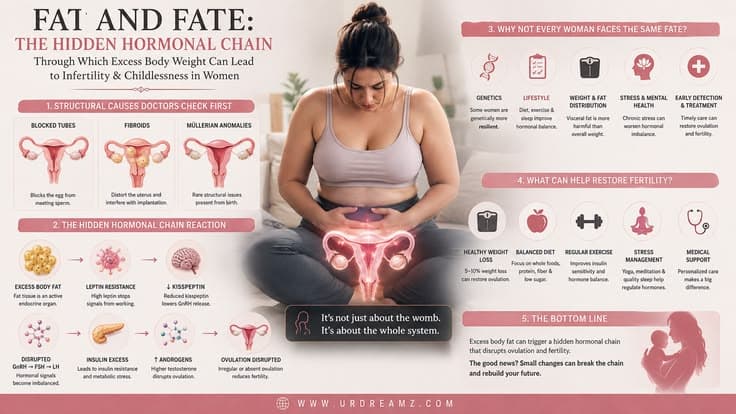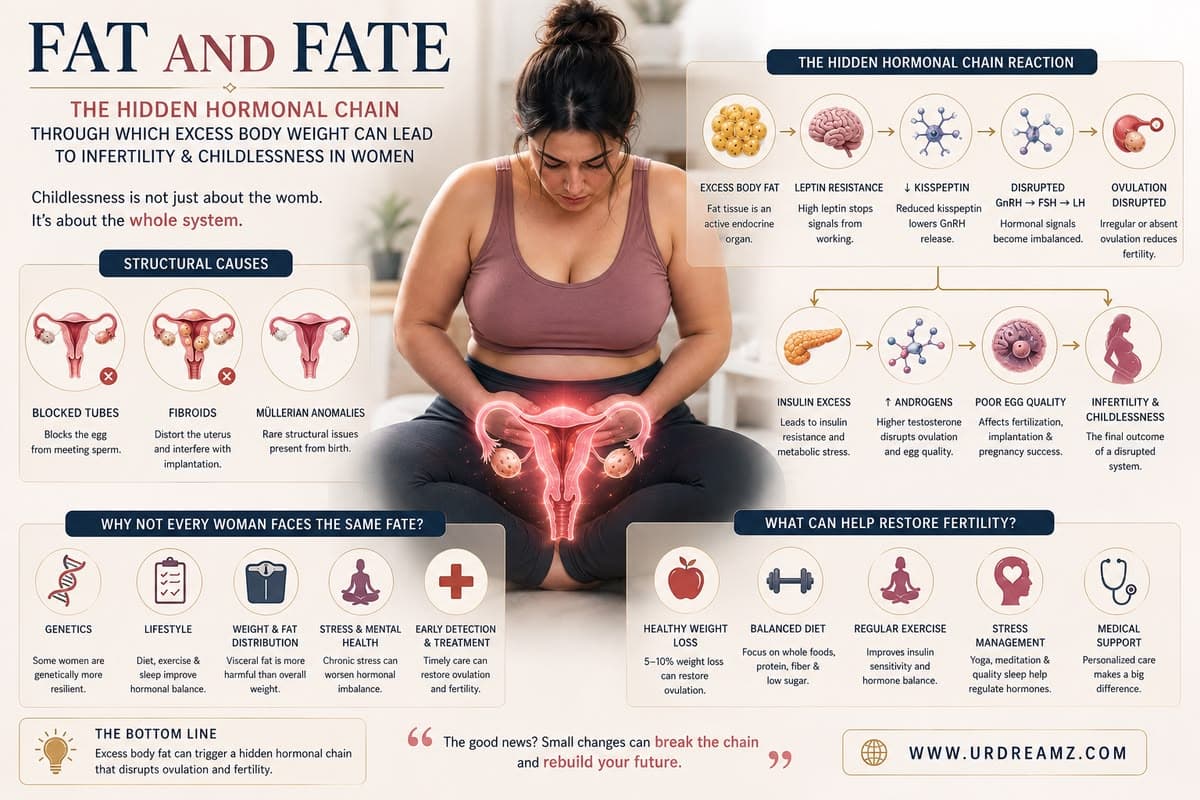
Fat and Fate: The Hidden Hormonal Chain Through Which Excess Body Weight Can Lead to Infertility and Childlessness in Women
In Surah Ash-Shura (42:49–50), it is described that the dominion of the heavens and the earth belongs to Allah alone, and that He grants daughters to whomever He wills, sons to whomever He wills, both together to whomever He wills, and withholds children from whomever He wills, for He is All-Knowing and All-Capable. Alongside this, the Quran also repeatedly invites reflection and contemplation on the workings of the created world. In that same spirit of reflection, this article looks closely at one very physical, very well-documented piece of the puzzle: how excess body fat can disturb the delicate hormonal chain a woman's body depends on to conceive.
In many households and communities, when a woman does not conceive, the search for "the reason" almost always starts and ends with her womb. She is examined, questioned, and often blamed, while the actual medical picture is far broader and far more nuanced than that. Before any conversation about weight or hormones even begins, doctors typically rule out a set of structural and mechanical causes first. This article walks through those causes, and then goes deep into the hormonal chain reaction that excess fat tissue can trigger — explained step by step, the same way it would be sketched out on a whiteboard in a medical class.
Table of Contents
- How Fertilization Actually Happens — The Basics
- Cause 1: Blocked Fallopian Tubes
- Cause 2: Fibroids and Uterine Growths Blocking Implantation
- Cause 3: Müllerian Anomalies — When the Uterus Doesn't Form Typically
- Müllerian Agenesis (MRKH) Explained
- Septate Uterus and Its Surgical Treatment
- Bicornuate Uterus Explained
- When All Structures Are Normal: Turning to Fat and Hormones
- Fat Is Not Just Tissue — It Is an Endocrine Organ
- Meet the Hormones Fat Tissue Releases
- Why FSH and LH Matter So Much
- GnRH and the Hypothalamus: The Command Center
- Kisspeptin: The Missing Link Between Leptin and GnRH
- Leptin Resistance: When More Fat Means Less Signal
- The Chain Reaction: From Adipose Tissue to a Missed Period
- Adiponectin and Insulin Sensitivity
- Hyperinsulinemia: When Insulin Goes Into Overdrive
- Testosterone, Voice Changes, Facial Hair, and Ovarian Cysts
- PCOD, PCOS, and PMOS — What These Cysts Really Are
- Why Not Every Woman with Obesity Becomes Infertile
- Obesity, Egg Quality, and IVF Outcomes
- The Encouraging Part: How Much Weight Loss Actually Helps
- A Practical, Sustainable Path Forward
- When to See a Doctor
- Frequently Asked Questions
1. How Fertilization Actually Happens — The Basics
Before understanding what can go wrong, it helps to understand what is supposed to go right. Each month, one ovary matures and releases an egg — this is ovulation. If sperm reach the egg inside the fallopian tube and successful fertilization occurs, a single fertilized cell called a zygote is formed. This zygote then begins a multi-day journey down the fallopian tube toward the uterus, dividing and developing along the way, until it reaches the uterine cavity and implants itself into the uterine lining, the endometrium. From that point, pregnancy properly begins.
This means that natural conception depends on at least three things happening correctly, in sequence: a clear, open pathway for the egg and sperm to meet and for the resulting embryo to travel; a uterine lining that is healthy and receptive enough to accept implantation; and a hormonal signaling system precise enough to trigger ovulation on a regular monthly rhythm in the first place. When a woman struggles to conceive, doctors typically investigate all three areas, not just one.
2. Cause 1: Blocked Fallopian Tubes
The fallopian tubes are the passageway the egg and sperm travel through, and the path the fertilized zygote follows on its way to the uterus. If one or both tubes are blocked — often due to past pelvic infection, endometriosis, previous surgery, or scar tissue — the egg and sperm may never meet at all, or a zygote that does form may become trapped, unable to reach the uterus. Blocked fallopian tubes are one of the most common mechanical causes of female infertility and are usually diagnosed through a specialized X-ray or ultrasound procedure that checks tubal patency.
3. Cause 2: Fibroids and Uterine Growths Blocking Implantation
Even when the tubes are completely open and a zygote successfully reaches the uterus, a second obstacle can appear at the destination itself. Fibroids — benign (non-cancerous) growths of muscle tissue within the uterine wall — and certain other uterine growths can distort the shape of the uterine cavity or the lining itself. Depending on their size and location, they may prevent an embryo from implanting successfully, or, if implantation does occur, can sometimes interfere with the pregnancy continuing normally. Many fibroids are harmless and require no treatment, but fertility-relevant ones are typically evaluated and sometimes surgically removed.
4. Cause 3: Müllerian Anomalies — When the Uterus Doesn't Form Typically
If the tubes are open and there are no fibroids blocking implantation, doctors then look at a less commonly discussed but medically well-recognized category: Müllerian anomalies. These are congenital (present from birth) variations in how the uterus, cervix, and upper vaginal structures developed while a baby girl was still in her mother's womb. The "Müllerian ducts" are the embryonic structures that are supposed to fuse and form the uterus during early fetal development; when this process doesn't happen typically, a range of structural variations can result.
5. Müllerian Agenesis (MRKH) Explained
In Müllerian agenesis, also known as Mayer-Rokitansky-Küster-Hauser (MRKH) syndrome, the uterus fails to develop at all, or develops only in a rudimentary, non-functional form, despite the ovaries and external genitalia typically developing normally. This is a genetic and developmental condition, not something caused later in life by weight, diet, or lifestyle. Women with this condition typically have normally functioning ovaries and can, in some cases, still have biological children through gestational surrogacy, since eggs can often still be retrieved even though there is no uterus to carry a pregnancy.
6. Septate Uterus and Its Surgical Treatment
A septate uterus occurs when a band of fibrous or muscular tissue — a septum — divides the uterine cavity partially or fully into two sections. This tissue typically has a poor blood supply, making it a difficult surface for an embryo to implant into successfully, and even when implantation does occur, it is associated with a higher risk of early miscarriage. The encouraging part of this particular anomaly is that it is often correctable: a minimally invasive procedure called hysteroscopic septum resection can remove the dividing tissue, after which many women go on to conceive and carry a pregnancy successfully.
7. Bicornuate Uterus Explained
A bicornuate uterus, sometimes described as "heart-shaped," occurs when the upper part of the uterus does not fully merge during development, leaving two separate horns instead of one single cavity. This shape can narrow the space available for a pregnancy to grow and has been linked to a higher risk of preterm birth and certain positioning complications later in pregnancy, though many women with this anomaly do conceive and carry pregnancies to term, sometimes with closer monitoring by their obstetrician.
8. When All Structures Are Normal: Turning to Fat and Hormones
If the tubes are open, the uterine cavity is structurally normal, and no fibroids or anomalies are found, but a woman still isn't conceiving, attention typically turns toward hormonal function — and this is exactly where body fat becomes relevant. Most people have never been told what fat tissue actually is at a biological level, so before going further into the hormone chain itself, it's worth pausing on that question directly.
9. Fat Is Not Just Tissue — It Is an Endocrine Organ
Fat is commonly thought of as inert padding, similar to any other soft tissue in the body. Biologically, this is inaccurate. Adipose (fat) tissue functions as an endocrine organ, much like the liver or thyroid gland — meaning it actively manufactures and releases hormones and signaling molecules into the bloodstream. In a woman at a healthy weight, this system operates quietly and helps support normal reproductive function. When fat mass increases significantly, the volume and balance of what it releases changes, and that change can directly disturb the reproductive hormone chain.
10. Meet the Hormones Fat Tissue Releases
Fat tissue releases several important substances relevant to fertility: leptin, a hormone that signals the brain about the body's energy stores; adiponectin, a hormone that supports healthy insulin function; inflammatory messengers called IL-6 and TNF-alpha; and an enzyme called aromatase, which converts androgens into estrogen. Each of these plays a specific role in the chain reaction described in the sections ahead.
| Substance Released by Fat Tissue | Normal Role | Effect When Fat Mass Is Excessive |
|---|---|---|
| Leptin | Signals brain about energy reserves; supports normal GnRH pulsing | Chronically elevated → brain becomes resistant to its signal |
| Adiponectin | Supports healthy insulin sensitivity | Levels fall as fat mass rises |
| IL-6 / TNF-alpha | Short-term immune signaling | Chronic low-grade inflammation |
| Aromatase (enzyme) | Converts small amounts of androgen to estrogen | Excess activity → additional, cycle-independent estrogen |
11. Why FSH and LH Matter So Much
Pregnancy itself is a separate event from ovulation and menstruation, but all of these processes rely on the same two hormones in both men and women: follicle-stimulating hormone (FSH) and luteinizing hormone (LH). In women, FSH stimulates the ovary to develop a mature egg-containing follicle each month, and a surge of LH triggers the actual release of that egg. In men, these same two hormones are essential for sperm production. Without FSH and LH working correctly, a woman's periods can become irregular or her ovaries may not release an egg at all.
12. GnRH and the Hypothalamus: The Command Center
FSH and LH are not released independently — they are triggered by another hormone, gonadotropin-releasing hormone (GnRH), which comes from a small but powerful region of the brain called the hypothalamus. The hypothalamus acts as the command center: it decides when to instruct the ovary, through this hormonal chain, to release an egg. If a woman is unmarried or not attempting pregnancy, an unfertilized egg is simply shed along with the uterine lining during menstruation. If conception occurs, the fertilized egg becomes a zygote and begins the journey described earlier.
13. Kisspeptin: The Missing Link Between Leptin and GnRH
The hypothalamus does not release GnRH randomly — it needs its own trigger, and that trigger is a hormone called kisspeptin. Kisspeptin neurons sit directly upstream of the GnRH-producing cells and are themselves highly sensitive to leptin, the hormone released by fat tissue. In simple terms, leptin is what normally tells the kisspeptin system, "energy stores are adequate, it's safe to proceed with the reproductive cycle," and kisspeptin then relays that message onward to trigger GnRH release.
(Leptin)
(Hypothalamus)
(Pituitary)
(Egg Release)
14. Leptin Resistance: When More Fat Means Less Signal
Here is where excess body fat directly interferes with this chain. When fat mass becomes significantly excessive, leptin is released in much larger and more constant quantities than the body was designed to handle. Instead of this simply strengthening the "go ahead" signal, the brain's leptin receptors gradually become less responsive over time — a state called leptin resistance. The kisspeptin system, which depends on properly functioning leptin signaling, no longer receives a clear message, and its own output drops as a result.
15. The Chain Reaction: From Adipose Tissue to a Missed Period
Once kisspeptin output falls, the entire downstream chain weakens along with it: GnRH is no longer released from the hypothalamus in the clean, rhythmic pulses that ovulation depends on, which in turn reduces and destabilizes FSH and LH output from the pituitary gland. With FSH and LH no longer signaling correctly, the ovary either fails to mature an egg properly or fails to release it on schedule. This is the core biological explanation for why a significant increase in body fat is so strongly connected to irregular periods and reduced fertility — not because fat is inherently harmful tissue, but because too much of it disrupts a communication chain that depends on precise, balanced signaling.
*Illustrative representation of the mechanism, not a measured clinical scale for any individual patient.
16. Adiponectin and Insulin Sensitivity
While leptin rises with excess fat, a second important hormone moves in the opposite direction: adiponectin, which is also produced by fat tissue, but whose levels actually fall as fat mass — particularly abdominal fat — increases. Adiponectin's main job is supporting insulin sensitivity, meaning it helps the body's cells respond efficiently to insulin. When adiponectin levels drop, insulin sensitivity drops right along with it.
17. Hyperinsulinemia: When Insulin Goes Into Overdrive
When the body's cells stop responding efficiently to insulin, the pancreas compensates by producing more and more of it to keep blood sugar under control — a state called hyperinsulinemia. This excess insulin does not stay confined to blood sugar regulation. It travels to the ovaries and directly stimulates them to produce more testosterone than they normally would. Over time, chronically elevated insulin is also one of the key drivers behind the development of type 2 diabetes in women carrying excess weight, which is why doctors often check blood sugar and insulin levels together when investigating hormone-related infertility.
18. Testosterone, Voice Changes, Facial Hair, and Ovarian Cysts
Testosterone is present in every woman's body in small, normal amounts, but the excess ovarian testosterone driven by hyperinsulinemia can produce visible physical effects in some women: a deeper voice, increased facial or body hair growth (a pattern called hirsutism), and acne. Inside the ovary itself, elevated androgens interfere with the normal maturation of follicles. Instead of one follicle maturing fully each month and releasing a healthy egg, many small, underdeveloped follicles can accumulate along the ovary's edge — these are the "cysts" seen on ultrasound, though in most cases they are actually immature egg-containing follicles that never fully developed, not cysts in the sense of an abnormal growth.
19. PCOD, PCOS, and PMOS — What These Cysts Really Are
These small underdeveloped follicles are the basis of the conditions commonly referred to as PCOD, PCOS, and PMOS. All three terms describe some version of this same underlying picture: hormonal imbalance, often involving insulin resistance and elevated androgens, that prevents normal ovulation. However, these terms are frequently used inconsistently across different clinics and regions, so it is worth understanding the general distinctions.
| Term | General Meaning | Typical Clinical Weight |
|---|---|---|
| PCOD (Polycystic Ovarian Disease) | Ovaries release immature eggs which accumulate as small follicles; often improves significantly with lifestyle and weight changes | Usually considered milder / more lifestyle-responsive |
| PCOS (Polycystic Ovary Syndrome) | A broader recognized endocrine and metabolic syndrome involving insulin resistance, elevated androgens, and ovulatory dysfunction | Often requires more structured medical management |
| PMOS | Not a globally standardized medical term; usage and definition vary by clinic and region | Always confirm the specific definition your own doctor is using |
20. Why Not Every Woman with Obesity Becomes Infertile
It needs to be said clearly: obesity does not guarantee infertility, and having a healthy weight does not guarantee fertility either. The chain reaction described above represents a significantly increased statistical risk, not a fixed rule that applies identically to every woman. Individual biology varies enormously — genetics, how and where a woman's body stores fat, her baseline hormone levels, insulin sensitivity, and countless other factors all influence whether and how strongly this chain reaction plays out in any one person. This is precisely why one woman with obesity may conceive without any difficulty at all, while another woman with a similar body weight may struggle significantly — the underlying hormonal response to excess fat is not identical from person to person.
21. Obesity, Egg Quality, and IVF Outcomes
Beyond simply disrupting ovulation, research has also examined whether obesity affects the internal quality of eggs and the receptiveness of the uterine lining itself, since both matter for conception and for pregnancy continuing successfully after implantation. Several studies looking at assisted reproduction have observed that women with a higher body mass index sometimes need higher medication doses during ovarian stimulation, tend to have somewhat lower egg and embryo quality on average, and may experience modestly lower implantation and live birth rates per IVF cycle, although outcomes vary considerably between individuals and clinics.
| BMI Category (WHO Classification) | BMI Range (kg/m²) | General Fertility-Relevant Note |
|---|---|---|
| Underweight | Below 18.5 | Can also disrupt ovulation via insufficient leptin |
| Normal weight | 18.5 – 24.9 | Generally most favorable for spontaneous ovulation |
| Overweight | 25.0 – 29.9 | Increasing risk of hormonal disruption |
| Obesity Class I | 30.0 – 34.9 | Noticeably higher rates of ovulatory dysfunction reported |
| Obesity Class II | 35.0 – 39.9 | Further increased hormonal and IVF-response impact |
| Obesity Class III | 40.0 and above | Highest reported impact; often needs structured medical weight management first |
22. The Encouraging Part: How Much Weight Loss Actually Helps
The most hopeful finding in this entire area of research is that reaching an "ideal" body weight is not actually necessary to see real improvement. Multiple studies have found that even a modest reduction — commonly cited as around 5 to 10 percent of total body weight, achieved gradually — can meaningfully improve insulin sensitivity, lower excess androgen levels, and restore regular ovulation in a substantial number of women whose infertility was linked to excess weight.
*Simplified illustrative trend based on general clinical research patterns; individual results vary significantly.
23. A Practical, Sustainable Path Forward
Extreme, rapid weight loss is generally discouraged in a fertility context, because very low-calorie approaches can themselves disturb the leptin signal in the opposite direction and worsen ovulatory problems. A gradual, sustainable, nutrient-dense approach tends to be safer and more effective. Broadly supported strategies include favoring whole, minimally processed foods over refined sugar and refined flour; including adequate protein and healthy fats at each meal to support satiety and hormone production; incorporating regular moderate physical activity, which improves insulin sensitivity independent of weight loss itself; and working, wherever possible, with a doctor or registered dietitian who understands insulin resistance and PCOS specifically.
| Food Group | Generally Recommended | Best Minimized |
|---|---|---|
| Carbohydrates | Whole grains, legumes, vegetables | Refined flour, sugary drinks, white bread |
| Protein | Fish, eggs, poultry, lentils, tofu | Heavily processed/cured meats |
| Fats | Olive oil, nuts, seeds, avocado | Trans fats, deep-fried foods |
| Beverages | Water, unsweetened tea | Sugary sodas, excess caffeine |
24. When to See a Doctor
Professional evaluation is generally advisable if periods are consistently irregular or absent, if visible signs like excess facial hair growth or persistent acne appear alongside irregular cycles, if you have been trying to conceive for over a year without success (or six months if you are over 35), or if there is a known family history of thyroid disorders, diabetes, or reproductive structural conditions. A doctor can determine through blood tests, ultrasound, and sometimes hysteroscopy whether the underlying issue is structural, hormonal, or a combination of both, and can design a management plan accordingly — rather than the situation being assumed, guessed at, or blamed on the woman without any real investigation.
Frequently Asked Questions
No. Obesity significantly raises the statistical risk of hormonal infertility, but it does not guarantee it. Individual biology varies, and many women with obesity conceive without any medical intervention at all.
No. Infertility can involve either partner and can stem from structural causes (like blocked tubes, fibroids, or Müllerian anomalies), hormonal causes (like obesity-related imbalance), or male-factor causes. A full evaluation of both partners is the appropriate approach.
A septate uterus can often be corrected through a minimally invasive hysteroscopic procedure. A bicornuate uterus is a different structural variation that is not typically "corrected" the same way, though many women with it still carry pregnancies successfully, often with closer monitoring.
A signaling chain starting in the brain: kisspeptin triggers GnRH release from the hypothalamus, GnRH triggers FSH and LH release from the pituitary gland, and FSH and LH together trigger the ovary to mature and release an egg.
Excess fat causes chronically high leptin levels, which leads to leptin resistance in the brain. This weakens the kisspeptin signal, which in turn disrupts GnRH, FSH, and LH release, ultimately reducing the regularity of ovulation.
Research commonly points to meaningful hormonal and ovulatory improvement with a gradual loss of around 5 to 10 percent of body weight, rather than reaching any single "ideal" number.
They describe overlapping but not identical pictures of hormonal imbalance affecting ovulation. Definitions and terminology vary by clinic and region, so it's best to ask your own doctor which specific diagnosis applies to you.