How Nvidia Lost 95% of China's AI Chip Market: The Full Story of US Export Controls, Trump's Reversals, and China's Rise to Self-Reliance
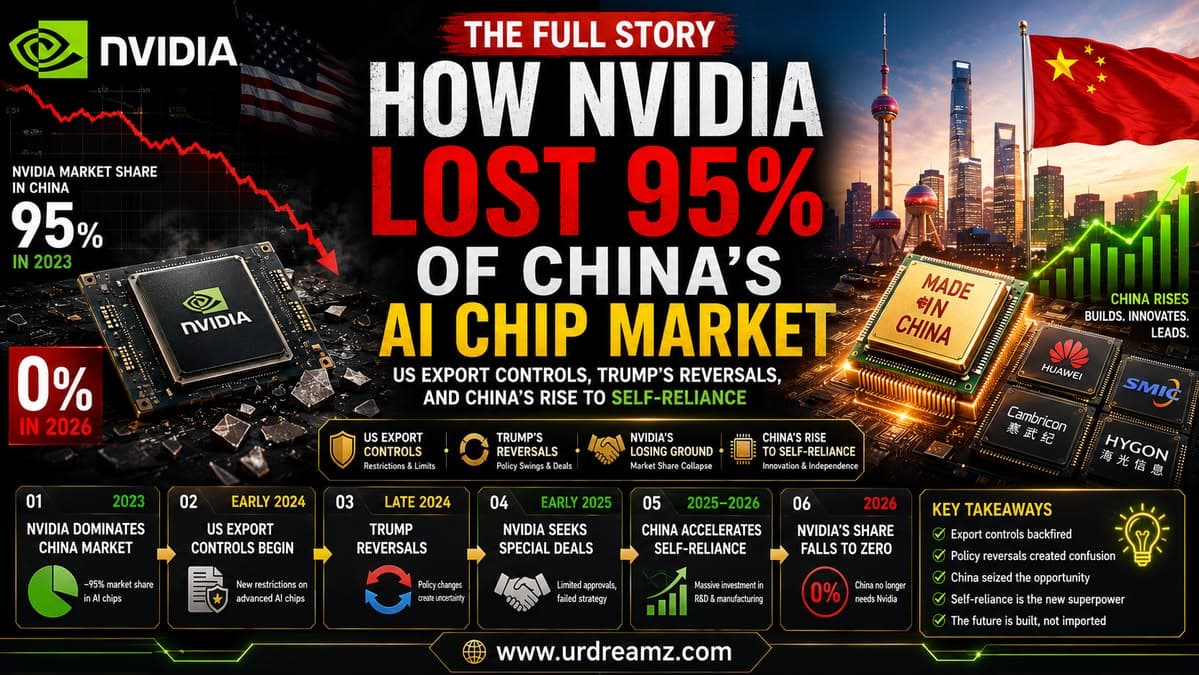
There's an old lesson that shows up again and again in business, politics, and everyday relationships: push someone away hard enough, for long enough, and eventually they stop needing you at all. Right now, one of the clearest real-world examples of that lesson playing out is happening inside the global semiconductor industry. In 2023, Nvidia controlled roughly 95 percent of China's AI chip market. By 2026, the company's own CEO publicly admitted that share had fallen to zero. This is the complete, carefully fact-checked story of exactly how that happened - a multi-year sequence of export bans, workaround chips, reversals, and revenue-sharing deals that ultimately pushed China to build an AI chip industry that no longer needs Nvidia at all.
1. Nvidia's Dominance in China Before the Restrictions
Before any of this began, Nvidia's position in China's AI chip market was about as dominant as any company gets in any market anywhere. As recently as 2023, Nvidia controlled an estimated 95 percent of China's AI accelerator market - the specialized chips used to train and run artificial intelligence models. Chinese tech giants, cloud providers, and research labs relied almost entirely on Nvidia hardware to build and scale their AI systems, making the company's chips essentially the default infrastructure of China's entire AI industry.
2. October 2022: The First Major Export Controls
The turning point came in October 2022, when the Biden administration imposed sweeping export controls on advanced AI chips and semiconductor manufacturing equipment bound for China. The stated rationale centered on national security - specifically, concern that China's military and intelligence services could leverage cutting-edge American AI chips for applications the US government considered a strategic threat.
3. What the 2022 Controls Actually Targeted
The restrictions specifically targeted the most advanced AI chips - the kind capable of the fastest, most powerful AI model training - along with the sophisticated manufacturing equipment needed to produce cutting-edge semiconductors domestically. The goal wasn't to block China from AI computing entirely, but to prevent it from accessing the top tier of chip performance that could meaningfully accelerate military-relevant AI capabilities.
4. Nvidia's First Workaround: Downgraded Compliant Chips
Rather than exit the Chinese market entirely, Nvidia's initial response was to design specifically downgraded versions of its top chips - intentionally reduced in performance just enough to fall under the new export control thresholds - allowing continued legal sales to China. These compliance-specific chips, including versions like the A800 and later the H800, let Nvidia maintain a foothold in the market while technically satisfying the new US restrictions.
5. 2023: The Restrictions Tighten Further
The US government continued tightening these controls throughout 2023, closing loopholes and lowering the performance thresholds further, which meant Nvidia's earlier compliant chips no longer qualified either. Each round of tightening forced Nvidia back to the drawing board, designing yet another compliance-specific chip variant to keep some presence in the Chinese market under the new, stricter rules.
6. Why Simply Making a "Weaker" Chip Wasn't a Long-Term Fix
This cycle - restrict, redesign, restrict again - revealed a structural problem with the entire approach. Each new compliant chip was, by definition, weaker than what Chinese customers actually wanted, while the underlying restrictions kept moving the target further away. It became an increasingly difficult, ultimately unsustainable game of trying to design a chip specifically weak enough to satisfy regulators but still strong enough to remain commercially attractive to customers.
7. The Political Backdrop Behind the Original Controls
The original 2022 controls reflected a broader, bipartisan shift in US policy thinking about China - a growing view across the US political spectrum that unrestricted technology transfer to China carried genuine long-term strategic risk, regardless of which party held the White House. This is an important context: while implementation and specific tactics shifted significantly between administrations, the underlying strategic concern about China's AI and military technology development remained consistent.
8. 2025: A New Administration, A New Approach
When the Trump administration took office in 2025, its approach to the China chip question shifted in ways that surprised many observers - moving away from the Biden administration's structured, tiered restriction framework and toward a more transactional, deal-based approach that combined continued restriction with negotiated commercial arrangements.
9. Scrapping the "AI Diffusion Framework"
In May 2025, the Trump administration formally scrapped the Biden-era "AI Diffusion Framework," a structured global tiering system that had categorized countries by how much access to advanced US AI chips they could receive. Removing this framework opened the door to a more case-by-case, negotiation-driven approach to chip exports going forward.
10. The H20 Chip and the 15% Revenue-Share Deal
Later in 2025, the administration allowed Nvidia to resume selling a specifically designed compliant chip, the H20, to Chinese customers - but with an unusual condition attached: Nvidia and other chipmakers were reportedly required to pay the US government 15 percent of the revenue generated from these China-bound chip sales in exchange for the export license. This kind of direct government revenue-sharing arrangement tied to export licensing was a genuinely unusual policy tool, rarely used in this way before.
11. Why China Pushed Back on the Revenue-Share Arrangement
China's response to this arrangement was notably cool. Rather than simply accepting a deal that effectively taxed its own purchases to fund the US government, Chinese authorities increasingly signaled a preference for reducing dependence on Nvidia altogether, rather than continuing to operate under a framework it viewed as both commercially unfavorable and strategically risky to rely on long-term.
12. A Full Ban Attempt and Its Consequences
At various points across this period, restrictions tightened to the point of effectively blocking even the compliant, downgraded chips from reaching China at all. Each time this happened, it accelerated exactly the outcome US policymakers had hoped to avoid: rather than slowing China's AI progress, it gave Chinese chipmakers and cloud providers a stronger, clearer incentive to invest aggressively in domestic alternatives instead of waiting out the restrictions.
13. December 2025: The H200 Reversal
On December 8, 2025, the Trump administration reversed course again, deciding to permit exports of Nvidia's H200 chip to China - a significantly more powerful chip than the earlier H20, reportedly around six times more capable. This reversal was publicly framed as a form of commercial re-engagement rather than a security policy shift.
14. The Terms of the H200 Deal
The framework formalized through a Federal Register rule on January 15, 2026 included several specific conditions: China-bound H200 shipment volume was capped at 50 percent of equivalent US domestic shipments, a 25 percent tariff was applied and routed through Taiwan, and exporters were required to meet specific US-supply certification requirements before shipments could proceed.
15. Why Experts Called the Framework "Strategically Incoherent"
The Council on Foreign Relations publicly described the resulting H200 framework as "strategically incoherent and unenforceable," warning that strict, faithful enforcement would end up blocking most sales anyway, while looser, more permissive enforcement would undermine the entire national security rationale the restrictions were originally built around. In other words, the policy tried to satisfy two genuinely conflicting goals - meaningful security restriction and meaningful commercial access - at the same time, and struggled to convincingly deliver either.
16. China's Domestic Response: Restricting Nvidia at Home
While Washington was negotiating export terms, Beijing was simultaneously working the problem from the other direction - actively discouraging, and in specific cases formally restricting, Chinese companies and government entities from purchasing Nvidia chips at all, regardless of what the US export rules technically allowed.
17. The Cyberspace Administration's Role
China's Cyberspace Administration formally banned domestic tech companies from purchasing Nvidia's RTX Pro 6000D servers, a clear, concrete example of Chinese regulators actively steering the market away from Nvidia hardware rather than simply responding passively to whatever the US allowed through.
18. Government and Military Procurement Bans
Beyond that specific product ban, broader reporting throughout 2025 and 2026 described Chinese government agencies directing state-linked firms to prioritize domestic chip suppliers, alongside restrictions on Nvidia purchases for government and military-linked projects specifically - a mirror image, in effect, of the security-driven restrictions the US had imposed from its own side of the relationship.
19. Jensen Huang's "Zero Market Share" Admission
In a May 2026 interview with the Special Competitive Studies Project, a bipartisan US initiative focused on technology competitiveness, Nvidia CEO Jensen Huang stated plainly that the company's China market share had fallen from 95 percent to zero, and separately described the underlying export control approach as having "largely backfired."
20. The Gap Between "Zero" and Trailing-Year Data
It's worth noting a genuine nuance here: while Huang's "zero" statement reflects Nvidia's forward-looking position on new China-bound H200 shipments, trailing full-year data from research firm IDC estimated Nvidia still held roughly 55 percent of China's AI accelerator market across all of 2025, reflecting months when earlier compliant products were still shipping before the tightest restrictions took full effect. Both figures are accurate - they simply describe different points along a very steep, ongoing decline rather than contradicting each other.
21. Huawei's Rise to Market Leadership
As Nvidia's position collapsed, Huawei's Ascend series of AI chips moved decisively into the gap. Estimates from Bernstein Research place Huawei's share of China's AI chip market at roughly 50 percent by 2026, up from around 40 percent in 2025 - a striking reversal considering Huawei held a comparatively modest position in this specific market just a few years earlier.
22. Other Domestic Chinese Chip Players
Huawei isn't the only beneficiary. Chinese chipmakers Cambricon and Hygon/Sugon have both carved out meaningful market share, while Alibaba's in-house T-Head chip division and Baidu's own custom AI chips have given both companies a direct pipeline into China's rapidly expanding domestic AI infrastructure spending, further diversifying China's chip supply away from any single domestic or foreign provider.
23. DeepSeek and the Shift Toward Huawei-Optimized AI
One of the most closely watched signals of this shift involves DeepSeek, the Chinese AI lab whose efficient models gained major global attention. Reporting from early 2026 indicated DeepSeek's next model generation was being built to run on Huawei's Ascend 950-class hardware, with major Chinese platforms placing significant orders - a strong signal that even China's most technically sophisticated AI labs were actively adapting their own systems around domestic chips rather than waiting for Nvidia access to return.
24. Training vs Deployment: Why the Shift Wasn't Instant
It's worth understanding why this transition took real time rather than happening overnight. Earlier reporting from 2025 described DeepSeek struggling to complete long, complex AI model training cycles specifically on Huawei's Ascend hardware, since training AI models is a uniquely long-duration, failure-sensitive computing task requiring extremely reliable, mature infrastructure. Deployment and everyday inference - actually running an already-trained model to answer queries - is considerably more forgiving, which is why Chinese firms could adopt domestic chips for deployment more quickly than for the harder problem of full model training.
25. The Financial Cost to Nvidia
The financial impact on Nvidia has been substantial and well documented - estimates place the annual revenue gap created by lost China sales somewhere between 15 and 20 billion dollars, an enormous sum even for a company of Nvidia's scale, representing not just a one-time loss but an ongoing, recurring gap in what was previously one of its most important global markets.
26. The Rise of a Black Market for Nvidia Chips
Despite the formal restrictions, demand for genuine Nvidia chips inside China hasn't disappeared - it's simply gone underground. Reports describe a gray and black market where Nvidia's restricted chips change hands at roughly two to three times their normal US price, with some reports citing complete server configurations selling for as much as a million dollars each, reflecting just how much unmet demand for top-tier Nvidia hardware still exists inside China even after the formal restrictions took hold.
27. Jensen Huang's Own Words: "Largely Backfired"
Perhaps the most striking part of this entire story is that the assessment of failure doesn't come primarily from critics of the policy - it comes from Nvidia's own CEO. Huang's public description of the export control strategy as having "largely backfired" is a remarkable admission from the leader of the very company these restrictions were, in part, meant to protect and empower against Chinese competition.
28. Attempts to Repair the Relationship
Throughout this period, there were repeated attempts from the American side to re-engage and rebuild commercial ties, including high-profile visits and negotiations aimed at restoring some level of normal trade. Jensen Huang himself made visits to China during this period, reportedly drawing enthusiastic crowds and public attention, reflecting how much goodwill and brand loyalty Nvidia had built up in China over its years of market dominance, even amid the broader political breakdown.
29. Why Simply Offering the Chips Back Wasn't Enough
By the time later negotiations and reconciliation attempts took place, China's own domestic chip ecosystem had already progressed far enough that simply reopening access to Nvidia chips no longer held the same appeal it once did. Having spent several years building out Huawei's Ascend line, Alibaba's T-Head chips, and other domestic alternatives - and having optimized major AI systems like DeepSeek specifically around this domestic hardware - China had genuinely reduced its practical dependence on Nvidia, making a simple return to the pre-2022 status quo far less realistic than it might have seemed at the outset of the dispute.
30. The Bigger Strategic Lesson
Stepping back from the specific chips, tariffs, and percentages, this entire saga illustrates a broader strategic principle relevant well beyond the semiconductor industry: restricting access to something a determined, capable actor genuinely needs doesn't necessarily eliminate that need - it often accelerates their motivation and ability to build an independent alternative instead. What began as an effort to constrain China's AI hardware access ultimately helped catalyze a faster, more determined buildout of China's own domestic chip industry than might have otherwise occurred on the same timeline.
31. What This Means for Global Tech Policy Going Forward
This case is now widely studied by policymakers and analysts well beyond the US-China relationship specifically, as a cautionary example for any country considering similar technology restriction strategies against a large, capable rival. The lesson isn't necessarily that export controls never work - it's that they carry a genuine risk of accelerating exactly the self-sufficiency they're meant to prevent, particularly when applied against an economy with the scale, capital, and technical talent to eventually build a credible domestic alternative.
32. Frequently Asked Questions
What percentage of China's AI chip market did Nvidia control before the restrictions?
Roughly 95 percent as recently as 2023, before US export controls began significantly eroding that position.
When did the US first restrict AI chip exports to China?
The first major restrictions were imposed by the Biden administration in October 2022, targeting the most advanced AI chips and semiconductor manufacturing equipment.
Did Nvidia's market share really fall to zero?
CEO Jensen Huang stated in May 2026 that the company's forward-looking China market share had fallen to zero, though trailing full-year 2025 data from IDC still showed roughly 55 percent, reflecting earlier months before the tightest restrictions fully took hold.
Which company benefited most from Nvidia's decline in China?
Huawei, whose Ascend chip line grew to an estimated 50 percent share of China's AI chip market by 2026.
Did China ban Nvidia chips domestically?
China's Cyberspace Administration formally banned domestic firms from purchasing specific Nvidia products, alongside broader government direction steering state-linked firms toward domestic alternatives.
How much money has Nvidia lost from the China restrictions?
Estimates place the ongoing annual revenue gap at roughly 15 to 20 billion dollars.
What is the main lesson from this situation?
That restricting a capable, well-resourced rival's access to critical technology can accelerate their drive toward genuine self-sufficiency rather than simply constraining them indefinitely.
33. Conclusion
What started in October 2022 as a targeted national security measure has, by 2026, reshaped the entire global AI chip industry - not by stopping China's AI progress, but by redirecting it toward a fully domestic supply chain that no longer depends on Nvidia at all. Nvidia's own CEO now openly admits the strategy "largely backfired," while Huawei, Alibaba, Cambricon, and DeepSeek have collectively built exactly the kind of self-sufficient AI hardware ecosystem the restrictions were, in part, meant to prevent. Whatever comes next in this relationship, the underlying lesson is already clear and well documented: cut someone off for long enough, and don't be surprised when they stop needing you at all.