The President Who Was Killed at 46: The Full Story of John F. Kennedy's Life, Presidency, and Assassination
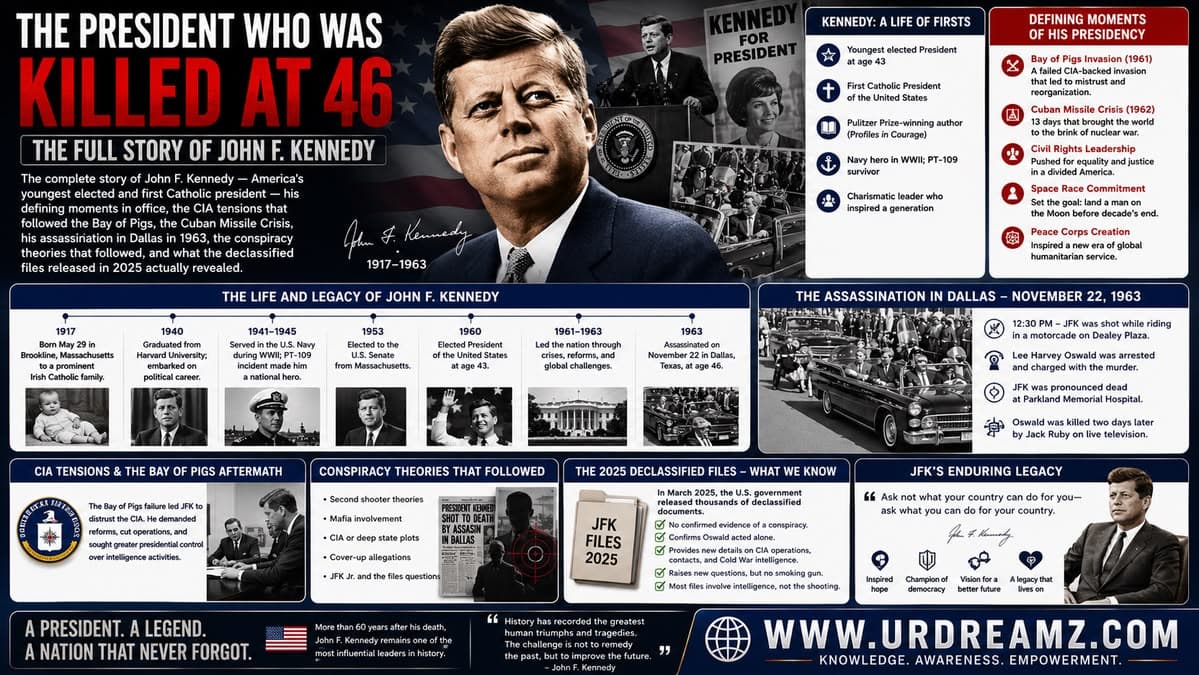
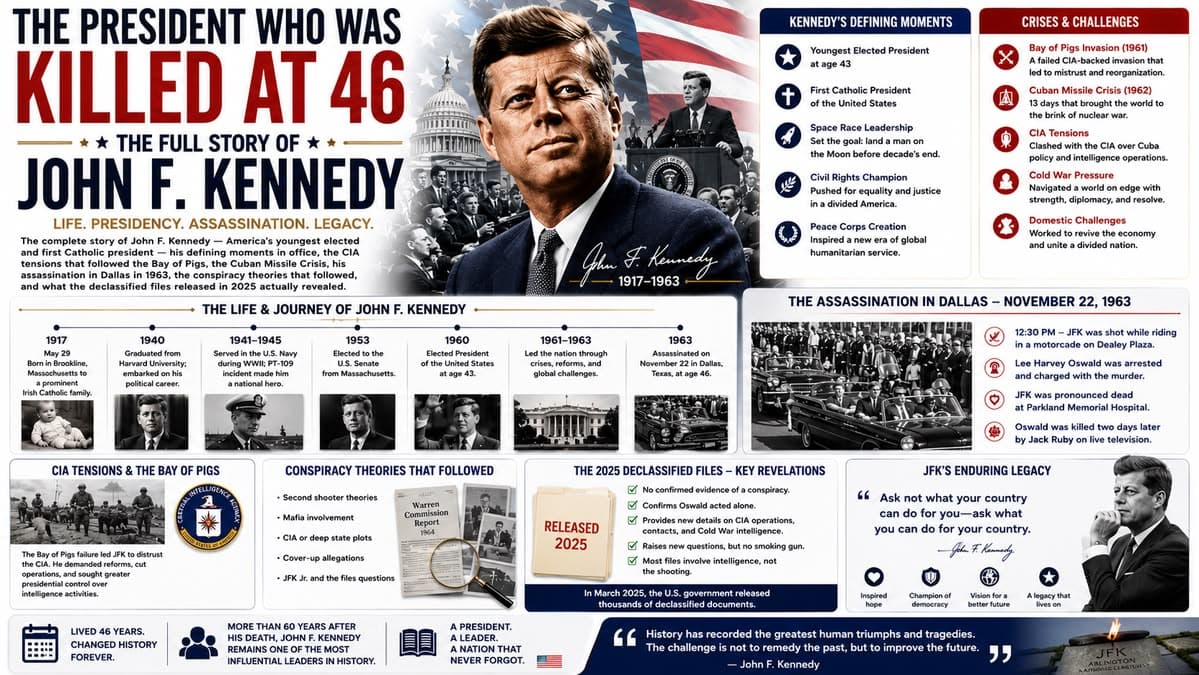
Some stories in history repeat themselves in a quiet, uncomfortable pattern: a person rises fast, challenges the system that surrounds them, and is removed before anyone can fully explain why. Few stories illustrate this pattern as vividly as that of John Fitzgerald Kennedy — the youngest man ever elected President of the United States, the first Catholic to hold that office, a leader who steered the world back from the edge of nuclear war, and a man who, at just 46 years old, was shot dead in broad daylight while riding through the streets of Dallas, Texas.
This is the full story of who Kennedy was, what he actually did in office, why his relationship with the CIA and the American security establishment grew so tense, what happened on November 22, 1963, and why — more than six decades later — his assassination remains one of the most examined, debated, and, for many, unresolved events in modern history.
Very few political stories carry this particular combination of ingredients: genuine, verifiable historical achievement sitting right alongside a death so sudden, so publicly witnessed, and so incompletely explained that entire generations of researchers, journalists, and ordinary citizens have spent their lives trying to understand it. Understanding Kennedy properly means holding both halves of the story at once — the real, documented policy decisions that shaped the Cold War era, and the layer of mystery that has never fully lifted from the afternoon he died.
1. Who Was John F. Kennedy?
John Fitzgerald Kennedy, commonly known as JFK, was born on May 29, 1917, into a wealthy and politically ambitious Irish-Catholic family in Massachusetts. He served in the United States Navy during the Second World War, was elected to the House of Representatives and later the Senate, and in 1960 won the presidency in one of the closest elections in American history, narrowly defeating Richard Nixon. He was sworn in as the 35th President of the United States on January 20, 1961.
Before entering politics, Kennedy's wartime service left a lasting mark on his public image. As a young naval officer, he commanded a patrol torpedo boat, PT-109, which was struck and split in half by a Japanese destroyer in the Pacific in 1943. Kennedy was credited with helping save several members of his crew, an episode that later became part of his political narrative as a war hero. His rise through Congress in the years that followed was steady rather than dramatic, but by the time he ran for president in 1960, he had built a national profile as a articulate, telegenic figure whose televised debates with Nixon are often credited with demonstrating, for the first time, just how much visual presence would come to matter in American politics.

2. The Youngest Elected President in American History
At the time of his inauguration, Kennedy was 43 years old, making him the youngest person ever elected to the presidency. It's worth noting a small but important distinction here: Theodore Roosevelt was actually younger when he became president, at 42, but he assumed office after President William McKinley was assassinated rather than through an election. Kennedy remains, to this day, the youngest candidate ever chosen by the American public through the ballot box.
His youth, combined with his charisma and his young family, contributed to what became known as an era of renewed optimism in American public life — a sense that a new, more energetic generation of leadership had arrived after the older, more cautious politics of the 1950s.
3. The First Catholic President — But Not the Only One
Kennedy made history as the first Roman Catholic ever elected President of the United States, at a time when many Americans were openly skeptical about whether a Catholic president would prioritize the Vatican over the Constitution. Kennedy directly addressed these fears in a famous speech during his campaign, insisting on a strict separation between his personal faith and his duties as a public official.
It's worth correcting a common misconception here: Kennedy was the first Catholic president, but not the only one in American history. Joe Biden, who became president in January 2021, is the second Catholic to hold the office — a fact that is sometimes overlooked when people retell Kennedy's story, but one worth setting straight for the historical record.
4. The Bay of Pigs Invasion and the Break with the CIA
In April 1961, just months into his presidency, Kennedy authorized a covert, CIA-planned invasion of Cuba by a group of Cuban exiles, aimed at overthrowing the communist government of Fidel Castro. The operation, known as the Bay of Pigs invasion, collapsed within days. The exile force was quickly outnumbered and captured, and the failure became a major embarrassment for the young administration.
Kennedy was reportedly furious with the CIA in the aftermath, feeling that the agency had misled him about the operation's chances of success. He is widely quoted as saying he wanted to "splinter the CIA into a thousand pieces and scatter it to the winds" — a line that has been repeated in countless books and documentaries ever since. It's worth noting that historians differ on exactly how and when Kennedy said this; the quote comes primarily from journalist Tom Braden, a former CIA official who claimed to have heard it secondhand, and its precise wording has never been independently verified through a direct recording or written record. Whether or not Kennedy used those exact words, there is little dispute that the Bay of Pigs disaster badly damaged his trust in the agency and that he moved to reduce the CIA's influence and reorganize its leadership in the months that followed.
In the aftermath, Kennedy replaced the CIA's director, Allen Dulles, and pushed for greater oversight of covert operations to be routed more directly through the White House and the Department of Defense rather than left largely to the agency's own discretion. This period also saw increased tension around a covert program targeting Fidel Castro's government, known as Operation Mongoose, which continued under Kennedy's administration even as his broader relationship with the intelligence community grew more strained. These overlapping currents — public embarrassment, private anger, and quiet institutional restructuring — set the stage for a presidency that, from its earliest months, was never entirely comfortable with the machinery of American intelligence operating around it.
5. The Cuban Missile Crisis: Thirteen Days from Nuclear War
In October 1962, American reconnaissance flights discovered that the Soviet Union was secretly installing nuclear missile sites in Cuba, within striking distance of most of the continental United States. What followed became known as the Cuban Missile Crisis — thirteen tense days widely regarded as the closest the world has ever come to full-scale nuclear war between the United States and the Soviet Union.
Rather than launching an immediate military strike, as several of his military advisors urged, Kennedy chose a more measured approach: a naval blockade, which he officially termed a "quarantine," combined with intense back-channel diplomacy with Soviet leader Nikita Khrushchev. The standoff ultimately ended with the Soviet Union agreeing to remove its missiles from Cuba, in exchange for a public U.S. pledge not to invade Cuba and a quieter, less publicized agreement to remove American missiles from Turkey. Kennedy's handling of the crisis is still studied today as a case study in crisis management and restraint under extraordinary pressure.
What made the crisis so dangerous was not only the presence of the missiles themselves, but the sheer number of moments during those thirteen days when a single miscalculation, a downed reconnaissance aircraft, or an overly aggressive response from either side could have escalated the standoff into open war. Kennedy convened a small group of senior advisors, later known as the Executive Committee of the National Security Council, and deliberately kept the circle of decision-making tight in order to explore options carefully rather than rushing toward the most aggressive available response. This preference for measured deliberation over immediate military action would later be cited by historians as one of the clearest examples of the difference Kennedy's particular temperament and judgment made at a genuinely pivotal moment in world history.
6. Kennedy and the Civil Rights Movement
Kennedy's early approach to civil rights was cautious, shaped partly by a desire to maintain political support among Southern Democrats. Over the course of his presidency, however, and particularly after violent clashes over desegregation in the South drew national and international attention, his position shifted noticeably. In June 1963, he delivered a nationally televised address explicitly framing civil rights as a moral issue, and he proposed what would eventually become the Civil Rights Act — sweeping legislation aimed at ending segregation and discrimination in public life.
This shift did not happen in a vacuum. Events such as the violent response to civil rights demonstrators in Birmingham, Alabama, and the standoff over the desegregation of the University of Alabama, where Kennedy federalized the National Guard to ensure Black students could enroll, played a direct role in pushing him toward a more forceful public stance. His June 1963 address is often cited as one of the most significant moral statements made by a sitting American president on the subject of racial equality up to that point, explicitly describing civil rights as "a moral issue... as old as the scriptures and... as clear as the American Constitution."
Kennedy did not live to see this legislation passed; it was his successor, Lyndon B. Johnson, who signed the Civil Rights Act into law in 1964, drawing heavily on the momentum and political groundwork Kennedy had built in his final months in office.
7.1 The Space Race and "We Choose to Go to the Moon"
Beyond foreign policy and civil rights, Kennedy is also remembered for setting one of the most ambitious public goals in American history. In a 1962 speech at Rice University, he committed the United States to landing a man on the moon before the end of the decade, famously declaring that the country chose to pursue this goal "not because it is easy, but because it is hard." This commitment accelerated funding and political support for NASA's Apollo program, which would ultimately succeed in landing astronauts on the moon in July 1969 — nearly six years after Kennedy's death, but built directly on the foundation and national sense of purpose he had established.
7. A President Increasingly at Odds with Parts of the National Security Establishment
By 1963, several strands of Kennedy's presidency had put him in tension with elements of the American security and military establishment. His skepticism toward unchecked CIA covert operations after the Bay of Pigs, his cautious, diplomacy-first handling of the Cuban Missile Crisis rather than a more aggressive military response, and reported discussions within his administration about limiting U.S. military involvement in Vietnam all set him apart from some of the more hawkish voices around him. These tensions form the backdrop against which many later theories about his death would be built, even though establishing a direct, proven link between any of these policy disagreements and his assassination has never been achieved through verified evidence.
8. November 22, 1963: The Assassination in Dallas
On the morning of November 22, 1963, President Kennedy traveled to Dallas, Texas, as part of a political trip through the state ahead of the 1964 election campaign. Riding in an open-top presidential limousine alongside his wife, Jacqueline Kennedy, and Texas Governor John Connally, Kennedy waved to enthusiastic crowds lining the motorcade route through downtown Dallas.
As the motorcade passed through Dealey Plaza at approximately 12:30 p.m. local time, shots rang out. Kennedy was struck twice, including a fatal shot to the head, and was rushed to Parkland Memorial Hospital, where he was pronounced dead shortly afterward. He was 46 years old. Governor Connally, riding in the same car, was also seriously wounded but survived. The assassination was witnessed by large crowds and famously captured on amateur film by bystander Abraham Zapruder, whose footage remains one of the most studied pieces of visual evidence in American history.
Vice President Lyndon B. Johnson was sworn in as president just under two hours later, aboard Air Force One on the tarmac at Dallas Love Field, with a visibly shaken Jacqueline Kennedy, still in her blood-stained clothing, standing beside him. The image of that hurried, improvised swearing-in ceremony became one of the defining photographs of the entire event, symbolizing both the shock of the moment and the constitutional continuity of American government even amid crisis.
8.1 The National Mourning and the Funeral
Kennedy's death triggered an outpouring of national and international grief rarely matched before or since. His body lay in state in the Capitol Rotunda, where hundreds of thousands of mourners filed past to pay their respects, and his funeral procession through Washington, D.C., drawn by a riderless horse in the traditional symbol of a fallen leader, was broadcast live to an estimated audience of hundreds of millions of people around the world. His young son, John Jr., saluting his father's casket on his third birthday, became one of the most enduring and heartbreaking images of the entire tragedy. The scale of public grief, unfolding almost entirely on live television, marked one of the first times a major world event had been experienced collectively, in real time, by such a vast global audience.
9. Lee Harvey Oswald: The Accused Assassin
Within hours, police arrested a 24-year-old former U.S. Marine named Lee Harvey Oswald, who had been working at the Texas School Book Depository, the building from which investigators concluded the fatal shots had been fired. Oswald had a complicated personal history, including a period living in the Soviet Union before returning to the United States, and connections to pro-Cuba political activity in the months before the assassination.
It's important to correct a detail that often gets simplified in retellings: Oswald never stood trial and never gave a courtroom confession explaining a motive. Publicly, he denied shooting Kennedy, at one point telling reporters he was "just a patsy" — a phrase suggesting he believed he was being framed. Any specific motive attributed to him, personal or otherwise, comes from the broader investigation into his background and beliefs rather than from a formal admission on his part, since he was killed before the case against him could be tested in court.
10. The Killing of Oswald by Jack Ruby
Two days after Kennedy's assassination, as Oswald was being transferred between jail facilities in front of live television cameras, Dallas nightclub owner Jack Ruby stepped forward and shot him at point-blank range. Oswald died shortly afterward. Ruby was convicted of murder, though the conviction was later overturned on appeal, and he died in prison in 1967 before a new trial could take place.
The fact that the accused assassin was himself killed just two days later, in full view of television cameras and while in police custody, has remained one of the most cited reasons for public skepticism about the official account — since it meant Oswald could never be questioned in open court, and any explanation for his motive died with him.
11. The Warren Commission's Official Conclusion
President Lyndon Johnson established a commission, headed by Chief Justice Earl Warren, to investigate the assassination. After a lengthy inquiry, the Warren Commission concluded in 1964 that Lee Harvey Oswald had acted alone, firing three shots from the sixth floor of the Texas School Book Depository, and that there was no evidence of a broader conspiracy. This remains the official U.S. government position on the assassination to this day.
The Commission's findings have nonetheless been the subject of sustained criticism and skepticism for decades, both from independent researchers and, at various points, from congressional investigations of their own. A later U.S. House Select Committee on Assassinations, reporting in 1979, concluded that Kennedy was "probably assassinated as a result of a conspiracy," based partly on disputed acoustic evidence, though it did not identify who else might have been involved, and its scientific basis has itself been challenged by subsequent analysis.
11.1 How the Assassination Changed Presidential Security
Kennedy's assassination fundamentally reshaped how the United States protects its presidents. Before 1963, it was not unusual for a president to ride in an open-top car through crowded city streets with minimal barriers between the vehicle and the public, as Kennedy did that day in Dallas. In the aftermath, presidential security protocols were overhauled dramatically: open-top vehicles were phased out in favor of armored, closed limousines, the Secret Service significantly expanded its personnel and its authority, and protective details became far more tightly coordinated with local law enforcement during any public presidential appearance. Congress also passed legislation in the wake of the assassination making the killing of a sitting president a federal crime for the first time, closing a legal gap that had previously left such matters largely to individual state jurisdiction.
12. Why So Many Conspiracy Theories Emerged
Few events in modern history have generated as many competing theories as the Kennedy assassination. It's important to be clear from the outset: none of the theories below have been proven with verified evidence to the standard that would overturn the official findings, and serious historians continue to disagree sharply about which, if any, hold merit. They are presented here as theories that have circulated publicly, not as established facts.
Part of what has allowed these theories to persist for so long is the unusual combination of circumstances surrounding the case: a chief suspect killed before trial, decades of partial government secrecy that only fueled public suspicion regardless of what the withheld files actually contained, genuine and well-documented tension between Kennedy and parts of the intelligence community, and a physical crime scene that has been re-examined by forensic experts, ballistics specialists, and amateur researchers alike for more than sixty years without producing a single account that satisfies everyone.
| Theory | Core Claim | Common Criticism |
|---|---|---|
| CIA Involvement | Rogue elements within the CIA orchestrated the killing over Kennedy's post-Bay of Pigs efforts to curb the agency's power | No verified documentary evidence has surfaced directly linking any CIA operation to the shooting itself |
| Organized Crime | Mafia figures targeted Kennedy in retaliation for his administration's crackdown on organized crime, led by his brother, Attorney General Robert Kennedy | Motive and some circumstantial links exist, but no direct evidence has been proven in court |
| Multiple Shooters / "Grassy Knoll" | Witnesses reported hearing or perceiving shots from a grassy area to the side of the motorcade, suggesting more than one gunman | Acoustic and forensic analysis of the available evidence remains disputed among experts |
| Soviet or Cuban Involvement | Retaliation theories tied to Oswald's time in the Soviet Union or his pro-Castro sympathies | No credible evidence has linked either government directly to the assassination |
| Lone Gunman (Official Position) | Oswald acted alone, motivated by personal and ideological grievances | Remains the U.S. government's official conclusion, though public trust in it has never fully recovered |
What makes the Kennedy assassination unusual, compared to other major unsolved questions in history, is the sheer volume of physical evidence, eyewitness testimony, and government documentation connected to it — and yet, despite that volume, no single account has managed to fully satisfy public skepticism for more than six decades.
13. Decades of Partial Declassification
In 1992, following renewed public interest sparked in part by a major Hollywood film about the assassination, the U.S. Congress passed a law requiring that all remaining government records related to Kennedy's death be released within 25 years, by 2017. Some documents were withheld even after that deadline, citing ongoing national security concerns, and further partial releases occurred in 2017, 2018, and 2022 under different administrations, gradually bringing the share of publicly available records in the National Archives' collection to roughly 97 percent of an estimated five million total pages.
14. Trump's 2025 Executive Order and the Release of the Remaining Files
On January 23, 2025, President Donald Trump signed an executive order directing the declassification of the remaining federal records related to the assassinations of John F. Kennedy, his brother Robert F. Kennedy, and civil rights leader Martin Luther King Jr. The order instructed the Director of National Intelligence to present a plan for the full release of the JFK-related files within 15 days.
Roughly two months later, on March 18, 2025, the Trump administration released approximately 80,000 pages of previously classified or partially redacted records related to Kennedy's assassination. This release built on earlier document drops from the Biden administration, which had made more than 13,000 additional files public during its term. According to independent reporting and fact-checking organizations that reviewed the newly released material, the files offered additional detail about CIA operations, surveillance activities, and Cold War-era intelligence practices from the period, but did not contain evidence overturning the Warren Commission's core conclusion or definitively proving any of the major conspiracy theories that have circulated for decades.
15. What the Newly Released Files Actually Showed
It's worth being precise about what the 2025 document release did and did not accomplish, since public expectations around it were extremely high after decades of anticipation. The files added considerable detail to the historical record — particularly around CIA activities, informant networks, and the broader Cold War intelligence apparatus of the early 1960s — giving historians a much fuller picture of the era Kennedy operated in. However, independent analysts and fact-checkers who reviewed the material broadly agreed that it did not contain a "smoking gun" that definitively proved a conspiracy or named additional shooters. For many longtime researchers of the assassination, the release was valuable for historical texture but did not resolve the central, decades-old question of whether Oswald acted entirely alone.
16. Timeline: Key Moments in the Kennedy Story
| Date | Event |
|---|---|
| May 29, 1917 | John Fitzgerald Kennedy is born in Massachusetts |
| January 20, 1961 | Kennedy is inaugurated as the 35th U.S. President at age 43 |
| April 1961 | The Bay of Pigs invasion fails, straining Kennedy's relationship with the CIA |
| October 1962 | The Cuban Missile Crisis brings the world to the edge of nuclear war |
| June 1963 | Kennedy delivers a major national address on civil rights |
| November 22, 1963 | Kennedy is assassinated in Dallas, Texas, at age 46 |
| November 24, 1963 | Lee Harvey Oswald is shot and killed by Jack Ruby |
| 1964 | The Warren Commission concludes Oswald acted alone |
| 1979 | A House committee suggests a "probable conspiracy" based on disputed evidence |
| 1992 | Congress mandates full record release within 25 years |
| January 23, 2025 | Trump signs an executive order for full declassification |
| March 18, 2025 | Approximately 80,000 pages of files are publicly released |
17. Kennedy's Lasting Legacy
Regardless of where one stands on the unresolved questions surrounding his death, Kennedy's presidency left a lasting imprint on American public life. His handling of the Cuban Missile Crisis is still cited as a model of restraint in the face of potential nuclear catastrophe. His civil rights address laid essential groundwork for landmark legislation passed shortly after his death. His challenge to Americans to pursue ambitious national goals, most famously the commitment to land a man on the moon within the decade, helped define the spirit of the era that followed him. And his sudden, violent death, still debated and re-examined more than six decades later, cemented his place as one of the most consequential and closely studied figures in modern American history.
18. Why This Story Still Resonates Today
Part of what keeps the Kennedy story so persistently relevant is not just the unresolved questions about who was ultimately responsible, but the broader pattern it represents: a leader who, in various ways, pushed back against powerful institutions around him — the CIA, entrenched Cold War military thinking, and the political status quo on civil rights — and was removed from the picture before his full vision could be realized. Whether that pattern reflects a genuine cause-and-effect relationship or simply a coincidence magnified by decades of speculation is a question historians continue to debate, and one that each new document release seems to reopen rather than settle.
18.1 A Pattern Seen Throughout History
Kennedy's story is often discussed in isolation, but historians who study political power more broadly sometimes place it alongside a recurring pattern seen across different countries and different eras: a leader who accumulates significant public support, begins to challenge or limit the influence of powerful institutions surrounding them — whether intelligence agencies, military establishments, or entrenched political networks — and is then removed from power, sometimes through legitimate political processes and sometimes through violence, before that challenge can fully play out.
Drawing a direct, proven causal line from any specific policy disagreement to Kennedy's assassination has never been achieved through verified evidence, and doing so would go well beyond what the historical record actually supports. What can be said with confidence is that Kennedy's presidency was defined, in part, by a series of genuine confrontations with powerful institutions, and that his sudden removal from office, regardless of its ultimate cause, ended those confrontations before their outcome could be known. It is this unresolved tension — between documented historical fact and a conclusion that has never been fully settled to public satisfaction — that continues to make his story feel unusually alive, even six decades later.
19. Frequently Asked Questions (FAQs)
How old was John F. Kennedy when he died?
Kennedy was 46 years old when he was assassinated on November 22, 1963, having been born on May 29, 1917.
Was Kennedy the youngest U.S. president ever?
He was the youngest person ever elected president, at age 43. Theodore Roosevelt was younger when he took office, at 42, but became president through succession after an assassination rather than through an election, which is why Kennedy holds the distinction specifically for the youngest elected president.
Was Kennedy the only Catholic president?
No. He was the first Catholic president, but not the only one — Joe Biden became the second Catholic U.S. president when he took office in January 2021, more than half a century after Kennedy's presidency.
What was the Bay of Pigs invasion?
It was a failed, CIA-planned invasion of Cuba in April 1961 by Cuban exiles aiming to overthrow Fidel Castro's government. Its failure significantly damaged Kennedy's trust in the CIA and led him to push for changes in the agency's leadership and oversight.
Did Kennedy really want to dismantle the CIA?
He is widely quoted as wanting to "splinter the CIA into a thousand pieces," though the exact origin and wording of this quote is debated among historians, since it comes primarily from a secondhand account. He did move to reduce the agency's influence and reorganize its leadership after the Bay of Pigs failure, regardless of the precise wording used.
What was the Cuban Missile Crisis?
A thirteen-day standoff in October 1962 after the Soviet Union placed nuclear missiles in Cuba. Kennedy's measured, diplomacy-focused response, including a naval quarantine rather than an immediate strike, is widely credited with avoiding nuclear war between the two superpowers.
Where was Kennedy assassinated?
He was shot while riding in an open-top motorcade through Dealey Plaza in Dallas, Texas, on November 22, 1963, and was pronounced dead a short time later at Parkland Memorial Hospital.
Who was accused of killing Kennedy?
Lee Harvey Oswald, a former U.S. Marine working at the Texas School Book Depository, was arrested and charged, though he was killed before he could stand trial and formally answer the charges against him.
Did Oswald confess to killing Kennedy?
No. Oswald denied shooting Kennedy and described himself as "a patsy" before he was killed two days later by Jack Ruby, meaning no courtroom confession or cross-examined motive was ever established.
Who killed Lee Harvey Oswald?
Jack Ruby, a Dallas nightclub owner, shot and killed Oswald on live television as he was being transferred between jail facilities on November 24, 1963, an event witnessed by millions of viewers in real time.
What did the Warren Commission conclude?
It concluded in 1964 that Oswald acted alone and that there was no evidence of a broader conspiracy — a finding that remains the official U.S. government position on the assassination to this day.
Did a later investigation dispute this conclusion?
Yes. A 1979 congressional committee suggested Kennedy was "probably" killed as part of a conspiracy, based on disputed acoustic evidence, though it did not identify additional suspects and its scientific basis has since been challenged by later analysis.
Did Trump release all the JFK files?
In January 2025, Trump signed an executive order for full declassification, and in March 2025 the administration released roughly 80,000 pages of previously classified or redacted records, building on earlier partial releases from prior administrations.
Did the newly released files prove a conspiracy?
No. Independent reviewers found the files added valuable historical detail about CIA and Cold War-era intelligence activity but did not contain evidence overturning the official conclusion or definitively proving any specific conspiracy theory that has circulated over the decades.
Why are there so many theories about Kennedy's assassination?
A combination of factors — Oswald's death before trial, disputed physical evidence, Kennedy's tense relationship with parts of the security establishment, and decades of partial government secrecy — has fueled ongoing public skepticism about the official account, even though no alternative theory has been proven to a standard that overturns it.
How did Kennedy's death change presidential security?
It led to major changes including the end of open-top presidential vehicles, a significantly expanded Secret Service, and new federal legislation making the killing of a sitting president a federal crime for the first time.
What is Kennedy best remembered for besides his death?
His handling of the Cuban Missile Crisis, his civil rights address that helped pave the way for the Civil Rights Act, and his commitment to the Apollo moon landing program are among his most widely cited achievements.
Is it possible we will ever know for certain what happened?
After more than six decades of investigations, declassifications, and independent research, most historians consider it unlikely that any single new document will definitively settle the matter for everyone, though each new release continues to add detail to the historical record.
Conclusion
John F. Kennedy's story is, in many ways, two stories layered on top of each other. The first is the story of a young, energetic president who guided the world through its closest brush with nuclear war, pushed his country toward a reckoning on civil rights, and captured a sense of optimism that still colors how many people remember the early 1960s. The second is the story of his sudden, violent death — an event so heavily documented and yet so persistently disputed that it has generated more books, films, investigations, and government inquiries than almost any other moment in modern history.
More than sixty years on, and even after the release of tens of thousands of newly declassified pages, the core question that has haunted this story since November 22, 1963 remains formally unresolved in the eyes of many of the people who have studied it most closely: was this the act of one troubled young man acting entirely alone, or was it something larger? The official record says the former. Public skepticism, sustained across generations, has never fully accepted that answer. What both sides agree on is this — Kennedy's life and death changed the trajectory of American history, and the questions his assassination raised about power, secrecy, and accountability remain as relevant today as they were on the day it happened.
Perhaps the most enduring lesson of Kennedy's story is not found in any single document, forensic report, or conspiracy theory, but in the broader pattern his life traces: a leader who rose quickly, achieved genuine, verifiable successes on the world stage, and pushed against powerful institutions that surrounded him, only to be removed at the height of his influence in a way that has never been fully, satisfyingly explained to the public he served. Whatever the ultimate truth of November 22, 1963 turns out to be, the fascination with Kennedy's story shows no sign of fading, and each new generation continues to revisit the same photographs, the same footage, and the same unanswered questions, searching for a resolution that has eluded every investigation that has come before it.