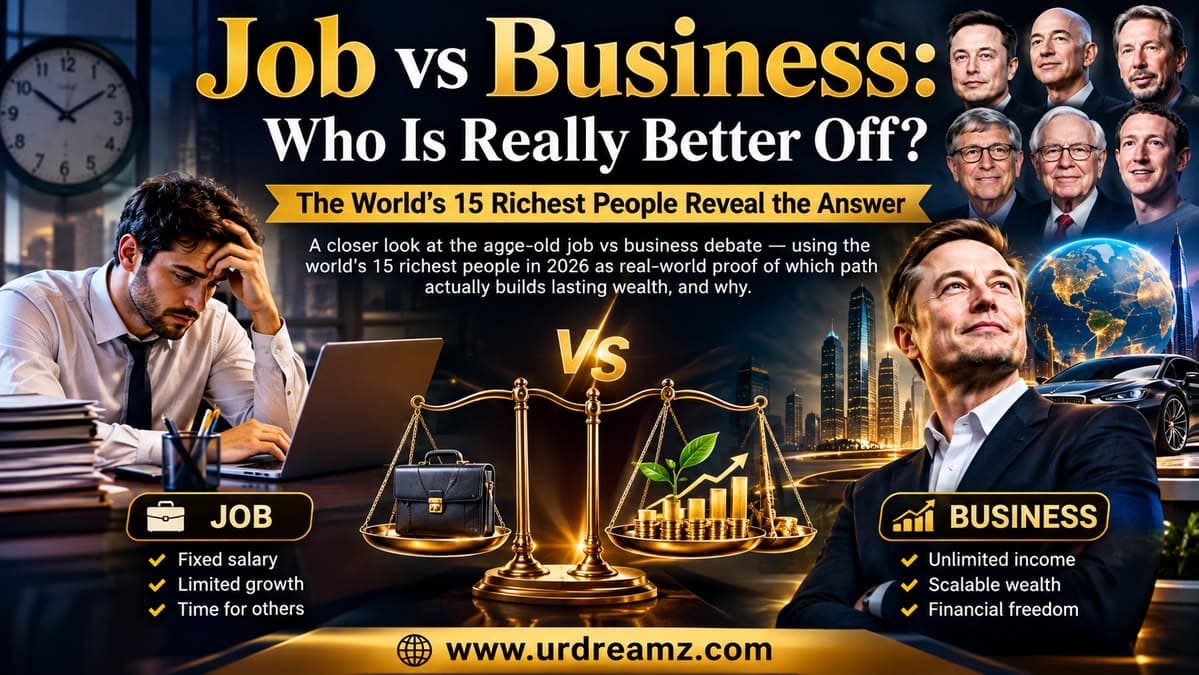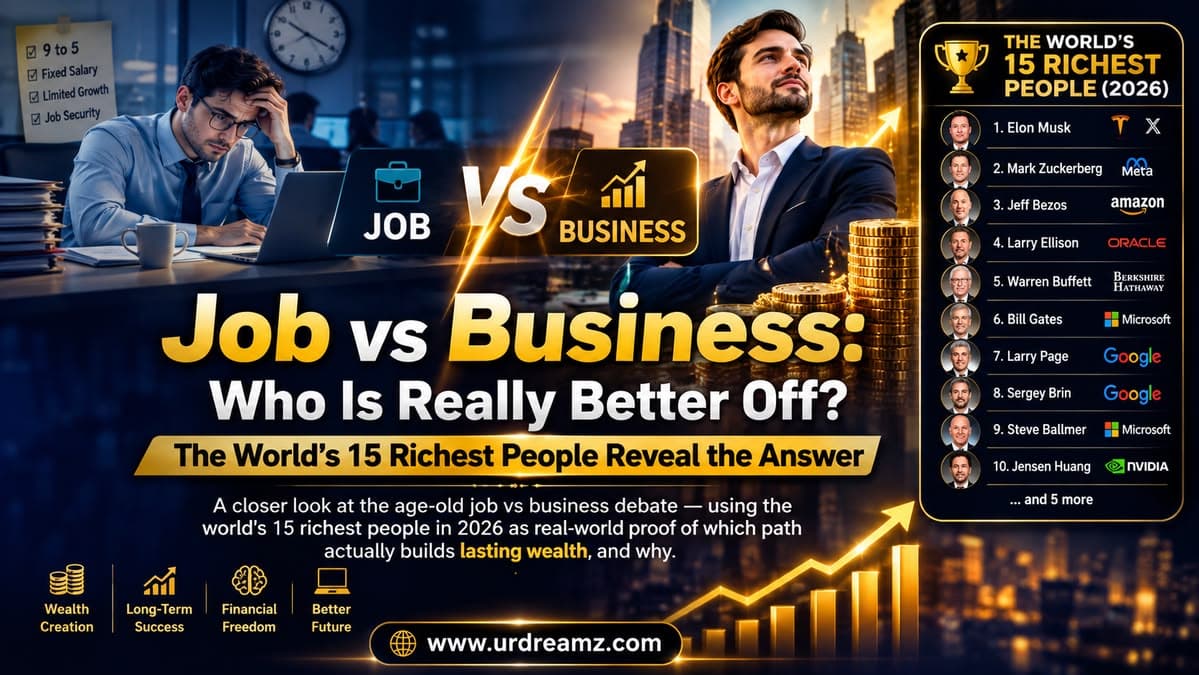
Job vs Business: Who Is Really Better Off? The World's 15 Richest People Reveal the Answer
Before diving into this article, I want to be completely honest about its purpose. This is not written to motivate you in some empty, feel-good way, and it is absolutely not written to make anyone feel small, insulted, or looked down upon because of the path they have chosen in life. Every single word here is written carefully, with the intention of never hurting anyone's heart. At the same time, there is a reality sitting quietly in front of all of us, one that most people never actually stop to look at directly. This article is simply an invitation to look at it honestly, so that you can understand something important about how wealth actually gets built in this world.
A Number That Is Hard to Ignore Once You See It
If you take a close look at the list of the wealthiest people on the planet, a striking pattern jumps out almost immediately. Around seventy-five percent of the names on that list built their fortunes through business ownership. Roughly fifteen percent built their wealth primarily through investing. About seven percent inherited significant wealth from their families. A small slice, around three percent, comes from professional athletes and public performers. And then there is one category that barely registers at all, sitting at close to zero percent: people whose primary income came from a salary, a wage, or traditional employment.
This is not meant to insult anyone who holds a job. It is not a judgment on your worth as a person, your intelligence, or your effort. Plenty of hardworking, brilliant, deeply capable people spend their entire careers as employees. But the pattern itself is worth sitting with, because it has been repeating itself for decades, quietly, consistently, almost like a fact of nature that nobody bothered to point out clearly. A salary can keep you alive today. It can pay this month's bills, cover today's groceries, and protect you from today's immediate hardship. What it has almost never done, across the history of modern wealth, is turn an ordinary person into one of the wealthiest people on Earth.
Why Business Ownership Keeps Winning This Race
There is a reason business owners and investors dominate these lists so completely, and it comes down to a handful of principles that employment, by its very structure, cannot offer. When you own a business, your growth is not capped by anyone's approval. Nobody sits above you deciding whether your idea is allowed to succeed or how big your reward is allowed to become. You are not required to walk into someone's office and ask permission before making a decision that could change your future. Employment, no matter how senior the position, almost always involves operating inside boundaries set by someone else.
A salaried employee is, in a very real sense, priced by the market rather than by their own vision. The market decides what a particular role is worth, and that number rarely moves dramatically no matter how much extra value a person quietly creates. Business owners are not bound by that same ceiling. Their income is tied to the value their business generates, and that value has no fixed upper limit. They are not clocking hours according to someone else's schedule. They are building systems, and once a system is strong enough, it starts working on their behalf around the clock, generating results even while they sleep.
The Idea That Money Itself Can Become a Tireless Worker
One of the most important truths successful investors and business owners eventually discover is this: money, when left sitting idle, behaves a lot like an ordinary worker. It can get tired. It can lose value. It can sit still and do absolutely nothing for you. But money that is deliberately put to work, whether through a business, an investment, or an asset that generates ongoing returns, does not need rest, does not get sick, and does not ask for a day off. It can work for twenty-four hours a day, generating value long after the person who deployed it has gone to bed. This single realization separates the way wealthy people think about money from the way most employees are taught to think about it.
Inherited Wealth Often Started With Exactly This Same Decision
It would be easy to assume that people born into wealthy families simply got lucky and never had to think about any of this. But if you trace almost any long-standing family fortune back far enough, you tend to find the same origin story repeating itself. Somewhere in that family's past, there was almost always one person who refused to stay locked into someone else's system, who broke away from the predictable safety of employment, and who took the risk of starting something of their own. That single decision, made by one determined individual, often became the foundation that an entire family has continued building on for generations. Inherited wealth, in other words, is frequently just business ownership viewed several decades later.
A Quiet Message Hidden Inside This Entire List
If there is one message worth taking away from all of this, it is a simple but sobering one. If your income today depends entirely on showing up to a job, then the moment that job disappears, for whatever reason, your income disappears along with it. There is nothing left standing behind you once that single source of income is gone. But people who spend their time and energy building systems, whether that system is a business, a brand, or a portfolio of investments, are building something that can continue generating value even when they personally step away. This is not a criticism of anyone currently holding a job. It is simply an observation about how lasting wealth tends to get built, repeated again and again throughout the list of the world's richest people.
Understanding the List You Are About to Read
With that context in mind, let's walk through the fifteen wealthiest individuals in the world as of 2026, based on figures compiled from Forbes' 2026 World's Billionaires List and supplemented with Bloomberg Billionaires Index data for additional context. These numbers shift constantly, sometimes by billions of dollars in a single day, so treat every figure here as an approximate snapshot rather than a fixed, unchanging number. What matters more than the exact dollar amount is the story behind how each person got there, because those stories are where the real lessons live.
1. Elon Musk – Roughly $839 Billion
Sitting at the very top of the list is Elon Musk, whose fortune is estimated at around eight hundred and thirty nine billion dollars, built primarily through Tesla, SpaceX, and his newer venture xAI. Musk was born in Pretoria, South Africa, and showed an early fascination with computers, reportedly building and selling a video game while still a child. He left South Africa as a teenager, eventually settling in the United States, where he studied physics and economics.
His financial journey began with an early software company that he sold for a substantial sum, and the proceeds eventually helped create PayPal after a series of mergers. Rather than sitting comfortably on that fortune, Musk poured nearly everything he had into three separate, extremely risky ventures at once: Tesla, SpaceX, and a solar energy company. By 2008, all three were on the brink of collapse simultaneously, and Musk came dangerously close to personal bankruptcy. He pushed through that period, and in the years since, his net worth has grown by hundreds of billions of dollars, driven largely by the rising value of SpaceX and Tesla's continued dominance in the electric vehicle space. The lesson from his story is striking: real wealth often comes from a willingness to reinvest everything, repeatedly, into high-risk ventures, even while staring down the possibility of losing it all.
2. Larry Page – Roughly $257 Billion
In second place is Larry Page, co-founder of Google, with an estimated fortune of around two hundred and fifty seven billion dollars. Page grew up in East Lansing, Michigan, in a household where both parents worked as computer science professors, giving him early exposure to technology most children never had. He studied at the University of Michigan before continuing into a doctoral program at Stanford, where he met his future business partner, Sergey Brin.
Together, the two developed an algorithm for ranking web pages that would eventually become the backbone of Google. The company's public offering in 2004 marked a turning point that transformed both founders into billionaires many times over. Page later reorganized Google under a larger holding company, bringing together ambitious projects ranging from self-driving vehicles to advanced artificial intelligence research under one umbrella. His story demonstrates how a single, well-executed technical breakthrough, when scaled globally, can generate more value than entire traditional industries combined.
3. Sergey Brin – Roughly $237 Billion
Just behind his co-founder is Sergey Brin, holding an estimated two hundred and thirty seven billion dollars. Brin's story carries an extra layer of significance, since he was born in Moscow and emigrated to the United States with his family at the age of six, partly to escape religious persecution they faced in the Soviet Union. Like Page, he pursued a doctoral degree at Stanford before leaving academia to build what would become one of the most valuable companies in modern history.
While his wealth trajectory closely mirrors Page's through their shared ownership in Alphabet, Brin has remained deeply involved in some of the company's more experimental ventures, including early wearable technology and autonomous vehicle research. His journey is a powerful reminder that immigrant families who arrive with very little can, within a single generation, help build something that reshapes how the entire world accesses information.
4. Jeff Bezos – Roughly $224 Billion
Jeff Bezos, founder of Amazon, holds an estimated fortune of around two hundred and twenty four billion dollars. Born in Albuquerque, New Mexico, and raised between Houston and Miami, Bezos graduated with top honors from Princeton in computer science and electrical engineering. He walked away from a highly lucrative position at a Wall Street investment firm at the age of thirty to start an online bookstore out of his garage in 1994, a decision that many around him considered financially reckless at the time.
Amazon expanded far beyond books, eventually becoming what many now call the everything store, before branching into cloud computing through Amazon Web Services, a division that began as an internal tool and eventually became the company's most profitable arm and a foundational piece of infrastructure for much of the modern internet. Bezos stepped down from his role as chief executive in 2021 but remains closely involved as executive chairman. His guiding philosophy, often described as treating every single day like the company's very first day, reflects a mindset of constant urgency, even decades into massive success.
5. Mark Zuckerberg – Roughly $222 Billion
Mark Zuckerberg, head of Meta, the parent company behind Facebook, Instagram, and WhatsApp, holds an estimated net worth of around two hundred and twenty two billion dollars. Born in White Plains, New York, Zuckerberg showed early programming talent, building a music recommendation tool in high school that drew interest from major technology companies well before he ever founded Facebook from his college dormitory in 2004.
Meta's growth was shaped significantly by two bold acquisitions: Instagram, purchased for roughly one billion dollars in 2012, and WhatsApp, acquired for nineteen billion dollars in 2014. Both deals were widely questioned at the time as overpriced gambles, yet both turned out to be transformative additions to the company's overall ecosystem. In more recent years, Zuckerberg has directed significant investment toward artificial intelligence while continuing to maintain the company's dominance in social media. His story illustrates the value of being willing to compete against your own product before someone else does it for you.
6. Larry Ellison – Roughly $190 Billion
Larry Ellison, founder of Oracle, holds an estimated fortune of around one hundred and ninety billion dollars. Born in the Bronx and raised on Chicago's South Side after being adopted, Ellison dropped out of two different colleges before eventually finding his footing as a computer programmer. He co-founded Oracle in 1977, reportedly landing a government intelligence agency as the company's very first client.
Oracle rode the wave of enterprise database technology to become one of the most dominant business software companies in the world. Now in his eighties, Ellison has continued pushing the company aggressively into cloud infrastructure, directly competing against some of the largest technology firms on the planet. He also holds a significant ownership stake in Tesla and has built one of the most extensive real estate portfolios among the world's wealthiest individuals, including ownership of the majority of the Hawaiian island of Lanai. His story shows that dominating a less glamorous, business-to-business market can outlast flashy consumer trends by decades.
7. Bernard Arnault and Family – Roughly $171 Billion
Bernard Arnault, chairman and chief executive of the luxury conglomerate LVMH, holds an estimated fortune of around one hundred and seventy one billion dollars, making him the highest-ranking non-American on this particular list. Born in Roubaix, France, Arnault trained as an engineer before eventually taking control of his father's construction company and using it as a springboard into an entirely different industry.
His key insight was recognizing that, unlike most technology products, luxury brands tend to appreciate in value and prestige as they age. Through a long series of carefully calculated acquisitions, he assembled a conglomerate that now includes more than seventy prestigious brands spanning fashion, spirits, and jewelry. Notably, Arnault built his fortune entirely outside the technology sector, distinguishing him from most of the names above him on this list. His story is a reminder that brand heritage, when managed patiently and strategically, can compound in value just as powerfully as any high-growth startup.
8. Jensen Huang – Roughly $154 Billion
Jensen Huang, founder and chief executive of the semiconductor company Nvidia, holds an estimated fortune of around one hundred and fifty four billion dollars, marking the first time he has appeared this high on a global wealth ranking. Born in Tainan, Taiwan, Huang immigrated to the United States as a child and later studied electrical engineering at Oregon State University, reportedly working part-time at a diner to help cover his education costs.
He co-founded Nvidia in 1993, according to popular accounts, inside a booth at that very same diner chain. For years, the company focused primarily on graphics processors for video games. Huang's defining insight was recognizing that the same parallel processing architecture used for gaming graphics could also power deep learning and artificial intelligence workloads. When the generative artificial intelligence boom accelerated in the early 2020s, Nvidia was perfectly positioned to benefit, and its valuation grew accordingly. His journey highlights the power of staying committed to a specific area of technical expertise for decades before the rest of the world catches up to its true potential.
9. Warren Buffett – Roughly $149 Billion
Warren Buffett, chairman of Berkshire Hathaway, holds an estimated fortune of around one hundred and forty nine billion dollars. Born in Omaha, Nebraska, Buffett reportedly purchased his very first stock at the age of eleven and filed his first tax return at just thirteen. He later studied under Benjamin Graham, widely regarded as the father of value investing, at Columbia Business School.
Under his leadership, Berkshire Hathaway has compounded returns at an average of roughly twenty percent annually for more than six decades, a record that remains largely unmatched in modern financial history. His overall strategy has remained remarkably simple throughout his career: identify strong companies trading at reasonable prices, hold onto them for the long term, and allow the power of compounding to do the heavy lifting over time. Remarkably, more than ninety nine percent of his total wealth was accumulated after he had already turned fifty years old. His story is perhaps the single strongest argument for the value of starting to save and invest early, even with modest amounts, since time itself becomes one of the most powerful forces working in your favor.
10. Amancio Ortega – Roughly $148 Billion
Amancio Ortega, founder of the Inditex group and the fashion brand Zara, holds an estimated fortune of around one hundred and forty eight billion dollars. Born in a small village in northwestern Spain, Ortega left formal education at the age of fourteen to work as a delivery assistant for a shirt manufacturer. He founded Zara in 1975, pioneering what later became known as the fast fashion model, where new clothing designs can move from initial concept to store shelves in as little as two weeks.
His holding company has since diversified heavily into global real estate, owning prime commercial properties across major cities including New York, London, and Seoul. Ortega has remained famously private throughout his career, rarely appearing in public or granting interviews. His story demonstrates that speed and tightly controlled internal operations can outperform even the largest advertising budgets, since Zara has historically spent very little on traditional marketing, relying instead on rapid inventory turnover and carefully chosen store locations.
11. Steve Ballmer – Roughly $139 Billion
Steve Ballmer, former chief executive of Microsoft, holds an estimated fortune of around one hundred and thirty nine billion dollars, and his story stands out for a very specific reason: he is widely recognized as the first person to reach centibillionaire status primarily through employee stock ownership rather than as a company founder. Born in Detroit, Michigan, Ballmer attended Harvard alongside Bill Gates and joined Microsoft as one of its earliest employees in 1980, eventually rising to serve as chief executive from 2000 to 2014.
The overwhelming majority of his fortune comes from his substantial personal shareholding in Microsoft, which he has held onto for well over four decades rather than selling off over time. He also owns the Los Angeles Clippers basketball franchise, purchased for two billion dollars in 2014. His story is somewhat unique on this list because he never founded the company that made him wealthy. Instead, his fortune grew through sustained loyalty to a single compounding asset held over an extraordinarily long period of time.
12. Carlos Slim Helu – Roughly $132 Billion
Carlos Slim Helu, chairman of Grupo Carso and America Movil, holds an estimated fortune of around one hundred and thirty two billion dollars. Born in Mexico City to a family of Lebanese immigrants, Slim began investing at the remarkably young age of twelve and later earned an engineering degree. His father ran a modest trading business, which gave him early, practical exposure to commerce, though nowhere near the scale of wealth he would eventually build himself.
Between 2010 and 2013, Slim held the position of the wealthiest person in the world according to major financial rankings. His fortune grew substantially through the acquisition of Mexico's telecommunications monopoly during a major government privatization effort in the 1990s, which he then expanded across Latin America, eventually serving hundreds of millions of subscribers through his telecommunications businesses. His story highlights how acquiring undervalued, essential infrastructure during moments of major economic transition can create wealth that compounds across generations.
13. Gautam Adani – Roughly $115 Billion
Gautam Adani, founder and chairman of the Adani Group, holds an estimated fortune of around one hundred and fifteen billion dollars. Born in Ahmedabad, India, Adani left college at the age of sixteen and reportedly began his working life sorting diamonds in Mumbai before founding a commodity trading firm in 1988, the seed that would eventually grow into a sprawling infrastructure conglomerate.
Today, his group controls a significant share of India's airport operations and operates the country's largest port. What began as a modest trading business has expanded dramatically over several decades through a steady series of strategic acquisitions across ports, energy, and infrastructure. His journey illustrates how owning essential infrastructure in a rapidly developing economy can become one of the fastest-compounding forms of wealth, largely because assets like ports, airports, and power grids become nearly impossible for competitors to replicate once they are built.
14. Bill Gates – Roughly $108 Billion
Bill Gates, co-founder of Microsoft, holds an estimated fortune of around one hundred and eight billion dollars. Born in Seattle, Washington, Gates had rare early access to a computer terminal at the age of thirteen through his private school, an opportunity that was extraordinarily uncommon during the early 1970s. He eventually left Harvard without finishing his degree to co-found Microsoft alongside Paul Allen in 1975.
The defining turning point in his career came through a software licensing agreement with IBM in 1980, which guaranteed Microsoft a royalty on every personal computer sold using their operating system. In recent years, Gates has slipped outside the very top tier of global wealth rankings for the first time in over three decades, though this shift reflects deliberate, large-scale philanthropic giving through his foundation rather than any decline in the underlying value of his holdings. He has also diversified significantly through a separate investment vehicle spanning agriculture, hospitality, and energy. His story offers two lessons at once: owning a foundational technology platform can be more valuable than owning the hardware built on top of it, and choosing to give enormous sums away, even at the cost of ranking position, reflects an entirely different definition of what it means to be wealthy.
15. Francoise Bettencourt Meyers – Roughly $100 Billion
Rounding out the top fifteen is Francoise Bettencourt Meyers, holding an estimated fortune of around one hundred billion dollars, derived from her controlling stake in the cosmetics company L'Oreal. Born in Neuilly-sur-Seine, France, she is the granddaughter of L'Oreal's founder and the only child of the company's former controlling shareholder, from whom she inherited her position after her mother's passing.
Beyond her role as vice chair of L'Oreal's board, she is also a published author who has written extensively on historical and religious scholarship, and she is a trained classical pianist. She remains one of the more private figures among the world's wealthiest individuals. Her story stands apart from most of the others on this list because her wealth is inherited rather than self-built. Yet her continued stewardship of the company, protecting its brand value and making careful long-term governance decisions, shows that inherited wealth still requires real skill and discipline to protect and grow rather than simply being handed down and left untouched.
What These Fifteen Stories Have in Common
Reading through these fifteen journeys back to back, a few shared threads become impossible to miss. Almost every single person on this list, at some critical point, made a decision to step outside the boundaries of a predictable, employer-controlled paycheck. Some built entirely new companies from nothing. Others took over and dramatically expanded existing family businesses. A couple built their fortunes not by founding anything, but by recognizing the long-term value of an asset and holding onto it with extraordinary patience. Not one of them built a fortune of this scale by simply collecting a salary and waiting for annual raises.
Another pattern worth noticing is how many of these individuals faced real financial danger at some point along the way. Musk nearly went bankrupt while running three companies simultaneously. Bezos walked away from a secure, high-paying career to bet everything on an idea nobody was certain would work. Huang worked a service job to fund his education before spending decades committed to a single technical vision before it paid off. Wealth on this scale rarely comes without some period of serious risk, uncertainty, or sacrifice along the way.
This Is Not a Judgment on Anyone Who Holds a Job
It is worth repeating, clearly and sincerely, that none of this is meant to suggest that having a job makes someone less valuable, less intelligent, or less deserving of respect. The world runs because of employees. Hospitals function because of nurses and doctors who are paid a salary. Schools function because of teachers who are paid a salary. Entire economies depend on millions of dedicated employees showing up every single day and doing essential work that keeps society functioning. There is genuine honor in steady, reliable work, and choosing stability over risk is a completely legitimate, often wise, decision, especially for people supporting families or facing financial constraints that make risk-taking genuinely dangerous.
What this list does highlight, however, is a pattern about how the very largest fortunes in the world tend to get built. It is simply an invitation to understand that pattern clearly, not so that everyone abandons their job tomorrow, but so that people can make informed, intentional decisions about where they want to place their long-term energy, whether that means starting something on the side, learning how to invest wisely, or simply understanding why building an asset tends to create a different kind of financial future than trading time for a paycheck alone.
What Ordinary People Can Actually Take From This
Very few people will ever build a fortune measured in the hundreds of billions of dollars, and that was never really the point of looking at this list closely. The real value lies in the underlying principles these individuals demonstrated, principles that apply at every financial scale, not just the very top. Starting small and reinvesting profits rather than spending them immediately, staying committed to one area of expertise long enough for the world to eventually catch up to its value, taking calculated risks instead of avoiding all risk entirely, and thinking in terms of building systems rather than simply trading hours for money are all lessons that can meaningfully shape someone's financial future, regardless of their current income level.
Even someone who chooses to remain employed can apply these same principles on a smaller scale, whether through consistent long-term investing, building a small side business alongside their main job, or simply developing specialized skills patiently over many years rather than chasing short-term gains. The goal is not necessarily to become one of the fifteen richest people on the planet. The goal is to understand, clearly and honestly, which financial behaviors tend to compound over time and which ones tend to remain flat no matter how many years pass.
Why the Zero Percent Statistic Deserves a Closer Look
Of everything discussed in this article, the detail that tends to sit heaviest with people is the near-total absence of salaried employees from lists like this one. It is worth pausing on why that is, rather than simply accepting it as an interesting statistic and moving on. A salary, by its very design, is structured to be predictable rather than unlimited. Employers calculate wages based on market rates, role responsibilities, and budget constraints, and while promotions and raises do happen, they almost always move in modest, incremental steps rather than exponential leaps. A ten percent raise after a strong year is considered generous in most industries. Compare that to a business or investment that can double, triple, or grow tenfold within a similar timeframe, and the mathematical gap becomes obvious rather quickly.
This does not mean employment is a flawed or foolish choice. It means employment, as a financial structure, was never designed to produce this kind of extreme wealth in the first place. It was designed to provide consistency, predictability, and shared risk between employer and employee. Business ownership and investing, by contrast, were never designed to offer that same safety. They trade predictability for unlimited upside, along with unlimited downside. Understanding this distinction clearly helps explain the zero percent statistic without turning it into either an insult toward employees or an unrealistic promise that starting a business guarantees similar results.
The Difference Between Working for Money and Building With Money
Another thread worth pulling apart is the difference between working for money and putting money to work. Most people spend the majority of their working lives in the first category, exchanging hours and effort directly for a paycheck. This is a completely natural starting point, and in fact, almost everyone on the list above began exactly there, with limited resources and no guarantee of success. What separates their eventual outcomes is what they chose to do with the money once they started earning it.
Rather than treating every dollar earned as something meant purely for immediate spending, each of these individuals, at some point, redirected a meaningful portion of their earnings toward something designed to generate more value over time, whether that meant reinvesting profits back into a growing company, purchasing shares in a promising business, or acquiring assets like real estate and infrastructure that would appreciate steadily for decades. This shift, from spending everything you earn to deliberately building something with a portion of it, is often the quiet turning point in almost every major wealth story, long before the public ever notices the person's name.
Why Patience Shows Up Again and Again in These Stories
It would be easy to read through this list and assume that everyone on it experienced some sudden, dramatic breakthrough that instantly changed their financial trajectory. In reality, patience shows up as a recurring, almost boring theme throughout nearly every one of these journeys. Warren Buffett spent decades quietly compounding returns before the majority of his current fortune ever materialized. Jensen Huang spent roughly three decades focused on a single area of technical expertise before the rest of the world suddenly needed exactly what he had been building all along. Amancio Ortega spent years refining an unglamorous, operationally intense fast fashion model long before it became a globally recognized brand.
This pattern matters because modern culture often glamorizes overnight success stories while quietly ignoring the long, unremarkable middle years that came before any headline-worthy breakthrough. Almost nobody on this list became this wealthy within their first year of effort. Most spent ten, twenty, or even thirty years steadily building before their fortune reached the scale being discussed here. Recognizing this should feel encouraging rather than discouraging, since it suggests that consistent, patient effort over a long period tends to matter far more than any single lucky break.
How Family and Legacy Fit Into This Picture
A theme that connects several names on this list, even those who are technically self-made, is the eventual involvement of family in preserving and extending what was built. Bernard Arnault's fortune is explicitly listed alongside his family, reflecting how his children now hold significant roles within the luxury empire he assembled. Francoise Bettencourt Meyers represents an entire family legacy stretching back nearly a century, carefully protected and grown across multiple generations rather than simply inherited and left untouched.
This reinforces something worth remembering: businesses, unlike jobs, can outlive the person who originally built them. A job typically ends when an individual retires or passes away, and whatever income it generated disappears along with that departure. A well-structured business or investment portfolio, however, can continue generating value for children, grandchildren, and future generations, provided it is managed thoughtfully. This is often what people mean when they describe building something bigger than themselves, since the goal shifts from simply earning a living to creating something capable of supporting an entire family line long into the future.
A Balanced Reminder Before Moving Forward
As this article draws toward its conclusion, it feels important to offer one more balanced reminder. Not every attempt at business ownership succeeds. For every name that appears on a list like this one, countless other entrepreneurs took similar risks and did not achieve similar outcomes, sometimes losing significant amounts of money along the way. Business ownership is not a guaranteed shortcut to wealth, and treating it as one would be dishonest and potentially harmful advice. What this list demonstrates is a pattern among those who did succeed at the very highest level, not a guarantee that following the same path will produce the same results for everyone who tries.
Similarly, choosing to remain employed is not a mistake or a missed opportunity in every case. Many people build genuinely comfortable, secure, fulfilling lives through steady careers, without ever feeling the need to build a business or take on significant financial risk. The purpose of exploring this list closely is not to push everyone toward entrepreneurship regardless of their circumstances, but to offer a clear, honest picture of how history's largest fortunes have tended to form, so that each person can make their own informed decision about where they want to place their effort, their risk tolerance, and their long-term goals.
One Last Look at the Bigger Picture
Stepping back from the individual profiles, it helps to see this entire list as one continuous story rather than fifteen separate ones. A young computer enthusiast in South Africa, a pair of graduate students at Stanford, a Wall Street employee willing to walk away from security, a college dropout adopted into a modest Chicago household, a factory delivery worker in rural Spain, a diner employee in Oregon studying engineering, an immigrant family fleeing persecution, and a woman quietly protecting a century-old family legacy all eventually arrived at the same extreme level of financial outcome, despite starting from wildly different circumstances. What connects them is not luck alone, and it is certainly not privilege alone, since several of these individuals started with very little. What connects them is a willingness, at some critical moment, to step outside the boundaries of a fixed paycheck and take ownership of something larger than themselves, even when the outcome was far from guaranteed.
That single thread, repeated across radically different backgrounds, countries, and industries, is really the heart of what this entire article has been trying to gently point toward. Not that everyone must become a billionaire, and not that a job is somehow beneath anyone who holds one, but that the world's largest fortunes tend to be built by people who, sooner or later, stopped renting out their time exclusively and started building something they could actually own.
The Countries Represented on This List
It is also worth noting how geographically spread this list actually is, since it is easy to assume extreme wealth is concentrated in just one country or region. While the United States is home to the largest share of names here, reflecting the scale and reach of its technology and financial sectors, the list also includes individuals from France, Spain, Mexico, and India, along with people originally born in South Africa, the former Soviet Union, and Taiwan who later built their fortunes elsewhere. This geographic spread reinforces an important point: the underlying principles behind building extraordinary wealth are not tied to a single culture, economy, or starting point. They show up again and again across very different countries, industries, and personal circumstances, which suggests these are transferable principles rather than something limited to one particular environment or set of advantages.
A Quick Recap of the Top Fifteen
To close things out with a simple summary, here is the order of the fifteen names discussed above, from the largest fortune to the smallest, along with their primary source of wealth: Elon Musk through Tesla, SpaceX, and xAI; Larry Page and Sergey Brin through Google and Alphabet; Jeff Bezos through Amazon; Mark Zuckerberg through Meta; Larry Ellison through Oracle; Bernard Arnault through LVMH; Jensen Huang through Nvidia; Warren Buffett through Berkshire Hathaway; Amancio Ortega through Inditex and Zara; Steve Ballmer through his long-held Microsoft shares; Carlos Slim Helu through Grupo Carso and America Movil; Gautam Adani through the Adani Group; Bill Gates through Microsoft and his broader investment holdings; and finally Francoise Bettencourt Meyers through her family's controlling stake in L'Oreal. Together, these fifteen names represent trillions of dollars in combined wealth, built across technology, luxury goods, telecommunications, retail, infrastructure, and investing, spanning multiple continents and generations.
Frequently Asked Questions About the World's Richest People
Who is currently the richest person in the world? As of the 2026 Forbes World's Billionaires List, Elon Musk holds the top position, with an estimated net worth of around eight hundred and thirty nine billion dollars, driven primarily by his ownership stakes in Tesla, SpaceX, and xAI.
How many of the world's richest people built their wealth through business rather than a salary? The overwhelming majority of the world's wealthiest individuals built their fortunes through business ownership, with investing, inheritance, and professional sports or entertainment making up smaller portions of the list, while traditional salaried employment accounts for almost none of the wealth at this level.
Did any of the richest people in the world inherit their fortune? Yes, a small percentage of individuals on the list, such as Francoise Bettencourt Meyers of L'Oreal, inherited significant wealth from their families, though most inherited fortunes originally trace back to a business that was founded by an earlier generation.
Is it true that most billionaires took major financial risks before becoming successful? Yes, many of the individuals on this list experienced serious financial risk or near failure at some point in their journey, including periods of near bankruptcy, walking away from secure careers, or spending years committed to an idea before it became profitable.
Does this mean having a stable job is a bad financial decision? No, a stable job remains a completely valid and often necessary choice, especially for people managing financial responsibilities that make risk-taking unwise. This list simply highlights a pattern in how the very largest fortunes tend to be built, not a judgment on the value of steady employment.
What can an average person learn from studying the world's richest people? Even without aiming for extreme wealth, ordinary people can apply similar principles on a smaller scale, such as reinvesting earnings, developing specialized skills over time, taking calculated risks, and focusing on building assets rather than relying solely on a fixed paycheck.
A Final, Gentle Word
If you have read this far, I hope none of this left you feeling small, discouraged, or judged in any way, because that was never the intention behind a single sentence in this article. Life circumstances, responsibilities, and opportunities are different for every single person reading this, and there is real dignity in whatever honest path you are currently walking. What this list offers is simply a clear, unfiltered look at a pattern that has quietly repeated itself for decades, so that anyone who wants to build something larger for themselves or their family has an honest starting point for understanding how that kind of wealth tends to get built. Whether you choose to act on that understanding today, gradually over the coming years, or not at all, the choice remains entirely yours, and it always will.
Whatever you decide to do with everything shared here, know that the intention behind every paragraph was simply to hand you a mirror, not a verdict. What you choose to do with that reflection, whether it changes something in your life starting today or simply gives you something to think about quietly tomorrow, is entirely, completely up to you. And if all you take away from this article is a slightly clearer sense of how wealth tends to be built in this world, that alone was worth the time spent reading it.