Why Was ICC Prosecutor Karim Khan Removed? The Netanyahu Warrant, the Misconduct Case, and the Political Storm Explained
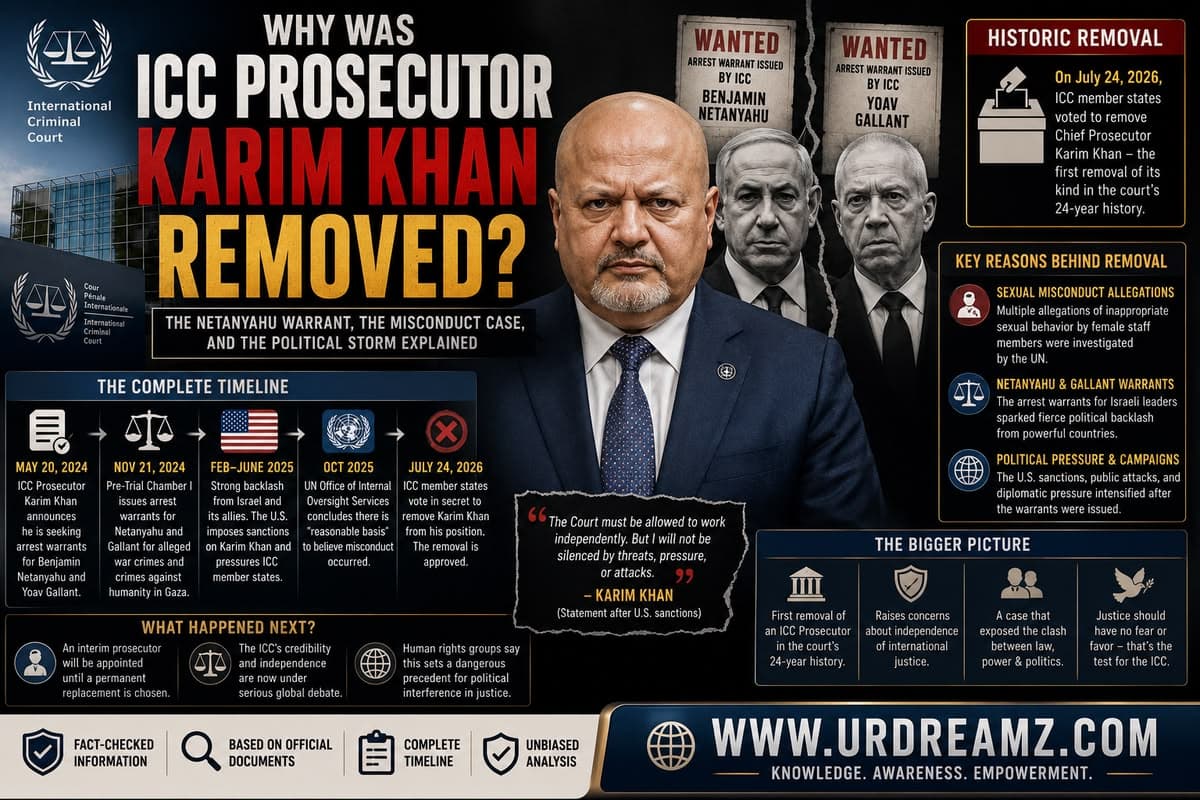
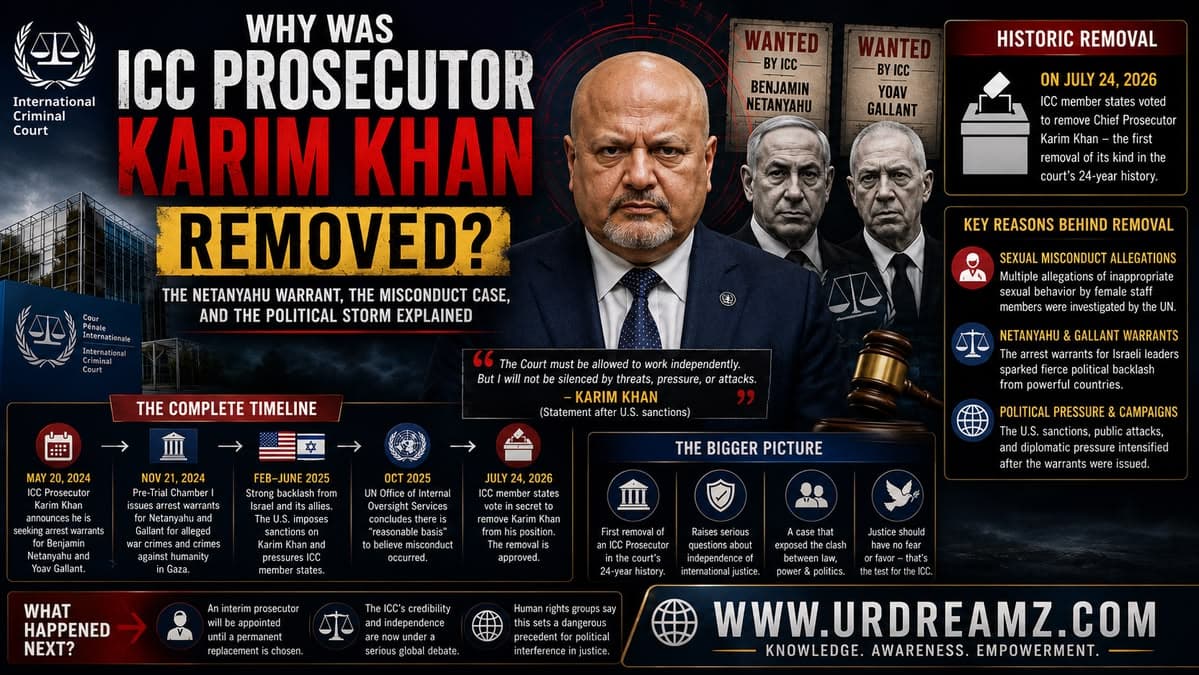
On July 24, 2026, something happened at the International Criminal Court that had never happened before in its 24-year history: member states voted to remove the court's own chief prosecutor from office. The man at the center of it, British barrister Karim Khan, had spent the previous two years pursuing some of the most politically explosive arrest warrants any ICC prosecutor has ever sought - including one against Israeli Prime Minister Benjamin Netanyahu. This guide lays out the complete, carefully sourced story: who Karim Khan is, what those warrants actually involved, what the misconduct allegations against him say, how the vote itself unfolded, and why so many people - including Khan's own legal team - believe the two stories are connected, even as the court's own leadership insists they are not.
1. What Just Happened, in Plain Terms
On Friday, July 24, 2026, the Assembly of States Parties - the body made up of all 125 member countries of the International Criminal Court - held a special session at United Nations headquarters in New York and voted, by secret ballot, to remove Karim Khan from his position as the ICC's Chief Prosecutor. The stated grounds were serious sexual misconduct allegations. It was the first time in the court's history that a sitting chief prosecutor had been removed from office this way.
2. Who Is Karim Khan?
Karim Khan is a 56-year-old British barrister who was elected as the ICC's Chief Prosecutor in February 2021, becoming only the third person to hold that position since the court's founding in 2002. During his tenure, his office pursued some of the most high-profile and politically sensitive investigations in the court's history, including cases connected to Russia, Israel, the Philippines, Myanmar, and Afghanistan.
3. What the ICC Actually Is
The International Criminal Court is a permanent international tribunal based in The Hague, established to prosecute individuals for genocide, crimes against humanity, war crimes, and the crime of aggression, when national courts are unable or unwilling to do so themselves. It operates independently of the United Nations, though it maintains a formal cooperation agreement with it, and its authority comes specifically from the states that have voluntarily joined as member parties.
4. How an Arrest Warrant Actually Gets Issued
It's worth being precise about how this process actually works, since it's commonly misunderstood. The Chief Prosecutor's office - which Khan led - investigates a situation and applies to a panel of ICC judges for an arrest warrant. It is the judges, not the prosecutor alone, who review the application and decide whether to formally issue the warrant. Khan's role was to build and submit the case; the judges were the ones who ultimately approved it.
5. Correcting a Common Misconception About "15 Countries"
A claim circulating widely online suggests that "15 countries" individually issued arrest warrants against Netanyahu. This isn't accurate. The arrest warrant was issued by the International Criminal Court itself, as a single institution, based on Khan's application and approved by ICC judges in November 2024. What varies by country is enforcement - as ICC member states, many countries are technically obligated under the Rome Statute to arrest Netanyahu if he enters their territory, but the warrant itself came from one institution, not from a coalition of individual countries each separately issuing their own warrants.
6. The Netanyahu and Gallant Arrest Warrants Explained
In November 2024, ICC judges issued arrest warrants for Israeli Prime Minister Benjamin Netanyahu and his then-Defence Minister Yoav Gallant, based on Khan's application alleging war crimes and crimes against humanity connected to the conduct of the war in Gaza. This marked the first time the ICC had issued an arrest warrant against the sitting leader of a close US ally, making it one of the most diplomatically sensitive actions in the court's history.
7. Why the Warrant Was So Controversial
The warrant triggered immediate, forceful backlash from both Israel and the United States, neither of which recognizes the ICC's jurisdiction over their nationals, since neither country is a member state of the court. Israeli officials condemned the warrant as biased and politically motivated, while members of the US government, particularly under the Trump administration, escalated pressure on the court and its officials in direct response, framing the ICC's actions as an overreach threatening national sovereignty.
8. The Sexual Misconduct Allegations Against Khan
Separately from the Netanyahu case, Khan faced sexual misconduct allegations first reported roughly two years before his removal. According to documents cited by the Associated Press, the allegations centered on a subordinate staff member who accused him of engaging in a sexual relationship and, according to the reporting, attempting to discourage her from pursuing her allegations. Khan has consistently denied these findings.
9. Timeline: How the Allegations Surfaced
The allegations against Khan first became public roughly two years prior to his removal. In May 2025, Khan took formal leave from his role pending a UN-linked investigation into the claims. He was then temporarily removed from his duties in June 2026, ahead of the final vote, and in the days immediately before the July vote, his accuser gave a public interview to CNN's Christiane Amanpour, intensifying media attention on the case right before the Assembly convened.
10. The Investigation and Its Findings
An executive committee tied to the court's oversight body investigated the allegations and concluded that Khan had committed "serious misconduct and a serious breach of duty," specifically describing "prohibited conduct against a subordinate staff member." This finding formed the official basis presented to the Assembly of States Parties ahead of the vote.
11. Khan's Denial and His Legal Team's Response
Khan has disputed the investigation's findings throughout. His lawyer, Tayab Ali, stated publicly that the underlying investigation found no misconduct, including no sexual misconduct, and argued that Khan was denied a fair opportunity to respond - claiming he was excluded from the session and not permitted to make submissions before the vote took place. Ali has pledged to formally challenge the removal decision.
12. The July 24, 2026 Vote: How It Worked
The vote took place during a closed-door special session of the Assembly of States Parties at UN headquarters in New York, conducted by secret ballot among the court's 125 member states. A simple majority was required to remove Khan from office, with an absolute majority threshold of 63 votes needed for the decision to pass.
13. The Vote Results: 82 For, 13 Against, 15 Abstained
According to diplomatic sources and the Assembly's own confirmed results, 82 of the 125 member states voted in favor of removing Khan, comfortably surpassing the 63-vote threshold required. Thirteen states voted against removal, and 15 abstained from the vote entirely. Assembly President Päivi Kaukoranta formally announced the results, confirming that the Assembly had found Khan committed serious misconduct and a serious breach of duty.
14. Why This Was Historic
This marked the first time in the ICC's 24-year history that a sitting chief prosecutor had been removed from office through this kind of formal disciplinary vote - an unprecedented moment for an institution that had never previously had to exercise this specific mechanism against its own most senior official.
15. US Sanctions Against Khan
Separately from the ICC's own internal disciplinary process, the Trump administration imposed direct sanctions on Karim Khan, part of a broader pattern of US pressure on the court following the Netanyahu and Gallant warrants. Washington has publicly characterized the ICC's actions against Israeli officials as a threat to US and allied sovereignty, framing its sanctions as a response to what it views as ICC overreach.
16. Sanctions Against Other ICC Officials
Khan was not the only ICC-linked official targeted by US sanctions. Deputy Prosecutor Mame Mandiaye Niang, who has helped lead the prosecutor's office since Khan's leave began, has also been sanctioned by Washington specifically in connection with the ICC's Gaza-related investigation, illustrating how the pressure campaign extended well beyond Khan personally to other senior figures within the prosecutor's office.
17. Israel's Public Role in the Push to Remove Khan
Israeli officials have not been shy about claiming credit for influencing the outcome. Israel's Foreign Minister, Gideon Sa'ar, has publicly stated that Israel played a significant behind-the-scenes role in the effort to remove Khan, a rare degree of open acknowledgment from a government actively working to influence an international court's internal disciplinary proceedings against its own chief prosecutor.
18. The Case That This Was Political Retaliation
Khan's legal team, along with a number of independent observers, has argued that regardless of the validity of the misconduct allegations themselves, the timing and circumstances of the removal cannot be fully separated from the intense political pressure the court has faced since issuing the Netanyahu and Gallant warrants. Critics point to the scale of US sanctions, Israel's public claims of involvement, and the unusual procedural circumstances of the vote itself as evidence that political considerations shaped the outcome, even if the misconduct allegations are independently credible.
19. The Case That the Two Issues Are Separate
Other observers, including some legal analysts closely following the case, have pushed back firmly against conflating the two issues. Independent commentary on the case has stated clearly that the specific misconduct allegations against Khan had nothing to do with his decision to pursue the Netanyahu and Gallant warrants, and that the allegations themselves - involving a staff member under his direct authority - predate and stand entirely apart from his prosecutorial decisions regarding Gaza. Palestinian Ambassador to the Netherlands Ammar Hijazi similarly stated publicly that the vote was not intended as a political proxy vote on any case before the court.
20. Other Arrest Warrants Khan Pursued
The Netanyahu and Gallant warrants were far from the only high-profile actions taken during Khan's tenure. His office also pursued and secured an arrest warrant for Russian President Vladimir Putin in 2023 over alleged war crimes connected to the war in Ukraine, sought warrants tied to the Philippines under former President Rodrigo Duterte's drug war, pursued cases against Myanmar's military junta leadership, and sought warrants connected to Taliban officials in Afghanistan - a pattern showing Khan repeatedly pursued cases against sitting or recently sitting heads of state and senior officials across multiple continents, not solely in relation to Israel.
21. What Happens to the Netanyahu Warrant Now?
Importantly, Khan's removal does not automatically cancel or invalidate the existing arrest warrant against Netanyahu and Gallant. Since the warrant was issued by ICC judges, not by Khan personally, any active ICC warrants remain legally in place regardless of who currently holds the Chief Prosecutor position - meaning Khan's removal is a personnel and disciplinary matter, not a reversal of the court's judicial decisions themselves.
22. Who Leads the Prosecutor's Office Now?
Following Khan's removal, the office continues to be led on an interim basis by Deputy Prosecutors Nazhat Shameen Khan and Mame Mandiaye Niang, who have effectively run the office's day-to-day operations since Khan first took leave in May 2025, well before the formal removal vote took place.
23. The Election of a New Prosecutor
The removal vote automatically triggers a formal election process for a new Chief Prosecutor, though that process is not expected to conclude before sometime next year, meaning the office will continue operating under interim leadership for an extended period while member states work through the selection process for Khan's permanent successor.
24. What This Means for the ICC's Independence
Regardless of which interpretation of events one finds more persuasive, this episode has raised serious, widely discussed questions about the ICC's institutional independence going forward - specifically, whether an international court meant to operate free of political pressure from powerful states can genuinely maintain that independence when it takes action against officials from those same powerful states or their close allies.
25. Broader Implications for International Justice
Beyond the ICC specifically, this case has become a significant reference point in broader debates about the limits of international justice mechanisms when they come into direct conflict with the interests of major world powers. Whether the court's credibility emerges strengthened or weakened from this episode will likely depend heavily on how transparently the new prosecutor's office handles the ongoing Gaza investigation and the existing warrants going forward.
26. Weighing Both Sides Honestly
A fair, complete reading of this case has to hold two things at once without collapsing either into the other: independent investigators did formally conclude that Khan committed serious misconduct against a subordinate staff member, a finding neither trivial nor something to dismiss simply because of its politically inconvenient timing - and at the same time, the surrounding political context is real, well documented, and impossible to fully separate from the outcome, given the scale of US sanctions, Israel's own public claims of involvement, and the unusual procedural circumstances Khan's team has raised. Both of these things being true simultaneously is exactly what makes this case genuinely complicated, rather than a simple story with one obvious villain.
27. Frequently Asked Questions
Why was ICC Prosecutor Karim Khan removed?
Officially, over sexual misconduct allegations involving a subordinate staff member, following an investigation that found he committed "serious misconduct and a serious breach of duty."
Did 15 countries issue an arrest warrant against Netanyahu?
No - the arrest warrant was issued by the International Criminal Court itself, based on an application from Prosecutor Karim Khan and approved by a panel of ICC judges in November 2024, not by 15 individual countries separately.
Was Karim Khan a judge or a prosecutor?
A prosecutor - he led the office responsible for investigating and applying for arrest warrants, while a separate panel of ICC judges reviewed and formally approved those warrants.
Does the Netanyahu arrest warrant still stand after Khan's removal?
Yes - since the warrant was issued by ICC judges rather than by Khan personally, it remains legally active regardless of who holds the Chief Prosecutor position.
How did the ICC vote to remove Khan?
By secret ballot among the court's 125 member states, with 82 voting in favor of removal, well above the 63 votes needed for an absolute majority.
Was this the first time an ICC chief prosecutor was removed from office?
Yes - this was the first removal of a sitting chief prosecutor in the ICC's 24-year history.
Is Karim Khan's removal connected to the Netanyahu warrant?
This remains genuinely disputed - Khan's legal team argues the timing reflects political pressure, while other observers and court officials maintain the misconduct allegations are entirely separate from and predate his decision to pursue the Netanyahu warrant.
28. Conclusion
The removal of Karim Khan is genuinely two stories tangled together: a serious, independently investigated misconduct finding against a senior official, and an unprecedented political storm triggered by his decision to pursue an arrest warrant against a sitting Israeli prime minister. Both are real. Both are documented. And reasonable, well-informed people looking at the same set of facts have reached very different conclusions about how much weight each one deserves. What's clear beyond dispute is this: for the first time in its history, the world's only permanent international criminal court removed its own chief prosecutor - and however this specific case is ultimately judged, the questions it raises about political pressure, institutional independence, and accountability at the highest levels of international justice aren't going away anytime soon.