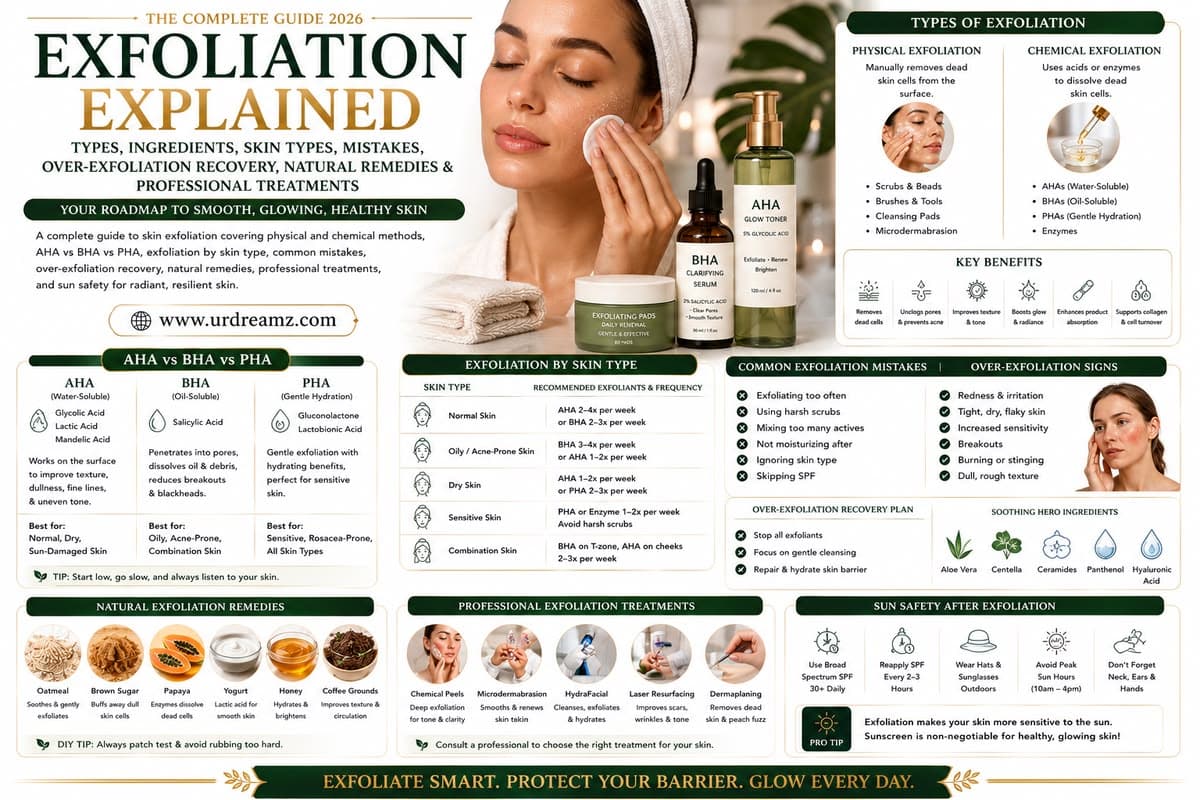
Exfoliation Explained: Types, Ingredients, Skin Types, Mistakes, Over-Exfoliation Recovery, Natural Remedies & Professional Treatments — The Complete Guide 2026
Exfoliation is one of the most talked-about steps in modern skincare, yet it is also one of the most misused. Done well, it can leave skin looking smoother, brighter, and more even-toned. Done carelessly, it can strip away the skin's protective barrier and leave it red, tight, and sensitive for weeks. This guide walks through everything worth knowing about exfoliation — how it works, the different methods available, which approach suits which skin type, how to avoid common mistakes, and how to recover if you have already gone too far.
Whether you have never exfoliated before or you have been using acids and scrubs for years without really understanding what they do, this guide is built to give you a clear, practical picture. We will look at the science behind how skin naturally renews itself, break down the difference between physical and chemical exfoliation, explain the major exfoliating acids in plain language, and cover the lifestyle habits — from sun protection to product layering — that determine whether exfoliation helps your skin or quietly damages it over time.
1. What Is Exfoliation?
Exfoliation is the process of helping the skin shed the outermost layer of dead, built-up cells sitting on its surface. Skin does this on its own to some degree, but factors like age, dehydration, sun damage, and simple day-to-day buildup of dirt and oil can slow this natural shedding down, leaving a dull, rough, or congested surface behind. Exfoliating products and tools are designed to speed up or support this process, encouraging fresher, smoother-looking skin to come through.
The word itself comes from a Latin root meaning "to strip away leaves," which is a fairly accurate description of what is happening at a cellular level — the outermost, oldest layer of skin cells is being lifted away to reveal newer cells underneath. This can be done mechanically, by physically rubbing or brushing the skin, or chemically, by applying an ingredient that loosens the bonds holding old cells together so they release more easily.
It is worth noting that exfoliation is not strictly necessary for everyone. Skin already exfoliates itself continuously as part of its natural cycle, and healthy, well-hydrated skin with good circulation can often manage this process reasonably well on its own. Exfoliation becomes most useful when that natural process has slowed down or is being outpaced by buildup, which is common with aging, dehydration, sun damage, or skin conditions that cause excess flaking or congestion. In other words, exfoliation is best thought of as a supportive step rather than a mandatory daily ritual.
2. The Skin's Natural Renewal Cycle
Underneath the visible surface of your skin, new cells are constantly being produced in the deepest layer of the epidermis. Over roughly a month, these cells gradually travel upward, flattening and hardening as they go, until they reach the surface as part of the outermost layer, known as the stratum corneum. Once there, they are meant to loosen and fall away in a final stage called desquamation, making room for the next wave of cells arriving from below.
This entire cycle depends heavily on adequate hydration. Water helps the enzymes responsible for breaking the bonds between old skin cells function properly; when skin is dehydrated, those enzymes slow down, and dead cells can cling to the surface longer than they should. This buildup is what often shows up as flakiness, rough texture, a dull complexion, or pores that appear clogged. As we age, this renewal cycle also naturally slows down, which is part of why exfoliation tends to become more relevant — not less — as skin matures.
Several other everyday factors can also interfere with this cycle beyond hydration and age. Prolonged sun exposure thickens and roughens the outer layer of skin over time, while stress and poor sleep can affect the hormones involved in cell regeneration. Even something as simple as consistently sleeping in makeup or not cleansing thoroughly enough at night can leave a residue on the skin that interferes with the natural shedding process, contributing to the appearance of buildup even in people whose underlying renewal cycle is otherwise healthy.
| Stage | What Happens |
|---|---|
| Cell Formation | New skin cells are produced in the basal layer, the deepest part of the epidermis |
| Migration | Cells gradually move upward toward the surface over several weeks |
| Flattening & Hardening | Cells lose their nucleus and flatten out as they near the surface |
| Desquamation | Old, flattened cells loosen and shed from the outermost layer |
3. Why Exfoliation Matters: Key Benefits
When performed correctly and at a sensible frequency, exfoliation can offer a range of visible and functional benefits for the skin. It is not simply a cosmetic step — it also affects how well the rest of your skincare routine performs, since a surface clogged with dead cells can act as a barrier that keeps serums and moisturizers from absorbing properly.
Beyond the surface-level improvements, some research also links long-term, consistent exfoliation to increased collagen production, since the process of gently removing the outer layer and encouraging renewal can stimulate activity in the deeper layers of skin over time. This is one of the reasons exfoliation is often mentioned alongside anti-aging skincare, although it should be viewed as one supportive habit among many rather than a stand-alone solution for aging skin.
| Benefit | Explanation |
|---|---|
| Smoother Texture | Removing built-up dead cells leaves the surface of the skin feeling softer and more even |
| Brighter Complexion | A cleared surface reflects light more evenly, reducing the dull, tired look caused by buildup |
| Fewer Clogged Pores | Regularly clearing away dead skin and debris can reduce the frequency of blackheads and breakouts |
| Better Product Absorption | Serums and moisturizers can penetrate more effectively once the surface barrier of dead cells is reduced |
| More Even Tone | Consistent exfoliation over time may help soften the appearance of mild discoloration and rough patches |
| Improved Circulation | Physical exfoliation in particular can stimulate blood flow to the surface of the skin |
4. Types of Exfoliation
There are three broad categories of exfoliation: physical (mechanical), chemical, and enzymatic, along with a fourth category of professional, in-office treatments that go beyond what most at-home products can achieve. Understanding the difference between these categories is the single most important factor in choosing a method that will work with your skin rather than against it.
None of these categories is inherently superior to the others — each has situations where it performs particularly well, and each carries its own risks if used carelessly. A person with resilient, oily skin might do perfectly well with an occasional physical scrub, while someone with reactive, sensitive skin might find that even a mild chemical exfoliant needs to be introduced slowly. The goal is not to find the single "best" category, but to find the specific method within whichever category suits your skin that you can use consistently, without triggering irritation.
| Type | How It Works | Examples |
|---|---|---|
| Physical / Mechanical | Manually loosens and removes dead cells through friction | Face scrubs, body scrubs, exfoliating brushes, cleansing cloths, exfoliating gloves |
| Chemical | Dissolves the bonds holding dead cells together using acids | AHAs, BHAs, PHAs, azelaic acid |
| Enzymatic | Breaks down keratin proteins in dead skin cells using natural enzymes | Papaya enzyme (papain), pineapple enzyme (bromelain), pumpkin enzyme |
| Professional / In-Office | Uses stronger concentrations or specialized tools under professional supervision | Chemical peels, microdermabrasion, dermaplaning, laser resurfacing |
4.1 Physical vs Chemical Exfoliation: A Detailed Comparison
Physical exfoliation offers the advantage of immediate, visible results — you can feel the smoother texture right after rinsing off a scrub. However, it relies entirely on how much pressure and how coarse a material is used, which makes it easy to overdo, especially on facial skin, which is far more delicate than skin on the body. Chemical exfoliation tends to work more evenly across the entire treated area, since it does not depend on how hard you rub, and many chemical exfoliants also bring additional benefits, such as hydration or oil control, depending on the specific acid used.
| Feature | Physical Exfoliation | Chemical Exfoliation |
|---|---|---|
| Mechanism | Manual friction against the skin | Acids dissolve the bonds between dead cells |
| Evenness of Result | Depends on pressure and technique, can be uneven | Generally more even across the treated area |
| Risk of Micro-Tears | Higher, especially with coarse or jagged particles | Lower when used at an appropriate strength |
| Best Suited For | Normal to oily, resilient skin | Most skin types, including sensitive skin with the right acid |
| Speed of Visible Result | Immediate | Gradual, often over several uses |
5. Chemical Exfoliating Ingredients Explained
Chemical exfoliants are generally divided into three main families based on their solubility and how deeply they work: alpha hydroxy acids, beta hydroxy acids, and polyhydroxy acids. A fourth ingredient, azelaic acid, does not technically belong to any of these families but is often grouped alongside them because of its similar exfoliating and brightening effects.
Reading an ingredient list for a chemical exfoliant can feel intimidating at first, since many products list multiple acids together, sometimes at concentrations that are not always clearly disclosed. A practical approach is to focus first on which family of acid a product primarily relies on, since that alone tells you a great deal about how it will likely behave on your skin — whether it will mainly work on the surface, penetrate into the pore, or offer an especially gentle introduction to chemical exfoliation.
5.1 Alpha Hydroxy Acids (AHAs)
AHAs are water-soluble acids that work primarily on the surface of the skin, loosening the connections between dead cells so they shed more easily. They are generally associated with improving texture, brightness, and the appearance of fine surface lines, and several also have some ability to attract and hold water, giving them a mild hydrating effect alongside their exfoliating action.
| AHA | Source | Best For |
|---|---|---|
| Glycolic Acid | Derived from sugar cane, smallest molecule size among common AHAs | Fast, surface-level smoothing and brightening; may cause more sensitivity in beginners |
| Lactic Acid | Derived from milk sugars | Dry and dehydrated skin, since it also has a mild hydrating effect |
| Mandelic Acid | Derived from bitter almonds, largest molecule size among common AHAs | Sensitive or acne-prone skin, due to its slower, gentler action |
| Citric Acid | Derived from citrus fruits | Mild brightening, often used in lower concentrations alongside other acids |
5.2 Beta Hydroxy Acids (BHAs)
Unlike AHAs, BHAs are oil-soluble, which allows them to travel inside the pore itself rather than only working on the surface. This makes them especially useful for oily and acne-prone skin, since they can help clear out the combination of oil and dead skin that leads to clogged pores and breakouts.
| BHA | Source | Best For |
|---|---|---|
| Salicylic Acid | Derived from willow bark or synthesized | Oily, acne-prone, and congested skin; helps clear clogged pores from within |
5.3 Polyhydroxy Acids (PHAs)
PHAs work in a similar way to AHAs but have a much larger molecular size, which means they do not penetrate as deeply into the skin. This makes them one of the gentlest chemical exfoliant options available, often suitable for people who find AHAs or BHAs too irritating.
| PHA | Characteristic | Best For |
|---|---|---|
| Gluconolactone | Larger molecule, gentle surface action | Sensitive skin, reactive skin, and delicate areas like the lips |
| Lactobionic Acid | Also has notable hydrating properties | Dry, sensitive, or dehydrated skin |
5.4 Azelaic Acid and Enzyme Exfoliants
Azelaic acid is a naturally occurring dicarboxylic acid, often derived from grains, that offers gentle exfoliation alongside brightening and soothing properties, making it a popular option for uneven tone and mild redness. Enzyme exfoliants, on the other hand, use naturally derived proteins from fruits such as papaya or pineapple to break down the outer layer of dead skin cells. Enzymes tend to be gentler than acids and are often a good entry point for people who are new to chemical exfoliation.
5.5 Choosing Between AHA, BHA, and PHA: Quick Decision Guide
| If Your Main Concern Is... | Consider Using | Why |
|---|---|---|
| Dullness and rough texture | AHA (glycolic or lactic acid) | Works on the surface to smooth and brighten |
| Oily skin and clogged pores | BHA (salicylic acid) | Oil-soluble, able to clear inside the pore |
| Sensitivity or first-time use | PHA (gluconolactone) or enzyme exfoliant | Larger molecules mean gentler, more surface-level action |
| Dryness alongside dullness | Lactic acid (AHA) | Combines mild exfoliation with a hydrating effect |
| Uneven tone and mild redness | Azelaic acid | Gentle exfoliation with additional brightening and soothing benefits |
5.6 Ingredient Concentration Guide for Beginners
Chemical exfoliants are typically sold at different concentrations, and starting with a lower percentage allows the skin to build tolerance gradually before moving to a stronger formula.
| Acid | Beginner-Friendly Range | More Advanced Range |
|---|---|---|
| Glycolic Acid | 5–7% | 10% and above, typically for experienced users |
| Lactic Acid | 5–10% | Up to 10–15% for more experienced users |
| Salicylic Acid | 0.5–2% | Higher concentrations are typically reserved for professional treatments |
| Mandelic Acid | 5–10% | Rarely needs to go much higher for most users |
These ranges are general guidelines rather than strict rules, and individual skin tolerance varies considerably — the safest approach is always to start low, patch test, and increase gradually only if the skin shows no signs of irritation.
6. Physical Exfoliation Tools and Materials
Physical exfoliants range from simple household ingredients to specialized tools, and the material used has a major impact on how gentle or aggressive the exfoliation will be.
Texture is really the deciding factor here. A material that feels only mildly gritty between your fingers can still cause noticeable irritation when rubbed repeatedly against thin facial skin, while the same texture might be perfectly appropriate for tougher areas like the heels or elbows. When trying a new physical exfoliant for the first time, testing it gently on a small patch of skin and paying attention to how it feels immediately afterward — smooth and comfortable versus tight or slightly stinging — is one of the simplest ways to judge whether it is suited to your face.
| Tool / Material | Texture | Best Use |
|---|---|---|
| Fine Sugar or Salt Scrub | Moderate, granular | Body exfoliation, not recommended for the face |
| Jojoba Beads | Smooth, round, gentle | Facial scrubs, safe for regular use |
| Oatmeal or Rice Powder | Fine, soft | Sensitive facial skin |
| Konjac Sponge | Very soft | Gentle daily cleansing and light exfoliation |
| Muslin Cloth | Soft, textured | Gentle daily use alongside cleanser |
| Exfoliating Brush | Firm bristles | Body exfoliation, occasional use |
| Pumice Stone | Coarse, abrasive | Feet and calluses only, never the face |
Facial skin is thinner and more delicate than skin on the rest of the body, which is why coarse materials designed for the body — such as loofahs, pumice stones, or crushed shell scrubs — should never be used on the face, since they carry a higher risk of causing tiny tears in the skin's surface.
7. Exfoliation by Skin Type
Just as with moisturizer, the right exfoliation method depends heavily on your underlying skin type. Choosing a method suited to your skin reduces the risk of irritation while still delivering the benefits of smoother, brighter skin.
7.1 Oily and Acne-Prone Skin
| Category | Details |
|---|---|
| Skin Characteristics | Visible shine, enlarged pores, thicker texture, frequent blackheads and breakouts |
| Recommended Exfoliant | Salicylic acid (BHA), since it is oil-soluble and can work inside the pore |
| Suitable Frequency | Generally tolerates exfoliation more often than other skin types, but should still avoid daily use of stronger formulas |
| Tips | Avoid harsh scrubbing on active breakouts, as this can spread bacteria and worsen inflammation |
Best Practices: Oily and acne-prone skin often benefits more from a leave-on BHA product, such as a toner or serum, than from a physical scrub, since the oil-soluble nature of salicylic acid allows it to work inside the pore rather than just on the surface. It is still possible to over-exfoliate oily skin, so watching for early signs of irritation matters just as much as it does for any other skin type.
7.2 Dry Skin
| Category | Details |
|---|---|
| Skin Characteristics | Tightness, flaking, rough patches, dull appearance |
| Recommended Exfoliant | Mild AHA such as lactic acid, which also offers a hydrating effect |
| Suitable Frequency | One to two times per week is usually sufficient |
| Tips | Avoid coarse physical scrubs, which can create micro-tears in already fragile, dry skin; always follow with a rich moisturizer |
Best Practices: For dry skin, exfoliation should be viewed as a way to help moisturizer absorb more effectively rather than a stand-alone treatment. Applying a hydrating serum immediately after a mild AHA, followed by a rich, barrier-supporting cream, tends to produce noticeably better results than exfoliating alone.
7.3 Combination Skin
| Category | Details |
|---|---|
| Skin Characteristics | Oily T-zone with normal or dry cheeks |
| Recommended Exfoliant | A balanced approach — BHA on the oilier T-zone, a gentler AHA or PHA on the cheeks |
| Suitable Frequency | Can vary by zone, or adjust seasonally as the skin's oil production shifts |
| Tips | Consider spot-treating rather than applying the same product uniformly across the whole face |
Best Practices: Combination skin often shifts with the seasons, becoming oilier in warmer months and drier in colder ones. Reassessing your exfoliation routine every few months, rather than sticking rigidly to one product year-round, tends to keep combination skin more balanced over time.
7.4 Sensitive Skin
| Category | Details |
|---|---|
| Skin Characteristics | Prone to redness, stinging, and reactions to new products |
| Recommended Exfoliant | Gentle PHA, mandelic acid, or enzyme-based exfoliants; avoid physical scrubs entirely |
| Suitable Frequency | Once a week to start, increasing only if the skin tolerates it well |
| Tips | Always patch test first, and avoid combining exfoliation with other active ingredients on the same day |
Best Practices: Sensitive skin generally responds best to the least invasive option that still delivers a noticeable improvement. Starting with an enzyme-based exfoliant rather than an acid, and waiting several days between introducing any new product, makes it far easier to identify the source of a reaction if one occurs.
7.5 Understanding Skin pH and Exfoliation
Healthy skin sits at a naturally acidic pH, generally between 4.5 and 5.5, which helps maintain the skin's protective barrier and supports the beneficial microorganisms living on its surface. Chemical exfoliants work within this acidic environment by design, but overusing them, or combining them with other pH-altering products, can temporarily push the skin's surface too far from its natural balance, weakening the barrier and increasing sensitivity. Using a gentle, pH-balanced cleanser before exfoliating, rather than a highly alkaline soap-based one, helps the skin stay within a healthier range and allows exfoliating acids to perform as intended.
7.6 Exfoliation for Special Groups: Men, Teenagers, and Mature Skin
Men's Skin: Regular shaving already provides a degree of physical exfoliation, so additional exfoliation should be gentle and infrequent to avoid compounding irritation, particularly around the jawline and neck.
Teenage Skin: Teenagers dealing with oil and occasional breakouts can benefit from a mild salicylic acid cleanser used a few times a week, but harsh scrubs should generally be avoided, since overly aggressive exfoliation can worsen active acne.
Mature Skin: As the natural renewal cycle slows with age, gentle, consistent exfoliation using AHAs can help support a brighter, smoother appearance, though mature skin often benefits from starting at a lower frequency and gradually building tolerance.
7.7 Layering Exfoliants with Vitamin C and Retinol
Many people build routines that include several active ingredients beyond exfoliants, and knowing how to layer them safely prevents unnecessary irritation. Vitamin C, commonly used in the morning for its brightening and antioxidant properties, is generally fine to use on the same day as a chemical exfoliant, though applying it right after a strong acid can occasionally cause extra sensitivity in reactive skin — using it at a different time of day, such as vitamin C in the morning and exfoliation at night, tends to work well for most people.
Retinol requires more caution. Since both retinol and chemical exfoliants increase skin cell turnover, using them together on the same night significantly raises the risk of redness, peeling, and irritation. Most dermatologists recommend alternating nights, using an exfoliating acid on some evenings and retinol on others, rather than combining the two, and allowing the skin to signal how much it can comfortably tolerate before adding anything further.
7.8 Climate Considerations for Exfoliation
Just as with moisturizing, the climate you live in affects how your skin responds to exfoliation. In hot, humid environments, increased sweat and oil production can make skin more resilient to slightly more frequent exfoliation, though it also increases the temptation to over-exfoliate in an attempt to control shine. In dry or cold climates, the skin barrier is already under more stress from low humidity, so exfoliation frequency often needs to be reduced, and follow-up hydration becomes even more important. Seasonal transitions are a common time for people to notice new sensitivity to a product that previously worked well, which is usually a sign to scale back frequency rather than switch products entirely.
8. How Often Should You Exfoliate?
There is no single frequency that works for everyone — the right schedule depends on your skin type, the method you are using, and how your skin responds over time. As a general starting point, most people do best exfoliating one to three times per week, with oily skin sometimes tolerating more frequent use and sensitive or dry skin generally needing less.
| Skin Type | Physical Exfoliation | Chemical Exfoliation |
|---|---|---|
| Oily / Acne-Prone | 2–3 times per week | Can often tolerate near-daily use of a mild BHA cleanser |
| Normal | 2–3 times per week | 2–4 times per week |
| Dry | Once a week or less | 2–3 times per week with a mild AHA |
| Combination | 1–2 times per week, zone-based | Varies by zone and season |
| Sensitive | Avoid or use very rarely | Once a week, building up gradually |
Regardless of skin type, it is always safer to start with a lower frequency and slowly increase it based on how the skin responds, rather than starting with an aggressive schedule and having to scale back after irritation has already occurred.
9. How to Exfoliate Correctly: Step-by-Step
| Step | Action | Purpose |
|---|---|---|
| 1 | Cleanse the skin first with a gentle cleanser | Removes surface dirt and oil so the exfoliant can work more effectively |
| 2 | Choose one exfoliation method for that session | Avoids compounding irritation from mixing physical and chemical exfoliation |
| 3 | Apply the product using gentle, circular motions for around 30 seconds if physical | Provides effective exfoliation without excessive friction |
| 4 | Rinse thoroughly with lukewarm water | Hot water can strip natural oils and increase irritation |
| 5 | Pat skin dry gently | Avoids further friction on freshly exfoliated skin |
| 6 | Apply a hydrating, barrier-supporting moisturizer | Replenishes moisture and helps calm the skin after exfoliation |
| 7 | Apply sunscreen the following morning without fail | Freshly exfoliated skin is more vulnerable to UV damage |
9.1 Where Exfoliation Fits in Your Skincare Routine
Exfoliation is generally used after cleansing and before the rest of your routine, since it needs direct contact with clean skin to work effectively, and the products applied afterward absorb better once the surface has been cleared. A typical order looks like this: cleanser, exfoliant, toner (if used), serum, moisturizer, and sunscreen during the day.
9.2 Common Skin Concerns Addressed by Exfoliation
| Concern | How Exfoliation Helps | Recommended Approach |
|---|---|---|
| Acne Scars | Gentle, consistent exfoliation can support smoother texture over time by encouraging cell renewal | Mild AHA or professional treatment for more noticeable scarring |
| Hyperpigmentation / Dark Spots | Surface-level discoloration may fade gradually with consistent, gentle exfoliation | AHA or azelaic acid, paired with daily sunscreen |
| Clogged Pores / Blackheads | Clears the combination of oil and dead skin sitting inside the pore | Salicylic acid (BHA) |
| Rough, Bumpy Texture | Removes the buildup of dead cells causing an uneven surface | AHA or gentle physical exfoliation |
| Dull Complexion | Reveals fresher skin cells that reflect light more evenly | Any well-tolerated exfoliation method used consistently |
9.3 Face vs Body Exfoliation: Key Differences
Facial skin and body skin are not the same, and products designed for one should generally not be used on the other. Facial skin is thinner, more sensitive, and more exposed to daily environmental stress, which is why facial exfoliants are typically formulated to be gentler, with finer particles or lower acid concentrations. Body skin, particularly on areas like the elbows, knees, and feet, is thicker and can generally tolerate coarser scrubs, stronger acid concentrations, and more frequent exfoliation without the same risk of irritation. Using a body scrub on the face is one of the most common causes of facial micro-tears and irritation, so it is worth checking product labeling before applying anything new to facial skin.
9.4 Exfoliating Product Formats: Cleansers, Toners, Serums, and Masks
Beyond the physical-versus-chemical distinction, exfoliating ingredients are also delivered through several different product formats, and the format itself affects both strength and how the product fits into a routine.
| Format | Contact Time | Typical Strength | Best For |
|---|---|---|---|
| Exfoliating Cleanser | Short, rinsed off quickly | Generally mild | Gentle daily or near-daily use |
| Exfoliating Toner | Left on the skin | Mild to moderate | Regular use for most skin types, several times a week |
| Exfoliating Serum | Left on, absorbed into skin | Moderate to strong | Targeted concerns, used with more caution |
| Peeling Mask / Overnight Peel | Extended contact time | Moderate to strong | Weekly or biweekly, more intensive treatment |
Because leave-on formats like toners, serums, and masks stay in contact with the skin far longer than a rinse-off cleanser, they generally deliver stronger results but also carry a higher risk of irritation if overused. A sensible approach for beginners is to start with an exfoliating cleanser, and only move on to a leave-on toner or serum once the skin has shown it tolerates that gentler introduction well.
9.5 Exfoliation Do's and Don'ts at a Glance
| Do | Don't |
|---|---|
| Patch test any new exfoliating product before full use | Apply a new product to your entire face without testing first |
| Start with a lower frequency and build up gradually | Jump straight into daily use of a strong acid or scrub |
| Follow exfoliation with a hydrating moisturizer | Skip moisturizer because the skin feels "clean enough" |
| Wear sunscreen daily, especially after chemical exfoliation | Go without sun protection after using acids |
| Choose one exfoliation method per session | Mix a physical scrub with a chemical acid on the same day |
| Pause exfoliation if skin becomes red, tight, or irritated | Push through visible irritation, assuming it will resolve on its own |
10. Signs Your Skin Needs Exfoliation
Not every skin concern calls for exfoliation, but certain recurring signs suggest that dead skin buildup may be part of the problem.
| Sign | What It Suggests |
|---|---|
| Dull, tired-looking complexion | A buildup of dead cells is preventing light from reflecting evenly off the skin |
| Rough or uneven texture | Dead skin cells have accumulated on the surface instead of shedding naturally |
| Frequent clogged pores or blackheads | Oil and dead skin are combining and building up inside the pore |
| Makeup applying unevenly or looking patchy | A rough surface is preventing products from sitting smoothly on the skin |
| Skincare products seem less effective than before | A layer of dead cells may be blocking proper absorption |
11. Common Exfoliation Mistakes
Even people who understand the basics of exfoliation can fall into small habits that gradually undermine their results. Most of these mistakes are not about using the wrong product entirely, but about small details in frequency, technique, or timing that compound over weeks and months.
| Mistake | Why It's a Problem | Fix |
|---|---|---|
| Exfoliating too often | Can strip the skin barrier and cause chronic redness and sensitivity | Stick to a frequency appropriate for your skin type and increase gradually |
| Using harsh, jagged physical scrubs on the face | Can create micro-tears that lead to irritation and increased sensitivity | Choose smooth, fine-particle exfoliants suited to facial skin |
| Mixing multiple strong acids at once | Can overwhelm the skin barrier and cause significant irritation | Introduce one exfoliating product at a time and monitor how skin responds |
| Skipping moisturizer afterward | Leaves skin more vulnerable to dryness and irritation right after exfoliating | Always follow exfoliation with a hydrating, barrier-supporting moisturizer |
| Skipping sunscreen the next day | Freshly exfoliated skin is more sensitive to UV damage | Apply broad-spectrum sunscreen daily, especially after chemical exfoliation |
| Exfoliating on broken, sunburned, or irritated skin | Can worsen existing damage and increase the risk of infection | Wait until the skin has fully healed before resuming exfoliation |
| Combining exfoliation with retinol on the same night | Both increase cell turnover and can compound irritation when layered together | Alternate nights between exfoliating acids and retinol |
12. Over-Exfoliation: Signs, Causes, and Recovery
Over-exfoliation happens when the skin is exfoliated too frequently, too aggressively, or with too many products at once, gradually wearing down the skin's protective barrier faster than it can repair itself. This is one of the most common skincare mistakes, particularly among people who assume that if a little exfoliation helps, more must help even more.
The tricky part about over-exfoliation is that it does not always happen suddenly. In many cases, it builds gradually over weeks as small amounts of extra exfoliation — an extra weekly use here, a slightly stronger product there — slowly add up until the skin barrier reaches a tipping point. This is why it helps to periodically review your full routine rather than only focusing on your dedicated exfoliating product, since cleansers, toners, and even some moisturizers can quietly contain exfoliating acids that add to the overall load on the skin.
| Category | Details |
|---|---|
| Common Signs | Persistent redness, stinging or burning with most products, tightness, visible flaking, increased breakouts, a shiny or "raw" appearance |
| Common Causes | Exfoliating too many times per week, layering multiple acids or a scrub with an acid, using overly strong formulas without building tolerance, skipping moisturizer and sunscreen |
| Recovery Approach | Pause all exfoliation and other active ingredients; simplify to a gentle cleanser and a rich, barrier-repair moisturizer with ceramides |
| Typical Recovery Timeline | Mild cases may improve within one to two weeks; more significant barrier damage can take several weeks of consistent, gentle care |
Once the skin has calmed down and no longer feels tight, stinging, or reactive, exfoliation can be slowly reintroduced — starting with a gentler method, a lower frequency, and close attention to how the skin responds before increasing intensity again.
13. Natural and DIY Exfoliation Options
Many people prefer to use simple, kitchen-based ingredients for occasional exfoliation. These can be a gentle, low-cost option, though it is worth remembering that natural ingredients can still cause irritation, and coarse ingredients like raw sugar crystals should always be used with a light hand on facial skin.
Exfoliation itself is far from a modern invention. Historical records suggest that exfoliating practices date back thousands of years, with ancient civilizations using combinations of oils, salts, and mildly acidic substances like soured milk to improve the look and feel of skin long before the concept of "AHA" or "BHA" existed in a lab. Many of today's kitchen-based natural exfoliants echo these traditional practices, relying on the same basic principle of using mild acids or gentle abrasion to encourage smoother skin.
| Natural Ingredient | Exfoliating Property | Best Use |
|---|---|---|
| Fine Oatmeal | Gentle, soothing physical texture | Sensitive facial skin |
| Rice Flour | Very fine, mild texture | Facial exfoliation for most skin types |
| Yogurt | Contains mild lactic acid | Gentle chemical-style exfoliation for dry or normal skin |
| Papaya Pulp | Contains natural papain enzyme | Gentle enzymatic exfoliation for most skin types |
| Honey | Mild enzymatic and soothing properties | Sensitive or irritated skin |
| Brown Sugar (fine grain) | Mild physical texture, softer than white sugar | Body exfoliation, used gently |
| Ground Coffee | Moderate physical texture with antioxidant properties | Body exfoliation, not recommended for the face |
As with any exfoliating product, natural remedies should be patch tested first, applied gently, and followed with a moisturizer to help the skin recover comfortably afterward.
14. Professional Exfoliation Treatments
For deeper or more targeted results than at-home products can typically achieve, several professional treatments are available through licensed estheticians or dermatologists. These generally use stronger concentrations or specialized equipment and often come with a longer recovery period.
| Treatment | How It Works | Common Use |
|---|---|---|
| Chemical Peels | Higher-concentration acids applied under professional supervision | Uneven tone, fine lines, acne scarring |
| Microdermabrasion | A handheld device uses fine crystals or a textured tip along with suction to physically remove the outer skin layer | Rough texture, mild scarring, dullness |
| Dermaplaning | A specialized blade is gently glided across the skin to remove dead cells and fine facial hair | Smoother makeup application, brighter appearance |
| Laser Resurfacing | Targeted light energy removes the outer skin layer and stimulates new collagen production | Wrinkles, deeper discoloration, scarring |
Professional treatments should only be performed by a qualified, licensed practitioner, and anyone considering them should discuss their skin history, sensitivities, and expectations beforehand.
14.1 Exfoliating Before Waxing or Shaving
Exfoliation is often recommended as a preparation step before hair removal, since clearing away dead skin cells allows a razor or wax to work more effectively and can help reduce the likelihood of ingrown hairs afterward. Timing matters here — exfoliating too close to a waxing appointment can leave the skin more reactive to the process, while exfoliating too long before it can allow dead skin to build back up. As a general guideline, gentle exfoliation one to two days before waxing or shaving tends to work well, while chemical exfoliants are usually best avoided in the 24 to 48 hours immediately before and after hair removal, since the skin is more sensitive during that window.
15. Sun Protection After Exfoliation
Freshly exfoliated skin, particularly after chemical exfoliation, is more vulnerable to ultraviolet damage, since the protective outer layer has just been thinned. Certain acids, especially AHAs like glycolic acid, are also known to temporarily increase photosensitivity, making sunscreen an essential, non-negotiable follow-up step.
| Sun Safety Tip | Why It Matters |
|---|---|
| Apply broad-spectrum SPF 30 or higher every morning after exfoliating | Newly exposed skin cells are more vulnerable to UV-related damage |
| Avoid exfoliating right before extended sun exposure | Reduces the risk of sunburn on freshly treated skin |
| Reapply sunscreen every two to three hours outdoors | Maintains consistent protection throughout the day |
| Consider exfoliating in the evening | Allows the skin to begin recovering overnight before sun exposure the next day |
16. Exfoliation Myths vs Facts
Skincare advice around exfoliation is full of persistent myths, many of which encourage overuse rather than caution. Separating fact from marketing-driven claims can make a meaningful difference in how healthy your skin barrier stays over time.
| Myth | Fact |
|---|---|
| You should feel a strong tingling or burning for exfoliation to work | Effective exfoliation should feel comfortable; significant stinging is a sign of irritation, not effectiveness |
| Daily exfoliation gives faster, better results | Over-exfoliating can damage the skin barrier and ultimately worsen skin texture |
| Physical scrubs are always gentler than chemical exfoliants | A harsh physical scrub can be more damaging than a mild, well-formulated chemical exfoliant |
| Oily skin does not need to worry about over-exfoliating | Oily skin can tolerate more frequent exfoliation but can still be over-exfoliated with excessive use |
| Natural exfoliants are always safe | Natural ingredients can still be abrasive or trigger irritation, especially in coarse or concentrated forms |
| Exfoliation alone can dramatically reduce pore size | Exfoliation can reduce the appearance of clogged, enlarged-looking pores, but it does not physically shrink pore structure |
16.1 Natural vs Synthetic Exfoliating Ingredients
Similar to the debate around moisturizer ingredients, many people assume natural exfoliants are automatically gentler or safer than lab-formulated acids. In practice, both categories include mild and strong options, and the deciding factor is usually concentration and formulation rather than origin.
| Aspect | Natural Exfoliants | Synthetic / Lab-Formulated Acids |
|---|---|---|
| Examples | Papaya enzyme, oatmeal, fine rice powder | Glycolic acid, salicylic acid, gluconolactone |
| Consistency | Can vary depending on the source ingredient | Precisely measured concentration for predictable results |
| Strength Control | Harder to control exact strength at home | Concentration is clearly labeled and easier to manage |
| Irritation Risk | Generally low but can still occur, especially with coarse textures | Varies by concentration and skin tolerance |
16.2 Budget vs Luxury Exfoliating Products
As with most skincare categories, a higher price tag does not automatically mean a more effective exfoliant. What matters most is the type and concentration of the active ingredient, along with how well the overall formula suits your skin type. Many affordable exfoliating toners and cleansers use the same core acids found in significantly more expensive products, with the price difference often reflecting packaging, branding, and added fragrance rather than a meaningful difference in exfoliating power. For most people, a well-formulated, correctly concentrated budget product will deliver results that are functionally identical to a luxury alternative using the same active ingredient.
16.3 Quick Glossary of Exfoliation Terms
| Term | Meaning |
|---|---|
| Desquamation | The natural shedding of dead skin cells from the outer layer of skin |
| Cell Turnover | The overall cycle of new skin cells forming and old cells shedding |
| Keratolytic | A substance that helps loosen and break down the outer layer of dead skin cells |
| Comedolytic | An ingredient that helps clear and prevent clogged pores |
| Patch Test | Applying a small amount of a new product to a discreet area to check for a reaction before full use |
| Photosensitivity | Increased sensitivity of the skin to sunlight, often temporarily caused by certain exfoliating acids |
Having a working knowledge of these terms makes it much easier to read product labels critically, compare different exfoliants at a glance, and avoid being misled by marketing language that sounds impressive but does not actually describe how a product works.
16.4 Sample Weekly Exfoliation Routine by Skin Type
| Skin Type | Sample Weekly Approach |
|---|---|
| Oily / Acne-Prone | Mild salicylic acid cleanser 3–4 times a week, alternating with a plain gentle cleanser |
| Dry | Lactic acid serum twice a week, always followed by a rich moisturizer |
| Combination | Salicylic acid on the T-zone twice a week, gentle AHA on the cheeks once a week |
| Sensitive | Mild enzyme or PHA exfoliant once a week, building up slowly if well tolerated |
These are general starting points rather than fixed rules — the best routine is always the one your own skin tolerates comfortably over time, adjusted gradually based on how it responds. Keeping a simple mental note, or even a written log, of when you exfoliate and how your skin looks and feels in the days that follow can make it much easier to spot patterns and fine-tune your routine over several weeks rather than guessing from one use to the next.
17. Frequently Asked Questions (FAQs)
What is exfoliation in skincare?
Exfoliation is the process of removing dead skin cells from the surface of the skin, either through manual scrubbing or by using chemical ingredients that dissolve the bonds between cells. It is meant to support the skin's own natural renewal process rather than replace it entirely.
How often should I exfoliate my face?
Most people do well exfoliating one to three times a week, though the ideal frequency depends on skin type and the strength of the product being used. Starting on the lower end and adjusting based on how your skin responds is always the safer approach.
Is it safe to exfoliate every day?
Daily exfoliation is generally not recommended for most skin types, since it can wear down the skin barrier over time; some oily skin types may tolerate very mild daily formulas, but caution is still advised. Signs like tightness or redness are a clear signal to scale back.
What is the difference between physical and chemical exfoliation?
Physical exfoliation uses manual scrubbing to remove dead skin cells, while chemical exfoliation uses acids or enzymes to dissolve the bonds holding those cells together. Chemical methods tend to produce more even results since they do not depend on scrubbing pressure.
Which is better, AHA or BHA?
Neither is universally better — AHAs work well for dry skin and surface texture, while BHAs are oil-soluble and better suited for oily, acne-prone, or congested skin. Some people even alternate between the two depending on how their skin behaves seasonally.
Can exfoliation help with acne?
Yes, particularly BHA-based exfoliants like salicylic acid, which can help clear the combination of oil and dead skin that contributes to clogged pores and breakouts. It is still important to avoid over-exfoliating active breakouts, since this can worsen inflammation.
Does exfoliation remove dark spots?
Regular, gentle exfoliation may help soften the appearance of mild surface discoloration over time, though deeper pigmentation often requires additional targeted treatment such as brightening serums or professional guidance.
Is exfoliation good for sensitive skin?
Yes, but sensitive skin should stick to very gentle options like PHAs, mandelic acid, or enzyme exfoliants, and avoid physical scrubs entirely. Introducing any new product slowly and patch testing first is especially important for this skin type.
What happens if you over-exfoliate?
Over-exfoliating can damage the skin barrier, leading to redness, stinging, tightness, flaking, and increased sensitivity to other products. Recovery usually involves pausing all active ingredients and simplifying the routine until the skin calms down.
Should you moisturize after exfoliating?
Yes, moisturizing immediately after exfoliation helps replenish hydration and support the skin barrier while it recovers. Skipping this step is one of the most common reasons people experience unnecessary dryness after exfoliating.
Should you apply sunscreen after exfoliation?
Yes, freshly exfoliated skin is more vulnerable to UV damage, so daily sunscreen is essential, especially after chemical exfoliation. This applies even on cloudy days, since UV rays can still reach the skin through cloud cover.
Can exfoliation make your skin glow?
Removing dull, dead surface cells can make the skin appear brighter and more radiant, since light reflects more evenly off a smoother surface. This effect is temporary and depends on maintaining a consistent, appropriate routine.
Is exfoliation good for oily skin?
Yes, oily skin often benefits from regular exfoliation, particularly with a BHA like salicylic acid, which helps manage clogged pores. Even oily skin, however, can become irritated if exfoliated too aggressively or too often.
Which exfoliator is best for dry skin?
A mild AHA like lactic acid tends to work well for dry skin, since it also offers a gentle hydrating effect alongside exfoliation. Pairing it with a rich moisturizer afterward tends to give the best results.
Can exfoliation remove blackheads?
Regular exfoliation, particularly with salicylic acid, can help prevent and reduce blackheads by clearing built-up oil and dead skin from inside the pore. Consistency matters more than intensity for this benefit to show over time.
What is the best exfoliator for beginners?
A gentle enzyme exfoliant or a low-concentration PHA is often a good starting point for anyone new to exfoliation, since they are less likely to cause irritation. Building tolerance slowly is more important than choosing the strongest available product.
Can teenagers exfoliate their skin?
Yes, though teenagers dealing with oil or occasional breakouts should stick to mild formulas used a few times a week rather than harsh daily scrubs. A simple, consistent routine tends to work better than an elaborate one at this age.
Should men exfoliate their face?
Yes, though since shaving already provides some physical exfoliation, additional exfoliating products should be gentle and used less frequently, particularly around the jawline and neck where shaving irritation is most common.
Can you exfoliate if you have eczema or rosacea?
Exfoliation is generally not recommended for active eczema or rosacea flare-ups, and anyone with these conditions should consult a dermatologist before introducing exfoliating products, since the skin barrier is already compromised in these conditions.
How long does it take to see results from exfoliation?
Some improvement in texture and brightness can be noticeable almost immediately, while more significant changes in tone and texture typically take several weeks of consistent, appropriate use.
What's the best time to exfoliate, morning or night?
Both can work well; many people prefer exfoliating at night so the skin has time to recover before sun exposure the next day, particularly when using chemical exfoliants that increase photosensitivity.
Can exfoliation improve uneven skin tone?
Yes, consistent gentle exfoliation can help even out mild surface-level tone irregularities over time, though deeper discoloration may need additional treatment alongside a consistent exfoliation routine.
Can I use exfoliants with retinol?
It is generally best to alternate nights between exfoliating acids and retinol, since combining both at once can significantly increase the risk of irritation. Listening to how your skin responds is the best guide for adjusting this balance over time.
Is it necessary to exfoliate if I already use a cleanser?
Cleansing removes surface dirt and oil, but it does not typically remove the buildup of dead skin cells the way an exfoliant does, so the two steps serve different purposes and are not interchangeable.
Can I exfoliate my body every day?
Body skin is generally more resilient than facial skin, but daily exfoliation is still not recommended for most people, since it can still lead to dryness or irritation over time, particularly in dry climates.
What should I do if my skin reacts badly to an exfoliant?
Rinse the product off with lukewarm water and a mild cleanser, avoid other active ingredients until the irritation settles, and apply a soothing, fragrance-free moisturizer; if symptoms are severe or do not improve, seek medical advice.
Do I need to exfoliate if my skin already feels smooth?
Even smooth-feeling skin benefits from occasional exfoliation, since some buildup is not always noticeable by touch alone, though the frequency can be lower if your skin generally looks and feels healthy already.
Can exfoliation help reduce the appearance of fine lines?
Regular, gentle exfoliation may support smoother-looking skin and, over time, has been associated with encouraging collagen activity, which can subtly soften the appearance of fine surface lines, though it is not a substitute for dedicated anti-aging ingredients.
Is it better to use a leave-on exfoliant or a rinse-off one?
Leave-on exfoliants like toners and serums tend to be more effective since they stay in contact with the skin longer, but rinse-off options like exfoliating cleansers are gentler and better suited to frequent use or sensitive skin.
Can exfoliating acids expire or lose effectiveness over time?
Yes, like most active skincare ingredients, exfoliating acids can degrade over time, especially once opened and exposed to air and light, so checking expiration dates and storing products properly helps maintain their effectiveness.
Conclusion
Exfoliation, when approached thoughtfully, can genuinely transform how skin looks and feels — smoother texture, a brighter complexion, fewer clogged pores, and skincare products that finally seem to work the way they are supposed to. The key word is thoughtfully. Exfoliation is not a step where more is automatically better; it is a step where the right method, the right frequency, and the right amount of restraint matter just as much as the product itself.
Understanding your skin type is the starting point for almost every decision covered in this guide, from choosing between a physical scrub and a chemical acid to deciding how many times a week your skin can comfortably handle. Just as important is what happens after exfoliating — moisturizing to support the barrier and protecting the skin with sunscreen the next day, since freshly exfoliated skin is at its most vulnerable in the hours and days that follow treatment.
It also helps to remember that exfoliation works alongside the rest of your routine rather than in isolation. How you layer it with other actives like vitamin C and retinol, how the climate you live in affects your skin's tolerance, and how consistently you follow up with hydration all shape the final result far more than the specific product or brand you choose. A modest, well-tolerated routine followed consistently for months will almost always outperform an aggressive routine that has to be paused every few weeks because the skin barrier needs time to recover.
If you are ever unsure whether your skin is reacting normally or showing early signs of over-exfoliation, it is always worth pausing your routine and, if needed, consulting a dermatologist rather than pushing through discomfort. Used consistently and with a light hand, exfoliation can be one of the most rewarding steps in a skincare routine — not because it does more, but because it lets everything else in your routine finally work the way it was meant to.