Future Technology Guide Part 2 — Spatial Computing, Ambient Intelligence, Solid-State Batteries, Neuromorphic Chips, Photonic Computing, Digital Twins, Smart Infrastructure, Human-Machine Interface, Connected Ecosystems, Wireless Energy Transfer, Cybersecurity & Smart Homes 2026–2045
Welcome to Part 2 of our comprehensive future technology series — covering the emerging technologies that will reshape computing, energy, healthcare, infrastructure, and daily life from 2026 through 2045. This guide answers the most-searched questions about spatial computing technology and what it means for the future, ambient intelligence and humanized computing, solid-state batteries vs lithium-ion, neuromorphic chips architecture and companies, photonic computing and whether it is the future of AI, digital twins in medicine and manufacturing, smart infrastructure explained, human-machine interface (HMI) design, connected ecosystems and IoT, wireless energy transfer and wireless charging roads, the future of cybersecurity including zero trust security, and smart home automation trends for 2035 — all with keywords from your Google auto-suggestions, People Also Ask, and ChatGPT research.
Part 1: Spatial Computing — The Next Digital Revolution After Smartphones
What is spatial computing technology? What is meant by spatial computing? What is an example of spatial computing? What is the difference between AR and spatial computing? What skills are needed for spatial computing? Spatial computing examples. Spatial computing stock. Spatial computing course. Spatial computing Apple. Spatial computing devices. Spatial computing jobs. Spatial computing brands. Spatial computing salary. Spatial computing Gartner. Is VR the future of technology? How will VR be in 10 years? What is the 20-20-20 rule for VR? What are the benefits of spatial computing? What is the average salary of someone in VR? What are the 7 computer skills? Who is Cathy Hackl future dynamics spatial AI expert and CEO? What are the 4 phases of the digital revolution? What are the top 5 emerging technologies?
Spatial computing is the technology that merges the digital and physical worlds — allowing humans to interact with digital content in three-dimensional space rather than on flat screens. Instead of looking at a phone or monitor, spatial computing places digital information, interfaces, and experiences directly within your physical environment, anchored to real-world objects and spaces. It is the convergence of augmented reality (AR), virtual reality (VR), mixed reality (MR), artificial intelligence, and advanced sensing technologies into a unified computing paradigm.
What is the difference between AR and spatial computing? AR is one component of spatial computing. Spatial computing is the broader concept — it encompasses AR (overlaying digital on physical), VR (fully immersive digital environments), mixed reality (digital and physical interacting with each other), and the AI and sensor infrastructure that makes all of it work seamlessly. Spatial computing Apple — Apple's entry into spatial computing via the Apple Vision Pro (launched 2024) was the most high-profile mainstream introduction of this technology. Apple CEO Tim Cook has described spatial computing as the successor to the smartphone era, with the same transformative potential as the iPhone in 2007.
What Skills Are Needed for Spatial Computing?
Spatial computing jobs. Spatial computing salary. Spatial computing course. The fastest-growing roles in spatial computing include: 3D environment designers, spatial UX/UI designers, Unity and Unreal Engine developers, AR/VR software engineers, computer vision specialists, and spatial data analysts. Spatial computing salary — in 2026, experienced spatial computing developers command $120,000–$250,000 annually in the US. Entry-level roles start at $70,000–$90,000. Who is Cathy Hackl? Cathy Hackl is a leading futurist, spatial AI expert, and CEO known for her work on the metaverse and spatial computing — one of the most cited voices on how these technologies will reshape business and society.
The 20-20-20 Rule for VR
What is the 20-20-20 rule for VR? The 20-20-20 rule for VR is an eye health guideline: every 20 minutes of VR use, take a 20-second break and look at something 20 feet away. This reduces digital eye strain and accommodation fatigue caused by the fixed focal distance of VR headsets. Extended VR sessions without breaks can cause headaches, nausea, and blurred vision — particularly during the adaptation period when using VR for the first time.
Table 1: Spatial Computing Devices — Current Landscape 2026
| Device / Platform | Company | Type | Primary Use Case | Price Range | Key Feature |
|---|---|---|---|---|---|
| Apple Vision Pro | Apple | Spatial Computing Headset | Productivity, entertainment, spatial apps | $3,499+ | EyeSight passthrough, visionOS, M2 + R1 chips |
| Meta Quest 3 | Meta | Mixed Reality Headset | Gaming, fitness, enterprise, social VR | $499–$649 | Full color mixed reality, Snapdragon XR2 Gen 2 |
| Microsoft HoloLens 2 | Microsoft | AR Headset (Enterprise) | Industrial training, remote assistance, surgery | $3,500+ | Holographic AR overlays in physical environment |
| Magic Leap 2 | Magic Leap | AR Headset (Enterprise) | Healthcare, defense, manufacturing | $3,299+ | Wide field of view, bright environment AR |
| Snap Spectacles | Snap | AR Glasses (Consumer) | Social AR, everyday AR overlays | $99/month subscription | Lightweight consumer AR glasses form factor |
| RayBan Meta Smart Glasses | Meta + Ray-Ban | AI-Enhanced Smart Glasses | AI assistant, photos, calls, social | $299–$379 | No screen — AI assistant via voice, mainstream adoption |
Extended Reality (XR) Applications in Education and Business
What are the applications of extended reality? What is extended reality in education? What are the 5 applications of VR? How can VR be used for education? How to use VR in teaching? What are the 4 phases of the digital revolution?
Extended Reality (XR) is the umbrella term for AR, VR, and MR combined. In education, XR enables: virtual field trips to historical sites, space, or dangerous environments; medical training simulations where students practice surgery without risk to patients; language learning in immersive cultural environments; and STEM experiments in virtual laboratories. In business: virtual showrooms where customers try products before purchase, remote collaboration in shared virtual workspaces, industrial maintenance training using AR overlays on equipment, and architectural visualization of buildings before construction begins.
Part 2: Ambient Intelligence and Humanized Computing — The Invisible Technology Revolution
What is ambient computing? What is ambient intelligence with an example? What is the ambient intelligence course? What is an example of ambient invisible intelligence? What's the difference between AI and AU? Is ChatGPT augmented intelligence? What are the 4 types of artificial intelligence? What is an example of ambient AI? Which 3 jobs will survive AI? What are 7 types of AI? Can AI read the room? Ambient intelligence and humanized computing. Ambient intelligence meaning. Ambient intelligence in healthcare. Ambient intelligence examples. Ambient intelligence and smart environments. Ambient intelligence technology. Ambient intelligence technologies applications and opportunities. Ambient intelligence vs artificial intelligence. Ambient intelligence PDF. Ambient intelligence company. Ambient intelligence journal. Ambient intelligence book. Ambient intelligence courses. Is ambient computing the integration of technology into our daily lives? Why is ambient computing the next big thing in tech? What is an example of ambient computing?
Ambient intelligence is the vision of technology so seamlessly embedded in our environment that it becomes invisible — sensing context, anticipating needs, and responding proactively without requiring explicit commands. The word "ambient" comes from the Latin "ambire" meaning "to surround" — ambient intelligence literally surrounds you. Rather than you adapting to technology (typing commands, tapping screens, navigating apps), the technology adapts to you — understanding your habits, preferences, location, emotional state, and current activity to deliver exactly the right support at the right moment.
What is an example of ambient intelligence? A smart home that dims lights and lowers the thermostat when it detects you have fallen asleep — without you pressing anything. A hospital room that monitors vital signs continuously, alerts nurses before a patient deteriorates, and adjusts room temperature based on the patient's body temperature. A car that notices you are tired (via steering behavior and eye tracking) and suggests a coffee stop. What is an example of ambient AI? Amazon Alexa learning your morning routine and beginning to make coffee at your usual wake time without being asked. Can AI read the room? Increasingly yes — modern ambient AI systems use cameras, microphones, motion sensors, and biometric readings to infer emotional state, energy level, and social context.
What's the difference between AI and ambient intelligence (AU)? Traditional AI is a tool you actively engage — you ask it a question, it answers. Ambient intelligence is passive and proactive — it monitors continuously and acts automatically when conditions are met. All ambient intelligence uses AI, but not all AI is ambient. Is ChatGPT augmented intelligence? ChatGPT is an example of augmented intelligence — AI that enhances human cognitive capability rather than operating autonomously. Ambient intelligence goes one step further toward autonomous operation with minimal human initiation.
Ambient Intelligence in Healthcare
Ambient intelligence in healthcare. Healthcare is the most impactful application domain for ambient intelligence. Examples: continuous patient monitoring systems in ICUs that predict deterioration 6–8 hours before it becomes clinically apparent; ambient AI that monitors elderly patients in their homes for falls, medication compliance, and behavioral changes indicating cognitive decline; operating rooms with ambient systems that track surgical instrument counts, monitor surgeon fatigue, and alert to anomalies in real time. The core value: turning passive environments into active health partners that never sleep, never miss a reading, and never experience compassion fatigue.
Part 3: Solid-State Batteries Explained — The Technology That Will Transform EVs
Do solid-state batteries exist yet? What are solid-state batteries used for? Is Tesla going to use solid-state batteries? Who is leading in solid-state batteries? What battery does Elon Musk use? What is the lifespan of solid-state batteries? Do solid-state batteries have a future? What is the 80% rule for lipo batteries? Is Tesla using a solid-state battery? Do iPhones use solid-state batteries? Why don't EVs use solid-state batteries? Solid-state batteries Toyota. Solid-state batteries (SSBs). Solid-state batteries for EV. Solid-state batteries for cars. Solid-state batteries companies. Solid-state batteries the critical role of mechanics. Solid-state batteries news. Solid-state batteries hype hopes and hurdles. Solid-state batteries stocks. Solid-state batteries vs lithium-ion. Solid-state batteries in cars. Solid state batteries materials. Future of solid-state batteries explained PDF. Solid-state battery vs lithium-ion. What are solid-state batteries made of. Solid-state battery advantages and disadvantages. How do solid-state batteries work. Are solid-state batteries better for the environment. Solid-state battery cost vs lithium-ion. Solid-state battery research paper.
Solid-state batteries (SSBs) are the next generation of energy storage technology — replacing the liquid or gel electrolyte found in conventional lithium-ion batteries with a solid electrolyte material. This seemingly simple change unlocks dramatic improvements in safety, energy density, charging speed, and lifespan. Do solid-state batteries exist yet? Yes — solid-state batteries exist and are already used in small devices (some hearing aids, pacemakers, and specialty electronics). The challenge is manufacturing them at the scale and cost needed for electric vehicles and consumer electronics. Do iPhones use solid-state batteries? No — current iPhones use lithium-ion batteries. However, Apple is researching solid-state battery integration for future devices.
How Do Solid-State Batteries Work?
In a conventional lithium-ion battery, lithium ions move through a liquid electrolyte between the anode (negative electrode) and cathode (positive electrode) during charging and discharging. The liquid electrolyte is flammable — responsible for the thermal runaway fires seen in lithium-ion batteries. In a solid-state battery, a solid ceramic, glass, or polymer material replaces the liquid electrolyte. Lithium ions still move between anode and cathode, but through a solid medium — which is non-flammable, enables thinner construction, allows higher voltage operation, and permits the use of a lithium metal anode (instead of graphite) that dramatically increases energy density.
Table 2: Solid-State Batteries vs Lithium-Ion — Complete Comparison
| Feature | Lithium-Ion (Current Standard) | Solid-State Battery (Next Generation) | Advantage |
|---|---|---|---|
| Energy Density | ~250–300 Wh/kg | ~400–500 Wh/kg (projected) | Solid-State — 60–80% more range per kg of battery |
| Safety | Liquid electrolyte is flammable — fire risk under damage or overcharge | Solid electrolyte is non-flammable — no thermal runaway risk | Solid-State — dramatically safer in crashes and extreme conditions |
| Charging Speed | Fast charging degrades battery; 20–80% in ~20–30 min with DC fast charging | Can theoretically charge in 10 minutes or less without degradation | Solid-State — charges faster without degrading battery life |
| Lifespan (cycles) | 500–1,500 charge cycles before significant degradation | Projected 5,000+ cycles — battery may outlive the vehicle | Solid-State — dramatically longer lifespan reduces lifetime cost |
| Temperature Range | Performs poorly in extreme cold; degrades faster in extreme heat | Wider operating temperature range — better cold weather performance | Solid-State — more reliable in all climates |
| Cost (2026) | ~$100–$130 per kWh (mature, scaled manufacturing) | ~$800–$1,200 per kWh (early production) | Lithium-Ion — far cheaper currently; solid-state targeting $90/kWh by 2030 |
| Environmental Impact | Liquid electrolyte contains toxic solvents; recycling complex | Potentially simpler recycling; some formulations use less toxic materials | Solid-State — marginally better, but depends on specific chemistry |
Who Is Leading in Solid-State Batteries?
Who is leading in solid-state batteries? Solid-state batteries Toyota. Solid-state batteries companies. Solid-state batteries stocks. Toyota is arguably the global leader in solid-state battery development for EVs, with patents exceeding all other automakers combined and a target of commercial solid-state EVs by 2027–2028. Other major players: Samsung SDI, QuantumScape (backed by Volkswagen), Solid Power (backed by BMW and Ford), CATL, and Panasonic. What battery does Elon Musk use? Tesla currently uses lithium-ion batteries — its proprietary 4680 cell design is an advanced lithium-ion technology, not solid-state. However, Tesla is researching solid-state technology. Is Tesla using a solid-state battery? Not in production vehicles as of 2026. Solid-state batteries hype hopes and hurdles — the primary manufacturing challenge is that solid electrolytes are brittle and crack under the expansion and contraction of electrode materials during charging cycles — a fundamental engineering problem that Toyota and others are actively solving.
Part 4: Wireless Energy Transfer and Wireless Charging Roads — Nikola Tesla's Dream Realized
How does wireless energy transfer work? What was Nikola Tesla's dream? How does wireless transfer work? Is wireless power transfer safe for humans? Why don't we use Tesla's wireless power? Is it safe to sleep near a Wi-Fi router? Which country has wireless charging roads? What places have wireless charging? Which phones in Pakistan support wireless charging? How big is the wireless charging market? Is wireless charging the future? What are the top 3 wireless carriers? Wireless power transmission project. How wireless energy transfer works PDF. How wireless energy transfer works Tesla. Long range wireless power transmission. Wireless electricity for home. Wireless power transmission PDF. Types of wireless power transmission. Wireless power transfer circuit. Wireless charging cities 2022. Wireless charging roads for electric vehicles project. Wireless charging highway. Wireless charging road Detroit. Wireless EV charging at home. Wireless charging road Norway.
Wireless energy transfer (also called wireless power transmission or WPT) is the transmission of electrical energy from a power source to a device without physical conductive connections. What was Nikola Tesla's dream? Tesla's visionary dream — articulated in the late 1800s and early 1900s — was a global wireless electricity network: power generated from Niagara Falls transmitted wirelessly through the Earth and atmosphere to any point on the planet, with his Wardenclyffe Tower as the broadcast hub. While Tesla's specific resonant earth-transmission concept was never commercially realized, his fundamental principles of electromagnetic resonance are the direct precursors to modern wireless charging technology.
How Does Wireless Energy Transfer Work?
The two primary mechanisms: (1) Inductive coupling (near-field): A transmitter coil generates an alternating magnetic field; a receiver coil in the device captures this field and converts it back to electricity. This is how wireless phone chargers (Qi standard) work — requires the device to be within centimeters of the pad. (2) Magnetic resonance coupling: Transmitter and receiver are tuned to the same resonant frequency — enabling energy transfer at greater distances (centimeters to meters) without precise alignment. This is the technology being applied to wireless EV charging systems embedded in roads.
Wireless Charging Roads — The Future of EV Infrastructure
Which country has wireless charging roads? Wireless charging road Detroit. Wireless charging road Norway. Wireless charging highway.
- Detroit, Michigan (USA): In 2023, Detroit launched a quarter-mile stretch of public road with embedded wireless EV charging technology — one of the first in the world
- Norway and Sweden: Multiple pilot projects on highways with dynamic wireless charging enabling EVs to charge while driving at highway speeds
- Israel: ElectReon has deployed commercial wireless charging roads and is expanding across Europe
- Italy: A 1km stretch of the A35 highway near Brescia features wireless charging lanes for commercial trucks
Is wireless charging the future? Yes — for short-range applications (phones, wearables, EVs at stops), wireless charging is already mainstream. For dynamic road charging (charging while driving), it is in early commercial deployment with large-scale rollout expected in the 2030s. Is wireless power transfer safe for humans? At the power levels used for consumer devices and EV charging, wireless power transfer is safe — electromagnetic field strengths are well within international safety standards. Why don't we use Tesla's wireless power globally? Because Tesla's long-range atmospheric transmission concept loses too much energy over distance to be economically viable — modern wireless power is efficient only at short ranges.
Part 5: Neuromorphic Chips — Brain-Inspired Computing for Ultra-Efficient AI
What is a neuromorphic chip? Which company makes neuromorphic chips? What is the difference between a neuromorphic chip and a GPU? What is an example of a neuromorphic device? How much does a neuromorphic chip cost? Does Elon Musk still own Neuralink? Neuromorphic chips company. Neuromorphic chips price. Neuromorphic chips for sale. Neuromorphic chips architecture. Neuromorphic chips stock. What is neuromorphic computing? Neuromorphic chips Intel. Neuromorphic hardware. Neuromorphic computing. Neuromorphic chips PDF. Neuromorphic chips examples. Neuromorphic chips PPT. Neuromorphic chips stock.
A neuromorphic chip is a processor designed to mimic the architecture and function of the biological brain — specifically the network of neurons and synapses that enable efficient pattern recognition, learning, and decision-making in living organisms. Unlike conventional CPUs and GPUs that process data sequentially or in large parallel batches using enormous amounts of power, neuromorphic chips process information in an event-driven, sparse, and asynchronous manner — activating only when needed, like real neurons that fire only when stimulated.
What is the difference between a neuromorphic chip and a GPU? A GPU (Graphics Processing Unit) processes thousands of operations in parallel using fixed, power-hungry architecture — excellent for training large AI models but inefficient for inference at the edge. A neuromorphic chip processes information like the brain — spiking neural networks that consume energy only when neurons "fire" — making them extraordinarily energy-efficient for real-time pattern recognition. A GPU might consume 300–700 watts; an equivalent neuromorphic chip performing the same inference task might use milliwatts.
Who Makes Neuromorphic Chips?
Which company makes neuromorphic chips? Neuromorphic chips company. Neuromorphic chips Intel. Neuromorphic chips stock.
- Intel Loihi 2: Intel's neuromorphic research chip — one of the most advanced, capable of learning in real-time from sparse sensory data. Used in robotics, prosthetics, and olfactory AI (electronic nose)
- IBM TrueNorth: IBM's 4,096-core neuromorphic chip with 1 million programmable neurons and 256 million synapses — extremely low power consumption
- BrainScaleS (Heidelberg University): European neuromorphic computing platform running 10,000x faster than biological neurons
- SpiNNaker (University of Manchester): Designed to simulate up to 1 billion neurons in real time — primarily for neuroscience research
- Akida (BrainChip): A commercial neuromorphic AI processor targeting edge devices — sensor fusion, keyword detection, gesture recognition at microwatts
Neuromorphic chips price: Research-grade neuromorphic chips are not sold to general consumers — they are supplied to academic institutions and technology partners. BrainChip's Akida chips are available commercially for edge AI applications at competitive prices for volume orders. Neuromorphic chips stock: BrainChip Holdings (ASX: BRN) is the most prominent publicly traded pure-play neuromorphic computing company as of 2026.
Part 6: Photonic Computing — Using Light Instead of Electricity to Power AI
Is photonic computing possible? What is photonics in computing? Is Nvidia investing in photonics? Is photonics the future of AI? Which 3 jobs will survive AI? Which country is leading in photonics? Photonic computing vs quantum computing. Photonic computing PDF. Photonic computing chips. Photonic computing companies. Photonic computing vs optical computing. Photonic computing stocks. Photonic computing book. Photonic computing Reddit.
Photonic computing uses photons (particles of light) instead of electrons to perform computations. Since light travels faster than electrical signals, generates far less heat, and can carry multiple data streams simultaneously through different wavelengths (wavelength-division multiplexing), photonic chips promise to overcome the fundamental physical limits of silicon-based electronics. Is photonic computing possible? Yes — photonic chips exist today and are already used in data center interconnects (transmitting data between servers using light). The challenge is building fully programmable photonic processors for general-purpose computing.
Is photonics the future of AI? Many researchers believe photonic AI accelerators could eventually replace or supplement GPU clusters for AI inference — offering orders of magnitude better energy efficiency and speed. Is Nvidia investing in photonics? Nvidia has integrated silicon photonics into its networking infrastructure (Quantum InfiniBand switches) and is developing photonic interconnects for its GPU clusters. A pure photonic GPU remains in research stage. Which country is leading in photonics? The US leads in research (MIT, Stanford), with significant commercial development in the Netherlands (ASML's photonic lithography), Japan (Sumitomo Electric), and Germany (Fraunhofer institutes).
Photonic Computing vs Quantum Computing
Photonic computing vs quantum computing. These are often confused but are distinct technologies. Photonic computing uses classical light to perform conventional computation faster and more efficiently. Quantum computing (including photonic quantum computing, where photons serve as qubits) uses quantum mechanical properties like superposition and entanglement for exponentially more powerful computation. They are complementary: photonic computing will likely accelerate classical AI workloads in the near term, while quantum computing addresses fundamentally different problem classes requiring quantum advantage.
Leading Photonic Computing Companies
Photonic computing companies. Photonic computing stocks. Key players in 2026: Lightmatter (building photonic AI chips with investments from Google and others), Luminous Computing (photonic neural network accelerators), Lightelligence, Xanadu (photonic quantum computing), and PsiQuantum. Traditional semiconductor companies including Intel, Cisco, and TSMC are also investing heavily in silicon photonics manufacturing.
Part 7: Digital Twins — AI-Powered Virtual Replicas That Predict Real-World Outcomes
What is a digital twin with an example? Is a digital twin an AI? What are the four types of digital twins? Who are the digital twins? Who is the father of digital twins? What is a real-life example of a digital twin? Can a human have a digital twin? Is a digital twin 2D or 3D? Which software is used for digital twins? Digital twin examples. Digital twins in medicine. Digital twins AI. Digital twins in construction. Digital twin software. Digital twins in manufacturing. Digital twins company. Digital twins download. Digital twins AI.
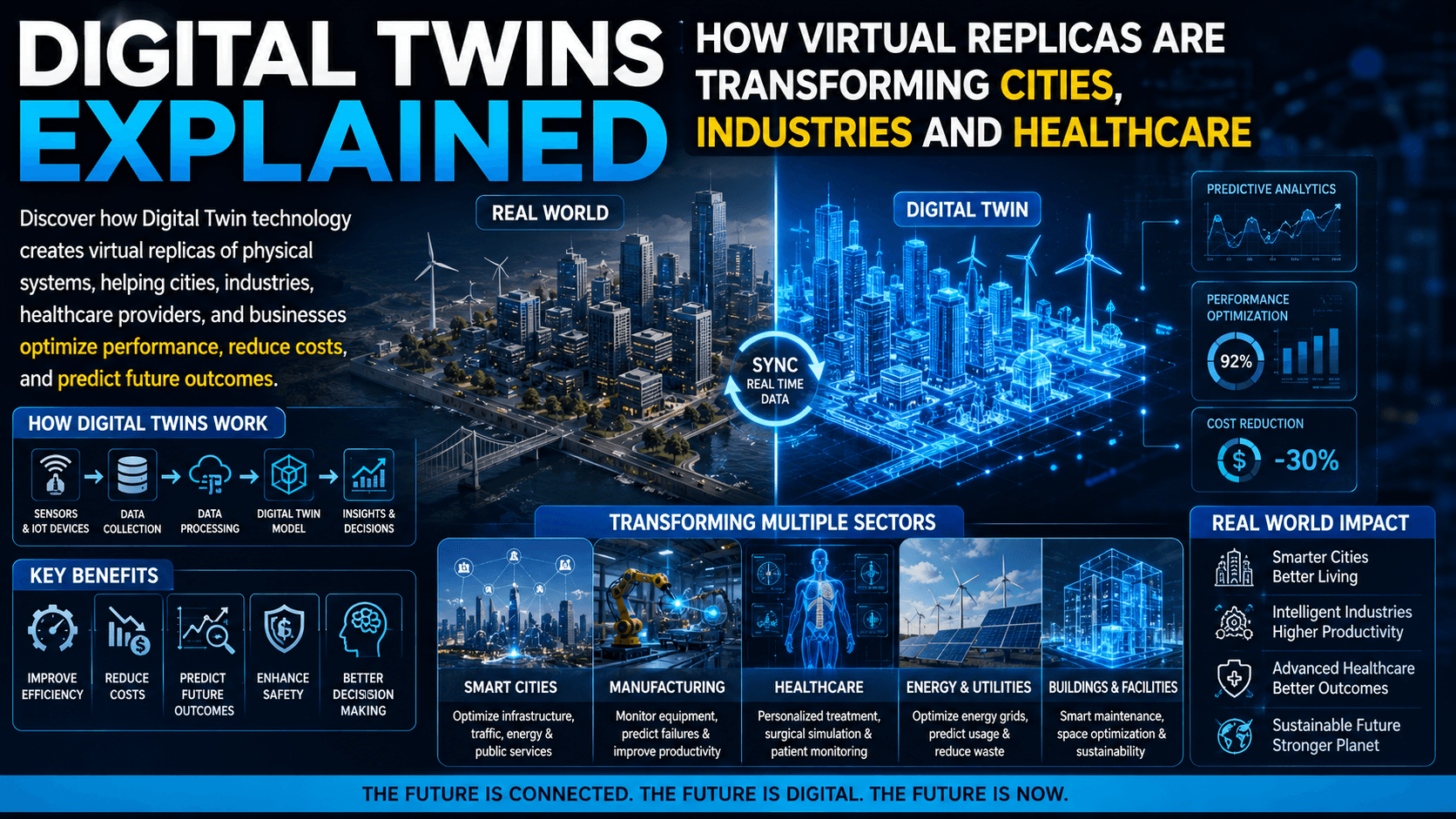
A digital twin is a real-time virtual model of a physical object, system, process, or even person — continuously updated with live data from sensors, IoT devices, and operational systems. The twin mirrors its physical counterpart exactly, enabling simulation, prediction, and optimization without touching the real thing. Is a digital twin an AI? A digital twin uses AI — specifically machine learning models that process the continuous data stream and generate predictions — but the twin itself is a simulation model, not an AI system. AI is the intelligence that makes the twin useful. Is a digital twin 2D or 3D? Digital twins are typically 3D virtual models, though the most important aspect is not the visualization but the real-time data synchronization and predictive modeling.
Table 3: The 4 Types of Digital Twins — Applications by Industry
| Type | What It Models | Industry Application | Example | Key Software |
|---|---|---|---|---|
| Component Twin | Individual parts or components of a larger system | Manufacturing, aerospace | A jet engine turbine blade monitored for metal fatigue in real time | Siemens NX, PTC ThingWorx |
| Asset Twin | Complete assets made of multiple components | Energy, utilities, heavy industry | A wind turbine monitored for optimal pitch angle and bearing wear | ANSYS, GE Digital APM |
| System Twin | Systems of multiple interacting assets | Smart cities, factories, hospitals | A hospital's entire HVAC, lighting, and patient flow system modeled together | Microsoft Azure Digital Twins, AWS IoT TwinMaker |
| Process Twin | Entire operational processes end-to-end | Supply chain, logistics, manufacturing | A car factory's complete production line modeled to optimize throughput | Dassault Systèmes 3DEXPERIENCE, Nvidia Omniverse |
Digital Twins in Medicine — Can a Human Have a Digital Twin?
Digital twins in medicine. Can a human have a digital twin? Yes — human health digital twins are one of the most exciting frontiers. Your health digital twin would be a continuously updated virtual model of your biology — built from your genomic sequence, real-time biomarker data from wearables, medical imaging, lifestyle data, and clinical history. The AI twin runs simulations: what happens to your blood pressure if you change medications? How will your tumor respond to this chemotherapy regimen? What diet change will most reduce your cardiovascular risk? Healthcare providers already use simplified digital twin approaches in clinical trials. Full personal health twins are projected to be available in developed healthcare systems by 2035–2040.
Who is the father of digital twins? Dr. Michael Grieves (University of Michigan) is credited with formulating the digital twin concept in 2002, initially applied to product lifecycle management. Which software is used for digital twins? Leading platforms: Siemens Teamcenter and NX, PTC ThingWorx, Microsoft Azure Digital Twins, AWS IoT TwinMaker, GE Digital's Predix, Dassault Systèmes 3DEXPERIENCE, and Nvidia Omniverse (particularly for photorealistic industrial twins). Digital twins in construction: Construction digital twins model building projects before and during construction — detecting design conflicts, optimizing material use, and managing worker safety in real time.
Part 8: Smart Infrastructure — Building the Intelligent Physical World
What is a smart infrastructure? What are the 4 types of infrastructure? What is the smart infrastructure sector? What are 5 examples of infrastructure? What are the 8 types of infrastructure projects? Who pays for infrastructure? Smart infrastructure examples. Smart infrastructure Siemens. Smart infrastructure group. Smart infrastructure and construction. Smart infrastructure meaning. Smart infrastructure magazine. Smart infrastructure solutions. Smart infrastructure ventures. Smart infrastructure engineer. Smart Infrastructure Analyst. Siemens smart Infrastructure jobs. Siemens smart infrastructure locations. Smart infrastructure buildings Siemens. Siemens smart infrastructure electrification automation.
Smart infrastructure refers to physical infrastructure — roads, bridges, buildings, power grids, water systems, transportation networks — embedded with sensors, connected devices, and AI systems that enable real-time monitoring, predictive maintenance, automated management, and dynamic optimization. The 4 types of infrastructure: Transportation (roads, railways, airports, ports), Energy (power grids, pipelines, renewable installations), Communications (internet, telecommunications, data centers), and Social (schools, hospitals, water systems, waste management). Smart infrastructure adds a digital intelligence layer to all of these.
Siemens smart infrastructure — Siemens AG's Smart Infrastructure division is one of the world's largest players in this space, providing building automation systems, electrical distribution, intelligent transportation, and energy management solutions. Siemens Smart Infrastructure focuses on three core areas: electrification (distributing electrical power intelligently), automation (building and facility management systems), and digitalization (connecting physical assets to digital management platforms). Siemens smart infrastructure electrification automation — these divisions handle everything from smart switchgear and microgrids to building management systems that optimize energy consumption in commercial and industrial buildings.
Examples of Smart Infrastructure in Practice
- Smart bridges: Embedded sensors monitoring structural integrity, detecting cracks, measuring stress loads, and alerting engineers before failure — deployed on major bridges in the US, UK, and China
- Intelligent power grids: AI-managed electricity distribution that balances supply and demand in real time, integrates renewable energy sources, predicts outages, and reroutes power automatically during failures
- Smart water networks: Sensor-equipped water distribution systems that detect leaks instantly (cities lose 20–30% of water to leaks in aging pipe systems), optimize pressure, and monitor water quality continuously
- AI-managed traffic systems: Traffic lights that adjust timing based on real-time traffic flow rather than fixed schedules — reducing average commute times 15–25% in pilot cities
- Smart building systems: Commercial buildings that monitor occupancy, adjust HVAC and lighting accordingly, and optimize energy consumption — reducing building energy use by 20–40%
Part 9: Human-Machine Interface (HMI) — How Humans Control Intelligent Systems
What is the Human Machine Interface? What is the concept of Human Machine Interface? What is an example of a Human Machine Interface? What do you mean by human interface? What are the 4 stages of HMI? What is an example of a human interface? Human machine Interface example. Human machine interfaces notes. Human machine interface design. Human Machine Interface PDF. What is HMI in PLC? Types of HMI.
A Human-Machine Interface (HMI) is any system, device, or software through which a human operator monitors, controls, and interacts with a machine, process, or system. HMIs translate complex machine data into understandable visual displays and translate human commands into machine-executable instructions. What is HMI in PLC? In industrial automation, an HMI is the touchscreen panel or software interface that allows operators to monitor and control a Programmable Logic Controller (PLC) — the computer that runs machinery. The HMI shows the PLC's sensor readings (temperature, pressure, flow rates), alarm status, and process visualization, and allows operators to adjust setpoints and control sequences.
The 4 Types of HMI
Types of HMI. What are the 4 stages of HMI?
- Pushbutton replacer HMI: Simple display replacing physical buttons and switches — showing basic status information and accepting simple commands
- Data handler HMI: Displays process data, trends, and historical information — enables operators to monitor production metrics over time
- Overseer HMI: Integrates multiple systems into a unified control interface — used in complex industrial plants, power stations, and water treatment facilities
- Enterprise HMI: Business intelligence layer connecting operational technology (OT) with information technology (IT) — providing management dashboards that connect factory floor data to business metrics
Modern HMI design is rapidly evolving — moving from physical panels to cloud-connected, mobile-accessible interfaces with AI overlays that predict problems, recommend actions, and automate routine monitoring. Spatial computing and augmented reality are beginning to replace flat HMI screens with immersive AR views that overlay process data directly onto physical equipment.
Part 10: Connected Ecosystems — Internet of Everything and AIoT
What is a connected ecosystem? What are the 4 types of ecosystems? Why are ecosystems connected? What is a connected business ecosystem in the digital area? What are the 7 types of ecosystems? What are the 3 types of ecosystems? What are the applications of AIoT? What is an example of an AIoT device? What is ambient computing? Will IoT be replaced by AI? Connected ecosystems. Connected device ecosystems. Connected product ecosystems. Connected vehicle ecosystems. Connected car ecosystems. Connected ecosystems of things. Connected Pakistan. Internet of behaviors. Internet of everything. Machine to machine communication. Future internet infrastructure. Digital ecosystem evolution. Next generation networking. What is the next generation of internet? What is the next-generation internet network? What is the new technology for the internet? What is Elon Musk's new internet system? What is new internet technology in 2026? Is LiFi faster than WiFi? Which country is no. 1 in internet speed?
A connected ecosystem in technology refers to a network of interconnected devices, platforms, services, and users that share data and functionality seamlessly — creating emergent intelligence and value greater than any individual component. The most familiar connected ecosystems are Apple's (iPhone, Mac, Watch, iPad, AirPods, iCloud, App Store all working together), Google's (Android, Search, Maps, Gmail, YouTube, Chrome), and Amazon's (Alexa, Echo, Prime, AWS, Ring all sharing data and services).
What is AIoT? AIoT (Artificial Intelligence of Things) is the combination of AI intelligence with IoT connectivity — moving from simple connected sensors to devices that can analyze data locally, make decisions autonomously, and learn from patterns over time. What is an example of an AIoT device? A smart security camera that not only records footage but uses on-device AI to recognize faces, detect unusual behavior, distinguish humans from animals, and alert only when relevant — rather than transmitting all video to the cloud. Will IoT be replaced by AI? No — AI enhances IoT rather than replacing it. The combination of IoT connectivity and AI intelligence (AIoT) is the direction of evolution.
What is Elon Musk's new internet system? Starlink — SpaceX's satellite internet constellation — is not technically a "new internet system" but a new delivery mechanism for internet access via low-Earth orbit satellites. By 2026, Starlink has over 6,000 satellites providing high-speed internet globally including remote areas previously without broadband access. Is LiFi faster than WiFi? Yes — LiFi (Light Fidelity, which uses visible light for data transmission) can theoretically achieve data rates of 224 gigabits per second — vastly faster than current WiFi standards. However, LiFi requires line-of-sight and does not penetrate walls, limiting it to specific indoor environments.
Part 11: Edge Computing — Why Processing at the Source Changes Everything
What are the benefits of edge computing? In what ways is edge computing important to modern businesses? What are the 5 advantages and disadvantages of cloud computing? What is a benefit to an organization of implementing edge computing? Who is the father of edge computing? What is an example of edge computing? Advantages and disadvantages of edge computing. One advantage of edge computing is enclosed system. Applications of edge computing. Is edge computing the future? How to implement edge computing. Edge computing trends. Edge computing 2025. Identify the benefits of adopting a multi-cloud strategy.
Edge computing processes data near the source of generation — at the "edge" of the network — rather than sending it to centralized cloud servers. Instead of a factory sensor sending data 500 miles to a data center for analysis, an edge computing device processes that data locally, making decisions in milliseconds. Who is the father of edge computing? The concept was formalized by Weimo Shi in 2016, though the principles trace to earlier distributed computing and content delivery network (CDN) architectures.
Table 4: Edge Computing vs Cloud Computing — Benefits, Trade-offs & Use Cases
| Dimension | Cloud Computing | Edge Computing | Best Approach |
|---|---|---|---|
| Latency | 50–200ms round-trip (high) — data travels to data center and back | 1–5ms (near-real-time) — processing happens locally | Edge — for autonomous vehicles, robotic surgery, industrial safety |
| Bandwidth Cost | High — all raw data transmitted to cloud | Low — only processed results or anomalies sent to cloud | Edge — reduces bandwidth costs by 60–90% in IoT deployments |
| Privacy & Security | Sensitive data leaves the premises — compliance risk | Data processed locally — never leaves the facility; better compliance | Edge — for healthcare, financial, and government data |
| Scalability | Virtually unlimited — scale up cloud resources on demand | Limited by local hardware — must plan capacity in advance | Cloud — for variable or unpredictable workloads |
| Reliability | Depends on internet connectivity — outages affect all operations | Operates independently of internet — continues during outages | Edge — for mission-critical operations requiring 24/7 uptime |
| AI Inference | Powerful cloud GPUs — ideal for model training | Optimized small models on edge chips — ideal for real-time inference | Hybrid — train in cloud, deploy inference at edge |
Part 12: Future of Cybersecurity 2026–2035 — Zero Trust, AI Defense & Quantum Threats
What will be the future of cyber security? What is the hottest cybersecurity startup in 2026? What is L1 L2 L3 in cyber security? What is 90% of cyber attacks? Who is the No. 1 hacker? What do hackers hate the most? Future cybersecurity technologies 2023. What is the future of cyber security in next 10 years. Future of cybersecurity 2030. What is the future of cyber security jobs. Cyber security future challenges and opportunities. What is the future of cybersecurity. Cyber security and emerging technologies PDF. Future of AI in cybersecurity. Zero trust security. Cyber resilience strategies. Identity security systems. Digital threat intelligence. Cloud security innovations. Future cyber defense. Security automation. Cyber risk management. Next generation encryption. Digital privacy technologies.
The cybersecurity landscape is transforming faster than almost any other technology domain. What is 90% of cyber attacks? Over 90% of successful cyberattacks begin with phishing — deceptive emails or messages tricking users into revealing credentials or installing malware. Despite all the sophisticated technology, the human element remains the primary attack vector. What do hackers hate the most? Multi-factor authentication (MFA) — studies show MFA blocks over 99% of automated credential-based attacks. Simple, cheap, and devastatingly effective.
Zero Trust Security — The Future Cybersecurity Model
Zero trust security. Zero Trust is a security framework built on the principle "never trust, always verify" — regardless of whether the user is inside or outside the network perimeter. Traditional security assumed that everything inside the corporate network was trustworthy (the "castle and moat" model). Zero Trust assumes breach at all times and requires continuous authentication, least-privilege access, and microsegmentation of networks. In a zero trust architecture, every access request — even from an employee on a corporate laptop inside the office — is verified, authenticated, and logged as if coming from an untrusted source.
Future Cybersecurity Threats — Quantum Computing and AI Attacks
The two most significant emerging threats: (1) Quantum decryption — quantum computers running Shor's algorithm will eventually be able to break RSA and ECC encryption that protects most internet communications. This is driving urgent development of post-quantum cryptography (PQC) standards, with NIST publishing its first PQC standards in 2024. (2) AI-powered attacks — generative AI enables attackers to create highly personalized phishing attacks at scale, generate novel malware variants that evade signature-based detection, and autonomously probe systems for vulnerabilities far faster than human attackers.
Part 13: Smart Home Automation — Future of Living 2035 and Beyond
What is the future of smart homes? What is expected to happen in 2035? What is the next technology in 2035? How advanced will AI be in 2035? What are 10 disadvantages of automation? Is smart home profitable? What are common problems with smart homes? Which brand is best for smart homes? Future of smart home automation PPT. Future of smart home automation PDF. Future of smart home automation 2023. Future of smart home automation 2022. Top 10 smart home devices. The rise of smart home technology opportunities for the future of living. Smart home research. Articles about smart home technology. Will IoT be replaced by AI? What is the future of home automation? How smart homes will evolve by 2035 PDF.
Table 5: Smart Home Automation Evolution — 2026 to 2035 to 2045
| Home System | Current (2026) | 2035 Smart Home | 2045 Intelligent Home |
|---|---|---|---|
| Energy Management | Smart thermostats (Nest, Ecobee); basic schedule-based control | AI learns household patterns; dynamically balances solar, battery, and grid power; predicts energy needs 24 hours ahead | Home operates as energy-positive node in smart grid — sells surplus power, balances neighborhood demand, zero energy bills |
| Security | Smart cameras with app alerts; smart locks; motion sensors | Facial recognition, behavioral anomaly detection; AI distinguishes family from strangers; seamless entry for recognized residents | Perimeter AI that predicts threats before they materialize; biometric authentication throughout home; no keys or codes needed |
| Health Monitoring | Smart mirrors with basic health metrics; wearable data aggregation | Bathroom sensors measuring biomarkers daily (blood pressure, glucose proxies, hydration); early illness detection via toilet sensors | Full ambient health monitoring — rooms detect viral illness, mental health state, nutritional needs; coordinates with health digital twin |
| Kitchen & Food | Smart refrigerators tracking contents; voice-commanded recipe suggestions | AI meal planner based on nutritional goals, inventory, and dietary restrictions; automated grocery ordering; guided cooking via displays | Robotic kitchen assistants preparing meals autonomously; food 3D printing for personalized nutrition; waste-zero food management |
| Entertainment | Streaming services with recommendation algorithms; smart speakers | Immersive spatial audio systems; XR entertainment that fills entire rooms; AI-curated content based on mood and social context | Holographic entertainment environments; fully personalized AI-generated content; social virtual spaces indistinguishable from physical |
Common Problems With Smart Homes and Solutions
What are common problems with smart homes? What are 10 disadvantages of automation? The most common smart home challenges: (1) Compatibility — devices from different brands often don't communicate; the Matter protocol (2022+) is solving this as a universal smart home standard; (2) Complexity — setup and troubleshooting requires technical knowledge beyond many users; (3) Privacy concerns — always-on microphones and cameras raise legitimate surveillance worries; (4) Dependency — internet outages disable smart features; (5) Security vulnerabilities — poorly secured IoT devices are entry points for hackers. Which brand is best for smart homes? Apple HomeKit (most privacy-focused, premium ecosystem), Google Home (best AI assistant integration), Amazon Alexa (most compatible devices), Samsung SmartThings (most open and versatile).
Part 14: Future Internet Technologies, Future Transportation & The 7 Core Technologies
What is the next generation of internet? What is the next-generation internet network? Is NGI open source? What is the new technology for the internet? What is Elon Musk's new internet system? What are the 7 advanced technologies? Which country is no. 1 in internet speed? Is LiFi faster than WiFi? What is new internet technology in 2026? What are future transportation technologies? What will be the future of transportation? What are the 7 types of transportation? What are the technologies used in transportation? What are the 4 types of transport? What is the fastest mode of transport? Future transportation technologies explained essay. Future transportation technologies explained 2022. Top 10 future transportation. Future transportation ideas for students. Transportation in the future 2050. What is future transportation. Future transportation drawing. New technology in transportation. Next generation internet technologies PDF. Next generation internet technologies PDF free download. What are the 4 types of technology? What are the top 3 technologies? What are 10 types of technology? What are five technologies? What are the top 5 emerging technologies? What are the top 10 emerging technologies in 2026? What are the 7 core technologies?
Table 6: The 7 Core Technologies Shaping the Future — Complete Guide
| # | Core Technology | What It Does | 2026 Status | 2035 Impact |
|---|---|---|---|---|
| 1 | Pervasive Computing | Computing embedded in everyday objects — ambient and invisible | Smart devices, wearables, IoT sensors everywhere | Every surface, garment, and object becomes a computing interface |
| 2 | Wireless Mesh Networks | Self-organizing communication networks without central infrastructure | 5G NR, WiFi 7, Starlink constellation | 6G networks; ubiquitous connectivity including underwater and space |
| 3 | Biotechnology | Engineering biological systems for medicine, materials, and energy | CRISPR gene editing, mRNA vaccines, lab-grown meat | Personalized gene therapy, living medicines, bio-computers |
| 4 | 3D Printing / Additive Manufacturing | Creating three-dimensional objects layer by layer from digital files | Metal, ceramic, biological tissue printing; construction printing | On-demand manufacturing of most products; printed organs for transplant |
| 5 | Machine Learning / AI | Systems that learn from data and improve without explicit programming | LLMs, computer vision, autonomous systems — mainstream | AGI level reasoning; AI scientists discovering new knowledge independently |
| 6 | Nanotechnology | Engineering materials and devices at the nanometer (atomic) scale | Nano drug delivery, nano-coatings, nano-sensors in research | Medical nanobots, nano-scale chip manufacturing, nano-material construction |
| 7 | Robotics | Autonomous or semi-autonomous machines performing physical tasks | Industrial robots, humanoid robots (early), surgical robots | Humanoid robots ubiquitous in homes and workplaces; robot-human collaboration standard |
The 7 Types of Transportation and Future Technology
The 7 primary types of transportation are: Road (cars, buses, trucks), Rail (trains, subways, trams), Water/Marine (ships, boats, ferries), Air (airplanes, helicopters), Pipeline (oil, gas, water), Ropeway (cable cars, ski lifts), and Space (spacecraft, rockets). Future technology is transforming each: autonomous vehicles on roads, AI traffic management on rails, autonomous ships in marine transport, eVTOL flying taxis in air, AI-optimized pipeline management, and AI-designed spacecraft for space exploration.
People Also Ask — Future Technology FAQ
What is spatial computing and how is it different from VR?
Spatial computing is the broader technology paradigm that merges digital information with three-dimensional physical space — encompassing virtual reality (VR), augmented reality (AR), mixed reality (MR), and the AI and sensing systems that power them. VR is one subset of spatial computing — it creates fully immersive digital environments. Spatial computing is the complete ecosystem: hardware (headsets, cameras, depth sensors), software (spatial operating systems like Apple's visionOS), AI (scene understanding, hand tracking, object recognition), and applications (productivity tools, games, training, healthcare). Apple Vision Pro, announced as a spatial computing device rather than a VR headset, exemplifies this broader definition.
Why don't EVs use solid-state batteries yet if they are so much better?
Solid-state batteries are not yet used in production EVs primarily because of manufacturing challenges and cost. Three main obstacles: (1) Solid electrolytes are brittle and crack under the repeated expansion and contraction of electrode materials during charging cycles — a fundamental engineering problem being addressed through new electrolyte formulations and electrode designs; (2) Manufacturing solid-state batteries at scale requires entirely new production equipment and processes — existing lithium-ion battery factories cannot be easily converted; (3) Cost remains 6–10x higher per kWh than lithium-ion. Toyota, QuantumScape, and Solid Power are the closest to commercial EV deployment, targeting 2027–2028 for first solid-state EV models in limited production.
What is the difference between a neuromorphic chip and a regular GPU?
A GPU (Graphics Processing Unit) processes thousands of operations in parallel using a fixed, power-intensive architecture — Nvidia's H100 GPU consumes approximately 700 watts and excels at training large AI models. A neuromorphic chip mimics the brain's neuron-synapse architecture using spiking neural networks — activating processing only when data changes (like a neuron that fires only when stimulated). This event-driven processing uses orders of magnitude less power — Intel's Loihi 2 processes complex pattern recognition at milliwatts rather than hundreds of watts. Neuromorphic chips are ideal for edge AI inference (real-time sensory processing in robots, drones, wearables) while GPUs remain essential for AI training and large model inference in data centers.
What are the top 10 emerging technologies in 2026?
The top 10 emerging technologies in 2026 based on investment, maturity, and transformative potential: (1) Large Language Models and Generative AI reaching enterprise scale; (2) Spatial Computing and mixed reality headsets entering mainstream; (3) Solid-state batteries moving toward commercial EV production; (4) Neuromorphic chips enabling ultra-efficient edge AI; (5) Photonic computing for AI acceleration; (6) Digital twins becoming standard in manufacturing and healthcare; (7) Wireless charging infrastructure for EVs; (8) Zero Trust cybersecurity becoming the universal enterprise security standard; (9) Humanoid robots entering commercial deployment in factories; and (10) Quantum computing achieving practical advantage in specific domains including drug discovery and optimization.
Which technology will boom in 2026?
The technologies experiencing the most rapid growth in 2026 are: AI agents and autonomous AI workflows (the transition from chatbots to AI that takes multi-step actions); spatial computing driven by the expanding ecosystem around Apple Vision Pro; humanoid robots entering commercial deployment at scale; solid-state battery technology approaching commercial EV production; and AI-powered cybersecurity responding to the surge in AI-enabled attacks. Edge computing and AIoT are also booming as enterprises move AI processing from cloud to local devices for latency and privacy reasons.
Conclusion: The Converging Technology Wave of 2026–2045
The technologies explored in this Part 2 guide — spatial computing, ambient intelligence, solid-state batteries, wireless energy transfer, neuromorphic chips, photonic computing, digital twins, smart infrastructure, HMI, connected ecosystems, edge computing, cybersecurity, and smart homes — are not isolated innovations. They are a converging wave that amplifies each other. Spatial computing needs ambient intelligence to make it feel natural. Solid-state batteries enable the autonomous vehicles that need smart infrastructure to navigate. Neuromorphic chips make edge computing practical for AIoT. Photonic computing accelerates the AI that powers all of it.
Understanding these technologies — their principles, their current state, and their realistic timelines — is the foundation of informed decision-making for businesses, investors, students, and policymakers. The organizations and individuals who understand the convergence will capture the opportunities. Those who wait for the technologies to become obvious will find competitors have already built moats around them.
The future is not coming — it is already here, unevenly distributed across the labs, startups, and research institutions that are quietly building the world of 2035.
Need a Professional Website Optimized for the Future of Search?
In a world moving toward AI search, voice search, and spatial computing interfaces, a fast, well-structured, and technically optimized website is the foundation of any digital presence. If your business needs a professional website — complete with live domain, hosting, SEO setup, mobile-responsive design, and content strategy for modern AI-powered search — we build exactly that.
Business websites, eCommerce stores, landing pages, and portfolios — built for performance, designed for conversion, optimized for search. Send us a message with your requirements and we will get back to you with a plan.