Qatargate, Ioannis Lagos and the European Parliament's Corruption Problem: What Really Happened, Explained
The institution that lectures the world on ethics, transparency, and the rule of law has spent the last few years investigating its own members for exactly those failures. Here is the full, fact-checked story.
Introduction: The Teacher Gets Caught
Few institutions in the world position themselves as confidently on the subject of ethics as the European Union does. Brussels regularly issues statements on corruption in other regions, publishes rule-of-law reports grading member states and candidate countries, and presents the European Parliament as a model of democratic transparency that the rest of the world would do well to imitate. It is a familiar posture: 27 countries united under one roof, each with its own parliament, all supposedly bound by a shared standard of accountability higher than what they ask of anyone else.
That posture is not without foundation — the EU's institutions do operate under considerably more public scrutiny, disclosure requirements, and press freedom than many of the governments it compares itself favorably against, and its founding purpose after two catastrophic world wars was explicitly to bind European nations together under shared democratic rules precisely to prevent a return to authoritarianism and unchecked power. That history is part of why the specific failures documented in this article generate such intense scrutiny when they do surface: they are measured against a genuinely high bar the institution itself set, not an arbitrary standard imposed from outside.
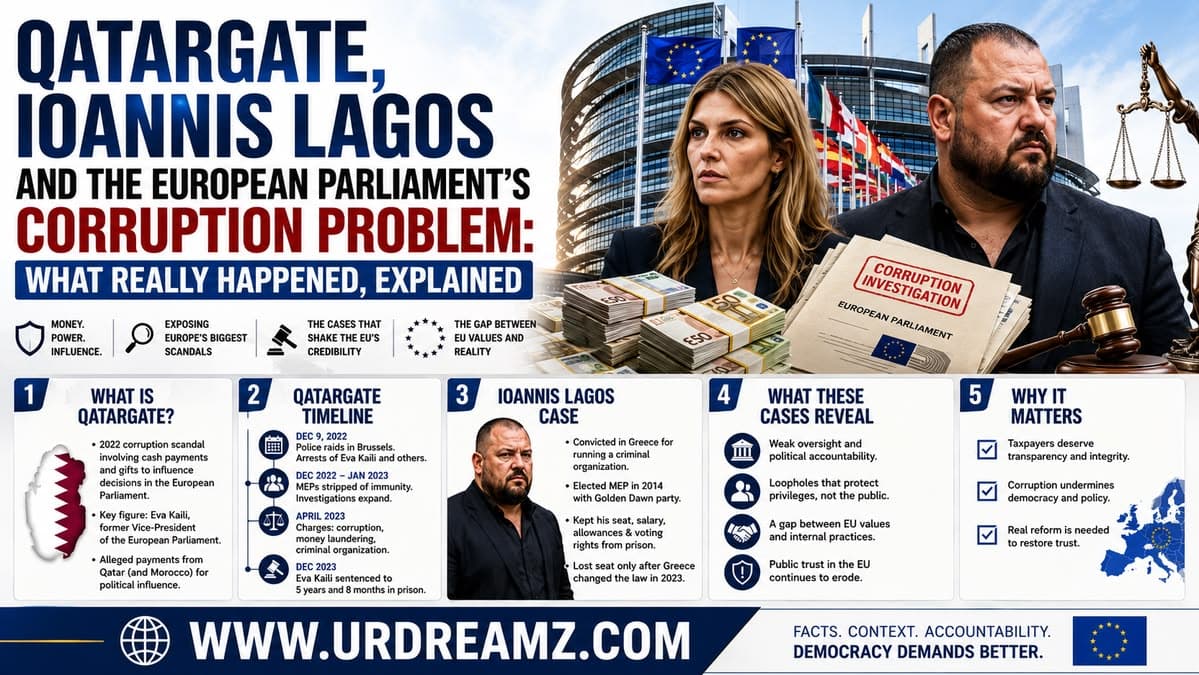
Then, in December 2022, Belgian police raided homes and offices across Brussels and found bags and suitcases stuffed with cash. One of the people arrested was a sitting Vice-President of the European Parliament. Investigators eventually recovered roughly €1.5 million in cash across multiple locations, tied to allegations that Qatar and Morocco had been paying European lawmakers for favorable treatment. Just as that story was unfolding, a separate and almost stranger case was quietly playing out: a European lawmaker convicted of running a criminal organization, sentenced to more than 13 years in prison, continued to collect his full parliamentary salary and take part in European Parliament business for years afterward.
This article walks through both cases in detail, using verified reporting rather than rumor, and explains exactly what happened, when, to whom, and what the European Parliament actually did in response. It is a story about power, immunity, and the gap that can open up between the values an institution preaches publicly and the standards it actually enforces on itself.
It is worth being precise from the outset about what this article is, and is not, claiming. It is not an argument that the European Union as a whole is uniquely corrupt compared to other governments, or that its 700-odd elected lawmakers are all implicated in wrongdoing — the overwhelming majority were not. It is, instead, a detailed account of two specific, thoroughly documented cases that reveal genuine structural weaknesses in how the Parliament investigates, disciplines, and holds accountable its own members — weaknesses that sit uncomfortably alongside the institution's frequent public role as a global authority on exactly these issues.
What Is the European Parliament, Exactly?
The European Union is made up of 27 member countries, and each of those countries has its own national government and parliament, just as most sovereign nations do. Sitting above and alongside those national governments is a separate layer of EU-wide institutions, the most visible of which is the European Parliament — a directly elected body of around 700 lawmakers, known as MEPs (Members of the European Parliament), who represent citizens across all 27 countries and vote on EU-wide legislation, budgets, and policy.
Understanding this structure is a useful starting point precisely because it explains why a scandal involving a handful of individuals could generate headlines across the entire continent: unlike a single national parliament answerable mainly to its own citizens, the European Parliament is meant to represent, and be answerable to, roughly 450 million people across an entire union of nations, which is part of why its credibility carries unusually high stakes.
| Feature | Detail |
|---|---|
| Member countries | 27 |
| Approximate number of MEPs | Around 700, elected directly by citizens across the EU |
| Main seats | Strasbourg (France) and Brussels (Belgium) |
| Role | Passes EU legislation, approves the EU budget, and oversees other EU institutions |
| Public image | Frequently presented as a model of transparency, democratic accountability, and rule-of-law standards for the rest of the world |
This dual structure matters for understanding the story ahead. MEPs enjoy a form of parliamentary immunity intended to protect them from politically motivated prosecution while carrying out their democratic duties. That protection is meant to safeguard democracy — but as both cases below show, it can also, in practice, delay accountability for individuals facing serious, well-documented criminal allegations.
It is also worth understanding how the European Parliament talks about itself publicly, since that self-image is central to why these two scandals landed with such force. The institution regularly publishes annual assessments of the "rule of law" in its own member states and in countries seeking to join the bloc, evaluating judicial independence, corruption levels, and media freedom. It conditions financial assistance to non-EU countries on similar governance benchmarks. In official communications and speeches, EU leaders routinely describe the Union's institutions as a model of transparency and democratic accountability that other regions of the world should aspire to match. That framing is precisely what makes both of the cases in this article land as more than ordinary political scandal — they strike directly at the credibility of the standard the institution claims to represent.
The Setup: How Qatargate Began
The investigation that would eventually become known as "Qatargate" did not start with the December 2022 raid — it started months earlier, following a tip from another European intelligence service. Belgian federal prosecutors opened a formal investigation in July 2022 into a former Italian MEP named Antonio Panzeri, who had left the European Parliament in 2019 but remained closely connected to it through an NGO he ran and through his contacts within the Socialists and Democrats political group.
According to testimony later given by Francesco Giorgi — a parliamentary assistant and the domestic partner of sitting MEP Eva Kaili — Qatar had been channeling cash to Panzeri since as early as 2019. The alleged goal was straightforward: influence votes and statements inside the European Parliament in ways favorable to Qatar, particularly around its labor practices and international image ahead of hosting the 2022 World Cup. Morocco was later implicated in a similar, parallel scheme.
Panzeri is a particularly important figure in the story precisely because he was no longer a sitting MEP himself by the time the scandal broke. He had left the Parliament in 2019 but continued operating an NGO focused on human rights, which prosecutors allege was used partly as a vehicle for channeling and disguising the payments, and he retained close, ongoing relationships with sitting members of his former political group. This detail matters because it illustrates one of the specific vulnerabilities watchdog groups later pointed to: former officials can retain significant informal access and influence within an institution's corridors long after they've left elected office, often with far less scrutiny than they faced while still serving.
| Timeline | Event |
|---|---|
| 2019 onward (alleged) | Cash allegedly begins flowing from Qatar to former MEP Antonio Panzeri |
| July 2022 | Belgian federal prosecutors formally open an investigation after an intelligence tip-off |
| Autumn 2022 | Investigators quietly build the case, watching movements and communications |
| December 9, 2022 | Coordinated raids across Brussels; multiple arrests, including a sitting Vice-President of the European Parliament |
The Raid: December 9, 2022
On the evening of December 9, 2022, Belgian police carried out searches across at least 16 addresses in Brussels. What made the operation legally unusual was how it reached a sitting Member of the European Parliament, who normally cannot be searched or arrested without parliament first lifting their immunity — a process that typically takes weeks or months.
That day, Eva Kaili's father, Alexandros Kailis, was stopped at a Brussels hotel carrying a suitcase containing what authorities described as several hundred thousand euros in cash. According to Kaili's own later account to the French newspaper Libération, she had discovered a large amount of cash in her home after her partner Francesco Giorgi was detained earlier that same day, panicked, and asked her father to remove it from the apartment along with a bag of baby items for her young daughter. Her father was intercepted with the money before he could leave the hotel.
Investigating judge Michel Claise treated the father's arrest, carrying cash directly linked to Kaili's apartment, as grounds to argue Kaili herself had been caught in the act — a legal status known as flagrante delicto, which allowed her parliamentary immunity to be bypassed immediately rather than through the normal lengthy process. A special police team, accompanied by the judge himself, then searched Kaili's home that same evening and arrested her in front of her two-year-old daughter. This exact legal maneuver — whether investigators were entitled to treat the situation as flagrante delicto — remains a central point of dispute in Kaili's ongoing legal defense years later.
Reporting on Kaili's arrest describes her as visibly shaken, in a state of shock, and crying during more than five hours of interrogation that followed. She was separated from her young daughter, and her legal team later raised her repeated requests to see the child — including one instance where she was reportedly refused both an in-person visit and a video call, prompting an emotional outburst from inside her cell describing the separation as intolerable. Whatever one concludes about her legal guilt or innocence, this human dimension of the case is part of why it captured such sustained public attention across Europe, well beyond the purely financial and political details of the alleged scheme itself.
The Briefcase Story: What Investigators Actually Found
The amounts recovered during the December 2022 raids became one of the most widely reported details of the entire scandal, precisely because of how visually dramatic they were — piles of cash, photographed by Belgian police, spread across banknotes of different denominations.
| Location | Amount Found |
|---|---|
| Home of former MEP Antonio Panzeri | Approximately €600,000 |
| Eva Kaili's Brussels apartment | Approximately €150,000 |
| Suitcase carried by Kaili's father at a hotel | Several hundred thousand euros (part of the total figure) |
| Total recovered across all searches | Approximately €1.5 million |
Kaili's father was released without charges after questioning, and Kaili herself has consistently denied wrongdoing, insisting through her lawyers that she had no knowledge of any bribery scheme and was simply trying to remove money from her home that she says did not belong to her, once she learned of it following her partner's arrest. Whatever the eventual court verdict, the scale and visibility of the cash recovered is precisely what made this the biggest corruption scandal to hit the European Parliament in decades.
Who Was Charged, and With What
In the days following the raid, Belgian prosecutors charged several individuals with participation in a criminal organization, corruption, and money laundering.
| Name | Role at the Time | Status |
|---|---|---|
| Eva Kaili | Sitting MEP and Vice-President of the European Parliament | Charged; stripped of her vice-presidency; case still pending years later |
| Francesco Giorgi | Parliamentary assistant, Kaili's domestic partner | Charged; later cooperated with investigators |
| Antonio Panzeri | Former MEP, NGO director | Charged; signed a deal to share information with authorities in exchange for reduced custody |
| Marc Tarabella | Sitting Belgian MEP | Charged; later released under electronic surveillance |
| Alexandros Kailis | Eva Kaili's father | Detained, later released without charges |
Two days after Kaili's arrest, the European Parliament voted 625 to 1 to strip her of her role as one of the chamber's 14 vice-presidents. She was also suspended from the Socialists and Democrats political group and expelled from her Greek party, PASOK. Belgian authorities conducted more than 20 raids in total, spanning Brussels and Italy, as the investigation widened.
Eva Kaili: From Rising Star to "Belgiangate"
Before her arrest, Eva Kaili was widely seen as one of the European Parliament's most media-friendly and prominent younger politicians — a former television presenter first elected in 2014, re-elected in 2019, and appointed a Vice-President responsible for representing the Parliament's president in relations with the Middle East. That last responsibility is part of what makes the case so pointed: the allegations concern precisely the region she was formally tasked with engaging on the institution's behalf.
Kaili spent months in pre-trial detention before being released to house arrest in April 2023 under an electronic ankle bracelet. She has continued to fight the case in the years since, challenging whether her parliamentary immunity was properly and legally lifted, and arguing that Belgian investigators may have engineered the circumstances of her arrest specifically to sidestep the normal immunity process. As of December 2025, three years after her initial arrest, Kaili still had not gone to trial — a delay so prolonged that some European reporters began referring to the case not as Qatargate, but as "Belgiangate," a wry nod to the Belgian justice system's own struggles to bring the case to a conclusion. She remains formally charged with participation in a criminal organization, corruption, and money laundering, and denies all wrongdoing.
Kaili herself has been vocal in her own defense throughout the proceedings, giving interviews to Italian and French media in which she describes her time in detention as harsh — at one point saying she was held in conditions she called inhumane — while insisting that her public engagement with Qatari and Moroccan officials was simply part of her official duties as the Parliament's designated representative for Middle East relations, not evidence of a secret bribery arrangement. Her defense has also focused heavily on the years-long delay itself, arguing that a case built on flagrante delicto justification should, by its own legal logic, have been resolved far more quickly than it has been. Belgian prosecutors, for their part, maintain the investigation remains active and point to the scale and complexity of a multinational financial scheme as the reason for the extended timeline.
The Denials: Qatar and Morocco Respond
Throughout the investigation, both Qatar and Morocco have firmly and repeatedly denied any wrongdoing, describing the allegations as unfounded. Qatar in particular pushed back hard against the implication that its outreach to European officials in the run-up to the 2022 World Cup amounted to bribery, framing its engagement with EU lawmakers as ordinary diplomatic relationship-building rather than a cash-for-influence scheme.
Neither country has been formally charged in a Belgian court, since the legal proceedings target individual MEPs, assistants, and intermediaries rather than the states themselves. The scandal nonetheless significantly damaged both countries' diplomatic standing in Brussels for a period, and led the European Parliament to freeze all legislative files specifically related to Qatar while the investigation proceeded.
The Second Story: Ioannis Lagos
While Qatargate dominated headlines in late 2022, a separate and in some ways even more striking case had already been unfolding for two years, involving a Greek MEP named Ioannis Lagos. Lagos was a founding member and spokesman of Golden Dawn, a Greek ultranationalist party widely described as neo-Nazi, which surged in popularity during Greece's economic crisis in the 2010s before being formally investigated as a criminal organization.
In October 2020, an Athens court convicted Lagos, alongside numerous other senior Golden Dawn figures, of directing a criminal organization responsible for a sustained campaign of violence — including physical attacks on immigrants, leftists, trade unionists, and gay people over roughly a decade. It was described at the time as the largest trial of its kind in Europe since the Nuremberg trials. Lagos received a sentence of 13 years and eight months in prison.
Golden Dawn's rise itself is part of what makes the case so significant beyond the immediate legal details. The party grew rapidly during Greece's severe financial crisis of the 2010s, at a time of soaring unemployment and social strain, presenting itself in some communities as a source of order and mutual aid — reportedly organizing food and clothing distribution for struggling families and elderly residents in certain neighborhoods — even as its leadership simultaneously organized and directed violent attacks against minority groups and political opponents. The Athens court's verdict formally established that this was not a case of a few extremist members acting independently, but a structured, hierarchical criminal organization with Lagos among its senior leadership, alongside founder Nikos Michaloliakos.
| Milestone | Date |
|---|---|
| Golden Dawn founded | 1980s |
| Lagos elected to Greek Parliament | 2012 |
| Lagos elected to European Parliament | 2019 |
| Athens court convicts Golden Dawn leadership, including Lagos, of running a criminal organization | October 7, 2020 |
| Sentence handed down | 13 years, 8 months |
| European Parliament votes to lift his immunity | April 2021 |
| Extradited to Greece to begin serving sentence | May 2021 |
| Lagos's MEP term formally ends | July 2024 |
The detail that draws the most disbelief is not the conviction itself, but what happened in the roughly six months between it and his eventual extradition: despite being a convicted criminal sentenced to over 13 years for leading a violent organized group, Lagos remained free in Brussels, protected by his parliamentary immunity, continuing to work as an MEP as though nothing had changed.
A Convicted Criminal Still Drawing an MEP Salary
On the very day his conviction was announced — October 7, 2020 — Lagos was not in the Athens courtroom to hear the verdict. He was in Brussels, delivering a speech on the floor of the European Parliament. Under the chamber's own rules, he continued to draw his full MEP salary, reported at the time as roughly €64,000 a year, along with the additional attendance allowances paid to sitting members, for months after being formally convicted of running a criminal organization.
| What Continued After Conviction | Detail |
|---|---|
| MEP salary | Continued in full for roughly six months post-conviction |
| Attendance allowances | Continued alongside salary until his immunity was lifted |
| Legislative participation | Continued speaking, voting, and participating in Parliament business |
| Freedom of movement | Remained free in Brussels rather than in custody |
Lagos used this window to legally contest his sentencing, accusing the three-judge panel of bias and calling for their recusal — a maneuver that, whatever its legal merits, also had the practical effect of buying additional time as a free man. It took until April 2021 for the European Parliament to formally vote to lift his immunity (658 votes in favor out of 693 cast), clearing the way for Belgian police to arrest and eventually extradite him to Greece the following month, nearly a full year after his conviction.
The scale of the resources Lagos continued to draw on after his conviction became a recurring point of scrutiny. Beyond his base salary, MEPs receive substantial allowances for staff, office costs, and travel, and reporting later confirmed that Lagos's claimed expenses during this period exceeded €100,000 — a figure that transparency campaigners eventually forced into public view only after taking the matter to court, since the Parliament initially resisted publishing the specific breakdown. Marie Toussaint, the MEP responsible for the parliamentary report on lifting his immunity, put the underlying frustration plainly at the time, arguing that Greek judicial authorities had been pressing for action for months and that it was essential Lagos face justice in his own country rather than continue evading it through the protections of his European office.
Voting From a Prison Cell
Even after his extradition and imprisonment at Domokos prison in central Greece, Lagos's story did not end there. Because his five-year European Parliament term did not expire until July 2024, he remained, on paper, a sitting MEP for years while incarcerated — and the European Parliament confirmed he was entitled to continue receiving his salary throughout that period, pending the final resolution of his appeals.
In March 2022, while serving his sentence, Lagos was recorded as one of only 13 MEPs who voted against a European Parliament resolution condemning Russia's invasion of Ukraine — a vote cast, according to reporting on the case, using the Parliament's remote participation systems, the same infrastructure originally built to let members vote from a distance during the COVID-19 pandemic. In the years that followed, transparency advocates pushed for full disclosure of exactly how much Lagos had continued to claim in expenses, and in May 2024 an EU court ruled that the European Parliament was legally required to publish the details of expense claims exceeding €100,000 that Lagos had made even after his imprisonment began.
Lagos's parliamentary term finally ended in July 2024, closing out a case that saw a man convicted of directing a violent criminal organization spend roughly four years as a European lawmaker after that conviction — nearly all of it either free on immunity or actively imprisoned, and drawing an EU salary throughout almost the entire period.
How the European Parliament Responded
To its credit, the European Parliament did not stay silent after Qatargate broke. President Roberta Metsola gave an unusually blunt public address within days of the December 2022 raid, stating plainly that "these criminal proceedings involving the parliament are damaging... for democracy, for Europe and for everything that we stand for," and promising that trust "will need to be rebuilt."
| Announced Reform | Purpose |
|---|---|
| Ban on unofficial "friendship groups" | Close off informal channels sometimes used by foreign governments to build influence with MEPs |
| Mandatory disclosure of meetings with third-country diplomats | Increase transparency around lobbying and diplomatic contact |
| Strengthened whistleblower protections | Encourage internal reporting of wrongdoing without fear of retaliation |
| Review of the Code of Conduct enforcement | Improve how ethics rule violations are investigated and policed |
| Push for an independent EU-wide ethics body | Move oversight outside of MEPs policing themselves |
On February 16, 2023, the European Parliament formally adopted a resolution — passing 441 votes to 70, with 71 abstentions — endorsing 14 specific reform points originally proposed by Metsola, along with recommendations for a genuinely independent ethics body with the power to launch its own investigations rather than relying solely on members to police each other.
Did the Reforms Actually Work?
Here the picture becomes considerably less flattering. Independent watchdog groups that have tracked implementation closely, including Transparency International EU and the European Ombudsman's office, have repeatedly found that many of the promised reforms were either watered down during implementation or never meaningfully enforced.
The European Ombudsman noted, roughly a year after the scandal, that while some welcome improvements had been made — such as clearer definitions of conflicts of interest and new disclosure obligations for meetings with lobbyists — it remained unclear how the new rules would actually be monitored or enforced, and criticized the lack of transparency in the reform process itself. By the scandal's third anniversary in December 2025, Transparency International EU's assessment was blunter still: the Parliament's own Advisory Committee on the Conduct of Members, the body tasked with overseeing MEPs' ethics compliance, remains composed entirely of MEPs policing themselves, with no independent external oversight — precisely the self-regulation model critics say enabled Qatargate in the first place. The same review pointed to newer allegations that had already surfaced in the years since, including claims of Russian influence operations within the Parliament and bribery allegations tied to a major Chinese technology company.
It would be unfair to say nothing changed at all — some genuine procedural improvements were adopted, and public scrutiny of MEPs' outside contacts increased measurably. But the core structural weakness that watchdogs identified from the very beginning — an ethics system built around members supervising themselves, with limited outside enforcement — remains largely intact years later.
This gap between announced reform and actual enforcement is itself worth studying as a case in miniature. Metsola's original December 2022 statement promised a "complete and in-depth look" at how the Parliament interacts with third countries, alongside a strengthened whistleblower system and a ban on informal friendship groups sometimes used by foreign governments to build quiet influence. Each of those specific commitments was, on paper, addressed by the February 2023 resolution. Yet the Ombudsman's subsequent review found the enforcement mechanism for several of these new rules simply unclear, and Transparency International's later assessments describe MEPs actively voting to weaken some of the very rules they had just adopted, during the technical process of writing them into the Parliament's internal procedures. The pattern that emerges is not one of outright hypocrisy or bad faith at the moment reforms were announced, but a familiar and more mundane failure: strong public commitments, followed by a quieter, less scrutinized implementation phase where much of the intended force is lost.
Why This Story Matters Beyond Brussels
It would be easy to read both of these cases as simply a European political drama with little relevance elsewhere. The more important point sits underneath the specific details: the European Union has built a significant part of its global identity around lecturing other countries and blocs on corruption, transparency, judicial independence, and the rule of law. It publishes annual rule-of-law reports assessing member states. It conditions financial aid and trade relationships on anti-corruption benchmarks for partner countries. It frequently positions its own institutions as the standard the rest of the world should be measured against.
Qatargate and the Lagos case do not prove that every EU institution is corrupt, and they should not be read that way — the vast majority of MEPs were never implicated in either scandal, and the fact that these cases were investigated, prosecuted, and publicly reported at all demonstrates that at least some functioning oversight exists. But the specific, verified details of both cases — bags of cash discovered in a sitting Vice-President's own home, a convicted leader of a violent organized-crime network continuing to draw a European salary and cast votes from a prison cell — are difficult to reconcile with an institution that positions itself as uniquely qualified to instruct the rest of the world on ethical governance.
There is also a fairness argument worth making explicitly, one that cuts in a different direction than pure criticism: the fact that both scandals became major, sustained international news stories, generated formal parliamentary votes, produced court proceedings, and triggered genuine (if imperfect) reform efforts is itself evidence of a functioning, if imperfect, accountability system — one considerably more transparent than what exists in many governments around the world that face far less international scrutiny for comparable or worse conduct. The criticism leveled at the European Parliament here is not that it is uniquely corrupt among global institutions, but that its own rhetoric sets an unusually high bar for itself, and these two cases show real, specific ways that bar was not met.
The Bigger Pattern: Institutions and Self-Policing
What both cases ultimately illustrate is a much older and more universal problem, one that shows up in governments, corporations, and institutions of every kind, not just in Brussels: bodies that are responsible for investigating and disciplining their own members rarely do so with the same rigor they apply to outsiders. The European Parliament's ethics committee is staffed entirely by MEPs. Immunity rules designed to protect legitimate democratic activity from political persecution can, in the hands of someone determined to delay justice, become a tool for exactly the opposite purpose. And reform announcements made in the heat of a scandal — however sincere in the moment — face a well-documented tendency to soften considerably once public attention moves elsewhere.
None of this is unique to the EU, and it would be inaccurate to single out European institutions as though similar dynamics don't exist in national governments, other international bodies, or large private organizations around the world. What makes the European Parliament's case particularly notable is simply the size of the gap between its public messaging and these specific documented events — a gap large enough that even sympathetic observers within Brussels, including the Parliament's own Ombudsman, have publicly acknowledged it.
It is also worth noting how these two cases interact with each other in the public imagination, even though they are legally unrelated. Qatargate involves an active, alleged bribery scheme with a foreign government; the Lagos case involves no bribery allegation at all, but rather the mechanical failure of an immunity and payroll system to react appropriately to an already-proven, serious criminal conviction. Taken separately, each could plausibly be dismissed as an unusual, isolated edge case. Taken together, they paint a more troubling picture of an institution whose formal safeguards — designed with legitimate democratic purposes in mind — repeatedly proved slow, self-referential, or simply unequipped to respond quickly when the person in question happened to be one of its own elected members.
Frequently Asked Questions
What is Qatargate?
Qatargate refers to a 2022 cash-for-influence corruption investigation into several current and former Members of the European Parliament and their associates, accused of accepting money and gifts from Qatar and Morocco in exchange for influencing EU decisions.
When did Qatargate happen?
The formal investigation began in July 2022, and the scandal became public on December 9, 2022, when Belgian police carried out coordinated raids and arrests across Brussels.
Who is Eva Kaili?
Eva Kaili is a Greek politician who served as a Vice-President of the European Parliament until her December 2022 arrest on charges of participation in a criminal organization, corruption, and money laundering, which she denies.
How much cash was found in the Qatargate raids?
Belgian authorities recovered approximately €1.5 million in cash across multiple locations, including roughly €600,000 at former MEP Antonio Panzeri's home, €150,000 at Eva Kaili's apartment, and a further sum in a suitcase carried by her father.
Was Eva Kaili convicted?
As of the most recent reporting, Kaili's case had still not gone to trial years after her arrest, with her legal team challenging the process used to lift her parliamentary immunity. She remains charged but not convicted.
Why is the case sometimes called "Belgiangate"?
The nickname reflects criticism of how long the Belgian judicial process has taken to bring the case to trial, years after the initial arrests, with some observers arguing the delay has become its own separate story.
Who is Ioannis Lagos?
Ioannis Lagos is a Greek politician and former MEP, a founding member of the neo-Nazi Golden Dawn party, convicted in 2020 of leading a criminal organization and sentenced to more than 13 years in prison.
How could a convicted criminal remain a sitting MEP?
Members of the European Parliament have parliamentary immunity that protects them from arrest and prosecution until the Parliament formally votes to lift it — a process that, in Lagos's case, took roughly six months after his conviction.
Did Lagos keep receiving his salary after being convicted?
Yes — under the Parliament's own rules, Lagos continued to receive his full MEP salary and allowances for months after his conviction, and continued receiving a salary throughout his imprisonment until his term ended in 2024.
Did Lagos vote on EU legislation from prison?
Reporting indicates Lagos participated in Parliament votes, including a March 2022 vote on a resolution condemning Russia's invasion of Ukraine, using the Parliament's remote participation systems while serving his sentence.
What happened to Lagos's parliamentary immunity?
The European Parliament voted 658 to 24, with 10 abstentions, to lift his immunity in April 2021, clearing the way for his arrest and extradition to Greece the following month.
How did the European Parliament respond to Qatargate?
President Roberta Metsola proposed a 14-point reform plan covering whistleblower protections, mandatory disclosure of meetings with foreign diplomats, a ban on informal friendship groups, and a push for an independent ethics body, which the Parliament formally endorsed in February 2023.
Were the promised reforms actually implemented?
Independent watchdogs including Transparency International EU and the European Ombudsman have found that while some improvements were made, key enforcement mechanisms remain weak, and the body responsible for policing MEPs' conduct is still made up entirely of MEPs themselves.
Did Qatar and Morocco admit any wrongdoing?
No — both countries have consistently and firmly denied the allegations, describing them as unfounded, and neither has been formally charged in the case.
How many people were charged in Qatargate?
Belgian prosecutors charged several individuals, including Eva Kaili, Francesco Giorgi, former MEP Antonio Panzeri, and Belgian MEP Marc Tarabella, with offenses including participation in a criminal organization, corruption, and money laundering.
What is parliamentary immunity, and why does it exist?
It is a legal protection preventing elected lawmakers from being arrested or prosecuted without the legislature's consent, designed to prevent political persecution of officials carrying out legitimate democratic duties.
Has anyone actually gone to prison over Qatargate?
As of the most recent reporting, the main Qatargate defendants had not yet been convicted at trial; Antonio Panzeri reached an agreement to cooperate with prosecutors in exchange for reduced custody conditions.
What is the European Parliament's Advisory Committee on the Conduct of Members?
It is the internal body responsible for overseeing MEPs' compliance with ethics rules; critics note it is composed entirely of MEPs, meaning members are effectively supervising their own conduct without independent outside oversight.
Is the European Union corrupt as a whole?
These specific cases involve a small number of individuals out of hundreds of MEPs and do not establish that the EU as a whole is corrupt; they do, however, expose real, documented weaknesses in how the European Parliament investigates and disciplines its own members.
What is the main criticism people raise about this story?
The central criticism is the apparent gap between the EU's public emphasis on transparency and anti-corruption standards for other countries, and the extended delays, weak internal enforcement, and immunity-related loopholes exposed by both the Kaili and Lagos cases.
Conclusion
Strip away the political noise and both of these stories come down to the same basic mechanism: rules originally written to protect legitimate democratic activity — parliamentary immunity, self-governing ethics committees, remote voting systems built for a pandemic — can, in specific circumstances, end up shielding exactly the kind of conduct they were never meant to protect. A sitting Vice-President's father caught with a suitcase of cash. A convicted leader of a violent criminal organization casting a vote on Europe's response to a war, from behind bars, on the Parliament's own systems, while still collecting a salary from the very institution investigating corruption elsewhere in its own ranks.
None of this means reform is impossible, and it would be wrong to conclude that every European lawmaker or every EU institution operates this way — most do not, and both scandals were eventually investigated, reported, and at least partially addressed rather than covered up entirely. But the documented facts of these two cases are a useful, concrete reminder that any institution confident enough to lecture the rest of the world on transparency and accountability should expect, fairly, to be held to that exact same standard when the cameras turn inward.
Both stories are, ultimately, still unfinished. Eva Kaili's case remains open, years after the initial arrests that made global headlines, with no trial date yet fixed as of the most recent reporting. The European Parliament's own post-Qatargate reforms remain, by the assessment of the watchdogs closest to the process, only partially delivered. And the underlying structural question both cases raise — whether an institution can be trusted to investigate and discipline its own members fairly — remains as open now as it was on the night Belgian police first opened that suitcase in a Brussels hotel room. Whatever conclusions individual readers draw from these facts, the facts themselves are a matter of public record, extensively documented by courts, journalists, and the European Parliament's own official statements and votes.