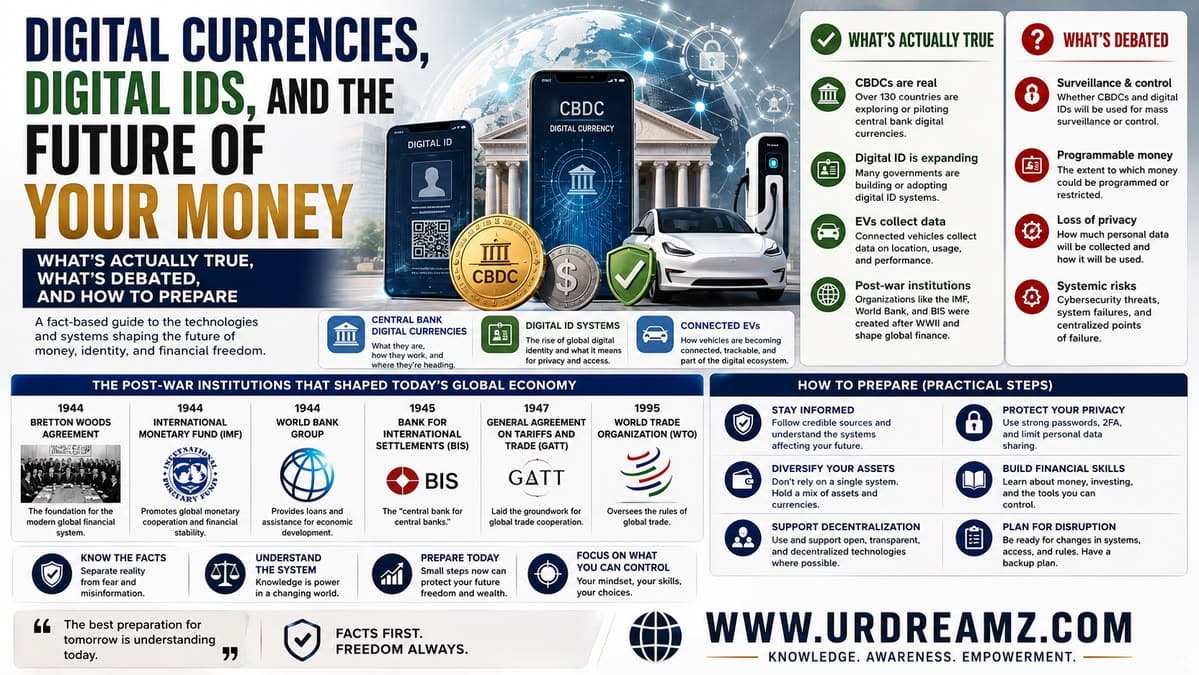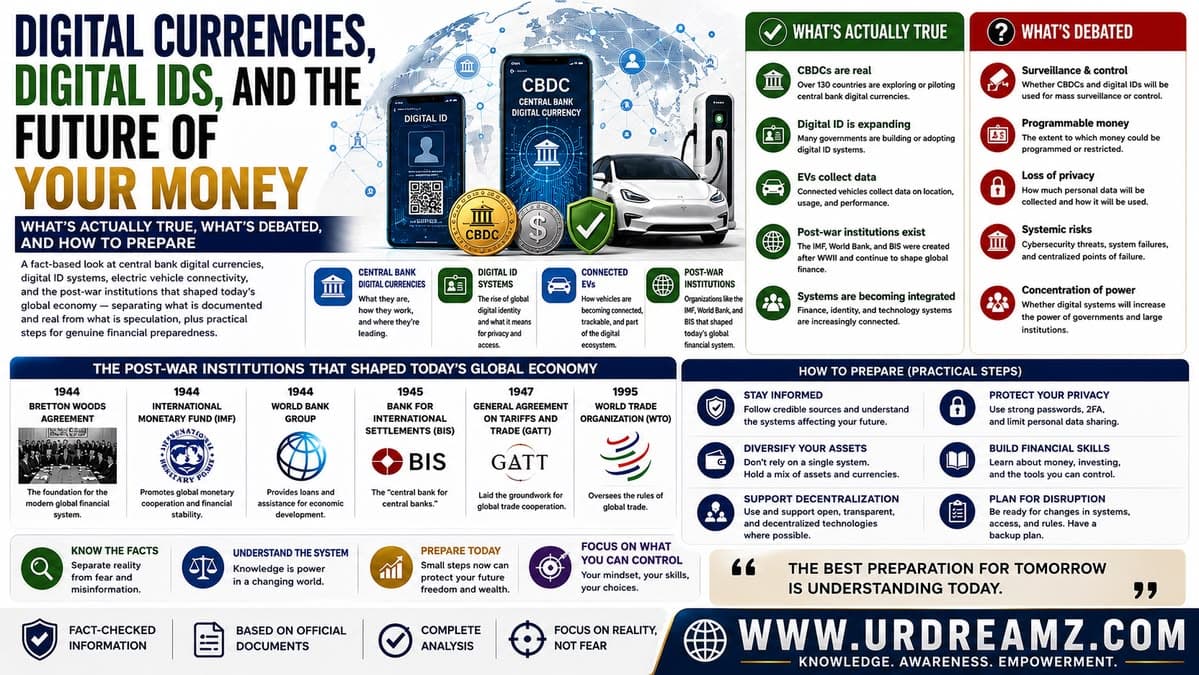
Digital Currencies, Digital IDs, and the Future of Your Money: What's Actually True, What's Debated, and How to Prepare
A clear-eyed look at the real technology, real history, and real financial preparedness behind one of the internet's most persistent anxieties.
Introduction: A Real Anxiety Worth Taking Seriously
A version of this worry circulates constantly online: that the money sitting in your bank account is about to become unsafe, that ongoing wars are secretly engineered opportunities to reshape the global financial system, that a small group of powerful people is quietly building the infrastructure to control ordinary life through digital currency, digital identity, and connected devices like electric cars. It is an unsettling picture, and it spreads widely because it touches something real: people genuinely do not have full visibility into how monetary policy, technology regulation, or geopolitics get decided, and that lack of visibility creates fertile ground for both legitimate concern and unfounded speculation to blend together, often within the very same social media post or video.
None of this is written to suggest that concern about privacy, financial security, or institutional accountability is misplaced — quite the opposite. The concern is legitimate; what varies enormously from one specific claim to the next is how well that concern is actually supported by verifiable evidence once you trace it back to its source.
This article takes that anxiety seriously enough to actually examine it, piece by piece, rather than either dismissing it outright or repeating it uncritically. Some of the underlying facts referenced in these narratives are genuinely true and well documented — international institutions really were built after major wars, mass surveillance capability really did expand sharply after 9/11, and central banks around the world really are actively developing digital currencies right now. Other parts of the narrative — a coordinated global plan to trap ordinary people, wars deliberately started as "opportunities," remote kill switches built into cars specifically to imprison citizens — are not supported by verifiable evidence and should not be presented as settled fact. The goal here is to walk through both categories honestly, source by source, so you can draw your own conclusions from what is actually documented rather than from what simply feels plausible.
It is worth being upfront about the approach this article takes, since the topic invites strong reactions in both directions. Nothing here is written to mock or dismiss anyone who holds concerns about digital currency, surveillance, or institutional power — those concerns, taken individually, are shared by economists, civil liberties organizations, and policymakers across the political spectrum, and dismissing them wholesale would be just as intellectually lazy as accepting every claim uncritically. The approach instead is to hold every specific factual claim to the same standard: what is the actual, checkable evidence, who is the original source, and does the conclusion drawn from that evidence match its actual strength, or does it overreach into territory the evidence doesn't support?
How Wars Have Historically Reshaped Global Institutions
It is entirely true, and well documented by historians, that major wars have repeatedly triggered large-scale reorganizations of the global economic and political order. This is not a secret or a conspiracy — it is one of the most thoroughly studied patterns in modern history, discussed openly in university courses, government archives, and mainstream economic history.
| Conflict | Institutional Change That Followed |
|---|---|
| World War I | League of Nations founded (precursor to the UN); major currency and reparations restructuring |
| World War II | United Nations, International Monetary Fund, and World Bank all founded within a few years of the war's end |
| Early Cold War | NATO founded in 1949 as a military alliance among Western nations facing Soviet expansion |
| September 11, 2001 attacks | USA PATRIOT Act passed; substantial expansion of government surveillance powers |
| 2008 global financial crisis | Sweeping banking regulation reforms and unprecedented central bank intervention in markets |
The honest, historically supported way to describe this pattern is that large-scale crises create political windows in which reforms that would otherwise be difficult to pass — because of institutional inertia, competing interests, or public resistance — suddenly become achievable, because the crisis itself generates urgency and public appetite for decisive action. This is a well-recognized phenomenon in political science, sometimes referred to as crisis-driven policy change. It does not require, and is not the same as, a claim that the crises themselves were secretly manufactured in advance to produce that outcome. The distinction matters enormously: one is a documented pattern of how human institutions respond to genuine shocks, and the other is an unproven and far more serious accusation that would require verifiable evidence of intentional coordination, which has not been produced for any of the recent conflicts referenced in these narratives.
Economists and historians who study this pattern generally point to a fairly mundane, if uncomfortable, explanation for why it recurs so consistently: ordinary politics is slow, and major structural reform usually faces entrenched resistance from groups who benefit from the status quo. A genuine crisis — a war, a pandemic, a financial collapse — temporarily overrides that resistance by making the cost of inaction visibly, immediately worse than the cost of change, which is precisely why so many landmark reforms in history cluster tightly around such moments rather than occurring steadily and predictably over time. Recognizing this pattern is a useful piece of civic literacy in its own right, since it helps explain why sweeping legislation so often appears in the immediate aftermath of a crisis rather than during calmer periods — without needing to assume the crisis itself was staged to produce that legislative window.
The UN, IMF, World Bank, and NATO: Why They Actually Exist
Since these institutions are frequently cited as evidence of a hidden plan, it is worth explaining plainly and factually what each one actually is and why it was created, based on public historical record rather than speculation.
| Institution | Founded | Stated Purpose |
|---|---|---|
| United Nations | 1945 | Prevent future world wars through diplomacy, collective security, and international law |
| International Monetary Fund (IMF) | 1944 (Bretton Woods) | Stabilize international currency exchange and provide emergency loans to countries facing balance-of-payments crises |
| World Bank | 1944 (Bretton Woods) | Fund postwar reconstruction, later expanded to long-term development lending for poorer countries |
| NATO | 1949 | Mutual defense pact among Western nations against Soviet military expansion during the Cold War |
All four institutions remain publicly funded, have publicly available governance structures, publish extensive records of their decisions and internal debates, and are regularly criticized, investigated, and reformed through ordinary democratic and diplomatic processes — including by member governments, journalists, and academic researchers. This level of public visibility does not make them immune to legitimate criticism; the IMF in particular has faced substantial, well-documented criticism over the decades for austerity conditions attached to its loans, and the World Bank has faced criticism over environmental and social impacts of funded projects. But visible, documented, and often criticized institutions are a very different thing from a secret cabal, and treating well-known, publicly governed organizations as evidence of hidden coordination tends to blur an important distinction between "institutions I disagree with" and "institutions operating in secret."
It is also worth noting that these institutions do not always act in unison, which is itself evidence against the idea of a single, tightly coordinated master plan. Member countries within the IMF and World Bank frequently disagree publicly over loan conditions, voting weight, and policy direction; NATO members have had well-publicized disputes over defense spending commitments and strategic priorities; and UN Security Council members regularly veto or block one another's proposals in full public view. A genuinely secret, unified global control structure would be difficult to reconcile with the extensive, well-documented record of open disagreement, gridlock, and competing national interests that characterizes how these institutions actually function day to day.
After 9/11: The Patriot Act and the Rise of Mass Surveillance
This part of the narrative is, in fact, solidly documented and worth understanding clearly rather than dismissing. The USA PATRIOT Act was signed into law in October 2001, just weeks after the September 11 attacks, and it substantially expanded the U.S. government's legal authority to conduct surveillance, share intelligence across agencies, and monitor financial transactions in the name of counterterrorism.
| Power Expanded | What It Allowed |
|---|---|
| Roving wiretaps | Surveillance following a specific person across multiple devices and communication methods |
| Section 215 orders | Government access to business records, later revealed to include bulk telephone metadata collection |
| National Security Letters | Ability to compel data from companies without a traditional court warrant, often under gag orders |
| Enhanced financial monitoring | Expanded bank reporting requirements aimed at detecting money laundering and terrorism financing |
The scale of this surveillance expansion became far more publicly visible in 2013, when former NSA contractor Edward Snowden leaked internal documents revealing bulk data collection programs that went considerably further than most of the public had previously understood. This is genuinely one of the strongest, best-documented pieces of evidence that a crisis can lead directly to expanded government surveillance capability — it is not speculation, it is a matter of public legislative and journalistic record. Where this historical fact gets stretched into something less supportable is in the leap from "this happened after 9/11" to "therefore, every subsequent crisis is engineered for the same purpose." One well-documented historical case does not, by itself, establish that later, unrelated events follow an identical hidden script.
It is worth adding that the Patriot Act story also demonstrates something important about how democratic accountability, however imperfect, tends to eventually respond to these expansions. Following the Snowden revelations, several of the bulk collection programs were subject to congressional review, public litigation, and eventual legislative reform — the USA FREEDOM Act of 2015, for instance, ended the NSA's bulk telephone metadata program in its original form, replacing it with a more restricted system requiring specific court orders. This does not mean surveillance concerns were fully resolved, and privacy advocates continue to raise legitimate ongoing objections to remaining programs. But it does show that even a well-documented case of dramatic post-crisis power expansion was not permanent or entirely unchecked — it went through a real, if slow and imperfect, public process of scrutiny and partial rollback, which is a meaningfully different picture than an unaccountable system operating entirely outside public knowledge or reach.
The "Great Reset" and "You'll Own Nothing": Where the Phrase Actually Came From
Few phrases have fueled more online speculation than "you'll own nothing and be happy," and it deserves a precise, factual explanation, since the actual origin is considerably more mundane than its viral reputation suggests.
In November 2016, the World Economic Forum published a short article titled "8 Predictions for the World in 2030," written by a Danish politician named Ida Auken, describing a speculative, first-person vision of a future society with minimal private ownership, extensive sharing of goods and services, and free access to many products. The article was explicitly framed as a forward-looking thought experiment about possible societal trends, not an announced policy or an official goal the WEF was working to implement. In 2020, the WEF separately launched an initiative called "The Great Reset," proposing that the economic disruption caused by the COVID-19 pandemic be used as an opportunity to pursue more sustainable and equitable economic policies going forward — again, a public, published set of policy recommendations and discussion papers, not a secret operational plan.
| Claim | What's Actually Documented |
|---|---|
| "You'll own nothing and be happy" is an official WEF policy goal | It originated from a single speculative opinion piece by an outside contributor, not an official WEF policy statement |
| The Great Reset is a secret plan | It was publicly announced, published, and debated openly, including significant public criticism |
| The WEF has enforceable global authority | The WEF is a Swiss nonprofit that hosts conferences and publishes reports; it has no legal or enforcement power over any government or economy |
None of this means the WEF's ideas are beyond legitimate criticism — plenty of economists, journalists, and policymakers have criticized specific Great Reset proposals on the merits, arguing they favor large corporations, lack democratic accountability, or overreach in scope. That is a normal, healthy part of public debate about an organization's published ideas. It is a different claim entirely to say the organization has secret, enforceable control over global economic policy, which is not supported by how international economic policy actually gets made — through national governments, central banks, and treaty negotiations, none of which the WEF itself has direct authority over.
What Is a Central Bank Digital Currency, Really?
A Central Bank Digital Currency, or CBDC, is a digital form of a country's official currency, issued and backed directly by that country's central bank, rather than by a commercial bank or a private company. It differs in a few specific, technical ways from the digital money most people already use every day through debit cards and banking apps.
| Feature | Regular Digital Bank Money (Today) | CBDC (Proposed/Piloted) |
|---|---|---|
| Issuer | Commercial bank, backed indirectly by the central bank | Issued directly by the central bank itself |
| Where it's held | In an account at a commercial bank | Potentially in a digital wallet, which could be bank-based or direct with the central bank depending on the design |
| Programmability | Generally not programmable by the issuing institution | Technically capable of being programmed with usage rules, depending on design choices made by the issuing government |
| Anonymity | Bank transactions are already tracked and reportable under existing law | Design varies widely by country; some pilots include privacy protections, others do not |
That word "programmable" is the single most important technical detail driving public concern, and it deserves to be explained honestly rather than glossed over. In principle, a CBDC could be designed with built-in rules — for example, restricting how or where certain funds could be spent, or setting an expiration date on stimulus payments to encourage rapid spending. Whether any specific country's CBDC actually includes such features depends entirely on the deliberate design and legal framework chosen by that country's government and central bank; it is not an automatic, unavoidable feature of digital currency itself. Several central banks piloting CBDCs, including the European Central Bank with its proposed digital euro, have publicly stated design commitments to privacy protections and have explicitly ruled out programmability features that would restrict how citizens spend their own money — though critics reasonably note that stated design intentions in an early pilot phase are not the same as permanent, legally binding guarantees, since legislation can change over time.
It also helps to understand what a CBDC is specifically not, since public confusion on this point fuels a lot of unnecessary alarm. A CBDC is not the same thing as cryptocurrency in the Bitcoin sense — it is centrally issued and controlled by a government authority rather than operating on a decentralized, permissionless network, which is precisely why privacy advocates draw such a sharp distinction between the two technologies despite their superficial similarity as "digital money." A CBDC is also not automatically the same as eliminating cash; most countries actively piloting CBDCs, including China and the eurozone, have publicly stated intentions to maintain physical cash alongside any digital currency rollout, at least for the foreseeable future, specifically in response to public concern about losing that option entirely.
Where CBDCs Actually Stand Around the World Today
Rather than relying on vague claims, it helps to look at the actual, documented status of CBDC development across major economies.
| Country/Region | Status |
|---|---|
| China | Furthest along globally; the digital yuan (e-CNY) has been in expanding pilot use across multiple cities for several years |
| European Union | Digital euro project in active development and legislative discussion, not yet fully launched nationwide |
| United States | Federal Reserve has conducted research and pilot studies, but has not committed to launching a retail CBDC, and the idea has faced significant political opposition |
| India | Digital rupee (e₹) in an active pilot phase across select banks and use cases |
| Nigeria | Already launched the eNaira, one of the first fully live retail CBDCs, with relatively limited public adoption so far |
| Bahamas | The Sand Dollar, launched in 2020, is one of the world's first fully operational CBDCs |
The overall global picture is one of active experimentation and uneven adoption, not a single, unified, secretly coordinated global rollout. Some countries are moving quickly, others have paused or scaled back projects amid public and legislative pushback, and a few, including the United States at the federal level, have faced enough domestic political resistance that full rollout remains genuinely uncertain rather than a foregone conclusion.
The Genuine Risks and Benefits of CBDCs
Serious economists, central bankers, and privacy advocates across the political spectrum have raised substantive, evidence-based arguments both for and against CBDCs, and both sides deserve fair treatment rather than dismissal, since this remains one of the more genuinely open and actively contested areas of monetary policy today.
| Argument in Favor | Argument of Concern |
|---|---|
| Could reduce transaction costs and speed up payments, especially for the unbanked | Could enable unprecedented government visibility into individual spending habits if not carefully designed |
| Could improve the speed and precision of monetary policy tools | Programmability features, if implemented, could theoretically restrict how and where money is spent |
| Could reduce reliance on cash in economies moving toward digital payments regardless | Centralizes financial infrastructure, creating a single point of technical and political vulnerability |
| Could improve financial inclusion for people without traditional bank access | Raises real questions about what happens to financial privacy compared to physical cash |
The most credible, mainstream position among independent economists and privacy researchers is neither blanket support nor blanket rejection, but a call for strong, legally enforceable privacy protections and clear limits on programmability written into law before any CBDC is fully deployed — precisely because the technology is flexible enough to be implemented either responsibly or in a genuinely concerning way, depending entirely on the legal and political choices made by each country's government. This is a legitimate, ongoing policy debate happening in public, through legislatures, central bank consultations, and academic research, rather than a hidden agenda being imposed without discussion.
Public consultation processes around CBDCs have, in several countries, produced measurable policy changes precisely because of this open debate, which is itself worth highlighting. The European Central Bank's digital euro consultation process received hundreds of thousands of public responses, with privacy consistently ranking as the top public concern, and subsequent design proposals have explicitly incorporated offline payment capability and stated privacy limits partly in direct response to that feedback. In the United States, public and congressional resistance has been substantial enough to meaningfully slow federal CBDC development, with several bills introduced specifically to restrict or prohibit a retail CBDC without explicit congressional authorization. Whatever one's ultimate view on the technology, this pattern of public feedback measurably shaping policy direction is itself evidence of an open, responsive process rather than a closed, predetermined one.
Digital ID Systems: Real Examples and Real Debates
Digital identity systems, which let citizens verify their identity electronically for government services, banking, or other purposes, are already in active use in several countries, providing real-world case studies rather than hypothetical scenarios.
| System | Country | Key Feature |
|---|---|---|
| Aadhaar | India | The world's largest biometric ID system, covering well over a billion residents, used for welfare distribution, banking, and tax filing |
| EU Digital Identity Wallet | European Union | Voluntary digital ID framework being rolled out across member states, intended to work alongside, not replace, physical ID documents |
| BankID | Sweden and other Nordic countries | Widely adopted digital identity system used for banking, government services, and private sector authentication |
India's Aadhaar system in particular has been the subject of extensive, well-documented public debate, including a landmark 2018 Indian Supreme Court ruling that upheld the program's constitutionality for welfare distribution while placing meaningful limits on mandatory use for private services, following years of litigation from privacy advocates concerned about surveillance potential, data breaches, and the exclusion of people unable to complete biometric verification. This is a useful real-world example precisely because it shows both sides of the argument playing out through an actual, functioning democratic and legal process — genuine benefits in efficiency and financial inclusion, genuine documented risks around privacy and exclusion, and a real court system weighing both rather than either side winning by default.
The Nordic BankID example is worth a brief additional mention because it illustrates a somewhat different model than Aadhaar's government-led approach: a jointly developed system operated primarily through commercial banks rather than a single government agency, achieving very high public adoption largely because it solved a genuinely convenient, everyday problem — logging into banking, government, and private services with one trusted credential — without a comparable level of the surveillance controversy that has surrounded Aadhaar. The contrast between these two real-world systems suggests that public trust in a digital ID system depends heavily on specific governance and design choices, rather than digital identity itself being uniformly either safe or dangerous regardless of implementation.
Electric Vehicles, Connectivity, and What's Actually Documented
Modern electric vehicles, along with most modern gasoline vehicles for that matter, are extensively connected to the internet, collect substantial data, and can, in fact, receive remote software commands from manufacturers — and this part of the concern is grounded in real, documented technical capability rather than pure speculation.
| Documented Capability | Real-World Context |
|---|---|
| Remote software updates | Manufacturers like Tesla routinely push over-the-air updates that can add, change, or occasionally limit vehicle features |
| Remote disabling for theft recovery | Several manufacturers can remotely limit or disable a reported stolen vehicle, a feature marketed as a security benefit |
| Extensive data collection | Location, driving behavior, and usage data are commonly collected and, according to privacy researchers, sometimes shared with third parties depending on the manufacturer's policies |
| Geofencing technology | Some fleet and rental vehicles already use geofencing to restrict where a vehicle can operate, primarily for commercial and insurance purposes |
Independent privacy research organizations, including the Mozilla Foundation's "Privacy Not Included" project, have specifically and publicly criticized the automotive industry as one of the worst-performing sectors for consumer data privacy, citing extensive data collection practices across nearly every major car brand, electric and gasoline alike. This is genuinely documented, published research, not speculation — and it is a reasonable basis for real consumer concern and stronger data protection regulation. Where the narrative moves into unsupported territory is the specific claim that this connectivity exists as part of a coordinated plan to trap or control the general population in restricted zones; no verified evidence supports that particular framing, even though the underlying technical capability for remote control and data collection is real, documented, and worth taking seriously as a genuine privacy and consumer rights issue in its own right.
It is also worth putting the "remote disabling" concern in a somewhat broader technical context. Nearly every category of modern connected consumer product — smartphones, smart home devices, even some appliances — includes some form of remote update or remote-lock capability, generally implemented for legitimate reasons like security patching, stolen-device recovery, or warranty enforcement. Electric vehicles are not unique in possessing this kind of connectivity; they are simply one of the largest and most consequential examples of a much broader trend toward internet-connected consumer hardware, sometimes described as the "Internet of Things." That broader trend raises genuinely important, actively debated questions about consumer rights, right-to-repair legislation, and data ownership that apply well beyond cars specifically — questions that deserve serious regulatory attention on their own merits, independent of any claim about a specific hidden agenda targeting electric vehicle owners in particular.
Why Billionaires Are Investing in "Post-Labor" Technology
It is also true and well documented that a number of prominent, wealthy individuals and companies are investing heavily in automation, artificial intelligence, and technologies aimed at reducing reliance on human labor across various industries — this is a matter of public record through company filings, investment announcements, and extensive media coverage, not a secret.
The more grounded, mainstream explanation for this pattern is straightforward economic self-interest rather than a coordinated societal control plan: companies and investors that successfully develop cheaper, more efficient automated alternatives to human labor stand to profit enormously, and this incentive alone is sufficient to explain heavy investment in the space without requiring a broader coordinated agenda. This trend does raise entirely legitimate, widely discussed public policy questions — about job displacement, wealth concentration, the need for retraining programs, and how societies should adapt economically as automation expands — and these are genuinely important, actively debated topics among economists, policymakers, and labor advocates. They do not, however, require or currently have verified evidence of a singular coordinated plan among wealthy individuals to intentionally engineer global instability for personal control, which is a considerably stronger and more specific claim than the underlying, well-documented investment trend itself actually supports.
How to Think Critically About Claims Like These
Given how much of this narrative blends genuinely documented facts with unverified extrapolations, it helps to have a simple, repeatable framework for evaluating similar claims as they continue to circulate.
| Question to Ask | Why It Helps |
|---|---|
| Is this a documented historical fact, or an interpretation of one? | Separates verifiable events from speculative conclusions drawn from them |
| Who would need to be involved for this to be true, and is there any direct evidence they coordinated? | Large, secret coordinated plans typically require many people to stay silent for years, which is difficult to sustain in practice |
| Does the claim conflate "this technology could theoretically be misused" with "this misuse has been confirmed to be happening"? | Technical capability for misuse is not the same as proof that misuse is the actual, intended purpose |
| Is the original source a single opinion piece, or an official, binding policy document? | Speculative essays and official policy carry very different weight as evidence |
| Would this claim hold up if I searched for the strongest counter-argument, not just supporting sources? | Genuine understanding requires engaging with the best opposing evidence, not only confirming sources |
None of this means skepticism toward powerful institutions is unwarranted — a healthy, evidence-based skepticism toward concentrated power, whether governmental or corporate, is a reasonable and often valuable civic habit. The distinction that matters is between skepticism grounded in verifiable evidence, applied consistently, and a narrative that selectively strings together real facts with unverified leaps to arrive at a predetermined, more dramatic conclusion.
Practical Financial Preparedness That Actually Helps
Regardless of which parts of this broader narrative you personally find convincing, genuine financial preparedness is valuable advice on its own merits, independent of any particular theory about the future. The following practices are widely recommended by mainstream financial planners for ordinary, non-speculative reasons — job loss, medical emergencies, economic downturns, or simple bad luck — and remain sound regardless of how digital currency policy eventually develops, and regardless of which specific predictions about 2030 or any other year eventually turn out to be accurate.
| Practice | Why It Helps |
|---|---|
| Build an emergency fund covering 3–6 months of expenses | Provides a buffer against job loss, medical costs, or unexpected disruptions of any kind |
| Diversify across asset types | Reduces exposure to any single point of failure, whether a bank, a currency, or an asset class |
| Keep some funds in accessible, liquid form | Ensures you can respond quickly to unexpected needs without forced asset sales |
| Understand your bank's deposit insurance coverage | Most countries insure deposits up to a certain limit; knowing that limit clarifies your actual real-world exposure |
| Stay informed through primary sources, not just viral content | Central bank announcements and government policy documents are publicly available and more reliable than secondhand summaries |
| Avoid panic-driven decisions | Financial decisions made under acute fear tend to produce worse long-term outcomes than calm, planned ones |
It is worth stating plainly, as a matter of factual record rather than reassurance, that in most countries with established deposit insurance systems, ordinary bank deposits up to the insured limit remain protected by law even during financial instability, and there is no verified evidence supporting the specific claim that bank savings will become broadly "unsafe" by any particular year. That said, the general financial planning principles above are worth following regardless — not because a specific catastrophic prediction is confirmed, but because they represent sound practice for managing ordinary financial risk under any circumstances. As always, this is general information rather than personalized financial advice, and significant financial decisions are worth discussing with a qualified, licensed financial advisor familiar with your specific situation.
Frequently Asked Questions
Is it true that bank savings will become unsafe by 2030?
There is no verified evidence supporting this specific claim; deposit insurance systems in most developed countries continue to legally protect insured bank deposits, independent of ongoing CBDC development.
What is a CBDC?
A Central Bank Digital Currency is a digital form of a country's official currency issued directly by its central bank, distinct from the digital money already used through commercial bank accounts.
Are CBDCs programmable by design?
They are technically capable of programmability depending on design choices, but whether any specific CBDC includes restrictive programming features depends on the legal framework each country chooses to implement.
Did the World Economic Forum officially say "you'll own nothing and be happy"?
The phrase originated from a 2016 opinion piece by an outside contributor describing a speculative future scenario, not an official WEF policy statement or goal.
Is the Great Reset a secret plan?
No — it was a publicly announced and published set of policy proposals introduced in 2020, openly debated and criticized, rather than a hidden operation.
Did the Patriot Act really expand government surveillance after 9/11?
Yes — this is well documented through legislative record and later confirmed in greater detail by the 2013 Snowden leaks, representing a real historical example of crisis-driven policy expansion.
Do electric vehicles really have remote disabling features?
Yes — several manufacturers can remotely limit or disable vehicles, primarily marketed as an anti-theft security feature, and this capability is documented rather than speculative.
Is car data privacy a real concern?
Yes — independent privacy research organizations have specifically flagged the automotive industry, including electric vehicle makers, for extensive data collection practices, making this a legitimate, evidence-based consumer concern.
Which countries currently have a working CBDC?
The Bahamas' Sand Dollar and Nigeria's eNaira are among the first fully operational retail CBDCs, while China's digital yuan has the largest active pilot program globally.
Is the United States close to launching a CBDC?
Not currently — the Federal Reserve has conducted research and limited pilots, but a full retail CBDC has faced significant political opposition and has not been formally adopted.
What is Aadhaar, and is it controversial?
Aadhaar is India's biometric national ID system, the largest in the world; it has faced genuine legal and public debate over privacy and exclusion, addressed in part through a landmark 2018 Indian Supreme Court ruling.
Were the UN, IMF, and World Bank created after World War II?
Yes — all three were established in the mid-1940s specifically in response to the war, a well-documented and openly discussed part of modern history.
Does this mean wars are deliberately started to create these opportunities?
No verified evidence supports the claim that modern conflicts are intentionally engineered to produce policy change; the documented pattern is that crises create political opportunity for reform, which is a different and much better-supported claim.
Why are billionaires investing in automation and AI?
Primarily for straightforward profit motives tied to reducing labor costs and improving efficiency, a well-documented business trend that does not require a coordinated societal control agenda to explain.
How can I protect my savings without falling for fear-based advice?
Focus on well-established practices — an emergency fund, diversification, understanding your deposit insurance coverage — rather than reacting to unverified predictions about specific catastrophic dates or events.
Is it wrong to be skeptical of governments and large institutions?
Not at all — evidence-based skepticism toward concentrated power is a healthy civic habit; the key distinction is grounding that skepticism in verifiable facts rather than unproven extrapolations.
What's the best way to fact-check claims like these in the future?
Trace the claim back to its original source, distinguish documented events from speculative interpretation, and deliberately seek out the strongest counter-evidence rather than only sources that confirm the claim.
Conclusion
The most honest answer to "is a hidden global plan controlling our future through digital currency, digital ID, and connected cars" is that some of the underlying facts are absolutely real and well documented — CBDCs are genuinely being developed and piloted around the world, digital ID systems are genuinely expanding, connected vehicles genuinely collect extensive data and can genuinely be controlled remotely by manufacturers, and history genuinely shows crises reshaping institutions. None of that requires exaggeration to be concerning enough to warrant real public attention, real regulation, and real informed citizen engagement.
What is not currently supported by verifiable evidence is the leap from those real facts to a claim of secret, coordinated intent to trap or control the global population — a much stronger claim that would require its own direct evidence, which has not been produced. The healthiest response to this entire topic is neither blind trust in institutions nor uncritical acceptance of viral claims, but the harder, more useful middle path: engaging directly with primary sources, supporting genuine transparency and privacy protections in how these real technologies get built and regulated, and building the kind of practical financial resilience — an emergency fund, sensible diversification, and a calm, informed mindset — that serves you well regardless of how any of these ongoing policy debates ultimately resolve.
Perhaps the most useful habit to take away from an article like this one is not a single verdict on any specific claim, but a durable method for evaluating the next one that comes along — and there will always be a next one, given how quickly technology, geopolitics, and economic policy continue to evolve. Ask where a claim actually originated. Ask what would need to be true, and who would need to be involved, for the strongest version of the claim to hold up. Ask whether the evidence supports the modest, documented version of the story, or only the more dramatic, unverified extension of it. Applied consistently, that habit will serve you considerably better over time than either reflexively trusting every official narrative or reflexively believing every viral one — and it costs nothing more than a few extra minutes of genuine, honest curiosity.