DeepSeek AI Explained: How China's AI Challenger Is Competing with ChatGPT and Gemini in 2026
In January 2025, a Chinese artificial intelligence company called DeepSeek shook the entire technology world to its core. Almost overnight, it leapfrogged to the top of the App Store charts, triggered a historic single-day drop in Nvidia's stock price — erasing over $600 billion in market value, the largest single-company decline in U.S. stock market history — and forced every major AI lab on the planet to rethink its assumptions about what it costs to build world-class artificial intelligence.
This was not a fluke. DeepSeek had done something the industry believed was impossible: it built an AI reasoning model that matched OpenAI's best systems on standardized benchmarks, using a fraction of the computing power and spending a reported $5.6 million on training — compared to the $78 million reportedly spent on GPT-4 and the $191 million spent on Google's Gemini Ultra.
In 2026, DeepSeek continues to evolve rapidly, releasing new model generations, expanding its open-source ecosystem, and establishing itself as a permanent fixture in the global AI landscape. Whether you are a developer, a business owner, a student, or simply someone trying to understand the AI world, this comprehensive guide covers everything you need to know about DeepSeek AI — from its origins and technology to its models, comparisons, use cases, privacy concerns, and future roadmap.
What Is DeepSeek AI? A Complete Introduction
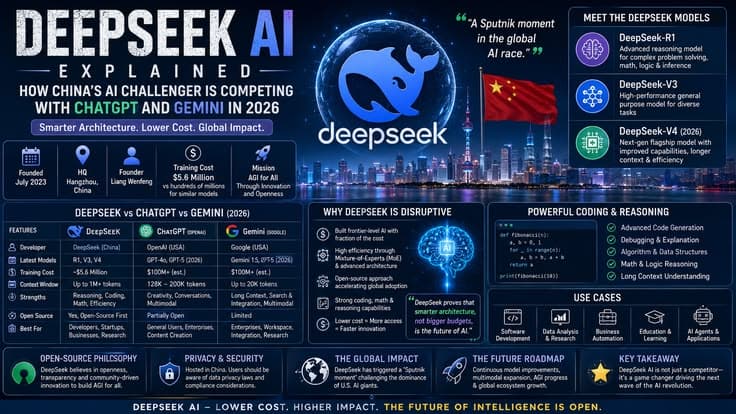
DeepSeek (full legal name: Hangzhou DeepSeek Artificial Intelligence Basic Technology Research Co., Ltd.) is a Chinese AI research company based in Hangzhou, Zhejiang Province. It was founded on July 17, 2023, by Liang Wenfeng, who is also the co-founder and CEO of High-Flyer, a prominent Chinese quantitative hedge fund.
DeepSeek is wholly owned and funded by High-Flyer, giving it the rare combination of financial backing without needing to pursue commercial revenue aggressively — which is one reason it can offer its models with such generous free access. The company employs approximately 160 researchers and engineers as of 2025, a remarkably small team relative to the scale of its achievements.
DeepSeek's stated mission is the pursuit of Artificial General Intelligence (AGI) — AI that can perform any intellectual task a human can. Its approach differs from Western counterparts in one fundamental way: rather than relying on ever-larger computing clusters and exponentially increasing budgets, DeepSeek bets on algorithmic efficiency — squeezing maximum intelligence out of minimum hardware.
| Detail | Information |
|---|---|
| Full Company Name | Hangzhou DeepSeek Artificial Intelligence Basic Technology Research Co., Ltd. |
| Founded | July 17, 2023 |
| Founder and CEO | Liang Wenfeng |
| Headquarters | Hangzhou, Zhejiang, China |
| Parent Company | High-Flyer (Chinese hedge fund) |
| Employees (2025) | ~160 |
| Primary Products | DeepSeek-R1, DeepSeek-V3, DeepSeek-V4, DeepSeek Coder, DeepSeek-VL |
| License Type | Open-weight (MIT License for most models) |
| Official Website | deepseek.com |
| Access Methods | Web chat, iOS app, Android app, API |
| Training Cost (V3) | ~$6 million (vs. $100M+ for GPT-4) |
| Market Disruption | Caused $600B Nvidia market cap drop in one day |
The History of DeepSeek: From Hedge Fund to AI Giant
DeepSeek's story begins not in a startup garage but inside one of China's most sophisticated quantitative trading firms. High-Flyer, co-founded by Liang Wenfeng, had been using deep learning algorithms for stock trading since 2016. By 2021, the firm was using AI exclusively for its trading operations and had accumulated tens of thousands of high-performance Nvidia GPUs — including reportedly 10,000 Nvidia A100 chips — before the United States imposed export restrictions on advanced semiconductors to China.
It was this stockpile of computing power — combined with the looming threat of chip access being cut off — that inspired Liang Wenfeng to pivot High-Flyer's AI capabilities toward building large language models. In July 2023, DeepSeek was formally incorporated as a separate research entity. Within 18 months, it had released models that rivaled OpenAI's GPT-4 and its own reasoning model o1, at a cost that defied every established assumption in the industry.
The January 2025 release of DeepSeek-R1 — a reasoning model trained using reinforcement learning — was the moment that captured global attention. When independent testers and benchmark evaluators confirmed that R1 matched or exceeded OpenAI's o1 on tasks involving mathematics, coding, and logical inference, the AI world entered a period of intense reassessment. The term "Sputnik moment" — borrowed from the 1957 Soviet satellite launch that shocked the United States into its space race — was widely used by analysts to describe the impact of DeepSeek's emergence.
DeepSeek's Core Models: A Complete Guide
DeepSeek's model lineup is organized around two primary architectural families: the V-Series (general-purpose flagship models) and the R-Series (reasoning-focused models), along with specialized variants for coding and multimodal tasks.
| Model | Type | Parameters (Total) | Active Params | Context Window | Primary Strength |
|---|---|---|---|---|---|
| DeepSeek-V3 | General LLM (MoE) | 671 Billion | 37 Billion | 128K tokens | Language, reasoning, general tasks |
| DeepSeek-V4 Pro | General LLM (MoE) | 1.6 Trillion | 49 Billion | 1 Million tokens | Advanced reasoning, agentic tasks, world knowledge |
| DeepSeek-V4 Flash | Lightweight LLM (MoE) | 284 Billion | 13 Billion | 1 Million tokens | Fast, ultra-low cost, everyday agentic workflows |
| DeepSeek-R1-Zero | Reasoning (RL only) | 671 Billion | 37 Billion | 128K tokens | Experimental pure reinforcement learning |
| DeepSeek-R1 | Reasoning (CoT) | 671 Billion | 37 Billion | 128K tokens | Math, coding, logic with transparent thinking |
| DeepSeek Coder / Coder-V2 | Specialized Coding | Varies | Varies | 128K tokens | Code generation, debugging, multi-language support |
| DeepSeek-VL | Multimodal (Vision-Language) | Varies | Varies | 128K tokens | Text and image understanding |
DeepSeek-R1: The Reasoning Breakthrough
DeepSeek-R1 is the model that changed everything. Unlike conventional language models that simply predict the next token in a sequence, R1 was trained using large-scale Reinforcement Learning (RL) combined with a rule-based reward system. The result is an AI that genuinely "thinks" before it answers — displaying its chain-of-thought reasoning process step by step, self-correcting when it detects an error, and arriving at answers through a transparent logical process that users can actually follow.
This capability makes R1 extraordinarily effective for tasks that require multi-step reasoning: complex mathematics, formal logic, algorithmic problem-solving, and sophisticated code generation. On standardized benchmarks like MATH-500, AIME, and SWE-bench, R1 matched or exceeded OpenAI's o1 — a model that cost OpenAI vastly more to develop and deploy.
DeepSeek-V4: The Flagship Generation
The DeepSeek-V4 series, released in 2026, represents the current pinnacle of DeepSeek's general-purpose AI capabilities. DeepSeek-V4 Pro features a massive 1.6 trillion total parameters but uses only 49 billion active parameters per token through its Mixture-of-Experts architecture. This gives it frontier-level intelligence at a fraction of the inference cost. Its 1 million token context window allows it to process entire codebases, lengthy legal documents, or multi-book research collections in a single prompt.
DeepSeek-V4 Flash is the cost-optimized variant — smaller and faster, with output speeds exceeding 100 tokens per second on optimized infrastructure — making it ideal for production deployments where cost and latency matter more than maximum intelligence.
The Technology Behind DeepSeek: How It Achieves So Much for So Little
DeepSeek's extraordinary cost-efficiency is not the result of corners being cut — it is the product of genuine architectural innovation. Three key technologies define its approach:
1. Mixture of Experts (MoE)
Traditional "dense" language models activate 100% of their parameters for every single token they process. DeepSeek's MoE architecture partitions the neural network into specialized sub-networks called "experts." For any given input, only a small fraction of these experts — those most relevant to the task at hand — are activated. The rest remain dormant, consuming no compute. This approach maintains elite-level performance while keeping hardware demands dramatically lower than equivalent dense models.
2. Multi-Head Latent Attention (MLA)
DeepSeek developed a proprietary memory compression technique called Multi-Head Latent Attention. This mechanism compresses the Key-Value (KV) cache — the memory store that allows a model to reference earlier parts of a conversation — into a much smaller representation. The result is that DeepSeek can handle extremely long context windows (up to 1 million tokens in V4) without requiring unsustainable amounts of GPU memory, enabling processing of entire documents or codebases that would overwhelm conventional architectures.
3. Reinforcement Learning and Model Distillation
Rather than requiring billions of human-annotated examples, DeepSeek's reasoning models are trained primarily through reinforcement learning — the model generates solutions to problems, evaluates them against objective criteria (such as mathematical correctness or code execution success), and iteratively improves without needing human feedback at every step. Additionally, DeepSeek uses model distillation to create smaller, highly capable versions of its flagship models. The large R1 model is used to "teach" smaller models — including versions of Meta's Llama and Alibaba's Qwen — producing distilled variants ranging from 1.5 billion to 70 billion parameters that can run locally on consumer hardware.
DeepSeek vs ChatGPT: The Definitive Comparison
The most-searched comparison in the AI world in 2026 is DeepSeek vs ChatGPT. Both are powerful AI systems, but they represent fundamentally different philosophies and excel in different domains.
| Feature | DeepSeek | ChatGPT (OpenAI) |
|---|---|---|
| Best For | Coding, math, logic, technical research | Creative writing, conversation, marketing, content |
| Reasoning Ability | Exceptional (shows chain-of-thought) | Strong, especially with o1/o3 models |
| Image Generation | Limited (via Janus-Pro architecture) | Excellent (DALL-E 3 integration) |
| Voice Mode | Not available | Advanced Voice Mode available |
| Web Search | Built-in (toggle on) | Available with web browsing |
| Context Window | Up to 1 million tokens (V4) | Up to 128K tokens (GPT-4o) |
| Free Tier | Generous — full models available free | Available but limited; Plus at $20/month |
| API Cost | Up to 96% cheaper than OpenAI | Industry standard pricing |
| Open Source | Yes — MIT License on model weights | No — proprietary closed models |
| Local Deployment | Yes — downloadable and self-hostable | No |
| User Interface | Functional, developer-focused | Polished, highly intuitive, beginner-friendly |
| Custom GPTs/Tools | Not available | Custom GPTs, file handling, data analysis |
| Coding Performance | Top-tier (SWE-bench, HumanEval) | Strong but often outpaced by DeepSeek R1 |
The summary verdict: choose DeepSeek if you are a developer, researcher, student, or business focused on technical tasks, coding, mathematics, or data analysis where cost-efficiency matters. Choose ChatGPT if you need a versatile, multimodal assistant for creative work, everyday conversation, image generation, or tasks that require a highly polished user experience.
DeepSeek vs Gemini: Google's Multimodal AI Takes On China's Reasoning Champion
Google's Gemini and DeepSeek represent two very different visions of what an AI model should be. Gemini is deeply integrated with Google's ecosystem — Search, Workspace, YouTube, Android — and excels in multimodal tasks involving images, audio, and video. DeepSeek focuses on text and code with unmatched cost-efficiency and transparent reasoning.
| Feature | DeepSeek | Google Gemini |
|---|---|---|
| Coding and Technical Tasks | Superior — especially R1 for complex logic | Strong but generally outperformed by DeepSeek R1 |
| Multimodal (Image, Audio, Video) | Limited text and basic image support | Excellent — native multimodal architecture |
| Context Window | 1 million tokens (V4) | 1 million+ tokens (Gemini 1.5 Pro) |
| Google Workspace Integration | Not available | Native integration with Docs, Sheets, Gmail |
| Real-Time Web Search | Built-in toggle (not as deep as Google) | Natively grounded in Google Search results |
| API Pricing | Extremely low cost | Higher premium for advanced models |
| Open Source | Yes | No (closed source) |
| Best Use Case | Developers, math, logic, API cost savings | Multimodal tasks, Google ecosystem users |
The verdict: choose Gemini if your workflow revolves around Google services, document processing, image analysis, or video understanding. Choose DeepSeek if you are a developer, researcher, or technical user who prioritizes raw reasoning power and cost-effective API access.
DeepSeek vs Claude (Anthropic): Precision vs Polish
Claude, developed by Anthropic, and DeepSeek occupy opposite ends of the AI quality spectrum in some respects. Claude is celebrated for its nuanced reasoning, beautifully polished long-form writing, and industry-leading safety architecture. DeepSeek is celebrated for its raw technical performance, mathematical capabilities, and radical affordability.
| Category | DeepSeek | Claude (Anthropic) |
|---|---|---|
| Math and Logic | Exceptional — leads most benchmarks | Very strong, best for clear explanations |
| Long-Form Writing Quality | Good but more utilitarian in tone | Excellent — highly polished, human-like prose |
| Coding (Algorithmic) | Top-tier for competitive programming | Best for end-to-end web development and architecture |
| Safety and Compliance | Chinese regulatory framework — some content limits | Industry-leading safety and constitutional AI |
| Enterprise Vision Capabilities | Limited | Strong multimodal with 200K context window |
| API Cost | Fraction of Claude's pricing | Premium pricing |
| Open Source | Yes | No |
Many professional developers use both tools: DeepSeek for high-volume, cost-heavy scaffolding and automated code generation, and Claude for architectural review, polished documentation, and quality-critical tasks where output must require minimal editing.
DeepSeek's Coding Capabilities: A Developer's Perspective
Among all of DeepSeek's strengths, its coding capabilities have generated the most excitement in the developer community. DeepSeek Coder and the reasoning-enabled R1 model together form what many developers call the most cost-effective coding assistant available anywhere in 2026.
What DeepSeek Can Do for Developers
Code Generation: DeepSeek can write complete, production-ready code in over 80 programming languages from natural language descriptions. It supports Python, JavaScript, TypeScript, Java, C++, Rust, Go, SQL, CUDA, Verilog, and many more. It generates not just syntax but well-structured, commented, test-ready code that follows established design patterns.
Debugging and Root Cause Analysis: Rather than guessing at bug causes, DeepSeek's reasoning models trace execution paths, analyze stack traces, and identify the exact root cause of an error before proposing a fix. This approach — showing its work rather than just outputting a patched line — is what developers find most valuable.
Code Refactoring: Feed DeepSeek legacy or messy code and it will optimize algorithms, apply design patterns, improve readability, and flag performance bottlenecks — all while explaining why each change improves the codebase.
Fill-in-the-Middle Completion: DeepSeek Coder supports advanced code completion that looks at both the code before AND after a gap in a file to generate contextually appropriate code for the middle — a more sophisticated capability than basic autocomplete.
IDE Integration: DeepSeek's API is compatible with OpenAI's API format, meaning it can be dropped into existing developer tools with minimal configuration. It integrates with VS Code via the Continue extension, works with Aider, Cursor, and other AI coding tools, and can be used to build custom development pipelines.
| Coding Task | DeepSeek Capability | Recommended Model |
|---|---|---|
| Boilerplate and script generation | Excellent | DeepSeek-V4 Flash (fast and cheap) |
| Complex algorithmic problems | Outstanding | DeepSeek-R1 (chain-of-thought) |
| Debugging and root cause analysis | Excellent | DeepSeek-R1 |
| Code refactoring | Very Good | DeepSeek-V4 Pro |
| Frontend development (HTML/CSS/JS) | Good | DeepSeek-V3 or V4 |
| Multi-language software engineering | Excellent (80+ languages) | DeepSeek Coder-V2 |
| Code documentation | Very Good | DeepSeek-V4 Flash |
| Test case generation | Excellent | DeepSeek-R1 |
DeepSeek API: Pricing, Access, and Integration
For developers and businesses, the DeepSeek API is one of the most compelling offerings in the AI industry. Its pricing is aggressively competitive — often 90–96% cheaper than equivalent OpenAI models — making it the default choice for any application where token costs matter at scale.
| Model | Input Price (per 1M tokens) | Output Price (per 1M tokens) | Speed |
|---|---|---|---|
| DeepSeek-V4 Pro | ~$0.43 | ~$0.87 | ~80 tokens/sec |
| DeepSeek-V4 Flash | ~$0.03 | ~$0.10 | ~102 tokens/sec |
| DeepSeek-R1 | ~$0.55 (cached) | ~$2.19 | ~60 tokens/sec |
| OpenAI GPT-4o (comparison) | ~$5.00 | ~$15.00 | ~80 tokens/sec |
The API is fully compatible with the OpenAI API format, which means developers can switch from OpenAI to DeepSeek by simply changing the base URL and API key in their existing code — no other modifications required. This OpenAI compatibility has dramatically accelerated adoption across the developer ecosystem.
Access the DeepSeek API through the official platform at platform.deepseek.com, where you can generate API keys, monitor usage, and access documentation.
DeepSeek's Open-Source Philosophy: Democratizing AI
One of DeepSeek's most consequential decisions has been its commitment to releasing model weights under permissive open-source licenses — primarily the MIT License. This means any developer, researcher, university, or startup in the world can download DeepSeek's model weights, modify them, fine-tune them on proprietary data, and deploy them on their own infrastructure without paying licensing fees or sending data to DeepSeek's servers.
This approach represents a fundamental challenge to the closed-source model that has dominated Western AI development. OpenAI, Anthropic, and Google all keep their most capable models behind proprietary APIs, meaning users must trust these companies with their data and accept whatever pricing those companies set. DeepSeek's open-weight models break that dependency.
The practical implications are enormous:
For Healthcare: Hospitals and medical research institutions can run DeepSeek locally, processing patient data without it ever leaving their own servers — satisfying HIPAA and other privacy regulations that make cloud-based AI inadmissible.
For Finance: Banks and financial institutions can fine-tune DeepSeek on their proprietary trading data, regulatory filings, and internal documents without exposing sensitive information to external providers.
For Education: Universities and schools can deploy DeepSeek for students at zero cost, giving learners access to frontier-level AI assistance without subscription fees.
For Developing Markets: Countries and organizations without large AI budgets can access cutting-edge capabilities through DeepSeek's free tier and open-source models, reducing the AI capabilities gap between wealthy and developing nations.
Best Use Cases for DeepSeek AI in 2026
DeepSeek's combination of advanced reasoning, coding expertise, long context windows, and extreme cost-efficiency makes it valuable across a wide range of practical applications.
| Use Case | Best DeepSeek Model | How to Use |
|---|---|---|
| Complex math and logic problems | DeepSeek-R1 | Enable Deep Think mode; watch chain-of-thought reasoning |
| Code generation and debugging | DeepSeek-R1 or Coder-V2 | Paste code or describe task; toggle reasoning for complex bugs |
| Research paper summarization | DeepSeek-V4 Pro | Upload PDF or paste text; ask for structured summary |
| Content writing and marketing | DeepSeek-V3 or V4 | Provide topic, audience, tone; generate drafts for editing |
| Data analysis and SQL queries | DeepSeek-R1 | Describe dataset structure; ask for analysis or query generation |
| Customer support chatbots | DeepSeek-V4 Flash (via API) | Integrate API; train on product documentation |
| Financial analysis and modeling | DeepSeek-V4 Pro | Feed financial data; request trend analysis or projections |
| Local private AI deployment | Distilled models (1.5B–70B) | Run via Ollama or LM Studio on local hardware |
| SEO content generation | DeepSeek-V3 or V4 | Provide keywords and structure; generate SEO-optimized articles |
| Language translation | DeepSeek-V3 | Paste text; request translation with context and tone preservation |
DeepSeek for Business: Enterprise Applications
Organizations across industries are integrating DeepSeek into their operations, attracted by its cost-efficiency, open-source flexibility, and powerful reasoning capabilities. The following business applications have emerged as the most impactful:
Software Development Teams: Development teams use DeepSeek to accelerate their entire coding pipeline — from writing boilerplate to reviewing pull requests to generating unit tests. The cost savings compared to premium coding assistants like GitHub Copilot Pro are substantial, particularly for high-volume teams.
Data Mining and Business Intelligence: Companies use DeepSeek's natural language querying capabilities to extract insights from large databases without requiring SQL expertise across their teams. Analysts can describe what they want to know in plain English and receive structured queries, visualizations, and interpretations.
Content Marketing and Copywriting: Marketing teams use DeepSeek to generate first drafts of blog posts, email campaigns, social media content, and ad copy at scale. The quality of output, while not matching Claude for polished prose, is sufficient for most marketing applications and dramatically reduces production time.
Customer Support Automation: Businesses deploy DeepSeek via API to power multilingual customer support chatbots that handle routine inquiries, escalating complex cases to human agents. The low API costs make this economically viable even for small and medium-sized businesses.
Predictive Maintenance: Manufacturing companies feed equipment sensor data into DeepSeek to identify patterns that predict failures before they occur, reducing unplanned downtime.
DeepSeek Privacy and Security Concerns
DeepSeek's rapid rise has not been without controversy. Its Chinese origins have raised significant privacy and security questions that any user or organization considering adoption should understand clearly.
Data Jurisdiction: When using DeepSeek's cloud-based chat interface or API, data is processed on servers in China, subject to Chinese law and government oversight. This creates legitimate concerns for users who handle sensitive personal, corporate, or government information. Multiple countries and organizations have restricted or banned DeepSeek on government devices as a precaution.
Content Restrictions: DeepSeek's models operate under Chinese regulatory constraints, which means certain topics — political events, historical controversies, and content that conflicts with Chinese government positions — may be restricted or deflected in responses. This content limitation is a meaningful consideration for users in journalism, political research, or human rights work.
The Open-Source Solution: For users concerned about data privacy, DeepSeek's open-source models provide a complete solution. By downloading and running DeepSeek locally — using tools like Ollama or LM Studio — no data ever reaches DeepSeek's servers. The AI runs entirely on the user's own hardware, providing full data sovereignty with no Chinese regulatory exposure.
Security experts recommend a simple framework for DeepSeek usage: use the cloud interface for non-sensitive general tasks, and deploy local open-source versions for any work involving confidential, proprietary, or sensitive information.
DeepSeek's Future Roadmap: What's Coming Next
DeepSeek does not publish formal public roadmaps in the way that some Western companies do, but its research publications, model releases, and strategic statements reveal a clear direction for the near and medium-term future.
| Development Area | Current Status (2026) | Expected Direction |
|---|---|---|
| Agentic AI | R1 models used in single-session tasks | Multi-step autonomous agents; independent task completion |
| Multimodal Capabilities | Basic image support via DeepSeek-VL | Native text, image, audio, and video processing |
| Hardware Independence | Adapting to Huawei Ascend chips | Full domestic chip optimization to bypass U.S. restrictions |
| Context Window | 1 million tokens (V4) | Further expansion; optimized retrieval for massive contexts |
| Model Distillation | 1.5B to 70B local variants available | More capable small models for consumer hardware |
| Global Ecosystem | API + open-source weights | Broader SDK support; developer tools; community frameworks |
| AGI Research | Formal company goal | Continued RL research; reasoning improvements |
The most consequential item on DeepSeek's near-term roadmap is the development of agentic AI systems — models that can autonomously execute multi-step tasks without human intervention at each stage. DeepSeek has confirmed its intent to release agentic models that can plan, execute, verify, and adapt complex workflows, bringing it into direct competition with OpenAI's Operator and Anthropic's agentic Claude products.
DeepSeek's Impact on the Global AI Industry
DeepSeek's emergence has had effects that extend far beyond the company itself. It has fundamentally reshaped assumptions, competitive dynamics, and economic models across the global AI industry:
Price Deflation: DeepSeek's aggressively low API pricing has forced competitors to slash their own costs. OpenAI, Anthropic, and Google have all responded with price reductions and new lower-cost model tiers that would likely not have materialized without the competitive pressure from DeepSeek.
The Efficiency Imperative: Before DeepSeek, the dominant narrative in AI was that more compute equals better AI — a formula that favored only the largest and most well-funded organizations. DeepSeek proved that algorithmic efficiency can compensate for hardware limitations, giving every AI lab in the world a new research priority: doing more with less.
Geopolitical Implications: DeepSeek's success has materially changed the calculus of the US-China technology competition. China is no longer playing catch-up in AI — it has demonstrated the ability to independently develop frontier-level systems even under semiconductor export restrictions. This has accelerated policy debates in Washington about chip export controls, AI safety, and national AI strategy.
Open-Source Movement: By releasing powerful models under permissive licenses, DeepSeek has strengthened the global open-source AI ecosystem and put additional pressure on closed-source providers to justify their proprietary approaches. It has energized the community of developers, researchers, and organizations who believe AI capabilities should be publicly accessible.
How to Get Started with DeepSeek AI: A Beginner's Guide
Getting started with DeepSeek is straightforward and free. Here is a step-by-step guide for first-time users:
Step 1 — Visit the Official Website: Go to chat.deepseek.com in your web browser, or download the DeepSeek app from the Apple App Store or Google Play Store on your mobile device.
Step 2 — Create an Account: Sign up using your email address or phone number. No credit card is required for the free tier. Account creation takes less than two minutes.
Step 3 — Choose Your Mode: Once inside the chat interface, you can select between two primary modes. Standard mode is ideal for quick answers, writing assistance, and general tasks. Deep Think (R1) mode activates the chain-of-thought reasoning engine — use this for math problems, coding challenges, and complex logical questions. You can watch the AI reason through problems step by step before it gives you its final answer.
Step 4 — Enable Web Search (Optional): Toggle on the web search feature to allow DeepSeek to access current information from the internet. This is useful for research on recent events, current statistics, and real-time data.
Step 5 — Upload Documents (Optional): DeepSeek supports uploading files including PDFs, text documents, and code files. Upload your documents and ask DeepSeek to summarize, analyze, extract information, or answer questions about the content.
Step 6 — Access the API (Developers): For programmatic access, visit the API platform at platform.deepseek.com, generate an API key, and integrate using the standard OpenAI-compatible SDK. The API works with Python, JavaScript, and any language that can make HTTP requests.
Frequently Asked Questions About DeepSeek AI
Is DeepSeek AI free to use? Yes. DeepSeek offers a generous free tier through its web chat interface and mobile app, with no usage limits on its base models. The API is also available at extremely low per-token pricing for developers and businesses.
Is DeepSeek safe to use? For general, non-sensitive tasks, DeepSeek is safe to use. For sensitive personal or business data, running the open-source model locally is the recommended approach, as it keeps data entirely on your own hardware with no exposure to DeepSeek's servers.
Can DeepSeek generate images? DeepSeek has limited image generation capabilities through its Janus-Pro multimodal architecture, but image generation is not its primary strength. For professional image generation, ChatGPT with DALL-E 3 or dedicated tools like Midjourney remain superior.
Which DeepSeek model is best for coding? DeepSeek-R1 is the best choice for complex algorithmic problems, debugging, and multi-step code generation. DeepSeek Coder-V2 is optimized for software engineering workflows. DeepSeek-V4 Flash is ideal for fast, cost-effective code generation at scale.
Can I run DeepSeek locally without internet? Yes. DeepSeek's distilled open-source models can be downloaded and run locally using tools like Ollama, LM Studio, or Jan. Models ranging from 1.5 billion to 70 billion parameters are available, with different hardware requirements. A 7B model runs comfortably on most modern laptops with 16GB RAM.
What is the DeepSeek R1 model? DeepSeek-R1 is DeepSeek's flagship reasoning model, trained using reinforcement learning to perform transparent chain-of-thought reasoning. It matches OpenAI's o1 on mathematical and coding benchmarks and is particularly valued for complex problem-solving where the reasoning process itself is as important as the final answer.
Conclusion: DeepSeek and the Future of AI
DeepSeek's story is ultimately a story about what happens when constraints drive innovation. Blocked from accessing the world's most advanced chips, DeepSeek's engineers were forced to think differently — and in doing so, they discovered that the conventional wisdom about what AI requires was fundamentally wrong. Intelligence does not require unlimited resources. It requires ingenuity.
In 2026, DeepSeek stands as one of the most important AI companies in the world — not because it has the largest team or the biggest budget, but because it has repeatedly demonstrated the ability to achieve frontier performance through architectural brilliance rather than computational brute force. Its open-source models have democratized access to advanced AI capabilities in a way that benefits developers, researchers, students, and businesses around the world.
The global AI race is no longer a competition between a handful of American companies. DeepSeek has made it a genuinely global contest — one where the winners will be determined not by who can spend the most, but by who can think the most clearly. And in that race, DeepSeek has proven it intends to be a serious contender for a very long time.