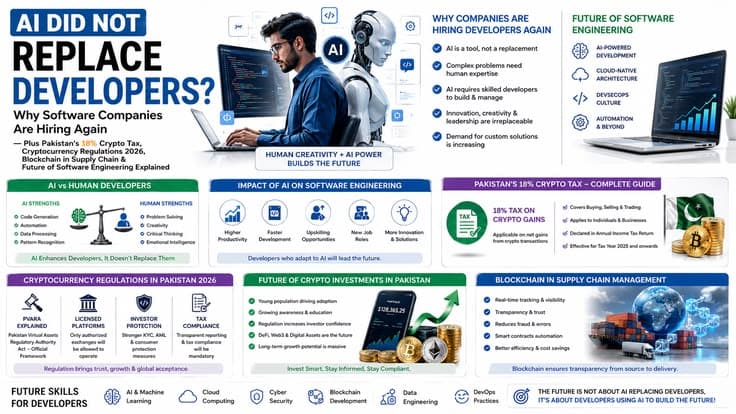
AI Did Not Replace Developers? Why Software Companies Are Hiring Again — Plus Pakistan's 18% Crypto Tax Explained
Two defining technology stories are reshaping 2026: software companies are quietly rehiring developers after discovering that AI is more costly and less productive than promised — and Pakistan has shocked its crypto community by imposing an 18% tax on digital assets before a formal crypto market even exists. This guide covers both stories in full, plus everything you need to know about the future of software engineering careers, AI vs human developers, Pakistan crypto regulations, blockchain in supply chain, and why human expertise still dominates in the AI era.
1. Breaking: Two Trending Tech Stories Defining 2026
Two major technology developments are dominating headlines across the globe in mid-2026, and both have profound implications for professionals, investors, and businesses in Pakistan and worldwide.
Story 1: AI Is More Costly Than Expected — Companies Are Rehiring Developers
Eighteen months ago, the narrative was clear: AI would slash software development costs, eliminate junior developer roles, and allow companies to build more with fewer people. That experiment has now produced its verdict — and it is not what the hype predicted. Across major technology firms, internal audits are revealing that AI-generated codebases require significantly more senior engineering time to review, debug, and maintain than originally estimated. The productivity gains at the individual task level are real, but at the system level — where integration complexity, security vulnerabilities, and maintenance costs accumulate — AI has created new categories of expensive problems that only experienced human engineers can solve.
The result: software companies are quietly but decisively rehiring. Job postings for software engineers have risen approximately 11% year-over-year. Boomerang hiring — the rehiring of developers who were laid off during the initial AI euphoria — is accelerating. Companies are specifically seeking engineers who understand legacy systems and can supervise, validate, and orchestrate AI-generated code at scale.
Story 2: Pakistan Imposes 18% Tax on Crypto — Before the Market Even Officially Launches
Pakistan's crypto community received a significant shock in the 2026 federal budget: the government imposed an 18% General Sales Tax (GST) on cryptocurrency transactions — an unusually high rate applied to an asset class that has not yet been formally launched through licensed exchanges under the new Pakistan Virtual Assets Regulatory Authority (PVARA) framework. Critics argue this creates a paradox: taxing a market before the regulatory infrastructure to support it is fully operational. Supporters argue it signals Pakistan's intent to treat crypto as a serious, taxable economic activity rather than a speculative gray market.
The implications are enormous for Pakistan's estimated 20+ million crypto users — one of the highest adoption rates per capita in the developing world. This section of the guide breaks down exactly what the tax means, who it affects, and what Pakistan's crypto future looks like.
2. Why AI Is Proving Too Costly — And Software Companies Are Hiring Again
The promise was intoxicating: AI coding assistants like GitHub Copilot, Cursor, and Claude Code would reduce headcount requirements, accelerate delivery timelines, and lower software development costs by 40–60%. Boards approved AI-first strategies. Hiring freezes replaced recruitment. Some companies executed painful layoffs in anticipation of the AI productivity revolution.
Now, in mid-2026, the post-experiment data is arriving — and it tells a far more complicated story.
The Hidden Costs of AI-Generated Code
AI coding tools genuinely accelerate the initial drafting of code. A task that once took a junior developer two days can be roughed out in two hours. But the problems begin at integration — the point where individual AI-generated code modules need to connect with real-world systems, legacy databases, proprietary APIs, and production infrastructure. Several specific cost categories have emerged:
- Security debt: AI-generated code frequently contains subtle security vulnerabilities that are not immediately obvious but create serious exposure in production. Security review of AI-generated code requires senior engineers spending 30–50% more time than reviewing human-written code of equivalent function.
- Hallucinated dependencies: AI tools confidently reference libraries, APIs, and functions that do not exist or have been deprecated, creating debugging spirals that consume far more time than the original code generation saved.
- Maintenance complexity: Codebases built primarily by AI tools tend to be larger, less coherent architecturally, and harder to maintain. When the original AI-assisted developer leaves, replacement engineers find the code difficult to understand and extend.
- Compliance gaps: AI tools do not understand sector-specific regulatory requirements — HIPAA in healthcare, PCI-DSS in payments, GDPR in data privacy. Human engineers with domain expertise are required to ensure compliance.
The Jevons Paradox at Work
The most counterintuitive finding is the Jevons Paradox effect: because AI makes coding cheaper and faster, the overall volume of software products companies attempt to build has expanded dramatically. Instead of maintaining 10 products with 50 engineers, companies now attempt to build 30 products — which still requires at least 50 engineers to oversee, integrate, and ship reliably. AI lowers the floor, but it raises the ceiling of ambition proportionally.
| AI Cost Category | Expected Saving | Actual Outcome (2026) | Net Impact |
|---|---|---|---|
| Initial code generation | 40–60% faster | 30–50% faster (verified) | Modest positive |
| Security review time | Reduced | Increased 30–50% | Net negative |
| Debugging AI output | Not factored | Significant new cost category | Net negative |
| System architecture | AI handles it | Still requires senior humans | No saving |
| Maintenance long-term | Lower | Higher (larger, harder codebases) | Net negative |
| Total headcount | 30% reduction | Net flat to growing | Neutral/positive for jobs |
The Boomerang Hiring Wave
Perhaps the most telling signal of AI's limitations is what companies are doing with their hiring budgets: many are actively re-recruiting the same senior engineers they laid off in 2023 and 2024. These "boomerang hires" are valued specifically because they understand the legacy systems that AI cannot autonomously navigate, and they can effectively supervise AI-generated code at the standards production environments require. Salaries for these returning engineers are frequently 20–35% higher than their original compensation — reflecting both market demand and the lessons organizations learned from losing them.
3. Why AI Cannot Fully Replace Software Developers
The fundamental question — will AI replace programmers? — has a clearer answer in 2026 than it did two years ago. The answer is: not fully, not soon, and possibly never for the most valuable forms of development work. The reasons are structural, not temporary.
The 10 Core Reasons AI Cannot Replace Developers
1. Managing Ambiguity and Context: Business requirements are rarely perfectly specified. A client who says "build a reporting dashboard" may mean an entirely different thing than the words suggest. Developers spend significant time in discovery — interviewing stakeholders, asking clarifying questions, challenging assumptions, and translating messy human intent into precise, executable specifications. AI can generate code from a specification, but it cannot derive the specification from organizational context and human relationships.
2. System Architecture at Scale: Designing a system that will handle 10 million users, integrate with 12 external APIs, comply with three regulatory frameworks, and be maintainable by a team that will change over five years is a deeply human cognitive task. It requires weighing trade-offs that involve business strategy, organizational capability, and technical risk simultaneously. AI generates code within a specified architecture; it does not design the architecture itself.
3. Complex, Multi-Layer Debugging: When a production system fails in a novel way — cascading errors across microservices, race conditions under specific load patterns, data corruption from an edge case in a business rule — the debugging process resembles detective work more than coding. It requires pattern recognition across years of system knowledge, hypothesis generation, experimental testing, and intuition developed through hard experience. Current AI tools perform poorly on this category of problem.
4. Innovation and Novel Problem Solving: AI is fundamentally a pattern-matching and interpolation technology. It excels at generating new instances of existing patterns. Breakthrough software innovation — new categories of products, new interaction paradigms, genuinely novel algorithmic approaches — requires human creativity operating at the frontier of what has ever been built before. AI cannot be the first to invent a new category of solution because it has no training data for it.
5. Ethical and Moral Decision-Making: Consequential software decisions — how to handle user data, what to log, how to design consent flows, how to ensure algorithmic fairness — require ethical reasoning that involves human values. An AI will generate code that does what it is told; a human developer who notices that what they have been told to build may harm users will push back, escalate, or redesign.
6. Communication and Stakeholder Management: Software engineering is fundamentally a collaborative, communicative discipline. Requirements negotiation, technical communication to non-technical stakeholders, team leadership, code review conversations, and post-incident retrospectives all require the full spectrum of human interpersonal intelligence.
7. Regulatory and Legal Compliance: Ensuring software complies with GDPR, HIPAA, PCI-DSS, SOX, Pakistan's PVARA regulations, or any of the hundreds of sector-specific legal frameworks requires human expertise in understanding complex, jurisdiction-specific legal requirements and translating them into technical controls.
8. Accountability and Ownership: When AI-generated code causes a data breach or a production outage, no AI system bears accountability. Human engineers take ownership — they are the ones who respond at 3 AM, communicate to customers, learn from failures, and ensure they do not recur.
9. Adaptability to New Technology: The technology landscape changes faster than any AI model can be retrained. Human developers continuously update their knowledge — learning new frameworks, new paradigms, new tools — in ways that AI systems cannot do autonomously between training runs.
10. User Experience Design and Empathy: Building software that humans find genuinely pleasant, intuitive, and emotionally appropriate to use requires deep empathy for how people think, feel, and behave under stress. This is irreducibly human.
| Capability | AI Performance | Human Developer Performance | Who Wins |
|---|---|---|---|
| Boilerplate code generation | Excellent | Good | AI |
| Pattern-based bug fixes | Good | Excellent | Tie |
| System architecture design | Poor | Excellent | Human |
| Requirements interpretation | Poor | Excellent | Human |
| Novel problem solving | Poor | Excellent | Human |
| Complex multi-system debugging | Poor | Excellent | Human |
| Security and compliance | Moderate | Excellent | Human |
| Stakeholder communication | None | Excellent | Human |
| Unit test generation | Good | Good | Tie |
| Code documentation | Excellent | Moderate | AI |
4. Software Companies Hiring Despite AI: The Data
Despite widespread predictions of technology sector job destruction, the data from 2026 paints a more nuanced picture. Software engineering job postings have rebounded approximately 11% year-over-year, after a 2023–2024 trough driven by post-pandemic corrections and AI adoption anxiety. The growth is not uniform — it is concentrated in specific role categories that represent the highest-value human contributions to AI-augmented software development.
Roles Seeing the Highest Demand
AI Solutions Engineers: These are senior software engineers who specialize in integrating large language model (LLM) APIs, building retrieval-augmented generation (RAG) pipelines, and automating business workflows using AI tools. They combine traditional software engineering competence with deep familiarity with AI toolchains. Salaries for this role have increased 25–40% in 18 months in major markets.
AI Full-Stack Developers: Engineers who can build complete applications — frontend in React or Next.js, backend in Python or Node.js, deployed via Docker and Kubernetes — and who additionally understand how to integrate agentic AI workflows, vector databases, and LLM orchestration frameworks. The demand for this profile has been described by multiple hiring managers as "essentially unlimited" in the current market.
Quality and Security Engineers: As AI-generated code volumes increase, the demand for engineers who specialize in testing, security review, and validation of AI outputs has surged. These roles command significant salary premiums precisely because they represent the bottleneck in AI-assisted development pipelines.
Cloud Architects: AI workloads are computationally intensive and cost-complex to optimize. Engineers who understand cloud infrastructure — AWS, GCP, Azure — and can architect cost-efficient, scalable AI deployment pipelines are among the most in-demand profiles in the 2026 market.
Cybersecurity Specialists: The attack surface of AI-augmented software is larger and more novel than traditional software. Security specialists who understand AI-specific vulnerabilities — prompt injection, model poisoning, hallucination-based exploits — are a new and high-value category.
| Role | Demand Trend | Salary Change (2024–2026) | Key Skills Required |
|---|---|---|---|
| AI Solutions Engineer | ↑↑↑ Strong Growth | +25–40% | LLM APIs, RAG, Python, cloud |
| AI Full-Stack Developer | ↑↑↑ Very High | +20–35% | React, Python, Docker, agentic AI |
| Security/Quality Engineer | ↑↑ Growing | +15–25% | AI testing, penetration testing, SAST |
| Cloud Architect | ↑↑↑ Very High | +20–30% | AWS/GCP/Azure, Kubernetes, cost optimization |
| Cybersecurity Specialist | ↑↑↑ Strong Growth | +20–35% | AI-specific security, OWASP, zero-trust |
| Senior Software Architect | ↑↑ Growing | +15–20% | System design, distributed systems |
| Entry-Level "Pure Coder" | ↓↓ Declining | Flat to negative | Basic syntax — insufficient alone |
| Boomerang Senior Engineer | ↑↑↑ High Demand | +20–35% vs. original salary | Legacy systems + AI supervision |
5. Future of Developer Jobs in the AI Era
The most accurate way to describe the future of developer jobs is an evolution from code-centric to system-centric. The developer of 2030 is less a person who types code and more a person who defines problems, orchestrates AI tools, reviews outputs, makes architectural decisions, and ensures the resulting systems are safe, compliant, and maintainable. This is a fundamentally more demanding role — and a more intellectually engaging one.
The Three Developer Archetypes Emerging
The AI Orchestrator: Senior engineers who spend most of their time defining high-level system requirements, selecting and configuring AI coding agents, reviewing their output, integrating components, and making architectural trade-off decisions. These engineers are highly paid because they multiply team output by 3–5x. They need strong system design skills, excellent code review ability, and deep understanding of AI toolchain limitations.
The Domain Specialist Developer: Engineers who combine deep software competence with specialized knowledge in a vertical domain — healthcare, fintech, logistics, energy, legal tech. These engineers are invaluable because they can translate complex domain requirements into technically sound software systems. AI tools cannot replicate domain knowledge, making these engineers increasingly scarce and valuable.
The AI/ML Engineer: Engineers who build, fine-tune, and deploy AI systems themselves — working with transformer architectures, vector databases, embedding models, and inference optimization. This is the fastest-growing category in absolute terms. Demand for AI/ML engineers is expected to grow by over 40% annually through 2030.
Skills That Will Define Developer Value in 2030
- System design and distributed architecture — The ability to design systems that are scalable, fault-tolerant, and maintainable at organizational scale
- AI tooling fluency — Deep proficiency with AI coding assistants, agentic workflows, prompt engineering, and output validation
- Security and compliance engineering — Understanding of security principles and regulatory frameworks applicable to target industries
- Product thinking — The ability to understand and influence what should be built, not just how to build it
- Communication and leadership — The ability to work effectively with non-technical stakeholders and lead cross-functional teams
- Domain expertise — Specialized knowledge in at least one industry vertical
6. AI Productivity vs Human Expertise: The Four Zones
Research from MIT Sloan, Forbes, and multiple enterprise case studies has identified a consistent four-zone model that describes how AI and human expertise interact across the lifecycle of any knowledge work task. Understanding this model is essential for both developers and organizations seeking to maximize the value of AI investments.
Zone 1: The Launch (0% to 60%) — AI Dominates
In the initial phase of any task — generating a first draft, creating boilerplate code, producing an outline, or summarizing a large document — AI performs exceptionally well. In minutes, it can produce output that would take an inexperienced human hours. The productivity gains in this zone are real and dramatic. Studies show the most significant productivity benefits accrue to less-experienced workers, who can now produce baseline-quality outputs at a speed that previously required years of accumulated knowledge.
Zone 2: The Rework (60% to 80%) — Human Oversight Required
Once AI produces its initial output, human judgment becomes essential. Fact-checking, contextualizing, identifying inconsistencies, aligning content with specific business requirements, and catching AI "hallucinations" all require domain knowledge the AI does not possess. Critically, less-experienced workers struggle most in this zone — because they lack the expertise to know what is wrong with the AI's output. The paradox: AI helps novices most in Zone 1, but exposes their knowledge gaps most in Zone 2.
Zone 3: The Refinement (80% to 90%) — Domain Expertise Essential
Pushing a task from "good" to "excellent" requires deep specialist knowledge. A senior security engineer refining AI-generated authentication code; an experienced UX designer adapting AI-produced wireframes to the specific psychological context of an application's users; a domain expert ensuring AI-generated medical billing code is compliant with the latest regulatory updates — these refinements are irreducibly human.
Zone 4: The Summit (90% to 100%) — Pure Human Judgment
The final judgments about whether something is ready to ship, whether it meets the standard the situation demands, and whether it represents the organization's values and responsibilities — these remain exclusively in the human domain. AI has no concept of "good enough for this context" without explicit human-defined criteria, and even then it cannot make the final accountability call.
| Zone | Stage | AI Contribution | Human Contribution | Risk if Human Absent |
|---|---|---|---|---|
| Zone 1 | Launch (0–60%) | Very High — fast baseline generation | Low — direction and prompting | Low — AI output acceptable |
| Zone 2 | Rework (60–80%) | Moderate — iteration on feedback | High — error detection, context alignment | High — errors propagate undetected |
| Zone 3 | Refinement (80–90%) | Low — lacks domain depth | Very High — specialist expertise | Very High — quality gap |
| Zone 4 | Summit (90–100%) | None — no accountability capacity | Exclusive — final judgment | Critical — no ship decision possible |
7. Impact of AI on Software Engineering Careers by Level
AI's impact on software engineering careers is not uniform across experience levels. The effects differ dramatically depending on career stage, specialization, and adaptability.
Impact on Junior Developers
This is the most significantly affected group. The traditional "junior developer pipeline" — where new graduates joined companies to write basic functions, fix small bugs, and build simple features under senior supervision — has been partially automated. Companies that previously hired 10 juniors per senior engineer now hire 2–3, relying on AI tools to handle the baseline work. For those entering the field, this means the path to employment is harder but not closed. The survivors are those who combine technical competence with AI tool fluency, product thinking, and communication skills from day one — traits that previous generations could develop gradually over several years.
Impact on Mid-Level Developers
Mid-level engineers (3–7 years experience) face what some engineering leaders call a "quiet crisis." They may not have the broad system design experience of seniors, but the junior tasks they relied on to build context are now handled by AI. The most successful mid-level engineers are aggressively expanding into AI-native workflows, taking ownership of system design decisions, and building domain expertise in specific verticals. Those who do not adapt risk being squeezed between AI tools above and a shrinking junior market below.
Impact on Senior Developers and Architects
For experienced engineers, AI has been unambiguously positive. Senior engineers who adopt AI tools report productivity gains of 2–5x on individual tasks while their unique value — architecture, judgment, domain knowledge, stakeholder management — has become more scarce and more valued relative to the market. Senior engineers who master AI-assisted development are effectively functioning as small teams, and are being compensated accordingly.
| Career Level | Experience | AI Impact | Job Security | Action Required |
|---|---|---|---|---|
| Entry/Junior | 0–2 years | High disruption — baseline tasks automated | Reduced | Master AI tools + system thinking from day one |
| Mid-Level | 3–7 years | Medium disruption — squeeze from both directions | Moderate | Expand into architecture, domain expertise |
| Senior | 8+ years | Net positive — AI multiplies output | High and growing | Adopt AI tools, mentor others on AI workflows |
| Architect/Lead | 10+ years | Strongly positive — scarcest resource | Very High | Lead AI adoption strategy, design AI-native systems |
| AI/ML Specialist | Any | Explosive growth opportunity | Very High | Build AI/ML fundamentals, specialize in LLM applications |
8. Why Human Developers Still Matter in 2026
The most reliable verdict from 2026's AI experiment in software development is this: the role of human developers has not been eliminated — it has been elevated. The routine, mechanical parts of coding have been automated. What remains is everything that made software development intellectually demanding and economically valuable in the first place.
Human developers still matter for four irreducible reasons. First, supervision and quality control: AI models generate code quickly but hallucinate, produce insecure logic, and create technical debt at scale. Human engineers are the essential quality gate between AI output and production systems. Second, system architecture: the capacity to envision how large, complex systems should be organized — what components to use, how they should interact, what trade-offs to make between speed, cost, reliability, and maintainability — remains exclusively human. Third, domain knowledge translation: converting messy, implicit, evolving business requirements into precise, reliable software requires deep understanding of both the business domain and its regulatory context. Fourth, accountability: when systems fail, the human engineer is accountable — to their team, their organization, their users, and the law. AI bears no accountability and therefore cannot substitute for the humans who do.
The developers who are thriving in 2026 are those who have reframed their identity: not as "code writers" but as "software system owners" who happen to use AI tools as one of many instruments in their workflow.
9. Pakistan's 18% Crypto Tax: Complete Explained Guide
In a move that surprised Pakistan's large and active crypto community, the 2026 federal budget introduced an 18% General Sales Tax (GST) on cryptocurrency transactions. This comes at a particularly complex moment: the Pakistan Virtual Assets Regulatory Authority (PVARA) is newly established, licensing frameworks for exchanges are still being finalized, and the formal, regulated crypto market has not yet launched. Critics have called the tax premature; the government argues it formalizes an already-large informal market.
What Is Taxed at 18%?
The 18% GST applies to services provided in connection with cryptocurrency transactions — including exchange services, brokerage fees, and transaction processing fees charged by virtual asset service providers. This is in addition to the existing capital gains tax structure on crypto profits. In practical terms, every time you transact through a licensed exchange, 18% GST is applicable to the service fee component of that transaction.
The Full Pakistan Crypto Tax Structure (2026)
| Tax Type | Rate | Applicable To | Trigger Event | Exemptions |
|---|---|---|---|---|
| Capital Gains Tax (CGT) | 15% | Profits from buying/selling crypto | Sale, P2P trade, crypto-to-crypto swap | Profits below PKR 50,000/year |
| General Sales Tax (GST) | 18% | Exchange/brokerage services | Each transaction via licensed platform | Direct P2P (unclear — evolving) |
| Income Tax (Mining) | Progressive slab rates | Crypto mining income | Block reward received | Deductible: electricity, hardware costs |
| Income Tax (Staking/DeFi) | Progressive slab rates | Staking, yield farming, DeFi rewards | Rewards received | Limited deductions available |
| Income Tax (Airdrops) | Progressive slab rates | Tokens received via airdrops | Airdrop receipt | None currently |
| Non-Filer Surcharge | Additional +varies | Non-registered taxpayers | Any crypto income activity | N/A — only for registered filers |
The Paradox: Taxing Before the Market Launches
The most significant controversy surrounding Pakistan's crypto tax is its timing. PVARA was formally constituted under the Virtual Assets Act, 2026, but as of the budget announcement, no exchanges have yet received full operational licenses under the new framework. This creates a practical paradox: the government is collecting GST on services that are not yet formally authorized to operate. The Pakistan Crypto Council and several legal scholars have argued this puts legitimate crypto businesses in an impossible compliance position — required to collect and remit a tax while simultaneously waiting for the license that permits them to legally provide the taxable service.
How the 18% GST Affects Pakistani Crypto Users
For the average Pakistani crypto trader or investor, the practical impact of the 18% GST depends significantly on how they currently access crypto markets. Users of major offshore platforms (which remain unlicensed in Pakistan) face ambiguity about whether the GST applies to their transactions. Users who migrate to licensed local exchanges — once available — will pay 18% GST on every service fee. For active traders, this substantially increases transaction costs and may reduce the economics of short-term trading strategies. For long-term holders, the primary tax exposure remains the 15% CGT on realized gains.
Important note: Tax laws involving cryptocurrency are evolving rapidly and the specifics above may change. Always consult a qualified Pakistani tax professional or the FBR's official guidance before making financial decisions.
10. Cryptocurrency Regulations in Pakistan 2026: Complete Framework
Pakistan's relationship with cryptocurrency has undergone a dramatic reversal. For years, the State Bank of Pakistan (SBP) maintained a functional ban, warning banks against facilitating crypto transactions. That ban has now been formally lifted and replaced with the most comprehensive crypto regulatory framework in Pakistan's history.
The Virtual Assets Act, 2026
Pakistan's Virtual Assets Act, 2026 is the cornerstone legislation governing cryptocurrency. It establishes PVARA as the primary regulatory authority, defines Virtual Asset Service Providers (VASPs) and their licensing requirements, sets AML/CTF compliance standards, and creates a Sharia Advisory Committee — making Pakistan one of the first countries globally to formally integrate Islamic finance principles into its digital asset regulatory framework.
Key Provisions of Pakistan's Crypto Framework
- PVARA licensing: All exchanges, custodians, brokers, and other VASPs must obtain a license from PVARA to operate legally
- Banking access: The SBP now permits regulated banks to open Client Money Accounts (CMAs) for licensed VASPs, solving the banking access problem that had plagued the sector
- KYC requirements: All licensed platforms must enforce Know Your Customer protocols and report trading data to PVARA and the FBR
- Privacy coin ban: Monero, Zcash, and other privacy-focused cryptocurrencies remain prohibited to prevent money laundering
- AML/CTF standards: Full compliance with Financial Action Task Force (FATF) standards required for all licensed operators
- Sharia compliance: A dedicated Sharia Advisory Committee reviews and certifies crypto products for Islamic finance compatibility
Government Strategic Initiatives
Beyond regulation, Pakistan has announced several ambitious strategic crypto-related initiatives. The government has earmarked approximately 2,000 MW of surplus power specifically for Bitcoin mining and AI data center operations, representing a significant bet on crypto mining as an economic activity. Strategic exploration of a national Bitcoin reserve is underway, following precedents set by El Salvador and, more recently, several Gulf states. The State Bank is also studying the feasibility of a Digital Rupee (CBDC) alongside the regulated private crypto ecosystem.
| Regulatory Element | Status (2026) | Governing Body | Key Requirement |
|---|---|---|---|
| Crypto legal status | Legal — digital asset class | PVARA / SBP | Not legal tender; must use PKR for payments |
| Exchange operation | Requires PVARA license | PVARA | KYC, AML, capital requirements |
| Banking access | Permitted for licensed VASPs | SBP | Client Money Accounts only |
| Taxation | Active — multiple categories | FBR / PVARA | 15% CGT + 18% GST on exchange services |
| Privacy coins | Banned | PVARA | Monero, Zcash prohibited |
| Sharia compliance | Committee established | Sharia Advisory Committee | Certification available for compliant products |
| Bitcoin mining | Government-supported | Government / PVARA | 2,000 MW surplus power earmarked |
| National BTC reserve | Under exploration | Federal Government | No formal decision yet |
11. Future of Crypto Investments in Pakistan
Pakistan is home to an estimated 20+ million cryptocurrency users — one of the largest crypto user bases in the developing world relative to formal financial sector participation. The country ranked among the top nations globally for grassroots crypto adoption for several consecutive years, driven by a combination of unbanked population seeking financial access, overseas workers using stablecoins for remittances, and tech-savvy younger demographics attracted by investment potential.
The Opportunity
The formalization of Pakistan's crypto market through PVARA represents a genuine turning point. For the first time, crypto investors can operate with legal certainty, use licensed local exchanges with consumer protection, and access banking services for their crypto activities. The government's decision to support Bitcoin mining using surplus energy could generate significant export revenue and position Pakistan as a regional hub for digital asset infrastructure.
For investors, the regulated environment reduces the counterparty risk that characterized P2P and offshore exchange usage. Consumer protection frameworks, KYC-verified platforms, and dispute resolution mechanisms are features that serious investors have long demanded and which were absent in the gray-market era.
The Challenges
The 18% GST adds meaningful friction to trading activity and may push some traders back toward offshore platforms to avoid the tax burden — a perverse incentive that could undermine the regulatory framework's goals. Financial literacy among Pakistan's large crypto user base remains uneven, leaving many vulnerable to market volatility and scams even under the new framework. The formal exchange ecosystem will take 12–24 months to mature fully, creating a transition period of regulatory ambiguity. And global crypto market volatility remains an ever-present risk for Pakistani investors who typically do not hedge their positions.
Stablecoins and Remittances
Perhaps the most practically significant use case for cryptocurrency in Pakistan is not investment but remittances. Pakistan receives approximately $30 billion in annual remittances — a critical component of the national economy. Using USDT, USDC, or other dollar-pegged stablecoins, overseas workers can transfer funds to Pakistan at dramatically lower cost and greater speed than traditional banking channels. As licensed exchanges come online, this use case is expected to grow substantially, potentially generating regulatory revenue that justifies the initial infrastructure investment.
12. Blockchain Technology in Supply Chain Management
While crypto markets generate headlines, blockchain technology's most transformative real-world applications are quietly reshaping global supply chains. Blockchain provides an immutable, decentralized ledger that enables unprecedented transparency, traceability, and automation across complex, multi-party logistics networks.
Core Applications in Supply Chain
Provenance and Traceability: Companies like Walmart, Nestlé, and Unilever use blockchain to track food products from farm to shelf. When a contamination event occurs, blockchain enables the precise identification and removal of affected products in hours rather than days — a capability that the 2018 romaine lettuce E. coli outbreak demonstrated was critically absent from conventional tracing systems.
Anti-Counterfeiting: In pharmaceuticals, luxury goods, and high-value manufacturing components, blockchain-based authentication makes counterfeiting economically prohibitive. Each item receives a unique blockchain-verified digital identity that can be confirmed at any point in the supply chain by any authorized party.
Automated Supply Chain Finance: Smart contracts on blockchain networks can automatically trigger payments when delivery milestones are verified on-chain — eliminating the invoice reconciliation delays that currently represent a major working capital burden for suppliers in global supply chains. Trade finance processes that currently take 10–14 days can be reduced to hours.
Sustainability Verification: Blockchain enables tamper-proof carbon accounting across supply chains, allowing companies to verify and certify the environmental claims of their suppliers. ESG reporting becomes auditable rather than self-reported, addressing a major credibility gap in current corporate sustainability frameworks.
| Use Case | Industry | Key Benefit | Adoption Stage | Example |
|---|---|---|---|---|
| Food traceability | FMCG / Retail | Contamination response: days → hours | Active deployment | Walmart + IBM Food Trust |
| Anti-counterfeiting | Pharma / Luxury | Eliminates counterfeit market access | Active deployment | LVMH Aura, MediLedger |
| Smart contract payments | Trade Finance | Settlement: 14 days → hours | Pilot to early deployment | Marco Polo, Contour |
| Carbon accounting | Cross-industry | Auditable ESG reporting | Early adoption | Multiple consortia |
| Inventory management | Manufacturing | Real-time multi-party visibility | Growing adoption | BMW, Toyota pilots |
| Customs clearance | Logistics | Document fraud elimination | Regulatory pilots | TradeLens (historical), successors |
Challenges to Blockchain Supply Chain Adoption
The primary barrier to blockchain adoption in supply chains is not technological but organizational. Multi-party blockchain networks require competing organizations to agree on data standards, governance frameworks, and the division of costs and benefits. The largest supply chains are often the most fragmented organizationally, making network formation slow and politically complex. Integration with legacy ERP systems — SAP, Oracle, Microsoft Dynamics — requires significant custom development work. And the energy consumption of some blockchain architectures (though private and consortium chains are far more efficient than public proof-of-work networks) remains a concern in sustainability-conscious procurement departments.
13. Conclusion: What This All Means for You
The two defining tech stories of 2026 — the AI developer hiring reversal and Pakistan's crypto tax — share a common thread: reality is more complex, more costly, and more interesting than the initial hype in either direction suggested.
For developers, the message is clear: AI has not destroyed your career — it has transformed it. The engineers who are thriving are those who have reframed themselves as system owners and AI orchestrators, mastered the tools, and invested in the human skills — architecture, domain expertise, communication, judgment — that AI cannot replicate. The engineers who are struggling are those who expected AI to be a temporary disruption that would pass, or who expected it to make traditional "code writing" roles obsolete and therefore not worth investing in.
For Pakistani crypto investors and businesses, the message is equally clear: the regulatory environment has permanently changed. Operating in the gray market is becoming riskier, not safer, as PVARA gains enforcement capability. The 18% GST is painful and arguably premature, but it signals that Pakistan is treating crypto as a permanent part of the financial landscape — not a temporary anomaly to be eliminated. Serious investors should formalize their tax positions, engage with licensed exchanges as they come online, and consult qualified tax professionals about their specific circumstances.
In both cases — AI and crypto — the professionals and investors who will thrive over the next decade are those who engage seriously with the underlying technologies, understand their genuine capabilities and limitations, and make decisions based on evidence rather than either uncritical enthusiasm or reflexive fear.