De-Dollarization Explained: How China and Russia Are Quietly Ditching the Dollar (And What It Actually Means)
No jargon, no lecture — just two friends talking through one of the strangest, quietest shifts happening in the world economy right now.
Okay, So What Are We Actually Talking About Here?
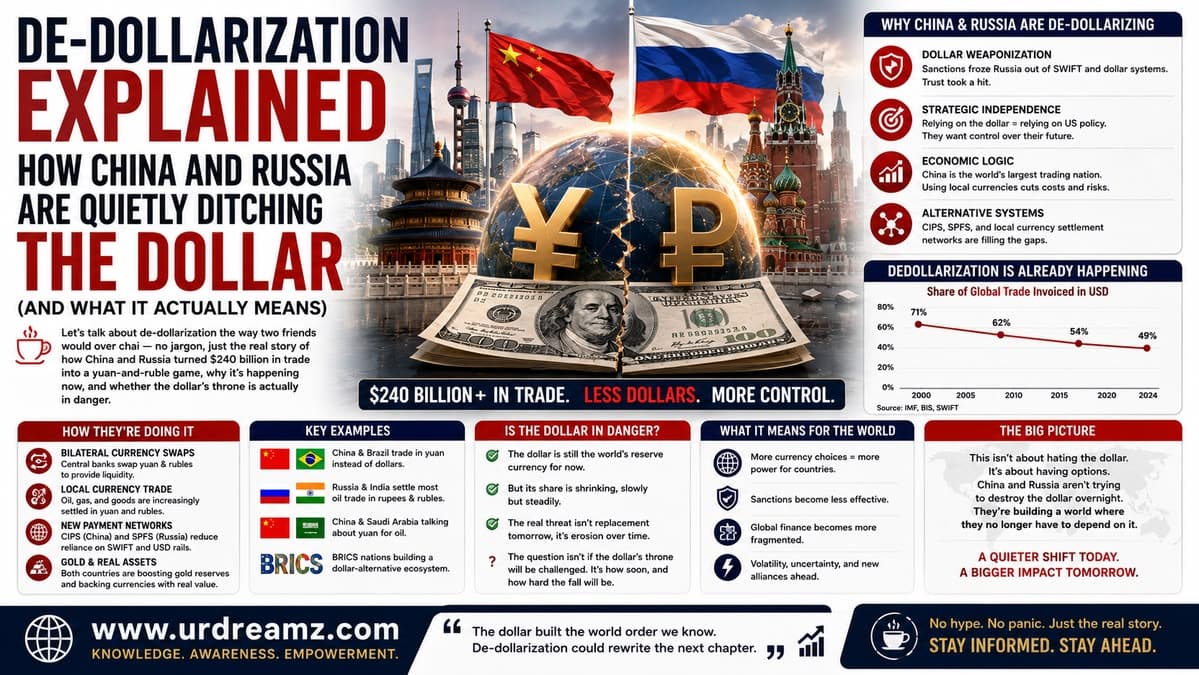
Let's just talk about this the way we'd talk about it if we were sitting across from each other with a cup of chai, not like a textbook. For as long as either of us has been alive, when people say "the world's money," they basically mean one thing: the US dollar. Doesn't matter if it's oil from the Gulf, gadgets from Asia, or a random invoice between two companies in South America that have nothing to do with the US — chances are, somewhere in that transaction, dollars changed hands. That's just been the rule of the game. People call it "dollar hegemony" or "the dollar's throne," and honestly, that's not an exaggeration.
Even something as simple as buying oil in a country that has nothing to do with America has, for decades, usually meant a dollar sign showed up somewhere in the paperwork. That's how deeply this one currency got woven into practically every corner of the global economy, far beyond anything America's own size alone would explain.
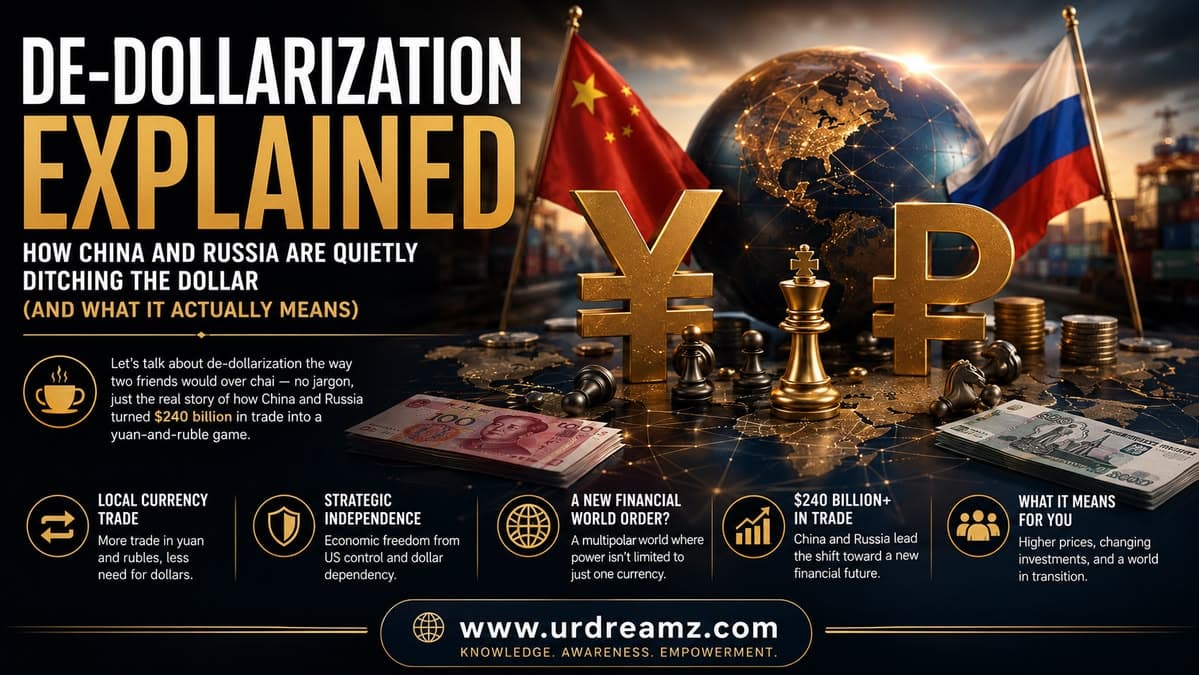
But here's the thing nobody's shouting about on the news, because it's not happening with fireworks — it's happening quietly, almost politely, like two neighbors slowly redoing the fence between their houses without telling anyone. China and Russia have been building a trade relationship so large and so deliberately structured around their own currencies that a huge chunk of it now barely touches the dollar at all. And when a shift like that happens between two of the biggest economies on Earth, people start using a word for it: de-dollarization.
So that's our topic today. Not the scary headline version, not the "the dollar is about to collapse tomorrow" version — just the real, documented story of what's actually happening, why it's happening now of all times, and what it might mean for the rest of us watching from the sidelines.
And look, I know these topics usually come wrapped in either total panic ("the dollar is dying, run for the hills") or total dismissal ("nothing's changing, don't worry about it"). Neither of those is really honest. The truth, like most real things, sits somewhere in the middle — genuinely fascinating, genuinely significant, but also genuinely more gradual and complicated than either extreme version makes it sound. So let's just walk through it together, piece by piece, the way you'd explain something to a friend who's smart but just hasn't had time to read all the reports themselves.
Why the Dollar Became King in the First Place
Before we get into China and Russia, let's quickly rewind, because the "why" here actually matters. The dollar didn't become the world's currency by accident — it was basically built that way on purpose, right after World War II.
| Moment | What Happened |
|---|---|
| 1944 — Bretton Woods Agreement | Major world economies agreed to peg their currencies to the dollar, and the dollar itself was pegged to gold |
| 1971 — Nixon ends the gold standard | The US stopped backing the dollar with gold, but the world kept using it as the default anyway, out of sheer habit and trust |
| 1970s — The "petrodollar" system | Oil-producing nations, especially Saudi Arabia, agreed to price and sell oil in dollars, cementing global demand for the currency |
| Ever since | Central banks worldwide hold dollars as their main reserve currency, and most global trade gets priced and settled in dollars by default |
So basically, the dollar's "kingship" isn't some ancient law of nature — it's a system that got deliberately built, piece by piece, over about three decades. And systems that get built can, at least in theory, get rebuilt. That's the door China and Russia have been quietly walking through.
Here's a way to think about why this system stuck around for so long, way past the point where the original gold-backing was even part of the deal: pure habit and trust, reinforced over and over by convenience. Once basically every bank, every trading desk, every oil terminal on Earth was set up to deal primarily in dollars, switching away from that became genuinely expensive and inconvenient for anyone trying to do it alone. It's a bit like everyone in a huge market agreeing to use one specific currency of chips at the tables — even if you'd personally rather use something else, if literally every other table only accepts those chips, you're stuck using them too, purely because that's what everyone else is doing. That's a huge part of why the dollar's position lasted as long as it has, completely separate from whether people actually still trust the US government's economic management as much as they once did.
Enter China and Russia: The Quiet Handshake
Here's where your original point really lands well: this hasn't been loud. There's been no press conference where China and Russia announced "we're going to dethrone the dollar." It's been the opposite — a slow, steady, almost boring-looking buildup of trade infrastructure, banking agreements, and currency swap deals that, brick by brick, added up to something genuinely enormous.
And the reason it's China and Russia specifically, and not some random pair of countries, comes down to simple math: these are two of the largest economies on the planet, sitting right next to each other, with exactly the kind of complementary needs that make a big trade relationship click. Russia has oil, gas, and raw materials in abundance. China has manufacturing, electronics, and consumer goods in abundance. Put those two together, add a shared incentive to reduce dependence on a currency controlled by a government both of them have tense relationships with, and you get exactly the kind of "let's just deal with each other directly" arrangement we're seeing play out.
What's genuinely striking, if you actually sit and read through the years of statements and agreements leading up to this point, is how unglamorous most of the groundwork looked at the time. Currency swap lines between China's and Russia's central banks, quietly signed years before anyone outside financial circles was paying attention. Small pilot programs letting a handful of Russian and Chinese banks settle specific transactions directly. Gradual increases in yuan trading volume on the Moscow Exchange, reported in financial trade press but barely making it into mainstream headlines. None of it looked like a dramatic geopolitical chess move in the moment — it looked like boring plumbing work. And that's exactly the point: the biggest structural shifts rarely arrive with a bang. They arrive as years of quiet plumbing work that only becomes an obvious, headline-worthy story once the pipes are already fully connected.
The Actual Numbers (And Yes, They're Real)
Now, let's actually look at the numbers, because this isn't some vague internet claim — it's backed by Chinese customs data and Russian government statements, both publicly available.
| Year | China-Russia Bilateral Trade |
|---|---|
| 2020 | Roughly $104 billion |
| 2023 | About $240 billion |
| 2024 | A record $244.8 billion (1.74 trillion yuan) |
| 2025 | Around $228 billion — a slight dip, but still more than double the 2020 figure |
So that $240 billion figure you mentioned? Spot on — that's exactly where this relationship has been sitting for the last couple of years, more than double what it was just five years earlier. Even with a small dip in 2025 (partly because of payment friction we'll get into shortly), we're still talking about one of the biggest bilateral trade relationships anywhere on the planet.
To put that in perspective, more than doubling a trade relationship in just four or five years is genuinely rare for two economies this size — usually you see that kind of growth curve between a small, fast-industrializing country and a much bigger partner, not between two nations that were already each other's major trading partners to begin with. Part of what makes the jump so sharp is exactly what we talked about with Western sanctions: when Western companies pulled out of Russia almost overnight after 2022, that left an enormous, sudden vacuum in nearly every sector of the Russian economy, from cars to electronics to industrial parts — and China, sitting right next door with a massive manufacturing base ready to scale up, was simply the fastest, most convenient replacement available. That's a big part of why the growth wasn't gradual and steady, but showed up as a genuine surge in a very short window of time.
The Real Twist: 95% (Now Basically 99%) in Yuan and Rubles
Here's the part that actually makes this story interesting, not just big. It's not just that the trade volume is huge — it's what currency that trade is happening in. By 2024, more than 95% of all China-Russia trade settlements were happening directly in yuan and rubles, completely bypassing the dollar. And by late 2025, some Russian officials were putting that number even higher — close to 99%, which is about as close to "completely" as any real-world statistic in economics ever gets.
| Timeframe | Share of Trade Settled in Yuan/Rubles |
|---|---|
| 2023 | Around 95%, according to Russian officials |
| 2024 | Over 95%, confirmed by multiple financial reports |
| Late 2025 / early 2026 | Close to 99%, according to statements from Russia's Finance Ministry |
Think about how big a shift that actually is. A decade ago, if a Russian oil company sold crude to a Chinese refinery, that invoice was almost certainly priced and settled in dollars, even though neither company was American and neither government particularly loved the idea. Now? That same transaction is happening directly in yuan or rubles, dollar completely out of the picture. That's not a small technical detail — that's the entire architecture of how two massive economies pay each other getting rebuilt from the ground up.
It's worth pausing on why this specific number — the percentage settled in local currencies rather than the total trade value — is actually the more important statistic of the two, even though the dollar-value headline number usually gets more attention. A country can have enormous total trade with another country and still route every single payment through dollars behind the scenes; the total volume alone tells you nothing about which currency is actually doing the work. The settlement percentage is the number that tells you whether the underlying financial plumbing has genuinely changed. And going from a system where the dollar quietly touched almost every transaction to one where it's involved in roughly one out of every hundred transactions, in just a handful of years, is about as dramatic a shift in financial plumbing as you'll ever see between two major economies during peacetime.
Why Now? The Sanctions Story
So why did this really take off? Honestly, the answer is less "grand master plan" and more "necessity." After Russia's 2022 invasion of Ukraine, Western countries hit Russia with sweeping financial sanctions, cutting many Russian banks off from the dollar-based international payment system. That left Russia with a genuinely urgent, practical problem: how do you keep trading with the rest of the world if the usual payment rails are suddenly blocked?
China, already sitting on years of quiet effort to internationalize its own currency and reduce its own vulnerability to potential future US sanctions, was right there with a ready answer: let's just trade directly in yuan and rubles. It solved Russia's immediate problem, and it happened to align perfectly with China's longer-term ambition of making the yuan a genuinely global currency rather than one mostly used at home. Two countries, two different motivations, one very convenient shared solution.
There's a slightly uncomfortable but honest way to describe the timing here: Western sanctions basically did China's marketing for it. China had been trying, in a fairly measured and patient way, to convince other countries to consider using the yuan more for years, with only modest success — most of the world simply had no urgent reason to bother switching away from a system that already worked fine for them. Then, almost overnight, one of China's biggest neighbors and trading partners suddenly had an extremely urgent reason. Sanctions didn't just fail to stop Russia from trading with the rest of the world; in a strange, unintended way, they accelerated exactly the kind of alternative payment system Beijing had been quietly hoping to build for years, just handed to it on a much faster timeline than it could have achieved through gradual persuasion alone.
What's Actually Moving Between These Two Countries
You mentioned Chinese electronics, cars, and machinery flooding into Russia, and that part checks out completely — the numbers back it up in a big way.
| Flowing Into Russia (from China) | Flowing Into China (from Russia) |
|---|---|
| Passenger cars — over 1 million exported in 2024 alone | Crude oil and refined petroleum products |
| Trucks — nearly 70,000 units in 2024 | Natural gas via pipeline and LNG shipments |
| Smartphones and consumer electronics | Coal and other raw materials |
| Industrial machinery and equipment | Timber and agricultural products |
Chinese car exports to Russia in particular are a great example of how fast this shift happened. When Western automakers pulled out of Russia after 2022, Chinese brands stepped into that gap almost instantly — and by 2024, Chinese passenger cars and trucks were showing up on Russian roads in genuinely massive numbers, more than a million vehicles in a single year. That's not a slow trickle; that's a full-on flood filling a vacuum almost overnight.
What's interesting is that this flood has already started to level off a bit, which tells its own small story about how these things actually evolve rather than growing forever in a straight line. By 2025, passenger car exports from China to Russia had reportedly dropped by around 42%, and truck exports fell even more sharply, by roughly 72%, compared to the previous year's peak. That doesn't mean Chinese cars are disappearing from Russian roads — export volumes are still well above where they sat before 2022 — but it's a reminder that even a fast-moving trend like this one settles into a more normal rhythm eventually, rather than continuing to explode indefinitely. Markets, even ones shaped heavily by geopolitics, still tend to find some kind of natural ceiling once the initial urgent gap gets filled.
The "Two Shopkeepers" Way of Understanding This
Your own analogy is honestly one of the best ways to explain this to someone who doesn't follow economics closely, so let's run with it. Imagine two big shopkeepers in the same neighborhood who, for years, have been settling every single deal between them through a third guy's ledger — someone who isn't even part of their deal, but everyone just uses his notebook out of habit because that's "how it's always been done."
Now, here's the part of the analogy that makes it feel especially real: imagine that third guy, the one holding everyone's notebook, has recently started using his control over that notebook as leverage — refusing to record certain deals, freezing certain pages, telling one shopkeeper he can't settle up with a third neighbor anymore because that neighbor is currently in the notebook-keeper's bad books. At some point, even a shopkeeper who was previously totally happy with the arrangement starts thinking hard about whether relying entirely on someone else's notebook, especially one that person can selectively edit, is really such a safe long-term bet. That's more or less the exact psychological shift that's been playing out at a national level — not because anyone necessarily distrusted the notebook-keeper before, but because watching the notebook get used as a weapon against one shopkeeper made every other shopkeeper start quietly wondering if they might be next.
Then one day, the two shopkeepers look at each other and go: wait, why are we still doing this through his notebook? We trust each other enough. Let's just open our own ledger, track it between ourselves, and cut the middleman out entirely. That's basically what's happening here. The "middleman notebook" is the dollar-based international payment system, and China and Russia have essentially decided they trust each other enough — and have enough of a shared incentive — to just deal with each other directly instead.
And just like in that neighborhood analogy, once two big shopkeepers start doing this successfully, other shopkeepers start watching closely, wondering if they should set up their own direct ledgers too.
Let's push the analogy just a little further, because it actually captures something else important too: switching to your own ledger isn't automatically smooth just because you've decided to do it. The two shopkeepers still have to agree on exchange rates between their own notebooks, still have to figure out what to do if one side ends up holding more of the other's currency than they know what to do with, and still have to build a level of trust that a third-party notebook used to provide almost automatically, just by being a neutral middleman everyone already trusted. That's basically the "cracks in the plan" we'll get to in a bit — the idea sounds simple in an analogy, but making it work smoothly in the real world, at the scale of hundreds of billions of dollars, is genuinely a much harder engineering problem than it sounds.
It's Not Just These Two — Who Else Is Joining the Match
This is exactly where your "new match, new teams" idea comes in, and it's genuinely accurate. China and Russia aren't playing this game alone anymore — other countries have been quietly testing the same approach.
| Country | What They've Been Doing |
|---|---|
| Brazil | Signed an agreement to settle China trade directly in yuan and Brazilian reais, with a dedicated yuan clearing bank set up in Brazil |
| India | Some Indian refiners have used yuan to pay for Russian oil purchases, sidestepping dollar-based payment routes |
| Saudi Arabia and Gulf states | Engaged in discussions and limited deals around yuan-based oil settlement, chipping away at the old "petrodollar" assumption |
| Central banks worldwide | The dollar's share of global central bank reserves has slipped from around 70% at the start of the millennium to under 60% more recently |
None of these examples are as dramatic as the China-Russia relationship yet, but they show the same underlying instinct spreading: more countries are quietly testing whether they really need the dollar in the middle of every single transaction, or whether direct currency deals can work just fine.
It's worth being clear-eyed about the difference in scale here, though, because it's easy to lump all of these examples together into one big "de-dollarization wave" when the reality is a lot more uneven. The China-Russia relationship is a fully mature, structurally embedded system now, covering the overwhelming majority of an enormous trade relationship. Brazil's yuan arrangement, by comparison, is still a relatively small and early-stage piece of its overall trade, most of which still runs through dollars. India's yuan use for Russian oil purchases has been described by Indian officials themselves as pragmatic and situational, driven by sanctions-related payment difficulties, rather than a deliberate long-term strategic shift away from the dollar as a matter of policy. Saudi Arabia and the Gulf states have discussed yuan-based oil settlement more as a bargaining chip and a hedge against overreliance on any single partner than as a settled, adopted practice. So while the direction of travel is genuinely similar across all these examples, the depth and permanence of the shift varies enormously from one case to the next — China-Russia is the deep end of the pool, and most of the rest of the world is still standing near the shallow end, testing the water with a toe.
Okay But Is the Dollar Actually in Trouble?
Here's where we need to be honest rather than dramatic, because it's easy to read all this and assume the dollar's about to fall off a cliff. It isn't — at least not anytime soon, and the data backs that up clearly.
| Reality Check | What the Numbers Actually Show |
|---|---|
| Dollar's share of global reserves | Still around 58–59% — down from 70%, but still by far the largest share of any single currency |
| Yuan's share of global reserves | Still in the low single digits globally, despite its huge role specifically in China-Russia trade |
| Global oil trade | Still majority priced in dollars overall, even as yuan-based deals grow in specific corridors |
| SWIFT payment system usage | Dollar remains the dominant currency for cross-border payments worldwide by a wide margin |
So the honest picture is this: what's happening between China and Russia specifically is real, well-documented, and genuinely significant — but it's happening inside one particular relationship, largely driven by sanctions pressure that most other countries aren't currently facing. It hasn't yet translated into the dollar losing its overall global crown. Think of it less like "the king has been dethroned" and more like "two powerful nobles have quietly built their own separate trading system on the side, and a few others are watching closely to see if they should do the same."
It helps to understand just how deep the dollar's advantages really run, beyond simple habit, because that's exactly what makes dethroning it such a genuinely slow process even under real pressure. The dollar benefits from the depth and liquidity of American financial markets, which are simply larger and more mature than almost any alternative on Earth, making it easy to move enormous sums in and out without drastically moving prices. It benefits from the rule of law and relative predictability of US courts enforcing financial contracts, something plenty of countries still trust more than the legal systems of potential alternative currency issuers. And it benefits from decades of accumulated infrastructure — clearing systems, correspondent banking relationships, hedging instruments — built specifically around dollar transactions, all of which would need to be replicated at genuinely enormous scale before any rival currency could realistically take over the dollar's overall global role rather than just chipping away at specific corners of it.
The Cracks in the Plan Nobody Talks About
Now, here's something that doesn't get mentioned enough in the excited headlines: this yuan-ruble system isn't as smooth as it sounds on paper. Russian companies have reportedly run into real, practical headaches trying to actually use the yuan they earn — trouble repatriating it efficiently, trouble deploying it usefully inside Russia's own financial markets, and Chinese banks applying extra caution on these deals because they're worried about getting hit with secondary sanctions themselves for doing business with sanctioned Russian entities.
There's also a liquidity problem — basically, there isn't yet a deep, mature global market for hedging and trading yuan-ruble transactions the way there is for dollar transactions, which makes large-scale corporate deals genuinely trickier to manage. And overall bilateral trade between the two countries actually dipped in 2025 for the first time in years, partly because of exactly these payment frictions. So this isn't some flawless, unstoppable machine — it's more like two determined partners building a brand-new system together, hitting real bumps along the way, but choosing to push through them anyway because the alternative (staying dependent on a currency controlled by a government they don't trust) feels worse to them than the growing pains.
To make this a bit more concrete, imagine a Russian energy company that sells a huge shipment of oil to a Chinese buyer and gets paid in yuan instead of dollars. Great, except now that Russian company is sitting on a large pile of Chinese currency it can't easily spend inside Russia, can't easily convert back into rubles without moving the exchange rate against itself, and can't easily invest in a deep, liquid Chinese bond market the way it once could park dollars in globally recognized US Treasury securities. Multiply that same headache across thousands of individual transactions, and you start to see why officials on both sides keep describing "settlement challenges" as an ongoing, unresolved issue even three years into this arrangement, rather than a problem that simply got solved once and for all when the two countries agreed to switch currencies in principle. Building a truly deep alternative financial ecosystem — with its own bond markets, hedging tools, and investment options — takes far longer than simply agreeing to invoice each other in a different currency, and that gap is exactly where most of the current friction lives.
What This Actually Means for Regular People Like Us
Okay, so why should any of this matter to someone who isn't a central banker or a hedge fund manager? Honestly, in the short term, probably not that much changes for your daily life directly. But zoom out a little, and there are a few genuinely interesting ripple effects worth understanding.
| Ripple Effect | Why It Matters |
|---|---|
| Slowly reduced US leverage from sanctions | If fewer countries rely on the dollar-based system, US sanctions become somewhat less globally effective as a tool |
| A more genuinely multipolar world economy | Trade increasingly flows through multiple currency systems rather than one single dominant one |
| New opportunities and risks for other emerging economies | Countries like Pakistan, India, and Gulf states get more currency options, but also more complexity to navigate |
| Long-term questions about dollar demand | If this trend spreads meaningfully beyond China and Russia, it could gradually affect global demand for dollars over many years |
None of this is an overnight story — it's a slow-burning shift playing out over years and likely decades, not months. But it's exactly the kind of quiet, structural change that's worth understanding now, rather than being surprised by it later once it's already reshaped the board.
Let's get even more concrete about how this could theoretically ripple outward, purely as a thought exercise rather than a prediction. If, over the coming decade, a meaningfully larger share of global trade genuinely shifts toward multiple regional currencies instead of one dominant global one, a few things could gradually follow: global currency markets could become somewhat more fragmented, meaning ordinary cross-border payments and remittances might eventually involve slightly more currency-conversion steps than they do today in a dollar-dominated world. Countries that currently benefit from cheap borrowing partly because global demand for dollar-denominated debt keeps interest rates relatively low could, over a very long horizon, see that advantage erode somewhat if global demand for dollars genuinely declines in a broad, sustained way. And countries positioned as regional trade hubs for the yuan, rather than the dollar, could see new opportunities open up in banking, logistics, and finance that didn't previously exist. All of this is speculative and depends heavily on how far this trend actually spreads beyond its current, fairly narrow China-Russia core — but it's the kind of long-run scenario serious economists genuinely discuss, rather than dismiss outright, precisely because the underlying shift, however slow, is real and ongoing.
Frequently Asked Questions
What is de-dollarization?
It's the process of countries reducing their reliance on the US dollar for international trade, reserves, and financial transactions, often replacing it with their own or partner countries' currencies.
Is de-dollarization actually happening between China and Russia?
Yes — this is well documented, with over 95% (and by some 2025 estimates, close to 99%) of bilateral trade settled directly in yuan and rubles rather than dollars.
How big is China-Russia trade right now?
It hit a record of about $244.8 billion in 2024, before dipping slightly to around $228 billion in 2025.
Why did China and Russia start trading in their own currencies?
Largely due to Western financial sanctions on Russia after 2022, which cut many Russian banks off from dollar-based payment systems, combined with China's long-standing goal of making the yuan a more globally used currency.
Is the US dollar about to collapse?
No — the dollar still makes up roughly 58–59% of global central bank reserves and remains dominant in global trade and payment systems overall, despite this specific shift within China-Russia trade.
What is the "petrodollar" system?
An arrangement from the 1970s where oil-producing nations, especially Saudi Arabia, agreed to price oil in dollars, which helped cement global demand for the currency.
Are other countries also moving away from the dollar?
To varying degrees — Brazil has agreements to settle China trade in yuan and reais, and some Indian refiners have used yuan for Russian oil purchases, though on a smaller scale than the China-Russia relationship.
What problems has the yuan-ruble system run into?
Russian companies have faced difficulty efficiently using yuan earnings, Chinese banks apply extra caution due to sanctions risk, and there isn't yet deep liquidity in yuan-ruble markets for large-scale hedging.
What does China get out of this arrangement?
Progress toward its long-term goal of internationalizing the yuan, reduced exposure to potential future US sanctions, and a reliable source of energy and raw materials from Russia.
What does Russia get out of this arrangement?
A practical way to keep trading despite Western sanctions, along with a steady supply of Chinese consumer goods, vehicles, and machinery to replace departed Western suppliers.
Does this affect Pakistan or other developing countries?
Indirectly — as more currency options become available globally, countries with strong trade ties to China in particular may find it easier to settle some trade in yuan going forward.
What happened to bilateral trade in 2025?
It declined by about 6.9% year-on-year, the first drop since the COVID-19 pandemic, partly attributed to payment settlement friction between the two countries.
How much has the dollar's share of global reserves fallen?
From around 70% at the start of the 2000s to roughly 58–59% in recent IMF reporting — a meaningful decline, though still far ahead of any other single currency.
Is this the same as BRICS creating a new shared currency?
No — this is bilateral direct-currency trade between China and Russia specifically, which is a different and more immediately practical development than a proposed shared BRICS currency, which remains largely conceptual.
Should I be worried about my own savings because of this trend?
Not based on this specific development — it's a slow, structural shift primarily affecting international trade settlement between specific countries, not a sudden threat to ordinary bank deposits or personal savings.
Why does everyone keep calling the dollar's position "hegemony"?
It's just a way of describing how dominant and default the dollar has been across global trade, reserves, and finance for decades — not a loaded term, just shorthand for its outsized, largely unchallenged role.
Could Pakistan realistically start trading in yuan too?
It already does to some extent, particularly through its close economic ties with China under projects like the China-Pakistan Economic Corridor, though dollar-based trade still makes up the majority of its overall international transactions.
What would it actually take for the yuan to seriously challenge the dollar globally?
It would need much deeper, more liquid Chinese capital markets, greater trust in Chinese financial and legal institutions among foreign investors, and far broader adoption well beyond its current concentration in a handful of sanctions-driven relationships.
Is this trend good or bad for the world economy overall?
Economists genuinely disagree — some see a more multipolar currency system as healthier and more resilient, while others worry it could fragment global trade and make some cross-border transactions more complicated and costly.
So Where Does This Leave Us?
If we're being real with each other, here's the honest summary: China and Russia have quietly built one of the largest trade relationships on Earth, and they've done it almost entirely outside the dollar system — not with some dramatic announcement, but through years of steady, deliberate groundwork. The numbers are real: $240-plus billion in trade, over 95% of it now happening in yuan and rubles. That part of your story checks out completely.
And honestly, that's exactly why this topic deserves a real explanation rather than either a viral panic post or a dismissive shrug — the facts here are genuinely strong enough to stand on their own, without needing any exaggeration to make them interesting. Sometimes the true version of a story is already dramatic enough.
What's also true, though, is that this hasn't toppled the dollar's overall global position — not yet, and maybe not for a very long time, if ever. The dollar is still the biggest player on the board by a wide margin. What we're actually watching is something a little more specific and, honestly, a little more interesting than a simple "king falls" story: two major economies deciding they no longer want a third party's notebook sitting between every single deal they make with each other, building their own system instead, hitting real bumps along the way, and doing it quietly enough that most of the world barely noticed until the numbers got too big to ignore.
If you take just one thing away from this whole conversation, let it be this: big global shifts almost never look dramatic while they're happening. They look like a series of boring press releases, technical banking agreements, and customs data updates that most people scroll straight past. It's only years later, once you line those small updates up next to each other, that you suddenly see the shape of something genuinely large having quietly formed the whole time. That's exactly what's happened here — a decade's worth of quiet plumbing work between two major economies, adding up to a $240-plus billion relationship running almost entirely outside the system most of the rest of the world still takes completely for granted.
Whether other countries follow that same playbook at scale is genuinely still an open question — and honestly, that's the part worth keeping an eye on going forward, way more than any single dramatic headline about "the death of the dollar."