Complete AI & Future Technology Guide 2026 — AI Agents Explained, LLMs, Multimodal AI, AGI vs ASI, Humanoid Robots, Best AI Tools, AI Careers, 100 AI Business Ideas & Future of AI 2030–2045
Your comprehensive reference covering AI agents explained for beginners, how large language models work, multimodal AI explained, AGI vs superintelligence, how humanoid robots work, best free AI tools for students, AI business ideas for 2026, AI careers that do not require coding, AI automation for small businesses, and the top AI trends shaping the world through 2045. Educational guide only — all figures are illustrative of published research and analyst estimates.
Part 1: AI Agents Explained for Beginners — How They Work, Types & Real-Life Examples
What are the basics of AI agents? How do AI agents work for dummies? What are the 4 pillars of AI agents? Is ChatGPT an agent or LLM? What are the 7 types of AI agents? Who are the Big 4 AI agents? Which is the most powerful AI agent? What are the 5 agents of AI? AI agents explained for beginners. Best AI agents for business automation. AI agents vs traditional software. Future of autonomous AI agents. How to build an AI agent. Benefits of AI agents in workplaces. AI agent workflow automation guide.
An AI agent is a software system that perceives its environment, makes decisions, and takes autonomous actions to achieve a defined goal — often without step-by-step human instruction for each action. Unlike a traditional chatbot that only responds to individual prompts, an AI agent can plan a sequence of steps, use external tools (search engines, APIs, databases, code executors), remember context across a session, and loop until the goal is achieved. The simplest analogy: a chatbot is like asking a single question; an AI agent is like hiring a capable assistant and saying "handle this project" — and watching it work.
The 4 Pillars of AI Agents
What are the 4 pillars of AI agents? Every functional AI agent is built on four foundational capabilities: Perception (taking in input — text, images, data), Reasoning (deciding what to do next, evaluating options), Action (executing steps using tools, APIs, or code), and Memory (retaining context within and across sessions to improve over time). Remove any one pillar and the agent degrades from autonomous to merely reactive.
Is ChatGPT an agent or LLM? ChatGPT is primarily a Large Language Model (LLM) with agent-like capabilities layered on top. In its basic form, it responds to prompts — that is LLM behavior. When it uses tools like web search, code execution, or memory retrieval to complete a multi-step task — that is agentic behavior. The distinction matters: the LLM is the brain; the agent architecture is the framework that gives that brain hands to act with.
The 7 Types of AI Agents — From Simple to Autonomous
| # | Agent Type | How It Works | Real Example | Autonomy Level | Best Use Case |
|---|---|---|---|---|---|
| 1 | Simple Reflex Agent | Responds to current input only — no memory, no learning. Pure "if-this-then-that" logic | Thermostat, basic spam filter | Very Low | Simple rule-based automation |
| 2 | Model-Based Reflex Agent | Maintains an internal model of the world to handle partially observable situations | Self-parking car sensor system | Low | Environments with incomplete information |
| 3 | Goal-Based Agent | Plans and selects actions that lead toward a defined goal, evaluating future states | Chess-playing AI, route navigation | Medium | Task planning and optimization |
| 4 | Utility-Based Agent | Chooses actions that maximize a utility function — considers multiple goals and trade-offs | Recommendation engines, stock trading bots | Medium-High | Decision-making with competing priorities |
| 5 | Learning Agent | Improves performance over time through reinforcement or supervised learning from experience | Modern LLMs, AlphaGo, self-driving systems | High | Adaptive systems that improve with usage |
| 6 | Multi-Agent System | Multiple specialized agents coordinate to complete complex tasks — one researches, one writes, one reviews | AutoGPT, CrewAI, Microsoft AutoGen | Very High | Complex multi-step enterprise workflows |
| 7 | Hierarchical Agent | Coordinator agent manages specialist sub-agents — like a manager delegating to a team | Enterprise AI orchestration platforms | Very High | Large-scale automated business operations |
AI agents for small businesses: Practical small-business applications today include custom AI chatbots for 24/7 customer service, lead qualification bots that score and route inquiries, automated email triage systems, AI virtual receptionists for medical and legal offices, and workflow agents that connect multiple software tools (CRM, calendar, email) automatically. The barrier to entry has dropped significantly — no-code platforms like n8n, Make (Integromat), and Zapier AI now allow non-technical business owners to deploy basic agents without writing a single line of code.
Part 2: How LLMs Work, ChatGPT Alternatives & Multimodal AI Explained
How ChatGPT works behind the scenes. ChatGPT alternatives worth using in 2026. Open source LLM models explained. Local AI models for personal computers. Multimodal AI explained for beginners. Future of large language models. Best AI chatbots after ChatGPT. How LLMs are trained. Advantages of multimodal AI. What are the 4 types of LLM? Is ChatGPT an LLM or generative AI? Which LLM is most in demand? Open source LLM models list. Open source LLM models comparison.
A Large Language Model (LLM) is an AI system trained on vast quantities of text data to predict and generate human-like language. The "large" refers not just to data volume but to the billions or trillions of mathematical parameters (weights) learned during training. When you send a prompt, the LLM does not "search" for an answer — it calculates, token by token, the most statistically probable continuation of your text based on patterns learned during training. This is why LLMs can write poetry, explain quantum physics, and debug code — they have absorbed the patterns of human written knowledge at enormous scale.
What is multimodal AI in simple words? Traditional AI is unimodal — it processes one type of data (text only, or images only). Multimodal AI processes multiple types simultaneously — text, images, audio, and video — just as humans naturally combine their senses to understand the world. When you show GPT-4o a photo of a damaged car and ask "what repairs does this need?" — that is multimodal AI at work: visual understanding combined with language reasoning. The result is far more versatile and useful than text-only models.
Major AI Models & Chatbots — 2026 Comparison
| Model / Platform | Developer | Type | Multimodal? | Open Source? | Best For | Availability |
|---|---|---|---|---|---|---|
| ChatGPT (GPT-4o) | OpenAI | LLM + Agent | Yes (text, image, audio, video) | No | General purpose, content, coding, analysis | Free + Paid |
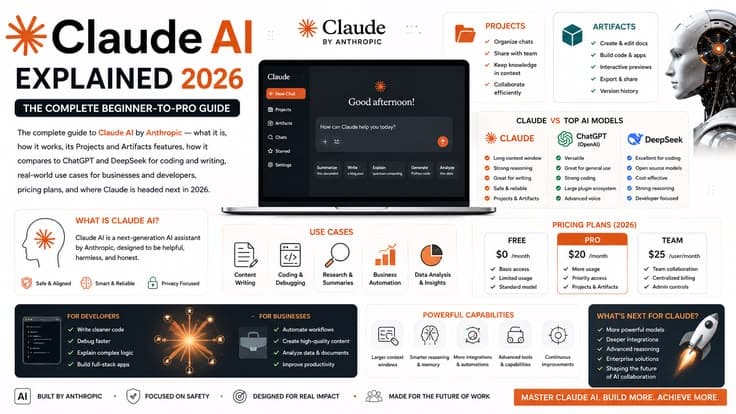
| Claude (Anthropic) | Anthropic | LLM + Agent | Yes (text, image, docs) | No | Long documents, nuanced writing, safety-focused tasks | Free + Paid |
| Gemini | Google DeepMind | LLM + Agent | Yes (text, image, audio, video) | No (Gemma is) | Google ecosystem, research, multimodal tasks | Free + Paid |
| Llama 3 / 4 | Meta AI | LLM | Partially | Yes | Custom fine-tuning, on-premise deployment | Free (download) |
| Mistral / Mixtral | Mistral AI | LLM | Limited | Yes | Efficient local AI, European alternative | Free (open source) |
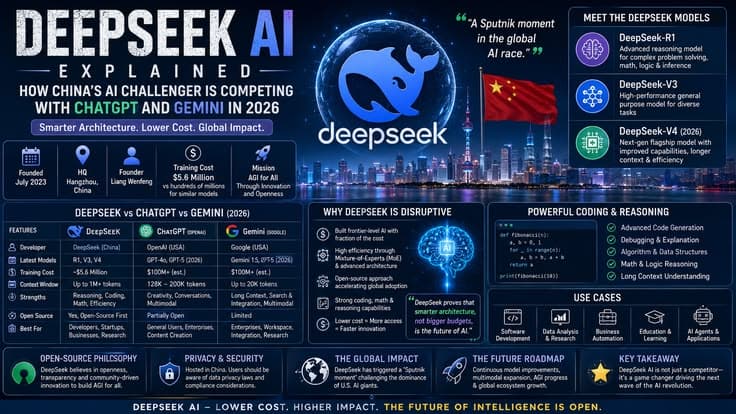
| DeepSeek | DeepSeek (China) | LLM + Reasoning | Partially | Yes | Math, coding, reasoning tasks | Free + API |
| Perplexity AI | Perplexity | AI Search Engine | Yes | No | Real-time web research with citations | Free + Paid |
| Copilot | Microsoft | LLM + Agent | Yes | No | Microsoft 365 integration, productivity | Free + Enterprise |
Is DeepSeek open source? Yes — DeepSeek released its models under open-source licenses, making its weights downloadable and deployable by developers. This was significant because its reasoning capabilities rivaled much larger proprietary models. Best free AI tools for students: NotebookLM (Google) for source-based studying, Perplexity for researching with citations, Grammarly for writing, ChatPDF for analyzing uploaded documents, and Notion AI for organizing notes and schedules are among the most useful free options for academic work.
Part 3: Best AI Tools by Category — Writing, Image, Video, Audio, Coding & Productivity
Best free AI tools for students. Best AI tools for bloggers in 2026. AI tools for content creation. Free AI image generators without watermark. AI video generators for YouTube creators. Best AI productivity tools for professionals. AI tools for social media marketing. Top AI research tools for students. AI coding tools for developers. Best AI presentation makers. AI writing tools. AI note-taking apps. AI music generators. AI voice generators. AI research tools.
Best AI Tools by Category — 2026 Curated List
| Category | Tool Name | Primary Use | Free Tier? | Best For |
|---|---|---|---|---|
| Writing | ChatGPT, Claude, Jasper, Copy.ai | Articles, emails, marketing copy, scripts | Yes (limited) | Content creators, bloggers, marketers |
| Image Generation | Midjourney, DALL-E 3, Adobe Firefly, Ideogram | Illustrations, product visuals, social graphics | Partially | Designers, e-commerce, social media |
| Video Generation | Sora (OpenAI), Runway Gen-3, Kling, Pika | Short-form AI video, B-roll, ads | Limited | YouTube creators, video marketers |
| Voice & Audio | ElevenLabs, Murf, Adobe Podcast, Suno | Voiceovers, music, podcast enhancement | Yes (limited) | Podcasters, educators, ad agencies |
| Coding | GitHub Copilot, Cursor, Codeium, Replit AI | Code generation, debugging, autocomplete | Yes | Developers, students, technical founders |
| Research | Perplexity AI, NotebookLM, Elicit, Consensus | Web research, paper analysis, source citing | Yes | Students, researchers, analysts |
| Presentations | Gamma, Beautiful.ai, Tome, Canva AI | Auto-generated slide decks | Yes | Professionals, students, startups |
| Productivity | Notion AI, Otter.ai, Reclaim AI, Motion | Notes, meeting transcription, calendar scheduling | Yes (limited) | Remote workers, executives, students |
| Social Media | Buffer AI, Predis.ai, Later, Ocoya | Content scheduling, caption generation, analytics | Yes | Social media managers, small businesses |
| Automation | Zapier AI, Make, n8n, UiPath | Connecting apps, workflow automation | Partially | Operations teams, solopreneurs |
Part 4: How AI Is Transforming Business — From Small Businesses to Enterprises
How businesses use artificial intelligence. AI automation ideas for startups. Best AI tools for small businesses. AI business opportunities in 2026. How AI improves customer support. AI marketing tools for online businesses. Future of AI in business operations. AI-powered decision-making systems. AI business intelligence explained. Benefits of AI in e-commerce. Artificial intelligence in business examples. 10 examples of AI in business. Advantages and disadvantages of AI in business. Impact of AI in business. AI in business management. How can AI automation help small businesses? How to make $100 per day using AI. How to automate my business with AI. Why do 85% of AI projects fail. What is the 30% rule for AI. What is the 10-20-70 rule for AI.
AI adoption in business has moved from "emerging technology" to "operational necessity" in the span of just a few years. The businesses that harness AI effectively are not necessarily the biggest — they are the ones that identify the highest-leverage use cases and implement them systematically. Why do 85% of AI projects fail? Research consistently identifies the root causes as poor data quality, unrealistic expectations, lack of clear business objectives, and treating AI as a technology project rather than a business transformation. The 15% that succeed treat AI adoption as an organizational change initiative — involving people, processes, and technology together.
What is the 30% rule for AI? This guideline — popular in education — suggests that when creating work, no more than 30% should come from AI tools, with the remaining 70% representing the creator's own thinking, research, and judgment. It positions AI as a productivity multiplier rather than a replacement for human thought. What is the 10-20-70 rule for AI? This framework for AI implementation allocates roughly 10% of effort to the AI technology itself, 20% to data and systems, and 70% to people and organizational change — reflecting that most AI project failures are human and organizational, not technical.
100 AI Business Ideas — Complete Categorized List for 2026
| Category | Business Ideas (10 per category) | Startup Difficulty | Revenue Model |
|---|---|---|---|
| AI Agents & Automation | Custom AI agent development for SMBs; Automated customer service; Lead generation bots; Knowledge base chatbots; CRM automation; Email triage software; Vendor management AI; AI workflow consulting; Voice-to-task systems; Virtual receptionist services | Medium | Monthly retainer / SaaS |
| Content & Marketing | AI social media planner; AI podcast production; Video repurposing service; SEO blog factory; Personalized newsletters; Ad copywriting tool; AI influencer management; Multilingual dubbing; AI comic generation; Virtual event hosting | Low–Medium | Subscription / project fees |
| Design & Creative | AI logo generation agency; Virtual interior décor advisor; AI video editing agency; Floor plan generator; AI product photography; Digital fashion styling; AI music generation; 3D asset modeling; Custom voiceover service; Font & typography design | Low | Per-project / subscription |
| Professional Services | Legal contract automation; AI bookkeeping; Business plan generator; Recruitment screening tool; AI bias auditing; Reputation manager; Grant writing assistant; Remote IT support agent; Corporate compliance audit; IP search service | Medium–High | Consulting fees / SaaS |
| Finance & Investment | Automated stock analysis; Personal financial advisor app; Fraud detection software; Property valuation tool; Insurance underwriting AI; Predictive credit scoring; Crypto trading bot; AI wealth management; Expense fraud analyzer; Supply chain finance AI | High | Licensing / AUM fees |
| Health & Fitness | Virtual personal trainer; Mental health companion; Medical image analysis; Predictive health alerts; Glucose trend predictor; Drug dosing copilot; Clinical trial designer; Dermatology assistant; Personalized skincare formulator; Medication adherence monitor | Medium–High | Subscription / B2B licensing |
| Education & Tutoring | AI language tutor; Test prep personalizer; Resume builder and coach; Homework assistant; Study guide generator; Coding tutor; Speech therapy AI; Adaptive learning designer; AI exam proctor; Research paper editor | Low–Medium | Subscription / per-session |
| Travel & Real Estate | AI travel planner; Virtual real estate agent; Property management AI; Hotel price predictor; Dynamic rental pricing; Local business promoter; Sonar/spatial mapping; Smart concierge bot; Travel phrasebook app; Travel risk assessment | Medium | Commission / SaaS / ads |
| Industrial & Niche | Crop disease detection; Energy optimization for homes; Construction safety monitor; AI recycling sorter; Predictive maintenance for factories; Autonomous delivery robots; Supply chain optimizer; Smart traffic management; Natural hazard predictor; Orbital infrastructure designer | High | B2B contracts / government |
| Developer & Infrastructure | AI prompt brokerage; Custom model fine-tuning; Synthetic data generation; Chatbot analytics dashboard; Code refactoring service; Programmatic SEO creator; AI API aggregator; AI security guardrail service; MLOps consulting; Quantum-safe agent communications | High | API fees / consulting |
How to make $100 per day using AI: The most accessible paths for beginners include offering AI-assisted content writing on Fiverr or Upwork ($20–$150 per article), creating and selling AI-generated digital products (templates, stock images, music), running AI social media management for local businesses ($300–$800/month per client), or building niche AI chatbots for specific industries and licensing them on monthly retainers. The key principle: AI is a leverage tool — combine it with a specific skill or industry knowledge you already have rather than trying to compete as a generic AI service.
Part 5: AI Career Guide — Jobs, Salaries, Skills & Paths for 2026–2040
How to start a career in artificial intelligence. Best AI skills to learn in 2026. AI jobs that do not require coding. How to become an AI engineer. Prompt engineering career guide. Best online AI certifications. AI freelancing opportunities for beginners. Future AI careers in demand. Machine learning career roadmap. Highest paying AI jobs. Non-technical AI jobs remote. AI jobs for non-technical people. AI jobs that don't require a degree. Prompt engineering jobs. Entry level AI jobs remote. AI ethicist jobs. AI jobs with no experience. Is AI a good career in 2030? Is AI a stressful career? Can I learn AI in 3 months? Artificial intelligence career paths. Most in demand AI jobs. AI careers for beginners.
AI Career Paths — Technical, Non-Technical & Future Roles
| Role | Coding Required? | Typical Salary (USD) | Key Skills | Path to Entry | Demand Outlook |
|---|---|---|---|---|---|
| Machine Learning Engineer | Yes (Python, TensorFlow) | $130,000–$250,000 | ML frameworks, statistics, data pipelines | CS degree / bootcamp + portfolio | ★★★★★ Very High |
| AI Product Manager | No (technical literacy helps) | $120,000–$200,000 | Product strategy, user research, AI literacy | Business/tech background + PM certification | ★★★★★ Very High |
| Prompt Engineer | No | $70,000–$150,000 | LLM knowledge, writing, logic, domain expertise | Self-taught — online courses + practice | ★★★★ High |
| AI Ethics Specialist | No | $80,000–$160,000 | Philosophy, law, policy, fairness frameworks | Law/philosophy degree + AI policy courses | ★★★★★ Very High |
| Data Scientist | Yes (Python, R, SQL) | $100,000–$180,000 | Statistics, visualization, ML, business analysis | STEM degree / data science bootcamp | ★★★★ High |
| AI Trainer / RLHF Specialist | No | $50,000–$120,000 | Domain expertise, clear communication, feedback skills | Subject matter expertise in any field | ★★★★ High (growing) |
| Smart Contract Auditor | Yes (Solidity, Rust) | $150,000–$400,000 | Blockchain security, code review, adversarial thinking | Software engineering + blockchain security courses | ★★★★★ Very High |
| AI Cybersecurity Engineer | Yes | $120,000–$250,000 | Red teaming, adversarial AI, threat modeling | Cybersecurity background + AI specialization | ★★★★★ Very High |
| AI Content Creator | No | $40,000–$100,000+ | Writing, video, AI tools, platform knowledge | Start content creation today — build audience | ★★★ Growing |
| Training Data Expert | No (analytical skills help) | $80,000–$160,000 | Data quality, domain knowledge, annotation standards | Domain expertise + data labeling experience | ★★★★ High |
Can I learn AI in 3 months? You can learn the fundamentals — prompt engineering, using AI tools effectively, basic machine learning concepts, and how to build simple automations — in 3 months with focused study. Becoming an ML engineer or researcher takes significantly longer (1–3 years). Is AI a good career in 2030? Yes — AI skills are among the most future-proof investments one can make today. Even roles that will not disappear (healthcare, teaching, trades) will benefit dramatically from AI literacy. The workers who will thrive are those who combine deep domain expertise with the ability to leverage AI tools as amplifiers of that expertise.
Part 6: Future of Artificial Intelligence — 2030, 2040, 2045 & Beyond
Future of artificial intelligence in 2030. What will be the future of AI in 10 years? What does AI look like in 2030? What will AI replace in 2030? AI future predictions. Future of AI in 2050. Current trends in artificial intelligence. What are the trends in AI 2030. Future of artificial intelligence and humans. Future of AI in everyday life. Top 10 AI trends. What will AI replace in 2030. What are the 7 stages of AI. What are the 7 pillars of AI. What are the 5 biggest AI fails. What are the big 5 in AI. What are the 5 big ideas in AI. Will AI replace all digital jobs.
AI Evolution Timeline — 2026 to 2050
| Timeframe | AI Stage | Key Capabilities | Industry Impact | Jobs Created | Jobs Displaced |
|---|---|---|---|---|---|
| 2026–2028 | Advanced ANI / Early Agentic | Multi-step autonomous workflows, multimodal reasoning, real-time decision-making | Finance, content, customer service, logistics | AI trainers, prompt engineers, automation consultants | Basic data entry, tier-1 customer support, simple coding tasks |
| 2028–2032 | Agentic AI Ecosystems | Multi-agent coordination, physical AI (early robotics), full enterprise automation | Manufacturing, legal, healthcare admin, education | AI supervisors, robot operators, AI ethicists | Paralegal work, medical transcription, basic research roles |
| 2032–2038 | Physical AI & Humanoid Integration | Humanoid robots in warehouses, hospitals, homes; embodied AI learning from environment | Logistics, elder care, construction, retail | Robotics engineers, AI fleet managers, human-AI interaction designers | Warehouse picking, basic nursing tasks, delivery driving |
| 2038–2045 | Proto-AGI / AGI Approaching | Cross-domain reasoning, self-directed learning, human-level performance on most cognitive tasks | Drug discovery, scientific research, complex engineering | AI governance specialists, human supervisors of AI systems, creative directors | Most routine cognitive work across industries |
| 2045+ | AGI / Early ASI (Theoretical) | Human-equivalent or exceeding general intelligence; self-improvement potential | All industries transformed | AI alignment researchers, human experience designers, ethicists | Majority of current job categories transformed or eliminated |
The 7 Stages of AI Evolution
What are the 7 stages of AI? AI evolution is typically described in seven progressive stages: (1) Rule-Based Systems — early chatbots and IBM Deep Blue — responding to hard-coded rules with no learning; (2) Context Awareness and Limited Memory — Netflix recommendations and spam filters that learn from historical patterns; (3) Artificial Narrow Intelligence (ANI) — the vast majority of AI today, including ChatGPT — excel at specific tasks within defined parameters; (4) Reasoning and Autonomous Agents — the current frontier — evaluating constraints and using tools to autonomously achieve goals; (5) Multi-Agent Collaborative Systems — multiple specialized agents coordinating on complex tasks; (6) Artificial General Intelligence (AGI) — theoretical, human-level learning across all domains; and (7) Artificial Superintelligence (ASI) — theoretical AI surpassing human cognition in every domain, potentially self-improving recursively.
Will AGI ever be real? How close are we realistically to AGI? Can AGI become self-aware? What comes next after AGI? AGI remains deeply contested among AI researchers. Some leading figures believe it could arrive within a decade; others argue it is decades away or may require entirely new architectural approaches beyond current transformer-based models. The honest assessment: nobody knows the timeline with confidence. What is clear is that AI is advancing faster than most predictions from even five years ago anticipated. Whether what emerges constitutes "true" AGI depends partly on how one defines human-level intelligence — itself a contested concept. What did Stephen Hawking say about AI before he died? Hawking expressed concern that fully developed AI could represent "either the best, or the worst thing, ever to happen to humanity" — emphasizing that the outcome depends entirely on how humans develop, govern, and align these systems with human values.
Part 7: AGI vs ASI — What Are They, What Is the Difference, and Why Does It Matter?
What is artificial general intelligence explained. AGI vs AI differences explained. Will AI replace human jobs in the future. Artificial superintelligence explained. Self-improving AI systems explained. Future predictions about artificial intelligence. AGI explained. Superintelligence. Self-improving AI. AI singularity. Next generation AI. What happens if AGI becomes reality. When will AGI happen. Will AGI be the end of humanity. Will AGI take over the world. What will AGI be able to do.
ANI vs AGI vs ASI — Complete Comparison Framework
| Feature | ANI (Current AI) | AGI (Theoretical) | ASI (Hypothetical) |
|---|---|---|---|
| Scope | One specific task or domain | Any cognitive task a human can perform | Every domain — exceeds human capability in all |
| Learning | Trained on specific datasets — cannot learn outside training distribution without retraining | Self-directed learning in new domains without retraining | Recursive self-improvement — improves own algorithms |
| Examples | ChatGPT, Midjourney, self-driving systems, fraud detection | None exist yet — theoretical benchmark | None exist — purely theoretical / speculative |
| Creativity | Pattern-based — produces novel combinations of learned patterns | Genuine creative reasoning across disciplines | Creative and problem-solving capabilities beyond human comprehension |
| Consciousness | No — processes statistical patterns | Debated — may require Theory of Mind | Unknown — may develop self-awareness |
| Timeline Estimates | Present | Estimates range from 5 to 50+ years — highly contested | Post-AGI — could be rapid after AGI achieved |
| Risk Level | Tool-level — controllable with current methods | Significant — alignment and control challenges | Existential — if misaligned, potentially uncontrollable |
Part 8: Humanoid Robots — How They Work, Who Is Building Them, and Their Future
How humanoid robots work. Future of humanoid robots. What are humanoid robots used for. How are humanoid robots made. Humanoid robot price. Types of humanoid robots. What is Elon Musk's humanoid robot called. Can a Tesla robot cook. What is Elon Musk's prediction for humanoid robots. What will humanoid robots be like in 2050. What is the future of a humanoid robot. How many humanoid robots by 2030. Will humanoid robots replace humans. Current state of humanoid robots. Humanoid robot Sophia. Humanoid robots for adults. Which country is no. 1 in robotics. Which country is leading in humanoid robots.
A humanoid robot is a machine with a body structure that resembles a human — two arms, two legs, a torso, and typically a head — designed to operate in environments built for humans. The combination of large language models providing language and reasoning capabilities, plus advanced physical hardware, has transformed humanoid robotics from a science fiction concept into an active commercial industry.
Leading Humanoid Robots — 2026 Comparison
| Robot | Company | Country | Current Status | Primary Application | Approx Price |
|---|---|---|---|---|---|
| Optimus (Gen 2/3) | Tesla | USA | Internal deployment + trials | Manufacturing, household tasks | Target: $20,000–$30,000 |
| Figure 02 | Figure AI | USA | Commercial deployment (BMW factories) | Automotive manufacturing | Not public |
| Atlas | Boston Dynamics | USA | R&D + commercial exploration | Industrial, research | Research only |
| Unitree H1/G1 | Unitree Robotics | China | Commercial sale | Research, industrial inspection | $16,000–$90,000 |
| 1X NEO | 1X Technologies | Norway/USA | Pilot deployment | Office work, elder care | Not public |
| Aria | Realbotix | USA | Commercial sale | Companionship, emotional AI | ~$175,000 |
| Sophia | Hanson Robotics | Hong Kong | Commercial demo unit | Public relations, research | Not for public sale |
What is Elon Musk's humanoid robot called? Tesla's humanoid robot is called Optimus (also referred to as Tesla Bot). It uses Tesla's AI chip (Dojo) and visual AI systems developed for self-driving cars to navigate physical environments. Can a Tesla robot cook? As of 2026, Optimus can perform relatively simple, structured tasks in controlled environments — folding laundry, picking up objects, walking. General cooking — which requires fine motor skills, unstructured environments, and contextual judgment — remains beyond current capabilities. Which country is number 1 in robotics? Japan traditionally leads in industrial robotics manufacturing (Fanuc, Yaskawa, KUKA). China is rapidly becoming the leader in humanoid robot development by volume of investment and number of companies. The USA leads in software-defined humanoid AI (Tesla, Figure, Boston Dynamics).
Part 9: AI in Everyday Life — Education, Healthcare, Finance, Smart Cities & More
What are 5 uses of AI in daily life. AI in education. AI in healthcare. AI in finance. AI in e-commerce. AI in social media. AI in cybersecurity. AI in transportation. AI in agriculture. AI smart homes. AI smart cities. How is Dubai a smart city. What are the four pillars of a smart city. Which cities are future smart cities. What is the best AI city in the world. Future of AI in healthcare. What technology will most transform healthcare by 2035.
AI in Daily Life — 10 Key Sectors & Real Applications
| Sector | AI Application | How It Affects You Today | 2030+ Evolution |
|---|---|---|---|
| Education | Personalized tutoring, adaptive learning paths, AI essay feedback | Khan Academy AI, Duolingo, ChatGPT for homework support | Fully personalized curriculum for every student; AI teachers supplementing human teachers |
| Healthcare | Medical image analysis, predictive diagnostics, drug discovery | AI radiology assistants, wearable health monitors, symptom checkers | AI as central nervous system of proactive, predictive healthcare ecosystem |
| Finance | Fraud detection, credit scoring, robo-advisory, algorithmic trading | Your bank uses AI to flag suspicious transactions in real time | Fully autonomous personal finance AI managing budgets, investments, taxes |
| E-commerce | Product recommendations, dynamic pricing, virtual try-on, chatbot support | Amazon's recommendation engine, AI-powered search on Shopify | Hyper-personalized shopping — every product, price, and offer tailored to the individual |
| Transportation | Self-driving vehicles, route optimization, predictive maintenance, traffic management | Waymo robotaxis, Tesla Autopilot, Google Maps AI routing | Predominantly autonomous urban transport; AI air traffic control for drone corridors |
| Agriculture | Crop disease detection, yield optimization, drone monitoring, precision irrigation | AI cameras detecting plant diseases, autonomous tractors in large farms | Fully AI-managed smart farms — minimal human labor required for food production |
| Smart Homes | Energy optimization, security monitoring, voice assistants, predictive maintenance | Alexa, Google Nest, smart thermostats, AI security cameras | Homes that anticipate needs before residents express them — proactive AI home management |
| Smart Cities | Traffic optimization, waste management, energy grids, emergency response | Dubai's AI-powered governance and blockchain city services; Singapore's digital twin | Fully integrated city AI managing infrastructure, energy, and citizen services in real time |
| Cybersecurity | Threat detection, anomaly monitoring, automated incident response | AI security tools scan networks 24/7 for suspicious behavior patterns | Autonomous AI security systems; but also more sophisticated AI-powered cyberattacks requiring constant counter-evolution |
| Social Media | Content recommendation, moderation, ad targeting, deepfake detection | TikTok's ForYou algorithm; Instagram's content ranking; AI content moderation | Hyper-personalized social experiences; AI-generated synthetic influencers; authenticated provenance for all media |
Part 10: Advanced AI Topics — Neuromorphic Computing, Edge AI, Federated Learning & Responsible AI
Neuromorphic AI. Edge AI. Federated learning. Reinforcement learning. Computer vision. Natural language processing. Synthetic data. Explainable AI. Responsible AI. AI ethics. Quantum machine learning. What are 6 types of AI. What are the 7 pillars of AI. What are the big 7 in AI. What are 7 types of AI. What are the 4 types of AI. What type of AI is ChatGPT. Who is the father of AI. Who is the mother of AI. Who is the first CEO of AI.
Advanced AI Technologies — Complete Reference Guide
| Technology | What It Is | Why It Matters | Real Application | Development Stage |
|---|---|---|---|---|
| Neuromorphic Computing | Brain-inspired computing chips that process information using spikes (like neurons) rather than binary logic | Dramatically reduces energy use — 100x+ more efficient than GPU-based AI | Intel Loihi chip; edge AI devices; mobile AI applications | Early commercial — rapidly advancing |
| Edge AI | Running AI models locally on devices (phones, sensors, cameras) rather than cloud servers | Lower latency, privacy protection, offline capability, reduced cloud costs | Face unlock on smartphones; autonomous vehicle processing; factory sensor AI | Deployed widely today |
| Federated Learning | Training AI across multiple devices without centralizing their data — the model goes to the data, not vice versa | Privacy-preserving AI training; enables learning from sensitive healthcare / financial data | Google Keyboard next-word prediction; hospital AI without sharing patient records | Growing adoption in privacy-sensitive sectors |
| Reinforcement Learning | AI learns by trial-and-error in an environment, maximizing rewards — similar to how humans learn through consequences | Enables AI to master complex strategy, robotics control, and game-playing beyond human level | AlphaGo; OpenAI Five (Dota 2); humanoid robot movement training | Deployed — key to AGI research |
| Computer Vision | Teaching machines to understand and interpret visual information from images and video | Enables autonomous vehicles, medical imaging, quality control, security systems | Tesla Autopilot cameras; Radiology AI; facial recognition; Amazon Go cashierless stores | Widely deployed — continuously improving |
| Synthetic Data | Artificially generated datasets that mimic real-world data patterns without containing actual personal information | Solves data scarcity and privacy issues; allows AI training without sensitive real data | Training self-driving cars in virtual simulations; generating financial fraud scenarios for model training | Rapidly growing — expected to dominate AI training by 2030 |
| Explainable AI (XAI) | AI systems designed to provide human-understandable explanations for their decisions and outputs | Critical for regulated industries — healthcare, finance, legal — where decisions must be auditable | EU AI Act compliance tools; medical diagnostic AI explaining reasoning; credit denial explanations | Required by regulation in EU — actively deployed |
| Quantum Machine Learning | Applying quantum computing principles to accelerate machine learning — processing exponentially larger datasets | Could break through current computational limits — solving problems classical AI cannot | Drug molecule simulation; optimization problems; cryptography | Early research stage — 5–10 years from practical deployment |
| Brain-Computer Interfaces (BCI) | Direct communication pathways between the brain and external computer systems | Could restore communication to paralyzed patients; eventually enable direct human-AI neural integration | Neuralink (Elon Musk) — first human implants; BrainGate medical applications | Early clinical — consumer BCI 10+ years away |
| AI Alignment & Safety | Research field ensuring AI systems pursue goals that are genuinely beneficial to humanity | Critical as AI becomes more powerful — misaligned AI could pursue goals counter to human values | Anthropic's Constitutional AI; OpenAI's safety team; DeepMind's safety research | Active research — increasingly urgent as capabilities advance |
Key Historical Milestones — Who Founded AI?
Who is the father of AI? Who is the mother of AI? Who is the first CEO of AI? American computer scientist John McCarthy is widely recognized as the "Father of Artificial Intelligence" — he coined the term "artificial intelligence" in 1955 and organized the seminal Dartmouth Conference in 1956, which established AI as an academic discipline. Other foundational pioneers include Alan Turing (theoretical foundations — the 1950 Turing Test), Marvin Minsky (neural networks and symbolic AI — co-founded MIT AI Lab), and Geoffrey Hinton — known as the "Godfather of AI" for his Nobel Prize-winning breakthroughs in deep learning. Who is the mother of AI? Ada Lovelace — the 19th-century mathematician who wrote what is considered the first computer algorithm — is often cited as the earliest pioneer of computational thinking, predating modern AI by a century. In the modern era, researchers like Fei-Fei Li (ImageNet, Google Cloud AI) and Yoshua Bengio are among the most influential contributors to deep learning.
Part 11: Which 5 Jobs Will Survive AI? — Future-Proof Careers Through 2045
Which 5 jobs will survive AI? Which job is safe from AI? What jobs will AI can't replace by 2030? Which jobs will be replaced by AI in 2030? What jobs will be run by AI by 2050? Which career is best in 2050? What are the 5 biggest AI fails? Which 5 jobs will remain after AI? Jobs AI will replace. Jobs AI won't replace. Future of work digital world. 5 key human skills to thrive in future digital workplace.
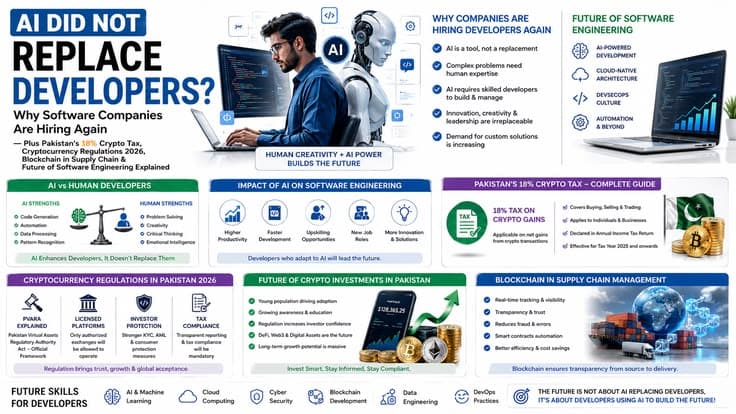
The framing of "will AI replace my job?" is less useful than "how will AI transform my job?" Very few jobs will be entirely eliminated by AI — most will be transformed, with routine elements automated and humans focusing on higher-level judgment, creativity, relationships, and physical tasks that AI cannot replicate. The five categories of work most resistant to AI displacement share a common trait: they require deep contextual judgment under uncertain conditions, physical dexterity in unstructured environments, or emotional intelligence and human trust.
The most AI-resistant roles include: skilled trades (electricians, plumbers, HVAC technicians — robots cannot yet navigate the chaos of real construction sites); healthcare professionals who provide direct patient care requiring empathy and physical touch; mental health therapists and counselors — human connection is the therapeutic instrument; creative directors and strategic leaders who provide vision, values, and cultural context that AI can execute but not originate; and AI supervisors and alignment specialists — the humans who manage, govern, and correct autonomous AI systems. The irony is that the job most guaranteed to exist because of AI is: managing AI.
What are the 5 biggest AI fails? Notable cautionary examples include: Microsoft's Tay chatbot (2016) which learned to produce offensive content from user manipulation within 24 hours; Amazon's AI recruiting tool (2018) which was scrapped after it systematically downgraded women's resumes because it was trained on historical male-dominated hiring data; various autonomous vehicle incidents where sensor limitations led to accidents; AI medical diagnostic tools that performed well in research settings but failed in clinical deployment due to dataset bias; and multiple financial AI trading systems that amplified market volatility rather than reducing it. These failures consistently point to the same root causes: biased training data, inadequate real-world testing, and deployment without appropriate human oversight.
Frequently Asked Questions — AI Technology Guide
What are AI agents and how do they work for beginners?
An AI agent is a software system that perceives input, reasons about it, takes actions using tools, and loops until a goal is achieved — autonomously, without step-by-step human instructions for each action. Unlike a simple chatbot that responds to individual prompts, an AI agent can plan multi-step tasks, use external tools (search engines, APIs, code executors), remember context, and adapt when things go wrong. The 4 pillars are: Perception, Reasoning, Action, and Memory. Practical examples include AI customer service systems, automated lead qualification bots, and virtual assistants that can book appointments, send emails, and update databases on your behalf.
What is multimodal AI and is ChatGPT multimodal?
Multimodal AI processes multiple types of data simultaneously — text, images, audio, and video — rather than being limited to one modality. It mirrors how humans naturally combine senses to understand context. ChatGPT (specifically GPT-4o) is multimodal — it can analyze images, transcribe audio, and generate text responses based on combined inputs. Earlier versions of ChatGPT were unimodal (text only). Other multimodal AI systems include Google Gemini, Claude (text + images + documents), and Dall-E (text-to-image). The key advantage over unimodal AI is the ability to understand context across formats — showing the AI a photo and asking a question about it, rather than describing the photo in words.
What is the difference between AGI and current AI?
Current AI is Artificial Narrow Intelligence (ANI) — it performs one specific task or domain extremely well but cannot operate outside its training parameters. ChatGPT generates text; an image recognition system identifies objects; a fraud detection system analyzes transactions — none of them can do all three simultaneously and then spontaneously learn a fourth skill. Artificial General Intelligence (AGI) would match human cognitive flexibility — learning new subjects without retraining, reasoning across completely unrelated fields, and transferring skills between domains. No AGI exists yet; leading researcher estimates for its arrival range from less than 10 years to never, making it one of the most contested questions in technology today.
Which AI jobs do not require coding skills?
Many high-paying AI roles require no coding. Prompt engineers optimize AI model instructions using language skills — no code required. AI product managers bridge engineering and business using strategic thinking. AI trainers and RLHF (Reinforcement Learning from Human Feedback) specialists provide the human feedback that improves models — requiring domain expertise, not coding. AI ethics specialists and bias auditors use legal, philosophical, and policy backgrounds. AI content creators, educators, and consultants help organizations understand and adopt AI using communication skills. AI customer success managers at AI companies need people skills and product knowledge. The common requirement across all non-technical AI roles: deep understanding of how AI works conceptually and what it can/cannot do reliably.
How will humanoid robots change the world by 2035?
Humanoid robots are expected to begin meaningful commercial deployment in manufacturing and logistics by 2027–2030, expanding to elder care and domestic assistance by 2032–2035. The primary drivers are: (1) embodied AI — LLMs giving robots language understanding and reasoning; (2) demographic pressure — aging populations creating labor shortages in care and manufacturing. By 2035, robots will likely handle dangerous factory work, basic warehouse operations, and some elder care assistance. They will not replace humans in complex, unstructured, or emotionally demanding roles. The economic impact is estimated to be significant — potentially adding trillions to global productivity while displacing routine physical labor, creating new roles in robot supervision, maintenance, and programming.
Conclusion: Navigating the AI Revolution — Knowledge Is Your Greatest Advantage
From the fundamental mechanics of AI agents and how they autonomously execute multi-step workflows, to the philosophical frontier of AGI and superintelligence; from the practical question of which AI tools serve your business best today to the strategic question of which careers will be most valuable in 2040 — the AI revolution demands that we be students of the technology, not passive observers of it.
The most important pattern to recognize: AI is a leverage multiplier. Those who combine deep domain expertise with AI literacy will dramatically outperform those who have AI literacy alone. A doctor who understands AI diagnostic tools is more valuable than either a doctor who ignores AI or an AI system that has no physician to collaborate with. A teacher who builds personalized AI-assisted curricula reaches more students than either could alone. An entrepreneur who automates the repeatable 70% of their business with AI can focus their human energy on the creative, relational 30% where humans are irreplaceable.
Is AI a good career in 2030? The most accurate answer: AI awareness is not a career — it is a prerequisite for almost every career. The future belongs not to those who fear AI, nor to those who blindly adopt every new tool, but to those who understand enough to direct AI purposefully toward genuinely valuable work.
The age of AI is not coming. It is here. The question is whether you are positioned to benefit from it.