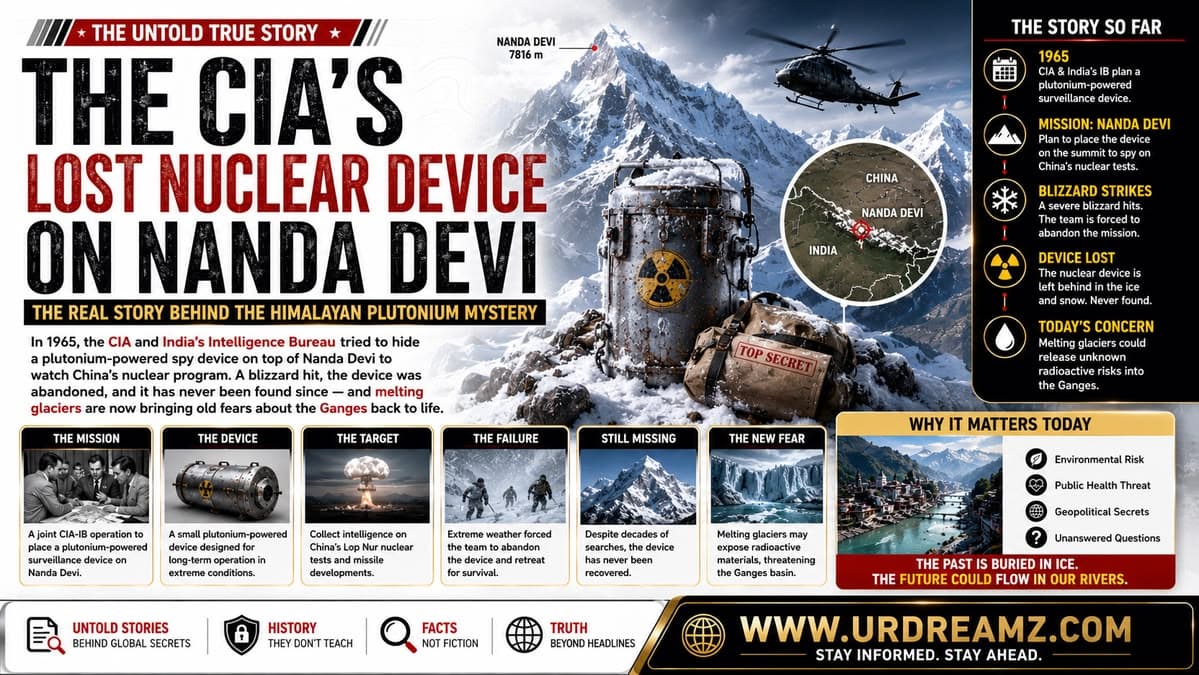
The CIA's Lost Nuclear Device on Nanda Devi: The Real Story Behind the Himalayan Plutonium Mystery
A Cold War spy mission went wrong on one of the world's most remote peaks in 1965 — and six decades later, melting ice is bringing the story back into the headlines.
Introduction: A Secret Six Decades Old
Somewhere near the summit of Nanda Devi, India's second-highest mountain, a small metal cylinder containing several kilograms of plutonium may still be sitting inside a glacier, exactly where a team of American and Indian climbers left it in October 1965. It has never been recovered. For over a decade after it disappeared, almost nobody outside a small circle of intelligence officials even knew it existed. Today, as Himalayan glaciers retreat faster than at almost any point in recorded history, the question of what happened to that device — and what could happen if the ice finally gives it up — has become urgent again, resurfacing in fresh reporting after decades of relative silence.
This is not internet folklore or a conspiracy theory circulating on social media. It is a documented Cold War intelligence operation, confirmed decades later through investigative journalism, declassified references, and on-record statements from the surviving members of the expedition itself, including its Indian commander. The core facts of the story are genuinely strange enough that they need no exaggeration: a joint American-Indian spy team, disguised as a scientific mountaineering expedition, hauled a plutonium-powered listening device up one of the most dangerous peaks on Earth to spy on China's nuclear missile program — and then lost it in a blizzard, never to be found again.
This article walks through exactly what happened, who was involved, what the device actually was, why it has never been recovered despite multiple search attempts, and what the real, evidence-based risk is today as warming temperatures accelerate glacier melt across the region.
Stories like this one tend to circulate online in exaggerated or garbled versions, sometimes stripped of dates, sometimes inflated with claims no credible source actually supports. The goal here is the opposite: to lay out precisely what has been confirmed through investigative reporting and firsthand testimony, to separate that from more speculative claims that surround the story, and to give an honest, evidence-based answer to the question everyone eventually asks — could this actually poison a river system that hundreds of millions of people depend on?
The Cold War Backdrop: China Goes Nuclear
To understand why anyone would attempt something as extreme as hiding a nuclear-powered spy device on a Himalayan summit, it helps to understand the panic that gripped Washington in October 1964. That month, China successfully detonated its first atomic bomb at the Lop Nur test site in the Xinjiang region, instantly becoming the fifth country in the world to possess nuclear weapons and dramatically escalating Cold War anxieties in both the United States and India.
For American intelligence agencies, the timing could not have been more alarming. Reconnaissance satellite technology in the mid-1960s was still in its infancy, unreliable, and far from capable of consistently tracking missile telemetry from a remote inland test site deep inside Chinese territory. The CIA needed a way to intercept the radio signals China's military would transmit while testing missiles capable of carrying that new nuclear capability — and Lop Nur sat roughly a thousand miles from the nearest point American intelligence could easily and covertly access.
India, for its part, had its own pressing reasons to cooperate. Just two years earlier, in 1962, India had fought and lost a brief but humiliating border war with China in the Himalayas. Despite its official policy of non-alignment during the Cold War, India's government quietly saw clear strategic value in a closer, if discreet, intelligence partnership with the United States against a shared and increasingly unpredictable neighbor.
It is worth pausing on just how limited the alternatives were at the time. Spy planes capable of overflying Chinese territory carried enormous political and diplomatic risk, as the U-2 incident with the Soviet Union just a few years earlier had made painfully clear. Ground-based human intelligence inside China's remote western deserts was virtually impossible for American operatives to gather directly. Against that backdrop, a fixed, autonomous listening post perched on the highest available terrain just across the border, requiring no ongoing human presence once installed, must have looked like an unusually elegant technical solution to an otherwise nearly unsolvable intelligence problem — which helps explain why two governments were willing to accept the very real physical risk of hauling radioactive material up one of the most dangerous mountains on the planet.
Why Nanda Devi Was Chosen
Nanda Devi rises to 7,816 meters (25,645 feet) in the Garhwal Himalayas of northern India, making it the second-highest mountain entirely within Indian territory and the 23rd-highest peak in the world. Its extreme elevation and its geographic position gave it something no other option could easily match: a commanding, elevated line of sight toward the Tibetan Plateau and, beyond it, the general direction of China's missile testing grounds nearly a thousand miles away.
The mountain had also long carried a reputation for extreme difficulty and isolation even among experienced Himalayan mountaineers, having only been first summited in 1936 and remaining, for decades afterward, one of the least-visited major peaks in the range precisely because of its punishing technical difficulty and remote approach. That very inaccessibility, which made it such a formidable climbing challenge, was exactly what made it so attractive as a hiding place for a piece of sensitive surveillance equipment — the same qualities that kept casual visitors away were expected to keep Chinese intelligence, or anyone else, from ever stumbling across the installation by accident.
| Factor | Why It Mattered |
|---|---|
| Extreme altitude (7,816 meters) | Gave the device a clear, elevated vantage point for intercepting distant radio signals |
| Location entirely inside India | Avoided the diplomatic complication of operating equipment on foreign or disputed territory |
| Remoteness | Made discovery by China, or by ordinary civilians, extremely unlikely |
| Existing mountaineering activity in the region | Allowed the mission to be disguised convincingly as an ordinary scientific climbing expedition |
That last point was central to the plan's design. Himalayan mountaineering expeditions, including joint international ones, were a fairly normal occurrence by the mid-1960s, which gave the CIA and India's Intelligence Bureau (IB) a ready-made cover story: a mixed American-Indian climbing team could travel into a sensitive border region, carry unusually heavy and unusual equipment, and attract far less suspicion than almost any other type of operation could.
Operation Hat: Building the Team
The mission, later given the covert designation Operation Hat, brought together an unusual mix of personnel. On the American side were several veteran climbers who had taken part in the United States' celebrated 1963 Mount Everest expedition, men with genuine world-class mountaineering credentials rather than intelligence officers pretending to be climbers. On the Indian side, the mission was led by Captain Manmohan Singh Kohli, a naval officer and experienced Everest summiteer, working in close coordination with India's Intelligence Bureau.
The team also included Indo-Tibetan Border Police personnel and local Sherpa support staff, some of whom, according to later accounts, were not fully briefed on the true nature of the cargo they were helping to transport — a detail that becomes especially unsettling in light of what that cargo actually was. In 1965, the joint team set out carrying not just standard mountaineering equipment, but a bulky, unusually heavy device: a nuclear-powered generator, along with an antenna and transceiver system designed to intercept telemetry signals from Chinese missile tests.
One especially striking detail from later accounts of the expedition involves how some of the Sherpa support staff reportedly used the generator's warmth to keep themselves comfortable during the brutally cold nights on the mountain, apparently without understanding that the heat radiating from the device came from decaying radioactive material rather than any conventional heating source. Whether or not this specific detail can be fully verified today, it captures something important about the operation as a whole: it was carried out under a level of secrecy so tight that even some of the people physically closest to the radioactive material, night after night, may not have known precisely what they were sleeping next to.
| Role | Personnel |
|---|---|
| Indian mission commander | Captain M.S. Kohli, Indian Navy, Everest veteran |
| American climbers | Veterans of the 1963 U.S. Everest expedition |
| Sponsoring agencies | U.S. Central Intelligence Agency (CIA) and India's Intelligence Bureau (IB) |
| Support personnel | Indo-Tibetan Border Police officers and local Sherpa climbers |
| Cover story | A joint scientific and mountaineering expedition |
The SNAP-19C: A Nuclear Battery on a Mountainside
The device at the center of this entire story was a SNAP-19C generator — SNAP standing for "Systems for Nuclear Auxiliary Power," a real family of American radioisotope thermoelectric generators (RTGs) developed for use in remote locations where solar panels or batteries were impractical, including on some NASA space missions. Rather than a nuclear reactor in the traditional sense, an RTG generates a small, steady electrical current from the natural heat given off by a decaying radioactive isotope — in this case, plutonium.
| Detail | Description |
|---|---|
| Device type | SNAP-19C radioisotope thermoelectric generator (RTG) |
| Fuel | Plutonium-238, with some accounts also referencing plutonium-239 |
| Approximate weight | Around 50 to 125 pounds, depending on the specific source cited |
| Purpose | Power an antenna and transceiver system designed to intercept Chinese missile telemetry signals |
| Design intent | Operate autonomously and undetected for an extended period without maintenance |
| Reported radioactive lifespan | Capable of remaining radioactive for several centuries |
Reports vary somewhat on the exact quantity of plutonium involved, but multiple accounts describe it as a meaningful fraction — commonly cited as around a third — of the total plutonium used in the atomic bomb dropped on Nagasaki in 1945. That comparison is not meant to suggest the device itself was a bomb capable of exploding; RTGs are not designed to detonate. The genuine risk they pose instead comes from radioactive contamination if the casing is breached and the plutonium is exposed to soil, ice, or water over a long period of time.
It is worth understanding why the American government considered this technology reasonably safe to deploy in the first place, since that context helps explain the decision rather than making it seem purely reckless. SNAP generators of this type had already been used successfully in a range of remote applications, including some early NASA space missions, precisely because their sealed casings were engineered to withstand severe physical stress without releasing their radioactive contents. The plan assumed the casing would remain intact even in a worst-case scenario like a fall or burial under snow — an assumption that, six decades later, has never actually been tested against reality, because the device itself has never been recovered and inspected.
October 1965: The Blizzard That Changed Everything
The plan called for the team to carry the generator, antenna, and transceiver components to a high perch near the Nanda Devi summit, assemble and camouflage the equipment, and then descend, leaving the device to transmit intercepted signals back to a receiving station for years without any need for further human contact. For a mission built around that kind of long-term, low-maintenance secrecy, the weather in October 1965 could not have been worse.
A severe blizzard struck while the team was still working at high altitude, roughly 2,000 feet short of the summit by some accounts, forcing an urgent decision under brutal, life-threatening conditions. Survival took priority over completing the installation. Under Kohli's orders, the climbers secured the generator, antenna, and associated equipment on an ice shelf or high ledge as securely as conditions allowed, and retreated down the mountain rather than risk the team's lives trying to finish the job or carry the heavy equipment back down through the storm.
| Event | Timing |
|---|---|
| China's first successful nuclear test at Lop Nur | October 1964 |
| CIA and India's Intelligence Bureau begin planning Operation Hat | Early-to-mid 1965 |
| Joint team ascends Nanda Devi | Autumn 1965 |
| Severe blizzard forces retreat before installation is completed | October 1965 |
| Team returns the following spring to find the device gone | Spring 1966 |
When the team returned the following spring, expecting to find the generator exactly where they had left it, it was simply gone. The most widely accepted explanation is that an avalanche, entirely plausible in that terrain and season, swept the equipment down the mountainside and into the glacier system that ultimately feeds into the Rishiganga river and, further downstream, the wider Ganges basin. No trace of the generator, its plutonium core, or its casing has ever been confirmed found since.
It is difficult to overstate how disorienting this discovery must have been for the mission's planners. A device engineered for autonomous operation over years, built to a standard that assumed its exact location would always be known and monitored, had simply vanished into terrain so vast, unstable, and difficult to access that even a team of the world's most experienced high-altitude climbers could not immediately determine where it had gone. The mountain itself, in effect, had swallowed a piece of American and Indian nuclear material whole, and neither government had any reliable way of knowing whether it remained sealed, intact, and inert somewhere nearby, or whether the fall itself had already compromised the casing.
The Search That Never Found It
Losing a device of this sensitivity was not something either government could simply shrug off. Over the following years, at least three dedicated recovery expeditions were mounted specifically to relocate the missing generator, each one hampered by the same brutal combination of extreme altitude, unstable terrain, unpredictable weather windows, and a mountain landscape that shifts constantly under the pressure of snowfall, avalanches, and glacial movement.
Each recovery attempt came back empty-handed. Eventually, according to later reporting on the episode, the American side concluded that continuing the search had become what one account described as a "feckless effort" and effectively abandoned the search as a lost cause, rather than risk further personnel and resources chasing equipment that appeared to have been buried, shifted, or destroyed beyond recovery by the mountain itself.
This is, in some ways, the most consequential single fact in the entire story: unlike a piece of equipment lost in an accessible location, this device sits somewhere within one of the most hostile, remote, and geologically unstable environments on the planet, which means the normal tools available for locating lost radioactive material — ground searches, radiation detection sweeps, aerial surveys — have all, so far, come up short.
Part of the difficulty stems from the sheer scale and constant motion of the terrain involved. Himalayan glaciers are not static, frozen blocks; they flow slowly downhill under their own weight, shift with seasonal snowfall and melt cycles, and periodically shed enormous quantities of ice and rock through avalanches that can bury or expose different sections of a mountainside from one year to the next. A relatively small, dense metal cylinder — heavy enough to sink rather than remain on the surface — could plausibly have settled anywhere along miles of shifting glacial terrain since 1965, buried under decades of subsequent snowfall, or carried gradually downhill by the glacier's own slow movement. Locating a single object under those conditions, using 1960s and even modern detection technology, has proven to be an extraordinarily difficult needle-in-a-haystack problem, compounded by the physical danger involved in mounting repeated search expeditions at that altitude.
Round Two: Nanda Kot and the Meltdown
Rather than abandon the broader surveillance objective entirely, the CIA and Indian intelligence made a second attempt using a different, somewhat lower peak nearby: Nanda Kot. A new SNAP-powered device was installed there in the spring of 1967, this time successfully reaching operational status, and it continued gathering intelligence for roughly a year.
This second device, however, met its own strange fate. Rather than being lost to an avalanche, it reportedly melted down into the surrounding ice over time — its own generated heat gradually causing it to sink into the glacier it was mounted on, eventually degrading its ability to transmit a usable signal. By 1968, it was retrieved or abandoned as no longer functional, depending on which account is consulted, closing out the second chapter of this unusual intelligence effort.
| Mission | Location | Timeframe | Outcome |
|---|---|---|---|
| First device (Operation Hat) | Nanda Devi | October 1965 | Lost in a blizzard; never recovered |
| Second device | Nanda Kot | 1967–1968 | Operated briefly, then melted into surrounding ice |
| Third device | Reported successful installation | From 1973 | Functioned as intended, later made obsolete by satellite technology |
A Third Attempt, and Then Obsolescence
A third device, installed successfully starting in 1973 according to available accounts, finally achieved something like the original mission's intended purpose, gathering signals intelligence on Chinese missile activity for a period without the catastrophic loss or slow meltdown that plagued its two predecessors. Its usefulness, however, proved to be limited mainly by advancing technology rather than by mountain weather: as American reconnaissance satellite capability matured through the 1970s, the entire concept of relying on a fragile, remote, high-altitude ground station became increasingly unnecessary, and the program was eventually phased out in favor of orbital surveillance.
Taken together, the three devices tell a fairly clear story of an ambitious Cold War intelligence concept overtaken, one attempt at a time, first by nature and then by better technology — but the first device, the one lost in 1965 on Nanda Devi itself, is the one that never got resolved, and the one whose consequences are still being debated today.
Why the World Didn't Know Until 1978
For roughly thirteen years after the original device went missing, almost nobody outside of a tight circle within the CIA and India's Intelligence Bureau knew this operation had ever taken place. The mission remained classified, unreported, and effectively invisible to the public until April 1978, when the American magazine Outside published an investigative report revealing that U.S. intelligence had attempted to plant a plutonium-powered surveillance device high on a Himalayan peak in 1965, that bad weather had forced an early abandonment of the equipment roughly 2,000 feet short of the summit, and that the device had never been relocated despite subsequent search efforts.
The revelation caused immediate alarm in India, both because of the obvious sovereignty and safety implications of a foreign radioactive device sitting undetected inside Indian territory, and because it forced India's own government to publicly acknowledge a level of covert intelligence cooperation with the United States that had never been disclosed to the Indian public. In the years since, additional reporting — including a more recent, detailed investigation by The New York Times published in December 2025 — has continued to add fresh detail and firsthand testimony from surviving expedition members, keeping the story alive well into its seventh decade.
The domestic political fallout in India in 1978 is worth understanding on its own terms. India had spent the intervening years publicly maintaining its non-aligned foreign policy stance, positioning itself as independent of both American and Soviet influence during the Cold War. The sudden public revelation that its own intelligence service had quietly partnered with the CIA on a nuclear-adjacent operation inside its own sovereign mountains complicated that carefully maintained narrative considerably, prompting uncomfortable questions in India's parliament and press about how much else its government may have agreed to without public disclosure. The story, in other words, was never purely a scientific or environmental concern — from the moment it became public, it was also a genuinely awkward diplomatic and domestic political matter for the Indian government of the day.
Could It Really Poison the Ganges?
This is the question that gives the story its lasting grip on public imagination, and it deserves a careful, balanced answer rather than either dismissal or exaggeration. The Ganges river system is one of the most important water sources on Earth, sustaining agriculture, drinking water, and daily life for an enormous population across northern India and Bangladesh — estimates of the population depending on the Ganges basin commonly range from several hundred million people up to roughly half a billion, depending on exactly how the basin's boundaries are defined.
| Concern | What Experts Actually Say |
|---|---|
| Mass contamination of the entire Ganges | Considered unlikely by most scientists, given the enormous volume of water available to dilute any leaked material across such a vast river system |
| Contamination of local streams directly below Nanda Devi | A more plausible and genuinely concerning risk, since dilution would be far less at that closer range |
| Health effects of plutonium exposure | Well established in general — inhaled or ingested plutonium is linked to increased cancer risk — though this depends entirely on actual exposure occurring |
| Likelihood the casing has already failed | Unknown; the device has not been located, so its physical condition cannot currently be verified |
In other words, the most extreme version of this fear — an entire river system serving hundreds of millions of people turning acutely toxic overnight — is not what mainstream scientific assessment supports, largely because of the sheer physical scale of the Ganges and the degree of dilution such an enormous volume of water would provide. The more grounded, genuinely credible concern sits closer to the source: the smaller mountain streams and glacial meltwater directly downhill from wherever the device actually rests, where far less dilution would occur if the casing were ever breached.
It also helps to distinguish between two very different failure scenarios when thinking through this risk realistically. The first, and by far the more alarming version repeated online, imagines the plutonium dissolving broadly into the river system and poisoning drinking water across an entire region — a scenario that would require both a casing failure and a scale of dispersal that the available science simply does not support given the volumes of water involved. The second, more plausible scenario involves a much more localized and contained release, affecting a limited stretch of stream or glacial meltwater in the immediate vicinity of the device, which would still represent a genuine environmental and public health hazard for anyone in that specific local area, but would look nothing like the apocalyptic river-wide contamination narrative that tends to dominate social media discussion of the topic.
Climate Change Brings the Story Back
For most of the six decades since the device went missing, its physical fate was largely academic — buried, presumably, under enough ice and snow that neither recovery nor accidental exposure seemed like a near-term concern. That assumption is exactly what recent years have started to challenge. Himalayan glaciers, including those in the Nanda Devi region, have been retreating at an accelerating pace as global average temperatures rise, exposing terrain, rock, and debris that had remained locked under ice for generations.
This is precisely why the story has resurfaced so prominently in recent reporting rather than fading into obscure Cold War trivia. A device that was effectively unreachable and inert under thick, stable ice cover in 1966 sits in a meaningfully different situation in a mountain range where the ice itself is measurably thinning and retreating year over year. Nobody can currently say with confidence whether the melting ice will eventually expose the device, further bury it under fresh rockfall and debris, or sweep it even further downstream through changing meltwater channels — but the underlying uncertainty is precisely why scientists and journalists have started paying renewed attention to a story most of the world had genuinely forgotten.
Scientific studies of the broader Himalayan region have documented accelerating ice loss across numerous glacier systems in recent decades, driven by rising average temperatures, and researchers studying the specific area around Nanda Devi have flagged the mountain's glaciers as part of this wider regional pattern. None of this constitutes direct proof that the specific SNAP-19C device is about to be exposed imminently — the mountain remains vast, and the device's exact resting place has never been confirmed — but it does mean the assumption that once carried genuine comfort, namely that the device was permanently and safely locked away under stable ice for the remainder of its multi-century radioactive lifespan, can no longer be taken for granted the way it once was.
The Human Cost and the Disputed Claims
Beyond the environmental question, the Nanda Devi mission has left behind a smaller set of more personal, harder-to-verify claims worth addressing honestly rather than treating as settled fact. Captain Kohli has, in later accounts, connected the heat given off by the buried generator to a landslide near a village close to the mountain that killed more than 200 people — though environmental scientists studying the region have generally suggested that ordinary climate-driven glacial instability offers a simpler and more likely explanation for that specific disaster, independent of the device's presence.
Separately, at least one surviving American climber involved in the original mission has attributed a later diagnosis of testicular cancer to his exposure during the expedition. Establishing a direct causal link between a single individual's cancer diagnosis, decades later, and a specific period of proximity to a sealed radioactive generator is scientifically very difficult to prove or disprove with certainty, and no rigorous, controlled study exists connecting the two events. These claims are included here not as verified fact, but because they are part of how the story has been told by the people who actually lived through it — and because they illustrate how a technically unresolved mystery like this one tends to accumulate additional, harder-to-confirm claims the longer it remains unsolved.
It is worth adding that neither of these disputed claims changes the core, well-documented facts of the mission itself — the failed installation, the lost device, the multiple unsuccessful recovery attempts, and the 1978 public revelation are all independently confirmed through multiple sources. The landslide and cancer claims sit in a different evidentiary category: plausible, emotionally resonant, and worth including for completeness, but ultimately unproven in the rigorous scientific sense, and readers should weigh them accordingly rather than treating them with the same confidence as the mission's core timeline.
Why This Story Still Matters Today
It would be easy to file this entire episode away as a colorful, slightly absurd footnote from an era of Cold War excess — and in one sense, it is exactly that: a moment when two governments, gripped by genuine nuclear anxiety, decided that hauling a radioactive generator up one of the most dangerous mountains on Earth was a reasonable response to a geopolitical threat. But the story also carries a more serious, still-relevant lesson about the long tail of Cold War-era decisions.
Set against the sweep of the entire Cold War, the Nanda Devi mission was a minor, largely forgotten footnote for most of its existence — a single failed operation among thousands of intelligence efforts mounted by both superpowers during those decades. What has kept it alive in public memory, long after most comparably obscure Cold War episodes faded away entirely, is the unusual combination of factors involved: a real, physically persistent hazard; one of the most iconic and treacherous mountains on Earth as its setting; and, more recently, a genuine environmental trigger in the form of accelerating climate change that has turned a once-static historical curiosity into an active, evolving question.
Choices made under acute, short-term security pressure in 1965 — install this device, accept this risk, worry about recovery later if something goes wrong — created a liability that has now outlasted the Cold War itself, outlasted the Soviet Union, and outlasted most of the original decision-makers involved, while the underlying physical risk, however small, has simply been inherited by whichever generation happens to be living in the region when the ice finally shifts enough to matter. That is arguably the most important takeaway from the entire episode: covert decisions made for urgent, temporary strategic reasons can leave behind consequences that persist for far longer than the crisis that originally justified them, in this specific case for as long as several centuries, given the reported radioactive lifespan of the material involved.
This pattern is not unique to Nanda Devi, either — from abandoned Cold War-era military installations to unresolved questions about nuclear waste storage sites worldwide, governments have repeatedly made high-stakes decisions under acute security pressure while treating long-term cleanup and monitoring as someone else's future problem. Nanda Devi is simply an unusually vivid, almost cinematic example of this broader dynamic, precisely because the setting is so extreme and the material involved so uniquely persistent, giving the story a staying power that keeps drawing new investigative attention decades after most people assumed it had been forgotten.
Frequently Asked Questions
What is the CIA Nanda Devi plutonium mystery?
It refers to a 1965 covert CIA and Indian Intelligence Bureau mission that lost a plutonium-powered surveillance device on Nanda Devi, India's second-highest mountain, which has never been recovered.
Why did the CIA want a device on Nanda Devi?
To intercept radio signals from Chinese missile tests at the Lop Nur site in Xinjiang, following China's first successful nuclear weapons test in October 1964.
What kind of device was lost?
A SNAP-19C radioisotope thermoelectric generator, powered by plutonium, designed to supply electricity to an antenna and signal-interception system for years without maintenance.
How was the device lost?
A severe blizzard forced the climbing team to abandon the installation before it was complete; when they returned the following spring, the equipment had disappeared, likely swept away by an avalanche.
Has the device ever been found?
No — at least three dedicated recovery expeditions searched for it in the years afterward, and none succeeded in locating it.
Who led the Indian side of the mission?
Captain Manmohan Singh Kohli, an Indian Navy officer and experienced Everest climber, led the Indian contingent in cooperation with the Intelligence Bureau.
Were the American climbers intelligence officers?
Several were veteran mountaineers who had taken part in the 1963 American Everest expedition, recruited for their genuine climbing skill rather than being trained intelligence officers themselves.
When did the public first learn about this mission?
The story remained classified and unknown to the public until April 1978, when the American magazine Outside published an investigative report revealing the operation.
Could the lost plutonium contaminate the Ganges River?
Most scientists consider mass contamination of the entire Ganges unlikely due to the river's enormous volume, though contamination of smaller streams closer to Nanda Devi remains a more plausible concern if the device's casing were ever breached.
How many people depend on the Ganges river system?
Estimates vary depending on how the basin is defined, generally ranging from several hundred million people to as many as half a billion.
Why is this story getting attention again now?
Accelerating glacier melt in the Himalayas due to climate change has raised new questions about whether long-buried material, including this device, could eventually be exposed or shifted by changing ice conditions.
What happened to the second device on Nanda Kot?
Installed in 1967, it operated briefly before its own heat caused it to gradually melt into the surrounding ice, degrading its function by 1968.
Was a third device ever successfully installed?
Yes — a third device, installed from 1973, reportedly functioned as intended before eventually being made obsolete by advances in satellite reconnaissance technology.
How radioactive is the lost device?
Reports describe it as capable of remaining radioactive for several centuries, given the properties of the plutonium isotopes involved.
Did anyone get hurt because of this mission?
At least one surviving climber has attributed a later cancer diagnosis to the expedition, though no rigorous scientific study has confirmed a direct causal link; a landslide near the mountain has also been debated as possibly connected, though most scientists point to independent climate-driven causes.
Is this story confirmed, or just a rumor?
It is a documented historical event, corroborated by investigative journalism dating back to 1978 and reinforced by more recent reporting, including firsthand accounts from surviving expedition members.
Why did India cooperate with the CIA on this mission?
Following its 1962 border war with China, India had a clear strategic interest in monitoring Chinese military activity, making intelligence cooperation with the United States appealing despite India's official non-aligned stance during the Cold War.
What does "Operation Hat" refer to?
It is the reported covert designation given to the original 1965 mission to install the plutonium-powered device on Nanda Devi.
Is anyone actively searching for the device today?
There is no publicly confirmed, ongoing dedicated search effort at this time, though scientific and journalistic interest in the region's changing ice conditions continues.
What is the single biggest lesson from this story?
That decisions made under short-term Cold War security pressure can create risks and liabilities that persist for centuries, long after the original crisis and the people who made those decisions are gone.
Conclusion
Six decades after a blizzard forced a team of climbers to abandon a plutonium-powered listening device high on Nanda Devi, the core facts of the story remain almost exactly as strange as they were the day Outside magazine first revealed them in 1978: a joint American-Indian intelligence operation, a nuclear generator hidden on one of the tallest and most remote mountains on Earth, and a search that never succeeded in bringing it back. What has changed is the urgency. A mystery that once seemed safely frozen in place, quite literally, now sits inside a mountain range where the ice itself is retreating, adding a genuine environmental question to what had long been treated mainly as an unusual piece of Cold War trivia.
The most responsible conclusion available today is neither panic nor dismissal. The catastrophic scenario — an entire river system serving hundreds of millions of people turning acutely toxic — is not what current scientific assessment supports, given the sheer scale of the Ganges basin and the dilution such a vast volume of water would provide. But the more modest, still-serious risk to smaller streams and communities closer to the source has not been ruled out either, precisely because the device itself has never been located, examined, or confirmed intact. Until it is, the honest answer to what is happening to that plutonium generator somewhere inside Nanda Devi's ice remains exactly what it has been for sixty years: nobody outside the mountain itself actually knows.
What makes this story worth telling in careful, sourced detail — rather than as a viral rumor stripped of context — is precisely that balance. It is a genuinely true, genuinely strange piece of Cold War history, involving real people, real risk, and a real unresolved question that current climate trends have made newly relevant. It deserves neither the exaggeration that turns it into an imminent doomsday scenario, nor the dismissal that treats it as harmless trivia simply because six decades have already passed without incident. Somewhere on one of the tallest mountains on Earth, a small piece of Cold War history is still sitting exactly where it landed, and the ice around it is changing in ways nobody fully anticipated in 1965 — which is reason enough to keep watching, keep studying, and keep asking the question honestly rather than letting it fade quietly back into obscurity a second time.