The Sea No Warship Can Reach: How the Caspian Sea Quietly Keeps Iran and Russia in the Fight
Let me ask you something a lot of people wonder about but never quite get a real answer to: how does Iran keep standing up to the two biggest military powers on the planet? No real navy to speak of, an economy under some of the heaviest sanctions in the world, surrounded by rivals on almost every side - and yet it just keeps going. People assume it's pure stubbornness, or luck, or propaganda. It isn't. There's a genuinely fascinating, very physical reason behind it, and it's sitting right there on a map, in plain sight, that almost nobody thinks to look at. Grab a coffee, because I'm about to walk you through it properly - no jargon, no rushing, just the real story of the one piece of water on Earth that America's navy has never been able to touch.
The Navy That Rules Every Ocean - Except One
Here's a fact that sounds almost unbelievable until you sit with it: the United States Navy can sail into essentially any ocean, any coastline, any strait on the planet. The Strait of Hormuz, the South China Sea, the Mediterranean, the Red Sea - anywhere there's open water connected to the world's oceans, an American warship can eventually get there. That's genuinely why people call the US Navy the ruler of the seas. It's not an exaggeration.
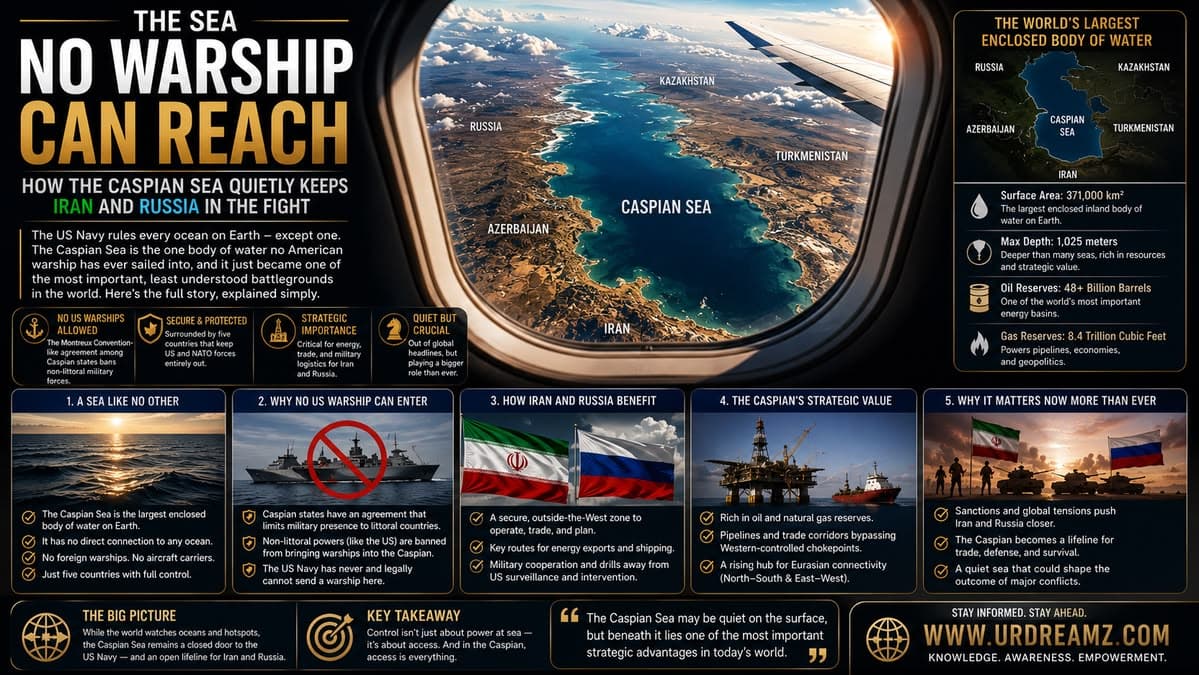
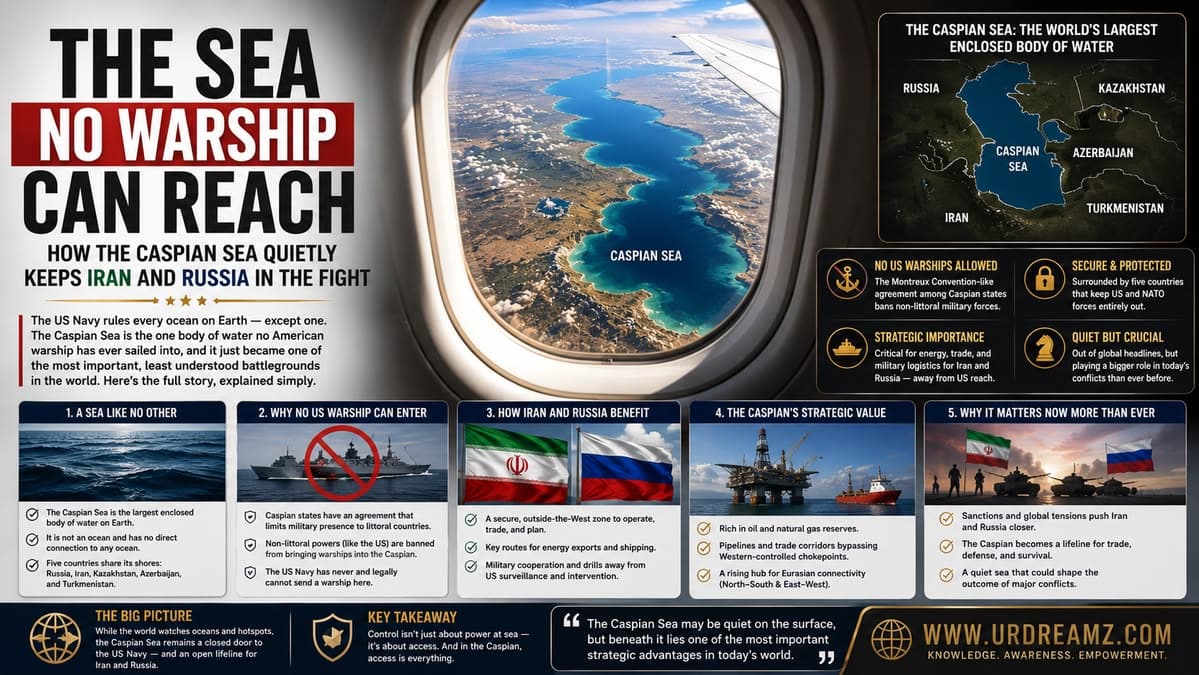
But there's one very large, very important body of water where that rule quietly breaks down completely. Not because America doesn't want to be there. Because it physically, legally, and geographically cannot get there. That place is the Caspian Sea.
So What Exactly Is the Caspian Sea?
The Caspian is the largest inland body of water on Earth - so big that people argue endlessly about whether to even call it a sea or the world's biggest lake. One edge of it touches Russia. The direct opposite edge touches Iran. In between, three more countries share its coastline: Azerbaijan, Turkmenistan, and Kazakhstan. That's it. Five countries, and only five countries, get a coastline on this water. Nobody else.
For years, analysts and researchers have quietly studied what actually moves across this water, because it turns out to be one of the least visible, least discussed trade and military corridors in the entire world - right up until Washington started paying very close attention to it, and suddenly it wasn't so quiet anymore.
Why No Outside Warship Has Ever Reached It
Here's the first reason, and it's the simplest one: geography. The Caspian Sea is completely landlocked. It has no open coastline connecting it to any ocean. You cannot just sail a ship from the Atlantic or the Persian Gulf and drift into the Caspian the way you could sail into the Mediterranean. There's no natural sea route in at all.
The Legal Wall Around It
The second reason is just as important as the geography, and it's arguably even stronger: the law. The five countries that border the Caspian have a long-standing understanding that no outside military is permitted to operate there. Not America, not anyone else. If a foreign power tried to force its way in militarily, that wouldn't be treated as some minor diplomatic incident - it would be treated as an act of open war against all five bordering nations at once. Nobody wants to test that line, which is exactly why nobody has.
The Only Key to the Door: The Black Sea
Now here's the part that makes this whole picture click into place. The Caspian isn't 100 percent sealed off from the rest of the world's waterways - there is technically one indirect route in, through a network of canals connecting the Caspian to the Black Sea via Russia's own internal river and canal system. Think of it like this: there's exactly one key that opens this particular door, and Russia is the one holding it. Nobody gets that key without going through Moscow first. That single fact tells you almost everything you need to know about who really controls access to this water.
What's Actually Moving Across This Water
So why does any of this matter? Because for years, US intelligence agencies and networks like CNN have laid out, fairly plainly, what's been quietly crossing the Caspian between Russia and Iran: oil, gas, metals - and weapons. Real military hardware. During periods when Iran has faced tight sanctions and blockades on its more visible trade routes, reporting has described Russia even sending food supplies to help Iran get through the squeeze. This is a genuine, functioning lifeline, and it's been running largely under the radar for a long time.
Why the World Suddenly Started Watching
For a long stretch, almost nobody outside a small circle of specialists paid much attention to any of this. That changed once Washington's intelligence community started publicly flagging the Caspian route as a serious concern - specifically because of what it enables between Russia and Iran. Once US officials started naming it directly, the story stopped being a quiet research footnote and started becoming genuine front-page material.
Here's Where I Need to Correct Something Important
Now, you might have heard a version of this story where the US itself starts firing missiles at Russian ships inside the Caspian, since it can't send its navy in. I want to be straight with you here, because getting this part right actually matters: that's not accurate. The US Navy has never operated inside the Caspian - not with ships, and not with missile strikes either. What has actually been happening in the Caspian recently is a different story entirely, and it's just as dramatic, if not more so.
The Real Story: Ukraine, Not America, Struck First
The actual strikes hitting Russian and Iran-linked vessels inside the Caspian Sea have come from Ukraine - using long-range drones, not American missiles. This is part of the broader Russia-Ukraine war, and it makes complete sense once you understand why: Iran has been supplying Russia with weapons - Shahed attack drones and increasingly capable ballistic missiles - for use against Ukraine. Ukraine, quite understandably, decided that if Iranian weapons are crossing the Caspian to reach the battlefield against them, that shipping route itself becomes a legitimate military target.
The Ghost Ship That Started It: Port Olya-4
Back in August 2025, Ukrainian special operations forces sank a cargo ship called Port Olya-4 - a vessel that had been used specifically to transport components for Iranian Shahed drones. Defense analysts described it at the time as one of the most technically demanding long-range strike operations Ukraine had ever pulled off, precisely because of how far away and how well-guarded that stretch of water is supposed to be.
Then a Warship, in May 2026
The strikes didn't stop there. In May 2026, Ukrainian forces hit a Russian Karakurt-class missile corvette operating in the Caspian - a real warship, not just a cargo vessel, armed with Kalibr cruise missiles that Russia has repeatedly used to strike targets inside Ukraine itself. That single strike made something very clear: Ukraine wasn't just going after weapons shipments anymore. It was going after the Russian military assets protecting that entire supply route.
Late July 2026: The Strike That Made Headlines
Then, just a matter of days before this article was written, it happened again - bigger and more publicly than before. Ukraine's intelligence services confirmed that drones had struck a Russian missile boat named the Molnyia, along with two cargo ships that had been under international sanctions specifically for transporting military cargo between Iran and Russia. Ukrainian President Volodymyr Zelensky posted about it directly, saying Ukraine had achieved "very strong results" with long-range strikes in the Caspian, explicitly naming vessels tied to Iranian military shipments as part of what was hit.
Iran's Furious Response
Iran didn't stay quiet about any of this. Iranian officials described the strike as a "hostile and criminal act," and Iran's Foreign Minister said he'd already been in direct contact with Russia and the European Union about how to respond, insisting publicly that what Ukraine had done "cannot go unanswered." One of the vessels hit was described by Iran as a purely commercial ship, which Tehran framed as a direct attack on a vital economic route rather than a legitimate military target - a claim that sits in obvious tension with the sanctioned cargo history reported around several of these same ships.
Why Would Ukraine Bother Hitting a Sea So Far From Its Own Coast?
This is the part that trips a lot of people up at first. Why would Ukraine, fighting a war on its own doorstep, spend resources striking targets thousands of kilometers away in a completely different sea? The answer is almost embarrassingly logical once you say it out loud: because that's exactly where the weapons being used against Ukrainian civilians are actually coming from. If Iranian drones and missiles are crossing the Caspian to reach Russian forces, then the Caspian genuinely is part of the war, whether or not it shows up that way on a typical map.
Israel and the US Have Their Own Separate Angle Here Too
It's also worth knowing that Ukraine isn't the only outside actor with an interest in this water. Israel, which has carried out its own strikes on Iranian targets alongside US forces at various points, has also reportedly hit Iranian assets connected to the Caspian. So while the US Navy itself has never physically entered these waters, American pressure, intelligence sharing, and coordination with allies like Israel very much extend into this picture - just not through direct US Navy action inside the sea itself, which is the part that often gets mixed up in how this story gets told.
Zelensky's Other Claim: Russia Feeding Iran Satellite Intelligence
There's another thread worth knowing about here. Zelensky has also alleged that Russia has been supplying Iran with satellite imagery to help plan and assess strikes across the wider Middle East - specifically claiming Russian satellites had observed airbases in Bahrain, Jordan, and Kuwait in the days just before some recent Iranian strikes. If accurate, that would mean the Russia-Iran relationship isn't just about moving weapons across the Caspian anymore - it's expanded into shared intelligence too, which is a meaningfully deeper level of cooperation than a simple supply route.
Okay, So Here's the Bigger Picture
Now let's zoom all the way out, because this is where the story actually gets interesting. A lot of people watching all this assume it's simply "America versus Iran" or "Iran and Israel just don't get along." Genuinely, that's a pretty shallow read of what's happening. What's really going on runs much deeper than any single country's grudge against another.
This Is a War Over Routes, Not Just Countries
Here's the honest version: this is a fight over control of trade and supply routes - the physical paths that let goods, weapons, and money move where they need to go. It's not really a war between "Iran" and "everyone else" as much as it's part of a much bigger, longer struggle over who controls the economic arteries running through Russia, China, and their partners. Countries rarely go to war purely over pride or ideology in the modern era. They go to war, or apply enormous pressure, over the things that actually keep their economy breathing - and that's routes, ports, and chokepoints far more often than it's abstract borders on a map.
Remember the Strait of Hormuz? Same Exact Pattern
Think back to how the Strait of Hormuz became a household name. Most people had never even heard the phrase before it suddenly started dominating headlines. Then tensions rose, shipping through it got disrupted, and almost overnight the entire world watched oil prices swing and global markets get shaken - all because of one relatively narrow stretch of water most people couldn't have pointed to on a map a year earlier. That's exactly the pattern playing out with the Caspian right now, just with a different sea and a different set of players.
Why Geography Can Beat Raw Military Power
Here's maybe the single most important idea in this whole story, so let me say it plainly: Iran, on paper, is not the most militarily powerful country in its own region, let alone the world. But its geography - specifically its access to this landlocked, legally protected, foreign-military-free sea, connected directly to Russia - gives it something that raw firepower alone can't buy: a route that's genuinely difficult for its rivals to touch. That's the real answer to the question I opened with. It's not that nobody can pressure Iran at all. It's that this one specific route has been extraordinarily hard to close, right up until Ukraine found a way to reach into it anyway.
What Happens to This Route Now?
With Ukraine now demonstrating, repeatedly, that it can strike deep inside the Caspian - hitting cargo ships, a missile corvette, and now a missile boat alongside sanctioned cargo vessels - the assumption that this water was simply untouchable has taken a real hit. Defense analysts have already suggested that shipping between Russia and Iran across the Caspian is likely to get noticeably harder going forward, precisely because these strikes prove the route isn't as safe as it once was. Whether that meaningfully slows down the flow of weapons reaching Russia, or simply pushes both countries to find new workarounds, is exactly the kind of question that will keep this specific stretch of water in the headlines for a while yet.
Frequently Asked Questions
Can American warships enter the Caspian Sea?
No - the Caspian is completely landlocked with no ocean access, and the five bordering countries maintain a long-standing agreement barring outside military forces from operating there.
Which countries border the Caspian Sea?
Russia, Iran, Azerbaijan, Turkmenistan, and Kazakhstan - only these five countries have a coastline on it.
Did the United States strike Russian ships in the Caspian Sea?
No - the recent strikes on Russian and Iran-linked vessels in the Caspian were carried out by Ukraine using long-range drones, as part of the ongoing Russia-Ukraine war, not by the US military.
Why is Iran supplying weapons to Russia through the Caspian?
Iran has been supplying Russia with drones and increasingly ballistic missiles for use in the war against Ukraine, and the Caspian Sea route offers a relatively hidden, hard-to-reach path for that military cargo to travel.
Is the only outside connection to the Caspian Sea through Russia?
Effectively yes - the main indirect route connecting the Caspian to the world's oceans runs through Russia's internal canal system linking it to the Black Sea, giving Russia significant control over outside access.
Why does this matter beyond Iran and Russia specifically?
Because it illustrates a broader pattern in modern geopolitics - conflicts increasingly center on controlling trade and supply routes rather than territory alone, a dynamic also seen clearly with chokepoints like the Strait of Hormuz.
One Last Thought Before You Go
So next time someone asks you how Iran manages to keep standing against pressure from two of the most powerful militaries on Earth, you'll actually have a real answer - not "stubbornness" or "propaganda," but a genuinely fascinating piece of geography, sealed off by both physics and international law, sitting quietly between Russia and Iran, doing far more heavy lifting than most people ever realize. And now that Ukraine has shown it can reach into that water too, the Caspian isn't quiet anymore - it's become one of the more important, if still under-the-radar, fronts in a conflict that keeps proving the same point over and over: the routes matter just as much as the countries fighting over them.