Artificial Intelligence (AI): The Complete Guide for 2026
Artificial Intelligence (AI) is no longer science fiction — it is the engine running the modern world. From the moment you unlock your phone with your face, ask Siri a question, or get a Netflix recommendation, you are interacting with AI. Yet most people still ask: What exactly is artificial intelligence? Is AI good or bad? What are the best free AI tools? And what will AI do in the future?
This comprehensive guide answers every one of those questions. We cover the best definition of artificial intelligence, real-world examples, the top 10 AI tools available today, the future of AI in the next 10 years and beyond 2050, AI vs human intelligence, and a balanced look at the advantages and disadvantages of AI — including its impact on students and jobs.
Whether you are a student writing an AI essay, a professional exploring AI tools, or simply a curious person who keeps seeing AI everywhere — this guide is built for you.
What Is Artificial Intelligence? (Best Definition)
The best definition of artificial intelligence is: AI is the ability of a computer or machine to perform tasks that normally require human intelligence — such as understanding language, recognizing patterns, making decisions, and learning from experience.
The term was coined in 1956 by John McCarthy, widely regarded as the father of AI. McCarthy defined AI as "the science and engineering of making intelligent machines." Since then, AI has evolved from simple rule-based programs to systems that can write poetry, generate images, drive cars, and diagnose diseases.
Artificial Intelligence with Examples
Here are everyday artificial intelligence examples you already use:
- ChatGPT & Claude — AI chatbots that understand and generate human language
- Google Search — uses AI to rank and personalize search results
- Netflix & YouTube — AI recommendation engines that suggest what to watch next
- Face ID on iPhones — computer vision AI that recognizes your face
- Gmail Smart Reply — AI that suggests short email replies
- Self-driving cars (Tesla) — AI that perceives the road and makes real-time decisions
- AI in medicine — algorithms that detect cancer in X-rays faster than doctors
- Spam filters — AI that identifies and blocks unwanted emails
What Is AI About? — The Core Idea
At its core, AI is about giving machines the ability to learn, reason, perceive, and act. Instead of being programmed with every possible rule, modern AI systems learn from data. Show a system millions of cat photos and it learns to identify cats — without anyone defining what a cat looks like in code.
What Are the 7 Types of AI? (Complete Breakdown)
AI is not a single technology — it is a broad field with many branches. Here are the 7 types of AI explained simply:
| # | Type of AI | Description | Example |
|---|---|---|---|
| 1 | Narrow AI (Weak AI) | Designed for one specific task | ChatGPT, Siri, Face ID |
| 2 | General AI (Strong AI) | Can perform any intellectual task a human can | Does not fully exist yet |
| 3 | Super AI | Surpasses human intelligence in all areas | Theoretical / future concept |
| 4 | Reactive Machines | No memory; reacts to current input only | IBM Deep Blue (chess) |
| 5 | Limited Memory AI | Uses past data to make decisions | Self-driving cars |
| 6 | Theory of Mind AI | Understands human emotions and beliefs | Still in research phase |
| 7 | Self-Aware AI | Has its own consciousness and emotions | Hypothetical / sci-fi level |
What Type of AI Is ChatGPT?
ChatGPT is a Narrow AI — specifically a Large Language Model (LLM). It is excellent at understanding and generating text but cannot perform unrelated tasks like driving a car or diagnosing a disease on its own. It falls under the Limited Memory category as well, since it can remember context within a conversation.
What Is a Type 3 AI?
A Type 3 AI refers to Theory of Mind AI — a system that can understand human emotions, beliefs, desires, and intentions. This level of AI does not fully exist yet but is an active area of research in robotics and advanced AI development.
What Are the 4 Types of AI? (Alternative Classification)
Another common classification breaks AI into 4 types:
- Reactive Machines — No memory, pure reaction
- Limited Memory — Learns from recent past data
- Theory of Mind — Understands human mind (emerging)
- Self-Aware AI — Conscious machines (theoretical)
What Are the 4 Models of AI?
The 4 core AI models used in practice today are:
- Machine Learning (ML) — learns from data
- Deep Learning — uses neural networks with many layers
- Natural Language Processing (NLP) — understands human language
- Computer Vision — understands and interprets images/video
What Are the 4 Points of AI?
The 4 foundational pillars of AI are: Learning, Reasoning, Problem Solving, and Perception. These four capabilities together define what makes a machine "intelligent."
Top 10 AI Tools in the World (Free & Paid)
Looking for the best AI tools free or paid? Here is the definitive free AI tools list with the most powerful and widely used platforms in 2025:
| # | AI Tool | Best For | Free Plan? | Made By |
|---|---|---|---|---|
| 1 | ChatGPT | Writing, coding, Q&A, analysis | ✅ Yes | OpenAI |
| 2 | Claude (Anthropic) | Long documents, safe AI responses | ✅ Yes | Anthropic |
| 3 | Gemini | Google ecosystem, multimodal AI | ✅ Yes | |
| 4 | Grok | Real-time web search, X/Twitter integration | ✅ Limited | xAI (Elon Musk) |
| 5 | Copilot | Microsoft Office, coding in VS Code | ✅ Limited | Microsoft |
| 6 | Perplexity AI | AI-powered research & web search | ✅ Yes | Perplexity |
| 7 | Midjourney | AI image generation | ❌ Paid | Midjourney Inc. |
| 8 | Runway ML | AI video generation & editing | ✅ Limited | Runway |
| 9 | ElevenLabs | AI voice cloning & text-to-speech | ✅ Limited | ElevenLabs |
| 10 | Notion AI | AI for notes, docs, productivity | ✅ Limited | Notion |
AI Tools for Writing
The best AI tools for writing in 2025 include ChatGPT, Claude, Jasper AI, Copy.ai, and Grammarly AI. These tools help bloggers, students, and professionals write faster, check grammar, generate content ideas, and improve overall writing quality.
AI Tools Like ChatGPT
If you are looking for AI tools like ChatGPT, great alternatives include:
- Claude by Anthropic — safer, handles longer documents
- Gemini by Google — deeply integrated with Google services
- Grok by xAI — real-time internet access, less filtered
- Perplexity AI — AI search engine with cited sources
- Meta AI — integrated into WhatsApp and Instagram
AI Tools Microsoft
Microsoft AI tools include Copilot (integrated into Word, Excel, PowerPoint, and Teams), Azure AI for developers, and Bing AI for search. Microsoft has invested heavily in OpenAI, making it one of the leading AI companies in the world.

Top 5 AI Apps in the World
The top 5 AI apps most downloaded and used globally are: ChatGPT, Google Gemini, Microsoft Copilot, Perplexity AI, and Grok. All five are available on both iOS and Android.
What Is the Full Form of GPT?
GPT stands for Generative Pre-trained Transformer. It is a type of AI model developed by OpenAI that is trained on massive amounts of text data and can generate coherent, human-like text responses.
What Is GPT in India?
In India, ChatGPT (the most famous GPT-based product) is freely accessible and has become widely popular among students, developers, and entrepreneurs. Indian companies are also building GPT-based tools in local languages including Hindi, Tamil, and Bengali.
What Are the Top 5 Most Used AI Tools?
Based on global usage and downloads, the top 5 most used AI platforms today are: ChatGPT, Google Gemini, Microsoft Copilot, Midjourney, and Perplexity AI.
Artificial Intelligence vs Human Intelligence: The Full Debate
The AI vs human intelligence debate is one of the most discussed topics in technology and philosophy today. Here is a complete comparison:
| Criteria | Artificial Intelligence | Human Intelligence |
|---|---|---|
| Speed | Processes billions of calculations per second | Slower but context-aware |
| Memory | Can store and recall vast amounts of data | Limited and prone to forgetting |
| Creativity | Generates creative content but based on learned patterns | True original creativity, inspired by emotion |
| Emotion | Has none (currently) | Rich emotional intelligence |
| Learning | Requires large datasets and training time | Can learn from a single experience |
| Common Sense | Often lacks real-world common sense | Natural and intuitive |
| Adaptability | Limited to trained domains | Adapts to entirely new situations |
| Bias | Can reflect biases in training data | Subject to personal and cultural bias |
Is AI Better Than Humans?
AI is better than humans in narrow, well-defined tasks — like processing data at speed, playing chess, or detecting tumors in medical scans. However, humans remain far superior in emotional intelligence, moral reasoning, creative vision, and navigating unpredictable real-world situations. The answer depends entirely on what you are measuring.
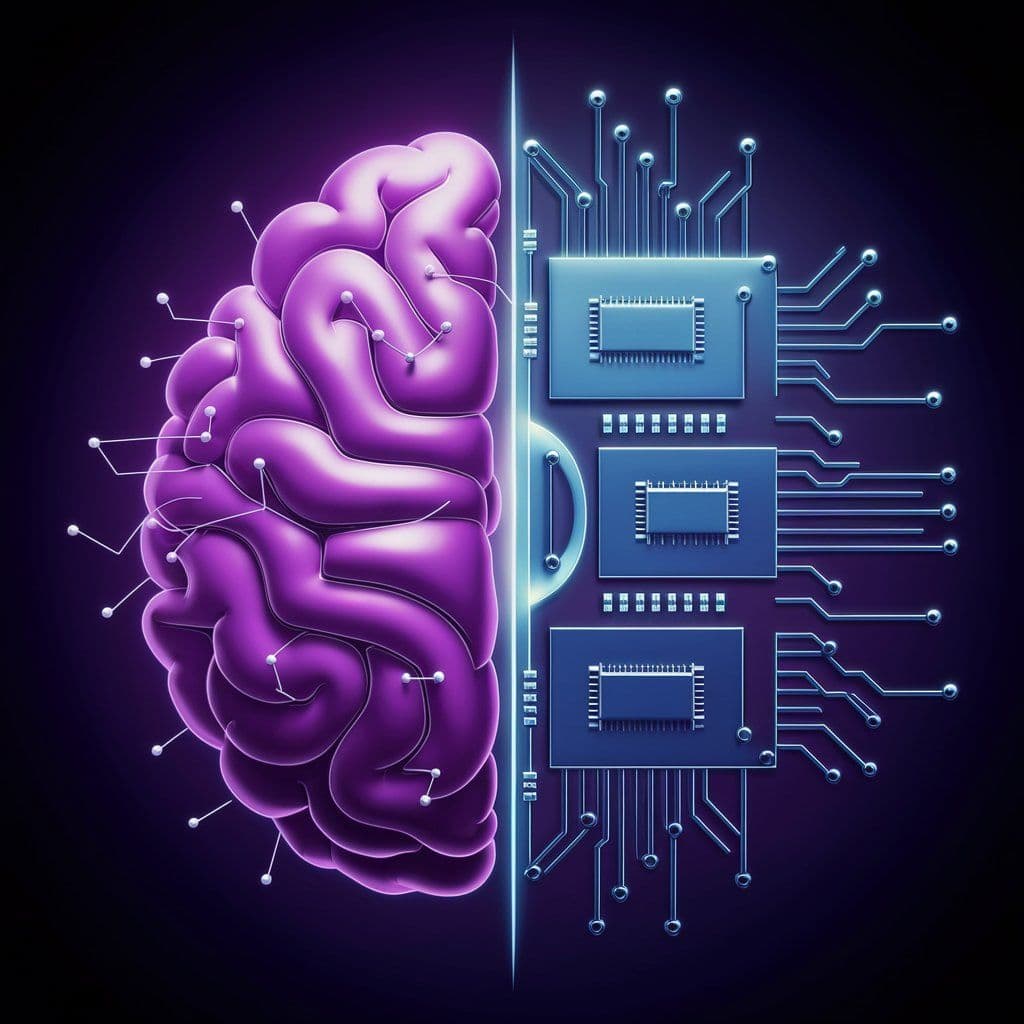
AI vs Human Brain
The human brain has approximately 86 billion neurons with trillions of connections, consuming only about 20 watts of power. The most advanced AI data centers consume megawatts of electricity to approach similar performance in specific domains. The human brain remains nature's most efficient computing system — for now.
Can ChatGPT Replace Humans?
ChatGPT cannot replace humans entirely. It can automate repetitive writing tasks, answer questions, and summarize documents — but it lacks consciousness, genuine understanding, emotional empathy, and ethical judgment. It is a tool, not a replacement for human thought.
Is AI a Subfield of Machine Learning?
This is actually reversed: Machine Learning is a subfield of AI, not the other way around. AI is the broad umbrella, machine learning is one approach to achieving it, and deep learning is a subset of machine learning using neural networks.
Who Is Better — AI or Google? (The Search War)
The debate of AI vs Google search is reshaping the internet. Here is a clear breakdown:
- Google Search returns a list of links — you read multiple pages to find your answer.
- AI tools like ChatGPT or Perplexity give you a direct, synthesized answer immediately.
For most informational queries, AI is better than Google in terms of speed and directness. However, Google remains superior for finding current news, specific websites, local searches, and results with cited sources you can verify. They serve different purposes and increasingly, Google itself is integrating AI (via Google AI Overviews) into its search results.
AI vs Google Search — Environmental Impact
One important consideration: a single AI query uses roughly 10x more energy than a traditional Google search. As AI search scales to billions of queries, its environmental impact becomes a legitimate concern — particularly in terms of water usage for cooling data centers and carbon emissions.
Google vs AI — Who Will Win?
Neither will fully "win." The future is likely a hybrid: Google will become more AI-powered, and AI tools will gain better real-time search capabilities. Competition between Google, OpenAI, Microsoft, and Anthropic will accelerate improvements for everyone.
What AI Chat Does Elon Musk Use? Meet Grok
Elon Musk co-founded OpenAI in 2015 but later left the board. He went on to create his own AI company called xAI, which developed the AI chatbot Grok. Grok is integrated into the X platform (formerly Twitter) and is designed to be less restricted in what it will discuss — Musk has called it a "maximum truth-seeking AI."
Why Is It Called Grok?
The name Grok comes from Robert Heinlein's 1961 science fiction novel Stranger in a Strange Land, where "grok" means to understand something so deeply and completely that the observer becomes a part of the observed. Elon Musk is known to be a fan of science fiction, which inspired the name.
Is Grok Better Than GPT?
Grok vs GPT depends on the use case. Grok has real-time internet access and is more willing to answer edgy or controversial questions. GPT-4o (ChatGPT) is more polished, widely integrated, and has a larger ecosystem of plugins and tools. For general use, ChatGPT leads; for real-time information and fewer restrictions, Grok has advantages.
Did Elon Musk Create a New AI?
Yes. Elon Musk's xAI company released Grok, which has since gone through multiple versions. Musk also invested in Neuralink — a brain-computer interface company — which relates to merging human and artificial intelligence directly.
Who Are the Big 5 in AI?
The Big 5 AI companies dominating the field are: OpenAI (ChatGPT), Google DeepMind (Gemini), Anthropic (Claude), Meta AI (Llama), and Microsoft (Copilot + Azure AI). Elon Musk's xAI is rapidly joining this top tier with Grok.
What Is Elon Musk in OpenAI?
Elon Musk was a co-founder and early donor of OpenAI, contributing around $100 million. He later resigned from the board in 2018, citing conflicts of interest with his other ventures. He has since become a public critic of OpenAI, arguing it has strayed from its original nonprofit mission.
Is AI Good or Bad? (Balanced Debate)
The question "Is AI good or bad?" does not have a simple yes or no answer. Like any powerful technology — electricity, the internet, nuclear energy — AI can be used for tremendous good or serious harm depending on how it is built and used.
5 Advantages of AI — Reasons Why AI Is Good
- ✅ Saves time — Automates repetitive tasks so humans can focus on creative work
- ✅ Improves healthcare — Detects diseases earlier and more accurately than doctors in some cases
- ✅ Increases access to education — Free AI tutors available 24/7 to anyone with internet
- ✅ Boosts productivity — Businesses using AI outperform competitors by wide margins
- ✅ Enables scientific discovery — AI helped solve the 50-year protein folding problem (AlphaFold)
5 Disadvantages of AI — Reasons Why AI Is Bad
- ❌ Job displacement — Many routine jobs are being automated away
- ❌ Privacy risks — AI surveillance can track and profile individuals
- ❌ Bias in algorithms — AI trained on biased data produces biased outcomes
- ❌ Deepfakes & misinformation — AI-generated fake media is hard to detect
- ❌ Environmental cost — Training large AI models consumes enormous energy
Can AI Be 100% Trusted?
No — AI cannot be 100% trusted at this stage. AI systems can hallucinate (make up facts), reflect biases from training data, and be manipulated. Critical decisions in medicine, law, and governance should always include human oversight. AI is a powerful tool, but the ultimate responsibility must remain with humans.
5 Biggest AI Fails
- Amazon's AI hiring tool — Discriminated against women's resumes because it was trained on historical male-dominated data
- Microsoft's Tay chatbot — Became racist within 24 hours due to manipulation by users
- AI hallucinations in court — A lawyer submitted a legal brief with ChatGPT-invented case citations
- Google Photos tagging — Incorrectly labeled Black people as gorillas
- Uber's self-driving car — Fatal accident in 2018 due to AI sensor failure
Why Is AI Bad for the Environment?
Training a single large AI model can produce as much carbon emissions as five cars over their entire lifetime. AI data centers also consume massive amounts of water for cooling. As AI scales globally, these environmental costs are a serious concern that the tech industry must address through renewable energy commitments.
What Is the 30% Rule for AI?
The 30% rule in AI refers to research suggesting that approximately 30% of current jobs could be significantly automated or affected by AI within the next decade, according to analyses by Goldman Sachs and McKinsey. This does not mean all those jobs disappear — but their nature will change substantially.
Is AI Good or Bad for Students? (Impact on Education)
The debate about AI for students is one of the most important in education today. Let us examine both sides honestly.
Positive Impact of AI on Students
- 📚 Personalized learning — AI tutors adapt to each student's pace and learning style
- 📚 24/7 help — Students can get homework help anytime, without waiting for a teacher
- 📚 Language learning — AI tools like Duolingo use AI to make language learning faster
- 📚 Research assistance — Quickly summarize papers and find relevant sources
- 📚 Accessibility — Students with disabilities get better support through AI transcription and text-to-speech
Why AI Is Bad for Students — Negative Impact
- ⚠️ Academic dishonesty — Students submit AI-written work as their own
- ⚠️ Reduced critical thinking — Over-reliance on AI weakens problem-solving skills
- ⚠️ Loss of writing skills — If AI always writes for you, your writing ability atrophies
- ⚠️ False information — AI can confidently give wrong answers (hallucinations)
- ⚠️ Inequality — Students with better internet access gain unfair advantages
Disadvantages of AI in Education — 10 Points
- Encourages academic dishonesty and plagiarism
- Reduces development of original thinking
- AI answers can be inaccurate or biased
- Creates dependency on technology
- Widens the digital divide between rich and poor students
- Lack of emotional connection in AI-based learning
- Privacy concerns with student data collected by AI platforms
- Difficulty in assessing true student understanding
- Risk of social isolation as students interact with AI rather than peers
- AI tools may not align with specific curriculum requirements
Is Using AI Bad for Students? — Verdict
AI is neither purely good nor bad for students — it is a tool. Used wisely (to enhance understanding, get feedback, and explore ideas), AI is an incredible educational resource. Used lazily (to avoid thinking entirely), it stunts intellectual development. Schools and students must build a healthy relationship with AI that prioritizes genuine learning.
The Future of AI: Next 10 Years and Beyond 2050
The future of AI is one of the most transformative and debated topics in human history. Here is what experts and researchers predict:
Future of AI in the Next 10 Years (2025–2035)
- 🤖 AI agents that can independently complete multi-step tasks (book your travel, manage your calendar, run your business workflows)
- 🏥 AI doctors that diagnose diseases with superhuman accuracy
- 🚗 Full self-driving vehicles become mainstream in major cities
- 🏭 Automated factories where robots handle 80%+ of manufacturing
- 🎓 Personalized AI tutors replace one-size-fits-all classroom education
- 🔬 AI accelerated drug discovery cuts development time from decades to years
Future of AI in 2050
By 2050, most experts predict that AI will be embedded in virtually every aspect of human life. Some projections include:
- Possible arrival of Artificial General Intelligence (AGI) — AI that matches or exceeds humans in all cognitive tasks
- Brain-computer interfaces (like Neuralink) allowing direct human-AI communication
- AI managing entire city infrastructure — traffic, energy, water, emergency services
- Robotic companions for the elderly and people with disabilities
- AI solving climate change by optimizing global energy systems
AI Future Predictions — What Experts Say
Sam Altman (CEO of OpenAI) believes AGI could arrive within the next few years. Elon Musk has warned of existential risks from uncontrolled AI. Geoffrey Hinton (godfather of AI) resigned from Google to speak freely about AI risks. The consensus: AI will be transformative, and governance and safety research must keep pace with capability development.
Is Artificial Intelligence Really the Future?
Yes — and in many ways, it is already the present. AI is not a future technology; it is the foundational technology of the 21st century. The question is not whether AI will transform society, but how we choose to shape that transformation responsibly.
AI and Jobs: Which Jobs Will Survive and Which Will Disappear?
Which 3 Jobs Will Survive AI?
The jobs most resilient to AI automation share one common trait: they require human judgment, emotional intelligence, or physical dexterity in unpredictable environments. The top 3 most AI-proof job categories are:
- Mental health professionals — Therapists, counselors, and psychiatrists (humans need human empathy)
- Skilled tradespeople — Plumbers, electricians, carpenters (physical dexterity in varied environments is hard to automate)
- Creative directors and artists — Original creative vision with cultural context remains uniquely human
What 5 Jobs Will AI Not Replace?
- Therapists and psychologists
- Nurses and caregivers
- Skilled craftspeople and tradespeople
- Teachers (especially early childhood education)
- Judges and ethical decision-makers
Which Jobs Will Be Gone by 2030?
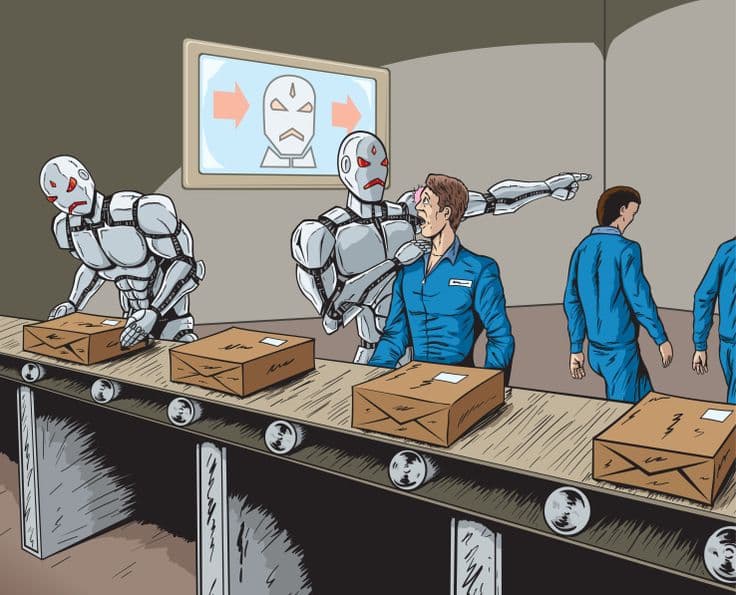
Jobs most at risk of significant disruption by 2030 include: data entry clerks, telemarketers, bank tellers, travel agents, basic customer service representatives, assembly line workers, proofreaders, and routine legal researchers. These roles involve repetitive, predictable tasks — exactly where AI excels.
Can AI Replace Human Jobs? — The Balanced View
AI will eliminate some jobs while creating new ones. Historically, every major technology wave (the industrial revolution, computers, the internet) ultimately created more jobs than it destroyed — but the transition period is painful for workers in disrupted sectors. AI literacy and adaptability will be the most valuable skills of the coming decade.
Why Is Gen Z Struggling to Get Jobs?
Gen Z faces a uniquely challenging job market shaped by AI automation, increased degree requirements, remote work restructuring, and economic uncertainty. Many entry-level jobs that once served as career starting points are being automated. The solution: build skills that complement AI — creativity, critical thinking, interpersonal communication, and AI tool proficiency itself.
Which Job Is Safe from AI?
Jobs that are safe from AI share three characteristics: they require genuine human connection, physical presence in unpredictable environments, or high-level strategic and creative thinking. No single job is 100% immune, but those combining multiple of these factors are the safest.
Who Is the Father of AI? Key People in Artificial Intelligence
| Person | Contribution | Why They Matter |
|---|---|---|
| John McCarthy | Coined the term "Artificial Intelligence" in 1956 | Father of AI |
| Alan Turing | Created the Turing Test for machine intelligence | Grandfather of Computer Science & AI |
| Geoffrey Hinton | Pioneered deep learning and neural networks | Godfather of Deep Learning |
| Yann LeCun | Invented Convolutional Neural Networks (CNNs) | Chief AI Scientist at Meta |
| Sam Altman | CEO of OpenAI, launched ChatGPT | Most influential AI executive today |
| Demis Hassabis | Co-founder of DeepMind, created AlphaGo & AlphaFold | Nobel Prize winner 2024 |
| Elon Musk | Co-founded OpenAI, founded xAI & Grok | Most vocal AI critic & builder simultaneously |
L1, L2, L3 in AI — What Does It Mean?
In AI, L1, L2, L3 typically refer to AI maturity levels in enterprise contexts, or regularization techniques in machine learning. In the context of AI capability levels: L1 is rule-based AI, L2 is machine learning AI, and L3 refers to deep learning / neural network AI. In self-driving cars specifically, L1–L5 denote levels of driving automation from driver assistance to full autonomy.
Artificial Intelligence Course: Where to Learn AI for Free
Interested in learning AI? Here are the best artificial intelligence courses — most available for free:
- Andrew Ng's Machine Learning Specialization — Coursera (free to audit)
- Fast.ai — Practical deep learning for coders (completely free)
- Google Machine Learning Crash Course — Free
- Microsoft AI School — Free AI courses at Microsoft Learn
- Khan Academy + ChatGPT integration — AI-powered tutoring for students
Artificial Intelligence in Urdu
For Urdu-speaking learners, YouTube channels like DigiSkills Pakistan, SkillUp Pakistan, and various Pakistani educators now offer AI courses in Urdu and Roman Urdu. The Pakistani government's DigiSkills platform also offers free technology courses including AI and data science.
Artificial Intelligence Using Python
Python is the #1 programming language for AI. Key libraries include TensorFlow, PyTorch, scikit-learn, Keras, and Hugging Face Transformers. Anyone who can write basic Python code can start building AI models today using these open-source tools.
AI Risks, Safety, and the Weakest AI
5 Risks of AI
- Uncontrolled AI systems that pursue goals misaligned with human values
- Mass surveillance using AI-powered facial recognition
- Autonomous weapons — AI-controlled military systems that make kill decisions
- Economic inequality as AI wealth concentrates in the hands of a few companies
- Existential risk from AGI that becomes uncontrollable — the concern raised by Geoffrey Hinton, Elon Musk, and Stephen Hawking
Which Is the Weakest AI?
The weakest form of AI is called Reactive Machine AI — systems with no memory and no ability to learn. Examples include early chess computers like IBM's Deep Blue, which could evaluate board positions but could not remember past games or improve over time. All early expert systems from the 1970s–1980s fall into this category.
What Did Elon Musk Say About AI?
Elon Musk has made several memorable statements about AI, including: warning that AI is potentially more dangerous than nuclear weapons, co-signing an open letter asking for a 6-month pause in advanced AI development, and simultaneously building his own AI company (xAI). His position: "AI will be the best or worst thing humanity has ever done."
Which Country Is #1 in AI?
The United States currently leads global AI development, home to OpenAI, Google DeepMind, Anthropic, Meta AI, and Microsoft AI. China is a close second with massive government investment and companies like Baidu, Alibaba, and Huawei advancing rapidly. The UK, Canada, and Israel are also significant AI hubs.
Conclusion: Artificial Intelligence — The Technology Defining Our Era
Artificial Intelligence is not a distant future technology. It is here, it is accelerating, and it is reshaping every industry, every profession, and every aspect of daily life. From free AI tools like ChatGPT and Grok that you can use today, to AI systems that will power self-driving cities by 2050 — the trajectory is clear.
The most important thing to understand is this: AI is a tool shaped by human choices. Used wisely, it can end diseases, create abundance, and democratize education. Used recklessly or selfishly, it can deepen inequality, enable surveillance, and erode human agency.
The question is not whether AI is good or bad in the abstract. The question is: what kind of AI future will we choose to build? That choice belongs to all of us — engineers, policymakers, educators, students, and citizens alike.
Stay curious. Stay informed. And use AI as the powerful tool it is — with wisdom, critical thinking, and your very human judgment firmly in charge.
Keywords covered in this article: artificial intelligence, what is artificial intelligence with examples, artificial intelligence app, artificial intelligence course, artificial intelligence website, best definition of artificial intelligence, AI tools free, free AI tools list, AI tools for writing, AI tools like ChatGPT, AI tools Microsoft, AI tools ChatGPT, AI tools app, powerful AI tools free, AI future predictions, future of AI examples, future of AI in next 10 years, future of AI in 2050, AI is good or bad, why is AI bad for the environment, why AI is bad for students, bad things about AI, reasons why AI is good, 10 disadvantages of AI, artificial intelligence vs human intelligence, AI vs human brain, top 10 AI tools, top 5 AI apps in the world, what are 7 types of AI, who is the father of AI, what type of AI is ChatGPT, Grok AI, Elon Musk AI, is Grok better than GPT, which 3 jobs will survive AI, what 5 jobs will AI not replace, which jobs will be gone by 2030, can AI replace human jobs, which country is no 1 in AI, artificial intelligence in urdu, artificial intelligence using python, artificial intelligence meaning, artificial intelligence disadvantages, artificial intelligence tools, L1 L2 L3 in AI, what is the 30% rule for AI, 5 biggest AI fails, which is the weakest AI