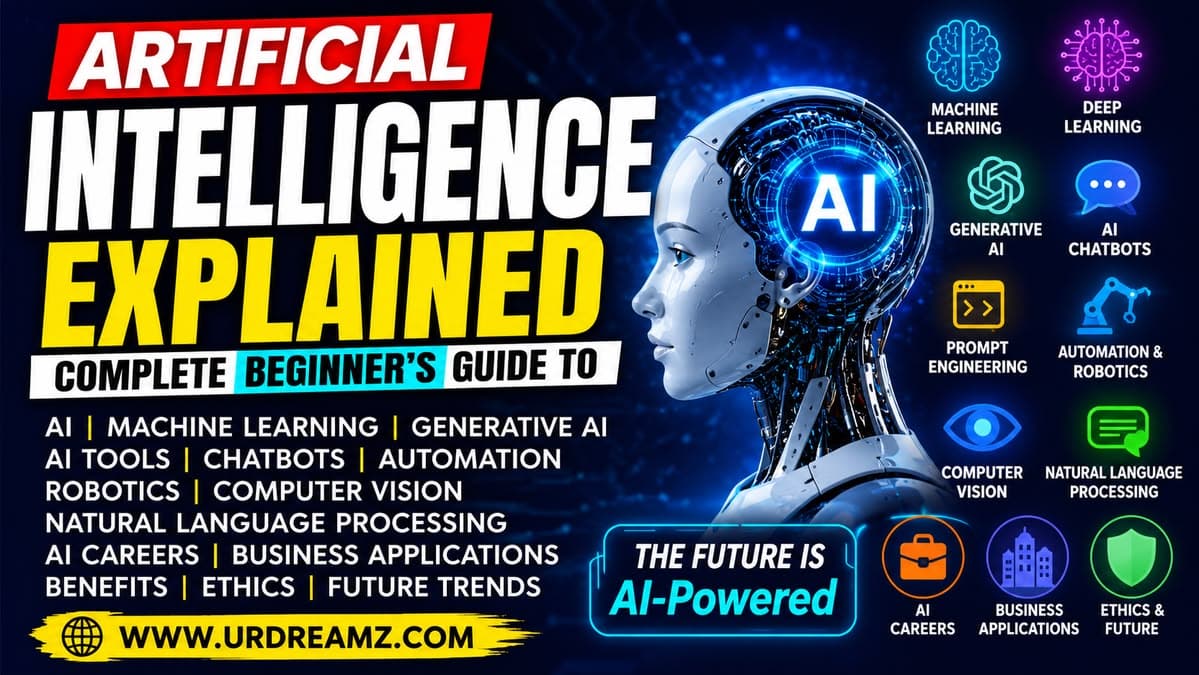
Artificial Intelligence Explained: Complete Beginner's Guide to AI, Machine Learning, Generative AI, Tools, Applications, Benefits and Future
Artificial intelligence has moved from a research-lab curiosity to something most people now use before they've had their morning coffee — a phone that recognizes a face, an app that predicts a commute, an assistant that answers a question in plain language. Yet for something so present in daily life, AI remains poorly understood by most of the people using it every day. This guide is built to change that: a complete, beginner-friendly walkthrough of what AI actually is, how machine learning and deep learning fit underneath it, how generative AI and today's chatbots actually work, which tools are worth knowing, and how AI is reshaping work, careers, and daily life.
Whether you're trying to understand the difference between AI, machine learning, and generative AI for the first time, deciding which AI tools are worth learning for your job, or simply want a clear-eyed view of where this technology is headed, this guide is designed to be a single, thorough reference you can come back to.
1. What Is Artificial Intelligence?
Artificial intelligence is the branch of computer science focused on building systems that can perform tasks normally associated with human thinking — understanding language, recognizing patterns, making predictions, and making decisions — by learning from data rather than following a fixed set of hand-written rules. Rather than a single technology, AI is best understood as an umbrella term covering many overlapping fields, including machine learning, deep learning, natural language processing, computer vision, and robotics, each contributing a different piece of what we now call "intelligent" software.
2. A Short History of AI
| Period | Milestone |
|---|---|
| 1950 | Alan Turing proposes the question "can machines think?" and outlines what became known as the Turing Test |
| 1956 | The term "artificial intelligence" is coined at the Dartmouth Conference, marking the field's formal beginning |
| 1960s–70s | Early rule-based programs and chatbots like ELIZA demonstrate limited but notable early progress |
| 1980s–90s | Expert systems and early neural network research grow, interrupted by periods of reduced funding known as "AI winters" |
| 1997 | IBM's Deep Blue defeats world chess champion Garry Kasparov |
| 2010s | GPUs and large datasets fuel a deep learning boom, dramatically improving image and speech recognition |
| 2017 | The transformer architecture is introduced, laying the technical foundation for modern large language models |
| 2020s | Generative AI tools like ChatGPT bring AI to mainstream, everyday use for the first time |
3. How AI Actually Works: The Basics
Modern AI systems generally work by being shown enormous amounts of data — text, images, numbers, or examples of correct outcomes — and adjusting their internal parameters until they get better at predicting the right answer. This process, called training, differs fundamentally from traditional programming, where a developer writes explicit step-by-step instructions. Instead of being told exactly what to do in every situation, an AI model learns statistical patterns from examples and applies those patterns to new, unseen situations.
4. Types of AI by Capability
| Type | Description | Current Status |
|---|---|---|
| Artificial Narrow Intelligence (ANI) | Designed to perform one specific task well, such as translation or image recognition | The only type that currently exists |
| Artificial General Intelligence (AGI) | Would match human-level reasoning and adaptability across virtually any task | Theoretical; does not yet exist |
| Artificial Superintelligence (ASI) | Would exceed human intelligence across essentially every domain | Purely theoretical and widely debated |
5. Types of AI by Functionality
| Type | Description | Example |
|---|---|---|
| Reactive Machines | Responds only to current input with no memory of the past | IBM's Deep Blue chess computer |
| Limited Memory | Uses recent data to inform decisions, though memory typically resets between sessions | Most modern AI, including chatbots and self-driving car systems |
| Theory of Mind (Theoretical) | Would understand and respond to human emotions and beliefs | Does not yet exist |
6. Weak AI vs Strong AI
"Weak AI," also called narrow AI, describes every AI system in use today — tools built to do one job well, whether that's generating text, recognizing faces, or recommending a movie, without any genuine understanding or self-awareness behind the output. "Strong AI" refers to the theoretical goal of building a machine with human-equivalent general intelligence, capable of understanding and reasoning across any domain the way a person can — a milestone that remains unreached and is the subject of ongoing debate about whether it's even achievable with current approaches.
7. Artificial General Intelligence (AGI)
AGI describes a hypothetical AI system that could learn, reason, and apply knowledge across a wide range of tasks with the same flexibility as a human being, rather than being limited to the narrow task it was trained for. Several major AI labs list AGI as an explicit long-term goal, but there is no consensus among researchers on when — or whether — current techniques like large language models can lead to it, and some argue a fundamentally different approach may be required.
8. Artificial Superintelligence (ASI)
ASI refers to a still more theoretical stage beyond AGI, in which a system's intelligence would surpass the best human minds across essentially every field, including creativity and social reasoning. Discussions of ASI tend to center on long-term safety and control questions rather than near-term product development, since no current technology is considered close to this threshold.
9. Machine Learning Explained
Machine learning is the subfield of AI concerned with building algorithms that improve automatically through exposure to data, rather than being explicitly programmed for every scenario. Instead of coding a fixed set of rules to identify, say, a cat in a photo, a machine learning system is shown thousands of labeled cat and non-cat images and gradually learns the visual patterns that distinguish them, patterns it can then apply to photos it has never seen before.
10. Supervised Learning
Supervised learning trains a model on labeled data, meaning each training example is paired with the correct answer, such as an email marked "spam" or "not spam." The model learns the relationship between inputs and outputs during training and applies that learned relationship to classify or predict outcomes on new, unlabeled data going forward.
11. Unsupervised Learning
Unsupervised learning works with unlabeled data, tasking the model with finding hidden structure or patterns on its own rather than predicting a known answer. It's commonly used for grouping similar customers together for marketing purposes, detecting unusual transactions, or discovering natural clusters within large, unlabeled datasets.
12. Reinforcement Learning
Reinforcement learning trains a model through trial and error, rewarding actions that move it closer to a defined goal and penalizing those that don't, much like training an animal with positive and negative feedback. This approach has powered some of AI's most famous milestones, including systems that learned to master complex games like Go purely by playing against themselves millions of times.
13. Common Machine Learning Algorithms
| Algorithm | Typical Use |
|---|---|
| Linear / Logistic Regression | Predicting numeric values or simple yes/no outcomes |
| Decision Trees | Rule-based classification that's easy to interpret |
| Random Forest | Combines many decision trees for more accurate predictions |
| Support Vector Machines (SVM) | Classification tasks with clearly separable categories |
| K-Nearest Neighbor (KNN) | Classifying new data based on similarity to existing examples |
| Clustering (e.g. K-Means) | Grouping similar, unlabeled data points together |
| Neural Networks | Complex pattern recognition across large, high-dimensional data |
14. Deep Learning Explained
Deep learning is a subset of machine learning built on neural networks with many stacked layers, allowing it to automatically extract increasingly abstract features from raw data without a human manually defining what to look for. It is the technology behind most of today's headline AI achievements — from image recognition to speech-to-text to the large language models powering modern chatbots — and became practical largely thanks to the combination of much faster processing power and vastly larger training datasets.
15. Neural Networks Explained
A neural network is a machine learning model loosely inspired by the structure of the brain, made up of layers of interconnected "nodes" that each apply a simple mathematical function to their input before passing a signal forward. During training, the network repeatedly adjusts the strength of connections between nodes, called weights, so that its output gets closer to the correct answer over many rounds of exposure to training data.
16. CNNs, RNNs and Transformers
| Architecture | Best Suited For | Key Idea |
|---|---|---|
| CNN (Convolutional Neural Network) | Image and visual pattern recognition | Scans small regions of an image to detect edges, shapes, and eventually whole objects |
| RNN (Recurrent Neural Network) | Sequential data like early speech and text tasks | Feeds previous outputs back into the network to retain short-term context |
| Transformer | Modern language models, translation, and multimodal AI | Uses an "attention" mechanism to weigh the relevance of every part of the input simultaneously |
17. Natural Language Processing (NLP)
Natural language processing is the field of AI focused on enabling computers to read, interpret, and generate human language, covering tasks like translation, sentiment analysis, speech recognition, and text summarization. Early NLP relied on hand-written grammar rules, which struggled with the genuine messiness and ambiguity of real language; modern NLP is built almost entirely on deep learning, allowing systems to learn language patterns directly from enormous volumes of text.
18. Large Language Models (LLMs) Explained
A large language model is a deep learning model, typically built on the transformer architecture, trained on massive amounts of text to predict the next word in a sequence with increasing accuracy. Through this seemingly simple prediction task, repeated across trillions of words, LLMs develop a broad statistical understanding of grammar, facts, reasoning patterns, and even some coding ability, which is why models like ChatGPT, Claude, and Gemini can hold fluent conversations and complete complex writing and reasoning tasks.
19. How LLMs Are Trained
| Stage | What Happens |
|---|---|
| Pretraining | The model is trained on massive, general text data to learn language patterns and world knowledge |
| Fine-Tuning | The model is further trained on more specific, curated data to improve accuracy for particular tasks |
| Reinforcement Learning from Human Feedback (RLHF) | Human reviewers rate model outputs, helping the model learn to give more helpful, accurate, and appropriate responses |
20. What "Hallucination" Means in AI
A hallucination occurs when an AI model generates a confident, fluent-sounding answer that is factually incorrect or entirely made up, rather than acknowledging uncertainty. This happens because language models are fundamentally predicting statistically likely text rather than retrieving verified facts from a database, which is why AI-generated claims, citations, and statistics should always be independently checked before being relied upon.
21. Generative AI Explained
Generative AI refers to models capable of creating new original content — text, images, audio, video, or code — rather than simply analyzing or classifying existing data. These models work by learning the underlying statistical patterns of their training data and then using that learned representation to produce new outputs that are similar in style and structure to what they were trained on, but not identical copies of any single example.
22. AI Image, Video, Voice and Music Generation
| Category | What It Does | Common Underlying Technique |
|---|---|---|
| AI Image Generation | Creates images from text prompts | Diffusion models that gradually remove noise to form an image |
| AI Video Generation | Creates or edits short video clips from prompts | Extended diffusion or transformer-based video models |
| AI Voice Generation | Converts text into realistic speech or clones a voice | Deep learning models trained on large voice datasets |
| AI Music Generation | Composes original music or backing tracks | Sequence models trained on musical structure and audio data |
23. Computer Vision Explained
Computer vision is the field of AI that enables machines to interpret and understand visual information from images and video, powering applications like facial recognition, medical image analysis, and the object detection used in self-driving cars. Most modern computer vision systems rely on convolutional neural networks, which learn to recognize increasingly complex visual features — from simple edges to entire objects — by training on large labeled image datasets.
24. AI Agents and Agentic AI
An AI agent is a system designed to pursue a goal somewhat independently, breaking it into steps, using tools like search or code execution, and adjusting its approach based on results, rather than simply responding to a single prompt with a single answer. "Agentic AI" describes this broader shift toward AI systems that can plan and act across multiple steps with less direct human guidance at each stage, representing a meaningful step beyond the single-turn chatbot model most people are familiar with.
25. Prompt Engineering Basics
| Technique | What It Does |
|---|---|
| Being specific and detailed | Reduces ambiguity and improves output relevance |
| Providing examples | Shows the model the exact format or style you want |
| Asking for step-by-step reasoning | Improves accuracy on complex or multi-step problems |
| Assigning a role or persona | Helps shape tone and perspective in the response |
| Specifying format and length | Produces more usable, consistently structured output |
26. Retrieval-Augmented Generation (RAG)
Retrieval-augmented generation is a technique that connects a language model to an external, up-to-date knowledge source — such as a document database or the live web — so the model can pull in relevant facts before generating an answer, rather than relying solely on what it learned during training. This significantly reduces hallucinations for fact-based queries and allows AI tools to answer questions about recent events or private company data they were never directly trained on.
27. Best AI Chatbots and Assistants Compared
| Assistant | Maker | Known Strength |
|---|---|---|
| ChatGPT | OpenAI | Broad general use, plugins, and wide ecosystem integration |
| Claude | Anthropic | Long-form writing, careful reasoning, and coding assistance |
| Google Gemini | Deep integration with Google's search and productivity tools | |
| Microsoft Copilot | Microsoft | Built into Windows, Office, and Bing search |
| Perplexity AI | Perplexity | Search-focused answers with cited sources |
| Meta AI | Meta | Integrated across Meta's social platforms |
Capabilities across these tools change frequently, so it's worth checking each provider's own documentation for the most current feature set before choosing one for a specific task.
28. Best AI Tools by Category
| Category | What to Look For |
|---|---|
| Writing & Content | Tone control, editing support, plagiarism awareness |
| Coding | Multi-language support, in-editor integration, explanation quality |
| Design & Image | Style flexibility, resolution, commercial usage rights |
| Research | Source citation, up-to-date web access |
| Productivity & Automation | Integrations with existing tools and workflows |
| Video & Audio | Editing control, voice quality, export formats |
29. AI Tools for Developers
AI-assisted coding tools like GitHub Copilot and various AI-enabled code editors can suggest completions, explain unfamiliar code, help debug errors, and even scaffold entire functions based on a natural language description. These tools are best treated as a productivity accelerator rather than a replacement for understanding the underlying code, since AI-generated code can contain subtle bugs or security issues that still require careful human review.
30. AI for Students and Learning
Used thoughtfully, AI tools can help students break down complex topics, generate practice questions, get instant feedback on writing, and explore concepts through conversation rather than passive reading. The most effective use tends to involve treating AI as a study partner for understanding, rather than a shortcut for producing finished assignments, since genuine learning still depends on active engagement with the material.
31. AI for Content Creators and Bloggers
Content creators commonly use AI for brainstorming topics, drafting outlines, generating first-pass copy to edit, creating supporting images, and researching background information faster than manual searching allows. Because AI-generated text can sound generic or repeat common phrasing, most successful creators use it as a starting point, then apply genuine editing, personal voice, and fact-checking before publishing.
32. AI for Small Business and Startups
Small businesses increasingly use AI for customer service chatbots, marketing copy, basic bookkeeping automation, and data analysis that would otherwise require dedicated staff. Because AI tools are now available at low or no cost for many of these tasks, they've lowered the barrier for small teams to operate with capabilities once reserved for much larger companies.
33. AI in Healthcare
In healthcare, AI supports faster analysis of medical images to help detect conditions like cancer earlier, accelerates early-stage drug discovery by narrowing down promising compounds, and helps personalize treatment recommendations based on patient data. These tools are generally designed to support clinicians' judgment rather than replace it, and their outputs still require review by qualified medical professionals.
34. AI in Finance and Banking
Financial institutions use AI to detect fraudulent transactions in real time by spotting unusual spending patterns, assess credit risk, automate customer support, and inform algorithmic trading strategies. Because financial decisions carry significant consequences, banks are also under growing regulatory pressure to ensure their AI models are explainable and free of unfair bias.
35. AI in Education
Educational institutions are experimenting with AI-powered tutoring systems that adapt to a student's pace, automated grading for objective assessments, and administrative automation that frees up teacher time. Alongside these benefits, schools are also actively working out policies around academic integrity as AI writing tools become widely accessible to students.
36. AI in Marketing and E-commerce
Marketing teams use AI for personalized product recommendations, automated ad targeting, generating campaign copy at scale, and analyzing customer sentiment across reviews and social media. In e-commerce specifically, recommendation engines and AI-powered search have become central to how customers discover products online.
37. AI in Manufacturing and Agriculture
In manufacturing, AI-powered computer vision inspects products for defects on the line, while predictive maintenance models flag equipment likely to fail before a breakdown occurs. In agriculture, AI helps analyze satellite and drone imagery to monitor crop health, optimize irrigation, and predict yields, supporting more efficient use of resources.
38. Robotics and Autonomous Vehicles
Robotics combines AI's perception and decision-making capabilities with physical hardware, enabling machines to navigate and interact with the physical world, from warehouse robots to surgical assistance systems. Autonomous vehicles apply this same combination — computer vision, sensor fusion, and real-time decision-making — to interpret road conditions and other traffic, though fully self-driving cars available to the general public remain limited and heavily geofenced as of the most recent data.
39. AI in Cybersecurity
Security teams use AI to continuously monitor network traffic for unusual patterns that may indicate an attack, automate threat detection at a scale no human team could match manually, and speed up incident response. At the same time, AI is also being used by attackers to craft more convincing phishing content and automate parts of an attack, making it simultaneously one of security's most valuable tools and one of its emerging risks.
40. Benefits of Artificial Intelligence
| Benefit | Why It Matters |
|---|---|
| Automation of repetitive tasks | Frees people to focus on higher-value, creative work |
| Faster insight from data | Speeds up decision-making across industries |
| Reduced human error | Consistent processes reduce mistakes in repetitive tasks |
| Round-the-clock availability | AI systems don't need rest or breaks |
| Accelerated research | Speeds up drug discovery, scientific modeling, and more |
41. Risks and Limitations of AI
| Risk | Description |
|---|---|
| Hallucinations | Confident but incorrect outputs presented as fact |
| Bias | Models can reflect and amplify biases present in training data |
| Job displacement | Automation can eliminate certain roles faster than new ones emerge |
| Privacy concerns | Large-scale data collection raises surveillance and consent questions |
| Overreliance | Uncritical trust in AI output can lead to costly mistakes |
42. AI Ethics and Responsible AI
Responsible AI is the practice of designing, deploying, and monitoring AI systems in ways that are fair, transparent, safe, and accountable to the people affected by them. This generally involves testing for bias before deployment, providing some level of explainability for how decisions are made, protecting user privacy, and maintaining human oversight for high-stakes decisions such as hiring, lending, or medical diagnosis.
43. AI Bias Explained
AI bias occurs when a model produces systematically unfair outcomes for certain groups, usually because the data it was trained on reflected existing human biases or lacked adequate representation of some populations. Real-world consequences have included resume-screening tools that disadvantaged qualified candidates and image or predictive policing systems that performed unevenly across different demographic groups, which is why bias testing has become a standard part of responsible AI development.
44. AI, Privacy and Data Protection
Because AI models are trained on and often continue to process large volumes of personal data, they raise legitimate concerns about how that data is collected, stored, and potentially exposed. Common safeguards include data anonymization, limiting what personal data is retained, and complying with regional privacy regulations that govern how personal information can be used to train or operate AI systems.
45. AI Regulation Around the World
| Region | Approach |
|---|---|
| European Union | The EU AI Act creates risk-based categories, banning certain high-risk uses and requiring registration for others |
| United States | A more fragmented approach combining sector-specific rules, state-level laws, and evolving federal guidance |
| China | Specific regulations targeting generative AI content and algorithmic recommendation systems |
AI regulation is an actively evolving area, so anyone building or deploying AI commercially should check current rules in their specific jurisdiction rather than relying on general summaries.
46. AI and Copyright
AI-generated content raises unresolved copyright questions on two fronts: whether training AI models on copyrighted material without a license constitutes infringement, and whether content generated by AI can itself be copyrighted at all. Courts and legislators in multiple countries are actively working through these questions, and the legal landscape is likely to keep shifting as more cases are decided.
47. AI Careers and Job Roles
| Role | Typical Focus |
|---|---|
| Machine Learning Engineer | Building and deploying ML models into production systems |
| AI Research Scientist | Advancing the underlying theory and techniques of AI |
| Data Scientist | Analyzing data and building predictive models |
| Prompt Engineer | Designing effective prompts and workflows for LLM-based applications |
| AI Product Manager | Guiding how AI capabilities are built into real products |
| AI Ethics / Governance Specialist | Overseeing fairness, safety, and compliance in AI systems |
48. How to Learn AI From Scratch
| Step | Focus |
|---|---|
| 1 | Build basic programming skills, typically in Python |
| 2 | Learn foundational math: statistics, linear algebra, and probability |
| 3 | Study core machine learning concepts and algorithms |
| 4 | Practice with real datasets and beginner projects |
| 5 | Learn a deep learning framework and build small neural network projects |
| 6 | Specialize in an area of interest, such as NLP, computer vision, or applied AI product work |
49. AI Certifications Worth Considering
Rather than treating any single certificate as a guaranteed credential, it's usually more valuable to choose courses from established providers that combine solid theoretical grounding with hands-on projects, since practical demonstrated skill tends to matter more to employers than the certificate itself. Building a portfolio of real projects alongside any coursework generally strengthens a candidate's position far more than certifications alone.
50. AI and the Future of Jobs
AI is expected to automate many routine and repetitive tasks while simultaneously creating new roles focused on building, managing, and overseeing AI systems themselves. Rather than a single wave of total job replacement, most analyses point toward significant task-level transformation within existing jobs, meaning most roles will change in what they involve rather than disappear outright, though the pace and unevenness of this shift varies considerably by industry and region.
51. The Future of Artificial Intelligence
Looking ahead, active areas of AI development include more capable multimodal models that can seamlessly work across text, image, audio, and video; increasingly autonomous AI agents capable of completing multi-step tasks with less supervision; and continued debate over whether and when AGI might become achievable. Alongside these technical developments, questions of regulation, energy consumption from AI data centers, and how societies adapt their workforces will likely shape AI's trajectory just as much as the underlying technology itself.
52. AI Myths vs Facts
| Myth | Fact |
|---|---|
| AI is conscious and has feelings | Current AI systems have no subjective experience; they generate statistically likely outputs based on training data |
| AI is always objective and unbiased | AI reflects the patterns and biases present in the data it was trained on |
| AI will replace all human jobs | Most current evidence points to task-level automation and job transformation rather than wholesale replacement |
| ChatGPT and similar tools are always accurate | Language models can produce confident but incorrect information and should be fact-checked |
| AGI already exists | All current AI systems are narrow AI; AGI remains theoretical |
53. Quick Glossary of AI Terms
| Term | Meaning |
|---|---|
| Algorithm | A set of rules or steps a computer follows to solve a problem or complete a task |
| Model | The trained system that makes predictions or generates output based on learned patterns |
| Training Data | The examples used to teach a model to recognize patterns |
| Parameter | An internal value a model adjusts during training to improve its accuracy |
| Token | A small unit of text, often a word or part of a word, that language models process |
| Inference | The process of a trained model generating a prediction or output on new input |
| Fine-Tuning | Further training a pretrained model on more specific data for a particular task |
54. Frequently Asked Questions
What is Artificial Intelligence in simple words?
Artificial intelligence is technology that allows computers to learn from data and perform tasks that normally require human thinking, such as understanding language or recognizing images.
What are the 4 types of AI?
AI is often described by functionality as reactive machines, limited memory, theory of mind, and self-aware AI, though only reactive machines and limited memory systems currently exist in practice.
Who is considered the father of AI?
John McCarthy is widely credited as a founding figure of AI, having coined the term at the 1956 Dartmouth Conference alongside other early pioneers of the field.
How can I start learning AI?
A common starting path is learning basic programming, particularly Python, followed by foundational statistics and machine learning concepts before moving into hands-on projects.
What type of AI is ChatGPT?
ChatGPT is an example of narrow AI, specifically a large language model built on transformer architecture, designed for text-based conversation and content generation.
What is the difference between AI and machine learning?
AI is the broad field of building systems that simulate intelligent behavior, while machine learning is a specific approach within AI where systems learn patterns from data rather than following explicit rules.
What is deep learning AI?
Deep learning is a subset of machine learning that uses multi-layered neural networks to automatically learn complex patterns from large amounts of data.
What is generative AI?
Generative AI refers to models that create new content, such as text, images, or audio, by learning patterns from training data rather than simply analyzing or classifying existing data.
Is Artificial General Intelligence possible?
AGI remains theoretical, and experts disagree on whether current techniques can eventually lead to it or whether a fundamentally different approach will be required.
What are the main branches of AI?
Key branches include machine learning, deep learning, natural language processing, computer vision, robotics, and generative AI, each addressing a different aspect of intelligent behavior.
55. Conclusion
Artificial intelligence is best understood not as one single invention but as a fast-moving collection of overlapping technologies — machine learning teaching systems to find patterns, deep learning scaling that ability through layered neural networks, and generative AI turning those learned patterns into genuinely new text, images, and ideas. Understanding how these pieces fit together makes it far easier to evaluate any new AI tool or headline, rather than treating "AI" as a single, mysterious black box.
What matters most for anyone approaching AI today, whether as a student, a professional, or simply a curious user, is building a working mental model of what these systems can and can't reliably do — genuinely useful for drafting, analyzing, and automating, but still prone to confident mistakes and shaped by the data they were trained on. Approaching AI with that balanced understanding, rather than either blind trust or blanket dismissal, is what allows people to get real value from it while staying alert to its limits.
As the technology continues to evolve, from more capable AI agents to ongoing debates over regulation, jobs, and AGI, the fundamentals covered in this guide should remain a solid foundation for understanding whatever comes next.