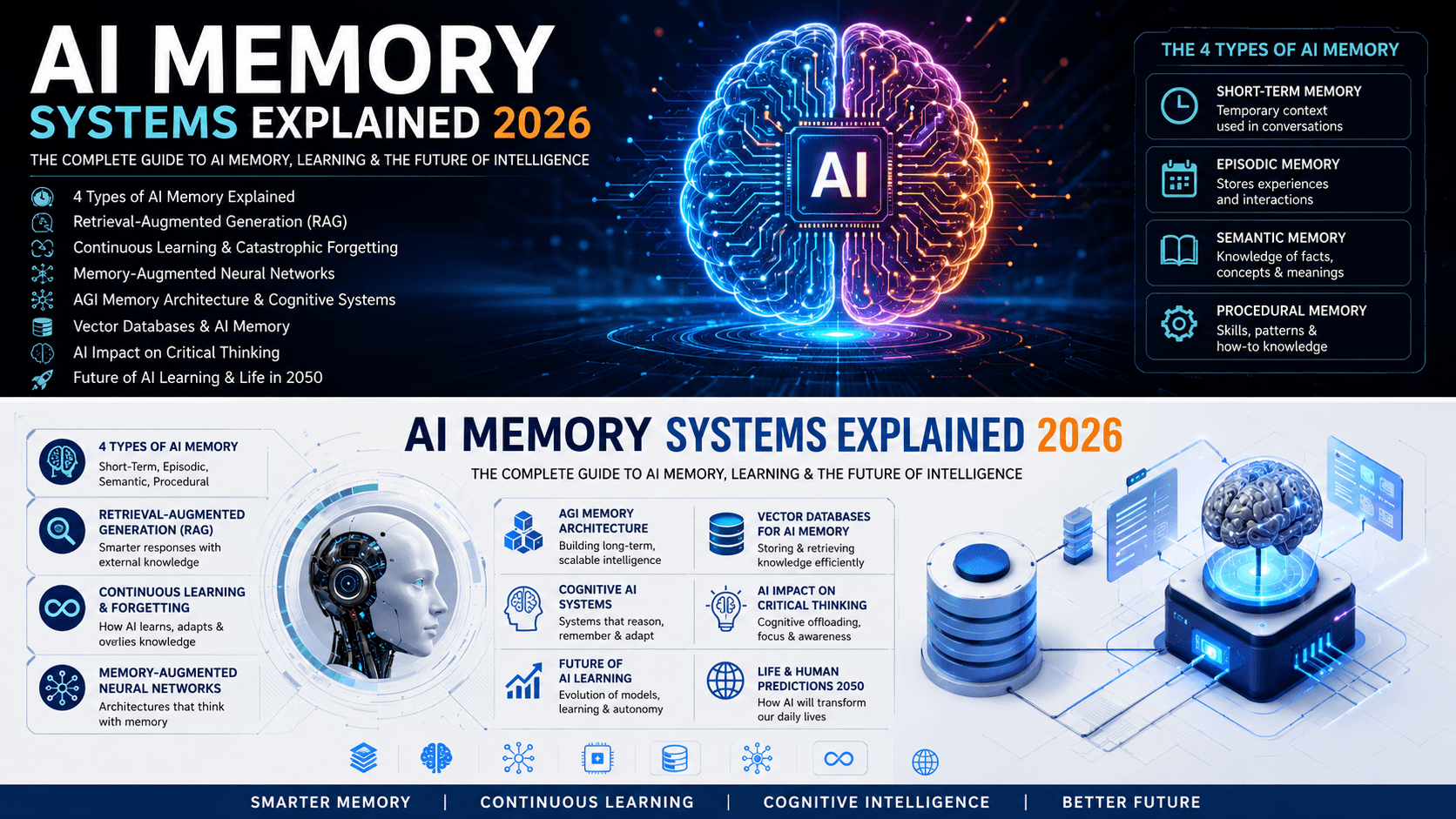
AI Memory Systems Explained 2026 — 4 Types of AI Memory, RAG, Continuous Learning, Memory-Augmented Neural Networks, AGI Memory Architecture, Vector Databases, Cognitive AI & Future of AI Learning
The single biggest limitation of current artificial intelligence is not intelligence — it is memory. A human doctor who sees a patient today remembers that patient next year. A lawyer who reads a case today recalls it when advising a client six months later. Most AI systems, by contrast, are fundamentally stateless — every new conversation begins from zero, with no knowledge of what came before. This is changing rapidly. AI memory systems are the fastest-evolving frontier in artificial intelligence, transforming AI from a sophisticated but forgetful tool into a persistent, personalized, continuously learning intelligence. This comprehensive guide covers everything: how AI memory systems work, the 4 types of AI memory, Retrieval-Augmented Generation (RAG) explained, continuous learning and catastrophic forgetting, memory-augmented neural networks, AI agent memory architecture, vector databases for AI memory, personalized AI memory, AGI memory systems and future intelligence, cognitive AI systems, how AI impacts critical thinking and cognitive offloading, and how future AI will learn and evolve — with every keyword from your research covered.
Part 1: Human Memory vs AI Memory — Understanding the Gap and the Bridge
Does AI have short-term memory? What is long-term memory in AI? What are the 4 types of memory? What is the difference between short-term and long-term memory? What is the 2 7 30 rule for memory? What are the 4 types of memory in humans? Can AI think just like humans? Can AI have feelings like humans?
Human memory and AI memory share the same fundamental challenge: how to store useful information, retrieve it accurately, and know when to update or discard it. But they differ profoundly in architecture, mechanism, and failure modes.
Table 1: Human Memory vs AI Memory — Complete Comparison
| Dimension | Human Short-Term Memory | Human Long-Term Memory | AI Short-Term (Context Window) | AI Long-Term (Memory Systems) |
|---|---|---|---|---|
| Capacity | ~7 items (Miller's Law "magic number 7 ± 2") | Virtually unlimited — theoretically infinite | Limited by token count — typically 4K to 2M tokens | Virtually unlimited — constrained only by storage infrastructure |
| Duration | 15–30 seconds without rehearsal | Minutes to a lifetime | Duration of active session — resets when conversation ends | Persistent indefinitely — until explicitly deleted |
| Forgetting Mechanism | Decay (fades without use) or interference (new info pushes out old) | Retrieval failure — the memory exists but cannot be accessed | Hard cutoff — oldest content is discarded when context window fills | Decay weighting — stale memories given lower retrieval priority over time |
| Storage Type | Neural activation patterns (electrochemical) | Synaptic connections (structural brain changes) | Transformer attention mechanism (matrix operations) | Vector embeddings in databases (mathematical representations) |
| Retrieval Method | Associative — cues trigger related memories | Associative + contextual — cues, emotions, environment trigger recall | Direct — all text in context window is instantly accessible | Semantic search — conceptually similar memories retrieved first |
| Best Analogy | Mental scratchpad — what you hold in mind right now | Personal library — a lifetime of filed information | Whiteboard — visible during the meeting, erased when done | External hard drive — persistent, searchable, doesn't forget |
The 2-7-30 Rule for Memory
What is the 2 7 30 rule for memory? The 2-7-30 rule is a spaced repetition memory retention guideline: review information after 2 days to begin consolidation, again after 7 days to strengthen the memory trace, and again after 30 days to cement it into long-term memory. This rule, derived from Ebbinghaus's forgetting curve research, is now being applied to AI memory systems — determining when to "review" and reinforce stored memories and when to decay or delete them.
Can AI think like humans? Artificial intelligence does not think like humans — it does not feel, understand, or experience the world. AI analyzes patterns in data and generates statistically likely responses. What it does extraordinarily well is pattern matching, language generation, and information synthesis at scale. The critical difference: human thinking is embodied, emotional, and contextual. AI thinking is mathematical, pattern-based, and probabilistic. Can AI have feelings? No — current AI systems do not have subjective experience or consciousness. They can recognize and respond to emotional language, but this is pattern matching, not feeling.
Part 2: The 4 Types of AI Memory — Short-Term, Episodic, Semantic & Procedural
What are the 4 types of memory in AI? AI agent memory types. Types of memory in AI agents. Types of AI memory. What are the 4 types of AI systems? Does AI use RAM or ROM? Does AI use GPU or CPU? What is the memory system in AI? Which AI is best for memory? Which AI has the best memory for roleplay? AI chatbot with good memory free. AI with long-term memory. AI memories Honor. AI memory app. AI memory stocks. AI memory companies.
Table 2: The 4 Types of AI Memory — Architecture, Function & Technology
| Memory Type | Human Analogy | What It Stores | Duration | How It Works in AI | Technology Used |
|---|---|---|---|---|---|
| 1. Short-Term Memory (Working Memory) | Mental scratchpad — holding a phone number long enough to dial it | Active conversation context — current messages, tool call results, temporary variables | Single session only — resets when conversation ends | The AI's context window holds all current text. Everything within the token limit is instantly accessible. Oldest content dropped when limit exceeded | Transformer attention mechanism, in-memory key-value stores (Redis), session state management |
| 2. Episodic Memory | Your personal diary — remembering what happened on a specific day | Past interactions, conversations, events, and decisions across multiple sessions with timestamps | Persistent across sessions — can span months or years | Records specific events and interactions as they occurred. AI can recall "Last Tuesday you asked me to format all reports as PDFs" or "In our March meeting, you said the budget was $50,000" | Vector databases, time-stamped conversation logs, episodic memory buffers (LangChain, Mem0) |
| 3. Semantic Memory | Personal encyclopedia — knowing that Paris is the capital of France regardless of how you learned it | Stable facts, user preferences, domain knowledge, and organizational information — knowledge independent of specific experiences | Permanent until updated — continuously refined as new information arrives | Stores facts like "User is a software engineer based in Karachi, prefers Python, works on e-commerce projects." Updated when user provides new information. Accessed for personalization | Knowledge bases, knowledge graphs (Cognee), structured databases, vector embeddings |
| 4. Procedural Memory | Muscle memory — riding a bike without thinking about each movement | Skills, workflows, rules, and learned behaviors — how to do things rather than facts about things | Long-term — refined through repeated use | AI learns that when a user asks for "a summary," they always want bullet points under 100 words. Stores interaction patterns, tool usage preferences, formatting rules. Automates sequences without re-instruction | System prompts, fine-tuning, reinforcement learning from feedback, behavior logs |
Does AI Use RAM or ROM? GPU or CPU?
Does AI use RAM or ROM? Does AI use GPU or CPU? AI systems use both RAM and GPU VRAM heavily. The model parameters (the billions of numerical weights that encode the AI's knowledge) are stored in GPU VRAM (Video RAM) — which is why AI accelerators like Nvidia's H100 have 80GB of high-bandwidth memory. During inference (generating responses), the GPU processes the computation while RAM handles system-level operations and data buffering. GPU vs CPU for AI: GPUs are overwhelmingly preferred for heavy AI workloads because they have thousands of smaller parallel cores designed for the matrix multiplication operations at the core of neural networks. A CPU has 8–64 powerful sequential cores; an AI GPU has 10,000+ smaller parallel cores. Can AI run without GPU? Yes — smaller models run on CPU, but significantly slower.
Part 3: How AI Memory Works — The 4-Stage Process: Ingestion, Vectorization, Retrieval, Injection
How does memory work in AI? How does ChatGPT have memory? How AI memory works. How ai agents remember conversations. How ai agents remember conversations github. How does AI remember our conversation? What is the role of memory in an agentic AI solution. What is the role of memory in an agentic AI system.
AI memory operates through a four-stage pipeline that transforms raw conversation data into persistent, retrievable intelligence:
Table 3: The 4-Stage AI Memory Pipeline — How AI Memory Works
| Stage | Process Name | What Happens | Technical Mechanism | Human Brain Parallel |
|---|---|---|---|---|
| Stage 1 | Ingestion | Incoming conversation text, documents, user preferences, and interaction data are captured and parsed into structured chunks | Text chunking algorithms split large documents into appropriately-sized segments; entity extraction identifies key facts (names, preferences, dates, decisions) | Paying attention — the initial encoding of a new experience |
| Stage 2 | Vectorization | Each text chunk is converted into a vector embedding — a mathematical array of numbers (typically 768–4096 dimensions) that captures the semantic meaning of the text | Embedding models (OpenAI text-embedding-3, Cohere Embed, Voyage AI) transform text into high-dimensional numerical vectors where similar concepts map to geometrically close positions in vector space | Encoding — converting sensory experience into neural patterns that can be stored |
| Stage 3 | Retrieval | When the user asks a question, the query is also vectorized and compared against stored memories using cosine similarity or dot product — the most semantically relevant memories are surfaced | Approximate Nearest Neighbor (ANN) search in vector databases (Pinecone, Weaviate, Chroma, Qdrant) retrieves the top-k most relevant memories based on semantic similarity, not keyword matching | Recall — finding the right file in the brain's filing system when a cue triggers it |
| Stage 4 | Injection | Retrieved memories are automatically inserted into the AI's active context window alongside the user's current message — the AI responds with awareness of relevant past context | Memory content prepended to system prompt or inserted as "memory" tokens; importance-weighted to avoid flooding the context window with irrelevant history | Working memory — consciously holding both current situation and relevant past knowledge simultaneously |
Key Memory Management Mechanics
- Selective Storage: Rather than saving entire conversation transcripts (which would inflate storage and token costs rapidly), modern systems use extraction algorithms to identify and save only the important facts, preferences, and decisions — discarding conversational filler
- Hybrid Retrieval: Combines exact keyword matching (BM25), vector-based semantic search, and entity linking to surface highly relevant memories precisely when needed — even when the user doesn't use the exact same words as the stored memory
- Decay and Update: AI memory systems dynamically update information over time and assign lower retrieval weights to stale or outdated memories — preventing the agent's context from being cluttered with irrelevant history from months ago
- Intelligent Summarization: Older episodic memories are automatically compressed into concise summaries, preserving key facts while reducing storage size — similar to how humans remember the key points of a meeting rather than every word spoken
Part 4: Retrieval-Augmented Generation (RAG) Explained — Definition, 4 Levels & How It Works
What is RAG? Retrieval augmented generation explained. Retrieval augmented generation example. Retrieval augmented generation explained geeksforgeeks. Retrieval Augmented Generation tutorial. Retrieval Augmented Generation pronunciation. What is RAG in AI. Introduction to retrieval augmented generation. Augmented meaning in RAG. RAG retrieval augmented generation explained. What are the 4 levels of RAG? What are the 7 types of RAG? Is ChatGPT a RAG? What is RAG vs LLM? What is L1 L2 L3 in AI? What are two main components of RAG? What are the 4 workflow stages of RAG?
Retrieval-Augmented Generation (RAG) is the process of optimizing a large language model's output by allowing it to reference an authoritative knowledge base outside its training data before generating a response. Rather than relying solely on what the model learned during training (which has a knowledge cutoff date), RAG dynamically retrieves relevant, up-to-date information and feeds it into the generation process.
Is ChatGPT a RAG system? ChatGPT with web search enabled uses a form of RAG — retrieving current web information before generating responses. The base ChatGPT model without search is a pure LLM. What is RAG vs LLM? An LLM alone generates responses entirely from its training data. RAG = LLM + external knowledge retrieval. The RAG system finds relevant documents, injects them into the LLM's context, and the LLM generates a response grounded in those retrieved documents — dramatically reducing hallucinations.
Table 4: The 4 Workflow Stages of RAG & 4 Levels of RAG Sophistication
| Category | # | Stage / Level | What Happens | Key Technology |
|---|---|---|---|---|
| RAG Workflow Stages | 1 | Indexing | Documents are chunked, vectorized, and stored in a vector database — creating the searchable knowledge base | Text splitters, embedding models, vector stores (Pinecone, Chroma) |
| 2 | Retrieval | User query is vectorized and compared against indexed documents — top-k most relevant chunks retrieved | ANN search, BM25 keyword search, hybrid retrieval | |
| 3 | Augmentation | Retrieved chunks are injected into the LLM prompt alongside the original question as additional context | Prompt engineering, context window management, reranking models | |
| 4 | Generation | LLM generates a response grounded in the retrieved context — citing sources, avoiding hallucination on retrieved facts | LLMs (GPT-4, Claude, Gemini, Llama), citation generation | |
| RAG Sophistication Levels | L1 | Naive RAG | Basic chunk retrieval — simple similarity search, no optimization. Fast to build but accuracy limited | Basic vector search, simple chunking |
| L2 | Advanced RAG | Pre-retrieval optimization (better chunking, query rewriting) + post-retrieval reranking (reorder results by relevance) | HyDE, query expansion, cross-encoder rerankers | |
| L3 | Modular RAG | Components are interchangeable — mix different retrievers, rerankers, and generators based on task requirements | LangChain, LlamaIndex modular pipelines | |
| L4 | Agentic RAG | AI agent decides when to retrieve, what to retrieve, and whether retrieved information is sufficient — may perform multiple retrieval passes | ReAct agents, tool-calling LLMs, self-reflection loops |
Part 5: Memory-Augmented Neural Networks — Architecture, Types & Guide
What is memory augmented neural network? Memory augmented neural networks guide github. Memory augmented neural networks explained.
Memory-Augmented Neural Networks (MANNs) are neural network architectures that combine a traditional neural network with an external memory component — enabling the network to read from and write to a memory matrix during processing. Unlike standard neural networks where "memory" is implicitly encoded in the weights during training, MANNs have explicit external memory that can be dynamically read and written at inference time.
Table 5: Types of Memory-Augmented Neural Networks — Architecture Comparison
| Architecture | Year Introduced | Memory Mechanism | Key Strength | Best Application |
|---|---|---|---|---|
| Neural Turing Machine (NTM) | 2014 (DeepMind) | External tape-like memory matrix with attention-based read/write heads — directly inspired by Turing's original computing machine concept | Can learn algorithmic tasks — sorting, copying — that are impossible for standard RNNs | Algorithm learning, sequence-to-sequence tasks, meta-learning |
| Differentiable Neural Computer (DNC) | 2016 (DeepMind) | Extended NTM with dynamic memory allocation, temporal linking (tracking write order), and content-based addressing | Can navigate complex graph structures and answer multi-step reasoning questions | Graph traversal, question answering on knowledge bases, planning tasks |
| Memory Networks | 2014 (Facebook AI Research) | Long-term memory component stores sentences/facts; inference component reads relevant memories to answer questions | Multi-hop reasoning — can chain together multiple stored facts to answer complex questions | Open-domain question answering, dialogue systems |
| Transformer + External Memory | 2017–present | Transformer's self-attention extended with retrieval from external vector stores — the foundation of modern RAG systems | Infinite scalable external memory; efficiently handles millions of documents | Enterprise knowledge assistants, long-context document analysis |
| Episodic Memory Networks | 2016 (Stanford / various) | Episodic memory module stores experience sequences; gating mechanism controls which memories are retrieved and combined for inference | Strong performance on tasks requiring multi-episode reasoning across many distinct past events | Multi-turn dialogue, personal AI assistants, lifelong learning agents |
Part 6: Continuous Learning AI — Catastrophic Forgetting, Elastic Weight Consolidation & Lifelong Learning
What is continuous learning in AI? Which type of AI will constantly learn and improve? What is a continuous learning system? What are examples of continuous learning? What are the 4 types of ML? Continuous learning AI. Continual learning AI. Continual learning vs continuous learning. What is continual learning in machine learning. Continual learning paper. Continual learning algorithms. Continual learning and catastrophic forgetting. Continual learning google. Best continuous learning AI systems. Will L&D be replaced by AI?
Table 6: The 4 Types of Machine Learning & How Continuous Learning Extends Each
| ML Type | How It Learns | Core Task Examples | Key Algorithms | Continuous Learning Extension |
|---|---|---|---|---|
| Supervised Learning | Learns from labeled data — input + correct output pairs | Email spam detection, house price prediction, image classification | Linear Regression, Decision Trees, SVM, Neural Networks | Online learning — model updates weights incrementally with each new labeled example rather than full retraining |
| Unsupervised Learning | Discovers hidden patterns in unlabeled data without guidance | Customer segmentation, anomaly detection, topic modeling | K-Means Clustering, PCA, Autoencoders, GANs | Streaming clustering — clusters update in real time as new data points arrive, without reprocessing old data |
| Semi-Supervised Learning | Uses small labeled + large unlabeled dataset; learns structure from unlabeled, fine-tunes on labeled | Medical imaging analysis, document classification | GANs, Autoencoders, Label Propagation | Active learning — model identifies which unlabeled examples it is most uncertain about and requests human labels for those specific cases only |
| Reinforcement Learning | Learns through trial and error in an environment — rewarded for good actions, penalized for bad | Game playing (AlphaGo), robotics, autonomous vehicles, recommendation systems | Q-Learning, Deep Q-Networks (DQN), Proximal Policy Optimization (PPO) | Online RL — agent updates its policy continuously as it interacts with the environment, rather than in separate offline training phases |
The Core Problem: Catastrophic Forgetting
Continual learning and catastrophic forgetting. The fundamental challenge of continuous learning is catastrophic forgetting — when a neural network is trained on new tasks or data, it tends to overwrite the weights that encode previously learned knowledge, destroying what it had previously mastered. It is like trying to teach someone a new language by overwriting their ability to speak their native language. Three main approaches to solving this: (1) Regularization-based — Elastic Weight Consolidation (EWC) identifies which neural network weights are most important for previous tasks and adds a penalty to prevent those weights from changing dramatically; (2) Replay-based — storing a small buffer of examples from previous tasks and periodically replaying them during new learning, similar to how humans review old material; (3) Architecture-based — adding new neural network components for new tasks while freezing old components, so new learning literally happens in new "rooms" that do not disturb old ones.
Part 7: AI Agent Memory Architecture — Frameworks, Platforms & Tools
AI agent memory. AI agent memory GitHub. AI agents memory management. Agent memory framework. Agent memory github. Long-term memory in agentic AI. Long term memory AI chat. Short term memory AI. AI agent memory architecture. AI memory open source. Agentic memory systems. AI agent with memory. Memory management for AI agents. Episodic memory in AI agents. What is the role of memory in an agentic AI solution. 4 pillars of AI agents. How does memory work in AI agents? Which component of an AI agent allows it to remember past conversations?
Table 7: Top AI Memory Platforms & Frameworks — Complete Comparison 2026
| Platform / Framework | Type | Primary Function | Best For | Open Source? | Key Feature |
|---|---|---|---|---|---|
| Mem0 | Dedicated AI memory layer | Persistent, self-evolving contextual memory for AI agents across sessions — automatically extracts, stores, and retrieves memories | Production AI applications needing persistent user memory without pipeline changes | Yes (MIT License) | Automatic memory compression — reduces token costs while maintaining context quality |
| Letta (formerly MemGPT) | OS-like memory management framework | Provides agents with OS-like memory management — agents can self-manage their own long-term state, deciding what to store and retrieve | Autonomous AI agents that need to manage their own memory like an operating system manages RAM | Yes (Apache 2.0) | Agents actively manage their own memory — not just passive storage |
| Zep | Memory extraction and search service | Provides memory, entity extraction, and semantic search for AI assistants — extracts facts from conversations automatically | Customer service AI and personal assistants requiring fast, accurate memory retrieval | Yes (community edition) | Temporal awareness — understands that "my old address" is less relevant than "my current address" |
| Cognee | Knowledge graph memory system | Organizes complex AI memory using knowledge graphs and vector search — maps relationships between facts, not just facts themselves | Enterprise knowledge management where relationships between information matter | Yes | Knowledge graph integration — understands that "Company A acquired Company B" connects multiple entities |
| LangChain Memory Modules | AI development framework | Modular memory components for building agents — entity memory, conversation summary memory, knowledge graph memory | Developers building custom AI applications with flexible memory requirements | Yes (MIT License) | Entity memory — extracts and tracks named entities (people, companies, places) across conversations |
| Redis AI Memory | In-memory database for AI | Sub-millisecond latency short-term memory and session state — rapid context caching for real-time AI applications | High-throughput production AI requiring ultra-fast short-term memory operations | Yes (Redis Stack) | Dual role — handles both fast short-term caching and vector search for longer-term semantic retrieval |
| Microsoft Copilot Memory | Enterprise AI memory product | Persistent memory layer for Microsoft 365 Copilot — remembers user preferences, project context, and work patterns across all Microsoft apps | Enterprise users working across Word, Teams, Outlook, and Excel with consistent AI context | No (proprietary) | Cross-application memory — AI remembers context from emails when you're writing documents |
Part 8: Vector Databases for AI Memory — How They Work & Leading Platforms
Vector databases. Vector databases for AI memory. Semantic memory systems in AI. Memory retrieval in AI. Knowledge storage systems. External memory models. What are the 4 pillars of ML?
Vector databases are the infrastructure backbone of modern AI memory. Unlike traditional databases that store and retrieve data by exact matching (find the row where ID = 42), vector databases store data as high-dimensional mathematical vectors and retrieve it by semantic similarity — finding the content that is most meaningfully related to the query, even when no exact keywords match. This is how AI can remember that "you mentioned you prefer dark themes in your code editor" when you ask "what color scheme should I use?" — the semantic relationship between the stored memory and the new query is mathematically measurable.
Table 8: Top Vector Database Platforms for AI Memory — 2026 Comparison
| Platform | Type | Best For | Hosting | Key Strength | Used By |
|---|---|---|---|---|---|
| Pinecone | Managed cloud vector database | Production AI applications requiring managed, scalable vector search with minimal ops overhead | Cloud-only (managed) | Ease of use, instant scalability, strong Python SDK | Enterprise RAG systems, AI startups |
| Weaviate | Open-source vector database | Multi-modal search (text + images + video) and enterprise knowledge graphs | Self-hosted or cloud | Native hybrid search (vector + BM25), GraphQL API, multi-modal support | Enterprise knowledge management, search applications |
| Chroma | Open-source vector database | Local development and prototyping — easiest to get started for AI developers | Local (in-memory or persistent) + cloud | Zero configuration for development, built-in embedding functions, Python-first | AI developers prototyping RAG systems, LangChain default for local dev |
| Qdrant | Open-source vector database | High-performance production workloads requiring payload filtering alongside vector search | Self-hosted, Docker, or cloud | Advanced payload filtering, Rust-based performance, sparse + dense vector support | Production AI systems requiring complex filtered retrieval |
| MongoDB Atlas Vector Search | Integrated vector search in general database | Organizations already using MongoDB wanting to add AI memory without separate vector DB | Cloud (Atlas managed) | Combines document storage and vector search in one system — unified data platform | Enterprises adding AI to existing MongoDB applications |
| Elasticsearch (Elastic AI) | Integrated vector search in search platform | Hybrid search combining traditional keyword search with semantic vector search | Self-hosted, Elastic Cloud | Best-in-class hybrid retrieval, enterprise security, existing enterprise adoption | Enterprise search, security analytics, AI agent memory for large organizations |
Part 9: Personalized AI Memory, Cognitive AI & AI Impact on Critical Thinking
Personalized AI memory explained. Personalized AI memory explained reddit. AI memory companies. AI memories Honor. AI memory app. AI memory stocks. AI memory system github. AGI memory systems and future intelligence pdf. AGI memory systems and future intelligence pdf download. What is AGI in artificial intelligence. AGI vs AI. When will AGI be achieved. Artificial general intelligence examples. Cognitive AI examples. Cognitive AI vs generative AI. Future of cognitive AI systems 2023. Cognitive offloading AI. AI tools in Society: Impacts on cognitive offloading and the Future of critical thinking. Negative impact of AI on critical thinking. Positive impact of AI on critical thinking. How does AI reduce critical thinking of students. Does AI harm critical thinking. Negative impact of AI on critical thinking research paper. Negative impact of AI on critical thinking essay. Negative impact of AI on critical thinking statistics. To think or not to think: the impact of AI on critical thinking.
Table 9: AI Impact on Critical Thinking — Benefits, Risks & Cognitive Offloading Research
| Category | Effect | Evidence / Research | Who Is Most Affected | Mitigation Strategy |
|---|---|---|---|---|
| POSITIVE — Expert Augmentation | AI handles routine cognitive tasks, freeing experts to focus on higher-order analysis and judgment | Harvard Business School research on AI augmentation shows 40%+ productivity gains for professionals who use AI as a tool while maintaining independent judgment | Experts with deep domain knowledge — AI amplifies what they already know | Use AI to augment research and drafting, always apply independent judgment before finalizing |
| NEGATIVE — Cognitive Surrender | Users accept AI output without critical evaluation — "trust bias" leads to accepting incorrect AI answers | Microsoft Research (2025) found users with lower domain expertise are most likely to accept AI errors uncritically | Novices, students, and users unfamiliar with the domain | Verify AI claims against primary sources; develop "AI literacy" to recognize hallucinations |
| NEGATIVE — Reduced Brain Engagement | Writing essays with generative AI shows significantly lower executive function and attention engagement than traditional writing | MIT Media Lab EEG studies: AI-assisted essay writing = dramatically lower neural engagement in prefrontal cortex vs. traditional search methods | Students and knowledge workers using AI for first-draft generation without prior thinking | "Think first, then consult AI" — do the cognitive work before using AI as a reviewer, not a generator |
| NEGATIVE — Loss of Analytical Skills | Higher AI reliance correlates with lower scores on critical thinking standardized tests over time | Multiple studies (NSTA, Duke CTL) show AI bypass of "productive struggle" weakens argument construction and analytical depth | Regular heavy AI users who outsource analysis rather than just research | Deliberately practice analysis without AI regularly — use AI as a "checker," not a "thinker" |
| NEGATIVE — Homogenization | AI generates statistically average responses — overreliance produces predictable, similar outputs across different users | Harvard Gazette (2025): "AI dulling our minds" — overuse reduces idea diversity and originality across populations | Creative professionals, researchers, writers who outsource ideation to AI | Use AI to pressure-test and refine your own original ideas — not to generate ideas from scratch |
| POSITIVE — Accessibility | AI makes high-quality research assistance and writing support available to people who previously had no access to expert guidance | Brookings Institution (2026): AI tutoring provides personalized learning pathways in under-resourced communities with teacher shortages | Students in developing countries, first-generation college students, self-learners | Design AI learning tools with built-in prompts that encourage critical reflection, not passive acceptance |
Notable AI Events — Pope Leo XIV and Elon Musk's Macrohard
Did the Pope use AI? Did Elon Musk create a new AI?
Pope Leo XIV and AI: In May 2026, Pope Leo XIV presented his first major papal teaching document — the encyclical Magnifica Humanitas — focused entirely on artificial intelligence. AI detection tools indicated that significant portions of the document were generated with AI assistance (potentially Anthropic's Claude). The Pope co-presented it with Christopher Olah, co-founder of Anthropic, and urged that AI be "disarmed" and heavily regulated to prevent "digital slavery" and protect human dignity. Pope Leo later joked that he asked AI what to tell Spanish bishops, and AI responded with what "Pope Francis would say" — demonstrating AI's tendency toward pattern-matching rather than genuine theological reasoning.
Elon Musk's Macrohard: In March 2026, Elon Musk unveiled Macrohard — a new AI project developed by Tesla and xAI that combines the Grok AI model with a Tesla-built agent capable of watching computer screens and performing tasks using keyboard and mouse actions (a computer-use AI agent). This represents Musk's entry into the agentic AI space, competing with OpenAI's Operator and Anthropic's Computer Use features.
Part 10: AGI Memory Systems, How Future AI Will Learn & Human Life in 2050
AGI memory systems and future intelligence. What is AGI intelligence? What is the future of AGI? Is ChatGPT AI or AGI? Is AGI actually possible? Is AGI better than AI? Which 3 jobs will survive AI? How is AI expected to evolve in the future? Can AI learn and evolve? What is the future of AI learning? Future of AI in next 10 years. Future of Artificial intelligence PDF. How will AI change the future of work. Future of AI in 2050. How future AI will learn and evolve PDF. Future of AI examples. AI future predictions. Artificial intelligence and the future of humans. What will happen in 2050 technology. 10 predictions for 2050. Future technology 2050 essay. Human life in 2050. Human life in 2050 essay. Human life in 2050 predictions. Human life in 2050 speech. What will happen in 2050 in space. Top 10 predictions for 2050. 10 predictions for 2050 pdf. Predictions for 2050 technology. 2050 future predictions. Top 10 predictions for the future. What will happen in 2050 technology. Life in 2050 essay 200 words. What is predicted to happen in 2050? Which country will be strongest in 2050? Is Earth in danger in 2050? What technology can we expect in the next 20 years? Will humans survive in 3000?
How Future AI Will Learn and Evolve — 4 Key Mechanisms
- Synthetic Data Generation: As human-generated internet data reaches saturation, AI will increasingly train on data it generates itself — high-quality synthetic information that mimics real-world patterns while avoiding copyright, privacy, and bias issues of scraped web data. AI models will generate training examples for their successors
- Autonomous Evolution (AutoML & Neuroevolution): Programs like Google's AutoML are already evolving to create other AI programs — using loose approximations of biological evolution to generate and test hundreds of thousands of candidate algorithms. Future AI will design its own architecture improvements without human engineers writing every rule
- Agentic Workflows and System Orchestration: Rather than single isolated tools, AI systems will evolve into collaborative multi-agent networks. One agent researches market data, another designs a product, a third tests safety — all without human intervention between steps
- Quantum-Accelerated Learning: The fusion of AI with quantum computing will allow training on molecular simulations and optimization problems currently computationally impossible — opening new frontiers in drug discovery, materials science, and fundamental physics
Human Life in 2050 — 10 Key Predictions
- Pervasive AI: AI will be core infrastructure — embedded in healthcare, transport, education, and homes — not an optional tool
- Autonomous transport: Nearly all vehicles electric and self-driving; traffic congestion largely eliminated in developed cities
- Extended lifespan: Medical breakthroughs targeting diseases at the genetic level; healthy lifespan potentially extended beyond 100 years
- Brain-computer interfaces: Direct neural-digital connection enabling thought-based internet access and memory augmentation
- Smart megacities: 68% of the projected 9.7 billion global population living in AI-integrated cities
- Clean energy dominance: Solar, wind, and fusion power have largely replaced fossil fuels
- Space commercialization: Permanent lunar bases, commercial space tourism, and early Mars infrastructure
- AI companions: Advanced AI providing personalized education, eldercare, and social interaction for isolated populations
- Earth resource crisis: 165 billion tonnes of raw materials extracted annually — 60% more than 2020 — threatening biodiversity without major policy changes
- Shifting superpowers: China and India dominating global economic output; major geopolitical realignment underway
People Also Ask — AI Memory Systems FAQ
What are the 4 types of AI memory and how do they work?
The 4 types of AI memory mirror human cognitive memory: (1) Short-Term Memory (Working Memory) — holds the active conversation context within the current session; limited by the AI's context window token count; resets when the session ends. (2) Episodic Memory — stores specific past interactions, events, and decisions across multiple sessions with timestamps; allows AI to recall "last week you asked for X" or "in our previous project, we decided Y." (3) Semantic Memory — stores stable facts and user preferences, like an encyclopedia of what the AI knows about you and your domain; updated as new information is learned. (4) Procedural Memory — stores skills, workflows, and learned behaviors — how to do things; for example, learning that you always want Python code, not JavaScript.
What is RAG (Retrieval-Augmented Generation) in simple terms?
RAG is the process of giving an AI access to an external knowledge base before it generates a response. Instead of only relying on what it learned during training (which has a cutoff date and may not include your specific documents), a RAG system first searches a database of relevant documents, retrieves the most relevant passages, and feeds them to the AI alongside your question. The AI then generates a response grounded in those retrieved documents. The result: more accurate, up-to-date, hallucination-resistant answers that can reference your private data. Think of it as giving the AI "open book" access to a specific library before answering your exam question.
What is catastrophic forgetting in AI and how is it solved?
Catastrophic forgetting is the tendency of neural networks to completely overwrite previously learned knowledge when trained on new tasks or data — like learning a new language by erasing your native language. It is the core obstacle to continuous learning in AI. Three main solutions: (1) Elastic Weight Consolidation (EWC) — identifies the most important weights for previous tasks and adds a mathematical penalty preventing those weights from changing during new training; (2) Experience Replay — stores a small buffer of examples from previous tasks and replays them during new training so the model maintains performance on old tasks; (3) Progressive Neural Networks — adds entirely new neural network components for new tasks while keeping old components frozen and unchanged.
Which AI has the best memory? Which AI assistant has the best long-term memory?
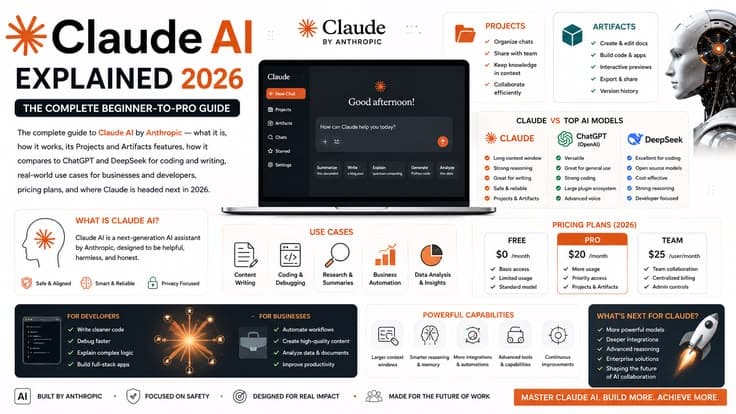
As of 2026, the leading AI assistants with persistent memory capabilities: ChatGPT (OpenAI) has a memory feature that stores facts across conversations. Claude (Anthropic) has a Projects feature for persistent document and preference storage. Google Gemini has memory integration with Google Workspace. For roleplay and character consistency, platforms like Character.ai and certain fine-tuned models prioritize in-session memory depth. For enterprise and developer use, Mem0-powered applications provide the most sophisticated persistent memory — extracting, storing, and retrieving user context automatically across all sessions. Perplexity AI does not have memory like ChatGPT — each session starts fresh. The "best memory" depends on use case: enterprise knowledge management (Mem0, Zep), personal assistant continuity (ChatGPT Memory, Claude Projects), or developer-controlled custom memory (LangChain, Letta).
Does AI harm critical thinking? What does research show?
Research shows AI can both help and harm critical thinking depending on how it is used. MIT Media Lab EEG studies found that writing with generative AI showed significantly lower brain engagement and executive function than traditional writing methods. Microsoft Research indicates the risk is highest for users unfamiliar with a topic — they cannot judge whether AI outputs are accurate. However, Harvard Business School research shows experts who use AI as an augmentation tool (doing the thinking themselves, using AI to check and extend their work) show significant productivity and quality gains. The key finding across studies: "AI as a thinker = cognitive atrophy; AI as a tool = cognitive amplification." The recommendation is "productive struggle first" — do the foundational work of reading, analyzing, and forming your own view before consulting AI.
Conclusion: Memory Is the Missing Piece That Will Make AI Truly Intelligent
The difference between an AI that is merely powerful and one that is genuinely transformative is memory. A doctor who forgets every patient after each appointment is useless. A teacher who cannot remember a student's progress is ineffective. An assistant who asks you the same questions every session is frustrating. The technical breakthroughs covered in this guide — RAG, continuous learning, memory-augmented neural networks, vector databases, episodic memory frameworks, and AGI memory architectures — are solving the statelessness problem that has been AI's most fundamental limitation.
The future is not an AI that gets smarter training data. It is an AI that remembers — your preferences, your history, your goals, your context. An AI that grows more valuable with every interaction, not one that resets to zero every time you open a new chat window. We are moving from AI as a tool you use to AI as a partner that knows you.
Understanding how AI memory works is not just technical knowledge — it is the foundation of understanding where intelligence itself is heading.
Need a Website Optimized for the Age of AI Search?
As AI memory systems make AI assistants more capable of recommending specific websites, products, and services — your website's content structure, technical quality, and authority signals matter more than ever for both traditional SEO and emerging AEO/GEO. We build professional, fast, and search-optimized websites that position your business for the future of discovery.
Business websites, eCommerce, portfolios — live domain included. Message us with your requirements.