AI Agents vs AI Assistants 2026: Complete Guide to Autonomous Intelligence, Multi-Agent Systems, and the Future of Work
Something fundamental is shifting in the world of artificial intelligence — and most people do not yet understand what it means for their careers, their businesses, and the global economy.
For the past three years, the world has been captivated by AI assistants — ChatGPT, Claude, Gemini, Copilot. These tools answer questions, write content, generate images, and help individuals be more productive. They are remarkable. But they are also, in the grand arc of AI development, just the beginning.
The next stage of artificial intelligence is not about tools that assist humans. It is about systems that act autonomously. It is about AI agents — intelligent systems that can set goals, make plans, take actions, learn from results, and complete complex multi-step tasks without constant human supervision.
By 2026, AI agents are no longer science fiction. They are operational in enterprises globally. They are being built by solo entrepreneurs on no-code platforms. They are reshaping entire industries — customer service, software development, scientific research, healthcare, legal work, and financial analysis. And by 2028, organizations will leverage AI for 80% of customer interactions through multi-agent orchestration systems.
This guide covers everything: what AI agents are, how they differ from AI assistants, how autonomous AI works, what multi-agent systems are, the best AI agent tools in 2026, how enterprise AI agents are transforming businesses, how AI will change the future workforce, and what the next evolution of artificial intelligence means for you. Every keyword covered. Nothing missed.
What Are AI Agents? The Complete Beginner's Explanation
What Is an AI Agent?
An AI agent is an artificial intelligence system that perceives its environment, makes decisions, takes actions, and works toward achieving a defined goal — autonomously, without requiring step-by-step human instructions for every action.
The word "agent" is deliberately chosen: an agent acts on behalf of someone or something. A human agent acts on behalf of a client. An AI agent acts on behalf of a user or organization — pursuing goals, navigating obstacles, and making judgment calls along the way.
The simplest way to understand an AI agent is through contrast with traditional software and AI assistants:
Traditional software: You press a button → software executes a predefined action → done.
AI assistant (e.g., ChatGPT): You ask a question → AI generates a response → done. One interaction, one output.
AI agent: You provide a goal → AI creates a plan → AI takes multiple actions across tools and systems → AI evaluates results → AI adjusts approach → AI continues until the goal is achieved.
How Do AI Agents Work? The Core Architecture
Every AI agent — regardless of its specific application — operates through the same fundamental cycle:
- Perception — The agent takes in information from its environment: web searches, documents, databases, APIs, user inputs, code repositories, email inboxes, or any data source it has been given access to.
- Reasoning and Planning — The agent processes this information using a Large Language Model (LLM) as its "thinking engine." It breaks the goal into sub-tasks, determines what needs to be done first, and creates a plan of action.
- Action — The agent executes actions using "tools" — functions that let it search the web, write and run code, send emails, call APIs, read and write files, interact with databases, and more.
- Memory — The agent maintains context across its actions, remembering what it has done, what worked, what failed, and what information it has gathered. This includes short-term working memory and, in advanced systems, long-term persistent memory.
- Evaluation — After taking actions, the agent evaluates whether it is progressing toward the goal. If something is not working, it changes approach. This self-correction capability is what separates AI agents from simple automation scripts.
- Iteration — The cycle repeats until the goal is achieved or the agent determines it requires human input to proceed.
What Is an Autonomous Agent in Artificial Intelligence?
An autonomous agent in artificial intelligence is an AI system that can operate independently — perceiving its environment, making decisions, and taking actions — without requiring direct human control of each step. The degree of autonomy varies: some agents require human approval at key decision points ("human-in-the-loop"), while others operate completely independently until a task is complete ("fully autonomous").
Autonomy in AI agents comes from three capabilities working together: the ability to plan (figure out what to do), the ability to act (actually do it), and the ability to learn (adjust based on results). Traditional automation systems have the first two but not the third — they cannot adapt when conditions change.
| Component | What It Does | Example | Traditional Software Has This? |
|---|---|---|---|
| Perception | Takes in information from environment | Reading emails, browsing web, reading files | Limited (input only) |
| Reasoning | Processes information, plans actions | Deciding the best approach to a complex task | No |
| Action | Executes steps using tools | Searching web, writing code, sending email | Yes (but only pre-programmed actions) |
| Memory | Maintains context across actions | Remembering what was done in previous steps | Limited |
| Self-correction | Evaluates results and adjusts approach | Trying a different strategy when first attempt fails | No |
| Goal-directedness | Works toward an end goal, not just completing tasks | Finding the answer even if path changes | No |
AI Agents vs AI Assistants — The Complete Comparison
What Is the Difference Between AI Agents and AI Assistants?
This is the question that confuses most people entering the field — and the confusion is understandable, because the line between the two is not always clear in practice. Here is the definitive explanation:
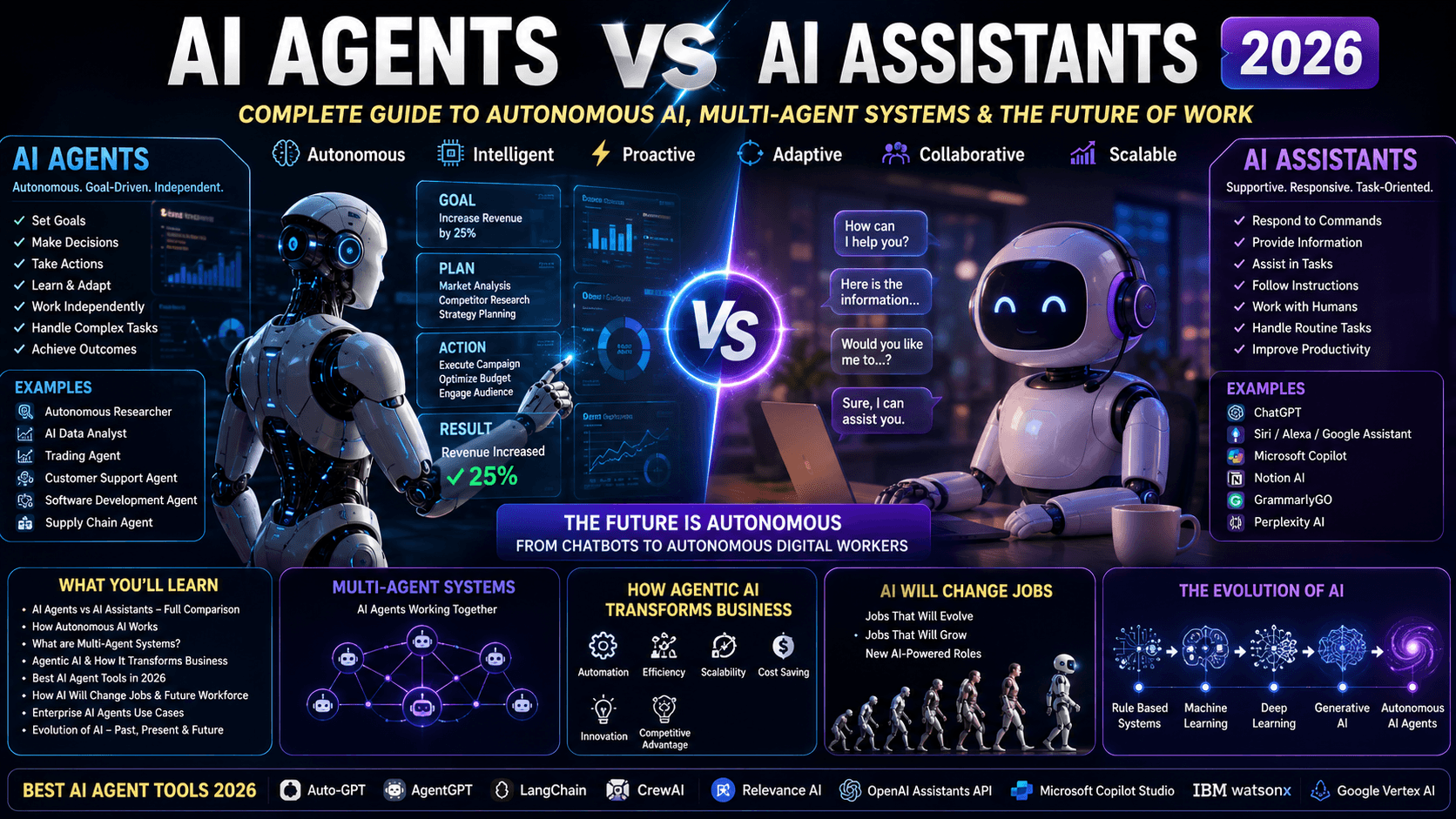
An AI assistant is reactive. You prompt it, it responds. The interaction is transactional — you give input, it gives output. ChatGPT answering your question, Copilot completing your code suggestion, Siri setting your alarm — these are AI assistants. Excellent, useful, powerful. But passive by nature.
An AI agent is proactive. You give it a goal, and it pursues that goal through a sequence of actions, adapting along the way. It does not wait for your next prompt before acting. An AI agent researching a topic does not just answer your question about it — it actually searches the web, reads multiple sources, synthesizes information, drafts a report, checks facts, edits the report, and delivers a finished document. Multiple steps. Multiple actions. Minimal supervision.
Is ChatGPT an AI Agent or an AI Assistant?
In its standard form, ChatGPT is an AI assistant — it responds to your prompts in a conversational way. However, when ChatGPT is given tools (like web search, code execution, or file reading) and uses them across multiple steps to accomplish a goal, it begins functioning as an AI agent. OpenAI's "Operator" feature and Anthropic's "Claude with computer use" are examples of AI assistants gaining agentic capabilities. The distinction is about architecture and behavior, not about the underlying model.
Are AI Agents Better Than AI Assistants?
This is a false comparison — AI agents and AI assistants serve different purposes and are complementary, not competitive. AI assistants excel at: immediate question answering, generating creative content, explaining concepts, proofreading, and quick-turn tasks. AI agents excel at: complex multi-step projects, automated workflows, tasks requiring multiple tools, research and synthesis, and operating unattended for extended periods.
The most powerful systems in 2026 combine both: an AI assistant as the front-end conversational interface, with AI agent capabilities running in the background to execute complex tasks on the user's behalf.
| Feature | AI Assistant | AI Agent |
|---|---|---|
| Nature | Reactive — responds to prompts | Proactive — pursues goals autonomously |
| Interaction Model | One prompt → one response | One goal → multiple actions → completed output |
| Human Involvement | Required at every step | Minimal (goal setting + oversight) |
| Tool Use | Limited or single-step tool use | Multi-tool, multi-step execution |
| Memory | Limited to conversation window | Short-term + long-term persistent memory |
| Self-Correction | None (responds but does not retry) | Built-in — adjusts approach when something fails |
| Complexity of Tasks | Simple to moderate tasks | Complex, multi-step, multi-system tasks |
| Examples | ChatGPT, Siri, Alexa, Copilot | AutoGPT, Devin, CrewAI agents, Google's Project Mariner |
| Best For | Quick answers, content generation, Q&A | Automated research, coding, business workflows |
Types of AI Agents — From Simple to Fully Autonomous
What Are the Different Types of AI Agents?
AI agents are not monolithic — they exist on a spectrum of intelligence and autonomy. Understanding the types helps you deploy the right type for each use case:
1. Simple Reflex Agents
The most basic type — acts entirely based on current perception, using pre-defined condition-action rules. No memory, no planning. Example: a thermostat that turns on heating when temperature drops below a threshold. Limited but extremely reliable for well-defined, repetitive tasks.
2. Model-Based Reflex Agents
Maintains an internal model of the world, allowing it to handle partially observable environments. Can track state across time. More capable than simple reflex agents but still rule-based. Example: a navigation system that maintains a map of roads even when GPS signal is temporarily lost.
3. Goal-Based Agents
Explicitly reasons about goals and takes actions to achieve them. These agents evaluate multiple possible actions and choose the one most likely to reach the desired outcome. Most modern AI agents in production environments fall into this category or above.
4. Utility-Based Agents
Goes beyond goal achievement to maximize a "utility function" — a measure of how desirable different outcomes are. These agents can make trade-offs between competing objectives. Example: an AI trading agent that maximizes returns while managing risk.
5. Learning Agents
Can improve their performance over time through experience. Includes a learning element that adjusts behavior based on feedback. This is the most sophisticated category and forms the foundation of truly adaptive AI systems.
6. Agentic AI (LLM-Powered Agents)
The newest and most discussed category — AI agents powered by Large Language Models as their reasoning engine, combined with tool-calling capabilities, memory systems, and multi-step planning. ChatGPT with tools, Claude with computer use, and frameworks like LangGraph and AutoGen belong here. This is what most people mean when they say "AI agents" in 2026.
| Agent Type | Memory | Planning | Learning | Complexity | Example Use Case |
|---|---|---|---|---|---|
| Simple Reflex | None | None | None | Very Low | Spam filters, thermostats |
| Model-Based Reflex | World model | None | None | Low | Navigation systems, inventory management |
| Goal-Based | World model | Yes | None | Medium | Route planning, chess AI |
| Utility-Based | World model | Yes (optimized) | Limited | High | Trading algorithms, resource allocation |
| Learning Agents | Adaptive memory | Yes (adaptive) | Yes | Very High | Game playing AI, recommendation systems |
| Agentic AI (LLM-powered) | Short + long-term | Yes (flexible) | Context-based | Extreme | Research agents, coding agents, business automation |
Agentic AI vs Traditional AI vs Traditional Software — The Key Differences
What Is Agentic AI?
Agentic AI refers specifically to AI systems that exhibit agency — the capacity to act independently in pursuit of goals, using judgment, tools, and adaptive planning. The term "agentic" distinguishes these systems from standard generative AI (which produces content but does not act) and traditional automation (which executes predefined scripts but does not think).
Agentic AI represents what many researchers consider the third wave of AI deployment:
- Wave 1 (2015–2020): Narrow AI — specialized models for specific tasks (image recognition, translation, recommendation systems)
- Wave 2 (2020–2024): Generative AI — LLMs that can generate text, images, code, and other content in response to prompts
- Wave 3 (2024–present): Agentic AI — LLM-powered systems that can plan, act, and accomplish complex goals autonomously
How Is Agentic AI Different From Traditional AI?
Traditional AI excels at a single well-defined task: classify this image, translate this sentence, predict this number. Agentic AI excels at open-ended, multi-step tasks where the exact path to the goal is not pre-defined. Traditional AI is a specialist. Agentic AI is a generalist that can use specialists as tools.
What Comes After Generative AI?
The question "what comes after generative AI?" has a clear answer in 2026: agentic AI. The transition is already underway. While generative AI tools like ChatGPT changed how individuals create content, agentic AI systems are changing how organizations operate — automating entire workflows, not just individual tasks.
Multi-Agent Systems — The Next Evolution of AI Collaboration
What Is a Multi-Agent System (MAS)?
A Multi-Agent System (MAS) is a network of multiple AI agents that work together — each with specialized roles, capabilities, and areas of responsibility — to accomplish goals that no single agent could achieve alone.
The analogy to human organizations is direct: just as a company has different departments (marketing, engineering, sales, finance) staffed by people with different specialties, a multi-agent system has different AI agents with different capabilities, coordinated by an orchestrator agent that assigns tasks and manages the workflow.
Single Agent vs Multi-Agent AI — When to Use Each
A single agent handles one task type at a time with a single AI model. Effective for: research tasks, content generation, customer service queries, code review. Best when the task is clear, bounded, and doesn't require simultaneous specialized capabilities.
A multi-agent system divides complex work across specialized agents running in parallel or sequence. Effective for: large software development projects, complex research synthesis, enterprise business process automation, any task requiring simultaneous specialized expertise.
How Do AI Agents Communicate With Each Other?
In a multi-agent system, agents communicate through several mechanisms:
- Shared memory/context — All agents access a common workspace where they can read and write information
- Message passing — Agents send structured messages to each other (task assignments, results, questions)
- Orchestrator delegation — A "manager" agent directs sub-agents and aggregates their outputs
- Blackboard systems — A shared data structure that any agent can read from or write to, enabling asynchronous coordination
Multi-Agent Systems With LangGraph and CrewAI
The two most widely used frameworks for building multi-agent systems in 2026 are:
- LangGraph — Built by the LangChain team, LangGraph allows developers to define agent workflows as graphs — nodes represent agents or actions, edges represent transitions. Excellent for complex, stateful workflows where agent interactions need precise control.
- CrewAI — A higher-level framework specifically designed for multi-agent "crews" — groups of AI agents with defined roles, goals, and backstories working together on a shared task. More accessible than LangGraph for non-experts; excellent for business process automation.
| Industry | Multi-Agent System Use Case | Agents Involved | Human Role |
|---|---|---|---|
| Software Development | Autonomous coding and testing | Planner + Coder + Tester + Reviewer + Deployer | Goal setting, final approval |
| Healthcare | Medical research synthesis | Searcher + Reader + Summarizer + Fact-checker + Report writer | Clinical oversight |
| Finance | Investment analysis and trading | Market analyst + Risk assessor + News monitor + Trade executor | Strategy approval |
| Customer Service | End-to-end customer issue resolution | Intake + Classifier + Specialist + Resolution + Follow-up | Escalation handling only |
| Content Marketing | Full content production pipeline | Researcher + Outliner + Writer + Editor + Publisher | Brand voice oversight |
Best AI Agent Tools in 2026 — Complete Comparison
What Are the Best AI Agent Tools?
The AI agent tools landscape in 2026 has matured significantly from the experimental early days of AutoGPT. There are now robust, production-ready tools for developers, no-code users, and enterprise teams alike:
| Tool | Type | Best For | No-Code? | Free Plan? | Price (Paid) |
|---|---|---|---|---|---|
| LangGraph | Developer framework | Complex stateful agent workflows | No (Python) | Open source | LangSmith from $39/month |
| CrewAI | Multi-agent framework | Business process automation | Partial | Open source | Enterprise pricing |
| AutoGen (Microsoft) | Multi-agent framework | Coding agents, research automation | No (Python) | Open source | Free (Azure compute costs) |
| n8n | No-code automation + agents | Business workflow automation | Yes | Yes (self-hosted) | $24–$60/month (cloud) |
| Zapier AI | No-code AI automation | App integration with AI steps | Yes | Limited | $20–$100/month |
| Relevance AI | No-code AI agent builder | Custom business AI agents | Yes | Limited | $19–$199/month |
| Devin (Cognition) | AI software engineer | Autonomous coding and debugging | No | No | $500+/month |
| Claude (Anthropic) + Computer Use | AI agent with computer control | Browser automation, complex tasks | API-based | Limited | API pricing by token |
| MindStudio | No-code AI agent builder | Custom AI apps without coding | Yes | Yes | $49–$199/month |
Best Free AI Agent Tools for Beginners
If you are starting with AI agents and want to experiment without cost:
- CrewAI — Open-source framework; run locally for free with your own API keys
- LangGraph — Open-source; free to run; only pay for LLM API calls (OpenAI, Anthropic, etc.)
- n8n self-hosted — Free to host on your own server; extensive AI agent capabilities
- AutoGen — Microsoft's open-source multi-agent framework; run locally
- MindStudio free tier — No-code agent building; free plan with limitations
How Do I Create an AI Agent Without Coding?
Creating an AI agent without coding is now genuinely accessible in 2026 through no-code platforms:
- Choose a no-code platform — Relevance AI, MindStudio, or Zapier AI are the most beginner-friendly
- Define your agent's role — Give it a clear purpose (research assistant, customer service bot, content creator)
- Connect tools — Use the platform's built-in connectors to give your agent access to web search, email, spreadsheets, etc.
- Write the agent's instructions — Describe in plain English what the agent should do when it receives a task
- Test with example tasks — Run your agent on real tasks and refine its instructions based on results
- Deploy — Embed in your workflow via API or the platform's built-in deployment options
Enterprise AI Agents — Transforming Business Operations
What Is Enterprise AI?
Enterprise AI refers to the application of artificial intelligence technologies at organizational scale — integrated into business processes, workflows, decision systems, and customer interactions across an entire company rather than for individual personal use.
Enterprise AI agents go beyond the individual productivity gains that personal AI assistants provide. They transform the economics, speed, and capability ceiling of entire business functions.
How AI Agents Are Transforming Business in 2026
The business transformation driven by AI agents operates across multiple dimensions:
- Customer Service — Multi-agent systems handle 80% of customer interactions end-to-end, from intake through resolution, with human agents handling only complex escalations
- Software Development — AI coding agents like Devin can independently complete software development tasks, write tests, debug, and deploy code — compressing weeks of work into hours
- Research and Analysis — Research agents can synthesize information from hundreds of sources simultaneously, producing comprehensive analysis that would take human researchers weeks
- Sales and Marketing — AI agents can conduct prospect research, personalize outreach, schedule follow-ups, and update CRM systems autonomously
- Finance and Accounting — AI agents process invoices, reconcile accounts, flag anomalies, and generate reports with minimal human oversight
- Legal — Contract review agents analyze agreements, flag risks, suggest standard modifications, and maintain compliance tracking across large document sets
Building GenAI Agents for Enterprise — Beyond the Hype
The promise of enterprise AI agents is enormous — but implementation requires careful navigation of real challenges. The most common enterprise AI agent implementation pitfalls:
- Hallucination risk — AI agents can confidently take wrong actions based on incorrect reasoning. Enterprise deployments require robust validation checkpoints.
- Security and access control — An AI agent with access to your entire enterprise system is a significant security surface. Least-privilege access principles are essential.
- Integration complexity — Connecting AI agents to legacy enterprise systems (ERP, CRM, legacy databases) requires significant technical work.
- Change management — Employees need to understand how to work alongside AI agents — both to use them effectively and to maintain appropriate oversight.
- Cost management — LLM API calls at enterprise scale can be surprisingly expensive. Cost monitoring and optimization are essential from day one.
| Business Function | Current AI Agent Use Case | Productivity Gain | Human Role After |
|---|---|---|---|
| Customer Service | End-to-end query handling with escalation routing | 70-80% reduction in handling time | Complex escalations only |
| Software Development | Autonomous coding, testing, debugging | 50-70% faster delivery | Architecture, strategy, review |
| Research and Analysis | Multi-source research synthesis in hours not weeks | 10-20x faster than humans | Judgment, interpretation, strategy |
| Sales Outreach | Prospect research, personalized outreach, CRM updates | 3-5x more prospects reached | Relationship building, closing |
| Legal Review | Contract analysis, risk flagging, compliance tracking | 80% reduction in review time | Negotiation, judgment, advice |
| Finance Operations | Invoice processing, reconciliation, reporting | 60-90% reduction in manual work | Oversight, exceptions, strategy |
AI Agents and the Future of Work — Complete Analysis
Will AI Agents Replace Human Workers?
This is the question every employee, student, and career planner is asking — and the honest answer requires nuance. AI agents will replace some jobs. They will transform more jobs. And they will create entirely new jobs that do not exist today.
The pattern in every previous technology revolution — from the printing press to the steam engine to the computer — is that technology eliminates some roles, creates new roles, and increases overall economic output. The AI agent revolution will follow this pattern, but at a pace that may be faster than any previous technology transition in history.
Which 3 Jobs Will Survive AI?
The jobs most resistant to AI agent replacement share three characteristics: they require genuine human judgment in novel, ambiguous situations; they require authentic human emotional connection; or they require physical dexterity in unstructured environments. The three broad categories that will survive:
- Strategic Leadership and Creative Direction — Setting organizational vision, making irreversible decisions under uncertainty, and leading human teams through change requires human judgment, accountability, and trust that AI cannot replicate.
- Deep Human Relationships — Therapists, doctors delivering serious diagnoses, grief counselors, child development specialists, spiritual advisors — roles where the human connection is itself therapeutic or essential.
- Complex Physical Craftsmanship — Skilled trades operating in unpredictable environments (plumbing, electrical work in old buildings, emergency response, surgical procedures in unusual anatomical situations) remain difficult to automate.
What Jobs Will AI Create?
The AI agent economy is already creating significant new employment categories:
- AI Agent Orchestrators — Professionals who design, deploy, and optimize multi-agent systems for enterprise workflows
- Prompt and Instruction Engineers — Specialists who craft the instructions that make AI agents work effectively and safely
- AI Output Evaluators — Humans who review AI-generated work for quality, accuracy, and safety before it reaches end users
- AI Ethics and Governance Officers — Professionals ensuring AI systems operate within legal, ethical, and organizational frameworks
- Human-AI Collaboration Designers — Specialists who design workflows that optimally combine human and AI capabilities
- AI Trainer and Fine-Tuner — Professionals who improve AI agent performance for specific domains through training data curation and model fine-tuning
How Will AI Agents Change the Workplace?
The fundamental shift in the AI-agent-enabled workplace is a move from humans doing work to humans managing AI doing work. This transition is already visible in the companies at the forefront of AI adoption:
| Current Human Role | What AI Agents Take Over | What Humans Focus On | Net Job Impact |
|---|---|---|---|
| Junior Software Developer | Boilerplate code, bug fixes, documentation, testing | Architecture, design, complex problem solving | Role transformation (not elimination) |
| Research Analyst | Data gathering, source synthesis, initial reports | Judgment, interpretation, client communication | Higher-value work; fewer analysts needed |
| Customer Service Agent | Routine queries, FAQ responses, status updates | Complex complaints, empathy-heavy interactions | Significant role reduction |
| Content Writer | First drafts, research, SEO optimization, repurposing | Brand voice, strategy, creative direction, editing | Role transformation; AI management skills required |
| Data Analyst | Data cleaning, standard reports, visualization | Hypothesis generation, business strategy, interpretation | Higher leverage; fewer analysts at lower levels |
| Project Manager | Status tracking, scheduling, progress reporting | Stakeholder management, risk judgment, leadership | Role evolution; AI orchestration skills required |
The Evolution of Artificial Intelligence — From Rule-Based Systems to Agentic AI
How Has Artificial Intelligence Evolved Over Time?
Understanding where AI agents came from helps you understand where they are going. The history of AI is a story of expanding capability — each generation solving problems the previous one could not:
1950s–1980s: Symbolic AI and Expert Systems — Early AI was rule-based: programmers wrote explicit logical rules that computers followed. Expert systems like MYCIN (medical diagnosis) and DENDRAL (chemistry) demonstrated AI could match human expertise in narrow domains — but were brittle, requiring human programmers to anticipate every scenario.
1990s–2010s: Machine Learning — Instead of programming rules, researchers trained statistical models on data, allowing computers to learn patterns. Support vector machines, decision trees, and early neural networks enabled applications like email spam filters, credit card fraud detection, and face recognition.
2012–2020: Deep Learning Revolution — Convolutional neural networks transformed computer vision; recurrent neural networks enabled better language processing. AlphaGo defeated the world champion at Go. Self-driving car research accelerated. The foundation was being laid for the next breakthrough.
2020–2023: Generative AI Era — GPT-3, then ChatGPT, then GPT-4, Claude, and Gemini demonstrated that large language models could generate remarkably human-like text, code, images, and other content. The world discovered that conversation was an interface for interacting with AI.
2024–Present: Agentic AI Era — The current revolution. AI systems that do not just respond but act. That do not just generate but execute. The next evolution of artificial intelligence is not about more powerful language models — it is about giving those models agency: the ability to use tools, make plans, take actions, and complete complex real-world tasks.
What Is the Most Advanced Form of AI in 2026?
In 2026, the most advanced deployed AI systems are multi-agent systems with specialized sub-agents, persistent memory, tool-calling capabilities, and human-in-the-loop oversight for high-stakes decisions. Beyond this category lies Artificial General Intelligence (AGI) — systems with human-level intelligence across all domains — which most researchers estimate is still years to decades away, though the gap is narrowing faster than anyone predicted in 2020.
What Comes After Agentic AI? — AGI and Beyond
The roadmap that most AI researchers describe:
- Agentic AI (2024–2030) — Autonomous systems completing complex tasks; currently deployed
- Early AGI (2030–2040?) — Systems with human-level intelligence across most cognitive domains; capable of independent scientific research, creative innovation, and complex reasoning
- Transformative AI (2040+) — Systems that can themselves accelerate AI development; the "intelligence explosion" scenario
| Era | Period | Technology | Capability | Limitation |
|---|---|---|---|---|
| Symbolic AI | 1950–1990 | Rule-based expert systems | Narrow domain expertise | Brittle; cannot handle novelty |
| Machine Learning | 1990–2012 | Statistical models | Pattern recognition in data | Feature engineering required; limited generalization |
| Deep Learning | 2012–2020 | Neural networks | Image, speech, game-playing | Requires massive training data; narrow task |
| Generative AI | 2020–2024 | LLMs (GPT, Claude, Gemini) | Content generation, Q&A, coding | Reactive; one-shot interaction; no persistent action |
| Agentic AI | 2024–Present | LLMs + tools + memory + planning | Autonomous task completion | Hallucination risk; cost; safety concerns |
| AGI (projected) | 2030–2040? | Unknown architecture | Human-level across all domains | TBD |
How AI Agents Are Used in Real Life — Examples Across Every Domain
How AI Agents Are Used in Real Life in 2026
AI agents are no longer confined to research papers and demos. They are deployed in production across every major industry:
Healthcare: AI research agents are accelerating drug discovery by autonomously searching scientific literature, identifying potential compound interactions, and designing experiments. Clinical documentation agents listen to doctor-patient conversations and automatically populate electronic health records — giving doctors time back for actual patient care.
Software Development: AI coding agents like Devin and GitHub Copilot Workspace are taking entire feature requests, breaking them into tasks, writing code, creating tests, debugging failures, and submitting pull requests — with developers reviewing rather than writing from scratch. Early data suggests 30–70% productivity improvements for developers using these tools effectively.
Legal Services: Document review agents can analyze thousands of contracts in hours, flagging risk clauses, inconsistencies, and unusual terms. What previously required teams of junior lawyers working for weeks can now be completed by a single AI agent overnight — dramatically reducing legal costs for businesses.
Scientific Research: Research agent systems are being used in cancer research (scanning clinical trial data for patterns), materials science (exploring new compound properties), and climate modeling (integrating data from multiple sources to generate more accurate projections).
Finance: AI trading agents monitor global news, social media, earnings reports, and market data simultaneously — executing trades based on complex multi-factor analysis at speeds and scales no human team can match. Risk management agents monitor portfolio exposure in real-time and automatically hedge positions when thresholds are breached.
AI Agents for Content Creators
For content creators — YouTubers, bloggers, podcast hosts, social media managers — AI agents offer transformative productivity gains:
- Research agents that automatically gather information, verify facts, and compile source lists for content
- SEO agents that analyze keyword opportunities, competitor content, and search intent before you write
- Repurposing agents that automatically convert a single blog post into social media posts, email newsletters, video scripts, and podcast show notes
- Scheduling and publishing agents that determine optimal posting times, prepare content for each platform's format, and publish automatically
- Analytics agents that monitor content performance across platforms and generate weekly insights reports
| Industry | AI Agent Application | Specific Example | Impact |
|---|---|---|---|
| Healthcare | Drug discovery research | Agent scans 10,000 research papers daily | 5–10x faster hypothesis generation |
| Software | Autonomous coding | Devin completes feature requests end-to-end | 50–70% developer time savings |
| Legal | Contract review and risk flagging | 1,000 contracts reviewed overnight | 80% reduction in junior lawyer hours |
| Finance | Autonomous trading and risk management | Multi-factor trade execution at microsecond speed | Eliminates human reaction delay |
| E-commerce | Personalized customer journey automation | Abandoned cart → email → discount → follow-up chain | 15–25% conversion improvement |
| Education | Personalized tutoring agents | Adaptive curriculum adjustment per student | 2x learning speed in controlled studies |
| Content Creation | Research-to-publication pipeline | Full blog post from keyword to published article | 10x content volume increase |
| Manufacturing | Predictive maintenance and quality control | Continuous monitoring → maintenance scheduling | 30–40% reduction in downtime |
Future of AI Agents — Predictions for 2026–2040
What Will AI Agents Do in the Future?
Based on current trajectories, here is what the evolution of AI agents looks like over the coming decades:
2026–2028: Workflow Domination — Multi-agent orchestration will handle 80% of customer-facing business processes. Every knowledge worker will have personal AI agents managing their schedules, communications, and routine work. Physical AI — agents that control robots and physical systems — will expand beyond digital workflows into manufacturing, logistics, and construction.
2028–2032: Digital-Physical Integration — AI agents will routinely manage both digital and physical environments. An AI building manager will handle HVAC, security, maintenance scheduling, and energy optimization simultaneously. AI logistics agents will coordinate global supply chains in real-time, routing around disruptions before they cause delays.
2032–2040: Agent Economy — Entire economic sectors will operate primarily through AI agent networks, with humans setting strategy and overseeing outcomes. AI entrepreneurs will create AI micro-businesses — automated companies that generate revenue through AI agent labor with minimal human involvement. The concept of a "one-person billion-dollar company" — previously theoretical — may become achievable through AI agent leverage.
Is Autonomous AI the Future?
Yes — but with an important qualification. Autonomous AI is the future of task execution. Human judgment, creativity, ethical reasoning, and emotional intelligence remain the future of direction and oversight. The most successful organizations and individuals of the next two decades will be those who most effectively combine autonomous AI capability with human wisdom, judgment, and values.
What Is AI's Biggest Weakness in 2026?
Despite remarkable capabilities, AI agents in 2026 have significant limitations that every user and builder must understand:
- Hallucination — AI systems can confidently produce incorrect information. In agentic systems, this can cascade across multiple steps before errors are detected.
- Common sense reasoning gaps — AI struggles with the kind of obvious, contextual judgment that any ten-year-old human applies effortlessly.
- Novel situation handling — Agents trained on existing data may perform poorly on genuinely novel situations outside their training distribution.
- Goal misspecification — If you describe a goal imprecisely, an AI agent may achieve what you said rather than what you meant — sometimes in unexpected ways.
- Long-horizon reliability — Over very long, complex tasks, AI agent performance can degrade as error accumulation and context limitations compound.
Conclusion: The Age of Intelligent Agents Has Begun
We are living through the most significant transformation in how work gets done since the invention of the computer. AI agents are not a future technology — they are here, operational, and already generating measurable productivity gains in every industry that has adopted them seriously.
The question is not whether AI agents will transform your industry. They will. The question is whether you will be among the people who understand these systems, deploy them effectively, and ride the transformation to greater productivity and opportunity — or among those who are surprised by the changes when they arrive.
The transition from AI assistants to AI agents represents the difference between a tool that helps you work and a system that works for you. Understanding this distinction — and building the skills to harness agentic AI effectively — is the single most important professional development investment you can make in 2026.
Start small. Experiment with one AI agent tool. Give it a real task. Watch how it plans, executes, and iterates. Then imagine an entire organization of such systems, coordinated by humans with the judgment and creativity that no AI can replicate — and you will begin to see the future that is already being built today.
The age of intelligent agents has begun. The only question is whether you will be shaping it or shaped by it.