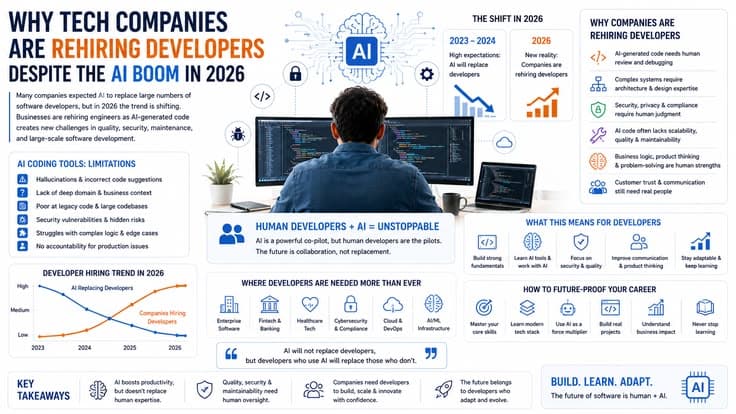
Why Tech Companies Are Rehiring Developers Despite the AI Boom in 2026
Many companies expected AI to replace large numbers of software developers, but in 2026 the trend is reversing. Businesses are quietly rehiring engineers as AI-generated code creates serious challenges in quality, security, maintenance, and large-scale software development. Here is the complete picture.
Introduction: The AI Developer Replacement Experiment That Backfired
In 2023 and 2024, a wave of optimism swept through the tech industry. AI coding tools were improving rapidly, developer salaries were high, and executives saw an opportunity to cut costs. The logic seemed simple: if AI can write code, why pay expensive human engineers?
The result was a wave of tech layoffs. Thousands of software engineers, especially junior and mid-level developers, lost their jobs as companies bet on AI coding assistants like GitHub Copilot, Claude Code, and ChatGPT to fill the gap.
By 2026, those same companies are quietly hiring those engineers back. Gartner reports that 50% of companies that laid off workers due to AI will rehire for the same roles by 2027. The AI replacement experiment, it turns out, was far more complicated than anyone anticipated.
This article covers everything: why companies are rehiring, what went wrong with AI-only development, what the actual limitations of AI coding tools are, why human programmers still matter, and what the future of software engineering careers looks like in 2026 and beyond.
| Expectation (2023–2024) | Reality (2026) |
|---|---|
| AI will replace 80% of developers by 2025 | Companies are actively rehiring laid-off engineers |
| AI code is production-ready | AI code has higher bug rates and security vulnerabilities |
| Junior developers are not needed | Senior engineers more valuable than ever; junior pipeline has collapsed |
| AI reduces software maintenance costs | AI actually increases maintenance costs without human oversight |
| AI understands business logic | AI has no institutional memory or contextual awareness |
Why Tech Companies Are Rehiring Software Engineers in 2026
The rehiring trend is not random. It is driven by specific, measurable failures that companies experienced after replacing human developers with AI-generated workflows. Here are the core reasons:
1. AI-Generated Code Quality Problems
The most immediate problem companies faced was code quality. AI coding tools generate code quickly, but that code frequently contains hidden bugs, missing edge case handling, deprecated function calls, and insecure defaults. When companies reduced their human developer teams and leaned heavily on AI, the number of production bugs increased, not decreased.
One YouTube analysis from April 2026 summarized it plainly: companies are rehiring developers because AI-generated code leads to more bugs, higher maintenance costs, and slower teams. The speed gain in code generation was wiped out by the time spent debugging, reviewing, and refactoring AI outputs.
2. Exploding Maintenance Costs
AI code is cheap to generate but expensive to maintain. Without experienced engineers who understand the full system architecture, AI-generated code creates what the industry calls "technical debt" at an accelerated rate. Components work in isolation but break when integrated. Functions pass unit tests but fail under real-world conditions.
Companies found themselves spending more engineering hours on maintenance and cleanup than they had before adopting AI-first workflows.
3. The Institutional Knowledge Problem
This is perhaps the most underappreciated factor. Software systems carry decades of decisions, workarounds, business logic compromises, and infrastructure choices that are never fully documented. Senior engineers carry this knowledge in their heads. AI models have no access to it.
When companies laid off experienced engineers, they did not just lose coding capacity. They lost institutional memory. AI could generate new code, but it could not understand why certain architecture decisions were made, what edge cases had been discovered over years of production use, or how to work within existing legacy constraints.
The result has been a trend toward "boomerang hiring," where companies specifically recruit former employees who already understand the internal systems, business logic, and technical culture that AI cannot learn from a prompt.
4. The Shift in Who Is Being Hired
The rehiring is not uniform. Companies are not simply restoring the teams they laid off. The pattern is selective and strategic:
| Category | 2024 Layoff Pattern | 2026 Rehiring Pattern |
|---|---|---|
| Junior Developers | Heavily laid off, seen as replaceable by AI | Still scarce; entry-level market remains difficult |
| Mid-Level Developers | Significant layoffs across generalist roles | Strong rehiring demand, especially with AI tool skills |
| Senior Engineers | Some layoffs, mostly selective reductions | Extremely high demand; salary premiums increasing |
| Domain Experts | Targeted cuts in niche areas | High demand; AI cannot replicate domain specialization |
| AI/ML Engineers | Generally protected or growing | Explosive demand; among the highest salaries in tech |
The Real Limitations of AI Coding Tools in 2026
To understand why human developers are still essential, you need to understand what AI coding tools actually cannot do. The limitations are not minor edge cases. They are fundamental to how large language models work.
1. Contextual Blindness
AI models generate code based on the prompt they receive and the patterns in their training data. They do not have a persistent understanding of your codebase, your business requirements, or the history of decisions that shaped your system. They see the files you show them, not the full picture of what your software is supposed to do and why it was built the way it was.
This limitation becomes critical at scale. A single function is fine. A 500,000-line enterprise application with ten years of accumulated business logic is beyond what AI can reliably handle without constant human guidance.
2. Hallucinations and Confident Errors
AI coding tools are trained to produce plausible-looking outputs, not necessarily correct ones. They will invent function names that do not exist, reference APIs that have changed, suggest library versions with known security vulnerabilities, and produce logic that looks correct but fails on edge cases.
The dangerous aspect is that these errors are presented confidently. Unlike a junior developer who might flag uncertainty, an AI tool will produce broken code with the same smooth delivery as working code. Catching these errors requires exactly the kind of expert human review that companies were trying to eliminate.
3. Security Vulnerabilities
Research consistently shows that AI-generated code contains a higher rate of security vulnerabilities than carefully written human code. AI models are optimized to generate code that works, not code that is secure. They may suggest insecure authentication patterns, miss input validation, use deprecated cryptographic functions, or introduce SQL injection vulnerabilities without any warning.
In enterprise and regulated industries, this is not acceptable. A company building financial software, healthcare applications, or government systems cannot deploy AI-generated code without rigorous human security review. That review requires senior engineers with deep security expertise.
4. Scalability and Architecture Failures
AI excels at small, isolated tasks. Ask it to write a function that sorts a list or validates an email address, and it performs well. Ask it to design a distributed microservices architecture that handles a million concurrent users with 99.99% uptime, and the outputs become unreliable.
Architecture is about tradeoffs that span the entire system. It requires understanding performance characteristics, failure modes, data consistency requirements, and long-term maintainability. These are not things an AI can determine from a prompt. They require human judgment informed by experience.
| Limitation | Description | Impact Level | Human Solution Required |
|---|---|---|---|
| Contextual Blindness | AI does not understand full codebase history or business context | High | Senior engineers with institutional knowledge |
| Hallucinations | Generates confident but incorrect code, APIs, or logic | High | Expert code review and testing |
| Security Gaps | Defaults to working code, not secure code | Critical | Security-focused engineers and audits |
| Architecture Weakness | Cannot design reliable large-scale distributed systems | High | System architects and engineers |
| Technical Debt | Optimizes for immediate results, not long-term maintainability | Medium-High | Experienced developers managing code quality |
| Copyright Risks | May reproduce licensed code or proprietary patterns | Medium | Legal review and IP-aware engineers |
| Skill Erosion | Over-reliance weakens team's debugging and problem-solving ability | Long-term High | Structured learning and non-AI coding practice |
| No Accountability | AI cannot take responsibility for system failures | High | Human engineers who own outcomes |
5. The Skill Erosion Problem
There is a subtler long-term problem emerging in 2026. Teams that relied entirely on AI-generated code for 12-18 months are finding that their engineers have lost sharpness in fundamental debugging and problem-solving skills. This phenomenon, sometimes called "vibe coding dependency," means that when complex AI-generated systems fail in production, fewer engineers have the ability to diagnose and fix them manually.
Companies are now instituting policies requiring engineers to write at least some code without AI assistance, specifically to preserve the skills needed to manage AI-generated systems effectively.
Why Human Programmers Still Matter: The Irreplaceable Value
The argument for human developers is not sentimental. It is practical. There are specific, concrete things that human engineers do that AI cannot replicate in 2026.
Translating Ambiguity into Requirements
Real business requirements are messy. Stakeholders say things like "make it faster" or "customers are confused by the checkout." Turning these vague, often contradictory inputs into precise technical specifications is a fundamentally human skill. It requires asking the right questions, understanding organizational politics, and knowing which constraints are real versus which are assumptions.
AI can only build what you specify. Specifying correctly is the hard part, and that is a human job.
System Architecture and Global Design
Human engineers understand systems holistically. They know how a change in the database schema will ripple through three microservices, affect two API consumers, and require a data migration that must be done without downtime. This kind of global system thinking requires experience, context, and judgment that no current AI tool possesses.
Ethical and Legal Judgment
Software increasingly makes decisions that affect people's lives: loan approvals, medical diagnoses, hiring recommendations, content moderation. These systems require human engineers who understand the legal landscape, can identify and mitigate bias, and take responsibility for the outcomes their systems produce. AI tools have no ethical agency and no legal accountability.
Client and Stakeholder Communication
Building software is a collaborative process involving clients, product managers, designers, and business analysts. The ability to communicate technical constraints in business language, manage expectations, and build trust with stakeholders is a fundamentally human skill that drives project success far more than raw coding speed.
| Skill Category | Specific Capability | Why AI Cannot Replicate It |
|---|---|---|
| Requirements Engineering | Translating ambiguous business needs into technical specs | Requires interpersonal context and organizational understanding |
| System Architecture | Designing reliable, scalable distributed systems | Requires holistic understanding of tradeoffs across the full stack |
| Ethical Judgment | Identifying bias, ensuring fairness, legal compliance | Requires moral agency and accountability AI does not possess |
| Institutional Memory | Understanding why systems were built a certain way | Requires lived experience with the specific codebase over time |
| Creative Problem Solving | Novel solutions to unprecedented technical challenges | Requires intuition and lateral thinking beyond pattern matching |
| Stakeholder Communication | Managing client relationships and expectations | Requires emotional intelligence and trust-building |
| Security Architecture | Designing systems that are secure by default | Requires adversarial thinking and deep security domain knowledge |
How the Software Engineering Role Is Evolving in 2026
The role of a software engineer has not been eliminated by AI. It has been transformed. Understanding this transformation is essential for anyone planning a career in tech.
From Coder to Architect
The most significant shift is from writing code to designing systems. As AI handles more of the routine code generation, the premium on engineering time has shifted toward the decisions that AI cannot make: system design, technology selection, architectural tradeoffs, and integration strategy.
Engineers who thrive in 2026 spend less time in editors and more time thinking about systems, reviewing outputs, and making architectural decisions. The Pragmatic Engineer describes this as a shift from "I write the code" to "I define what should be built, orchestrate AI to build it, validate it rigorously, and own the outcome."
The Reviewer and Validator Role
A growing portion of engineering work in 2026 is reviewing, testing, and validating AI-generated code. This requires deep expertise: you cannot catch an AI security vulnerability or architectural flaw without understanding what correct looks like.
This has created a paradox: as AI generates code faster, the review workload has increased proportionally. According to LeadDev, a 741% increase in code written has translated to only a 20% increase in releases. The bottleneck has moved from generation to validation.
The AI Orchestrator
A new engineering archetype is emerging: the engineer who specializes in working with AI agents, designing prompts and workflows, chaining together AI tools for complex tasks, and building the infrastructure that makes AI-assisted development reliable at scale. This role requires both traditional software engineering fundamentals and a deep understanding of how large language models work.
| Activity | Pre-AI (2022) | AI Era (2026) | Time Allocation Change |
|---|---|---|---|
| Writing boilerplate code | 40-50% of work time | 5-10% (AI handles most) | Significantly decreased |
| Code review and validation | 10-15% of work time | 30-40% (reviewing AI output) | Significantly increased |
| System architecture | 10-20% of work time | 25-35% of work time | Increased |
| Requirements and planning | 10-15% of work time | 20-25% of work time | Increased |
| Debugging complex issues | 15-20% of work time | 20-25% of work time | Slightly increased |
| AI tool management | Not applicable | 10-15% of work time | New category |
AI Engineering vs Software Engineering: Understanding the Difference
One important career consideration in 2026 is understanding the difference between software engineering and AI engineering. These are related but distinct fields, and understanding both helps you make informed career decisions.
Software Engineering
Software engineering focuses on building reliable, maintainable systems using deterministic logic. The same input always produces the same output. Success is measured by bug rates, test coverage, system uptime, and code maintainability. The core skills are system design, data structures, algorithms, software architecture, and engineering fundamentals.
AI Engineering
AI engineering focuses on building systems that learn from data and produce probabilistic outputs. The same input can produce different outputs depending on context. Success is measured by model accuracy, data quality, and behavior consistency. Core skills include machine learning algorithms, data engineering, model training and evaluation, and prompt engineering.
| Dimension | Software Engineering | AI Engineering |
|---|---|---|
| System Type | Deterministic: same input always yields same output | Probabilistic: outputs vary based on learned patterns |
| Core Focus | Architecture, scalability, reliability, maintainability | Model training, data quality, behavior tuning |
| Success Metric | Minimal bugs, high test coverage, efficient scaling | Model accuracy, data integrity, solving for drift |
| Validation | Unit tests, CI/CD pipelines, traditional QA | ML metrics (F1 scores, human evaluation frameworks) |
| Typical Education | Computer science degree or self-taught with portfolio | Often requires math-heavy background, sometimes masters or PhD |
| Average Salary (2026) | Mid-level: $125,000; Senior: $145,000+ | Entry: 15-20% premium over SWE; Senior: 20-40% premium |
| Job Market | Recovering after layoffs; strong demand for senior roles | Explosive growth; significant unmet demand |
Both fields are converging. Software engineers who understand AI tools and can integrate large language model APIs are among the most sought-after professionals in the market. AI engineers who understand how to build production-grade software systems are equally valuable. The intersection of both skills is the highest-demand combination in 2026.
Software Engineering Career Outlook in 2026
Despite the disruption, the long-term outlook for software engineering careers is positive. The US Bureau of Labor Statistics projects over 140,000 openings for software developers over the next decade. The AI market is projected to grow from $390 billion in 2025 to over $3.4 trillion by 2033, and every layer of that growth requires software engineers.
High-Demand Specializations in 2026
Not all engineering roles are equally in demand. The following specializations command the highest salaries and have the strongest job prospects in 2026:
| Specialization | Demand Level | Average Salary Range | Key Skills Required |
|---|---|---|---|
| AI/ML Engineer | Extremely High | $140,000 – $200,000+ | Python, TensorFlow, PyTorch, LLM APIs, data engineering |
| Cybersecurity Engineer | Very High | $130,000 – $185,000 | Penetration testing, secure architecture, compliance |
| Cloud/Infrastructure Engineer | Very High | $125,000 – $175,000 | AWS/GCP/Azure, Kubernetes, Terraform, DevOps |
| Full Stack Developer (AI-aware) | High | $100,000 – $150,000 | React/Next.js, Node.js, AI tool integration |
| Big Data Engineer | High | $130,000 – $180,000 | Spark, Hadoop, data pipelines, cloud data platforms |
| MLOps Engineer | High | $135,000 – $190,000 | Model deployment, monitoring, retraining pipelines |
| Product Engineer | Growing | $110,000 – $160,000 | Client communication, rapid prototyping, business logic |
The Junior Developer Pipeline Problem
One serious long-term issue the industry is beginning to grapple with is the collapse of the junior developer pipeline. When companies stopped hiring entry-level engineers and AI tools took over routine coding tasks, the traditional on-ramp for new developers disappeared.
Senior engineers learned their skills by doing routine work first. If AI handles all the routine work and companies only want to hire senior engineers, the question becomes: how do senior engineers of the future learn the fundamentals? This is not solved yet, and it is a growing concern in engineering communities around the world.
Pakistan and South Asia Tech Market
For developers based in Pakistan, the picture in 2026 is mixed but genuinely encouraging for those who adapt. Remote work and offshore software services continue to grow. LinkedIn currently lists 240+ software engineering positions in Pakistan, with over 430 active on Bayt.com and 159 specifically in Islamabad on Glassdoor.
The highest demand in the Pakistani market is for engineers who combine solid fundamentals with AI tool proficiency, particularly in full-stack development (MERN, Next.js), cloud platforms, and AI integration. Engineers who have these skills and can communicate effectively with international clients are commanding strong rates in the remote work market.
Skills Developers Need to Thrive in the AI Era
The question every working developer and computer science student is asking is the same: what skills should I develop to remain valuable in an AI-dominated industry? Here is the honest answer based on what the market is actually rewarding in 2026.
Non-Negotiable Fundamentals
The engineers who are thriving in 2026 are those who invested in deep fundamentals that AI cannot replicate. As one industry consensus puts it: "AI isn't replacing developers, it's replacing mediocre developers." The engineers at risk are those whose only skill was translating requirements into syntax. Those who understand why things work are indispensable.
AI Fluency as a Core Skill
Understanding how to work effectively with AI coding tools is no longer optional. This means knowing how to write effective prompts, how to structure AI-assisted workflows, how to validate AI outputs for security and correctness, and how to integrate LLM APIs into production applications.
| Skill Category | Specific Skills | Priority Level | Why It Matters |
|---|---|---|---|
| CS Fundamentals | Data structures, algorithms, system design, OS concepts | Critical | Required to evaluate and correct AI-generated code |
| AI Tool Proficiency | GitHub Copilot, Claude Code, Cursor, prompt engineering | Critical | Engineers using AI replace those who do not |
| System Architecture | Microservices, distributed systems, API design, scalability | Very High | AI cannot design reliable large-scale systems |
| Security Engineering | Secure coding, authentication, authorization, vulnerability assessment | Very High | AI-generated code has high vulnerability rates |
| Cloud Platforms | AWS, GCP, or Azure; Kubernetes; infrastructure as code | High | All production systems live in cloud environments |
| Communication Skills | Technical writing, stakeholder management, requirements gathering | High | Bridges gap between business needs and technical implementation |
| Testing and QA | Unit testing, integration testing, test-driven development | High | Essential for validating AI-generated code quality |
| Domain Specialization | Deep expertise in fintech, healthtech, edtech, or enterprise software | Medium-High | Domain context is irreplaceable by AI |
Best Practices for Working With AI Coding Tools Without Losing Your Edge
The goal is not to avoid AI tools. It is to use them intelligently while preserving and growing your own engineering judgment. Here are the practices that experienced engineers are adopting in 2026:
Review Everything, Trust Nothing Blindly
Treat AI-generated code the way you would treat code from a very fast junior developer who is overconfident and occasionally hallucinates. Review it carefully, test it thoroughly, and never deploy it without understanding what it does.
Write Architecture Before Code
Before asking AI to generate any significant code, spend time designing the architecture yourself. Define your data models, your API contracts, your service boundaries, and your error handling strategy. AI is a far more useful tool when it is filling in a well-defined structure rather than inventing one from scratch.
Maintain Manual Coding Skills
Deliberately write some code without AI assistance. Solve algorithm problems, contribute to open source, or build personal projects using only your own typing and thinking. This preserves the diagnostic skills you need to fix complex AI-generated failures.
Specialize in AI-Resistant Areas
Invest in skills that are inherently hard to automate: deep domain expertise, security architecture, large-scale system design, and stakeholder communication. These are the areas where human judgment remains indispensable regardless of how good AI tools become.
| Pitfall | What Goes Wrong | How to Avoid It |
|---|---|---|
| Generating large chunks at once | AI loses architectural consistency; produces contradictory patterns | Break tasks into small, well-defined increments |
| Skipping architecture phase | AI builds the wrong thing confidently | Design system structure before generating any code |
| Blindly trusting output | Subtle bugs and security issues make it to production | Always review, test, and understand generated code |
| Using AI for security decisions | Insecure defaults and vulnerable patterns introduced | Always have a security-trained human review authentication and data handling |
| Never coding manually | Debugging skills atrophy; cannot fix complex failures | Maintain non-AI coding practice deliberately |
The Long-Term Future: What Happens When AI Gets Better?
A fair question is: even if human engineers are valuable today, will AI not eventually become capable enough to replace them? This is worth addressing honestly rather than dismissively.
The Expanding Demand Principle
One of the most important economic observations about AI and software development is that demand for software appears to be infinite. Every time the cost of building software decreases, more software gets built. As AI makes code generation cheaper, organizations that could not previously afford custom software now can. This creates new demand for engineers to specify, validate, and maintain these systems.
The Stack Overflow Blog argued in February 2026 that "demand for code is infinite," suggesting that AI creates more developer jobs across hardware, model infrastructure, application, and integration layers than it eliminates from routine coding.
The Moving Goalpost of "Good Enough"
Each time AI becomes capable of handling a new category of engineering work, the industry raises its expectations for what good engineering looks like. A decade ago, basic CRUD applications were challenging. Today, they are trivial even without AI. The competitive floor has moved up, not down.
The Researcher Prediction
Researchers at Oak Ridge National Laboratory have suggested AI might replace software developers by 2040. Meanwhile, nearly 30% of developers surveyed by Evans Data Corporation believe their jobs could disappear in the coming years. These predictions deserve respect, but they also deserve scrutiny.
Every previous technology wave that was predicted to eliminate developers instead transformed what developers do and expanded how many were needed. Compilers were going to replace assembly programmers. IDEs were going to replace expert coders. The pattern suggests transformation, not elimination.
The most honest answer in 2026 is that the timeline is uncertain, but the immediate reality is clear: human developers are in demand, the companies that replaced them with AI are rehiring them, and the skills that make engineers valuable are shifting toward architecture, judgment, and AI fluency rather than raw syntax production.
Conclusion: The Developers Who Will Thrive and the Ones Who Will Struggle
The AI boom has not ended software engineering. It has split the profession into two trajectories. On one side are engineers who treat AI as an external tool, who resist learning new workflows, and who define their value entirely by how fast they type code. These engineers face genuine risk.
On the other side are engineers who use AI as an amplifier, who invest in the judgment and architectural thinking AI cannot replicate, who specialize deeply in domains where context matters, and who can bridge the gap between business needs and technical implementation. These engineers are more valuable in 2026 than at any point in the industry's history.
The companies rehiring developers in 2026 are not rehiring the same role that existed in 2022. They are hiring engineers who understand both the power and the limits of AI, who can build reliable systems at scale, and who take responsibility for outcomes. That combination is rare, it is in demand, and it cannot be automated away.
The consensus that has emerged across the industry, from LinkedIn threads to Reddit forums to Pragmatic Engineer analysis, is simple: "AI won't replace software engineers, but software engineers who use AI will replace those who do not."
The question is not whether to be a developer in the AI era. The question is which kind of developer to become.
| Developer Type | Current Status | 2026–2030 Outlook | Recommended Action |
|---|---|---|---|
| Syntax-only generalist | At risk; facing competition from AI tools | Declining demand and salary | Urgently upskill in architecture and AI tools |
| Junior developer (traditional path) | Difficult market; entry-level positions scarce | Challenging without AI fluency | Lead with AI tool proficiency alongside fundamentals |
| Mid-level engineer with AI skills | Strong demand; being actively rehired | Positive; salary premiums growing | Deepen specialization and system design skills |
| Senior engineer or architect | Extremely high demand; salary premiums increasing | Excellent; irreplaceable for complex systems | Add AI orchestration skills to existing expertise |
| AI/ML specialist | Explosive demand; significant talent shortage | Outstanding; fastest growing segment | Continue deepening ML fundamentals and application layer skills |
| Domain expert engineer | High demand in fintech, healthtech, govtech | Strong; domain context is AI-resistant | Maintain and deepen domain specialization |
Real-World Examples: Companies That Tried AI-Only Development and Changed Course
The rehiring trend is not theoretical. Specific patterns have emerged across the industry that illustrate why the AI-only development experiment failed in practice. While individual company names are not always publicly disclosed, the patterns documented by industry analysts, hiring platforms, and developer communities paint a consistent picture.
The Pattern: Layoff, Discover Problems, Rehire
In 2024, a decision was made at many companies simultaneously. Developers were expensive. AI coding tools were improving fast. The business logic was straightforward: reduce headcount, rely on AI for code generation, save millions in salary costs. The companies that moved fastest discovered the problems first.
By late 2024 and into 2025, these companies began experiencing increased production incidents, slower feature delivery despite faster code generation, growing technical debt that no one had the expertise to manage, and security vulnerabilities that required emergency remediation. The cost of these problems quickly exceeded the savings from reduced developer headcount.
The Hiring Platform Evidence
Job listing data from LinkedIn, Indeed, and Glassdoor tells a clear story. After a period of declining software engineer job postings in 2024, 2026 shows significant recovery. LinkedIn Pakistan currently shows 240+ active software engineer roles. Glassdoor lists 159 positions in Islamabad alone. Apple, Amazon, and IBM are among the top three companies globally by number of software engineering positions listed, according to the Pragmatic Engineer's May 2026 analysis of the job market.
What the Gartner Data Shows
Gartner's research provides the clearest quantitative picture. Their finding that 50% of companies that laid off workers due to AI will rehire for the same roles by 2027 is striking. It means the AI replacement wave is already reversing at scale, even before it reached its predicted peak. The same research found that only 18% of development tasks are fully automatable with current AI tools, making mass developer replacement mathematically impossible with 2026 technology.
| Data Source | Finding | Implication |
|---|---|---|
| Gartner Research | 50% of AI-attributed layoffs will be rehired by 2027 | The replacement experiment is already reversing at scale |
| TechWolf Analysis | Only 18% of development tasks are fully automatable today | Mass replacement was never mathematically viable |
| Pragmatic Engineer (May 2026) | Apple, Amazon, IBM top 3 by open software engineering roles | Major tech companies are actively expanding engineering teams |
| LeadDev (June 2026) | 741% increase in code written, only 20% increase in releases | AI creates a review bottleneck, not a solution to engineering capacity |
| Stack Overflow Developer Survey | 76% of developers using or planning to use AI tools | AI is becoming a standard tool, not a replacement for developers |
| Evans Data Corporation Survey | 30% of developers worry about job disappearing soon | Anxiety is real but industry data suggests concern is overstated |
The AI Productivity Paradox: More Code, Not More Software
One of the most revealing findings from 2026 is what LeadDev researchers called the AI productivity paradox. The introduction of AI coding tools created a massive increase in the volume of code being written. In some organizations, code volume increased by 700% or more. But actual software delivery, measured by features shipped, bugs fixed, and systems deployed, only increased by around 20%.
This gap reveals a fundamental truth about software development that the AI enthusiasm of 2023 and 2024 overlooked: writing code is not the bottleneck in software engineering. It never was. The bottleneck is everything that happens after the code is written.
What Actually Takes Time in Software Development
When you distribute time across a software project, code writing typically represents only 20-30% of the total effort. The majority of engineering time goes to understanding requirements, designing solutions, reviewing and testing code, fixing bugs, coordinating with stakeholders, deploying and monitoring systems, and maintaining existing software. AI can accelerate code generation. It cannot meaningfully accelerate any of the other activities.
The Review Burden Explosion
When AI started generating code at 10x the previous rate, someone had to review 10x the code. That responsibility fell on the same human engineers who were supposed to be freed up by AI assistance. In many teams, developers who expected AI to reduce their workload found themselves working longer hours reviewing, debugging, and refactoring AI-generated outputs.
This is not a temporary problem. It is structural. The faster AI generates code, the more review capacity is required. Without sufficient senior engineers to absorb that review load, code quality suffers and the speed advantage disappears.
How Smart Developers Are Adapting: Real Strategies That Work
Rather than fearing or ignoring AI, the developers who are thriving in 2026 have developed specific strategies for integrating AI tools while maintaining and growing their own expertise. These strategies are practical and actionable regardless of your current experience level.
The Specification-First Approach
Before writing a single line of code or prompting any AI tool, experienced engineers in 2026 spend significant time writing precise specifications. They define data models in detail, document API contracts, specify edge cases, and describe error conditions. This discipline makes AI tools dramatically more useful because the AI has clear context to work within. It also ensures the engineer understands what should be built before evaluating what AI produces.
The Incremental Generation Strategy
Instead of asking AI to build an entire feature at once, effective developers break work into small, verifiable increments. Generate a single function, verify it is correct, integrate it into the system, confirm it works, then proceed. This approach prevents the architectural inconsistency that emerges when AI generates large amounts of code without human checkpoints.
Building Your AI Review Checklist
Developers who consistently produce high-quality AI-assisted work maintain mental or written checklists they apply to every piece of AI-generated code. These typically cover security considerations (input validation, authentication, authorization), performance implications (database query efficiency, memory usage), error handling completeness, and integration with existing system patterns. Having an explicit checklist prevents the approval of code that has subtle but serious problems.
Continuous Learning Outside AI Assistance
The developers most confident in their AI-assisted work are those who regularly solve problems without AI help. They work through algorithm challenges, contribute to open source projects, and build personal tools using only their own knowledge. This practice ensures that when AI-generated code fails in production, they have the fundamental skills to diagnose and fix the problem manually without AI assistance.
| Strategy | Primary Benefit | Time Investment | Career Impact |
|---|---|---|---|
| Specification-first approach | Dramatically improves AI output quality | Medium upfront, saves time overall | High: demonstrates engineering maturity |
| Incremental AI generation | Prevents architectural drift and hidden bugs | Similar to traditional development | High: produces more reliable software |
| AI output review checklist | Catches security and logic errors before deployment | Low once checklist established | Very High: prevents production incidents |
| Manual coding practice | Preserves debugging and problem-solving skills | 1-2 hours per week minimum | High: essential for senior career progression |
| AI tool mastery | Amplifies productivity significantly | Ongoing learning curve | Critical: expected in most 2026 roles |
| Domain specialization | Creates AI-resistant expertise | Long-term investment, years of depth | Very High: domain experts command premium salaries |
What Industry Leaders and Communities Are Saying
The conversation about AI and developer jobs is happening loudly across every professional platform. Understanding the range of perspectives helps you navigate the noise and find the signal.
The LinkedIn Consensus
Professional conversations on LinkedIn in 2026 have largely converged around a pragmatic view. John Crickett's widely shared post that "software engineers who use AI tooling will replace software engineers who do not" has become something of an industry motto. The AI tooling is, as he described it, "getting to an undeniable level." Paul Iusztin, writing in early 2026, noted that while AI will not remove developers, it may replace those "who do not grow beyond just coding." The sentiment is consistent: AI fluency is table stakes, not a differentiator.
What Reddit Communities Are Experiencing
The r/ExperiencedDevs subreddit, which has some of the most candid developer discussions on the internet, reflects a nuanced picture. The most upvoted perspective in major AI-replacement threads consistently argues that AI is good for smaller tasks and helping out, but falls apart on complex requirements and large codebases. The community's consensus is that "crappy developers" who should not have been hired are at risk, while engineers with genuine skills are thriving. There is also growing discussion about the identity shift: a viral NDTV story in June 2026 about a developer who "does not feel like a developer anymore" after AI tools automated most of their coding touched a nerve across communities.
The Pragmatic Engineer Analysis
The Pragmatic Engineer newsletter, one of the most respected sources of engineering industry analysis, published detailed findings in February 2026 showing that well-run engineering teams using AI tools are seeing fewer incidents, faster delivery, higher code quality, and higher maintainability. The key qualifier is "well-run": teams with strong engineering culture, robust review processes, and experienced engineers directing AI usage. The newsletter also tracks the job market closely, noting in May 2026 that the market is recovering and that senior engineers and domain experts are in particularly strong demand.
The Andrew Ng Perspective
Andrew Ng, one of the world's most respected AI educators, posted in 2025 about "significant unmet demand for developers who understand AI," noting that most universities had not yet adapted their curricula. His perspective is that the demand for developers is not shrinking; it is shifting toward people who can bridge traditional software engineering and AI capabilities. He projected 200,000 new AI-related roles by 2030, with wages up to 56% higher for those who master AI integration.
The Tech Job Market in Pakistan: Opportunities in the AI Era
For developers based in Pakistan, particularly in major tech hubs like Islamabad, Rawalpindi, Lahore, and Karachi, the AI era presents a specific mix of challenges and genuine opportunities. Understanding the local and remote market dynamics helps you position your skills effectively.
The Remote Work Advantage
Pakistani developers have a structural advantage in the AI era: the global remote work infrastructure established during and after the pandemic remains strong. Companies in the US, UK, Europe, and the Gulf actively hire Pakistani engineers for remote roles, and the salary differential means Pakistani developers can earn highly competitive local incomes while working for international clients.
The AI era reinforces this advantage. AI tools reduce the communication overhead of remote collaboration, making it easier for distributed teams to work together effectively. Pakistani developers who combine strong technical fundamentals with AI tool proficiency are well-positioned to compete for remote roles that were previously harder to access.
Local Market Demand
Pakistan's own technology sector continues to grow. E-commerce, fintech, edtech, and enterprise software companies are all expanding engineering teams. The demand in the local market is heavily skewed toward practical full-stack skills: MERN stack, Next.js, React Native for mobile, and increasingly Python for AI integration. Cloud skills (AWS in particular) are valued across virtually every employer category.
Freelance and Agency Opportunities
For developers who prefer independent work, platforms like Upwork and Fiverr continue to show strong demand for Pakistani developers, particularly for React, Next.js, and Node.js projects. The AI era has actually created new freelance opportunities: clients who previously could not afford custom software are now commissioning development projects because AI tools have reduced the cost and time involved. Pakistani developers who position themselves as AI-assisted engineers, able to deliver faster with AI tools while maintaining quality through human oversight, are winning more competitive bids.
| Technology/Skill | Local Market Demand | Remote Market Demand | Average Monthly Rate (PKR) |
|---|---|---|---|
| React / Next.js | Very High | Very High | 150,000 – 350,000+ |
| Node.js / Express | High | High | 120,000 – 300,000+ |
| Python / Django / FastAPI | High | Very High | 130,000 – 320,000+ |
| AI/ML Engineering | Medium (growing rapidly) | Extremely High | 200,000 – 500,000+ |
| Cloud (AWS/GCP/Azure) | Medium-High | Very High | 180,000 – 400,000+ |
| Mobile (React Native / Flutter) | High | High | 120,000 – 280,000+ |
| Cybersecurity | Growing | Very High | 150,000 – 400,000+ |