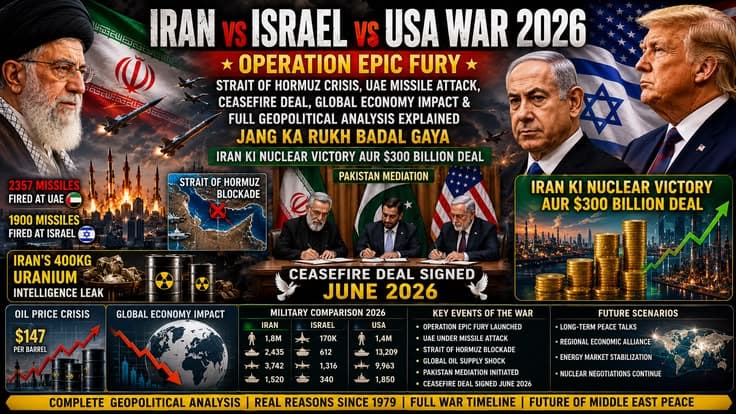
Iran vs Israel vs USA War 2026 — Operation Epic Fury, Strait of Hormuz Crisis, UAE Missile Bombardment, Ceasefire Deal, Global Economy Impact & Full Geopolitical Analysis Explained — War Takes a Decisive Turn (Updated June 16, 2026)
Breaking & In-Depth: The inside story of this war — complete timeline from 1979 to today, was Iran really building a nuclear bomb, why 2,357 missiles were fired at UAE, how Pakistan brokered the ceasefire, why oil prices reached $120 per barrel, and what happens next — all in this complete geopolitical analysis.
🚨 BREAKING UPDATE — JUNE 14, 2026: Iran's Nuclear Negotiation Victory & Strait of Hormuz to Reopen
In a dramatic turn of events, the Iran vs USA war took a decisive shift on June 14, 2026. After weeks of intense negotiations mediated by Pakistan, Oman, and Qatar, Iran has successfully secured a major diplomatic victory that has fundamentally altered the trajectory of the conflict.
🔹 Iran's Nuclear Demands Accepted: The United States has formally agreed to Iran's key nuclear conditions. Under the new framework, Iran will be permitted to maintain certain enrichment capabilities — a right it had consistently demanded throughout the negotiations. This marks a significant departure from the initial US position, which demanded a complete halt to all enrichment activities.
🔹 $300 Billion Iranian Assets Unfrozen: In what is being described as the largest financial settlement in modern geopolitical history, Iran has successfully secured the unfreezing of $300 billion USD of its overseas assets. These funds, which had been frozen for years due to international sanctions, will now be repatriated to Iran. This represents a monumental economic victory for Tehran, providing immediate relief to its sanction-strained economy.
🔹 Strait of Hormuz to Reopen: Following these agreements, Iran has confirmed that the Strait of Hormuz — which had been effectively closed for weeks causing a global energy crisis — will be reopened to international shipping immediately. This move is expected to rapidly stabilize global oil markets and ease the supply chain disruptions that had affected economies worldwide.
🔹 Ceasefire Terms Finalized: The agreement includes a 60-day ceasefire extension, during which both sides will work toward a permanent peace framework. The deal was signed electronically by President Trump, Vice President Vance, and Iran's Parliament Speaker Ghalibaf.
📌 Key Outcomes of June 14 Agreement
- Nuclear Program: Iran retains limited enrichment rights (subject to IAEA monitoring)
- Financial Relief: $300 billion in frozen assets released to Iran
- Strait of Hormuz: To reopen immediately — commercial shipping to resume
- Ceasefire: 60-day extension with permanent peace framework negotiations
- Sanctions Relief: Gradual rollback of sanctions based on compliance milestones
Analyst Take: This development represents a significant turning point in the conflict. Iran has effectively used its leverage — the Strait of Hormuz blockade and its nuclear threshold status — to extract massive economic and diplomatic concessions from the United States. For Trump, the deal secures a ceasefire before the upcoming elections while claiming victory on nuclear containment. However, the long-term implications for regional power balance, Israeli security, and Gulf stability remain deeply uncertain.
Part 1: The Inside Story of This War — What Media Doesn't Tell You
Iran Israel war latest developments. Iran vs USA conflict explained. Donald Trump role in Iran conflict. Can Iran Israel conflict trigger World War 3. Who started the Iran Israel war 2026.
Calling this war simply "Iran vs Israel vs USA" is not enough. This is not a simple military conflict — it is the result of a geopolitical game that has been going on for decades, and to understand it we must start from 1979.
1979 — The Revolution That Changed the World Map
When Ayatollah Khomeini's Islamic Revolution came in 1979, Iran became a force that rejected every command of the USA and UK. But it is important to understand: Iran was never their slave before, and it is not today either. When the world's biggest power — America's dollar value is one thing, but Iran's Rial exchange rate today is:
$1 USD = 1,375,878 Iranian Rial
This means decades of sanctions have devastated Iran's economy — but Iran still did not give up its military power, missile program, and nuclear ambitions. This is the greatest sign of defiance of a nation.
The Great Israel Plan — The Real Issue Started Here
If we examine the roots of this entire game, the real issue is: Israel wants the territory it occupies to become "The Greater Israel" — meaning it wants to take the lands of Arab countries under its control and establish a large Israeli empire. In this plan, the biggest threat to Israel was Iran, because Iran was neither intimidated like other Arab countries nor was it a puppet of the USA.
During the Biden-Obama era, Israel's hands were tied — because at that time American policy was focused on negotiation with Iran (the 2015 JCPOA nuclear deal). Iran continued working on its uranium enrichment program, and by 2026 it had accumulated 400 kg of highly enriched uranium — an amount considered sufficient for building a nuclear weapon.
Trump's Return to Power — And the Jewish Lobby Factor
When Donald Trump returned to power, Israel's joy knew no bounds. Why? Trump came to power in the USA with strong support from the Jewish lobby — powerful organizations like AIPAC (American Israel Public Affairs Committee) backed him. For Trump, displeasing Israel was politically impossible.
Trump clearly stated: "If Iran builds a nuclear bomb, it would be a torment for me." These were not just words — this was a political commitment he made to his Jewish voter base and Israeli allies. The chess board was now set.
The Role of Intelligence — The Night That Changed Everything
US and Israeli intelligence agencies gathered information about Iran's 400 kg uranium stockpile — through satellites, human intelligence, and cyber surveillance, they discovered the exact locations. But here is an interesting twist that very few people know:
Satellite imagery that came in the night before the US/Israel attack proved that Iran's 400 kg of uranium was still safe — meaning the facilities where the uranium was stored had not been targeted. This means even after the attack, the uranium remained. This is the twist that was preventing the war from stopping — because if the uranium had been destroyed, the true objective of the war would have been achieved.
Part 2: Operation Epic Fury — The Night of 28 February 2026 When the War Began
Operation Epic Fury 2026. Operation Epic Fury end date. Operation Epic Fury death toll. Operation Epic Fury objectives. Is Operation Epic Fury over. USA air strikes Iran. US military operations Iran.
28 February 2026 — on this night, the USA and Israel launched a massive coordinated military operation against Iran, code-named: "Operation Epic Fury."
The operation used US B-2 Spirit stealth bombers and "bunker buster" bombs — the same bombs designed to destroy underground fortified nuclear facilities. Israel conducted precision strikes using its F-35 and F-15 jets. According to CENTCOM, Iran's defense industrial base — where missiles and drones were manufactured — was degraded by 90%.
Iran itself proved that the attack had occurred — and not just from Iran's claims; satellite imagery confirmed that several key Iranian military sites were completely destroyed.
Operation Epic Fury — Key Statistics & Timeline
| Category | Detail |
|---|---|
| Start Date | 28 February 2026 |
| End Date (Major Operations) | 5 May 2026 |
| Duration | 38 days of major combat |
| US Weapons Used | B-2 Spirit Stealth Bombers, Bunker Buster Bombs, F-35 Stealth Fighters, Tomahawk Cruise Missiles |
| Israel Weapons Used | F-35I Adir, F-15I Ra'am, Jericho Missiles, Precision Guided Munitions |
| Targets Hit | 5,500+ military targets including nuclear facilities, missile production sites, naval bases, radar systems |
| Iran Defense Industrial Base Degraded | ~90% (per CENTCOM official reports) |
| Iran Navy | Decimated — dozens of warships and submarines destroyed |
| Iran Air Defense | Russian-supplied S-300 systems mostly destroyed |
| Key Leadership Killed | Senior IRGC commanders killed in targeted strikes |
| Trump's Stated Objective | Regime change + destroy Iran's nuclear + missile capability |
Iran's Response — That Shook the World
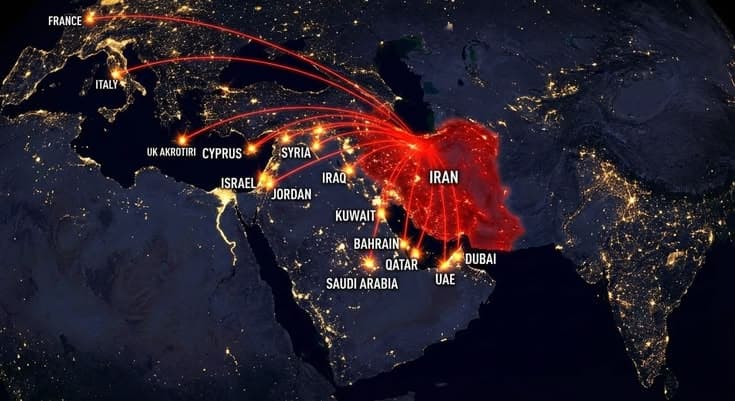
In response to Operation Epic Fury, Iran did something no one expected: launched a massive multi-front retaliatory campaign — and the most shocking part was that Iran fired the majority of its missiles not at Israel, but at the UAE.
Part 3: Iran's 2,357 Missiles on UAE — The Biggest Twist of This War
Why is Iran attacking the UAE? Iran UAE conflict. Iran attacks UAE. Missile attacks Middle East 2026. Iran retaliation strategy. Gulf states Iran conflict.
The biggest and most misunderstood twist of this war is: Iran fired the most missiles at the UAE — not at Israel! This sounds strange, but in the light of geopolitics, it is completely logical.
Iran Missile Attack Distribution — Where & How Many
| Target Country/Region | Missiles Fired | Reason | Impact |
|---|---|---|---|
| UAE (United Arab Emirates) | 2,357 missiles | First Arab country to normalize relations with Israel (Abraham Accords 2020) — Iran views UAE as "betrayer of Arab cause" and direct enabler of Israeli expansion | Major infrastructure damage, oil facilities hit, global energy markets shocked |
| Israel | 1,900 missiles | Primary adversary — targeting military bases, air defense systems, and civilian infrastructure | Significant damage despite Iron Dome/Arrow intercepting majority |
| US Military Bases (Gulf Region) | Multiple strikes across Iraq, Qatar, Bahrain, Kuwait | Direct response to US strikes — targeting American military infrastructure in Arab nations | 6 US soldiers killed, significant base damage reported |
| Saudi Arabia (KSA) | Only 49 missiles | Iran strategically targeted KSA minimally — trying to avoid complete Gulf coalition against itself; KSA had recently signed Saudi-Iran diplomatic normalization in 2023 | Limited damage — diplomatic signal more than military objective |
| Lebanon Front (Hezbollah proxy) | Thousands of rockets via Hezbollah | Proxy warfare — Hezbollah acting as Iran's forward force against Israel from Lebanese territory | Massive civilian displacement — over 1 million Lebanese displaced |
Why So Many Missiles on the UAE?
The reason for firing so many missiles at the UAE lies in pure geopolitical strategy: In 2020, the UAE normalized diplomatic relations with Israel through the Abraham Accords — in the Arab world, this was seen as a historic "betrayal." In Iran's view, the UAE became Israel's oldest Arab supporter.
Second: The UAE is a major hub of global oil infrastructure. If the UAE's economy is devastated, the global oil supply chain will break, energy prices will rise, and pressure will mount on the world to stop operations against Iran. This was Iran's classic asymmetric strategy — attack a point that causes the maximum global pain.
Third: The UAE hosted a hub for Israel's intelligence network and regional operations. Targeting the UAE was also an attempt to damage Israel's intelligence capabilities.
Iran's approach toward Saudi Arabia was completely opposite: only 49 missiles — a symbolic number. Why? In 2023, Iran and Saudi Arabia signed a diplomatic normalization agreement mediated by China. Iran did not want Saudi Arabia to become fully part of the US-Israel camp in this war. This was a calculated diplomatic move.
Part 4: Strait of Hormuz — The World's Most Dangerous Chokepoint
Strait of Hormuz crisis explained. 2026 Strait of Hormuz crisis. Strait of Hormuz importance. Which country controls Strait of Hormuz. Why is Strait of Hormuz closed. How Iran's control threatens global oil supply. Strait of Hormuz update today. Can Iran block Strait of Hormuz legally.
20% of the world's oil and Liquefied Natural Gas (LNG) passes through the Strait of Hormuz. This is a 54 km wide and 21 nautical mile narrow passageway connecting the Persian Gulf to the Gulf of Oman. If this closes, an earthquake hits the world's energy supply.
In response to Operation Epic Fury, Iran did exactly that: the IRGC (Islamic Revolutionary Guard Corps) established practical control over the Strait of Hormuz, laid sea mines, and halted commercial shipping — over 150 vessels were stranded.
An Iranian lawmaker and former IRGC commander Ebrahim Azizi correctly stated in an interview with BBC: "Tehran will NEVER cede control of the Strait of Hormuz. It is our inalienable right." He also said that Iran's parliament is introducing a bill under Article 110 of the constitution to establish Iran's legal control over the Strait.
Strait of Hormuz Blockade — Global Economic Impact
| Impact Area | Detail | Scale |
|---|---|---|
| Oil Price Spike | Global Brent crude surged — at times crossing $126 per barrel | Largest energy disruption since 1970s oil crisis |
| Shipping Vessels Stranded | 150+ commercial vessels blocked from transiting | Global supply chain emergency declared |
| Fertilizer Crisis | Persian Gulf is major hub for urea and ammonia production — agricultural chemicals delayed worldwide | Food price increases projected globally |
| LNG Supply to Asia | Japan, South Korea, India — major LNG importers — faced critical energy shortages | Emergency measures activated in multiple Asian economies |
| Rerouting Cost | Tankers rerouted via Cape of Good Hope — adding 10-14 days to transit times | Freight rates and insurance premiums skyrocketed |
| Global Inflation Impact | Higher energy costs cascaded into consumer goods, transport, and food production globally | Recession fears triggered in multiple economies |
Part 5: Military Comparison — Iran vs Israel vs USA
Military comparison Iran vs Israel. Military comparison Iran vs USA. Iran vs Israel military power 2026. Israel vs Iran who would win. Is Iran's military stronger than USA. Which army is stronger Iran or Israel. Can Israel defeat Iran military. US vs Iran war who would win. Iran vs USA military power 2026. Iran military power ranking.
Military Comparison — Iran vs Israel vs USA (2026)
| Military Factor | Iran | Israel | USA |
|---|---|---|---|
| Global Rank | #13 (Global Firepower) | #17 | #1 |
| Defense Budget | ~$8–15 billion | ~$24 billion (+ US aid) | ~$997 billion |
| Active Personnel | 610,000 + 350,000 reserves + Basij militia | 170,000 active + 465,000 reserves | 1,395,000 active |
| Combat Aircraft | ~280 (mostly pre-1979 US models + Soviet jets) | ~340 (F-35s, F-15s, F-16s — most advanced) | ~3,101 (stealth, carriers, bombers) |
| Ballistic Missiles | 2,000-3,000+ medium/short range — Iran's biggest asset | Jericho missiles + classified nuclear capability | Intercontinental + cruise missiles globally |
| Drones | 6,000-8,000+ Shahed kamikaze drones — mass produced cheaply | Advanced surveillance + combat drones | Most advanced drone fleet globally |
| Air Defense | S-300 (largely destroyed), Bavar-373 domestic system | Iron Dome + David's Sling + Arrow 2/3 — world's best layered defense | Patriot PAC-3, THAAD, Aegis globally |
| Naval Power | ~97 vessels + 6 submarines + fast attack boats in Hormuz | Small but advanced — Dolphin submarines (nuclear-capable) | 243 vessels + 71 submarines + 11 aircraft carriers |
| Nuclear Weapons | None yet — 400kg enriched uranium stockpile | ~90 warheads (undeclared but widely accepted) | ~5,042 warheads |
| Asymmetric Strength | Iran's BIGGEST advantage: Hezbollah, Hamas, Houthis, Iraq militias — Axis of Resistance | Cyber warfare (Unit 8200), Mossad global intelligence | Global bases, global power projection |
So Who Is Winning the War?
This question is not as simple as it seems. In conventional military power, the combination of USA + Israel is far stronger than Iran — B-2 bombers and bunker busters can destroy Iran's underground facilities that Israel alone cannot. Operation Epic Fury inflicted the greatest damage on Iran's conventional military capability.
But Iran proved one thing: it is fighting with the logic of Pakistan's 1965 war — it will not lose, but winning is also not necessary. Iran's real weapons are the Strait of Hormuz, its proxy network, and the propaganda of "we can build a nuclear bomb" — these three things together give Iran strength at the negotiating table.
Part 6: Impact of This War on the Global Economy — Pakistan, India, World
Impact of Iran Israel conflict on global economy. How the Middle East war affects oil prices. Iran Israel war and global financial markets. Impact of Iran Israel war on Pakistan. Impact of Iran Israel war on India. Impact of US Iran conflict on India. Impact of war on global economy. Global recession risk from Iran Israel war. Economic impact of geopolitical conflicts. Global energy crisis Middle East conflict.
Iran-Israel-USA War — Global Economic Impact Analysis
| Region/Country | Key Impact | Severity | Specific Effects |
|---|---|---|---|
| Global Oil Markets | Oil price surged to $120-126/barrel | Critical | 20% of world oil supply disrupted via Hormuz closure; largest disruption since 1973 oil crisis |
| Pakistan | Fuel price surge, import cost explosion, inflation spike | Severe | Pakistan is oil importer — Rs 50+ increase per liter petrol prices; trade routes disrupted; BUT Pakistan earned massive diplomatic credibility as mediator |
| India | Oil import bill surged; stock markets volatile | High | India imports 80%+ of oil — every $10/barrel increase adds $15 billion to import bill; Rupee weakened; Sensex fell sharply during peak tension |
| UAE | 2,357 missiles hit — massive economic damage | Catastrophic | Oil infrastructure hit; tourism collapsed; global shipping via Dubai disrupted; economic cost runs into hundreds of billions |
| Saudi Arabia | Limited military damage but energy markets shaken | Moderate | Oil revenues temporarily boosted by high prices but fear of widening conflict dampened investment |
| European Union | Energy prices skyrocketed — gas and electricity bills surged | High | Europe already energy-stressed after Russia-Ukraine war; Middle East disruption compounded the crisis; recession fears grew |
| USA | Gas prices hit $5.99/gallon in California | Moderate-High | Domestic production helped buffer impact but political cost of war became heavy; war economy spending increased deficit |
| China | Oil imports disrupted — world's largest oil importer affected | High | China buys 90% of Iran's oil — war disrupted this; China pushed hard for ceasefire to protect its energy supply lines |
Pakistan's Role — From Mediator to Peacemaker
In this entire war, there was an unexpected hero: Pakistan. Pakistan played the role of mediator between Iran and the USA — negotiations took place in Islamabad, Geneva, and Doha. Pakistan's Prime Minister Shahbaz Sharif announced the ceasefire and gained global credit.
For Pakistan, this was a double-edged sword: on one hand, strong border and brotherly relations with Iran; on the other hand, a defense pact with Saudi Arabia. Pakistan danced a very careful diplomatic dance — and ultimately successfully brokered the ceasefire.
Part 7: Ceasefire Deal June 2026 — Trump Said "Deal Signed" But the Twist Is Still There
Iran ceasefire agreement 2026. US Iran peace deal conditions. Trump Iran deal. Iran deal terms. Is there a ceasefire in 2026. Iran nuclear negotiations 2026. Ceasefire agreement 2026. US Iran deal Reddit. Did Iran agree to ceasefire.
On June 16, 2026 — as this analysis is being written — the biggest breaking news in the world is that Trump said during a meeting with French President Macron at the G7 summit: "I am very happy to say it's signed, the deal is all signed."
US-Iran Ceasefire Deal — Key Terms (June 2026)
| Aspect | USA/Trump Position | Iran Position | Status |
|---|---|---|---|
| Ceasefire Duration | 60-day ceasefire extension with framework for permanent peace | Agreed — Iran also proposed 10-point peace plan | ✅ Agreed — Signed electronically by Trump, Vance, and Iran's Parliament Speaker Ghalibaf |
| Strait of Hormuz | Must reopen immediately — Trump said "permanently toll free" | Iran says it will NEVER cede sovereignty — but agreed to reopen for now | ⚠️ Partial — Scheduled to reopen Friday; Iran still claims sovereign control |
| Nuclear Program | Complete halt to enrichment + 20-year freeze demanded | Iran wants 10-year limit + enrichment rights retained | ❌ Unresolved — Technical negotiations to begin; biggest sticking point |
| 400 kg Uranium Stockpile | Must be destroyed or removed from Iran | Disputed — Iran denies some claims about stockpile size | ⚠️ 60-day window to resolve |
| Sanctions Relief | Possible if Iran meets ALL obligations — no money upfront | Demands immediate sanctions relief and unfreezing of assets | ❌ Disputed — Vance confirmed "not a single dollar has changed hands yet" |
| Regional Peace | "Paragraph One" — Iran commits to regional peace and stops funding Hezbollah, Hamas, Houthis | Iran agrees in principle but details unclear | ⚠️ Most controversial — Iran's entire power projection relies on proxy network |
| Lebanon | Israel must withdraw from Lebanese territory | Iran demands complete halt to Israeli attacks in Lebanon | ❌ Israel refuses to withdraw — Netanyahu said forces will remain; major obstacle |
| Mediator | Pakistan (with Oman and Qatar support) | Accepted Pakistan as neutral mediator | ✅ PM Shahbaz Sharif announced breakthrough |
Why the War Is Not Stopping — The Real Question
Now here comes the question you asked: "If the 400 kg uranium issue was the real objective, and it got destroyed (or may have been destroyed), then why didn't the war stop?"
The answer is in three parts:
First: Satellite imagery proved that Iran's 400 kg of uranium remained safe — bunker busters did not hit the targets. So the US/Israel's real objective was not achieved. This is why stopping the war was difficult.
Second: Israel continued expanding its occupation in Lebanon for its "Greater Israel" plan — and Iran was fighting there through Hezbollah. This front was open, so a full ceasefire seemed impossible.
Third: Iran's Axis of Resistance — Hezbollah, Houthis, Iraqi militias — these groups were fighting their own wars. Even if Iran made a "deal," these groups would continue independently, especially Hezbollah which rejected the Lebanon-Israel ceasefire.
Part 8: Who Are Iran's Friends? And What Happens Next?
Who is Iran's best friend. Iran's allies. Are China and Russia helping Iran. Who is Iran's biggest ally. Future of Middle East geopolitics. Future scenarios for Middle East peace. Can Iran Israel conflict trigger World War 3. Future of regional alliances. Geopolitical consequences Iran Israel war.
Iran's Alliance Network
Iran did not stand alone in this war. Iran's partners in this war were:
- China: Iran's biggest economic lifeline — China buys 90% of Iran's oil. China diplomatically supported Iran, did not provide open military help but tried for sanctions relief. Hormuz closure was also damaging for China — so China also wanted a ceasefire.
- Russia: Russia had military coordination with Iran — Iran supplied drones to Russia for the Ukraine war, Russia supplied weapons to Iran. But Russia was preoccupied with its own Ukraine war — did not get directly involved.
- Pakistan: Border sharing and religious ties — but Pakistan chose the mediator role, did not take sides.
- Hezbollah (Lebanon): Iran's most powerful proxy — rained rockets on Israel from Lebanon. But Hezbollah rejected the Israel-Lebanon ceasefire deal.
- Houthis (Yemen): Continued disrupting shipping in the Red Sea — Iran's Yemen wing remained active.
- Iraq Militias: Conducted multiple attacks on US bases — 6 American soldiers killed.
Future Scenarios — Middle East 2026 to 2030
| Scenario | Probability | Conditions Required | Impact on Region | Impact on Global Economy |
|---|---|---|---|---|
| Successful Peace Deal — Iran gives up nuclear program, Hormuz stays open, sanctions lifted | 30-40% | Iran accepts nuclear limits + Lebanon settled + proxy groups restrained | Massive economic recovery + Gulf states pivot to reconstruction | Oil drops to $70-80/barrel; global markets rally; inflation eases |
| Fragile Cold Peace — Ceasefire holds but core issues unresolved; nuclear talks stall | 40-50% | Both sides exhausted but not defeated; 60-day ceasefire extended multiple times | Low-level proxy conflicts continue; regional reconstruction slow | Oil at $85-100; market volatility continues; investment uncertainty |
| Renewed War — Ceasefire collapses; Iran resumes nuclear work; Israel strikes again | 20-30% | Nuclear deal fails; Lebanon conflict reignites; internal Iranian politics shifts to hardliners | Catastrophic regional devastation; possible WW3 risk if miscalculation | Oil $150+/barrel; global recession triggered; trade system fragmented |
| Iran Regime Change — Internal protests collapse government | 10-15% | War damage + cost of living crisis + power grid failures trigger popular uprising | Unpredictable — could be democratic transition or chaos/civil war | Short-term chaos followed by potential long-term stabilization |
Could This Trigger World War 3?
The straightforward answer: A full-scale World War 3 is unlikely, but not impossible. This conflict is between limited nuclear powers (Israel + USA) and a conventional power (Iran). China and Russia did not provide direct military support — they are both preoccupied with their own problems.
But a "miscalculation" — a stray missile hitting the territory of a NATO ally, or a naval confrontation that escalates — could start a chain reaction for WW3. Historically, WW1 also started from a single assassination.
Frequently Asked Questions — Iran vs Israel vs USA War 2026
Who started the Iran Israel USA war 2026?
Technically, the USA and Israel launched "Operation Epic Fury" on 28 February 2026 — striking Iranian nuclear facilities, military infrastructure, and leadership. However, the deeper cause stretches back decades: Iran's 1979 Islamic Revolution which ended US dominance, decades of sanctions, Iran's nuclear program acceleration after the collapse of the 2015 JCPOA, and the Trump administration's decision that a nuclear-armed Iran was an "unacceptable threat." Trump's close ties to the Jewish lobby and Israeli government made military action against Iran politically viable in a way it wasn't under Biden.
Why did Iran fire more missiles at UAE than at Israel?
Iran fired 2,357 missiles at UAE compared to 1,900 at Israel for three strategic reasons: (1) UAE was the first Arab country to normalize relations with Israel through the Abraham Accords 2020 — Iran views it as a "betrayer of the Arab cause"; (2) UAE hosts critical oil infrastructure and global logistics hubs — hitting UAE maximizes global economic pain and pressure on the international community to end the war; (3) UAE serves as a regional intelligence hub for Israel and USA operations. Meanwhile, Iran only fired 49 missiles at Saudi Arabia — a calculated diplomatic move since the Saudi-Iran normalization deal of 2023 meant Iran didn't want to push KSA fully into the US-Israel camp.
Is the ceasefire deal between USA and Iran real?
As of June 16, 2026, a preliminary ceasefire Memorandum of Understanding (MOU) has been signed — Trump confirmed it at the G7 summit, and Iran's Parliament Speaker Ghalibaf also signed. However, it is approximately 1.5 pages long and is a "very general document" — most key issues remain unresolved. The Strait of Hormuz is scheduled to reopen Friday. But critical questions about Iran's 400 kg uranium stockpile, the nuclear program timeline, sanctions relief, Lebanon, and Hezbollah remain unanswered. The 60-day negotiation period that follows will determine if this becomes a real peace or another failed framework.
How did this war affect Pakistan?
Pakistan was affected in two very different ways: economically negative and diplomatically positive. Economically, Pakistan as an oil importer suffered significantly from global oil price surges — petrol prices increased sharply and inflation worsened. Trade routes through the Gulf were disrupted. However, Pakistan earned enormous diplomatic credibility by successfully mediating between the USA and Iran. PM Shahbaz Sharif announced the ceasefire breakthrough, making Pakistan a key player in global geopolitics. This ceasefire could provide Pakistan with leverage for sanctions relief requests, better trade terms, and stronger diplomatic standing globally.
What is the future of the Middle East after this war?
The Middle East is shifting toward a multipolar regional order. The war has dramatically altered power dynamics: Iran's conventional military was degraded but it proved its asymmetric reach through proxy networks and Hormuz leverage. Gulf states like Saudi Arabia and UAE are reconsidering their security architectures and moving faster toward economic diversification away from oil (Saudi Vision 2030). The Palestinian issue remains unresolved and is increasingly seen as central to any lasting regional stability. Nuclear uncertainty about Iran's program remains the region's biggest long-term flashpoint. The most likely outcome is a fragile cold peace rather than genuine resolution — with proxy conflicts continuing in Lebanon, Yemen, and Iraq for years to come.
Conclusion — This War Is Not Just a War
When you look at this entire story — from the 1979 Islamic Revolution to the June 16, 2026 ceasefire — one thing becomes clearly understood: this war is not just between two countries, but between two ideologies.
On one side is the system that was built after 1945 — US dollar dominance, the Western liberal order, and Israel's security guarantee. On the other side is Iran's "resistance axis" — which says that on our land, our will prevails, even if the economy is destroyed.
Iran proved one thing: a nation — no matter how bad its economic condition, no matter how far its currency has fallen against the dollar — if its population has nationalism and determination, it cannot be brought to its knees by pure military force.
The USA and Israel proved one thing: no matter how large the gap in intelligence and military technology, the "strategic depth" — geographical, demographic, and psychological — of a country like Iran cannot be eliminated in a single operation.
And the world learned one thing: the Strait of Hormuz is the nerve center of global civilization. When it stopped, everything stopped. Oil, food, trade, investment — everything depended on one chokepoint. And as long as the threat of conflict remains at that chokepoint, the world will continue working on new alternatives for energy security — renewable energy, alternative trade routes, and supply chain diversification.
Today, June 16, 2026, a ceasefire has been announced — but as history has always shown, incomplete agreements do not end wars, they only begin the next chapter. The outcome of the 60-day nuclear negotiations will decide whether the world is moving toward peace or toward a bigger storm.
This analysis contains a mix of facts and perspective — it is not the official position of any government or party. Written for educational purposes.