🔴 BREAKING — 6 June 2026: Iran Targets Kuwait | Trump's Power Under Threat | Is Saddam Hussein's History Repeating? Middle East Crisis, Oil Markets, Gold & Forex — Complete Analysis
🔴 Breaking: June 6, 2026 — Iran's Attack on Kuwait: The Complete Scenario
June 6, 2026 — just 2 days ago, news broke that shook the entire world, something very few were prepared for. Iran made Kuwait its primary target — and this is more than just a missile strike. This is a carefully calculated geopolitical move behind which decades of history, strategic interests, economic motives, and today's peculiar US domestic politics are hidden.
The world now faces several major questions: Why did Iran target Kuwait? Is the same pattern repeating that Saddam Hussein started in 1990? Can Donald Trump do anything this time — or are his hands tied? What will global oil prices, gold, and forex markets do? And most importantly: What will be the impact on Pakistan?
To answer all these questions, we must go back into history — to 1980. Because what is happening today is a reflection of yesterday.
Part 1: Historical Background — Saddam Hussein, Iran-Iraq War, and Kuwait's Quarrel
1979–1988: From Khomeini's Revolution to the Iran-Iraq War
The story begins in 1979 — when Imam Khomeini's Revolution came in Iran and the Shah of Iran was replaced by an Islamic Republic. This revolution changed the entire power dynamics of the Gulf. Saddam Hussein — who was the ruler of Iraq at the time and America's "friend" — saw this revolution as a direct threat to himself. He feared that this revolutionary Islamic ideology would spread among Iraq's Shia majority and end his secular Baathist rule.
In September 1980, Saddam Hussein attacked Iran — and thus began the Iran-Iraq War that continued for 8 years — from 1980 to 1988. This was one of the longest and most destructive wars of the 20th century. In this war:
- Approximately 500,000 to 1 million people were killed — on both sides combined
- Iraq's economy was completely destroyed — debts piled upon debts
- Saddam took enormous financial loans from Gulf Arab countries — especially Kuwait and Saudi Arabia — to fund the war effort
- Kuwait lent Iraq approximately $14 billion US Dollars — thinking that Iraq was helping stop Iran and thus Kuwait's own security would be ensured
Kuwait's Calculation: "Saddam Is Our Buffer Against Iran"
This brings us to an important point — why did Kuwait support Saddam? The answer is simple: Kuwait was afraid of Iran. After Khomeini's revolution, Iran's expansionist Islamic ideology was a major threat to Kuwait's rulers. Kuwait's population also had a significant Shia minority. Saddam — a secular, Sunni-dominated force — seemed to Kuwait's rulers as a "barrier" against Iran.
THIS IS POINT NUMBER ONE: Whenever Iran has had a conflict with any country — whether Iraq, Saudi Arabia, or anyone else — Kuwait has always supported Iran's rival. This is a pattern that began in 1980 and remains relevant even in 2026.
1988–1990: War Ended — But Saddam's Anger Did Not
In August 1988, the Iran-Iraq war ended — but Iraq was devastated. Eight years of war had destroyed Iraq's economy. Saddam had huge external debt — and the largest portion was owed to Kuwait. After the war, Saddam asked Kuwait: "Forgive that debt — I defended you against Iran."
Kuwait flatly refused.
Not only that — Kuwait did something else that infuriated Saddam even more:
Kuwait's "Horizontal Drilling" — Stealing Iraq's Oil?
Near the Iraq-Kuwait border lies the Rumaila Oil Field — this oil field extends beneath the land of both countries. Using horizontal and diagonal drilling techniques, Kuwait began extracting oil not only from its own side but also from Iraq's side. In other words, Kuwait was also extracting oil from Iraq's share.
For Iraq — already in economic ruins after 8 years of war — this "oil theft" was absolutely unacceptable to Saddam. This was the economic grievance that further fueled the fire for the invasion of Kuwait.
August 2, 1990: Saddam's Attack on Kuwait — The Beginning of the Gulf War
On August 2, 1990, Saddam Hussein launched a full-scale military invasion of Kuwait. Kuwait — a small country with no significant military force — was occupied overnight.
Saddam's logic was straightforward: "Kuwait won't return my money, steals my oil — I repaid their debt by fighting Iran with my blood — now they are mine."
But the world did not accept this logic.
Part 2: Gulf War 1990–91 — Alliance of 35 Countries, Buffer State Dilemma, and Saddam's "Burning" Legacy
Kuwait: A "Buffer State" That Everyone Wants
Kuwait's Strategic, Economic and Geographic Importance — In 2026
| Dimension | Detail | Strategic Importance | Who Wants It? |
|---|---|---|---|
| Oil Reserves | 101 Billion Barrels — 7% of world reserves | Direct impact on global energy supply | The whole world |
| Daily Oil Production | 2.7 Million Barrels per day | Key role in global oil price stabilization | USA, Europe, Asia |
| GDP / Wealth | $700+ Billion US Dollars | Investment power in global financial markets | US, UK, European investment markets |
| Geographic Location | Between Iran, Iraq, and Saudi Arabia | Buffer State — frontier for both powers | Iran, USA, Israel, Saudi Arabia |
| Strait of Hormuz Access | Direct sea route from Kuwait to Hormuz | .Mathematics20% of global oil supply passes through HormuzIran (wants control), USA (wants it open) | |
| Island Position | Kuwait has key islands near Hormuz | Naval surveillance and control point | Iran (competes with Qeshm, Kish islands) |
| Kuwaiti Dinar | World's most valuable currency | .=Indicator of regional financial stabilityGlobal forex markets |
The Gulf War was not a simple "save a small country" mission — it was the Buffer State Dilemma. In the final years of the Cold War, the Gulf was a proxy battleground between the USA and Russia (Soviet Union). Kuwait — due to its oil wealth and geographic position — played a key role for both superpowers. If Kuwait had fallen into Saddam's hands — who was practically Soviet-backed — the balance of power in the Persian Gulf would have shifted.
The Alliance of 35 Countries — America's Masterstroke
The USA built a coalition that was unprecedented — approximately 35 countries came together for Kuwait's liberation. Saudi Arabia, Egypt, Syria, UK, France, Australia, Pakistan — all together. Saddam, once a strong "friend" of America, had now become America's enemy. In January–February 1991, "Operation Desert Storm" expelled Iraq from Kuwait.
Saddam's Final Act of Revenge: Setting Fire to 700+ Oil Wells
While retreating from Kuwait, Saddam Hussein committed one final act of revenge — he set fire to more than 700 of Kuwait's oil wells. These wells burned for months — an environmental disaster and economic sabotage combined. Saddam's message was clear: "If it's not mine, it won't be anyone's."
But Kuwait rebuilt — and today, in 2026, it is once again a world-class oil producer. And once again, it is in the crosshairs.
Part 3: 5 Reasons — Why Did Iran Target Kuwait on June 6, 2026?
Point 1: Kuwait's Historical Pattern of Supporting Iran's Rival
As mentioned earlier — Kuwait has always supported Iran's rival. During the 1980–88 Iran-Iraq War, Kuwait supported Saddam. Today, in 2026, Kuwait is openly supporting US and Israeli wealth and foreign policy. For Iran, this is a clear signal: Kuwait is a loyal US-Israeli ally working against Iran's geopolitical objectives.
Iran's calculus is straightforward: target Kuwait — expose US bases in the Gulf, disrupt oil supply, and send a message to regional powers that Iran's reach is everywhere.
Point 2: Kuwait's Oil Wealth — The Meaning of 7% of World Reserves
Kuwait holds 7% of the world's proven oil reserves — 101 Billion Barrels. It sells 2.7 million barrels of oil daily. Kuwait's total wealth exceeds $700+ Billion US Dollars. If Kuwait's oil were shut down for even a single day — global oil prices could surge 5–10% immediately.
For Iran — which is under economic pressure due to US sanctions — disrupting Kuwait's oil is a "double win": weaken a competitor, raise global oil prices (making Iran's black market oil sales more profitable), and hurt the USA geopolitically all at once.
Point 3: The Kurdish Question, Syria, and Regional Redrawing
This point is complex but extremely important. The Kurdish nation — spread across Iraq, Turkey, Iran, and Syria — has for decades wanted its own separate country called "Kurdistan." Israel has a long-term plan — as some regional analysts discuss — for the Kurds to get an autonomous region. Not in Kuwait — but rather, after capturing some areas of Iran, they would settle Kurds there. This would shrink Iran's map and a pro-Israel Kurdish state would come into existence.
Today's Syrian government — Ahmad Hussein al-Sarakh — is with the USA but against the Kurds because the Kurds want to turn Syria into their autonomous region. The Kurdish autonomous region is spread across Iraq, Turkey, and Iran — and they also claim territory in Syria.
Kuwait's geographic position becomes important here: any landlocked country that wants to reach the Strait of Hormuz — for them, using Kuwait's sea route is essential. Surveillance of Hormuz from Kuwait is also possible. Iran does not want any such state near Kuwait's borders that could put pressure on Hormuz.
Point 4: The Iran-Israel Ceasefire Has Broken — Lebanon Again in the Crosshairs
Some time ago, a ceasefire between Iran and Israel was mediated by the USA. But now Israel is targeting Lebanon again — and Iran's proxies (Hezbollah) have become active once more. A new escalation cycle has begun.
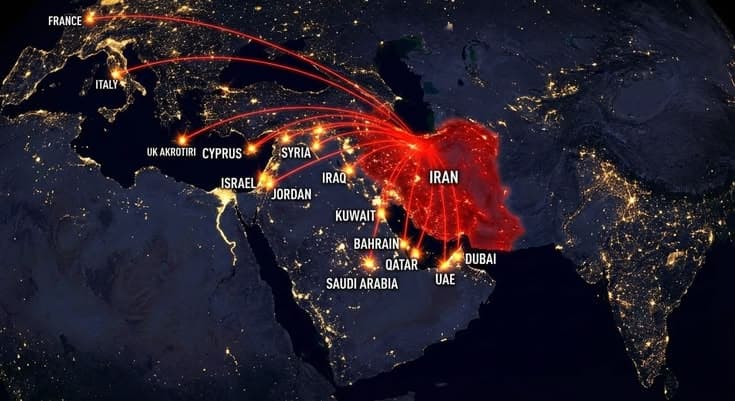
Iran's strategy is: if Israel advances into Lebanon — Iran will activate its targets across the entire Gulf. US bases in Kuwait, oil installations in Saudi Arabia, financial centers in the UAE — these are all Iran's "pressure points" that it uses for leverage. Kuwait is the first target because the US military presence there is the most visible.
Point 5: The Strait of Hormuz — Iran's Ultimate Weapon
The Strait of Hormuz — the narrow sea passage through which 20% of the world's oil supply passes. Iran has threatened that it can impose transit taxes on Hormuz and, if necessary, shut it down. Kuwait's island position — located near Hormuz — could be used for naval surveillance. Iran does not want any power to be present on these Kuwaiti islands that could complicate Hormuz operations.
Iran's "Qeshm Island" and "Kish Island" — which are Iran-controlled islands near Hormuz — are in strategic competition with Kuwait's islands. Iran wants to eliminate Kuwait from this strategic contest.
Part 4: Trump's Power Is Under Threat — Why Did the US Congress Revoke War Authority?
While all this was happening in the Middle East — another drama was unfolding in Washington DC that divided the world's attention.
June 3, 2026: Trump's Historic Defeat in Congress
June 3, 2026 — just 3 days before Iran's attack on Kuwait — a vote took place in the US Congress that may change the course of history. The US Congress revoked Donald Trump's war authority to conduct military operations against Iran.
The vote result: In Trump's favor: 208 votes — Opponents: 215 votes. Trump lost. And this loss is even more significant because 4 lawmakers from Trump's own Republican party voted against him. This was "party defection."
US Secretary of State Marco Rubio issued official notes stating: "The USA's Operation TF-IK Pod against Iran has ended." This was a publicly declared end of a military operation — and it sent a clear signal to Iran that America's capacity for military response has been politically weakened.
US Congress Vote — June 3, 2026: Revoking War Authority
| Detail | Trump's Side | Opponents | Result |
|---|---|---|---|
| Votes | 208 | 215 | Trump LOST |
| Party Defectors | 4 Republicans voted against Trump | All Democrats + 4 Republicans | Party unity broken |
| Operation Ended | Operation TF-IK Pod against Iran | — | Officially declared ended |
| Announcement | — | Sec. of State Marco Rubio | Public announcement signaled Iran |
| Trump's Popularity | Declining — pressure from Jewish lobby | Anti-war sentiment strong | Trump "confused" — pressure from both sides |
Why Is Trump "Confused" — Trapped From Both Sides
Understanding Trump's political situation is important because it directly affects Middle East policy:
- Pressure from the Jewish Lobby: The pro-Israel Jewish lobby provided critical financial and political support to Trump in the 2024 elections. If Trump takes any action against Israel — even indirect — this lobby could withdraw its support. For Trump, this is a matter of "power" itself.
- Iran is targeting the Gulf: Iran is targeting Kuwait and Gulf states — where US bases and US economic interests are located. If Trump does nothing — he will be seen as a "weak president."
- Congress has tied his hands: War authority has been revoked — so Trump now has limited military options.
- Threat of taxes on Hormuz: Iran wants to impose transit taxes on the Strait of Hormuz — which would directly hurt US oil companies and allies. This is also a problem for Trump's business-friendly agenda.
- Anger at Israel's PM: Reports indicate that Trump — who is politically under fire because of Israel — is also angry at Israel's PM Benjamin Netanyahu, saying "because of you, my popularity is falling, my face is in danger."
What Options Does Trump Have Now?
Despite losing in Congress, Trump is not completely powerless:
- Presidential Veto: If Congress passes any war-limiting resolution — Trump can block it using the Presidential Veto, unless it is passed by a 2/3 majority.
- War Powers Act 1973: This 1973 law allows the president to conduct military action for 90 days without Congressional approval. Trump can use this — and then make a deal with Congress.
- Senate: The House of Representatives (Congress) revoked war authority — but the numbers in the Senate are different. Trump can push his agenda through the Senate.
- Executive Orders: The President has executive powers that do not require Congressional approval for certain military and intelligence actions.
Bottom line: Trump is currently like a "confused puppet" — on one side the Jewish lobby and Israel, on the other side Iran and the Gulf crisis, on the third side his defeat in Congress, and on the fourth side the American public that does not want another war.
Part 5: Impact on Oil Markets — What Will Happen to Global Crude Oil in the Kuwait Conflict?
How does the Iran-Israel war affect oil prices? Why do oil prices increase during war? Millions of people are asking these questions. The answer is both simple and complex — simple because war = supply disruption = price increase. Complex because petroleum economics is not limited to supply-demand; geopolitical risk premium, currency movements, and market psychology also play a role.
Oil Price Impact in Different Scenarios of Middle East Conflict
| Scenario | Kuwait Oil Impact | Strait of Hormuz Impact | Expected Brent Crude Price | Impact on Pakistan |
|---|---|---|---|---|
| Limited Iran Targeting (Current) | Minor disruption, 5–10% production drop | Hormuz still open | $85–$95 per barrel (currently ~$80) | Petrol prices could rise 5–8% |
| Major Kuwait Infrastructure Attack | 30–40% Kuwait production halt | High risk, potential closure threats | $110–$130 per barrel | Petrol prices could rise 15–25%, pressure on PKR |
| Partial Closure of Strait of Hormuz | Full Kuwait disruption | 20% of world supply blocked | $150–$200 per barrel | Economic crisis — PKR crash, inflation surge |
| Full Gulf War Scenario | All Gulf producers disrupted | Complete closure possible | $200+ per barrel (higher than 2008 record) | Severe economic crisis — import bill skyrockets |
| Iran-Israel Ceasefire + Diplomatic Solution | Normal production resumes | Open | $70–$80 per barrel | Relief — status quo returns |
Why Do Oil Prices Increase During War? — The Mechanism Explained
There are 5 key reasons why oil prices rise during war:
- Fear of Supply Disruption: Even if actual supply is not disrupted — markets raise prices in "anticipation" of future disruption. Even with the news of the attack on Kuwait, Brent Crude saw an immediate spike.
- Strait of Hormuz Risk Premium: Whenever there is fear of Hormuz closure — a 10–20% premium is added to world oil prices because 20% of world supply passes through it.
- Insurance and Shipping Costs: Insurance for tankers in war zones increases dramatically — this cost is passed on to buyers, further raising oil prices.
- Speculative Trading: Commodity traders and hedge funds buy oil futures during war expecting prices to rise — this speculation itself pushes prices up (self-fulfilling prophecy).
- Dollar Strength and Inverse Relationship: During war, the dollar becomes a safe haven (prices rise) — but there is an inverse relationship with oil (a dollar-denominated commodity). These are complex dynamics that have different effects in different scenarios.
Kuwait's Oil — A Critical Gear in the World Economy
Kuwait produces 2.7 million barrels of oil per day. These are not just crude numbers — they are a direct impact on daily WTI and Brent pricing. Kuwait is a key member of OPEC+ — if Kuwait is disrupted, OPEC+ production quotas are naturally upset. Saudi Arabia may try to compensate — but Saudi Arabia also has its own pressures. Why are oil prices falling now? If a diplomatic solution comes — prices will drop. But as of today — the escalation scenario seems more likely.
Part 6: Why Do Gold Prices Rise During War? — Impact of Geopolitical Tensions on Forex Markets
Why Do Investors Buy Gold During War?
Why do investors buy gold? Why does gold rise during war? This is a question of financial psychology — and the answer lies in centuries of history. Gold is a "safe haven asset" — meaning when the world is uncertain, economies are unstable, currencies are volatile — investors flock to gold. Why?
- Gold has intrinsic value: No government can print gold — its supply is limited. Currencies can be printed, but not gold.
- Gold is an inflation hedge: War causes inflation (expensive oil = everything expensive). Historically, gold has given returns equal to or greater than inflation.
- Gold is not anyone's debt: Holding dollars or euros means trusting a country's economy — gold has no such dependency.
- Historical pattern: The 1990 Gulf War, the 2003 Iraq War, the 2008 financial crisis, the 2022 Ukraine War — every time, gold spiked significantly. The market has memorized this pattern — war = buy gold.
Historical Gold Prices During Major Conflicts
| Conflict / Event | Year | Gold Price Before | Gold Price Peak | % Increase | Duration of Spike |
|---|---|---|---|---|---|
| Gulf War (Kuwait Invasion) | 1990–91 | $350/oz | $410/oz | +17% | 6 months |
| 9/11 Attacks | 2001 | $270/oz | $320/oz | +18% | 3 months |
| Iraq War Start | 2003 | $340/oz | $390/oz | +15% | 4 months |
| Global Financial Crisis | 2008–09 | $700/oz | $1,923/oz | +175% | 3 years |
| Ukraine-Russia War | 2022 | $1,800/oz | $2,050/oz | +14% | 6 months |
| Iran-Israel Escalation 2024 | 2024 | $2,000/oz | $2,400/oz | +20% | Ongoing |
| Kuwait Crisis — June 2026 (Current) | 2026 | ~$2,500/oz (estimated) | $2,700–$3,000+ possible | +8–20% possible | TBD — depends on escalation |
How War Affects Forex Markets — Currency Movements
How does war affect the forex market? How do geopolitical tensions affect currency markets? During war, forex markets perform a complex dance:
Forex Market Reactions During Middle East Conflict
| Currency / Asset | Typical Movement During War | Reason | Pakistan Impact |
|---|---|---|---|
| US Dollar (DXY) | Strong — rises 2–5% | World's reserve currency — "safe haven" status | Pressure on PKR — dollar will become expensive |
| Gold (XAU/USD) | Very Strong — rises 10–25% | Ultimate safe haven — no counterparty risk | Domestic gold prices in Pakistan will rise |
| Swiss Franc (CHF) | Strong — rises 3–7% | Neutral country — traditional safe haven | Pakistani imports from Europe become expensive |
| Japanese Yen (JPY) | Strong — rises 2–5% | Safe haven currency — Japan's current account surplus | Indirect — Pakistan-Japan trade affected |
| Kuwaiti Dinar (KWD) | Under pressure — could fall 3–8% | Direct conflict zone currency | .=Remittances from Pakistani workers in Kuwait affectedIranian Rial (IRR) | Very weak — historic lows possible | Sanctions + war = currency collapse | Iran-Pakistan trade (gas pipeline) affected |
| Pakistani Rupee (PKR) | Weak — falls with oil price hike | Pakistan is a net oil importer — high import bill | Direct — inflation, current account deficit | Oil-linked Currencies (CAD, NOK, RUB) | Strong — rise with oil prices | .=Oil exporting countries benefitPakistan's exports to these countries may increase |
Part 7: Impact on Pakistan — The Middle East Crisis and Our Economy
Pakistan's relationship with the Middle East is not just geographic — it is about economy, remittances, oil imports, and regional security. When something happens in the Gulf — Pakistan is directly or indirectly affected.
Multidimensional Impact of the Middle East Crisis on Pakistan
| Impact Area | Current Status | What Will Happen If War Escalates | Severity |
|---|---|---|---|
| Oil Import Bill | Pakistan imports ~$15B+ oil per year} | If oil reaches $100+, import bill could become $20–25B+} | 🔴 Very High} |
| Remittances (Kuwait, Saudi, UAE)} | ~$5–7B annually from the Gulf} | In the Kuwait crisis, worker safety and remittances could drop} | 🔴 High} |
| PKR Value} | Already under pressure} | Oil price surge = import pressure = PKR weakens further} | 🔴 High} |
| Inflation} | Double-digit inflation} | Oil + transport + food prices cascade — inflation could rise} | 🔴 High} |
| Pakistani Workers in Kuwait} | ~90,000+ Pakistani workers} | .=Safety concerns, potential evacuation needed}🟠 Medium-High} | |
| Iran-Pakistan Gas Pipeline} | Under development, sanctioned} | Further complications if Iran-US tensions escalate} | 🟠 Medium} |
| Gold Prices (Pakistan Domestic)} | Already high} | International gold spike = gold becomes even more expensive in Pakistan} | 🟡 Medium} |
What Should Pakistan Do?
This article does not give financial advice — but from a policy perspective, analysts discuss these points:
- Build up oil reserves: Pakistan should maintain strategic petroleum reserves — a 60–90 day buffer is essential during a crisis.
- Secure remittance channels: Diplomatic security for Gulf workers and remittance channels should be Pakistan's priority.
- Diplomatic neutrality: For Pakistan, neutrality in the Gulf crisis is the best policy — just as neutrality was sought during the Afghanistan war. Taking sides could be costly.
- Domestic energy policy: This crisis once again highlights the need for investment in renewable energy and domestic gas production.
Part 8: Geopolitical Analysis — What Next? 4 Possible Scenarios
Middle East Crisis — 4 Possible Scenarios and Their Impact
| Scenario | Probability (Estimated) | Iran's Role | USA's Role | Oil Price | Gold Price | Pakistan Impact |
|---|---|---|---|---|---|---|
| Scenario 1: Diplomatic De-escalation Ceasefire through US-Qatar mediation |
25%} | Pulls back after symbolic strikes} | Mediates via Qatar/Oman} | $75–85} | $2,400–2,600} | Manageable — moderate pressure} | Scenario 2: Controlled Escalation Iran continues limited strikes, no full war} |
40%} | Targeted strikes on Gulf assets} | Defensive posture only} | $90–110} | $2,700–3,000} | Significant — inflation + PKR pressure} |
| Scenario 3: Regional War Israel hits Iran, Iran hits Gulf, USA involved} |
25%} | Full Gulf targeting + Hezbollah activation} | Military intervention} | $130–170} | $3,000–3,500} | Severe — energy crisis, evacuation of workers} |
| Scenario 4: Hormuz Closure Iran blocks Strait of Hormuz} |
10%} | Hormuz blocked — ultimate weapon} | Naval intervention — WWIII risk} | $200+} | $4,000+} | Crisis — economic catastrophe possible} |
The Buffer State Dilemma — Kuwait in 2026
In 1990-91, Kuwait was a buffer state between the USA and Russia on the last front of the Cold War. Today, in 2026, Kuwait is once again a buffer state — this time between the Iran and the USA-Israel axis. The difference is that this time:
- Russia is once again an active player — emboldened after the Ukraine war
- China defends its interests in the Gulf — Pakistan-China Economic Corridor (CPEC) connectivity with the Gulf is important
- Turkey is playing its own role — there is tension between Turkey, Iran, and Iraq on the Kurdish question
- India is also dependent on Gulf oil — but in this situation, India's position is hedged
A small country like Kuwait — between three superpowers — this is the "buffer state dilemma" for which there is no easy solution.
The Kurdish Question — Another Layer
The Kurdish nation is still spread across Iraq, Turkey, Iran, and Syria — with dreams of their own separate country. This issue adds another layer to any conflict in the Middle East. Israel's plan — as some regional analysts discuss — is to contain Iran through a Kurdish state. But this plan also affects Turkey, which has always been sensitive about its Kurdish population. Syria's new government which is US-aligned but against the Kurds — this is another paradox that makes regional politics even more complicated.
Frequently Asked Questions — Middle East Crisis, Oil, Gold & Pakistan
Why did Iran target Kuwait in June 2026?
Iran targeted Kuwait for 5 reasons: (1) Kuwait's historical pattern — it has always supported Iran's rival; (2) Kuwait's 7% of world oil reserves and $700B+ wealth — which are used against Iran's geopolitical objectives; (3) Strategic control over the Strait of Hormuz — Kuwait's islands challenge Iran's dominance over Hormuz; (4) US military presence in Kuwait — which is a direct threat to Iran; (5) Renewed Iran-Israel tensions and Trump's weakened domestic position — which have made Iran bolder.
Why did Saddam Hussein attack Kuwait?
Saddam Hussein attacked Kuwait in August 1990 for 3 reasons: (1) Kuwait refused to forgive the $14B+ debt from the 8-year Iran-Iraq War (1980–88); (2) Kuwait was extracting oil from Iraq's Rumaila oil field using horizontal drilling — which Saddam considered "oil theft"; (3) Kuwait was exceeding OPEC quotas, driving oil prices down, further harming Iraq's already weak budget. These three economic grievances together attempted to justify a devastating military invasion — which ultimately led to the Gulf War and Saddam's own destruction.
Why do oil prices rise during Middle East conflict?
Oil prices rise during Middle East conflict for 5 reasons: (1) Fear of supply disruption — markets anticipate future disruption even if actual supply is not cut; (2) Risk of Strait of Hormuz closure — 20% of world supply passes through it; (3) Increased insurance and shipping costs — war zone tankers become expensive; (4) Speculative trading — commodity markets buy oil futures during war; (5) Geopolitical risk premium — an "extra charge" for uncertainty is added to the price of oil. Kuwait's 7% of world reserves and 2.7M barrel/day production make the Kuwait conflict particularly heavy on global prices.
Why did the US Congress revoke Trump's war authority?
On June 3, 2026, the US Congress revoked Trump's war authority against Iran by a vote of 215 vs 208 — with 4 lawmakers from Trump's own Republican party voting against him. Reasons: increased anti-war sentiment, declining Trump popularity (due to the Israel-Palestine issue and domestic economic pressure), and constitutional debate about presidential war powers. Secretary of State Marco Rubio officially announced the end of Operation TF-IK Pod against Iran. However, Trump still has options through Presidential Veto, the War Powers Act of 1973 (90 days), and the Senate route.
What will be the impact of the Middle East crisis on Pakistan?
The Middle East crisis will have multidimensional effects on Pakistan: (1) The oil import bill could rise — if oil reaches $100+, Pakistan's annual import bill could increase by $5B+; (2) ~90,000+ Pakistani workers are in Kuwait — their safety and remittances are both at risk; (3) Pressure on PKR — oil price hike = import bill increase = further weakening of PKR; (4) Inflation cascade — expensive oil = expensive transport, food, manufacturing; (5) $5–7B annual remittances from the Gulf — if the Gulf destabilizes, this will directly hurt Pakistan's economy. Pakistan's best policy is diplomatic neutrality — taking sides could be very costly.
Conclusion: History Repeats Itself — And This Time the Stakes Are Higher
What is happening today on June 6, 2026, is a new chapter in history — but its characters and plot lines are old. The Iran-Kuwait conflict is a new episode of the same "buffer state dilemma" that began in 1990 with Saddam Hussein. Saddam had also targeted Kuwait because Kuwait supported his rival superpower (the USA) — and today Iran is operating on exactly the same logic.
The difference is that this time, there are some new variables in the equation: Trump's weakened domestic position, the US Congress revoking war authority, Iran's threat to weaponize the Strait of Hormuz, the intersection of the Kurdish question with Syria and Turkey, and a more multipolar world where Russia, China, and Turkey are also active players.
Oil markets, gold, and forex are reflecting — and will continue to reflect — all this uncertainty in their prices. For Pakistan — a net oil importer with hundreds of thousands of workers in the Gulf — this crisis is not just news; it is a reality that will directly affect the economy.
When Saddam left in 1990, he set fire to more than 700 of Kuwait's oil wells — and said: "If it's not mine, it won't be anyone's." Today, Iran's regional strategy also operates on a similar philosophy. But the world of 2026 is very different from 1990 — and this time, a "Gulf War" cannot be easily repeated.
Keep an eye on this news — this is not just a regional conflict, it is a direct test of global energy, currencies, and geopolitical balance. Follow our blog for updates.
Note: The geopolitical analysis, oil price scenarios, and economic projections given in this article are for educational and informational purposes only. Consult a qualified financial advisor before making any investment or financial decision. Geopolitical situations change rapidly — circumstances may change after the publication of this article.