Why Hair Turns White or Gray: The Science of Melanocytes, Stress, and Nutrient Deficiency
Somewhere deep inside every hair follicle on your scalp, a tiny population of cells is quietly deciding whether your next strand of hair will grow in black, brown, golden, gray, or pure white. Most people assume graying hair is simply "aging" and leave it at that — but the real story involves genetics, a specific type of stem cell, a color-producing enzyme that depends on a trace mineral, and even a documented biological pathway linking stress directly to hair color loss. This guide breaks down exactly why hair turns white or gray, which causes are reversible and which are permanent, and what the science actually says about nutrition, stress, and smoking's role in this process.
By the end of this guide, you will understand not just the four broad categories behind gray hair, but the precise chemical pathway your body uses to manufacture hair pigment in the first place, the exact mineral and vitamins that pathway depends on, and the surprisingly specific nerve-and-hormone mechanism that connects a stressful chapter of life to a head full of gray strands years later.
1. Introduction: Why Does Hair Turn White or Gray?
Hair turning white or gray is one of the most universal signs of aging, yet very few people understand what is actually happening at the cellular level when it occurs. The short answer is that hair color depends entirely on a pigment called melanin, produced by specialized cells living at the very root of each hair follicle. When those cells slow down, run out, or stop functioning properly, the hair that grows out loses its color — resulting in gray or, eventually, completely white strands. What makes this topic genuinely interesting is that not every cause of graying is the same: some causes are permanently written into your biology from birth, while others — surprisingly — can potentially be corrected if caught early enough.
2. Hair Anatomy 101: The Follicle and the Shaft
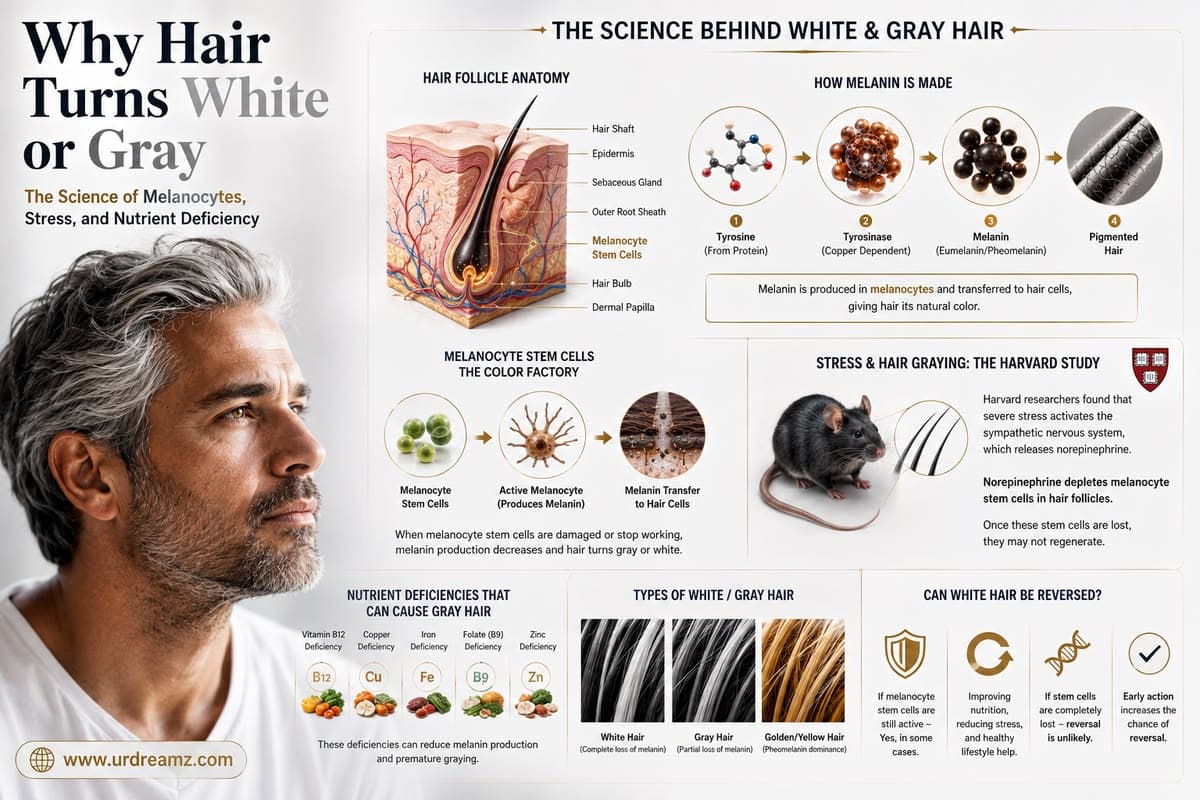
To understand why hair changes color, it helps to understand its basic structure. Every strand of hair has two main parts: the follicle, a small pocket-like structure embedded beneath the skin's surface where the hair actually originates and grows, and the shaft, the visible portion of hair that extends above the skin. All of the biological activity responsible for hair color, texture, and growth happens down in the follicle — by the time hair emerges as visible shaft, it is already essentially a dead, keratinized structure with its color already determined.
This is an important distinction because it explains why no topical product applied directly to the visible hair shaft can meaningfully restore natural pigment — hair dye can coat the outside of the shaft to change its apparent color, but it cannot reactivate a depleted melanocyte population, because the shaft itself contains no living cells capable of responding to any treatment. Any genuine biological intervention aimed at restoring natural hair color has to reach the follicle, and specifically the melanocyte stem cell population living within it, which is precisely why addressing nutrient deficiencies works through diet and blood supply rather than through anything applied directly to the hair itself.
3. Where Hair Color Is Actually Decided
Hair color is not decided somewhere along the visible shaft — it is determined entirely down at the root, inside the follicle, before the strand ever grows out and becomes visible. This is an important concept, because it means that by the time you see a gray or white hair on your head, the biological process that caused it happened days or weeks earlier, deep beneath the skin's surface, completely out of sight.
This delay between cause and visible effect is part of why it can be genuinely difficult to pinpoint exactly what triggered a particular gray hair. A stressful event, an illness, or a period of poor nutrition experienced weeks or even months earlier may only become visible as gray hair much later, once that particular follicle has cycled through and produced a new strand under the changed biological conditions. This lag is also why efforts to correct a nutrient deficiency or reduce stress do not produce instantly visible results — any improvement will only become apparent in hair that has not yet grown, not in strands that have already emerged from the scalp.
4. Meet the Melanocyte: The Cell That Colors Your Hair
Down at the base of every hair follicle live specialized pigment-producing cells called melanocytes. These cells are responsible for producing and depositing the pigment that gives hair its characteristic color — whether black, brown, red, or golden blonde. Melanocytes work in what is sometimes called the "melanin unit," continuously supplying pigment to the growing hair shaft as it forms, cycle after cycle, for as long as those melanocytes remain active and healthy.
Hair does not grow continuously forever from a single, unchanging melanocyte population — instead, each follicle cycles repeatedly through distinct growth phases over a person's lifetime, commonly described as the growth phase (anagen), a short transitional phase (catagen), and a resting phase (telogen), before the cycle begins again with new hair growth. Melanocyte activity is closely tied to this cycle, becoming most active during the early growth phase, when pigment is actively deposited into the newly forming hair shaft. This cyclical nature is part of why hair color can gradually shift over years, rather than all turning gray or white simultaneously — different follicles across the scalp are often at different points in their own individual growth cycles at any given time.
5. What Is Melanin?
Melanin is the pigment responsible for coloring not just hair, but also skin and the iris of the eyes. It is produced inside melanocytes and then transferred into the growing hair shaft, where it becomes permanently embedded as the hair grows outward. The amount and specific type of melanin present determines the exact shade of hair color a person has — more melanin generally produces darker hair, while less melanin produces lighter shades, and the complete absence of melanin results in hair that appears gray or white.
6. Eumelanin vs Pheomelanin: Two Types of Melanin
Not all melanin is identical — there are two primary types that determine the specific range of natural hair color a person has. Eumelanin is a darker pigment, more commonly dominant in people of Asian, African, and Middle Eastern descent, producing black and dark brown hair tones. Pheomelanin is a lighter, more reddish-yellow pigment, more commonly dominant among many people of European descent, contributing to blonde, golden, and red hair tones. Most people actually produce a combination of both pigments, with the ratio between them shaping their unique natural hair color.
Interestingly, both pigment types are produced through the same underlying tyrosinase enzyme pathway described later in this article — the difference between eumelanin and pheomelanin arises from subtle variations further along the chemical pathway, along with genetic differences in specific pigment-related genes that influence which of the two pigment types a person's melanocytes are predisposed to produce in greater quantity. This shared starting pathway is also why copper, the essential mineral cofactor for tyrosinase, remains relevant to hair color across all ethnic backgrounds and natural hair colors, not just to people with naturally dark hair.
| Melanin Type | Color Produced | More Commonly Dominant In |
|---|---|---|
| Eumelanin | Black, dark brown | Asian, African, Middle Eastern populations |
| Pheomelanin | Blonde, golden, red | Many European populations |
7. The Bulge Region and Melanocyte Stem Cells (MeSCs)
The mature, pigment-producing melanocytes found at the very base of a hair follicle do not last forever on their own — they are continuously replenished from a reserve population of cells located slightly higher up in the follicle, in a region called the bulge. Living in this bulge region are Melanocyte Stem Cells (MeSCs) — essentially "mother cells" that serve as the ongoing source of new pigment-producing melanocytes for the rest of a person's life. As long as this stem cell reserve remains healthy and active, the hair follicle can continue producing fresh, pigment-generating melanocytes cycle after cycle.
8. From Stem Cell to Differentiated Melanocyte: The Migration Journey
With each new hair growth cycle, a portion of the melanocyte stem cells housed in the bulge region divide and produce daughter cells. These daughter cells then migrate downward, traveling from the bulge all the way to the base of the follicle, known as the hair bulb. Upon reaching this destination, they mature into fully functional, pigment-producing cells called differentiated melanocytes. It is only these fully matured, migrated cells that actually manufacture and deposit melanin into the growing hair shaft — the stem cells themselves, still sitting up in the bulge, do not directly produce pigment.
This division of labor between the stem cells that remain in reserve and the differentiated cells that actually do the work of pigment production is a common design pattern seen throughout the body's stem cell systems, not just in hair follicles. It allows the body to maintain a protected, slowly renewing reserve population insulated from the wear and tear of daily activity, while still generating enough active, working cells to meet ongoing functional demand. In the case of hair, this arrangement allows a single follicle to produce many, many cycles of pigmented hair growth across a person's lifetime, drawing down the stem cell reserve gradually rather than exhausting it all at once under normal circumstances.
9. What Happens When Melanocyte Stem Cells Run Out
If the reserve population of melanocyte stem cells in the bulge becomes depleted — whether through natural aging, oxidative damage, or stress-related mechanisms — fewer daughter cells are available to migrate down and mature into pigment-producing melanocytes with each hair growth cycle. As an illustrative example, if a follicle once had enough active melanocytes to fully pigment 100% of a growing hair strand, but the stem cell supply has dropped enough that only about 20% of the previous melanocyte activity remains, the resulting hair will grow in visibly lighter, gray, or eventually completely white, depending on just how depleted that stem cell reserve has become.
This gradual, proportional relationship between remaining stem cell activity and visible hair color also explains why hair graying is so often a progressive, incremental process rather than a sudden switch from fully pigmented to fully white. A single strand might first emerge as a lighter shade of brown, then progress to a visibly gray tone in a later growth cycle, and only eventually appear as pure white once the local melanocyte stem cell supply for that specific follicle has been almost entirely exhausted. Because every individual follicle on the scalp has its own independent stem cell reserve, this also explains why gray and white hairs typically appear scattered among still-pigmented strands for years, rather than all follicles losing their color in perfect unison.
10. The Four Main Causes of Gray and White Hair
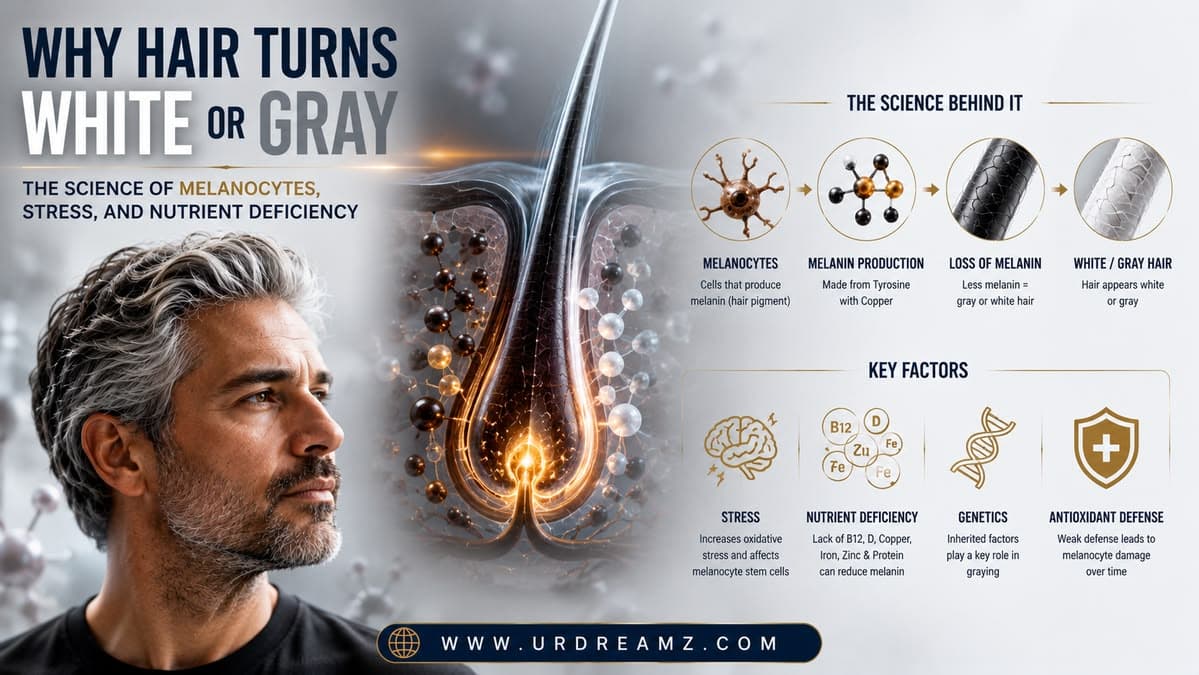
While many factors can influence hair color over a lifetime, they generally fall into four broad categories: genetics, natural aging, oxidative stress, and nutrient deficiency. Understanding which of these categories applies to a given individual is key to understanding whether their gray or white hair might respond to changes in diet or lifestyle, or whether it is simply a fixed biological reality.
| Cause | Reversible? |
|---|---|
| Genetics | No |
| Natural Aging | No |
| Oxidative Stress | Generally no (largely permanent cellular damage) |
| Nutrient Deficiency | Potentially yes, if corrected early |
11. Reversible vs Irreversible Causes: What You Need to Know
Of the four major causes described above, only nutrient deficiency offers a realistic possibility of reversing gray or white hair back to its natural color, and even then, only if the deficiency is identified and corrected before the melanocyte stem cell population has been permanently depleted or the associated follicle damage has become too extensive. If genetics, natural aging, or long-term oxidative stress are the primary drivers behind someone's gray or white hair, that hair is very unlikely to ever turn black again, regardless of dietary or lifestyle changes made afterward.
12. Cause 1: Genetics
Genetics is one of the most significant and unavoidable factors determining when — and sometimes whether — a person's hair turns gray or white. If a person's parents experienced early graying, there is a meaningfully higher likelihood that their children will experience a similar pattern and timeline, since the genes controlling melanocyte stem cell longevity and function are inherited. This is precisely why some individuals notice gray hairs appearing in their twenties, while others remain fully pigmented well into their fifties or sixties — much of this variation is written into a person's genetic code from birth.
13. Cause 2: Natural Aging
As the human body ages, countless biological systems gradually change, and the hair follicle is no exception. With advancing age, the population of melanocyte stem cells housed in the bulge region naturally declines in quantity over time — a normal, expected part of the aging process rather than a disease or disorder. As this stem cell reserve diminishes, fewer differentiated melanocytes are available to pigment each new hair growth cycle, eventually resulting in gray and then white hair as a natural consequence of getting older.
14. Cause 3: Oxidative Stress
Even when melanocyte stem cells in the hair follicle are otherwise healthy and functioning, they can still be damaged by a phenomenon called oxidative stress. Certain reactive chemical compounds, generated naturally within the follicle environment, can accumulate and actively attack the cellular machinery responsible for normal stem cell growth and function. In some cases, this oxidative damage becomes severe enough to kill the affected cells outright, permanently reducing the follicle's capacity to produce pigment in future growth cycles. Because this kind of cellular damage is generally not repairable, oxidative stress tends to be one of the more permanent contributors to gray and white hair.
15. Cause 4: Nutrient Deficiency
For some individuals, gray or white hair is not primarily driven by genetics, aging, or oxidative damage, but rather by a deficiency in specific nutrients essential to the melanin production process. This is genuinely good news for anyone affected, because unlike the other three major causes, nutrient-related graying can often be addressed — and in some cases even reversed — once the underlying deficiency is identified and corrected through diet or supplementation, provided the condition is caught before permanent follicle damage sets in.
16. How Melanin Is Actually Made: The Tyrosine Pathway
Melanin production inside a melanocyte follows a specific, well-defined biochemical pathway. It begins with an amino acid called tyrosine, which is converted into a compound called DOPA (dihydroxyphenylalanine), which is then further converted into dopaquinone. Through several additional chemical reaction steps, dopaquinone is ultimately transformed into the final pigment product: melanin. This entire multi-step conversion process does not happen spontaneously — it requires a specific enzyme to drive each chemical transformation forward.
17. Tyrosinase: The Enzyme That Makes It All Happen
The enzyme responsible for driving the tyrosine-to-melanin conversion pathway is called tyrosinase. Tyrosinase acts as the rate-limiting catalyst for the entire melanin synthesis process — without sufficient functional tyrosinase activity, the conversion from tyrosine through DOPA and dopaquinone into final melanin pigment simply cannot proceed efficiently, regardless of how much raw tyrosine is available in the cell.
This is a useful concept to understand because it explains why simply eating more protein, or consuming more tyrosine-rich foods on their own, does not automatically translate into darker hair. Tyrosine is genuinely important as the starting raw material, but the entire pathway is bottlenecked by the availability and activity of the tyrosinase enzyme itself. In other words, having plenty of raw material sitting in a factory does not help if the machine responsible for processing that material is not running at full capacity — and that machine, in this case, depends entirely on having enough of a specific mineral cofactor available.
18. Copper's Critical Role as a Cofactor
Crucially, tyrosinase cannot function on its own — it requires a specific mineral cofactor to become biologically active, and that cofactor is copper. Tyrosinase is classified as a copper-dependent enzyme, meaning its molecular structure includes copper ions that are essential to its catalytic activity. If the body has insufficient copper available, tyrosinase cannot function properly, regardless of how much tyrosine or how many healthy melanocytes are present — effectively bottlenecking the entire melanin production pathway at this single mineral. This is precisely why chronic copper deficiency has been linked to premature graying in some individuals, and why ensuring adequate dietary copper intake is considered relevant to supporting healthy hair pigmentation.
It is worth noting that copper deficiency severe enough to visibly affect hair color is relatively uncommon in people eating a varied diet, since copper requirements are comparatively small and the mineral is present in many everyday foods. However, certain groups face a genuinely elevated risk, including people with malabsorption conditions affecting the digestive tract, those who have undergone certain types of weight-loss surgery, and individuals consuming extremely restrictive or unbalanced diets over long periods. In these higher-risk groups, a simple blood test can confirm whether copper levels are truly low, helping distinguish a correctable nutritional cause from the more permanent causes of graying discussed elsewhere in this article.
19. Vitamin B12 and Its Role in Hair Pigmentation
Vitamin B12 plays a very different, though equally important, role in hair pigmentation compared to copper. Rather than being directly involved in the melanin synthesis pathway itself, vitamin B12 is essential for cell division throughout the body — and the cells inside a hair follicle happen to be among the most rapidly dividing cells anywhere in the human body, cycling and multiplying at a remarkably fast pace to sustain continuous hair growth. When vitamin B12 levels are insufficient, this rapid cell division process slows down, which in turn can reduce the rate at which melanocytes migrate from the bulge stem cell reserve down to the hair bulb. With fewer melanocytes successfully completing this migration and maturation process, less melanin is deposited into the growing hair shaft, resulting in gray or white hair.
Vitamin B12 deficiency is particularly relevant for people following strict vegetarian or vegan diets, since B12 is found almost exclusively in animal-derived foods, and it can also become a concern in older adults, whose ability to absorb B12 from food can decline with age due to reduced production of a stomach protein called intrinsic factor, which is required for B12 absorption in the small intestine. In these cases, premature graying is sometimes one of several early clues — alongside fatigue, pale skin, and mild memory or concentration issues — that prompt a doctor to check B12 levels through a simple blood test.
| Nutrient | Primary Role in Hair Pigmentation/Growth | Groups at Higher Deficiency Risk |
|---|---|---|
| Copper | Cofactor for tyrosinase; directly enables melanin synthesis | People with malabsorption conditions or very restrictive diets |
| Vitamin B12 | Supports rapid cell division needed for melanocyte migration | Vegetarians, vegans, older adults |
| Vitamin D | Supports hair growth cycle via VDR signaling; not directly linked to pigment | People with limited sun exposure, certain skin tones, older adults |
20. Vitamin D and Hair Growth: A Different Mechanism
Unlike copper and vitamin B12, vitamin D does not appear to play a direct role in determining hair color or pigmentation. Instead, vitamin D's primary relevance to hair health lies in preventing hair loss rather than preventing graying. This is an important distinction, since vitamin D deficiency and copper or B12 deficiency can produce very different visible symptoms in the hair, even though all three nutrients are broadly relevant to overall hair health.
21. Understanding the Vitamin D Receptor (VDR) in Hair Follicles
Hair follicles contain specialized docking sites called Vitamin D Receptors (VDR), embedded directly within the follicle structure. When vitamin D circulating in the bloodstream reaches the hair follicle, it binds to these VDR docking sites, and this binding event triggers important cell-signaling activity that helps maintain and sustain the normal hair growth cycle. When vitamin D levels are insufficient, this signaling pathway is disrupted, and the normal hair growth cycle is negatively affected — this is the underlying reason why vitamin D deficiency is strongly associated with hair thinning and hair loss, rather than with graying specifically.
22. Smoking and Premature Graying
Cigarette smoking has been identified as a significant contributing factor to premature hair graying. Each time a cigarette is smoked, more than 7,000 distinct chemical compounds are inhaled into the lungs, from where a substantial number of these chemicals are absorbed directly into the bloodstream. Once circulating in the blood, some of these harmful compounds eventually reach the hair follicles throughout the scalp, where they can interfere with the normal function of the melanin production system.
Beyond the direct chemical exposure described in the following section, smoking also creates a broader burden of oxidative stress throughout the body, since many of the compounds inhaled in cigarette smoke are known to generate reactive molecules that damage cells on contact. Because hair follicles, and the melanocyte stem cells within them, are just one of many tissues exposed to this circulating oxidative burden, long-term smokers often show a compounding effect — both the direct chemical disruption of melanocyte migration and the general accumulation of oxidative cellular damage contribute together, which is one reason premature graying is so consistently and strongly associated with smoking history in observational studies.
23. How Cigarette Chemicals Reach the Hair Follicle
When blood carrying cigarette-derived chemicals reaches the base of a hair follicle, some of these compounds leak out of the bloodstream and directly affect the local cellular environment surrounding the melanocyte stem cells. This chemical exposure can disrupt or actively halt the normal migration process by which melanocyte stem cells travel from the bulge region down to the hair bulb, creating localized cellular stress at the follicle level. Over time, repeated exposure to these harmful compounds through continued smoking can meaningfully accelerate the rate at which hair turns gray or white, well ahead of what genetics or age alone would typically produce.
24. Stress and Gray Hair: Debunking the Cortisol Myth
It is a widely repeated belief that stress causes gray hair primarily through elevated cortisol — the body's main stress hormone, which does indeed rise during periods of anxiety and depression. However, current research suggests that cortisol itself plays a comparatively minor direct role in this specific process. The far more significant mechanism linking psychological stress to hair graying involves a completely different biological pathway: the body's sympathetic nervous system.
25. Sympathetic Nerve Fibers and the Real Stress Pathway
Embedded directly beneath the base of each hair follicle are specialized nerve endings called sympathetic nerve fibers, part of the body's broader sympathetic nervous system — the same system responsible for the body's classic "fight or flight" stress response. These nerve fibers remain relatively quiet during calm, low-stress periods, but become highly active during periods of psychological stress, anxiety, or fear, directly wrapping around and interacting with the melanocyte stem cell population housed in the nearby bulge region.
26. Noradrenaline: The Chemical Messenger Behind Stress-Induced Graying
When these sympathetic nerve fibers become activated during periods of stress, they release a chemical signaling molecule called noradrenaline directly into the local environment surrounding the melanocyte stem cells. This noradrenaline signal essentially instructs the melanocyte stem cells to activate and begin migrating out of the bulge reserve all at once — a process that, under normal, non-stressful conditions, would happen much more gradually and in a controlled, sustainable manner across many hair growth cycles over a person's lifetime.
This mass, premature activation is the central problem with the stress-driven pathway: rather than the bulge releasing a small, sustainable number of new melanocytes with each individual hair growth cycle, a large portion of the entire stem cell reserve can be triggered to activate and migrate out essentially all at once. Once these cells have left the bulge and matured into differentiated melanocytes at the hair bulb, that specific portion of the stem cell reserve is gone — it cannot be replenished, since new melanocyte stem cells are not manufactured from scratch elsewhere in the body. This is precisely why the sympathetic-nerve-and-noradrenaline pathway is now understood as such a direct, mechanistic route from psychological stress to genuinely permanent hair graying.
27. The Harvard Mouse Study on Stress and Hair Color
This specific stress-to-graying pathway was documented through research conducted at Harvard University, using mice as the experimental model. Researchers found that when mice were exposed to significant stress, the sympathetic nerve fibers surrounding their hair follicles released noradrenaline, which triggered a rapid, premature activation and depletion of the melanocyte stem cell reserve. Because this stem cell reserve could not be replenished once fully exhausted, the affected mice experienced permanent hair graying as a direct, demonstrable consequence of the stress exposure — providing strong scientific evidence for a genuine, mechanistic link between psychological stress and hair color loss, distinct from the previously assumed cortisol-based explanation.
What made this research particularly compelling to the broader scientific community was the researchers' ability to isolate the specific mechanism responsible, rather than simply observing a general correlation between stress and graying. By selectively blocking different stress-response pathways in separate groups of mice, the research team was able to demonstrate that removing the sympathetic nerve signal specifically prevented the stress-induced graying, while interventions targeting cortisol alone did not produce the same protective effect. This kind of mechanistic evidence, isolating one specific biological pathway as the true driver, is considered a much stronger form of scientific proof than simple observational association, and it is part of why this noradrenaline-based explanation has become widely accepted as the primary biological link between stress and hair graying.
28. Why Stem Cell Depletion From Stress Is Often Permanent
The melanocyte stem cell reserve housed in the bulge region is a strictly limited resource — unlike some other stem cell populations in the body, it does not appear to regenerate indefinitely once significantly depleted. When chronic stress triggers repeated bursts of noradrenaline-driven activation over an extended period — typically described as unfolding over roughly two to three years of sustained stress exposure — the stem cell reserve can become progressively exhausted faster than it would through normal aging alone. Once this reserve has been sufficiently depleted through this accelerated, stress-driven mechanism, the resulting gray or white hair is generally considered permanent, since there is no remaining source of new melanocytes to restore pigmentation in that particular follicle.
29. At What Age Does Hair Normally Start Graying?
While there is considerable individual and genetic variation, hair graying commonly begins to appear at different average ages depending on ethnic background and genetic predisposition. Many people of European descent tend to notice their first gray hairs in their mid-to-late thirties, while many people of Asian descent often notice graying beginning slightly later, commonly in their late thirties to early forties, and people of African descent frequently experience noticeably later onset, often not until their mid-forties or later. These are general population trends rather than fixed rules, and individual genetics can cause significant deviation in either direction from these averages.
| Population Group | Commonly Reported Average Onset |
|---|---|
| European descent | Mid-to-late 30s |
| Asian descent | Late 30s to early 40s |
| African descent | Mid-40s or later |
Graying that begins noticeably earlier than these general averages — sometimes referred to as premature graying when it starts before age 20 in people of European descent, before 25 in people of Asian descent, or before 30 in people of African descent — is more likely to be linked to one of the additional factors discussed throughout this article, such as genetics running unusually strong in a particular family line, chronic stress, smoking, or an underlying nutrient deficiency, rather than being purely a reflection of typical age-related change.
30. Can Gray or White Hair Turn Black Again?
This is one of the most common questions people have, and the honest answer depends entirely on the underlying cause. If gray or white hair is primarily the result of a correctable nutrient deficiency — such as insufficient copper or vitamin B12 — and the deficiency is identified and corrected before the melanocyte stem cell reserve has been permanently exhausted, there is a genuine possibility that subsequently grown hair could return to its natural pigmented color, since the underlying melanocyte machinery may still be intact and simply lacking the raw materials it needs. However, if the graying is primarily driven by genetics, natural aging, oxidative stress, or long-term stress-induced stem cell depletion, the affected hair follicles are very unlikely to ever produce pigmented hair again, since the melanocyte stem cell source itself has been permanently lost.
There have been occasional documented case reports and anecdotal accounts describing individuals whose gray hair appeared to darken again after a significant reduction in stress, such as following a stressful life event resolving or a period of extended rest and recovery. While these cases are genuinely interesting and consistent with the underlying biology described in this article, it is important to understand that they appear to represent the exception rather than the rule, and are most plausible in situations where the underlying stem cell reserve was only temporarily suppressed rather than permanently exhausted. As a general rule, the earlier any underlying issue is identified and addressed, the better the odds of preserving or restoring natural pigmentation in future hair growth.
31. Foods High in Copper
Since copper is an essential cofactor for the tyrosinase enzyme that drives melanin production, ensuring adequate dietary copper intake is a reasonable, evidence-informed step for anyone concerned about nutrient-related premature graying.
| Copper-Rich Food |
|---|
| Beef liver |
| Shellfish |
| Cashews and almonds |
| Cocoa and dark chocolate |
| Lentils and chickpeas |
| Sesame and pumpkin seeds |
| Whole grains |
| Mushrooms |
32. Foods High in Vitamin B12
Because vitamin B12 is essential for the rapid cell division that supports melanocyte migration, maintaining adequate B12 intake is particularly important for individuals following restrictive diets, since B12 is found almost exclusively in animal-derived foods.
| Vitamin B12 Source | Additional Benefit |
|---|---|
| Liver | Supports red blood cell formation |
| Fish (salmon, tuna, sardines) | Supports brain and nerve function |
| Red meat (beef, mutton) | Boosts energy levels |
| Eggs | Supports immune system |
| Chicken | General B12 source |
| Milk and dairy (milk, cheese, yogurt) | General B12 source |
| Fortified cereals | Useful for vegetarians |
| Tofu | Plant-based fortified source |
| Shellfish (clams, mussels, oysters) | Very high B12 content |
| Nutritional yeast | Plant-based fortified source |
33. Foods High in Vitamin D
While vitamin D's role relates more directly to preventing hair loss than to preventing graying specifically, it remains an important part of overall hair follicle health and should not be overlooked when building a hair-supportive diet.
| Vitamin D-Rich Food |
|---|
| Salmon |
| Mackerel |
| Tuna fish |
| Cod liver oil |
| Egg yolks |
| Mushrooms |
| Milk |
| Yogurt |
| Cheese |
| Soy milk |
| Almond milk |
| Fortified cereals |
| Beef |
| Pork |
| Fortified orange juice |
Sunlight exposure also remains one of the most significant natural sources of vitamin D production in the body, and should be considered alongside dietary sources as part of an overall strategy to maintain healthy vitamin D levels.
34. Building a Hair-Healthy Diet
Rather than focusing on a single nutrient in isolation, the most effective approach to supporting healthy hair pigmentation and growth involves building an overall balanced diet that consistently includes sources of copper, vitamin B12, and vitamin D, alongside general good nutrition and hydration. For individuals following vegetarian or vegan diets, particular attention should be paid to vitamin B12 intake, since natural dietary sources are almost exclusively animal-derived, making fortified foods or supplementation especially important in these cases.
It is also worth remembering that because hair growth and pigmentation reflect gradual, cyclical biological processes, dietary improvements do not produce overnight results. Just as a single stressful week is unlikely to cause noticeable graying, a single well-balanced meal is equally unlikely to reverse it. Meaningful change, when it is possible at all, typically requires sustained improvement in nutrient intake over a period of months, giving the hair follicle enough growth cycles to reflect the corrected nutritional environment in newly produced hair. Patience, combined with consistency, is therefore just as important as identifying the right nutrients in the first place.
35. When Should You See a Doctor?
While a certain amount of gray hair is a completely normal part of aging and typically requires no medical attention, sudden, rapid, or unusually early graying — particularly in younger individuals, or graying accompanied by other symptoms such as fatigue, hair thinning, or changes in skin or nail health — can sometimes signal an underlying nutrient deficiency or other health condition worth investigating. In such cases, consulting a doctor for blood tests to check copper, vitamin B12, and vitamin D levels, among other relevant markers, is a reasonable and often clarifying step before assuming the graying is simply age-related.
A doctor may also consider checking thyroid function as part of this evaluation, since certain thyroid conditions have separately been associated with changes in hair color and texture, alongside more common symptoms like fatigue, weight changes, or temperature sensitivity. Because so many of the visible signs of nutrient deficiency and other underlying conditions overlap with normal, benign variation, a simple panel of blood tests is often the most efficient way to either identify a genuinely correctable cause or provide reassurance that the graying is simply a normal expression of genetics and age.
36. Common Myths About Gray Hair
Several persistent myths surround gray hair. One common misconception is that plucking a single gray hair will cause several more to grow back in its place — this has no scientific basis; the follicles surrounding a plucked hair are entirely independent and unaffected by the removal of a neighboring strand. Another widespread myth is that stress-related graying is caused mainly by elevated cortisol — as discussed earlier, current research points instead toward a sympathetic nervous system pathway involving noradrenaline as the more significant mechanism. A third myth suggests that gray hair is always fully permanent and can never improve — while this is true for causes rooted in genetics, aging, or long-term stem cell depletion, nutrient-deficiency-related graying can, in some cases, genuinely improve once the underlying deficiency is corrected.
A fourth common myth holds that only older people experience gray hair, leading many younger individuals to dismiss early graying as impossible or assume it must be dyed or bleached hair rather than genuine pigment loss. In reality, as this article has explained, genetics, chronic stress, smoking, and nutrient deficiencies can all cause graying to begin decades earlier than the population averages, meaning gray hair in a person's twenties or even teens, while less common, is entirely biologically plausible and worth understanding rather than dismissing. A fifth myth suggests that hair dye or specific shampoos can "feed" pigment back into hair from the outside — since the visible hair shaft is not living tissue, no topical product can restore natural pigment production; they can only mask gray hair by coating it with artificial color.
37. Frequently Asked Questions
- Q1: What is the main cause of hair turning gray or white?
- Hair turns gray or white when the melanocytes responsible for producing pigment (melanin) in the hair follicle slow down, deplete, or stop functioning — commonly due to genetics, aging, oxidative stress, or nutrient deficiency.
- Q2: Can gray hair turn black again?
- In some cases, yes — particularly if the graying is caused by a correctable nutrient deficiency, such as low copper or vitamin B12, and is addressed before the melanocyte stem cell reserve is permanently depleted.
- Q3: Does stress really cause gray hair?
- Yes. Research, including a documented Harvard University study on mice, has shown that stress activates sympathetic nerve fibers that release noradrenaline, which can prematurely deplete the melanocyte stem cell reserve.
- Q4: Is cortisol responsible for stress-related gray hair?
- Cortisol appears to play a relatively minor direct role; the more significant mechanism involves noradrenaline released by sympathetic nerve fibers near the hair follicle.
- Q5: What nutrient deficiencies are linked to premature graying?
- Copper deficiency and vitamin B12 deficiency are the two nutrients most directly linked to premature hair graying.
- Q6: Does vitamin D deficiency cause gray hair?
- Not directly. Vitamin D deficiency is more closely associated with hair loss and thinning, rather than with the loss of hair pigment.
- Q7: Why is copper important for hair color?
- Copper is an essential cofactor for tyrosinase, the enzyme responsible for converting tyrosine into melanin; without sufficient copper, this enzyme cannot function properly.
- Q8: Does smoking cause premature gray hair?
- Yes. Chemicals from cigarette smoke enter the bloodstream and can reach hair follicles, disrupting melanocyte stem cell migration and accelerating premature graying.
- Q9: What are melanocyte stem cells (MeSCs)?
- MeSCs are a reserve population of stem cells located in the bulge region of the hair follicle that continuously generate new pigment-producing melanocytes throughout a person's life.
- Q10: At what age does hair typically start graying?
- This varies significantly by genetics and ethnicity, but many people begin noticing gray hairs anywhere from their mid-thirties to mid-forties on average.
- Q11: Can plucking a gray hair cause more to grow back?
- No, this is a myth. Plucking a gray hair has no effect on neighboring hair follicles, which function entirely independently.
- Q12: Is genetic gray hair reversible?
- No. If graying is primarily driven by genetics, it is considered a permanent trait and generally cannot be reversed through diet or lifestyle changes.
- Q13: What foods help support natural hair color?
- Foods rich in copper (such as shellfish, nuts, and dark chocolate) and vitamin B12 (such as fish, eggs, and dairy) support the biological processes involved in melanin production.
- Q14: What is the difference between eumelanin and pheomelanin?
- Eumelanin produces darker hair tones like black and brown, while pheomelanin produces lighter, more reddish-yellow tones like blonde and red.
- Q15: Should I see a doctor if my hair is graying early?
- If graying is sudden, rapid, or occurs at an unusually young age, it may be worth consulting a doctor to check for underlying nutrient deficiencies such as low copper or vitamin B12.
38. Conclusion
Gray and white hair is far more than a simple sign of getting older — it is the visible outcome of a complex biological system involving melanocyte stem cells, a specific copper-dependent enzyme, essential vitamins, and even the body's stress response working through the sympathetic nervous system. While genetics and natural aging remain the two most significant and unavoidable drivers of hair graying for most people, understanding the role that oxidative stress, smoking, chronic stress, and specific nutrient deficiencies play opens up a genuine opportunity for some individuals to slow, and in certain nutrient-related cases, even partially reverse premature graying. Whether or not your gray hair can be corrected, understanding the science behind why it happens — from tyrosine and copper down to noradrenaline and melanocyte stem cells — offers a far clearer picture than simply chalking it all up to "getting older."