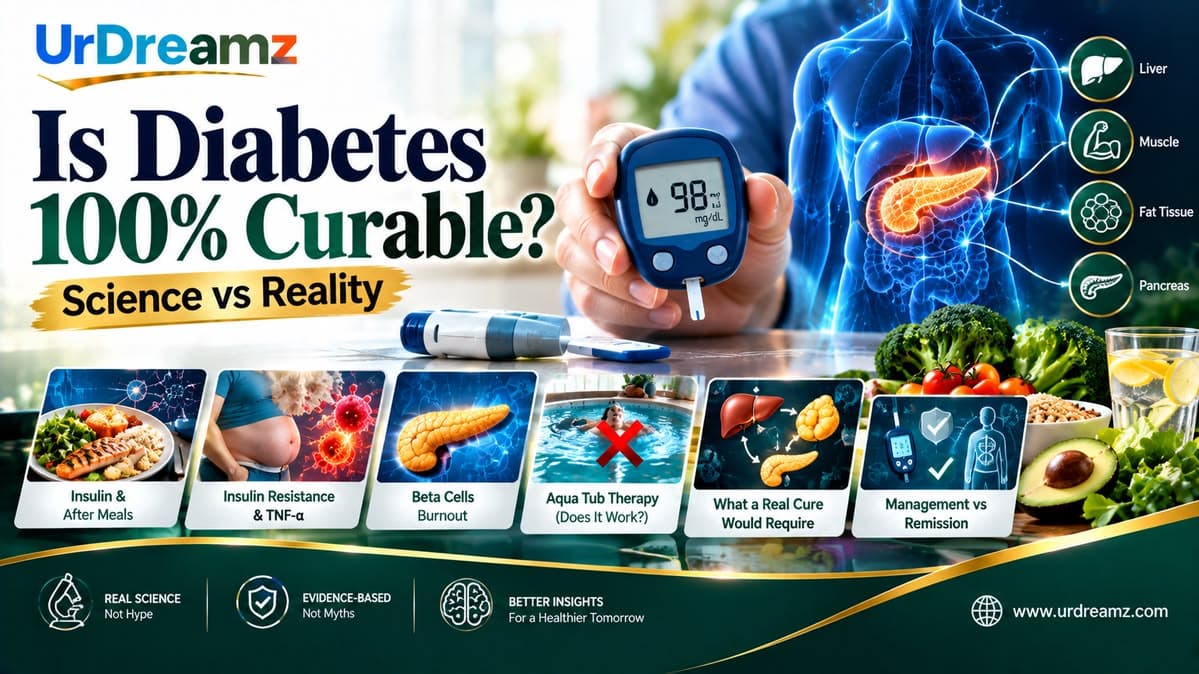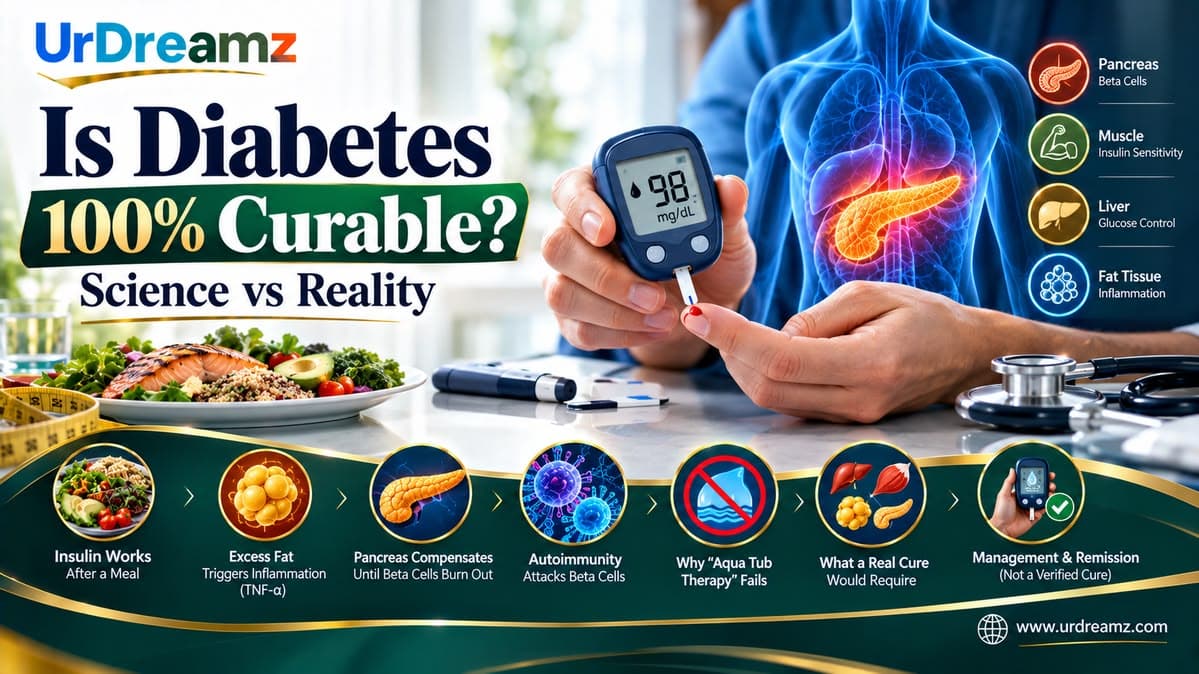
Is Diabetes 100% Curable? Science vs Reality
Roughly 1 billion people worldwide are currently living with diabetes — and not one verified, peer-reviewed cure exists for any of them. This guide separates real science from wishful marketing: how insulin actually works after you eat, how overeating and excess fat tissue trigger insulin resistance, why the pancreas eventually burns out, why claims like "20 minutes in a colored water tub" don't hold up, and what a genuine cure would actually require.
Introduction
Somewhere online right now, someone is selling a "guaranteed diabetes cure." A special tea, a colored water tub, a 21-day detox, a miracle supplement — the marketing changes, but the promise is always the same: reverse diabetes completely, permanently, and without the hard work of actual lifestyle change or medical treatment. It's an appealing promise, especially for the roughly one billion people worldwide currently managing this condition. But appealing isn't the same as true, and this guide exists to walk through, honestly and in real scientific detail, what actually happens inside the body when diabetes develops, why no verified cure currently exists anywhere in the world, and what a genuine cure would actually have to accomplish.
This isn't a guide built on vague reassurance or fear — it's built on the actual biology: how insulin works after a meal, what happens inside fat tissue when someone consistently overeats, how a specific inflammatory molecule called TNF-alpha directly interferes with insulin's ability to do its job, and how the pancreas's own heroic compensation eventually leads to its own exhaustion. Understanding this full mechanism is what makes it possible to tell the difference between a legitimate medical breakthrough and a marketing claim dressed up in scientific-sounding language — exactly the distinction this guide is built to help you make.
It's worth being clear from the outset about why this distinction matters so much, beyond simple intellectual curiosity. Believing a false cure claim carries real, practical costs: money spent on ineffective products, time lost that could have gone toward genuinely effective treatment, and sometimes, most dangerously, a person stopping legitimate prescribed medication because they believe they've been "cured" by something else — a decision that can allow blood glucose to climb back to dangerous levels without the person realizing it, since diabetes so often progresses silently, as covered later in this guide. Understanding the real science isn't just satisfying curiosity; it's a genuine, practical form of self-protection.
The Scale of the Problem: Diabetes Worldwide
The numbers behind diabetes are genuinely staggering. Roughly 11% of the world's population currently lives with diabetes, combining both Type 1 and Type 2. With the global population sitting at around 9 billion people, that works out to approximately 1 billion people worldwide currently managing this condition in some form.
And among every single one of those roughly one billion people, there is currently not one verified, scientifically confirmed cure available anywhere in the world. That's not a failure of effort or funding — diabetes has been one of the most heavily researched conditions in modern medicine for decades. It reflects, instead, just how biologically complex the condition actually is, a complexity this guide walks through step by step.
It's worth pausing on this scale for a moment, because numbers this large can become abstract very quickly. A billion people is roughly equivalent to the combined population of the world's two most populous countries. It means diabetes touches, directly or through a family member, an enormous share of humanity — which is exactly why the research effort behind finding better treatments, and eventually a genuine cure, involves some of the largest and most well-funded areas of medical science in the world today. The absence of a cure isn't for lack of trying; it reflects a problem that spans multiple organ systems simultaneously, as the rest of this guide explains in detail.
Is There a Verified Cure Right Now? The Honest Answer
The honest, scientifically grounded answer is no. There is currently no treatment, anywhere in the world, that can completely and permanently eliminate diabetes at its root in a way that's been verified through rigorous, peer-reviewed research. What exists instead is management and control — medication, lifestyle changes, and in some specific cases, a state called remission (discussed in detail later in this guide), where blood glucose returns to a normal range without medication, though the underlying vulnerability to the condition typically remains.
This distinction between "cure" and "management" isn't a matter of semantics — it reflects a genuine, fundamental difference in what's actually happening in the body, and it's the difference this entire guide is built to explain clearly.
Debunking Miracle Cures: The "Aqua Tub Therapy" Example
One recent claim circulating online involves something sometimes marketed as "Aqua Small Tub Therapy" — the claim is that standing in a tub filled with yellow-colored water for just 20 minutes causes the pancreas to increase insulin release from a baseline of around 20% up to 50%, supposedly by relieving "pressure" on insulin receptors.
This example is worth examining not to single out one particular claim, but because it illustrates a pattern seen repeatedly with "miracle cure" marketing: a plausible-sounding mechanism (percentages, specific numbers, familiar-sounding anatomical terms like "insulin receptors") wrapped around an intervention that has no actual demonstrated connection to those numbers or mechanisms. Recognizing this pattern — specific-sounding claims without an actual verified mechanism or clinical evidence behind them — is one of the most useful general skills for evaluating any health claim, not just this particular one.
A few practical questions are genuinely useful to ask whenever encountering a claim like this. First: has this been tested in a properly designed clinical trial, published in a peer-reviewed medical journal, rather than simply described in a video, testimonial, or advertisement? Second: does the proposed mechanism actually make biological sense given what's already well established about how the relevant organ or system works — in this case, there is no known pathway by which external water temperature or color could directly influence pancreatic beta cell activity from outside the body. Third: is the claim asking you to abandon or reduce legitimate, prescribed medical treatment in favor of the new intervention — a major red flag, since legitimate medical advances are typically studied as additions to established care, not replacements for it, especially in early stages of research. Applying these same three questions to any future "breakthrough" claim — not just this specific example — offers a genuinely reliable filter for separating real science from marketing.
How Insulin Normally Works After You Eat
To understand why diabetes is so difficult to genuinely cure, it helps to first understand exactly how insulin is supposed to work in a healthy body. Every meal you eat contains some degree of sugar content, even foods that aren't obviously "sweet," since many carbohydrates are broken down into sugar during digestion. As this sugar enters the bloodstream, the pancreas detects the rise and releases insulin in response.
This insulin then travels to three main destinations: the liver, the muscles, and adipose tissue (body fat). At each of these locations, insulin delivers essentially the same message: sugar has arrived in the blood, so either use it for immediate energy or store it for later. Each of these tissues has specialized doorways on their cell surfaces called insulin receptors (IR), and insulin needs to successfully bind to these receptors for its message to actually get through and for glucose to be taken up or stored properly.
It's worth walking through what happens at each of these three destinations individually, since they each play a somewhat different role in the overall picture. In the liver, insulin's arrival signals the organ to stop producing and releasing additional glucose into the blood — the liver has its own internal glucose reserves and production capacity, and insulin's job here is essentially to tell it "there's already enough sugar circulating, hold off." In muscle tissue, insulin signals specialized glucose transporter proteins to move to the cell surface, allowing glucose to enter and either be used immediately for energy or stored as a short-term reserve fuel called glycogen. In adipose tissue, insulin similarly promotes glucose uptake and, when energy intake consistently exceeds what's needed, encourages the conversion and storage of that excess energy as fat. Together, these three destinations form a coordinated system: the liver holds back its own output, while muscle and fat tissue actively absorb the incoming glucose, working together to bring blood glucose back down to a normal, stable range after a meal.
Overeating, Fat Tissue, and the Birth of Insulin Resistance
Here's where the problem begins for many people. If someone consistently eats more than their body needs, adipose tissue — body fat — expands over time. But adipose tissue isn't simply passive storage; as it grows, it becomes increasingly active in releasing certain chemical signals into the bloodstream. One of the most significant and well-studied of these signals is a molecule called TNF-alpha (tumor necrosis factor-alpha).
TNF-alpha circulates through the blood and directly interacts with insulin receptors on the liver, muscle, and fat cells themselves, altering them through a process called serine phosphorylation. This modification effectively jams the insulin receptor — when insulin arrives afterward and tries to bind to these altered receptors, the receptors no longer open properly. The message insulin is carrying simply doesn't get through, even though insulin itself is present in completely normal, or even elevated, amounts. This state — insulin present and trying to work, but the receptors no longer responding properly — is called insulin resistance, and it's the central starting problem behind the majority of Type 2 Diabetes cases.
| Step | What Happens |
|---|---|
| 1. Consistent overeating | Adipose tissue (body fat) expands over time |
| 2. Fat tissue becomes active | Expanded adipose tissue releases TNF-alpha and other inflammatory chemicals into the blood |
| 3. Insulin receptors are altered | TNF-alpha modifies insulin receptors on liver, muscle, and fat cells through serine phosphorylation |
| 4. Insulin resistance develops | Insulin can no longer bind and signal effectively, even though it's present in normal or high amounts |
Moderation in Eating: An Old Principle, Confirmed by New Science
Long before modern endocrinology could explain TNF-alpha and insulin receptor phosphorylation in a laboratory, the basic principle of eating in moderation had already been recognized across many cultures and traditions as simply good, healthy living. The Quran, for instance, instructs believers to "eat and drink, but do not be excessive," specifically noting that excess is not something that is loved. It's a genuinely interesting reflection of how closely this centuries-old guidance on moderation lines up with what modern metabolic science has since independently confirmed: that consistent overeating, rather than any single food or occasional indulgence, is what drives the chain of events — fat tissue expansion, TNF-alpha release, and insulin receptor resistance — that leads toward Type 2 Diabetes.
The practical takeaway isn't about extreme restriction or a single "perfect" diet — it's about managing overall eating patterns to avoid the kind of sustained excess that drives adipose tissue expansion and the resulting inflammatory signaling described in the previous section.
The Pancreas Fights Back: Beta Cells Working Overtime
When the pancreas — specifically the insulin-producing beta cells within it — detects that insulin isn't successfully getting its message through to the liver, muscles, and fat tissue, it doesn't simply give up. It compensates by increasing insulin production significantly. If beta cells were previously releasing around 25% of their maximum capacity under normal, healthy conditions, they might now push that output up to 55% or higher, essentially forcing more insulin into circulation in an attempt to overcome the resistance at the receptor level.
For a period of time, this compensation actually works to some degree — with enough extra insulin circulating, at least some receptors do eventually respond, and blood glucose can remain in a reasonably controlled range even while significant insulin resistance is already present beneath the surface. But this compensation comes at a real, cumulative cost to the beta cells themselves, described in the next section.
Beta Cell Exhaustion: When Compensation Fails
Beta cells forced to work at 55% output or higher, sustained over months and years, gradually become damaged and exhausted — a process doctors refer to specifically as beta cell exhaustion. Over time, exhausted beta cells begin to die off, meaning the pancreas's actual insulin-producing capacity shrinks. Where beta cells might have been forced up to producing 55% of maximum output during the compensation phase, a pancreas with significant beta cell loss might now only be able to produce around 20%, or less — not due to resistance alone this time, but because there are simply fewer functioning beta cells left to produce insulin at all.
This creates a genuinely dangerous, double-sided problem: insulin resistance is still present at the receptor level, reducing how effectively any insulin that is produced can actually work, and at the same time, the pancreas's raw capacity to produce insulin in the first place has been reduced through beta cell exhaustion and death. These two problems — resistance and reduced production — compound each other, and it's precisely this combination that produces the clinically diagnosable high blood sugar that defines Type 2 Diabetes.
Why Diabetes Is Called a "Silent Killer"
Diabetes is frequently described as a "silent killer" for good reason: it's fundamentally a metabolic disorder — meaning it arises from how the body processes eating and digestion — and its effects extend well beyond blood sugar numbers alone. Left unmanaged, chronically elevated blood glucose gradually damages blood vessels and nerves throughout the body, quietly affecting multiple organ systems at once: the eyes, kidneys, nerves, heart, and blood vessels supplying the limbs, often with few or no obvious symptoms until significant damage has already occurred. This multi-organ reach is exactly why diabetes carries such serious long-term health consequences, and exactly why finding a genuine cure — rather than simply managing symptoms — remains such an important, actively pursued research goal.
What a Real Cure Would Actually Require
Understanding the full mechanism described throughout this guide makes it possible to answer a genuinely important question: what would a real, complete cure for Type 2 Diabetes actually have to accomplish? Based on the biology covered so far, a genuine cure would need to successfully address several distinct problems simultaneously, not just one.
| Requirement | What It Would Need to Do |
|---|---|
| 1. Restore beta cell mass | Repair or regenerate the pancreas's insulin-producing capacity that was lost to exhaustion and cell death |
| 2. Reverse liver insulin resistance | Restore the liver's ability to properly respond to insulin's signal to stop releasing excess glucose into the blood |
| 3. Reverse muscle insulin resistance | Remove the block on muscle insulin receptors so insulin can once again signal glucose uptake into muscle tissue |
| 4. Stop adipose tissue inflammatory signaling | Prevent fat tissue from continuing to release TNF-alpha and similar chemicals that caused the receptor resistance in the first place |
Even restoring beta cell function alone — say, through laboratory-based regeneration bringing beta cell mass back up to 50% of normal capacity — would not be enough on its own if the liver, muscle, and fat tissue receptors remain resistant. The newly restored insulin supply would still run into the same blocked, unresponsive receptors described earlier in this guide, largely negating the benefit of restoring beta cell production in the first place.
Why No Single Medicine Does All Four Jobs Yet
This is precisely the challenge that has, so far, prevented a genuine, complete cure from existing: no single treatment currently available addresses all four of these requirements simultaneously. Some medications improve insulin sensitivity in the liver. Others help muscle tissue respond better to insulin. Some newer treatments show promise in supporting beta cell health. But a single, unified treatment that restores beta cell mass, reverses insulin resistance in the liver, reverses it in muscle tissue, and simultaneously halts the inflammatory signaling from fat tissue — all at once, in one coordinated intervention — does not currently exist anywhere in medical science.
This is exactly why Type 2 Diabetes continues to be described as a genuine challenge for the entire world, and exactly why it affects so many different organ systems together rather than remaining a simple, single-organ problem. The disease didn't develop through one single malfunction — it developed through a cascade across at least four separate points, and reversing it completely would require successfully addressing every one of those points together, not just one or two in isolation.
What Modern Medicine Can Actually Offer Today
While a complete, verified cure doesn't yet exist, this doesn't mean current treatment options are ineffective — far from it. Modern medicine offers several genuinely powerful tools for managing, and in some cases substantially reversing, the progression of Type 2 Diabetes.
| Approach | What It Does |
|---|---|
| Sustained weight loss | Reduces adipose tissue mass and its associated TNF-alpha release, meaningfully improving insulin sensitivity |
| Metformin | Reduces excess glucose production by the liver and modestly improves insulin sensitivity |
| GLP-1 receptor agonists | Support insulin release, slow digestion, and often produce significant weight loss |
| Regular physical activity | Improves glucose uptake in muscle through a pathway partly independent of insulin signaling |
| Bariatric (weight loss) surgery | In appropriate candidates, has produced diabetes remission in a substantial proportion of patients, largely through significant, sustained fat mass reduction |
Several of these approaches work by directly targeting one or more of the four requirements described in the earlier section — particularly weight loss's effect on reducing TNF-alpha signaling from fat tissue, which is precisely why sustained, meaningful weight loss remains one of the single most effective tools currently available for improving, and in some cases substantially reversing, insulin resistance.
Remission vs. Cure: A Critical Distinction
It's worth spending real time on this distinction, since it's frequently the source of confusion — and sometimes deliberate marketing manipulation — around diabetes "cures." Diabetes remission refers to a state where blood glucose returns to a normal range without needing medication, typically achieved through substantial, sustained weight loss. This is a genuinely excellent outcome and is achievable for a meaningful proportion of people with Type 2 Diabetes, particularly when caught relatively early, before extensive beta cell exhaustion has occurred.
Understanding this distinction is exactly why claims of "100% permanent cure" deserve real skepticism — genuine remission, achieved through legitimate methods like sustained weight loss or bariatric surgery, is real and valuable, but it is fundamentally different from the kind of permanent, guaranteed cure that miracle-cure marketing often implies.
The Future of Diabetes Research
None of this means a genuine cure is impossible — it means the challenge is significant and multi-pronged, exactly as this guide has described. Active areas of research include beta cell regeneration and stem cell-derived replacement therapies, more targeted anti-inflammatory treatments aimed specifically at reducing TNF-alpha and similar signaling from fat tissue, and combination therapies designed to address multiple points in this cascade simultaneously rather than just one. Given how well understood the underlying mechanism has become — precisely the mechanism walked through step by step in this guide — the scientific foundation for eventually developing a genuine, verified cure is arguably stronger today than at any previous point in medical history, even though that outcome hasn't been achieved yet.
Common Diabetes Cure Myths
| Myth | Reality |
|---|---|
| A specific tea, tub, or supplement can cure diabetes in days | No credible clinical evidence supports rapid, complete cure claims from any single product or short-term intervention |
| If blood sugar looks normal, diabetes is cured | Normal blood sugar while on medication or during early remission does not mean the underlying condition has been permanently resolved |
| Diabetes only affects blood sugar | It's a multi-organ metabolic disorder affecting the liver, muscle, fat tissue, and pancreas together, with downstream effects on the heart, kidneys, eyes, and nerves |
| Cutting out sugar completely guarantees a cure | While reducing sugar and refined carbohydrates helps, overall eating pattern and body fat levels matter more than eliminating any single food entirely |
| Once diagnosed, nothing can be done | While a verified cure doesn't exist, meaningful improvement and even remission are genuinely achievable through evidence-based approaches |
Frequently Asked Questions
Is diabetes 100% curable?
No, there is currently no verified, scientifically confirmed cure for diabetes anywhere in the world; treatment focuses on management, control, and in some cases remission.
How many people worldwide have diabetes?
Roughly 11% of the world's population, or approximately 1 billion people, currently live with diabetes, including both Type 1 and Type 2.
What causes insulin resistance?
Consistent overeating leads to expanded fat tissue, which releases inflammatory chemicals like TNF-alpha that alter insulin receptors on the liver, muscle, and fat cells, blocking insulin's signal.
What is TNF-alpha and how does it relate to diabetes?
TNF-alpha is an inflammatory chemical released by expanded fat tissue that modifies insulin receptors through serine phosphorylation, directly causing insulin resistance.
What is beta cell exhaustion?
It's the gradual damage and death of insulin-producing beta cells caused by being forced to work at significantly elevated capacity over a long period to compensate for insulin resistance.
Can diabetes be reversed?
Diabetes can often be substantially improved, and in some cases put into remission, particularly through sustained weight loss, though this differs from a permanent cure.
What is the difference between diabetes remission and a cure?
Remission means normal blood glucose without medication, typically achievable through weight loss, but the underlying vulnerability usually remains; a cure would mean permanent resolution, which hasn't been demonstrated.
Are miracle diabetes cures like special water therapies real?
No, claims like standing in colored water to boost insulin secretion have no known physiological mechanism or credible clinical evidence supporting them.
Why is diabetes called a metabolic disorder?
Because it arises from how the body processes eating and digestion, involving the liver, muscle, fat tissue, and pancreas together rather than a single isolated problem.
What would a real cure for diabetes require?
It would need to simultaneously restore beta cell mass, reverse insulin resistance in the liver and muscle, and stop inflammatory signaling from fat tissue — no single current treatment does all four.
Does weight loss help diabetes?
Yes, sustained weight loss reduces fat tissue mass and its TNF-alpha release, meaningfully improving insulin sensitivity and, in some cases, producing remission.
Why does diabetes affect so many organs?
Because chronically elevated blood glucose gradually damages blood vessels and nerves throughout the body, affecting the eyes, kidneys, nerves, heart, and circulation over time.
Conclusion
Is diabetes 100% curable? Based on the current, honest state of medical science, the answer is no — not yet. What exists today is genuine, evidence-based management: medications that improve insulin sensitivity, lifestyle changes that reduce the inflammatory signaling driving insulin resistance, and, for some people, achievable remission through sustained weight loss. What doesn't exist is a single, verified treatment capable of simultaneously restoring beta cell mass, reversing insulin resistance in the liver and muscle, and halting inflammatory signaling from fat tissue all at once — the four things a genuine cure would actually require.
Understanding this full mechanism — from a single overeaten meal, to expanding fat tissue, to TNF-alpha, to insulin receptor resistance, to beta cell exhaustion — is exactly what makes it possible to recognize a genuine scientific breakthrough when one eventually arrives, and to recognize marketing dressed up as science in the meantime. Until that breakthrough arrives, the honest, evidence-based path remains the same one doctors have recommended for decades: moderation in eating, sustained healthy weight management, regular physical activity, and, where needed, appropriate medical treatment — not a shortcut, but a genuinely effective one.
Disclaimer: This blog is created for general health awareness and educational purposes only. It is not intended to diagnose, treat, or provide medical advice, and should not be used as a substitute for consultation with a qualified healthcare professional regarding any health condition.