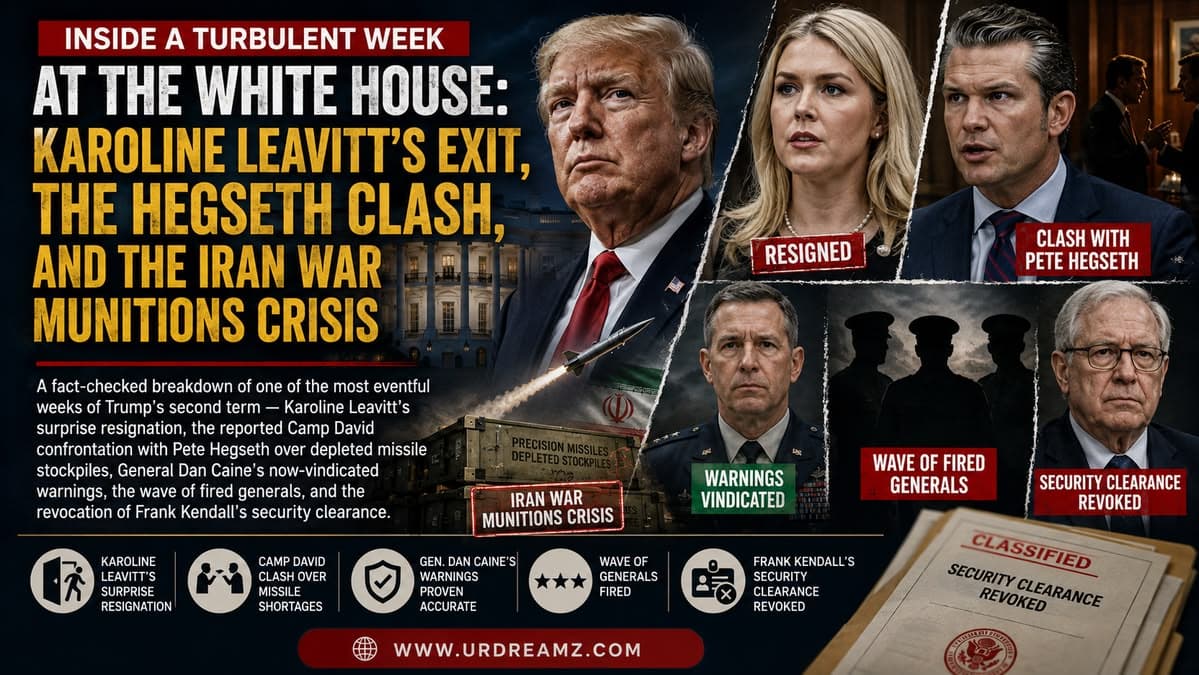
Inside a Turbulent Week at the White House: Karoline Leavitt's Exit, the Hegseth Clash, and the Iran War Munitions Crisis
A fact-checked look at a genuinely eventful stretch inside Washington — a surprise resignation, a reported blowup at Camp David, a general whose warnings turned out to be right, and a security clearance revoked over a leak.
Introduction: A Lot Happening at Once in Washington
Some weeks in Washington move quietly. This was not one of them. Within the span of just a few days in early-to-mid August 2026, the White House announced the surprise departure of one of President Trump's most visible aides, a major newspaper reported a tense confrontation between the president and his defense secretary over a military supply crisis, a four-star general's private warnings about that same crisis were publicly vindicated, more senior military officers were removed from their posts, and the Pentagon revoked a former Cabinet-level official's access to classified information over an alleged leak.
None of these stories exist in a vacuum — they're all connected, directly or indirectly, to the same underlying story: the ongoing US military engagement with Iran, and the strain it has placed on America's weapons stockpiles, its military leadership, and its communications operation. This article walks through each piece carefully, sourced from major outlets including The Washington Post, CNN, Reuters, and the Associated Press, separating what has been confirmed on the record from what remains disputed or officially denied.
It's worth being upfront about the approach here: several of the claims connected to this story circulated online in dramatic, tabloid-style formats, and some accounts blended confirmed reporting with speculation or outright unverified rumor. This piece sticks specifically to what has actually been reported by named, mainstream outlets, and flags clearly wherever something remains officially disputed rather than settled fact.
Karoline Leavitt's Surprise Departure
On Wednesday, August 12, 2026, President Trump announced in a Truth Social post that White House Press Secretary Karoline Leavitt would be leaving her post by the end of the month. The announcement came less than a month after Leavitt had returned from maternity leave following the birth of her second child on May 1.
| Detail | Fact |
|---|---|
| Announcement date | August 12, 2026 |
| Departure timing | End of August 2026 |
| Stated reason | To spend more time with her two young children and family |
| New role | Trump said she would become one of his "top outside advisors" and an "influential voice" for the Republican Party ahead of the November 2026 midterms |
| Trump's public praise | Called her "one of the best White House Press Secretaries in the History of the Office" |
Trump wrote that Leavitt "will now be one of my top outside advisors, and an influential voice within the Republican Party, as we work to defy History, and conclusively win the Midterm Elections." Leavitt herself confirmed the decision in a post on X, describing the role as "the honor and adventure of a lifetime" and thanking the president for the opportunity. She also used part of her farewell statement to criticize Democrats, saying they seek "to destroy everything great about America" — a notably combative note to end on, even by the standards of a political departure statement.
Who Is Karoline Leavitt, and Why Her Exit Matters
Leavitt, 28, made history as the youngest White House press secretary ever, having taken the role at 27 when Trump's second term began in January 2025. Before that, she worked as a spokeswoman for MAGA Inc., Trump's super PAC, and later became the national press secretary for his 2024 campaign, where she famously returned to work just four days into her own maternity leave following the assassination attempt against Trump in Butler, Pennsylvania.
| Background | Detail |
|---|---|
| Age | 28 |
| Prior role | National press secretary for Trump's 2024 presidential campaign |
| Political history | Previously ran for Congress in New Hampshire, losing the general election |
| Tenure | Press secretary since January 20, 2025 |
| Defining moments defended in role | The "Signalgate" scandal, the release of Epstein-related files, and the Iran war coverage |
Her exit is significant timing-wise for a specific reason: it comes less than three months before the November 2026 midterm elections, at a moment when the administration's messaging operation is already under considerable strain from an unpopular, prolonged war and a string of negative leaks. During her recent maternity leave, White House press briefings had already become noticeably less frequent, with officials including Vice President JD Vance, Secretary of State Marco Rubio, and Treasury Secretary Scott Bessent filling in at the podium with mixed results. As of the initial announcement, it was not immediately clear who would replace her, according to a source cited by CNN.
Vice President Vance offered a personal note in response to the announcement, writing on X that Leavitt "has one of the hardest jobs in the Administration" and adding that he understood "how difficult yet rewarding a constant job like this can be for a young parent." Secretary of State Rubio similarly praised her as "a critical part" of the administration's work. These warm, on-record tributes from senior colleagues are worth noting specifically because they stand in some tension with the more skeptical read some commentators have offered — namely, that a departure landing in the middle of such a difficult news cycle for the administration invites at least some scrutiny about timing, even when the stated personal reason is entirely genuine and consistent with her own prior public statements about the demands of the job.
The Backdrop: A War That Was Supposed to Be Short
To understand why this particular week generated so much simultaneous turmoil, it helps to understand the conflict sitting underneath nearly all of it. The United States, alongside Israel, has been engaged in an extended military campaign against Iran that began in early 2026. Trump had initially suggested the conflict could be resolved in a matter of weeks — reportedly anticipating a war lasting roughly four to six weeks.
That is not how it played out. By August 2026, the conflict had stretched on for roughly five months, well beyond the timeline the administration had originally projected, and the strain on US military resources had become significant enough to shape strategic decisions at the highest levels of government.
The war's trajectory has been shaped by a mix of battlefield realities and diplomatic maneuvering that have repeatedly pushed back the timeline Trump initially set out publicly. At various points, Trump has both threatened dramatically expanded strikes — at one stage describing a planned operation as "the biggest attack since World War II" — and pulled back from that same escalation, citing requests for restraint from Iran and regional partners alongside what he described as the outlines of a possible negotiated deal. That back-and-forth pattern, escalation followed by pullback followed by renewed pressure, has itself become part of why sustaining munitions supply became such a persistent challenge: rather than one short, intense campaign with a clear endpoint, the conflict has involved repeated waves of strikes and defensive operations stretched across months, each one drawing further on the same finite stockpiles.
The Washington Post Story: Trump Confronts Hegseth
On August 5-6, 2026, The Washington Post reported that President Trump had confronted Defense Secretary Pete Hegseth during a Cabinet meeting at Camp David, demanding to know why he had apparently been misled about the severity of America's depleted munitions stockpiles.
| Detail | What Was Reported |
|---|---|
| Where it happened | A Cabinet meeting at Camp David |
| Trump's reported statement | He believed the munitions issue "had been fixed" |
| Hegseth's reported response | Did not dispute the shortages, but denied misleading Trump, and reportedly pointed to his deputy, Stephen Feinberg, for failing to ensure the president was fully informed |
| Source | Two people familiar with the exchange, cited by The Washington Post |
According to the Post's reporting, the shortages in long-range guided missiles and air-defense interceptors were among the factors behind Trump's decision not to launch what he had publicly described as "the biggest attack since World War II" against Iran. On social media, Trump had claimed the US was "locked and loaded" for a massive strike but had held back after Iran and other Middle Eastern countries reportedly asked for restraint, citing the outlines of a possible deal.
Several other outlets independently corroborated pieces of this same story around the same time, which lends it additional credibility even where specific details differ slightly between reports. The New York Times reported separately that Trump's own advisers had directly warned him about dwindling stocks of Patriot interceptors and other air defense systems deployed across the Middle East. Reuters reported that the US Army had used "virtually all" of its stockpile of highly accurate long-range missiles during the five-month conflict — weapons that allow precision strikes from a safe distance and had played a central role throughout the campaign. When multiple separate news organizations, each relying on their own independent sourcing, converge on largely the same underlying picture, that pattern itself carries more weight than any single outlet's account taken alone.
What the Numbers Actually Show
Separate from the question of who told Trump what and when, the underlying numbers about US munitions consumption during this conflict are striking on their own, and have been independently reported by multiple outlets including Reuters and CNN.
| System | Reported Depletion |
|---|---|
| Tomahawk cruise missiles | Over 850 fired in the first month of the conflict alone |
| ATACMS (tactical ballistic missiles) | Roughly 1,300 used; one official told the Washington Post the inventory had been depleted to the point there was "basically none left" |
| THAAD interceptors | Nearly 80% of the US inventory depleted compared to prewar levels, according to CNN |
| Patriot missile stockpiles | About half depleted compared to prewar levels |
| Targets struck in Iran | More than 13,000 through an April ceasefire period |
| Incoming Iranian munitions defended against | Over 8,500 during the same period |
Defense experts cited in this reporting warned that replenishing these stockpiles could take years, even with new production agreements in place. Separately, the Financial Times reported that Trump had rejected a request from Ukraine's President Volodymyr Zelensky for hundreds of additional Patriot interceptors, citing depleted US stockpiles and the Pentagon's own requirements amid the Iran war — illustrating how the munitions strain from one conflict was already affecting US commitments elsewhere.
It's worth pausing on why these particular systems matter so much strategically, since the numbers alone don't fully convey the significance. THAAD and Patriot systems are primarily defensive — they're what intercept incoming missiles and drones before they can strike populated areas, military bases, or critical infrastructure. Tomahawks and ATACMS, by contrast, are offensive precision-strike weapons used to hit specific targets from a distance without putting pilots or ground troops directly in harm's way. Depleting both categories simultaneously creates a genuinely difficult strategic bind: reduced offensive stockpiles limit how aggressively the US can strike new targets, while reduced defensive interceptor stockpiles limit how well American forces, allied forces, and civilian population centers can be protected from retaliatory strikes — meaning the shortage isn't simply an inconvenience, it's a factor that directly shapes what military options remain genuinely safe to pursue.
The White House and Pentagon Pushback
It's important to note clearly: both the White House and the Pentagon strongly and repeatedly denied the Washington Post's account of a heated confrontation.
| Official | Response |
|---|---|
| Karoline Leavitt (White House Press Secretary) | Called the report "100 percent fake news" and said Trump had "utmost confidence" in Hegseth |
| Sean Parnell (Chief Pentagon Spokesman) | Said Hegseth "did not mislead anyone about our munitions posture" and called claims of internal disagreement "equally fictional" |
| Trump (via Truth Social) | Insisted the US possesses "massive amounts" of munitions and that more are being manufactured and shipped as needed |
At the same time, it's worth noting that this denial exists alongside a fairly consistent, independently corroborated body of reporting from multiple separate outlets — CNN, Reuters, the Financial Times, and The Washington Post all separately reported significant concerns about depleted stockpiles, even if the specific detail of a tense personal confrontation between Trump and Hegseth remains disputed by the administration. The pattern across recent months has generally been that the White House labels reports it dislikes as "fake news" even when the underlying facts are later substantiated by additional reporting or events — which is exactly what happened with the next part of this story.
General Dan Caine: The Warning That Came True
Perhaps the most striking thread running through this entire episode involves General Dan Caine, Chairman of the Joint Chiefs of Staff — America's highest-ranking military officer. According to multiple reports, including from CNN and The Washington Post, Caine warned Trump and senior officials before the Iran war even began that a protracted conflict could seriously strain US weapons stockpiles, particularly those needed to continue supporting Israel and Ukraine.
| Timeline | What Happened |
|---|---|
| Before the war began | Caine and other military leaders warned Trump that a prolonged campaign could strain stockpiles |
| February 2026 | The Washington Post reported Caine cautioned that shortfalls in munitions and limited allied support would add significant risk to any operation |
| Trump's public response at the time | Called reports of the warning "100 percent incorrect," insisting Caine believed a war could be "easily won" |
| By August 2026 | Senior military commanders reportedly described inventories as "dangerously low," and Caine was described by sources as privately seeking an "off-ramp" from the conflict |
Caine's position throughout has reportedly been a careful balancing act — warning about real risks and limitations while also reassuring the administration that the US military remains capable of inflicting significant damage on Iran if ordered to escalate further. According to CNN, he has discussed the risks of continued escalation with other senior officials including CIA Director John Ratcliffe, Secretary of State Marco Rubio, and Vice President JD Vance, working to coordinate a unified position before meetings with the president. The broader picture that emerges from this reporting is fairly clear: the concerns Caine raised months before the war even started turned out to be substantially accurate, even though the administration publicly dismissed them at the time.
There's a genuinely notable professional tightrope in Caine's position worth spelling out, since it says something about how difficult his role has become. As Chairman of the Joint Chiefs, his job requires him to give the president his honest military assessment while also maintaining the confidence of both his civilian leadership and the wider military he oversees — a balance that gets considerably harder when his honest assessments turn out to contradict the president's own public statements and preferred narrative. According to sources familiar with his private conversations, Caine has explicitly said he wants to "restore trust in his position" and in the military more broadly, at a moment when multiple outlets have reported that the role of Chairman has become increasingly politicized. Being publicly proven right about a warning the president had personally dismissed as "100 percent incorrect" places him in an unusually delicate position — vindicated on the substance, but navigating the political fallout of that vindication carefully rather than publicly claiming credit for it.
The Pattern of Fired Generals
Against this backdrop, Defense Secretary Hegseth has removed a significant number of senior military officers since taking office in early 2025 — described by multiple outlets as "more than a dozen" generals and admirals.
| Officer | Position | Outcome |
|---|---|---|
| Gen. C.Q. Brown | Former Chairman of the Joint Chiefs of Staff | Removed early in Hegseth's tenure |
| Adm. Lisa Franchetti | Chief of Naval Operations | Removed early in Hegseth's tenure |
| Gen. Jim Slife | Vice Chief of Staff of the Air Force | Removed early in Hegseth's tenure |
| Gen. Randy George | Army Chief of Staff | Asked to retire immediately in April 2026, mid-war |
| Gen. David Hodne | Commander, Army Transformation and Training Command | Removed the same day as George, April 2026 |
| Maj. Gen. William Green Jr. | Army Chief of Chaplains | Removed the same day as George, April 2026 |
The dismissal of General George in particular drew significant attention because of its timing — it came during an active war, just a day after Trump's national address signaling an intensification of strikes on Iran. George had been confirmed by the Senate in 2023 by a striking 96-1 vote and was, according to Axios, "not exactly a controversial figure." The Pentagon did not publicly give a reason for his removal. One source told Axios the dismissal stemmed from "clashing personalities" rather than disagreement over military strategy, while another official, speaking anonymously, described the wartime timing of the firing as "insane." It's worth being precise here: available reporting does not establish a confirmed, direct causal link between these firings and the individual officers' agreement with Caine's specific warnings — the Pentagon has generally declined to give reasons for these departures, and the "clashing personalities" explanation reported by Axios is a different, though not necessarily contradictory, account.
The scale of leadership turnover this represents is worth sitting with for a moment. Losing over a dozen senior generals and admirals in roughly a year and a half, including the chief of an entire military branch removed abruptly in the middle of an active war, is a genuinely unusual pace of change for the US armed forces, which typically prize continuity and predictable succession, particularly during wartime. Defense officials quoted anonymously by Axios described the George dismissal specifically as generating real concern among military leadership about what it might mean for the broader war effort and for longer-term military modernization programs already underway — concerns significant enough that even officials generally supportive of the administration's broader direction were reportedly uneasy about the disruption this particular round of changes introduced at such a sensitive moment.
Frank Kendall and the Air Force One Leak
The same general week also saw the Pentagon take action against a former Cabinet-level official entirely outside the current administration. On Friday, August 7, 2026, the Pentagon revoked former Air Force Secretary Frank Kendall's eligibility for access to classified information and barred him from holding any sensitive position.
| Detail | Fact |
|---|---|
| Who | Frank Kendall, Air Force Secretary from 2021 to 2025 under President Biden |
| Action taken | Revocation of classified access eligibility and any sensitive-position privileges, effective immediately |
| Official reason given | Alleged unauthorized disclosure of classified information about Air Force One's capabilities to a media outlet |
| Context | Followed reporting, including by The New York Times and The Wall Street Journal, on security concerns about the new Qatari-gifted jet serving as a temporary Air Force One |
| Kendall's response | Said he was "completely mystified," insisting he had "always been extremely careful" not to disclose anything classified |
Pentagon spokesman Sean Parnell announced the action on X, writing that "safeguarding classified information is a non-negotiable duty" and that "those who violate that trust forfeit the privilege of access and any role requiring it." Notably, the Pentagon did not specify which outlet Kendall allegedly spoke with or exactly what information he disclosed. Kendall told the Associated Press that no one had told him what he was accused of revealing. This was not the first such action by the administration — it previously revoked security clearances from 37 then-current and former national security officials, and Hegseth separately pulled clearance from retired Joint Chiefs Chairman Gen. Mark Milley early in his tenure. The action also came amid what several outlets described as a broader crackdown on press-related disclosures, including subpoenas issued to New York Times reporters covering the Air Force One safety concerns.
The underlying Air Force One story is worth a brief explanation on its own, since it's the specific controversy that appears to have triggered Kendall's clearance revocation. The Trump administration accepted a luxury Boeing 747-8 as a gift from the government of Qatar, intended to serve as a temporary presidential aircraft while the long-delayed, next-generation official Air Force One replacement jets remain under construction. Reporting from multiple outlets, including detailed comparisons published by the Wall Street Journal, raised specific security concerns about this Qatari-donated jet lacking certain advanced defensive and antimissile capabilities present in the older, purpose-built Air Force One aircraft it was temporarily replacing. Kendall, drawing on his own background and expertise from years overseeing Air Force programs, had been quoted discussing these security concerns in news coverage — the specific activity the Pentagon now says crossed the line into an unauthorized disclosure of classified information, though Kendall himself maintains he never discussed anything genuinely classified.
Connecting the Dots: What This Week Actually Reveals
Taken individually, each of these stories could be described as a routine, if notable, Washington news item — a press secretary stepping back for family reasons, a disputed newspaper report, a Pentagon leadership shuffle, a security clearance dispute. Taken together, though, a clearer pattern emerges: an administration managing a longer, more costly war than it initially anticipated, facing mounting evidence that internal warnings about resource strain were accurate, dealing with a wave of leaks about that strain, and responding to nearly all of it with firm public denial paired with personnel changes.
It's worth being careful and fair about what is and isn't established here. The reporting on Trump's specific confrontation with Hegseth remains officially denied by the White House, even though it was independently reported with named sourcing standards by a major outlet. Dan Caine's warnings and their apparent vindication are more solidly corroborated across multiple independent reports. The reasons behind the various general dismissals remain murky and are not officially confirmed to be connected to the munitions controversy specifically. And Frank Kendall's clearance revocation has an official, stated justification that is separate from — even if occurring in the same news cycle as — the broader munitions story, though its timing amid the administration's evident sensitivity to unflattering leaks is difficult to ignore entirely.
What Happens Next
Several threads from this week remain genuinely open questions heading into the fall of 2026. Who will replace Karoline Leavitt as press secretary, and how that person handles an already strained relationship between the White House and much of the press corps, remains to be seen. Whether the Iran conflict moves toward the "off-ramp" that General Caine has reportedly been seeking, or toward the further escalation Trump has periodically threatened, will significantly shape both the military and political story lines through the November midterms. And whether Congress or independent oversight bodies pursue further scrutiny of the munitions shortage, the string of general dismissals, or the security clearance actions remains an open question that will likely play out over the coming months.
Frequently Asked Questions
Why is Karoline Leavitt leaving the White House?
Trump and Leavitt both publicly cited her desire to spend more time with her two young children and family, following her return from maternity leave after the birth of her second child in May 2026.
When does Karoline Leavitt's departure take effect?
By the end of August 2026, according to Trump's Truth Social announcement on August 12.
Will Karoline Leavitt still work with the Trump administration?
Yes — Trump said she would become one of his "top outside advisors" and remain an influential voice for the Republican Party ahead of the midterm elections.
What did the Washington Post report about Trump and Hegseth?
That Trump confronted Hegseth at a Camp David Cabinet meeting over depleted US munitions stockpiles, saying he believed the issue "had been fixed" and had apparently been misled.
Did the White House confirm this confrontation happened?
No — the White House and Pentagon both denied the report, with Press Secretary Karoline Leavitt calling it "100 percent fake news."
How depleted are US munitions stockpiles from the Iran war?
Reports indicate nearly 80% of THAAD interceptors and about half of Patriot missile stockpiles were depleted compared to prewar levels, alongside over 850 Tomahawk missiles fired in the first month alone.
Who is General Dan Caine?
He is the Chairman of the Joint Chiefs of Staff, America's highest-ranking military officer, who reportedly warned Trump before the Iran war began that a prolonged conflict could strain US weapons stockpiles.
Was Dan Caine's warning proven correct?
Largely yes — subsequent reporting confirmed significant depletion of key munitions systems, matching the concerns Caine had raised before the war began, even though Trump initially dismissed the reports as "100 percent incorrect."
How many generals has Pete Hegseth fired?
Multiple outlets describe the total as "more than a dozen" senior generals and admirals since Hegseth took office in early 2025, including the Army Chief of Staff and the former Chairman of the Joint Chiefs.
Why was Army Chief of Staff Randy George fired?
The Pentagon did not publicly give a reason; one source told Axios it stemmed from personality clashes rather than strategic disagreements, though officials described the wartime timing as unusual.
Who is Frank Kendall?
He served as US Air Force Secretary from 2021 to 2025 under President Biden, and currently serves as a senior fellow at the Center for American Progress.
Why did the Pentagon revoke Frank Kendall's security clearance?
Over an alleged unauthorized disclosure of classified information regarding the capabilities of the new Qatari-gifted Air Force One jet to a media outlet.
Has Frank Kendall been charged with a crime?
As of the most recent reporting, the Pentagon had not specified whether he was being referred for prosecution.
Why is the Qatari-gifted Air Force One controversial?
Reporting indicated the jet lacked some of the advanced antimissile capabilities of the previous Air Force One, raising security concerns that were covered by multiple major outlets.
Is the Iran war still ongoing as of this reporting?
Yes, based on available reporting the conflict had continued for roughly five months by August 2026, well beyond the four-to-six-week timeline Trump had initially anticipated.
What does "seeking an off-ramp" mean in this context?
It refers to reports that General Caine has been privately encouraging senior officials to find a way to de-escalate and end the conflict, given the risks and resource strain of continued military action.
Conclusion
Strip away the individual headlines and this was, in the end, one story told from five different angles: a war that ran longer and cost more than the administration expected, a top general whose early warnings about that cost were dismissed and later substantiated, a defense secretary facing hard questions about what he knew and when, a press secretary stepping away just as the messaging challenge around all of this intensified, and a former official losing his security clearance over a leak connected to a separate but related controversy involving presidential aircraft security.
None of these threads are fully resolved. The Washington Post's account of the Trump-Hegseth confrontation remains disputed by the parties involved even as its underlying facts about depleted stockpiles are corroborated elsewhere. The reasons behind several general dismissals remain officially unexplained. And the broader question — whether the United States can sustain its current level of military commitment across Iran, Israel, and Ukraine simultaneously without straining its stockpiles past a genuinely risky point — is a question that reporting suggests is still very much being fought over inside the highest levels of the Pentagon and the White House, even as the public statements continue to insist everything is under control.