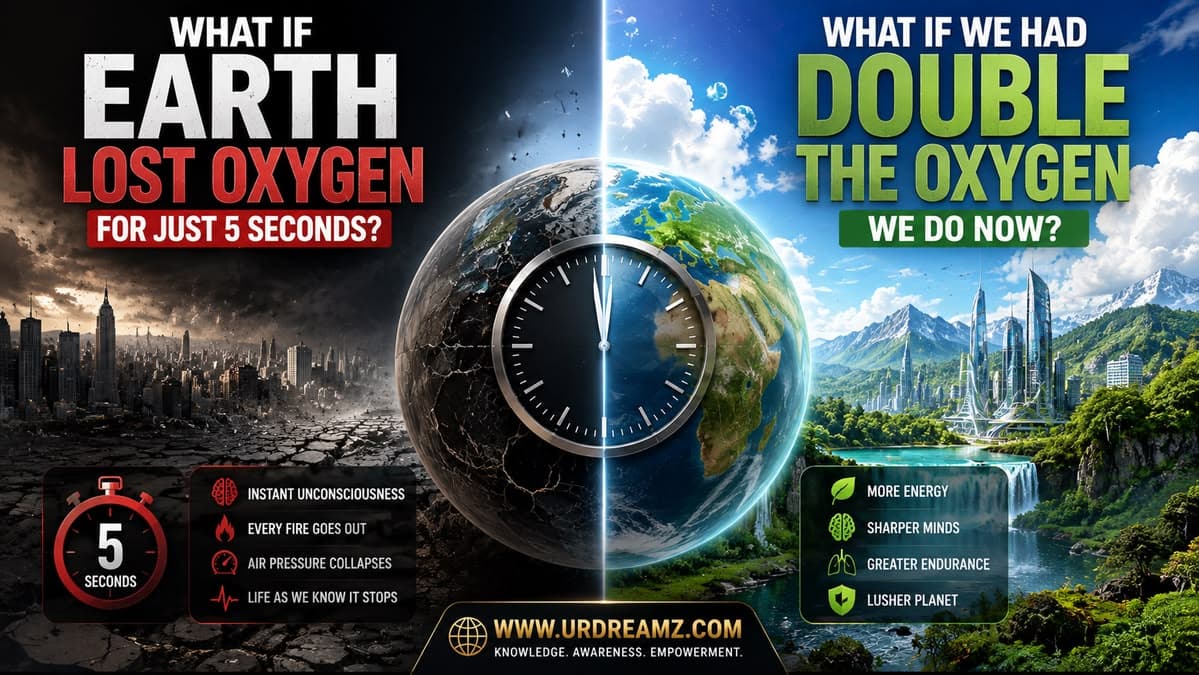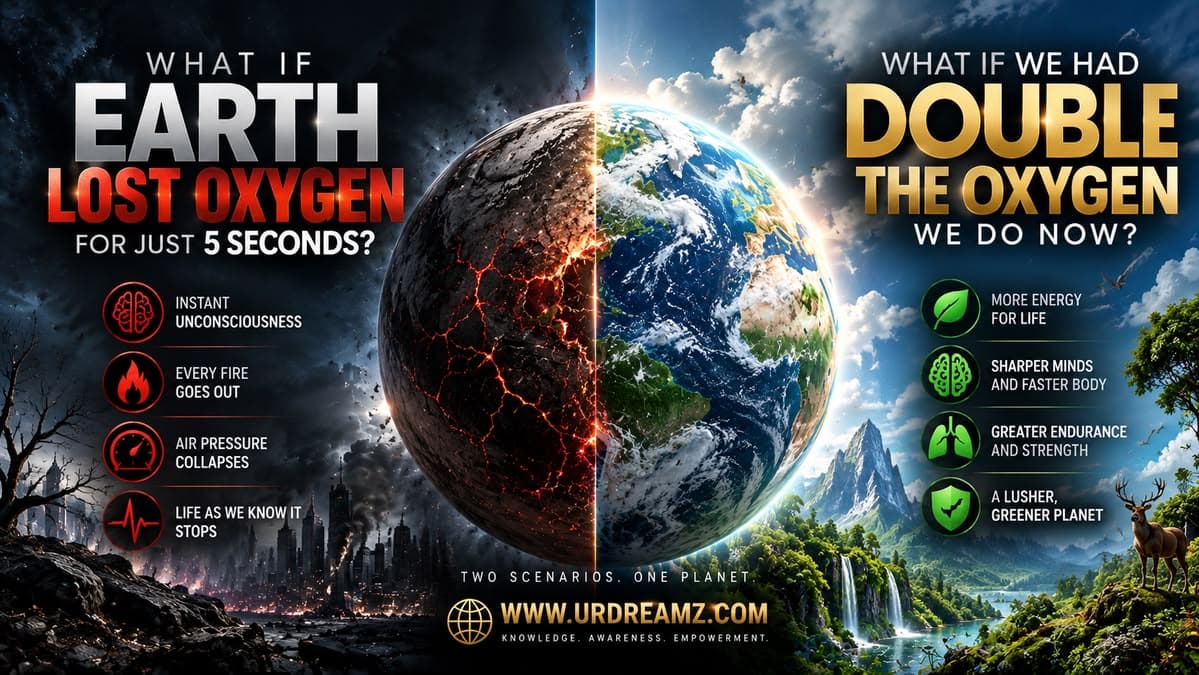
What If Earth Lost Oxygen for Just 5 Seconds? (And What If We Had Double the Oxygen We Do Now?)
Let's actually sit down and think this through together — properly, honestly, without the exaggeration that usually comes with this question.
Alright, Let's Actually Think About This One
You know how sometimes a question sounds almost silly at first — "what if oxygen disappeared for just five seconds" — and then the more you actually sit with it, the more it quietly turns into one of those questions that makes you go "wait, actually... that's kind of terrifying"? That's exactly this one. Five seconds sounds like nothing. You could hold your breath for five seconds without even trying hard. So the instinct is to think, okay, that's basically a non-event, right? Most of us would probably answer that question the same way without thinking twice.
Except this was never really about you holding your breath. This is about everything else that oxygen is quietly doing in the background, every single second, that has absolutely nothing to do with your lungs. That's the part that turns this from a boring trivia question into something genuinely worth sitting down and thinking through properly. So let's do exactly that — no exaggeration, no viral-video drama for the sake of drama, just an honest walk through what actually would and wouldn't happen, and then, once we're done with that, let's flip the question entirely and ask what happens if we had way more oxygen instead of none at all, since that flip side turns out to be just as worth exploring properly.
One quick honest note before we dive in, because it matters: this whole "5 seconds without oxygen" scenario is a popular thought experiment that science YouTubers and writers love to explore — it's not an event that's ever actually been tested or recorded, obviously, because there's no way to safely test it. So some of what follows is well-grounded, solid science, and some of it is a more speculative extrapolation that different sources describe slightly differently. We'll be honest about which parts are which as we go, instead of pretending every single claim floating around online about this topic is equally solid.
And honestly, that opening thought you had — about hydrogen and oxygen being individually dangerous, flammable gases that somehow combine into the calm, life-sustaining water we drink every day — is exactly the right instinct to bring into this whole conversation. Because once you start looking closely at how these gases actually behave, both alone and together, you realize the entire topic is full of these little moments where the universe's actual chemistry turns out to be more careful, more balanced, and honestly more interesting than the dramatic headline version usually gives it credit for. So let's keep that same instinct going as we work through the rest of this.
First, What Is Oxygen Even Doing Up There?
Before we get to the dramatic five-second scenario, let's quickly ground ourselves in what oxygen actually is and does, because that's really the foundation everything else builds on. It's easy to take for granted since we never actually see it, smell it, or think about it consciously — but everything from your car starting in the morning to the color of the sky above you depends on this one invisible gas being exactly where it's supposed to be.
| Fact About Oxygen | Why It Matters |
|---|---|
| Makes up about 21% of the air we breathe | This is the exact number behind that "sudden pressure drop" idea we'll get to shortly |
| A powerful oxidizer, not itself a fuel | This is why oxygen doesn't burn on its own, but makes everything else burn much more easily |
| Forms ozone (O3) high in the atmosphere | Ozone is what blocks most harmful ultraviolet radiation from reaching us |
| Constantly reacts with metals to form oxide layers | That thin oxide layer is actually what stops raw metal surfaces from sticking to each other |
| Makes up roughly 45% of Earth's crust by mass | Most of that oxygen is chemically locked into minerals and rock, not floating around as breathable gas |
That last point is honestly the single most important thing to keep in your back pocket for the rest of this article, so hold onto it: there's a massive difference between the oxygen gas floating around in the air we breathe, and oxygen that's chemically bonded inside rocks, minerals, and water molecules. The five-second scenario is specifically about that free-floating atmospheric gas vanishing — not about ripping oxygen out of every rock and water molecule on the planet. That one distinction is going to clear up almost every "myth vs. reality" confusion we're about to untangle.
Think of it this way: oxygen exists in basically two very different "states" on Earth. There's the free, loose, gaseous form — two oxygen atoms bonded together as O2, floating around in the air, ready to react with whatever it touches. And then there's the bonded, locked-in form, where an oxygen atom has already found a stable, permanent chemical partnership with something else — like the silicon and other elements inside rock minerals, or the two hydrogen atoms inside a water molecule. Once oxygen has settled into one of those stable, bonded relationships, it's genuinely a different situation chemically than the loose gas floating in the air, and removing the loose gas doesn't automatically reach into every one of those already-settled relationships and undo them. Keeping that difference clear in your head is really the key to telling apart the parts of this scenario that are solid science from the parts that got a bit exaggerated somewhere along the way.

Second by Second: What Would Really Happen
Okay, so let's actually walk through this. If, somehow, every molecule of free oxygen gas in Earth's atmosphere simply vanished for five seconds, here's the reasonably well-supported version of what would happen, based on how these gases and systems actually behave.
| Effect | Why It Would Happen |
|---|---|
| Combustion engines would stall | Burning fuel requires oxygen; without it, that chemical reaction simply can't happen |
| Planes in the air could lose engine power mid-flight | Jet engines rely on the same combustion process as car engines, just at a much larger scale |
| A sudden, noticeable drop in air pressure | Removing roughly a fifth of all atmospheric gas instantly reduces total atmospheric pressure |
| Discomfort or pain in your ears | Your inner ear is extremely sensitive to sudden pressure changes, similar to what happens during a fast plane descent |
| The sky darkening noticeably | Less atmospheric gas overall means less scattering of sunlight, which is part of why the sky appears blue in the first place |
| A spike in ultraviolet radiation reaching the surface | The ozone layer, made of oxygen, would momentarily vanish along with the oxygen itself |
Notice something about this list — none of it is instant total destruction. It's a genuinely bad, dangerous five seconds, full stop, but it's a specific, explainable kind of bad, not a magical apocalypse where everything simultaneously combusts and crumbles all at once. That distinction is exactly what we're going to spend the next few sections carefully working through.
The Sky Going Dark and That Sudden Sunburn
Let's take these two together, because they're actually connected through the same underlying cause: oxygen's role in the upper atmosphere. High above us, sunlight constantly converts some regular oxygen (O2) into ozone (O3), and that thin ozone layer is what absorbs the vast majority of the sun's harmful ultraviolet radiation before it ever reaches the ground.
If all the oxygen gas on Earth genuinely vanished for those five seconds, the ozone layer built from that oxygen would, logically, vanish right along with it. That means, for those five seconds, unfiltered ultraviolet radiation would come pouring straight through to the surface with nothing to stop it. Anyone directly exposed to open sunlight during that window — and this is exactly the beach scenario you mentioned — could genuinely suffer a severe, sudden burn, precisely because the usual protective filter simply isn't there anymore, even if only for a few seconds. This part of the popular explanation genuinely holds up reasonably well: no ozone means no UV filter means real, fast skin damage for anyone standing in direct sun at that exact moment.
The sky darkening is a slightly softer claim, worth being a little more careful with. Our sky looks blue mainly because sunlight bounces around and scatters off the gas molecules in our atmosphere, and nitrogen actually does the bulk of that scattering work, not oxygen specifically, since nitrogen makes up roughly 78% of the air compared to oxygen's 21%. So removing oxygen alone wouldn't empty the sky of scattering gas entirely — nitrogen would still be there, still scattering plenty of light. That said, losing a full fifth of the total atmosphere's gas molecules in an instant would still reduce overall scattering to some degree, which is likely where the "darker sky" idea in these popular explanations comes from — it's a real, directionally correct effect, just probably less dramatic and less "black sky, no sunlight" than some of the more dramatic viral clips suggest.
It's worth adding one more layer to the UV part of this story, since it's genuinely the scariest and best-supported piece of the whole scenario. Ozone doesn't just casually reduce UV exposure a little bit — it's specifically the layer responsible for absorbing the most dangerous, highest-energy portion of the sun's ultraviolet spectrum, the kind that can cause immediate cellular damage to skin and eyes with even brief exposure. Without that filter in place, even a handful of seconds of direct, unfiltered exposure to strong midday sunlight could plausibly cause damage far beyond an ordinary sunburn — genuinely closer to the kind of burn you'd expect from a much longer, much more severe overexposure. This is exactly the part of the scenario where "only five seconds" stops sounding harmless the moment you actually understand what that protective filter is normally doing for us every single second of every single day, completely unnoticed.
Your Ears, and That 21% Pressure Drop
This one's pretty straightforward physics, and it holds up well. Air pressure is basically a measure of how much gas is pressing down on you at any given moment, and if roughly 21% of all that gas — every single oxygen molecule — instantly disappeared, the total pressure pressing down on you would drop by a meaningful, sudden amount, more or less matching that percentage.
You've actually already felt a smaller version of this — that popping, uncomfortable feeling in your ears when a plane is descending quickly, or when you're driving up a steep mountain road fast. Your inner ear has a tiny pocket of air trapped behind your eardrum, and it needs a moment to equalize with whatever the pressure is outside. A sudden, sharp pressure drop like this scenario describes would hit that same mechanism, but much faster and much more intensely than anything you'd normally experience — genuinely uncomfortable, possibly painful, for basically everyone on the planet simultaneously, for those five seconds.
Metal Welding Itself Together — Wait, Really?
Okay, this one sounds like the most made-up claim on the whole list, and yet it's actually grounded in a genuinely real, documented phenomenon called cold welding. Here's the science behind it: metal surfaces are covered in an extremely thin layer of oxide — literally a microscopic coating formed when the metal's surface reacts with oxygen in the air. That oxide layer is exactly what keeps two pieces of bare metal from fusing together the instant they touch each other.
In a genuine vacuum — like the environment out in space — this oxide layer isn't there to begin with, or gets worn away over time, and metal surfaces that touch each other can, in fact, spontaneously bond together at the atomic level, which is a real, well-documented engineering headache for spacecraft designers. The claim in this five-second scenario extends that same logic to Earth's surface: if oxygen vanished, any exposed metal surfaces newly touching each other during that window wouldn't have a protective oxide layer forming, and could theoretically start fusing. This is one of the more speculative extensions in the whole thought experiment, since five seconds is an extremely short window for this to meaningfully happen at scale compared to the timeframes usually involved with cold welding in space — but the underlying chemistry it's built on is completely real, not made up.
NASA engineers have actually had to design around this exact problem for real spacecraft hardware, which tells you how genuinely significant cold welding can be once the conditions are right — bolts, hinges, and moving mechanical parts on satellites and space stations have needed special coatings specifically to prevent metal components from permanently fusing together in the vacuum of space, where that natural oxide layer simply isn't being replenished the way it constantly is here on Earth. So while the "five seconds on Earth" version of this claim is stretching a real phenomenon into a much shorter and more dramatic timeframe than it's usually observed in, it's not pulling the underlying science out of nowhere — it's borrowing a genuinely documented engineering challenge and asking what a much faster, much more extreme version of it might look like.
Now Let's Fix the Two Biggest Myths
Alright, here's where we need to be the honest friend in the conversation, not just the excited one. A couple of the claims that circulate a lot with this topic don't actually hold up once you look closely at the chemistry, and it's worth clearing them up properly rather than just repeating them because they sound dramatic.
| Popular Claim | What's Actually More Accurate |
|---|---|
| Concrete buildings would instantly crumble to dust | The oxygen inside concrete's minerals is chemically bonded, locked into the material's structure — it isn't affected by a brief disappearance of free atmospheric oxygen gas, so structures would most likely remain standing and stable |
| All the world's oceans would turn into hydrogen gas and float away | Water (H2O) already has its oxygen atom chemically bonded to two hydrogen atoms in a stable molecule; removing separate, free-floating O2 gas from the air doesn't rip apart already-formed water molecules — the oceans would stay exactly as they are |
Let's slow down on that second one specifically, because it's the one most worth correcting carefully. Water and atmospheric oxygen are chemically completely different things, even though both technically "contain" oxygen. The oxygen atom sitting inside every water molecule is tightly bonded through what chemists call covalent bonds to two hydrogen atoms — that bond is what makes water water, and it has absolutely nothing to do with the separate O2 gas molecules floating loosely in the air around us. Removing the free-floating gas doesn't reach into every water molecule on Earth and rip its oxygen atom back out; those are simply two separate chemical situations that don't interact that directly, especially not within a five-second window. So no, the oceans would not spontaneously start splitting into hydrogen and floating off into space — that idea, however dramatic it sounds, doesn't hold up chemically.
It's worth explaining briefly why breaking water apart into hydrogen and oxygen actually requires real, deliberate energy input in the first place, since that helps make clear just how far-fetched the "instant ocean decomposition" idea really is. Splitting a water molecule into its separate hydrogen and oxygen components — a process called electrolysis — requires running an electrical current through the water, using genuine, substantial energy to break those strong covalent bonds apart. It's not something that happens spontaneously just because some unrelated gas somewhere else briefly disappeared from the air above it. If breaking water apart were that easy, honestly, our oceans would have fallen apart on their own a very long time ago, given how much unrelated activity — storms, lightning, temperature swings — happens on Earth's surface every single day without a problem. The fact that this doesn't happen constantly is itself a pretty strong clue that water's chemical stability isn't nearly as fragile as this particular viral claim suggests.
The Water Point — And Why It's Actually Beautiful Chemistry
Now, here's something worth pausing on, because it connects directly back to that thought you opened with — the one about hydrogen and oxygen individually being highly flammable, dangerous gases, and yet somehow combining into water, the very thing that sustains all life. That observation is genuinely accurate, and honestly, it's one of the more elegant little facts in all of chemistry.
Hydrogen gas on its own is explosively flammable — it's actually one of the most flammable substances known, which is exactly why hydrogen fuel and hydrogen bombs are treated with such extreme caution. Oxygen gas on its own isn't flammable itself, but as we mentioned earlier, it's a powerful oxidizer that makes virtually everything around it burn far more violently. Put those two separately dangerous, separately unstable gases together in exactly the right ratio — two hydrogen atoms bonded to one oxygen atom — and instead of an explosion, you get something so stable, so calm, and so essential that every living cell on this planet depends on it completely. That specific chemical arrangement, sitting quietly in a glass of water on your table, is doing none of the violent, reactive things either gas would do on its own. Whatever framework you view that fact through — as a marvel of chemistry, or as a sign of deliberate design in how the universe is put together, or honestly both at once — it's a genuinely remarkable, well-documented piece of real science, not an exaggeration at all.
There's actually a neat, related detail worth adding here for anyone who's ever watched two hydrogen atoms and one oxygen atom get "introduced" to each other in a lab demonstration: the reaction that forms water from hydrogen and oxygen gas is itself explosively energetic — it's the same basic reaction that powered early rocket engines, and the same reaction behind the famous, tragic Hindenburg disaster, where a hydrogen-filled airship caught fire catastrophically. So it's not that hydrogen and oxygen calmly, gently combine into water without any drama at all — the actual moment of combination is genuinely violent and energetic. What's remarkable is what happens after that: once the reaction is complete and the water molecule has formed, all of that instability disappears entirely, locked away permanently in a stable, calm, life-sustaining substance. The chaos is real, but it's temporary and one-directional — water, once formed, simply doesn't go back to being an unstable, explosive mixture on its own, which is a genuinely elegant piece of how chemistry tends to settle toward stability rather than staying stuck in a dangerous, reactive state.
Okay, Now Flip It — What If We Had Double the Oxygen?
Alright, let's completely change direction now. Instead of losing oxygen, what if Earth's atmosphere had roughly double its current amount — say, jumping from about 21% up toward 40-something percent, while everything else about our planet stayed the same? This is a genuinely different scenario from the "100% pure oxygen" thought experiment you might see elsewhere online, which is a much more extreme, apocalyptic situation involving removing nitrogen entirely. Doubling oxygen while keeping other gases around is a considerably gentler, more survivable — and honestly more scientifically interesting — scenario to think through.
| Effect of Roughly Doubled Oxygen | Why It Would Happen |
|---|---|
| Significantly higher wildfire risk | More oxygen makes combustion easier to start and harder to put out, even at moderately elevated levels |
| Potential for larger insects over long evolutionary timescales | Many insects breathe through a network of tiny tubes limited by how far oxygen can diffuse, so more available oxygen could support bigger body sizes over generations |
| More oxygen available for human blood to carry | Could plausibly support higher endurance and energy levels, though the body's own regulation systems would also need to adjust |
| Not necessarily faster plant growth | Plant growth depends primarily on carbon dioxide, water, and sunlight — extra oxygen doesn't directly speed up photosynthesis, and can, in some plants, slightly interfere with it instead |
That last point is worth sitting with for a second, because it directly corrects a really common and totally understandable assumption — the idea that "if oxygen is good for us, more of it must be good for plants too, so they'd grow faster." It's a completely reasonable guess, but it's actually backwards from how plant biology works, and we'll dig into exactly why in a moment.
This Actually Happened Once — Meet the Carboniferous Period
Here's something genuinely cool: we don't have to guess entirely in the dark about what higher oxygen levels do to life on Earth, because our planet has actually been there before. During the Carboniferous period, roughly 300 to 360 million years ago, geological evidence suggests atmospheric oxygen levels were considerably higher than today — commonly estimated somewhere around 30 to 35%, compared to our current 21%.
| What Scientists Believe Happened | Why It's Connected to Higher Oxygen |
|---|---|
| Dragonfly-like insects with wingspans of over 60 centimeters existed | Higher oxygen levels are believed to have allowed insects, which breathe passively through tiny tubes, to grow to much larger sizes than insects can reach today |
| Massive coal deposits formed during this era | Enormous, dense forests thrived and were later buried and compressed, eventually becoming the coal we mine today |
| Wildfire evidence increases sharply in the fossil record | Higher oxygen concentration makes wildfires easier to start and considerably harder to extinguish once burning |
The giant insect connection is genuinely one of the more fascinating, well-supported pieces of this whole topic, and it's worth understanding why it works the way it does. Unlike humans and other larger animals, most insects don't have lungs — they breathe passively through a network of tiny tubes called tracheae, which rely on oxygen simply diffusing in from the outside air rather than being actively pumped in like our own breathing. That diffusion process gets less efficient the larger an insect's body gets, which is generally thought to be one of the main reasons insects today stay relatively small. With significantly more oxygen available in the surrounding air, that same diffusion process becomes considerably more efficient even at larger body sizes, which is a big part of why scientists believe dragonfly-like creatures back then could grow to sizes that would seem almost unbelievable by today's standards — genuinely large enough that, as you said, most of us would probably jump back a little if we saw one crawling toward us today.
It's worth noting that this "oxygen limits insect size" idea, sometimes called the oxygen limitation hypothesis, isn't the only explanation scientists have proposed for the Carboniferous giants — some researchers point to other factors too, like reduced predation pressure from larger flying vertebrates that hadn't evolved yet at the time, or simply more abundant food and habitat in those enormous ancient forests. Most researchers today think it was probably a combination of factors working together rather than oxygen levels alone doing all the work. Still, laboratory experiments raising modern insects in artificially oxygen-enriched environments have shown measurable increases in body size across several insect species, which gives real, testable, present-day support to the idea that oxygen availability genuinely does play a meaningful role in how large these small, tube-breathing creatures can grow.
Would Plants Really Grow Faster? Let's Check
Now here's the correction worth spending real time on, because it's such a natural and reasonable assumption to make, and yet it runs the opposite direction from what most plant biology tells us. Photosynthesis — the actual process plants use to grow, using sunlight to convert carbon dioxide and water into sugar and oxygen — depends primarily on carbon dioxide availability, water, and light, not on how much oxygen happens to be floating around in the surrounding air.
In fact, for a large group of plants known as C3 plants (which includes the majority of the plant species we're familiar with, including most trees, wheat, and rice), higher oxygen concentrations can actually interfere somewhat with photosynthesis, through a process called photorespiration. Without getting too deep into the chemistry, the key enzyme plants use to capture carbon dioxide can occasionally grab an oxygen molecule by mistake instead, and when that happens, it triggers a less efficient side process that essentially wastes some of the plant's energy rather than contributing to growth. Higher atmospheric oxygen levels make this "mistaken grab" happen more often, which means, if anything, significantly higher oxygen levels could make photosynthesis in many common plants slightly less efficient, not more — the exact opposite of the fast-growing, fruit-bursting forest image that seems intuitive at first.
It's worth mentioning that not every plant would respond identically, which is a nice example of how biology rarely gives one single, universal answer. A smaller but important group of plants, called C4 plants — which includes crops like corn and sugarcane — have evolved a slightly different internal chemistry that mostly sidesteps this photorespiration problem in the first place, making them considerably less sensitive to oxygen levels one way or the other. So a genuinely higher-oxygen world would likely be a mixed bag for plant life overall: some species facing a mild efficiency penalty through more photorespiration, others largely unaffected, and the overall outcome depending heavily on which other conditions — temperature, rainfall, carbon dioxide levels — happened to be present at the same time, rather than oxygen alone determining whether plants thrive or struggle.
None of this means plant life would be doomed in a higher-oxygen world — the Carboniferous period, after all, had some of the most enormous, thriving forests in Earth's entire history, existing at that same elevated oxygen level. It just means the growth boom in that era was likely driven mainly by other favorable conditions of the time — warm, wet climate and abundant carbon dioxide among them — rather than the higher oxygen itself directly speeding up how plants photosynthesize.
More Oxygen Also Means More Fire — Here's Why
This part of the idea holds up really well scientifically, and it's honestly one of the most important, practical consequences of any meaningfully higher oxygen world. Remember, oxygen itself doesn't burn — it's the oxidizer that makes combustion possible and makes it burn more intensely. The more oxygen available in the surrounding air, the easier it becomes for a fire to start in the first place, the faster it spreads once it does start, and the harder it becomes to put out using normal methods.
This is actually one of the leading scientific explanations for why wildfire evidence shows up so heavily in the fossil and geological record from the high-oxygen Carboniferous period — those ancient forests, thriving under elevated oxygen levels, were also considerably more vulnerable to fires spreading rapidly and burning intensely once ignited, compared to forests under today's atmospheric conditions. It's a genuinely useful, sobering reminder that "more of something generally considered good" doesn't automatically mean "purely better in every way" — in this case, more of the exact gas we need to survive also comes bundled with a meaningfully higher fire risk for the whole planet, which is exactly the kind of balance and trade-off that shows up again and again once you actually dig into how Earth's systems work.
Modern fire scientists studying this relationship have found that even relatively small increases in atmospheric oxygen concentration, on the order of just a few percentage points above today's 21%, measurably change how easily materials ignite and how completely they burn, even for materials that don't normally combust easily at today's oxygen levels. Some researchers studying the Carboniferous fire record have proposed that wildfires may have actually acted as a kind of natural regulating mechanism during that era, periodically burning off excess vegetation and, in some models, helping keep atmospheric oxygen from climbing even higher than it did, since burning consumes oxygen even as it releases carbon back into the system. It's a genuinely elegant, if slightly unsettling, example of a planetary feedback loop — one where a spike in one direction eventually creates the conditions that pull the system partway back toward balance, even if getting there involves a considerable amount of fire along the way.
Frequently Asked Questions
What would actually happen if Earth lost oxygen for 5 seconds?
Combustion engines would stall, air pressure would drop suddenly, the ozone layer would briefly vanish allowing intense UV radiation through, and the sky would likely darken somewhat — a genuinely dangerous but explainable set of effects rather than instant total destruction.
Would buildings and concrete really crumble without oxygen?
Most likely not — the oxygen locked inside concrete's minerals is chemically bonded and stable, unaffected by a brief disappearance of free atmospheric oxygen gas.
Would the oceans really turn into hydrogen gas?
No — water's oxygen atom is chemically bonded within the H2O molecule, completely separate from the free oxygen gas in the air, so removing atmospheric oxygen wouldn't break apart existing water molecules.
Why would people near the ocean get sunburned so badly in this scenario?
Because the ozone layer, which is made of oxygen and blocks most harmful UV radiation, would disappear along with the oxygen itself, allowing intense unfiltered UV rays to reach anyone in direct sunlight.
Is the "metal welding together" claim actually real science?
It's based on a real phenomenon called cold welding, which genuinely occurs in vacuum environments like space, though applying it to a brief five-second scenario on Earth is a more speculative extension of that real underlying chemistry.
Why would the sky get darker if oxygen disappeared?
Losing roughly a fifth of the atmosphere's total gas would somewhat reduce overall light scattering, though nitrogen (not oxygen) does most of that scattering, so the effect is likely more modest than some dramatic descriptions suggest.
Has this "5 seconds without oxygen" scenario ever actually happened?
No — it's a popular hypothetical thought experiment used by science communicators to explore atmospheric chemistry, not an event that has ever occurred or been tested.
What would happen if oxygen levels doubled instead of disappearing?
Likely effects include a significantly higher wildfire risk and, over long evolutionary timescales, potential for larger insects, though it would not necessarily speed up plant growth.
Did Earth ever actually have much higher oxygen levels?
Yes — during the Carboniferous period, roughly 300 to 360 million years ago, atmospheric oxygen is estimated to have reached around 30 to 35%, compared to about 21% today.
Why were insects so much bigger during that period?
Because insects breathe passively through tiny tubes that rely on oxygen diffusion, and higher oxygen levels made that diffusion process efficient enough to support much larger body sizes than insects can typically reach today.
Would more oxygen make plants grow faster?
Not necessarily — photosynthesis depends mainly on carbon dioxide, water, and light, and in many common plants, higher oxygen levels can actually slightly reduce photosynthetic efficiency through a process called photorespiration.
Why does more oxygen increase fire risk?
Because oxygen is a powerful oxidizer that makes combustion easier to start, faster to spread, and harder to extinguish, even at moderately elevated atmospheric levels.
Is hydrogen really that flammable on its own?
Yes — hydrogen gas is one of the most flammable substances known, which is exactly why combining it stably with oxygen to form ordinary water is such a remarkable piece of chemistry.
What percentage of Earth's crust is actually oxygen?
Roughly 45% by mass, though nearly all of that is chemically bonded within minerals and rock rather than existing as breathable gas.
Could a human survive five seconds without breathing at all?
Easily — most people can comfortably hold their breath for well over five seconds; the real danger in this scenario comes from everything else oxygen does in the environment, not from the brief pause in human breathing itself.
So What's the Real Takeaway Here?
Here's the honest summary, friend to friend: five seconds without oxygen would genuinely be a rough, dangerous window for the planet — engines stalling, pressure dropping, UV radiation spiking, the sky dimming a bit — but it wouldn't be the instant, everything-collapses-at-once apocalypse that some of the more dramatic viral versions of this story like to suggest. Concrete buildings would most likely still be standing. The oceans would still be oceans, not a cloud of escaping hydrogen gas. The real story is dangerous enough on its own without needing to stretch the chemistry past what it actually supports.
And flipping it around to the double-oxygen question turns out to be just as interesting, maybe even more so, because we actually have real geological evidence from Earth's own past to check our guesses against — giant dragonflies, massive ancient forests, and a fire-prone world that genuinely existed here once. It's a great reminder that "more of a good thing" doesn't automatically mean "purely better," and that even something as simple as the exact ratio of gases we breathe every single day is balanced far more precisely, and far more remarkably, than most of us ever stop to think about. Whether you look at that precision through the lens of hard science or through the lens of wonder at how deliberately everything fits together, it's genuinely one of those facts worth sitting with for a moment — the next time you take a completely ordinary, completely unremarkable breath.
Either way, it's a genuinely good habit to carry forward past this one specific topic: the real, honest version of a scientific story is almost always interesting enough on its own merits, without needing a viral exaggeration bolted onto it to hold your attention. And if a friend brings you a claim like this one next time, you'll already know exactly which questions to ask before deciding how much of it to believe.