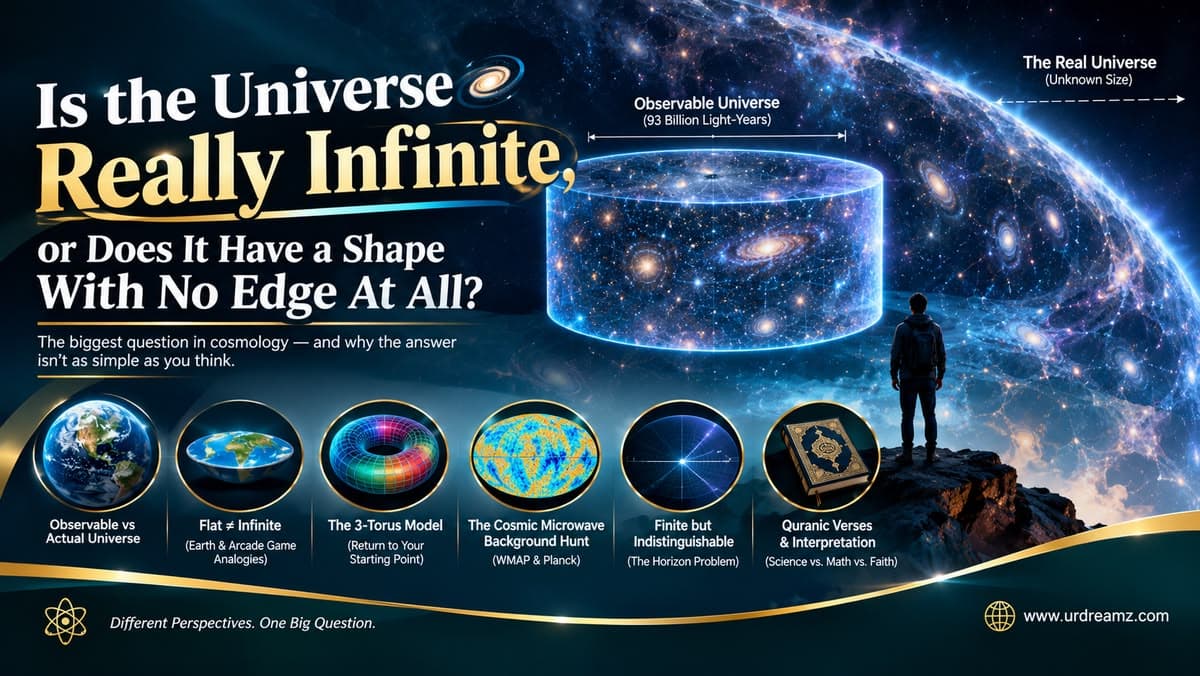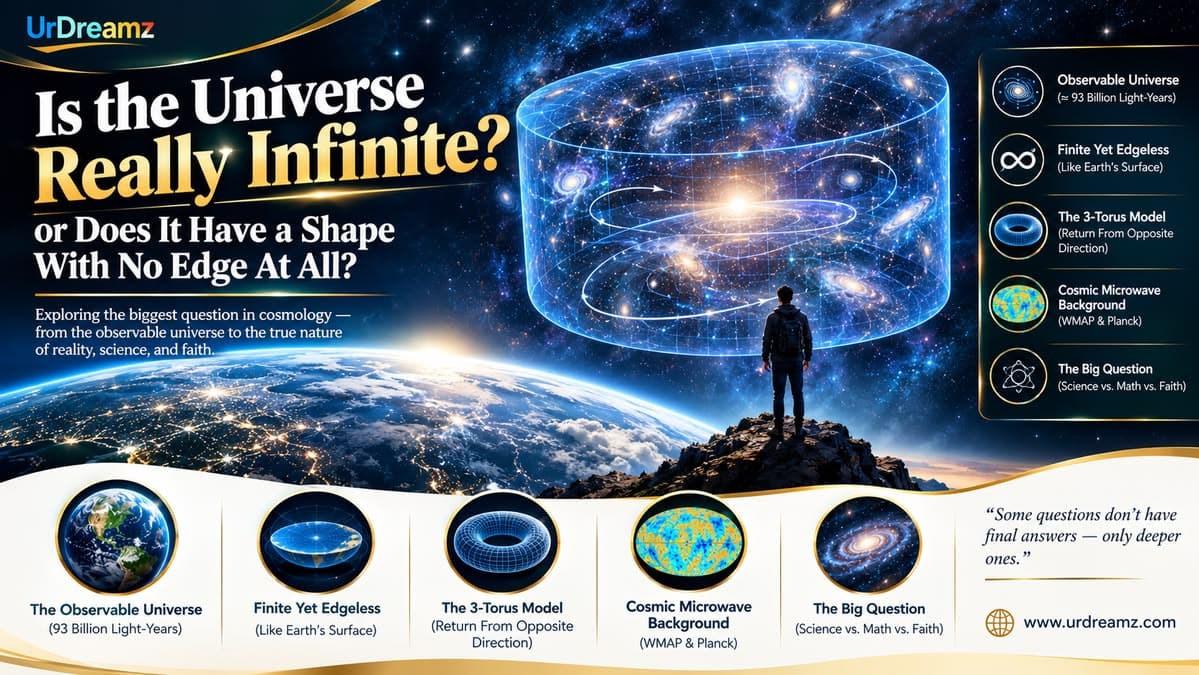
Is the Universe Really Infinite, or Does It Have a Shape With No Edge At All?
Step outside on a clear night, look up, and your mind almost automatically fills in a particular picture: space stretching outward forever in every direction, with no end, no wall, and no final boundary. It feels like the only possibility that makes sense. But is that actually what physics tells us?
Here is the question in its sharpest form. Suppose you could travel at the speed of light in a perfectly straight line for trillions of years. Would you simply keep encountering new stars, new galaxies, and new empty space forever? Or is there a third possibility that most people never consider: that the total volume of the universe is finite, yet it still has no edge, no corner, and no wall you could ever reach?
That third option is not science fiction. It is a serious, actively researched branch of cosmology called cosmic topology, and recent reviews of the field have made clear that it remains genuinely unresolved. This article walks through what the science actually says, where the limits of our knowledge sit, and how believers have reflected on these questions in light of Quranic verses about the heavens, while being careful to separate what is established science, what is open question, and what is interpretation.
The Crucial Distinction Almost Everyone Misses
Before anything else, one distinction has to be firmly in place, because almost every popular misunderstanding of this topic traces back to ignoring it: the observable universe is not the universe.
The observable universe is the region of space from which light has had enough time to reach us. Light travels fast, but it is not infinitely fast, and the universe has a finite age of roughly 13.8 billion years. So there is a hard limit on how far out we can possibly see, not because there is a barrier out there, but because light from beyond that distance simply has not arrived yet.
NASA places the diameter of this observable region at roughly 92 to 93 billion light-years. This figure confuses many people on first encounter. If the universe is only 13.8 billion years old, how can we see 46 billion light-years in each direction? Shouldn't the limit be 13.8 billion light-years?
The answer is that space itself has been expanding the entire time that ancient light was traveling toward us. The photons reaching our telescopes today set out from regions that were much closer at the time of emission, but those regions have since been carried far further away by the ongoing expansion of space. So the light took 13.8 billion years to arrive, while its point of origin is now roughly 46 billion light-years distant. Both statements are simultaneously true.
What NASA and every serious cosmology source are careful to say next is the part that matters most for our question: 93 billion light-years is the limit of what we can see, not a measurement of how big the universe actually is. Science currently has no confirmed total size for the universe, and no confirmed answer to whether it is finite or infinite.
Observable Universe: The Numbers That Matter
What we can actually measure, versus what remains unknown
The first three figures are well-established measurements. The fourth is not a gap in current data collection that better telescopes will simply fill; it may be permanently beyond direct observation.
Scale of What We Can See
Putting the observable universe in perspective against its contents
Bars are illustrative rather than proportionally scaled, since the quantities measure different things. The CMB release at 380,000 years is so early relative to 13.8 billion that it barely registers visually.
Geometry and Topology Are Two Different Questions
To make progress on this puzzle, cosmologists separate two questions that sound similar but are genuinely distinct.
Geometry asks about local curvature. Is the fabric of space flat, like a sheet of paper, positively curved like the surface of a sphere, or negatively curved like a saddle? This is measurable. If you drew an enormous triangle across space, would its angles add up to exactly 180 degrees, more, or less? Precision measurements of the cosmic microwave background have constrained this quite tightly, and the answer appears to be that space is flat, or extremely close to it.
Topology asks a completely different question: how is the whole thing connected? Does traveling far enough in one direction eventually bring you back to where you started? Are there hidden loops in the global structure of space that local measurements simply cannot detect?
Here is the key insight that surprises most people: geometry does not determine topology. Knowing that space is flat does not tell you whether it is infinite or whether it loops back on itself. These are logically independent properties.
The Paper and the Globe: An Analogy That Actually Works
Picture a flat sheet of paper. It has finite area and it has edges. Walk a marble across it and eventually the marble falls off the side. This is the intuitive picture most people have when they imagine a finite universe, and it is precisely why a finite universe feels absurd. What would be at the edge? A wall? What is on the other side of the wall?
Now picture the surface of the Earth. Its area is finite, roughly 510 million square kilometers, a specific and measurable number. But walk in any direction you like, as far as you like, and you will never reach an edge. There is no point on Earth's surface where you fall off into nothing. Keep walking in a straight line and you eventually arrive back at your starting point, having circumnavigated the globe.
The Earth's surface is finite but unbounded. It has a limited total area and yet possesses no edge whatsoever.
Now make the conceptual leap. The Earth's surface is two-dimensional, curved through a third dimension. Mathematicians have known for well over a century that three-dimensional spaces can have exactly the same property: finite total volume, no boundary anywhere. We cannot easily visualize this, because visualizing it would require imagining curvature through a fourth spatial dimension, and human brains are not built for that. But mathematically, such spaces are entirely consistent and well-understood.
The Video Game That Explains Cosmic Topology
There is a second analogy that is arguably even more useful, because it does not require any curvature at all.
Think of an old arcade game like Asteroids or Pac-Man. Your ship flies off the right edge of the screen and instantly reappears on the left. Fly off the top, come back from the bottom. Within that game world, there is no wall, no edge, no boundary. Yet the total playable area is obviously finite, just a single screen.
The screen is flat. There is no curvature whatsoever. And yet it is finite and edgeless, because the edges are identified with each other: the right edge and the left edge are the same edge.
This is exactly the structure cosmologists call a torus. Extend it to three dimensions and you get a 3-torus, one of the most studied candidate topologies for our universe. In a 3-torus universe, space is locally flat, matching our observations perfectly, but traveling far enough in any direction brings you back to your starting point from the opposite side.
The implication is genuinely startling. In such a universe, an astronaut traveling in a perfectly straight line for billions of light-years could, in principle, arrive back at our own solar system approaching from the opposite direction, never having turned around and never having crossed any boundary. This remains theoretical, with no confirmed evidence, but it is mathematically coherent and fully consistent with a flat geometry.
| Model | Total Volume | Has an Edge? | Local Geometry | Currently Ruled Out? |
|---|---|---|---|---|
| Infinite flat space | Infinite | No | Flat | No, remains viable |
| 3-Torus (small) | Finite | No | Flat | Small versions largely excluded |
| 3-Torus (large) | Finite | No | Flat | No, remains viable |
| Spherical (closed) | Finite | No | Positively curved | Disfavoured but not eliminated |
| Flat sheet with edges | Finite | Yes | Flat | Not considered in modern cosmology |
The Myth: "Flat Means Infinite"
This deserves its own section because it is one of the most persistent errors in popular science writing about cosmology.
You will frequently read that measurements showing space to be flat therefore prove the universe is infinite. This inference is simply incorrect. Flatness is a statement about local curvature. Infinitude is a statement about global topology. As the video game example demonstrates, a space can be perfectly flat everywhere and still be finite and edgeless.
Mathematicians have catalogued the possibilities. For flat three-dimensional space, there are exactly eighteen distinct topologies that are both flat and finite in at least one direction, along with the infinite option. The 3-torus is only one of them. Others involve twists and screw motions, where traveling around the universe brings you back rotated or reflected relative to how you started.
So when someone says "science has proven the universe is flat, therefore it goes on forever," they have made a logical jump that the mathematics does not support.
How You Would Actually Test This: Circles in the Sky
If the universe loops back on itself, and if the loop is small enough to fit inside our observable horizon, there should be a detectable fingerprint. This is where the cosmic microwave background becomes the central tool.
The CMB is the oldest light in existence, released roughly 380,000 years after the Big Bang when the universe cooled enough for atoms to form and the primordial fog cleared. It surrounds us as a nearly uniform glow, mapped with extraordinary precision by missions including NASA's WMAP and the European Space Agency's Planck observatory.
Here is the logic of the test. In a universe that wraps around, light from a single distant region could reach us by more than one path, arriving from two different directions in the sky. Geometrically, this would mean the sphere of the last scattering surface intersects itself, and those intersections would appear as pairs of circles on our sky showing the same pattern of temperature fluctuations, just viewed from different angles.
These are called matched circles, or more evocatively, "circles in the sky." Finding a matched pair would be near-definitive evidence of cosmic topology. It would tell us the universe is finite and it would let us measure its size directly.
The Search for Matched Circles: A Timeline
How the hunt for evidence of cosmic topology has unfolded
The pattern here is important: negative results have excluded specific, simple models rather than settling the underlying question. Recent literature has explicitly revisited whether earlier searches were as conclusive as they were treated at the time.
What the Searches Actually Found, and What They Did Not
This is where precision matters enormously, because the popular summary of the search results is more definitive than the actual scientific record justifies.
Early searches through WMAP data reported no matched circles above a certain angular size, and this was widely reported as ruling out a finite, multiply-connected universe. That interpretation calcified into something close to consensus for years: any nontrivial topology must repeat at scales larger than our observable horizon, or not exist at all.
But the picture has become considerably more nuanced. A significant limitation of the early searches is that they primarily looked for circles that were back-to-back, appearing in exactly opposite directions on the sky. That assumption works for some topologies and fails for others. Many multiply-connected spaces, particularly those involving twists or screw motions, produce matched circles that are not antipodal at all. Searching only for opposite-facing pairs and finding none does not exclude topologies that would never have produced opposite-facing pairs in the first place.
Recent work has reinforced this reassessment. Analysis published in Physical Review Letters in 2024 demonstrated that observational constraints from the absence of matched circles still leave many topological possibilities open, and that the shortest distance around the universe may not be much larger than the horizon diameter if certain CMB anomalies do have a topological origin. Scientific American ran a feature in 2026 under the headline that we thought we knew the shape of the universe and were wrong, describing precisely how a premature consensus formed.
The honest summary: searches have narrowed the field. They have not closed the question.
| Claim | Status | Explanation |
|---|---|---|
| The universe is 93 billion light-years across | Partly true | That is the observable region only, not the total universe |
| Flat geometry proves infinity | False | Flat spaces can be finite and edgeless; eighteen such topologies exist mathematically |
| No matched circles found, so topology is ruled out | Overstated | Searches focused on back-to-back circles; many topologies produce non-antipodal ones |
| The universe has an edge somewhere | Not in modern cosmology | No mainstream model proposes a wall or boundary of space |
| Science has settled whether the universe is finite | False | This remains genuinely open and actively researched |
The Fundamental Difficulty: We Might Be Inside a Very Large Loop
There is a structural problem with this entire research program that may never be solvable, and it deserves to be stated plainly.
Suppose the universe genuinely is finite, but the scale at which it repeats is substantially larger than our observable horizon of 93 billion light-years. In that case, no matched circles would appear in the CMB, because the light has not had time to travel all the way around. The curvature would be so gentle across our visible patch that space would look perfectly flat to every measurement we could make. Every observation would be consistent with an infinite universe, and yet the universe would be finite.
In other words, a sufficiently large finite universe is observationally indistinguishable from an infinite one. This is not a temporary limitation waiting on better instruments. It is a limit imposed by the finite speed of light and the finite age of the cosmos.
Future missions will push the boundaries of what can be tested. LiteBIRD, a planned space mission focused on CMB polarization, and large-scale three-dimensional galaxy mapping surveys will refine our constraints considerably. But they cannot see beyond the horizon, and no instrument ever will.
Why a Large Finite Universe Looks Exactly Like an Infinite One
The observational problem that may be permanently unsolvable
This diagram is schematic, not to scale. If the repeating scale of a finite universe exceeds our observable horizon, no matched circles appear, curvature registers as flat, and the finite and infinite cases become observationally identical.
One Thing Modern Cosmology Firmly Rejects: An Edge
Whatever the final answer turns out to be, there is one scenario that no serious cosmological model includes: a place where space simply stops and you encounter a wall.
The logic is straightforward. If the universe is infinite, the question of an edge dissolves entirely; there is nothing to reach. If the universe is finite, it is finite in the manner of a sphere's surface or a torus, curved or connected back on itself such that a traveler can move forever without ever encountering a terminus.
So the common mental image of a finite universe, a bounded box with walls and something mysterious beyond them, is not what cosmologists mean when they discuss a finite universe. That picture does not appear anywhere in the mathematics. Finite, in this context, has always meant finite and unbounded.
Reflecting on the Quran and the Expanding Heavens
Many Muslim readers approach these questions with a verse in mind that has been widely cited in discussions of cosmology.
وَالسَّمَاءَ بَنَيْنَاهَا بِأَيْدٍ وَإِنَّا لَمُوسِعُونَ
"And the heaven We constructed with strength, and indeed, We are [its] expander."
Surah Adh-Dhariyat, verse 47
Classical commentators, including Ibn Kathir, discussed this verse primarily in terms of Allah's power and the vastness of His creation, drawing readers toward reflection on divine majesty rather than toward any particular physical model. Many contemporary Muslim writers have noted the resonance between the verse's language of expansion and modern cosmology's discovery that space itself is expanding.
It is worth approaching this carefully and honestly. The Quran is guidance, not a physics textbook, and reading it as one carries real risks. Scientific models change. Tying a verse too tightly to a specific current theory means that if the theory is later revised, the association becomes a liability rather than a support. The more sustainable approach, favoured by many scholars, is reflection rather than proof-texting: the verse invites contemplation of a creation whose scale genuinely exceeds human comprehension, and modern cosmology has, if anything, deepened that sense of scale enormously.
The Seven Heavens Interpretation, and Why It Requires Care
A specific interpretation circulates in these discussions that deserves direct, respectful engagement. The argument runs roughly as follows: Surah Al-Mulk describes Allah adorning the lowest heaven with lamps. Therefore everywhere stars exist belongs to the first heaven alone. Therefore the entire cosmos, observable and unobservable together, constitutes only the first heaven and first earth, with six further heavens above and six further earths below. Therefore the universe is definitively finite.
وَلَقَدْ زَيَّنَّا السَّمَاءَ الدُّنْيَا بِمَصَابِيحَ
"And We have certainly beautified the nearest heaven with stars."
Surah Al-Mulk, verse 5
Several things should be said about this. First, the verses themselves are authentic and the concept of seven heavens appears in multiple places in the Quran, as does a reference to a corresponding number of earths in Surah At-Talaq, verse 12. These are not disputed texts.
Second, what the seven heavens actually are has been a subject of considerable scholarly discussion across Islamic history, and there has never been unanimous agreement on mapping them onto physical astronomical structures. Classical commentators offered varied views. Some understood them as physical layers. Some understood them as realms not accessible to ordinary observation. Some declined to speculate, treating the matter as belonging to the unseen, al-ghayb, which Allah has not given us the means to investigate.
Third, and most importantly for the purposes of this article: the conclusion that "therefore the universe is finite" is a theological inference, not a scientific finding. It may well be correct. But it is not something cosmology has demonstrated, and presenting it as though physics has confirmed it conflates two different kinds of claim. A person may hold this interpretation with full conviction as a matter of belief while simultaneously acknowledging that science, working within its own methods and limits, has not settled the question.
That honest separation actually strengthens both domains. It protects the religious conviction from becoming hostage to the next revision of a cosmological model, and it keeps the scientific discussion clear about what evidence does and does not show.
| Statement | Type of Claim | Basis |
|---|---|---|
| The observable universe is ~93 billion light-years across | Scientific measurement | Observation and calculation, well-established |
| A flat universe can still be finite and edgeless | Mathematical fact | Proven in differential geometry and topology |
| Space itself is expanding | Scientific measurement | Observed redshift, CMB, extensively confirmed |
| The Quran describes seven heavens | Textual fact | Explicit in multiple verses |
| The cosmos equals only the first heaven | Theological interpretation | One reading among several; not a scientific finding |
| The universe is definitively finite | Currently unresolved | Neither confirmed nor refuted by available evidence |
Where Genuine Humility Enters
There is something worth sitting with in the position we actually occupy. We are beings on a small planet, orbiting an ordinary star, in one galaxy among an estimated two trillion within our observable horizon alone. Our entire capacity to observe the cosmos is bounded by a sphere defined by the speed of light and the age of the universe, and beyond that sphere lies a region whose extent we cannot measure and may never be able to measure.
Within that bounded view, we have worked out that space is expanding, mapped radiation from 380,000 years after the beginning, catalogued billions of galaxies, and determined the geometry of space to remarkable precision. These are extraordinary achievements produced by a species that has only had telescopes for four centuries.
And still, one of the most basic questions imaginable, is there an end to all this, remains unanswered. Not because scientists have been careless, but because the honest answer is that the evidence available to us does not determine it.
For a believer, this is where reflection naturally deepens. The Quran repeatedly invites contemplation of the heavens and the earth as signs, and the modern picture makes that invitation more vivid rather than less. For anyone, believer or not, there is something genuinely humbling in reaching the edge of what can be known and finding that the universe still has not finished surprising us.
What Comes Next in the Research
The question is not being abandoned. Several efforts will sharpen our constraints in the coming years.
LiteBIRD, a planned Japanese-led space mission, will measure CMB polarization with unprecedented sensitivity, potentially revealing topological signatures that temperature maps alone could miss. Large-scale galaxy surveys building three-dimensional maps of cosmic structure offer an independent route: if space wraps around, the pattern of galaxy distribution should carry correlations reflecting that.
New analytical methods matter too. As researchers have recognized that earlier searches were narrower than appreciated, more comprehensive computational frameworks are being developed to search for the full range of possible matched-circle configurations, including the non-antipodal ones that earlier work largely missed.
None of this guarantees an answer. If the universe is finite but very large, these efforts will find nothing, and the absence will remain ambiguous. But the search itself represents something admirable: a sustained attempt to determine the shape of everything, conducted from within a very small corner of it.
Where the Question Stands Today
Confidence levels across the main open questions in cosmic topology
The proportions shown reflect the qualitative state of the field as described in recent reviews, not a formal quantitative assessment. The largest remaining segment is the one that matters most to the headline question.
Final Thoughts
So, is the universe infinite, or does it have a finite shape with no edge at all?
The honest answer is that nobody knows, and the reasons for not knowing are themselves illuminating. We know the observable universe spans roughly 93 billion light-years, that space is expanding, and that local geometry is flat or nearly so. We know that flatness does not imply infinity, that finite-and-edgeless universes are mathematically coherent, and that searches for matched circles have narrowed the possibilities without eliminating them. We know that no mainstream model includes an edge in the sense of a wall.
What we do not know is the total size, the global topology, or whether the question is even answerable in principle from inside a light-speed-limited horizon.
For those who approach this with faith, the Quranic invitation to reflect on the heavens sits comfortably alongside this uncertainty, provided we keep clear about which claims rest on observation and which rest on interpretation. For everyone, the situation is a reminder that the limits of human knowledge are real, that certainty is often claimed more readily than it is earned, and that some of the oldest questions we have asked remain, magnificently, still open.
Frequently Asked Questions
How big is the universe? The observable universe is approximately 93 billion light-years in diameter. The total size of the entire universe is unknown, and science has not determined whether it is finite or infinite.
If the universe is 13.8 billion years old, how can it be 93 billion light-years across? Because space itself has expanded while light traveled toward us. Light took 13.8 billion years to arrive, but the regions that emitted it have since been carried much further away by cosmic expansion.
Does a flat universe have to be infinite? No. This is a common misconception. Flatness describes local curvature; infinitude describes global topology. Mathematically there are eighteen distinct flat topologies that are finite in at least one direction, including the 3-torus.
What are matched circles? If the universe wraps around on itself, light from one region could reach us by two different paths, producing pairs of circles in the cosmic microwave background with identical temperature patterns. Finding such a pair would be strong evidence of a finite, multiply-connected universe.
Have scientists ruled out a finite universe? No. Searches through WMAP and Planck data excluded certain simple, small topologies, but those searches focused primarily on back-to-back circles and many topologies remain viable. Recent work has explicitly revisited whether the earlier consensus was premature.
Could the universe have an edge or a wall? No mainstream cosmological model proposes one. If infinite, there is nothing to reach. If finite, it is finite in the way a sphere's surface is finite, curved or connected such that no boundary is ever encountered.
Does the Quran say whether the universe is finite? The Quran describes seven heavens and refers to Allah expanding the heaven. How these descriptions relate to modern cosmological models is a matter of interpretation on which scholars have historically differed, and it is not something physics has confirmed or denied.
Will we ever know the answer? Possibly, if the universe is finite at a scale smaller than our observable horizon and future missions detect the signature. If it is finite but much larger, it may remain observationally indistinguishable from an infinite universe permanently.