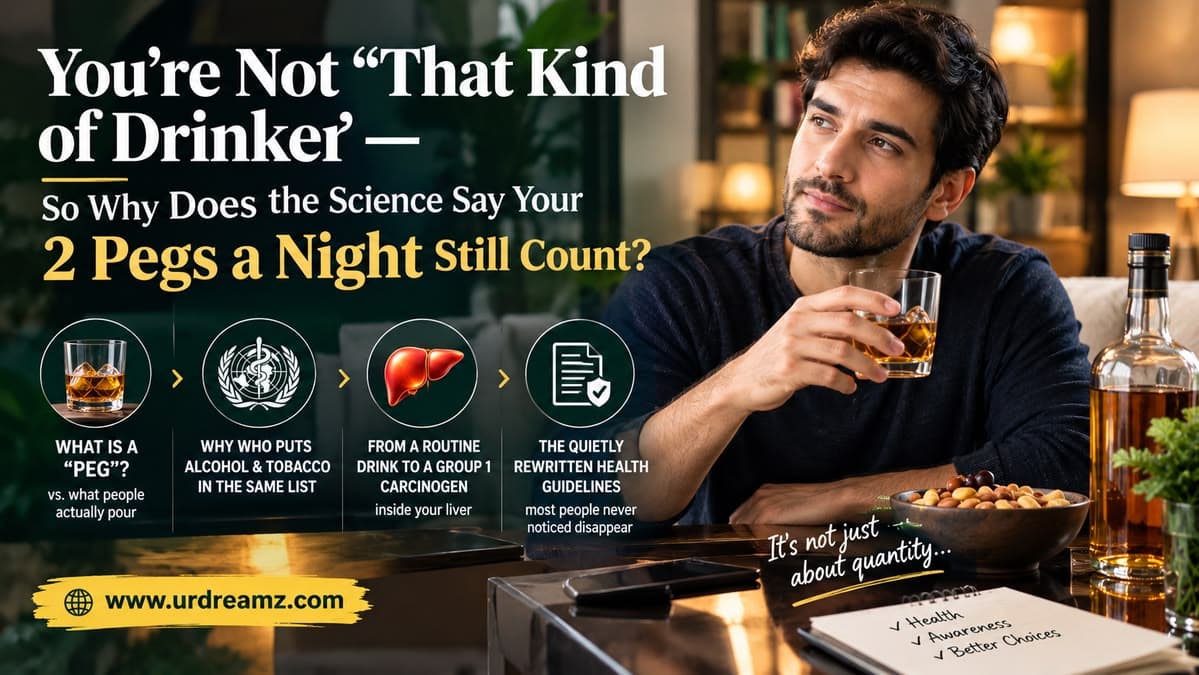
You're Not "That Kind" of Drinker — So Why Does the Science Say Your 2 Pegs a Night Still Count?
You're not an "alcoholic." Obviously not. That word belongs to someone else — someone struggling, someone who's lost control, not someone who comes home from work, opens a bottle, makes a small plate of something to go with it, has two pegs, sleeps well, and is back at the office by nine the next morning, functioning perfectly. You even have a line ready: "It's just two pegs. Doctors themselves say a little alcohol is fine for the heart." If that's really the whole picture, then fair enough — you're not who the word "alcoholic" was built to describe. But that leaves two much more useful questions worth actually answering honestly: do you know what real, measurable damage two pegs a day causes over time? And are you even sure that what you're calling "two pegs" is actually two pegs at all, by the standard the very guideline you're quoting was built on?
This article isn't here to lecture or shame — it's here to hand you the actual research, explained in plain language, so you can decide for yourself with real information rather than a comforting stereotype built to describe someone else entirely. We'll look at what a "peg" is actually supposed to measure, why global health authorities place alcohol on the same list as tobacco, what's really happening inside a single cell when alcohol breaks down in your body, why your liver won't tell you anything is wrong until it's already seriously wrong, and a major shift in official drinking guidance that happened quietly, in the first week of 2026, that most people never even noticed.
Quick Answer
Last updated: September 2026
Alcohol is classified by the World Health Organization's International Agency for Research on Cancer (IARC) as a Group 1 carcinogen — the same category as tobacco — with clear evidence linking it to at least seven types of cancer, including breast, liver, and mouth/throat cancers. It breaks down in the liver into acetaldehyde, a toxic, DNA-damaging compound, and does measurable liver damage from the very first drink, even though symptoms often don't appear for years because the liver has no pain receptors to signal early injury. In India, national surveys estimate roughly 16 crore people drink alcohol, and about 5.7 crore — nearly one in three drinkers — are affected by harmful or dependent use. What many casually call "2 pegs" is often, by official standard-drink measurement, closer to 4 standard drinks, since a common "large peg" (60ml) already equals roughly two standard units on its own. In January 2026, the United States quietly removed its long-standing daily drink-limit numbers from federal dietary guidelines, replacing them with vague advice to simply "drink less" — a change public health researchers have widely criticized.
1. Redefining "Alcoholic": Why the Stereotype Misleads Everyone
Ask most people to picture "an alcoholic" and the image that comes up is fairly consistent: someone visibly struggling, disheveled, perhaps homeless, someone whose life has clearly and dramatically fallen apart. That image lets a huge number of regular, functional, evening drinkers off the hook entirely in their own minds — because they don't look anything like that picture. They come home, pour a drink or two, eat dinner with the family, sleep fine, and show up to work the next day. Surely that's a completely different category of person.
Here's the uncomfortable truth this article is built around: the visible stereotype and the biological damage are not the same measurement. Liver cells, blood vessels, and DNA don't check whether someone still holds down a job or maintains a tidy home before deciding whether to sustain damage from repeated alcohol exposure. The research in the sections ahead isn't really about the extreme, visible end of alcohol use — it's about the ordinary, socially acceptable, "just two pegs" pattern that a huge number of otherwise completely functional people quietly maintain for years, often decades, without ever questioning it.
2. What Exactly Is a "Peg"? The Measurement Nobody Actually Measures
Here's a genuinely useful question almost nobody asks: what does "a peg" actually, precisely mean? In casual conversation, it's treated like a fixed, self-evident unit — as though everyone pouring "two pegs" is pouring exactly the same amount. In reality, a peg has never been a scientifically standardized unit in the way a milligram or a milliliter is. It's an informal pour, historically tied to specific volumes, but rarely measured with any actual precision in a typical home setting, where a "peg" is usually just "how much fits when I pour until it looks about right."
3. From the British Raj to Your Living Room: A Brief History of the Peg
The word and the habit both trace back to the British colonial period in India. During British rule, alcohol serving sizes were informally standardized around the imperial fluid ounce — roughly 30 ml — giving rise to the "chota peg" (small peg), with a "bara peg" (large peg) set at roughly double that, around 60 ml. These measurements stuck around long after the British left, becoming deeply embedded in South Asian drinking culture, bar menus, and everyday language — including the far more theatrical "Patiala peg," an oversized, often informally measured pour that can range anywhere from 90 ml to 120 ml or more.
4. The Real-World Peg: What Field Research Found People Actually Pour
Here's where things get genuinely revealing. When researchers actually went into homes, bars, and social settings across different Indian states to measure what people were really pouring when they said "one peg," the results didn't neatly match the textbook 30 ml or 60 ml figures. Field studies documenting real drink sizes across cities like Delhi, Jaipur, and Goa found that respondent-described "standard" pegs commonly ranged from roughly 40 ml up toward 60 ml, with larger "double" or "Patiala" pours reported as high as 80 ml or more — consistently on the higher end of, or beyond, the traditional 30/60 ml assumption most people carry around in their heads.
| Term | Traditional/Textbook Volume | What Field Research Often Finds in Practice |
|---|---|---|
| Chota (small) peg | 30 ml | Often poured closer to 40 ml |
| Bara/Burra (large) peg | 60 ml | Frequently poured at or above 60 ml |
| Patiala peg | 90–120 ml (informal) | Can reach 80 ml or more depending on the pourer |
| International "standard drink" (spirits) | ~25–30 ml at ~40% alcohol | Used as the baseline unit for most global health guidelines |
5. "2 Pegs" vs. "2 Standard Drinks": Why the Math Doesn't Add Up
This is precisely where the comforting "it's just 2 pegs, even doctors say that's fine" line quietly falls apart under its own math. International drinking guidelines are built around a "standard drink" unit — roughly 25 to 30 ml of spirits at typical strength — not around the Indian "large peg" of 60 ml. If someone is pouring two large (bara) pegs each evening, at roughly 60 ml apiece, that's approximately 120 ml of spirits total — which, measured in actual standard-drink units, works out to something closer to four standard drinks, not two. The confusion isn't really about willpower or self-control at all; it's a straightforward, easy-to-miss unit mismatch, and it means a huge number of people who believe they're drinking a modest, "doctor-approved" amount are, by the very standard they're citing, drinking roughly double that.
*Illustrative calculation based on standard-drink unit definitions and common Indian peg sizing; individual pours vary.
6. Meet Acetaldehyde: The Toxic Byproduct Your Own Liver Creates
Once alcohol enters the body, the liver gets to work breaking it down, and the very first thing it turns into isn't harmless — it's a compound called acetaldehyde. Acetaldehyde is itself classified as a carcinogen and is considerably more chemically reactive and toxic than the alcohol it came from, capable of directly damaging cell membranes and interfering with DNA repair processes. It's short-lived — the body quickly converts it further into a less harmful substance — but that brief window is enough for real, cumulative cellular damage to occur, especially with repeated, regular exposure night after night, year after year.
7. The Cell Blueprint Analogy: How Alcohol Sets the Stage for Cancer
Here's a simple way to understand how this translates into cancer risk over time. Every cell in your body carries a kind of internal blueprint — its DNA — that instructs it exactly how to divide and replicate correctly, the same way an architect's map tells construction workers exactly how to build each wall of a house. Acetaldehyde and the broader toxic stress alcohol places on cells can damage this internal blueprint. When the blueprint is damaged, the instructions for building new, correct cells get corrupted too — and a cell built from a damaged blueprint doesn't reliably fold back into a normal, well-behaved cell. Repeated damage of this kind, across enough cell divisions over enough years, is a core part of the biological pathway through which chronic alcohol exposure raises the risk of cancer developing in the tissues most directly exposed to it — a slow, cumulative process happening at a scale far too small to feel or notice, but very real and very measurable under a microscope.
8. WHO's Group 1 List: Why Alcohol Sits Beside Tobacco
The International Agency for Research on Cancer (IARC), the World Health Organization's dedicated cancer research body, maintains a formal classification system ranking substances by how strong the evidence is that they cause cancer in humans. Group 1 is the highest, most certain category — reserved for substances with clear, well-established evidence of causing cancer in humans, not just a suspected or theoretical risk. Tobacco sits in this category. So does alcohol. This isn't a fringe or provisional classification — it reflects decades of accumulated, internationally reviewed research, and it places alcohol in the same tier of established risk as a substance almost nobody would casually defend as "not that big a deal," a comparison worth sitting with the next time alcohol gets waved off as basically harmless in small amounts.
8b. How IARC Actually Decides: Inside the Classification Process
It's worth understanding briefly how a substance actually earns a place in Group 1, since this isn't a casual or hastily made designation. IARC convenes international panels of independent scientists who review the entire published body of evidence — laboratory studies on how a substance behaves at the cellular level, animal studies, and large-scale human epidemiological studies tracking real populations over years or decades. A Group 1 classification specifically requires "sufficient evidence" of carcinogenicity in humans, the strongest possible evidence tier in the system, as opposed to lower categories reserved for substances with only limited, suggestive, or animal-only evidence. Alcohol didn't land in this category based on a handful of studies or a single controversial paper — it reflects a broad, internationally reviewed consensus built from a substantial and consistent body of research spanning many decades and many countries, which is precisely why public health bodies treat this specific classification with such seriousness.
9. The (At Least) 7 Cancers Linked to Alcohol
Alcohol consumption has been linked with strong, consistent evidence to at least seven types of cancer, spanning several different organ systems throughout the body.
| Cancer Type | Part of the Body Affected |
|---|---|
| Mouth (Oral cavity) | Lining of the mouth |
| Pharynx | Throat |
| Larynx | Voice box |
| Esophagus | Food pipe |
| Liver | Primary organ processing alcohol |
| Colorectum | Colon and rectum |
| Breast | Breast tissue (in women) |
The pattern across this list is notable: it isn't confined to just the organs alcohol physically passes through first. Breast tissue, for instance, is affected through alcohol's influence on hormone levels rather than direct physical contact — a reminder that alcohol's cancer risk operates through multiple different biological pathways at once, not a single simple mechanism.
10. Breast Cancer and Alcohol: What the WHO Europe Data Shows
The scale of this specific link is worth sitting with. According to WHO estimates, in the year 2020 alone, alcohol consumption was responsible for close to 40,000 new breast cancer cases across the WHO European Region — a region that also reports the highest rate of new breast cancer diagnoses of any WHO region worldwide. This is not a theoretical, small-print risk buried in a footnote; it represents a substantial, real, measurable share of an extremely common cancer, directly tied to a substance millions of people consume casually and repeatedly without a second thought.
11. "But I Only Drink a Little": The Light-Drinker Cancer Paradox
Here's a detail that surprises most people and deserves to be understood properly rather than dismissed. Because far more people worldwide drink lightly or moderately than drink heavily, a meaningful share of alcohol-related cancer cases overall actually occurs among people who considered themselves light or occasional drinkers — not primarily among the small number of very heavy drinkers, even though heavy drinkers individually carry a higher personal risk. This is a simple, well-established pattern in population health research: when a risk factor is common across a huge population, even a modest individual risk increase, multiplied across millions of "just a little" drinkers, adds up to a large total number of cases — often larger, in absolute terms, than the cases coming from the much smaller group of heavy, obviously at-risk drinkers. In other words, the comforting phrase "I only drink a little" doesn't remove a person from the at-risk population in the way most people assume it does; it just changes their personal odds slightly, without ever bringing them down to zero, and across an entire population of light drinkers, those slightly-elevated individual odds still translate into a very real, very large total number of preventable cases each year.
12. Why Your Liver Stays Silent Until It's Already Too Late
One of the most dangerous features of alcohol-related liver damage is precisely how quiet it is. Liver damage genuinely begins from the very first drink processed — there is no true "safe threshold" below which zero cellular stress occurs — but the liver itself has no pain receptors in the way skin or muscle does. It simply doesn't have a built-in alarm system to signal early injury the way a burn or a cut immediately does. This means someone can accumulate real, measurable liver damage over ten, fifteen, twenty years of "just two pegs a night," feeling completely fine the entire time, right up until symptoms like fatigue, abdominal swelling, or yellowing of the eyes finally appear — usually a sign that the damage has already progressed considerably.
13. Fatty Liver → Inflammation → Cirrhosis: The Hidden Timeline
Alcohol-related liver disease typically progresses through a fairly predictable sequence of stages, each one building quietly on the last.
| Stage | What's Happening | Typically Noticeable? |
|---|---|---|
| Fatty Liver (Steatosis) | Fat begins accumulating within liver cells | Usually no symptoms at all |
| Alcoholic Hepatitis | Inflammation develops within the liver tissue | Often still minimal or vague symptoms |
| Fibrosis | Scar tissue begins replacing healthy liver tissue | Symptoms may begin appearing, often subtle |
| Cirrhosis | Extensive, largely irreversible scarring impairs liver function | Symptoms become clear — fatigue, swelling, jaundice |
This entire progression can take well over a decade, often unfolding almost entirely without pain, which is exactly why so many long-term "moderate" drinkers are caught off guard by a diagnosis that, in hindsight, had been quietly building for years.
13b. Genetics and Alcohol: Why Some People Flush and Others Don't
Some people notice their face, neck, or chest turning visibly red shortly after drinking even a small amount of alcohol — a reaction often brushed off as simply "low tolerance." The real explanation is genetic. A significant portion of people, particularly of East Asian descent, carry a variant of the enzyme responsible for clearing acetaldehyde from the body, meaning acetaldehyde builds up to uncomfortable levels much faster than normal after drinking, causing the flushing, rapid heartbeat, and nausea associated with this reaction. Counterintuitively, this uncomfortable flushing response is actually somewhat protective for most people who experience it, since the discomfort naturally discourages heavier drinking. However, research has found that people who carry this genetic variant but push through the discomfort and continue drinking moderate amounts anyway face a meaningfully higher risk of certain alcohol-related cancers, specifically of the esophagus and head and neck region, compared to people without the variant who drink similar amounts — because their bodies are accumulating higher levels of the toxic acetaldehyde byproduct discussed earlier in this article with every single drink.
14. India's Alcohol Reality: What the 16 Crore Number Means
National survey data from India's National Drug Dependence Treatment Centre (NDDTC) at AIIMS paints a sobering national picture. An estimated 16 crore people across India currently consume alcohol. Of that group, roughly 5.7 crore — about one in every three current drinkers — are estimated to be affected by harmful or dependent alcohol use, meaning they need some form of help or intervention for alcohol-related problems. Crucially, these figures come from population surveys, not hospital admission records — meaning the true number of people affected is very likely even higher once undiagnosed and untreated cases outside the formal healthcare system are accounted for. Separate reporting on treatment access has also noted that only a small fraction of people meeting criteria for alcohol dependence ever actually receive any form of formal treatment or counseling, meaning the visible, treated population represents only a small fraction of the true scale of the issue nationally.
*Based on the National Survey on Extent and Pattern of Substance Use in India, NDDTC, AIIMS.
15. The "Alcohol Is Good for the Heart" Myth — And Why It's Falling Apart
For years, a popular, widely repeated belief held that moderate drinking — particularly red wine — offered real cardiovascular benefits. This idea shaped public perception for decades and gave countless regular drinkers a reassuring, science-sounding justification for their habit. More recent, methodologically stronger research has substantially undermined this claim. Larger, more carefully designed studies examining people who began drinking earlier or drank even modest amounts have found higher overall death rates in these groups compared to genuine lifelong non-drinkers, including a notable share of deaths from heart-related causes specifically — directly contradicting the old "a little wine protects your heart" narrative.
16. The Sick-Quitter Bias: How Older Studies Got It Wrong
So how did the "alcohol is heart-healthy" idea gain so much traction in the first place, if the evidence doesn't actually hold up? A significant part of the answer lies in a well-recognized flaw called the "sick-quitter" bias. Many of the older studies comparing moderate drinkers to "non-drinkers" lumped together two very different kinds of non-drinkers into a single comparison group: genuine lifelong abstainers, and people who used to drink but stopped specifically because they had already developed a health problem. Because that second group was often already sicker for reasons entirely unrelated to alcohol, their outcomes dragged down the entire "non-drinker" comparison group's average health statistics — making moderate drinkers look artificially healthier by comparison, purely as a statistical artifact rather than a genuine protective effect of alcohol itself. Once more careful studies corrected for this bias by properly separating lifelong non-drinkers from former drinkers who quit due to illness, much of the apparent heart-health benefit of moderate drinking largely disappeared, revealing that a genuine methodological flaw, rather than any real protective property of alcohol, had been driving the headline for years.
16b. Beyond the Heart: Other "Benefits" Myths Worth Questioning
The heart-health claim isn't the only alcohol "benefit" that deserves closer scrutiny. The idea that alcohol helps with sleep is another common misconception — while it can help someone fall asleep faster initially, it disrupts the deeper, more restorative stages of sleep later in the night, as discussed further in this article, meaning the net effect on genuine rest is negative rather than positive. The belief that alcohol effectively relieves stress is similarly incomplete — it may provide short-term relaxation, but regular use as a coping mechanism has been linked to worsened anxiety over time, partly because of how withdrawal between drinking episodes affects the nervous system, creating a cycle where alcohol is increasingly needed just to return to a baseline level of calm rather than genuinely reduce stress below that baseline. In each case, a real, short-term effect gets mistaken for a genuine long-term benefit, when the fuller picture, examined over months and years rather than a single evening, tells a considerably less flattering story.
17. January 2026: The Guidelines That Quietly Disappeared
Here's a genuinely significant, recent development that slipped past most people's attention entirely. In its newly released 2025–2030 Dietary Guidelines, published in the first week of January 2026, the United States government removed its long-standing specific daily drink-limit numbers — the widely cited "two drinks a day for men, one for women" benchmark that had guided public health messaging for decades. In its place, the new guidance simply advises people to "consume less alcohol for better overall health," without defining any specific quantity at all. Public health researchers and reporting on the change noted that internal government analyses highlighting alcohol's cancer risk and preventable-death data appear to have been set aside in the final version, and the update also dropped explicit prior language connecting alcohol consumption to cancer risk. This means the very reference point so many casual drinkers use to reassure themselves — "the guideline says X drinks is fine" — has itself been quietly removed from the source document, precisely at a moment when the underlying cancer research pointing the other direction has never been stronger, leaving a genuine gap between what official guidance now says and what the scientific evidence itself continues to show.
18. Alcohol vs. Tobacco: Same List, Very Different Warning Labels
Perhaps the starkest contradiction in how society treats these two substances shows up on the packaging itself. Tobacco products across most countries are legally required to carry large, graphic warning labels — often including images of damaged lungs — directly confronting the buyer with the health risk at the point of purchase. Alcohol bottles, despite sitting in the very same Group 1 carcinogen category according to the same international research body, typically carry no comparable graphic warning at all in most markets, often nothing more than a small, easily overlooked text disclaimer, if anything. This isn't a reflection of the underlying science being any less serious for one substance than the other — it reflects differences in regulation, industry influence, and cultural normalization, not a genuine difference in classified cancer risk.
19. Hidden Drinking: Recognizing Concealed or Underestimated Consumption
Beyond outright concealment, one of the more common and easily overlooked patterns is simply underestimating one's own consumption — not necessarily hiding bottles, but genuinely, honestly miscounting due to inconsistent pour sizes, "topping up" a glass that was never fully empty, or mentally rounding down after a couple of drinks. True concealment does happen too, and it's worth being aware of the common patterns, both for self-reflection and for recognizing it in a loved one.
| Sign | What It Can Indicate |
|---|---|
| Drinking alone before a social event "to take the edge off" | Consumption beyond what's being openly acknowledged |
| Inconsistent counting ("just a couple" said repeatedly, imprecisely) | Genuine underestimation of actual volume consumed |
| Keeping drinks in unmarked containers or unusual locations | A pattern sometimes associated with concealment |
| Irritability or defensiveness when the topic is raised | Can signal discomfort with facing actual consumption levels |
| Needing progressively more to feel the same effect | A sign of developing tolerance, worth taking seriously |
None of these signs alone proves a serious problem — but noticing more than one, in yourself or someone close to you, is a reasonable prompt for honest reflection rather than automatic dismissal.
20. Sleep, Metabolism, and What Else Alcohol Quietly Sabotages
Beyond cancer and liver disease, alcohol undermines several other pillars of everyday health in ways that are easy to overlook because they don't feel dramatic in the moment. It disrupts REM sleep specifically — the deep stage where the brain does much of its overnight repair and memory consolidation — which is part of why a night of drinking can leave someone feeling tired even after a full night technically spent in bed. It also disrupts normal metabolism, since the liver prioritizes breaking down alcohol over its other usual functions, temporarily halting fat metabolism, disturbing blood sugar regulation, and promoting low-grade inflammation throughout the body — effects that compound quietly over years of regular use.
21. Brain Volume and Alcohol: What Regular Drinking Does to the Mind
Regular alcohol consumption has also been linked to measurable changes in brain structure over time, including reductions in overall brain volume and damage to the white matter responsible for efficiently transmitting signals between different brain regions. This isn't necessarily dramatic or immediately noticeable day to day, but it represents a genuine, cumulative form of wear on the very organ responsible for memory, decision-making, and long-term cognitive health — another example of damage that builds quietly in the background of an otherwise "normal," functional drinking pattern.
21b. Alcohol and Nutrient Deficiency: The Vitamin Connection
Regular alcohol consumption interferes with nutrient absorption and processing in several specific ways, contributing to deficiencies that most people never connect back to their drinking habits. Alcohol irritates the lining of the digestive tract, reducing the body's ability to properly absorb several key nutrients, and it also increases the body's excretion of certain vitamins through urine. Thiamine (vitamin B1) deficiency is one of the most well-documented consequences, since alcohol interferes with its absorption and storage, and in severe, prolonged cases can contribute to serious neurological complications. Folate (vitamin B9), vitamin B12, and zinc levels are also commonly reduced in regular drinkers, while alcohol's impact on liver function can additionally impair the body's ability to store and activate vitamin D. These deficiencies compound quietly alongside the liver and cancer risks already discussed, contributing to fatigue, impaired immune function, and, in the case of thiamine specifically, potential cognitive effects — yet another layer of harm that builds silently underneath an outwardly "normal," functional drinking pattern.
21c. Gut Health and Inflammation: The Lesser-Known Alcohol Connection
Alcohol's relationship with chronic, low-grade inflammation throughout the body deserves more attention than it typically receives. Regular alcohol exposure damages the protective lining of the gut, increasing what researchers sometimes call intestinal permeability — allowing bacterial byproducts that should normally stay contained within the digestive tract to leak into the bloodstream in small amounts. The immune system responds to this leakage with an ongoing, low-level inflammatory response, since it's essentially detecting material that shouldn't be circulating freely in the blood. This chronic inflammatory state has been linked in research to a wide range of downstream effects, including worsened liver damage, increased cardiovascular strain, and disrupted mood regulation, since inflammatory signaling molecules can also affect brain chemistry. This gut-driven inflammatory pathway is increasingly recognized as one of the more significant, if underappreciated, mechanisms connecting regular alcohol consumption to a broad range of seemingly unrelated health complaints — from persistent low energy to skin issues to a general sense of not feeling quite right, without an obvious single cause.
21d. What Alcohol Does to the Kidneys
The kidneys, much like the liver, quietly absorb ongoing damage from regular alcohol use without generating obvious early symptoms. Alcohol has a diuretic effect, meaning it increases urine production and can lead to dehydration, which forces the kidneys to work harder to maintain the body's fluid and electrolyte balance. Over time, regular heavy drinking has been associated with an increased risk of chronic kidney disease, partly through alcohol's contribution to high blood pressure, a major driver of kidney damage, and partly through direct effects on kidney tissue itself. Alcohol also interferes with the kidneys' ability to properly regulate sodium, potassium, and other electrolytes, disruptions that compound the fluid-balance issues already caused by dehydration. As with the liver, the kidneys generally don't provide reliable early warning symptoms of this kind of gradual damage, meaning routine checkups involving basic kidney function blood tests are one of the few genuinely reliable ways to catch developing issues before they become serious.
22. A Brief, Respectful Note on Religious Perspectives
Beyond the medical research, it's worth acknowledging that many religious traditions, including Islam, have historically taken a clear position prohibiting alcohol consumption entirely — a stance that, viewed alongside the modern research discussed throughout this article, has aged in a way that many contemporary public health bodies are only now fully catching up to, decades or centuries later.
23. So Should You Never Drink Again? Setting Realistic Expectations
This article isn't positioned to make that decision for anyone — that remains a personal choice, made with genuinely accurate information rather than a comforting stereotype about what "a real problem" looks like. What the research does make clear is that there is no fully risk-free amount of alcohol, that risk rises with quantity and frequency but doesn't start at zero, and that the popular "just 2 pegs, doctors say it's fine" reassurance is often built on a measurement mismatch rather than solid, current medical consensus. Whatever someone decides to do with that information going forward, doing so with an accurate picture, rather than a flattering assumption, is the actual point of this entire piece.
23b. A Final Word: Information, Not Judgment
It's worth returning, at the end of all this, to where this article began — with the comfortable stereotype of "an alcoholic" as someone else entirely, someone visibly struggling, nothing like a regular person with two pegs and a stable job. That stereotype isn't wrong, exactly; it's just incomplete, and it quietly does a lot of work letting a much larger group of people off the hook from ever examining their own habits closely. The goal of walking through the peg-measurement confusion, the acetaldehyde mechanism, the WHO's carcinogen classification, and the quietly rewritten dietary guidelines wasn't to hand anyone a diagnosis or a verdict — it was to close the gap between what people assume they're consuming and what they're actually consuming, and between what they believe the science says and what it currently, genuinely says. What anyone chooses to do with that closed gap is, as it should be, entirely their own decision to make.
24. How to Actually Cut Back: Practical, Realistic Steps
For anyone who reads all of this and wants to genuinely reduce their intake rather than simply feel briefly guilty about it, a few practical, realistic starting points tend to help far more than an abrupt, all-or-nothing resolution. Using an actual measuring tool at home rather than a "looks about right" pour immediately closes the measurement gap discussed earlier. Building in two or three completely alcohol-free days each week, rather than drinking daily out of pure habit, gives the liver genuine recovery time. Replacing the specific evening ritual — not just the drink itself, but the wind-down routine around it — with something else satisfying, like a short walk, a warm drink, or a call with a friend, addresses the habit loop rather than just the substance. And tracking actual intake honestly for a couple of weeks, without judgment, often reveals a real number meaningfully higher than the casual mental estimate most people carry around.
It also helps to plan for specific high-risk moments rather than relying purely on willpower in the moment itself — deciding in advance what to order at a social gathering, or having a non-alcoholic drink ready in hand before anyone can offer a top-up, removes a surprising amount of the friction involved in cutting back. None of these strategies require framing the change as a dramatic, all-or-nothing lifestyle overhaul; small, specific, repeatable adjustments tend to stick far better than a single sweeping resolution made in a moment of guilt, only to quietly fade within a few weeks.
25. When to Seek Professional Help
Certain signs warrant reaching out to a doctor or addiction specialist rather than attempting to manage things alone: experiencing withdrawal symptoms like shakiness, sweating, or anxiety when not drinking; needing progressively larger amounts to feel the same effect; repeated unsuccessful attempts to cut back; or drinking continuing despite clear, acknowledged harm to health, relationships, or work. Reaching out at this stage isn't a sign of the extreme, visible stereotype discussed at the very start of this article — it's simply the medically appropriate next step, and one that a large, mostly invisible number of otherwise completely functional people genuinely need, whether or not they currently see themselves that way.
25b. Withdrawal Symptoms: What Happens When a Regular Drinker Stops
For someone who has been drinking regularly over an extended period, suddenly stopping can trigger withdrawal symptoms, since the body has gradually adjusted its own chemistry to function with alcohol consistently present. Mild withdrawal commonly includes anxiety, irritability, sweating, tremors (particularly noticeable in the hands), headache, nausea, and difficulty sleeping, typically beginning within several hours to a day after the last drink. In more significant, longer-term drinking patterns, withdrawal can become considerably more serious, potentially including a racing heart, high blood pressure, hallucinations, seizures, or a severe condition called delirium tremens — a genuine medical emergency requiring immediate professional care. This is precisely why anyone with a longer history of regular, heavier drinking is generally advised not to attempt stopping abruptly and alone, but rather under medical supervision, where symptoms can be safely managed and, if necessary, medically treated as they arise.
25c. Alcohol Poisoning: Recognizing a Medical Emergency
Separate from long-term health effects, it's important to recognize the signs of acute alcohol poisoning, since this is a genuine, immediate medical emergency that can occur even in someone without any history of regular heavy drinking, simply from consuming too much too quickly on a single occasion. Warning signs include confusion, vomiting, seizures, slow or irregular breathing, blue-tinged or pale skin, low body temperature, and being unable to be woken up. If someone shows these signs, they should never simply be left to "sleep it off" — emergency medical help should be sought immediately, the person should be kept sitting up or on their side rather than lying flat on their back to prevent choking if they vomit, and they should not be left alone under any circumstances until help arrives. Alcohol poisoning can be fatal, and hesitating to seek help out of embarrassment or fear of getting someone in trouble has cost lives that timely intervention could have saved.
26. Frequently Asked Questions
Is alcohol really classified in the same cancer-risk category as tobacco?
Yes. The WHO's International Agency for Research on Cancer places both alcohol and tobacco in Group 1, its highest classification for substances with clear, established evidence of causing cancer in humans.
How many types of cancer are linked to alcohol?
At least seven, including cancers of the mouth, throat, larynx, esophagus, liver, colorectum, and breast.
Is "2 pegs" really more alcohol than people think?
Often, yes. A common large (60ml) peg already equals roughly two international standard drinks, meaning two large pegs can amount to about four standard drinks rather than two.
Does alcohol actually protect the heart in moderation?
This once-popular belief has been substantially undermined by more recent research, partly due to a methodological flaw called the sick-quitter bias in older studies, which made moderate drinkers appear artificially healthier by comparison.
Why doesn't liver damage from alcohol show symptoms earlier?
The liver has no pain receptors, so significant damage such as fatty liver or early inflammation can build silently for years before any noticeable symptoms appear.
How many people in India are affected by alcohol use?
National survey data estimates about 16 crore current alcohol users in India, with roughly 5.7 crore, or about one in three, affected by harmful or dependent use.
What changed in the January 2026 U.S. dietary guidelines?
The specific daily drink-limit numbers (two drinks for men, one for women) were removed and replaced with the vague guidance to "consume less alcohol for better overall health," a change public health researchers have criticized.
Do light or occasional drinkers really face meaningful cancer risk?
Because far more people drink lightly than heavily, a substantial share of total alcohol-related cancer cases occurs among light-to-moderate drinkers, even though each individual's personal risk is lower than a heavy drinker's.
Why do alcohol bottles not carry warning labels like cigarette packets?
This reflects differences in regulation and industry influence rather than a genuine difference in classified cancer risk, since both substances are classified in the same top-tier carcinogen category.
What is acetaldehyde and why does it matter?
Acetaldehyde is the first toxic compound alcohol breaks down into inside the liver. It is itself classified as a carcinogen and can damage cell membranes and DNA, contributing to alcohol's cancer risk.
Why do some people turn red or flush when they drink alcohol?
This flushing reaction is usually genetic, caused by a variant enzyme that clears acetaldehyde more slowly, allowing it to build up in the body. People with this variant who drink anyway face a higher risk of certain alcohol-related cancers.
Does alcohol cause vitamin deficiencies?
Yes. Regular alcohol use commonly reduces absorption and storage of thiamine (B1), folate (B9), vitamin B12, zinc, and vitamin D, contributing to fatigue and other health issues over time.
Can alcohol cause inflammation in the body?
Yes. Alcohol damages the gut lining, allowing bacterial byproducts to leak into the bloodstream and trigger chronic, low-grade inflammation that can affect the liver, heart, and even mood.
Does alcohol actually help you sleep better?
No, not genuinely. While it can help someone fall asleep faster, it disrupts REM sleep, the deep restorative stage, often leaving people feeling tired despite a full night in bed.
What are the common symptoms of alcohol withdrawal?
Mild withdrawal can include anxiety, sweating, tremors, headache, nausea, and trouble sleeping. More severe cases in long-term heavy drinkers can involve seizures or delirium tremens, which require immediate medical care.
What are the signs of alcohol poisoning, and what should you do?
Signs include confusion, vomiting, seizures, slow or irregular breathing, and being unable to wake up. This is a medical emergency — seek help immediately, keep the person on their side, and never leave them alone.
How does alcohol affect the kidneys?
Alcohol has a diuretic effect that can cause dehydration and electrolyte imbalance, and regular heavy drinking is linked to a higher long-term risk of chronic kidney disease, partly through its contribution to high blood pressure.