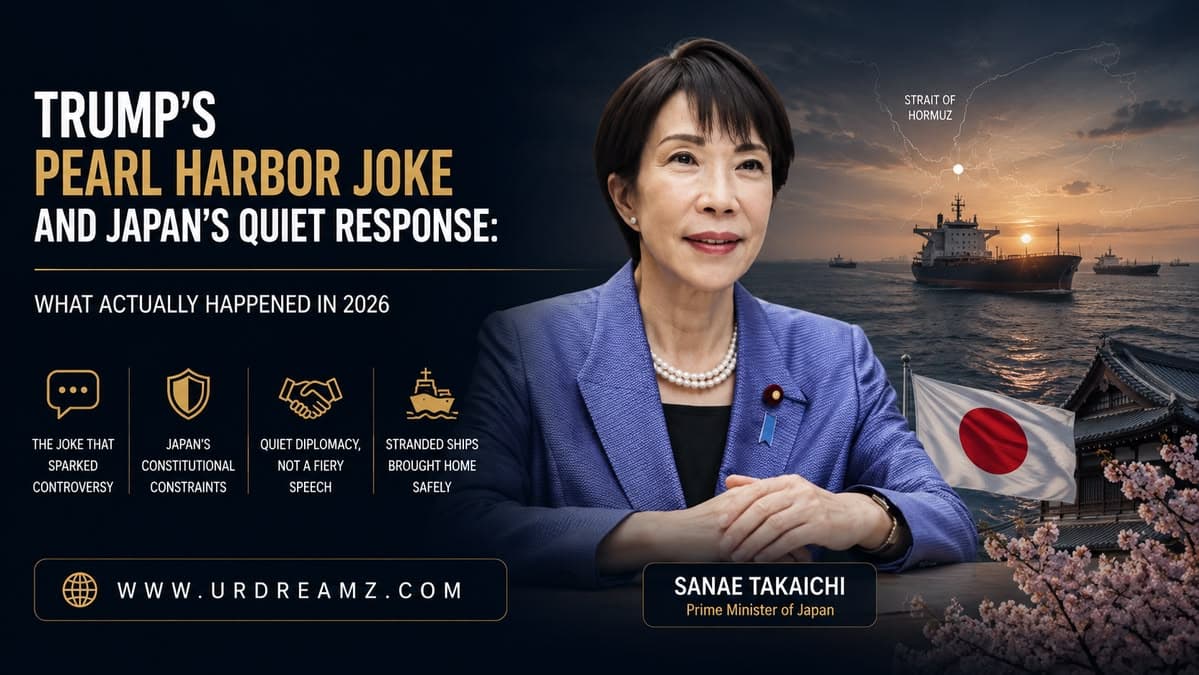
Trump's Pearl Harbor Joke and Japan's Quiet Response: What Actually Happened in 2026
There is a story that has been circulating online about Donald Trump, Japan's prime minister, and a sharp exchange involving Hiroshima and Nagasaki. It is a dramatic, emotionally charged version of events, the kind that spreads quickly because it feels satisfying, almost like watching history correct itself in real time. But when you actually go back and look at what was reported by journalists who were in the room, the real story turns out to be different in some important ways, and honestly, just as compelling, if not more so, once you understand the full context behind it.
So let's slow down and walk through what genuinely happened between the United States and Japan in 2026, starting from the beginning, because the real sequence of events says a lot about power, history, and the quiet kind of strength that doesn't always look like a confrontation. This is a long read, deliberately so, because a story this layered deserves more than a quick summary.
How This All Started: The 2026 Iran War
To understand any of this, you first have to understand the crisis that set everything in motion. On February 28, 2026, the United States and Israel launched a major military campaign against Iran, a campaign that included the assassination of Iran's supreme leader. Iran responded with missile and drone strikes against Israel, against American military bases in the region, and against Gulf states allied with the United States. What followed was one of the most disruptive events to hit global energy markets in years: Iran largely shut down the Strait of Hormuz, the narrow waterway between Iran and the Arabian Peninsula through which a massive share of the world's oil and gas normally travels.
The consequences were immediate and severe. Within weeks, roughly twenty thousand mariners and around two thousand ships were reported stranded in the Persian Gulf because of the closure. Merchant ships were damaged, some were abandoned, a tugboat was sunk, and several seafarers lost their lives. This was not some abstract diplomatic disagreement happening far away from ordinary people's lives. It was a very real crisis affecting global shipping, energy prices, and the safety of thousands of crew members trapped in dangerous waters.
Why Trump Started Pressuring Allies Like Japan
As the crisis dragged on, President Trump began publicly pressuring America's allies, including Japan, the United Kingdom, and Australia, to send warships to help secure the Strait of Hormuz and keep it "open and safe." This was a significant ask. Trump pointed to the scale of American defense spending in Japan and the presence of American troops there, essentially arguing that given the depth of the US-Japan alliance, Japan should be willing to step up and share the burden of protecting a waterway that Japan itself depends on heavily for its oil imports.
On the surface, this seems like a reasonable request between allies. But for Japan, the request touched on something far more complicated than simple military logistics. It touched on nearly eight decades of carefully maintained national identity.
Why This Was Never a Simple Request for Japan
Here is the part of the story that so much online commentary skips over entirely, and it is honestly the most important part. Japan's constitution, adopted in 1947 during the American-led occupation after World War II, contains a clause known as Article 9, often referred to as Japan's "pacifist clause." It states, in essence, that Japan forever renounces war as a sovereign right of the nation, and that it will not maintain land, sea, or air forces for the purpose of waging war.
This clause was not written by accident, and it was not a minor bureaucratic detail. It was written specifically to prevent Japan from ever again becoming the kind of militarized empire that led to the devastation of the Pacific War, a war that ended with the atomic bombings of Hiroshima and Nagasaki in August 1945, the only use of nuclear weapons in human history. Japan has spent the eighty years since then building its entire postwar identity around the idea of pacifism, even as it slowly developed a Self-Defense Force, a limited, defensively-oriented military structure that operates under strict legal constraints specifically designed to avoid crossing the line into anything resembling offensive warfare.
So when Trump asked Japan to send military vessels into an active, dangerous conflict zone, this was never going to be a simple yes-or-no decision for Tokyo. It touched directly on decades of constitutional interpretation, domestic political sensitivity, and a national memory shaped by being the only country in history to have experienced nuclear attack. A senior Japanese official was quoted describing any decision to dispatch military vessels as facing "high hurdles," noting that while it was not technically ruled out by law, given the ongoing conflict, it was something that needed to be judged very carefully.
Japan's Answer: A Careful, Measured "No" That Wasn't Quite a "No"
On March 16, 2026, just days before Prime Minister Sanae Takaichi was scheduled to visit the White House, Japan officially stated that it currently had no plans to deploy naval assets to the Strait of Hormuz. Japan was not alone in this. Australia and the United Kingdom made similar statements around the same time, with Australia's government noting that no formal request had even been made yet, and South Korea saying it was still discussing the matter with Washington before making any decision.
It is worth pausing here to notice something important: this was not a fiery, defiant refusal. It was not a dramatic speech invoking historical trauma as a form of protest. It was a measured, bureaucratic, carefully worded statement, the kind diplomats use specifically to avoid burning bridges while still declining to commit to something politically risky. Japan was navigating a genuinely difficult position: an essential ally publicly pressuring it for military support, while its own constitution and public opinion made that kind of support extraordinarily complicated to deliver. There was no press conference moment where a Japanese official stood up and dramatically rejected the request in front of cameras. It happened the way most consequential diplomatic decisions actually happen, quietly, through official statements, background briefings, and carefully worded responses to reporters' questions, far removed from the kind of cinematic confrontation that later versions of this story would imagine.
The White House Meeting: Where the Pearl Harbor Moment Actually Happened
On March 19, 2026, Prime Minister Takaichi traveled to Washington for her first White House visit as prime minister. The meeting was originally intended to focus on trade, business deals, and the broader relationship between the two countries, but it ended up almost entirely overshadowed by the war in Iran and the question of Japan's involvement in securing the Strait of Hormuz.
During their public appearance in the Oval Office, speaking through an interpreter, Takaichi struck a notably diplomatic tone. She described the security situation in the Middle East and around the world as "very severe," and rather than confronting Trump directly, she appealed to his self-image as a dealmaker and peacemaker, telling him, "Even against that backdrop, I firmly believe that it is only you, Donald, who can achieve peace across the world." Trump, for his part, praised Japan in vague terms, saying Tokyo was "really stepping up to the plate," though he offered few specifics about what exactly that support would involve.
Then came the moment that actually went viral, and it is important to be precise about what it was, because it is often misremembered or exaggerated. A reporter asked Trump why the United States had not given advance notice to allies like Japan before launching its strikes on Iran. Trump responded with a joke, referencing a completely different historical event: Japan's surprise attack on the American naval base at Pearl Harbor in 1941, which brought the United States into World War II. "We didn't tell anybody about it because we wanted surprise," Trump said. "Who knows better about surprise than Japan? Why didn't you tell me about Pearl Harbor, OK?"
It was, by most accounts, an uncomfortable moment. Reporters in the room noted that Takaichi's slight smile appeared to drop, and she raised her eyebrows as the comment landed. But she did not respond with a rebuttal, a speech, or any reference to Hiroshima or Nagasaki. She did not publicly invoke the atomic bombings as a counter-argument. She simply absorbed the moment with the kind of restrained, professional composure that diplomats are trained to maintain, even when a joke touches on something as sensitive as a surprise attack that killed over two thousand four hundred Americans and dragged the world into war.
Later that same evening, the tone shifted noticeably. Trump hosted a dinner for Takaichi, calling her a "spectacular woman" and saying it was "an honor to have you at the White House." The tension of the afternoon gave way to public warmth by nightfall, which is often how high-stakes diplomatic visits actually play out behind the scenes: friction and formality during the cameras-on portions, followed by a more cordial, relationship-preserving tone once the harder questions have passed.
Why the Pearl Harbor Comment Still Landed So Heavily
Even though Trump's joke referenced Pearl Harbor and not Hiroshima or Nagasaki, it is worth understanding why any comment touching on Japan's wartime history carries so much weight, regardless of which specific event is mentioned. Japan's entire postwar identity was rebuilt around the idea of never returning to militarism, a transformation forced upon it after the devastation of 1945 and formalized through Article 9 of its constitution. For a country that has spent eighty years insisting, both to itself and to the world, that it has permanently renounced war, being reminded of its imperial past by the leader of its most important ally, in a room full of international press, is not a small thing, even if it was delivered as a joke rather than an accusation.
This is why the moment resonated so strongly online, even in exaggerated or misremembered forms. It touched a real nerve, even if the specific historical reference people later attached to the story, Hiroshima and Nagasaki, was not actually the reference Trump made. The emotional core of the online reaction, discomfort at seeing Japan's wartime history casually invoked during a serious security negotiation, was genuine, even if some of the specific details that spread afterward were not accurate. It's a reminder that historical wounds don't need to be referenced with perfect accuracy to reopen real, contemporary discomfort; sometimes any reference at all, delivered at the wrong moment, is enough.
What Japan Actually Did Next: Diplomacy Instead of Warships
Here is where the real story becomes, in some ways, more impressive than the fictionalized version that spread online. Rather than sending military vessels into the Strait of Hormuz, something its constitution and domestic politics made extraordinarily difficult, Japan pursued an entirely different strategy: sustained, patient, high-level diplomacy directly with Iran.
In early April 2026, hours after Tehran agreed to a temporary ceasefire with the United States and Israel, Takaichi held her first direct phone call with Iranian President Masoud Pezeshkian, a twenty-five-minute conversation focused on the ceasefire and on securing safe passage for ships trapped in the Gulf. Later that same month, at an international meeting hosted by Britain and France specifically focused on the safety of the Strait of Hormuz, Takaichi pledged that Japan would take "all possible measures" to help stabilize the situation, emphasizing the importance of freedom and safety of navigation "for vessels of all nations," not just Japan's own.
By late April, this patient diplomatic approach began paying off. Japan announced that its last remaining Japan-linked vessel, a ship called the Idemitsu Maru, had safely transited the Strait of Hormuz and exited the Persian Gulf entirely. A Japanese government spokesperson described the transit as "a very positive development." Notably, Japan relies on the Middle East for more than ninety percent of its oil imports, which meant the safe exit of its vessels was not a symbolic win, it was a matter of direct, tangible national importance.
Takaichi continued her direct diplomatic engagement with Iran's president over the following months, holding at least a third phone call with him in June, once again urging that all vessels, including those from Japan and other Asian nations, be allowed to pass through the strait freely and safely. By late June, reporting indicated that the number of Japan-linked vessels remaining in the Gulf had fallen sharply, from forty-five at the start of the crisis down to thirty-seven, with several ships having successfully transited the strait using exactly this kind of sustained diplomatic pressure rather than any military escort.
"Active Neutrality": A Different Kind of Strength
Observers following the situation closely described Japan's approach during this entire period using a specific phrase: "active neutrality." Rather than either fully joining the American-led military pressure campaign or standing back and doing nothing, Japan carved out a middle path, refusing to send warships while still actively, persistently working every available diplomatic channel to protect its own interests and, by extension, the interests of other nations relying on the same shipping lanes.
This is worth sitting with for a moment, because it reframes the entire story in a way that the viral, fictionalized version completely misses. The popular version of this story imagines Japan's strength as a moment of defiant, emotional confrontation, a leader standing up and delivering a powerful rebuke rooted in historical grievance. The real story shows something quieter, but arguably more effective: a country that absorbed an uncomfortable joke without losing its composure, declined a request it was constitutionally and politically unable to fulfill without ever slamming the door on the relationship, and then went on to solve its actual problem, getting its ships and citizens home safely, through patient, repeated, unglamorous diplomatic effort rather than a single dramatic confrontation.
The Deeper Lesson Hiding Inside This Story
There is something genuinely worth reflecting on here, and it has nothing to do with whether Trump's joke was appropriate or not, or whether Takaichi should have responded more forcefully in the moment. It has to do with how real power and real historical memory actually operate in the world, as opposed to how we sometimes wish they operated when we're looking for a satisfying story.
The version of this story that spread online imagines history as something that settles scores directly and immediately, a wronged nation finally getting to say its piece to the very ally that once tested its resolve so brutally. It is an emotionally satisfying narrative, and it is easy to understand why people wanted it to be true. But the real world rarely hands out that kind of clean, cinematic justice. What actually happened was messier, quieter, and in its own way, more instructive: a nation that has spent eighty years defining itself by restraint chose restraint again, even when publicly provoked, and then quietly went about protecting its own people and interests through the tools actually available to it.
Japan's pacifist identity was not performed loudly in that Oval Office moment. It was demonstrated afterward, in a series of phone calls most people never heard about, in careful diplomatic language at an international summit, in the safe return of a single tanker called the Idemitsu Maru that most of the world never noticed leaving the Gulf. That, in many ways, is what a constitution built around "never again" actually looks like in practice, not a dramatic speech, but a series of quiet, consistent choices made under real pressure, over and over again, until the crisis eventually passed.
Why the Exaggerated Version Spread So Easily
It's worth asking, honestly, why the fictionalized version of this story, the one involving a fiery speech about Hiroshima and Nagasaki, spread as widely as it did. Part of the answer is simply that it is a better story in the traditional sense, complete with a clear villain, a clear moment of righteous pushback, and a satisfying emotional payoff. Real diplomatic exchanges rarely offer that kind of narrative clarity. They are full of hedged language, unclear outcomes, and moments that resolve quietly over months rather than in a single dramatic exchange.
There is also something deeper at work. The story taps into a very real, very legitimate historical grievance, the trauma of being the only nation ever struck by nuclear weapons, and channels it into a narrative where that grievance finally gets voiced directly to power. Even though that specific confrontation never actually happened the way it was described, the underlying feeling driving people to share it, a sense that history's deepest wounds deserve to be acknowledged rather than casually joked about, is completely understandable and worth taking seriously, even while correcting the specific facts of what was actually said and by whom.
What This Means Going Forward
The Strait of Hormuz crisis of 2026 eventually eased, though not without real cost: damaged ships, lost lives, disrupted global energy markets, and months of uncertainty for the tens of thousands of mariners caught in the middle of a conflict they had no part in starting. Japan's approach throughout, careful, patient, constitutionally constrained, but persistently active behind the scenes, offers a useful case study in how a nation can honor both its alliances and its own deeply held historical commitments without simply capitulating to pressure or completely withdrawing from the situation.
It also offers a quieter lesson about how stories travel in the age of social media. A single uncomfortable joke, delivered in a thirty-minute press appearance, can spiral into an entirely different narrative within days, one that feels true because it echoes something real, even when the specific details end up being invented along the way. Understanding what actually happened, the real timeline, the real constraints Japan operated under, and the real, unglamorous diplomatic work that ultimately resolved the immediate crisis, gives a far more accurate, and honestly more respectful, picture of what Japan's response to this moment truly looked like.
Understanding the Strait of Hormuz Itself
Before going further, it helps to understand exactly why this narrow strip of water matters so much to the entire planet, not just to the countries directly bordering it. The Strait of Hormuz sits between Iran and the Arabian Peninsula, connecting the Persian Gulf to the Gulf of Oman and, from there, to the open ocean. It is barely wide enough in places to be called a strait in the everyday sense of the word, yet an enormous share of the world's seaborne oil and natural gas passes through it every single day, making it one of the most strategically important chokepoints on the entire globe.
When a waterway this critical gets disrupted, the effects ripple outward almost instantly. Energy prices spike. Shipping insurance costs climb. Countries that rely heavily on imported oil, and Japan is very much one of them, suddenly find themselves facing real economic vulnerability tied directly to a conflict happening thousands of miles from their own shores. This is exactly why Japan could not simply ignore the crisis or treat it as someone else's problem, even while it remained unwilling to send military ships into the area. Japan's economic security was genuinely, directly tied to the outcome of this crisis, which is part of why its government kept working the diplomatic channels so persistently even after publicly declining Trump's request for military support.
Trump's Deadline and the Path to a Ceasefire
The pressure surrounding the Strait of Hormuz did not simply fade on its own. At one point, President Trump reportedly issued Iran a deadline to reopen the strait, warning of consequences described in extremely severe terms if Tehran failed to comply. According to reporting from the time, the United States and Iran ultimately reached a two-week ceasefire agreement less than two hours before that deadline was set to expire, a remarkably narrow window that underscores just how tense and unpredictable the entire situation had become by that point.
This ceasefire, however, did not immediately resolve everything. Even after Tehran indicated the strait was open again for commercial shipping following a related ceasefire involving Israel and Lebanon, Iran reportedly reimposed strict military control over the waterway again just days later, creating fresh uncertainty for shipping companies and governments alike. This back-and-forth pattern, brief moments of openness followed by renewed restrictions, is part of why Japan's diplomatic approach required so much patience and repetition rather than a single decisive breakthrough. Prime Minister Takaichi did not call Iran's president just once and solve the problem. She called multiple times over multiple months, continuing to press the same message about safe passage for all vessels, precisely because the situation kept shifting underneath her.
The Human Cost Behind the Headlines
It's easy, when discussing geopolitics at this level, to lose sight of the fact that real people were directly affected by every twist and turn of this crisis. Reports from April 2026 indicated that roughly twenty thousand mariners and around two thousand ships were stranded in the Persian Gulf because of the closure, unable to safely navigate through the strait in either direction. These were not abstract statistics. They were sailors, many of them far from home, sitting in dangerous waters for weeks or months, uncertain when or if they would be able to leave safely.
Among the reported casualties during the crisis were seafarers killed or missing, a sunk tugboat, more than a dozen merchant ships damaged, some of which were ultimately abandoned by their crews, and a port worker killed in Bahrain during related unrest. Families waiting at home for news of loved ones stuck on those vessels had no interest in the diplomatic theater unfolding in Washington. What mattered to them was far simpler and far more urgent: would their husbands, fathers, sons, and colleagues make it home safely, and how soon.
How Japan's Approach Compared to Other Allies
It is worth looking briefly at how Japan's response compared to that of other American allies facing the exact same pressure, because the comparison highlights just how carefully calibrated Japan's position actually was. Australia, for instance, similarly declined to commit ships, though its government framed this partly around the fact that no formal request had technically been made yet. The United Kingdom, rather than declining outright, chose to coordinate its response internationally, with its prime minister discussing the situation directly with both Trump and Canada's prime minister in an effort to build some kind of unified Western response rather than acting alone.
South Korea took yet another approach, publicly stating it was still in discussions with Washington and would only make a decision after careful review, essentially buying time without either committing or refusing outright. Seen alongside these other responses, Japan's position was not unusually defiant or unusual at all. It was, in many ways, simply the most constitutionally constrained version of a broader pattern playing out across multiple American allies in early 2026: genuine sympathy for the crisis and the alliance relationship, combined with real reluctance to commit military assets to an active, unpredictable conflict zone.
The Political Pressure Takaichi Faced at Home
None of this diplomatic balancing act was happening in a political vacuum for Prime Minister Takaichi. Domestically, she was navigating her own set of pressures entirely separate from the Hormuz situation, including debates over economic policy and tax reform that were testing the stability of her ruling coalition. Adding a highly sensitive, potentially unconstitutional military commitment on top of those existing domestic pressures would have been a significant political risk, regardless of how strongly Washington was pushing for it.
This domestic context matters because it helps explain why Japan's response needed to be as carefully calibrated as it was. A prime minister already facing scrutiny over domestic policy could not afford to be seen as either recklessly abandoning a key alliance or recklessly bending Japan's constitutional principles under foreign pressure. The measured, diplomacy-first approach Japan ultimately took managed to thread that needle, protecting the relationship with Washington, protecting Japan's own citizens and vessels, and avoiding a domestic political firestorm over constitutional overreach, all at the same time. It is also worth remembering that Takaichi herself, as one of Japan's more nationally prominent political figures, had every personal incentive to appear strong on the world stage. That she chose quiet persistence over public confrontation, even while facing real pressure both at home and abroad, says something about how she personally understood the moment, and about what kind of strength actually serves a country best during a genuine international crisis.
Why Article 9 Has Never Been Simple to Interpret
It's worth spending a little more time on Article 9 itself, because so much of Japan's cautious behavior throughout this entire crisis traces back to this single constitutional clause, and understanding its history helps explain why "high hurdles" was such an accurate description of Japan's situation. When Article 9 was written in 1947 under the guidance of the American-led occupation authorities, the intention was almost total demilitarization: no land, sea, or air forces of any kind for waging war. For a brief period after the war, Japan genuinely operated close to that ideal.
But reality intervened quickly. When the Korean War broke out in 1950, the United States itself pushed Japan to establish a lightly armed police reserve, recognizing that a completely demilitarized Japan in a increasingly tense Cold War environment created its own security risks. That police reserve eventually evolved, through several intermediate steps, into what is known today as the Self-Defense Force, formally established in 1954. Ever since, Japanese governments have operated under a delicate legal interpretation: Article 9 prohibits offensive war and the maintenance of war potential, but a strictly defensive military, one built around the principle of senshu bōei, or "exclusively defense-oriented policy," has been argued to fall outside that prohibition.
This interpretation has never been entirely settled or uncontroversial. Japanese courts, politicians, and legal scholars have debated its boundaries for decades, and various prime ministers, including Shinzo Abe in the 2010s, have pushed for formal constitutional revision to clarify or expand what Japan's military is actually permitted to do. None of those revision efforts have succeeded so far, which means that any request involving Japanese military deployment into an active conflict zone, exactly the kind of request Trump was making regarding the Strait of Hormuz, immediately runs into this decades-old, still-unresolved legal tension. This is precisely why Japanese officials described the decision as facing "high hurdles" rather than being simply "against the law" or "perfectly legal." The honest answer sits somewhere in a genuinely contested legal gray zone, and no Japanese government wants to be the one that gets that particular interpretation wrong in a live international crisis.
What Makes This Story More Interesting Than the Version That Went Viral
Here's something worth sitting with as we wrap up this deep dive. The invented version of this story, the one where Japan's leader delivers a fiery, righteous speech invoking Hiroshima and Nagasaki, imagines strength as something loud, immediate, and confrontational. It's a satisfying story precisely because it resolves tension quickly, in a single dramatic moment, the way a movie scene might.
The real story asks us to sit with something a little less immediately satisfying, but arguably far more impressive once you actually understand it. Real strength, in this case, looked like absorbing an uncomfortable, historically loaded joke in front of international media without losing composure. It looked like declining a politically dangerous request without ever publicly humiliating an essential ally. It looked like picking up the phone, again and again, month after month, to speak directly with the leader of a country in the middle of an active war, patiently repeating the same simple, humane request: let the ships and their crews pass safely. None of that makes for a viral thirty-second clip. But all of it reflects something genuinely admirable about how a small, careful, historically cautious country navigated an enormous crisis without compromising either its principles or its people's safety.
A Reminder About How Information Spreads Today
There's a broader lesson buried inside this entire episode, one that goes beyond Japan, Trump, or the Strait of Hormuz specifically. In an environment where video clips, screenshots, and secondhand retellings travel faster than full context ever can, it becomes incredibly easy for a real, complicated, multi-layered diplomatic story to get simplified into something more dramatic, more emotionally clean, and ultimately, less accurate than what actually happened. This isn't necessarily always the result of deliberate misinformation. Often, it's simply what happens when a genuinely uncomfortable moment gets retold enough times, with each retelling smoothing out the messy, unsatisfying parts of reality in favor of a version that feels more resolved, more just, more narratively complete.
The antidote isn't cynicism or assuming every viral story is false. It's simply pausing, when something feels emotionally very neat, to ask whether the real version might be messier, and whether that messier version might actually be worth understanding on its own terms rather than replacing it with something more dramatic. In this case, the real story, careful diplomacy, constitutional constraint, an uncomfortable joke absorbed rather than confronted, and a quiet, months-long effort to bring stranded ships and sailors home safely, turned out to be worth telling accurately, precisely because it says something true and specific about how modern alliances, historical memory, and careful statecraft actually intersect in the real world, without needing any invented dialogue to make the point.
So the next time a story like this crosses your feed, dramatic, emotionally satisfying, almost too perfectly resolved, it's worth taking a moment before sharing it further. Not to dismiss the underlying feeling behind it, which is often completely legitimate, but to check whether the actual reported events support the version being told. This deep dive is meant to leave you with a clearer, more accurate picture of what really happened, not a less interesting one. If anything, the real sequence of events, an eighty-year-old constitutional promise being quietly tested in real time, a joke that landed harder than intended, and a slow, determined diplomatic effort that eventually brought every stranded sailor and ship safely home, is a story that deserves to be remembered exactly as it happened, without needing any invented speech to make it worth telling.
Frequently Asked Questions
Did Japan's prime minister really respond to Trump by invoking Hiroshima and Nagasaki? No. According to verified reporting from the meeting, it was President Trump who made the historically charged comment, joking about Japan's 1941 attack on Pearl Harbor when asked why allies weren't warned before the Iran strikes. Prime Minister Takaichi did not respond with a rebuttal referencing Hiroshima or Nagasaki; she maintained a composed, diplomatic demeanor throughout the exchange.
Did Japan send ships to help secure the Strait of Hormuz? No, Japan officially stated it had no plans to deploy naval vessels to the Strait of Hormuz, citing the high legal and political hurdles involved given its pacifist constitution. Instead, Japan pursued direct diplomatic engagement with Iran to secure safe passage for its own trapped vessels.
What is Article 9 of Japan's constitution? Article 9 is a clause in Japan's 1947 constitution, adopted after World War II, in which Japan formally renounces war and the maintenance of military forces for the purpose of waging war. It remains the legal foundation behind Japan's cautious, defense-only military posture today.
What eventually happened to Japan's ships trapped in the Persian Gulf? Through sustained diplomatic efforts, including multiple direct phone calls between Prime Minister Takaichi and Iran's president, Japan successfully secured the safe exit of its stranded vessels over the following months, with the last Japan-linked ship, the Idemitsu Maru, safely transiting the Strait of Hormuz by late April 2026.
Why was Trump's Pearl Harbor comment considered controversial? The comment referenced Japan's 1941 surprise attack on the US naval base at Pearl Harbor, which killed more than 2,400 Americans and drew the United States into World War II. Making light of that event, especially while discussing why allies weren't warned about a separate military strike, struck many observers as an insensitive and undiplomatic moment during an otherwise formal meeting.
Did other US allies also decline to send ships to the Strait of Hormuz? Yes, Australia and the United Kingdom made similar statements around the same time as Japan, declining to commit naval vessels to the Strait of Hormuz, while South Korea said it was still reviewing the matter with Washington before making any decision.