Apple vs Samsung: The Full Story From 1938 to 2026, Rivals, Frenemies and Suppliers
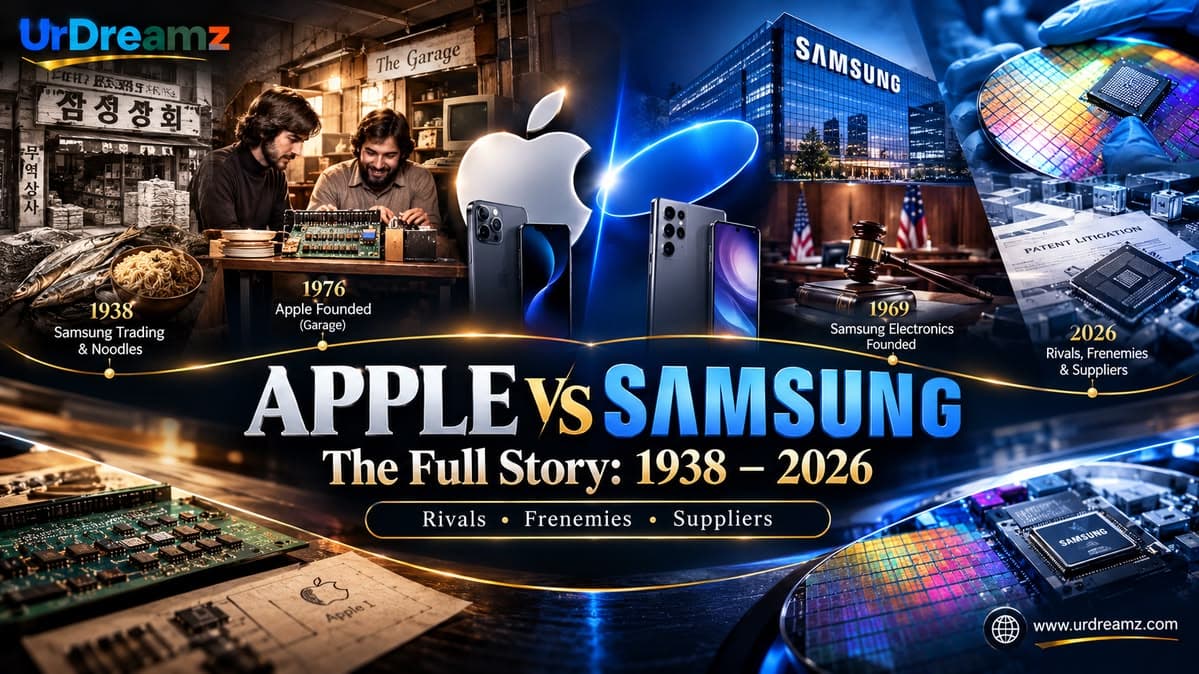
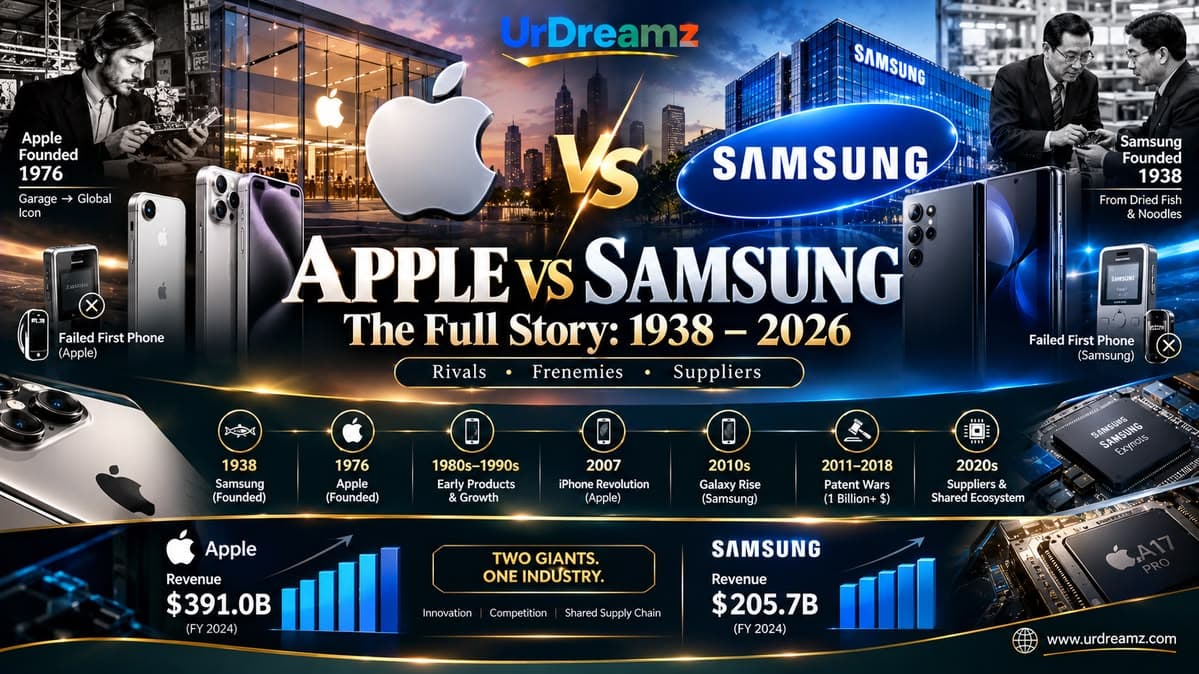
One of these companies started by trading dried fish, noodles and groceries in colonial-era Korea. The other started in a garage with two friends building circuit boards. Nearly ninety years later, one of them is worth close to four trillion dollars, and the other builds the screen and chips inside the very phone it once got sued over. This is the complete, verified story of Apple and Samsung: where they actually came from, who really made the first phone, the billion-dollar courtroom war that reached the US Supreme Court, and the strange, quiet partnership that continues underneath all the public fighting.
Disclaimer: This article is for general information and education only, based on public corporate history, court records, and financial reporting current as of September 2026, rewritten in our own words. Every fact, quote and figure here is drawn from real, verifiable sources; no incidents, court cases or customer stories in this article have been invented. Financial figures for large public companies change quarter to quarter; we note the date each figure applies to. This is not financial or investment advice. Last updated: .
Rivals in Public, Something Else in Private
In short: Apple and Samsung have spent more than fifteen years fighting each other in courtrooms, advertisements and product launches, yet neither company has ever been able to fully walk away from the other. Samsung has been one of Apple's most important component suppliers for years, building displays, memory chips and processors that end up inside the very iPhones Samsung was sued over for copying. Their fans argue constantly online; the companies themselves have moved between suing each other for over a billion dollars and signing multi-year supply contracts worth tens of billions more, sometimes in the very same years.
Understanding how these two companies actually relate to each other requires going back much further than the iPhone, because neither company started out making phones at all, and the full picture, correctly told, is stranger and more interesting than the simplified fan-war version most people repeat.
Samsung's Origin: Dried Fish, Noodles and Groceries, 1938
Samsung was founded on March 1, 1938, in Daegu, Korea, then under Japanese colonial rule, by a businessman named Lee Byung-chul. The original company, called Samsung Sanghoe, was a small trading firm with about forty employees, dealing in dried fish, locally grown groceries and noodles, exporting goods largely to China. There was nothing in this original business that hinted at electronics, phones or technology of any kind.
Over the following decades, Lee steadily diversified the company into an extraordinary range of industries. Samsung moved its headquarters to Seoul in 1947, survived the disruption of the Korean War by relocating to Busan, then built a sugar refinery and, in 1954, the largest woollen textile mill in the country at the time. From there, the company expanded into insurance, securities, retail, and eventually, in the late 1960s, electronics, followed by construction and shipbuilding in the 1970s, the industries that would eventually fund its rise into a global technology giant.
Illustrative timeline showing how long Samsung diversified before entering electronics, well before Apple even existed.
Apple's Origin: A Garage in California, 1976
Apple was founded on April 1, 1976, in Los Altos, California, by Steve Jobs, Steve Wozniak and Ronald Wayne, thirty-eight years after Samsung's founding. The company's first product was the Apple I, a hand-built computer circuit board designed largely by Wozniak, sold without a case, keyboard or monitor, intended for hobbyists who would build the rest themselves. From this modest beginning, Apple moved quickly into personal computers with the Apple II, then years later into the Macintosh line, before eventually branching into portable music players, phones and tablets.
The two companies could not have started from more different places: Samsung was a diversified trading conglomerate rooted in food and textiles that reached electronics only after three decades of expansion, while Apple was a technology company from its very first day, built by engineers rather than traders, with computing in its DNA from the start.
Family Empire vs Professional Corporation
This different origin shaped a lasting structural difference between the two companies that still matters today. Samsung Group remains, at its core, a family-controlled conglomerate, known in Korea as a chaebol. Leadership passed from founder Lee Byung-chul to his son Lee Kun-hee, and later to his grandson, Lee Jae-yong, who serves as chairman of Samsung Electronics today, with the fourth generation of the family already positioned within the business. This model of multi-generational family control is common among South Korea's largest conglomerates and is treated as a defining, if sometimes controversial, feature of the country's corporate landscape.
Apple has followed an entirely different path. After Steve Jobs's death in 2011, leadership passed not to a family member but to Tim Cook, a long-serving professional executive who had run Apple's operations for years beforehand. Apple has no founding family retaining board control, and its leadership succession has consistently followed a professional, merit-based corporate governance model rather than hereditary control. Neither structure is inherently superior; they simply reflect very different corporate philosophies rooted in each company's national and historical context.
Samsung's 80-Plus Industries: From Sugar Mills to Skyscrapers
Few people outside South Korea realise how far beyond electronics Samsung's business empire actually extends. Beyond Samsung Electronics, the group's affiliated companies span life and fire insurance, securities and asset management, shipbuilding, heavy industries, advertising, hospitals and hotels. Samsung C&T, the group's construction and trading arm, has been involved in some of the world's most famous engineering projects, including construction work on the Burj Khalifa in Dubai, currently the world's tallest building, and Malaysia's Petronas Twin Towers, once the tallest buildings in the world. Samsung's industrial reach is genuinely difficult to overstate, spanning well over eighty distinct business lines across the wider Samsung Group.
| Period | Industry entered |
|---|---|
| 1938 | Trading: dried fish, groceries, noodles |
| Early 1950s | Sugar refining (Cheil Jedang) |
| 1954 | Textiles and wool milling (Cheil Mojik) |
| 1950s-60s | Insurance, securities, retail |
| Late 1960s | Electronics (Samsung Electronics founded 1969) |
| Mid-1970s | Construction and shipbuilding |
| 1980s onward | Semiconductors, telecommunications, defence, engineering, hospitality |
Apple, by contrast, has remained comparatively narrow in its business scope for its entire history, focused almost exclusively on consumer hardware, software and, more recently, digital services, a deliberate strategic choice rather than an oversight, reflecting Steve Jobs's well-documented preference for a small number of excellent products over a sprawling conglomerate structure.
Samsung's First Phones: Three Failures Before a Hit
Samsung entered the mobile phone business well before Apple, but its early attempts were far from successful. Samsung's first mobile phone, the SC-100, launched in 1986 and failed commercially. A second attempt, the SH-100, followed in 1988 and also failed to gain traction. It was not until 1993, with the launch of the SH-700, that Samsung produced a genuine commercial hit, followed shortly after by the SH-770, which became a significantly bigger success in the South Korean market.
It is important to be precise about what these early devices actually were: they were basic feature phones built for voice calls and text messaging, using older-generation cellular technology, not smartphones in any meaningful modern sense, and not built on GSM networks that would later become globally standard. Samsung's genuine entry into the smartphone era would not come until 2009, more than two decades after its first, failed phone.
It took Samsung three failed launches over seven years before its first genuine commercial success.
What Apple Built Before the iPhone Existed
Apple's path to the smartphone was equally long, though the company was building an entirely different category of product for most of that journey. Starting with the Apple I and Apple II personal computers in the 1970s, Apple moved into the Macintosh line in 1984, expanded into laptop computers, and by the early 2000s had built the MacBook line into a significant business. In 2001, Apple launched the iPod, a portable music player that would become enormously successful, paired with iTunes, launched the same year, which reshaped how people bought and organised digital music.
Only in January 2007 did Apple announce its first phone, the original iPhone, more than three decades after the company's founding. This makes a common claim, that either company "invented the phone," inaccurate in both directions: Samsung built phones for over twenty years before Apple entered the category at all, but those phones were not smartphones by any reasonable modern definition, and Apple, when it did finally enter the category, arrived with the first true modern smartphone rather than a basic feature phone.
| Year | Product |
|---|---|
| 1976 | Apple I, a hand-built computer circuit board |
| 1977 | Apple II, one of the first mass-produced personal computers |
| 1984 | Original Macintosh launched |
| 1990s-2000s | MacBook laptop line developed and expanded |
| 2001 | iPod portable music player and iTunes launched |
| 2007 | Original iPhone announced, Apple's first phone ever |
2007: Apple's Gamble Changes Everything
On January 9, 2007, Steve Jobs unveiled the original iPhone, a device with a full touchscreen and no physical keyboard, at a time when nearly every major phone manufacturer, Samsung included, was still building devices with physical keys or styluses. At the time, Samsung's phone business was focused heavily on business-oriented devices running Windows Mobile, often featuring physical QWERTY keyboards aimed at corporate users rather than mainstream consumers.
The iPhone's touch-first design, combined with the App Store, launched in 2008 alongside the iPhone 3G, fundamentally reset consumer expectations for what a phone should look and feel like. Samsung, watching this shift unfold in real time, began quietly moving away from its older Windows Mobile-based strategy during 2008 and 2009, preparing a very different kind of response.
2009-2010: Samsung's Android Answer
Samsung's first genuine smartphones running Google's Android operating system arrived in 2009, but the device widely credited with truly launching Samsung's modern smartphone era, and the direct rivalry with Apple that continues today, was the original Samsung Galaxy S, released in 2010. It featured a 4-inch Super AMOLED display, notably vibrant compared with the LCD screens common at the time, and ran Android rather than building a proprietary operating system from scratch, a strategic choice that let Samsung move quickly by building on Google's platform rather than developing its own software ecosystem from the ground up.
The Smartphone War Timeline, 2007 to 2010
| Year | Milestone |
|---|---|
| 2007 | Apple launches the original iPhone with a full touchscreen, no physical keyboard |
| 2008 | Apple launches the App Store and iPhone 3G; Samsung still focused on Windows Mobile business phones |
| 2009 | Samsung releases its first Android-based smartphones, shifting away from older platforms |
| 2010 | Samsung launches the original Galaxy S with a 4-inch Super AMOLED display, officially beginning the modern rivalry |
The Billion-Dollar Patent War
The rivalry moved from the marketplace into courtrooms in April 2011, when Apple filed a lawsuit against Samsung in a US District Court, alleging that Samsung had "slavishly copied" the iPhone and iPad's design, user interface, rounded rectangular shape, and grid layout of app icons for its Galaxy line of devices. This was not a small or isolated lawsuit; it triggered a global legal conflict that eventually expanded into more than fifty separate lawsuits across roughly ten countries, with Samsung countersuing Apple in South Korea, Japan, Germany and the United Kingdom over its own mobile communication and wireless technology patents.
In August 2012, a US jury delivered a landmark verdict largely in Apple's favour, awarding just over one billion dollars in damages, one of the largest patent verdicts in US legal history at the time. Years of appeals followed. In a retrial addressing how design patent damages should properly be calculated, Samsung was ultimately ordered to pay a reduced final penalty of 539 million dollars. After roughly seven years of litigation across multiple countries, Apple and Samsung reached a confidential global settlement in 2018, formally ending the dispute without either company publicly disclosing the settlement's exact financial terms.
The reduction reflects the Supreme Court's 2016 ruling on how design patent damages should be calculated, not a negotiated discount.
| Date | Event |
|---|---|
| April 2011 | Apple sues Samsung in a US court over design and interface copying |
| 2011-2012 | Conflict expands to 50+ lawsuits in about 10 countries; Samsung countersues |
| August 2012 | US jury awards Apple just over $1 billion in damages |
| 2015-2016 | Case reaches the US Supreme Court over design patent damages calculation |
| 2018 retrial | Samsung ordered to pay a reduced $539 million |
| 2018 | Apple and Samsung reach a confidential global settlement |
All the Way to the US Supreme Court
One detail that makes this legal battle genuinely unusual, and worth telling as its own real story rather than any invented one, is that it eventually reached the highest court in the United States. Samsung appealed part of the original verdict specifically over how damages for design patent infringement should be calculated: should a company that copies a specific design element pay damages based on the profit from an entire finished product, or only from the specific infringing component? This was, remarkably, the first time in over a century that the US Supreme Court had agreed to hear a design patent case.
In December 2016, the Supreme Court sided with Samsung on this narrow technical question, ruling that damages could be calculated based on a specific component rather than automatically the entire product's profit, and sent the case back to a lower court to recalculate damages accordingly. This is precisely why the final 2018 retrial penalty, 539 million dollars, ended up considerably lower than the original 2012 jury verdict of just over one billion dollars, a legitimate legal outcome rather than any kind of settlement discount.
"Thermonuclear War": The Real Quotes Behind the Rivalry
Some of the most quoted lines from this entire saga come directly from Steve Jobs himself, documented in Walter Isaacson's authorised biography of Jobs, published shortly after his death in 2011. Jobs is quoted describing his fury at what he saw as Google's Android operating system copying the iPhone, with Samsung as by far its most successful hardware partner, saying he was willing to "spend every penny of Apple's 40 billion dollars in the bank" to, in his words, wage "thermonuclear war" over what he considered outright theft of Apple's work. This quote is real, verifiable, and widely cited in business journalism precisely because it captures the genuine intensity of feeling behind what might otherwise look like a purely financial legal dispute.
This is a useful example of how the real, documented history of this rivalry is already dramatic enough without needing any embellishment: an actual quote, from an actual named source, in an actual published biography, describing genuine boardroom fury that led directly to one of the largest patent lawsuits in corporate history.
Frenemies: Why Samsung Still Builds Parts for the iPhone
Here is the detail that most surprises people encountering this rivalry for the first time: throughout years of suing each other in courtrooms on four continents, Apple and Samsung have simultaneously maintained one of the technology industry's largest and longest-running supplier relationships. Samsung has for years been a major supplier of OLED display panels for iPhones, and Samsung's semiconductor division has manufactured memory chips and, at various points, processors used inside Apple's devices, a business relationship reportedly worth many billions of dollars annually.
This is genuinely, verifiably true, not an exaggeration: the two companies have simultaneously been fierce courtroom rivals and essential business partners, sometimes in the exact same fiscal year. Business analysts commonly describe this dynamic using the term "coopetition," a blend of cooperation and competition, precisely because it captures how two companies can compete intensely in one part of their business, consumer smartphones, while depending heavily on each other in another part, component supply chains, without either relationship meaningfully undermining the other.
This pattern is not unique to Apple and Samsung; it appears across the technology industry, where a handful of companies control the specialised manufacturing capacity, particularly for advanced displays and memory chips, that nearly every device maker needs regardless of who their retail competitors happen to be. What makes the Apple-Samsung case especially notable is simply the scale and public visibility of both the rivalry and the partnership happening side by side, making it one of the clearest, most widely documented examples of coopetition in modern corporate history.
The Ad War: When Companies Mock Each Other in Public
Beyond the courtroom, Apple and Samsung have engaged in a long-running, very public advertising rivalry. Samsung's "The Next Big Thing" advertising campaign, launched around the Galaxy S2 and S3 era, directly and pointedly mocked people queueing outside Apple Stores for new iPhone launches, portraying Galaxy owners as unimpressed bystanders watching iPhone fans wait in long lines for features Samsung's own phones already had. These advertisements were a real, deliberate, publicly aired marketing strategy, not an isolated joke, and they became a significant part of Samsung's brand positioning against Apple during that period.
Apple, for its part, has generally taken a different public approach, rarely naming Samsung directly in its own advertising, instead focusing its marketing on its own ecosystem, design philosophy and brand experience rather than direct comparative attacks, a contrast in advertising philosophy that itself reflects each company's broader brand strategy.
Hardware and Design: Two Different Philosophies
Beyond the history and legal battles, the two companies have settled into genuinely distinct hardware philosophies over the years. Samsung pushed display technology aggressively early on with vibrant AMOLED screens, later expanding into curved-edge designs and, more recently, mainstream foldable phones through its Galaxy Z series. Apple focused for years on colour-accurate flat display panels, entering the foldable phone category considerably later than Samsung.
| Aspect | Apple | Samsung |
|---|---|---|
| Display innovation | Colour-accurate flat panels; foldables adopted later | Early AMOLED leadership; curved edges; mainstream foldables (Galaxy Z) |
| Build materials | Stainless steel, titanium frames, Ceramic Shield glass | Gorilla Glass Victus across most tiers |
| Lineup strategy | Curated, premium-focused, fewer models | Every price point, from budget A-series to Ultra and Fold |
Software and Ecosystem: Closed Garden vs Open Field
The software philosophy divide is arguably even sharper than the hardware one. Apple's iOS is built around simplicity, tight security controls, long-term software update support, and deep integration across Apple's own hardware, iPhone, iPad, Mac and Apple Watch working together as a single connected ecosystem. Samsung's One UI, built on top of Google's Android, is built around a different philosophy entirely: high customisation, flexible file management, multitasking freedom, and compatibility across a much wider range of hardware from many different manufacturers, not just Samsung's own devices.
| Aspect | Apple (iOS) | Samsung (One UI / Android) |
|---|---|---|
| Core philosophy | Simplicity, tight security, curated experience | Customisation, flexibility, user control |
| Cross-device integration | Deep, but limited to Apple's own hardware | Broad, works across many Android-compatible devices |
| Update support | Long-term guaranteed updates across older models | Improved significantly in recent years, still generally shorter than Apple's |
Performance and Cameras: Where Each One Wins
On raw performance, Apple's custom-designed A-series chips have consistently led independent CPU benchmark scores and tend to be tightly optimised for iOS's specific software demands. Samsung's Galaxy flagships have generally competed strongly on multitasking-focused RAM capacity and GPU graphics versatility, benefiting from close collaboration with chipmakers like Qualcomm on Snapdragon processors used across many of its top devices.
On cameras, the two companies have carved out different strengths rather than one simply beating the other outright. Apple has generally been regarded as strong in smooth video capture, stabilisation and natural colour accuracy. Samsung has generally led in hardware zoom range and very high resolution sensors, offering more flexibility for cropping and creative editing after a photo is taken.
General industry consensus from tech reviewers; individual device generations vary.
The Numbers in 2026: Market Cap, Revenue and Profit
Financial comparisons between these two companies need to be read carefully and dated precisely, because 2026 has been an unusually volatile year for both, and the gap has narrowed and widened at different points during it. As of early 2026, Apple's market capitalisation stood at approximately 3.8 to 4 trillion dollars, making it the world's most valuable technology company, or the second most valuable company globally behind Nvidia, depending on the exact month measured. Samsung Electronics, by contrast, began 2026 valued at a few hundred billion dollars, but its valuation surged dramatically over the course of the year, crossing the one trillion dollar mark for the first time on May 5, 2026, driven by explosive demand for the memory chips Samsung manufactures for artificial intelligence data centres.
| Metric | Apple | Samsung Electronics |
|---|---|---|
| Market capitalisation | ~$3.8 to $4 trillion (early-mid 2026) | Crossed $1 trillion for the first time, May 5, 2026 |
| Full-year 2025 revenue | ~$400 billion+ | ~$200-250 billion (varies by reporting period) |
| Full-year 2025 net profit | ~$100 billion+ | ~$31.6 billion |
| Q1 2026 operating profit surge | Steady growth, no comparable single-quarter spike | Surged over 8x year-on-year to 57.2 trillion won on AI memory demand |
| Global smartphone brand ranking | Consistently #1 or #2 by revenue and profit share | Consistently #1 or #2 by unit shipment volume |
Figures are approximate and change frequently; Samsung's value rose sharply mid-2026 on AI-driven memory chip demand.
It is worth being explicit here: any single, fixed number for either company's market capitalisation will be somewhat out of date by the time you read this, since both stocks move daily and Samsung's valuation in particular has been unusually volatile in 2026. The directional picture, Apple significantly larger by market value and profit, Samsung far larger in physical manufacturing scale and industrial diversity, has remained broadly consistent even as the exact multiples have shifted.
Why Samsung's Value Exploded in 2026
Samsung's dramatic 2026 valuation surge had almost nothing to do with smartphones at all, which is an important nuance often missed in casual comparisons. The primary driver was Samsung's position as one of the world's largest manufacturers of memory chips, specifically the high-bandwidth memory chips essential for training and running large artificial intelligence models. As AI companies worldwide raced to build data centre capacity throughout 2025 and 2026, demand for this specific category of memory chip surged dramatically, and Samsung, alongside rivals like SK Hynix and Micron, benefited enormously.
This created a somewhat unusual situation: Samsung's smartphone division, competing directly against Apple's iPhone, actually faced real profitability pressure during parts of this period, while the company's overall stock and valuation soared on the strength of a completely different business line, semiconductor manufacturing for the AI boom. This is a useful reminder that comparing "Apple vs Samsung" purely as a smartphone rivalry, while intuitive, misses a large part of what actually drives each company's overall financial performance today.
The Real Question: Producer Mindset vs Consumer Mindset
Beyond the corporate history, the original framing behind this comparison raises a genuinely important personal finance question worth engaging seriously: is buying an expensive flagship phone on EMI, when it strains your monthly budget, a reasonable choice or a symptom of a deeper spending pattern worth examining? Financial literacy educators generally distinguish between two related but different concerns here. The first is straightforward affordability math: taking on debt for a depreciating consumer item, one that will be worth a fraction of its price within two to three years, carries a real opportunity cost, since that same monthly payment could instead go toward savings, an emergency fund, or an appreciating asset.
The second, more psychological concern is about what some financial writers call identity-driven spending, buying a product primarily because of what owning it signals to others rather than because of the specific features you'll actually use daily. Neither concern means every EMI purchase or every premium phone purchase is automatically unwise; a person with stable income and genuine professional need for a specific device is making a very different decision from someone stretching an already tight budget to keep up with a social trend. The distinction between a "producer mindset," building income-generating skills, businesses or assets, and a "consumer mindset," directing most disposable income toward consumption rather than building anything that generates future income, is a genuinely useful framework for personal reflection, even if reasonable people can disagree about exactly where any specific purchase falls on that spectrum.
So, Which One Is Actually Better?
Based on everything documented above, there is no single, objectively correct answer to "which is better," and any article claiming otherwise is oversimplifying a genuinely multidimensional comparison. Apple wins clearly on raw financial scale, profit margins, software update longevity, and the tightness of its integrated ecosystem across multiple device types. Samsung wins clearly on manufacturing scale, price-point variety, display technology history, and hardware flexibility, while also, through its semiconductor business, quietly powering a meaningful share of the broader technology industry, including some of Apple's own products.
The honest, evidence-based answer is that "better" depends entirely on what you personally value: a tightly closed, simple, long-supported ecosystem points toward Apple; broader choice, deeper customisation and a wider range of price points points toward Samsung. Both companies have built genuinely excellent, industry-leading products using very different philosophies, which is precisely why this rivalry has remained genuinely competitive, rather than one-sided, for well over fifteen years.
Frequently Asked Questions
- Which company is older, Apple or Samsung?
- Samsung is significantly older. It was founded on March 1, 1938, in Daegu, Korea, as a trading company dealing in dried fish, groceries and noodles. Apple was founded 38 years later, on April 1, 1976, in a garage in Los Altos, California.
- Who made the first phone, Apple or Samsung?
- Samsung made the first phone by over two decades, launching the SC-100 in 1986, though it was a basic feature phone that failed commercially. Samsung's first genuine hit phone was the SH-700 in 1993. Apple did not enter the phone category at all until the first iPhone in 2007, but that device was the first true modern smartphone.
- Is Samsung a family-owned company?
- Yes. Samsung Group is a chaebol, a family-controlled conglomerate, currently chaired by Lee Jae-yong, the grandson of founder Lee Byung-chul. Apple, by contrast, is run by professional management with no founding family retaining control; current CEO Tim Cook is not related to co-founder Steve Jobs.
- What was the Apple vs Samsung lawsuit about?
- Apple sued Samsung in April 2011, alleging Samsung copied the iPhone and iPad's design, user interface and app icon grid for its Galaxy devices. The conflict grew into over 50 lawsuits across about 10 countries, resulting in a $1 billion jury verdict in 2012, a Supreme Court ruling in 2016, and a reduced $539 million retrial penalty before a confidential settlement in 2018.
- Did the Apple-Samsung case really reach the US Supreme Court?
- Yes. In 2016, the Supreme Court heard the case specifically on how design patent damages should be calculated, the first design patent case it had heard in over a century. It ruled in Samsung's favor on that narrow technical question, leading to a reduced final damages figure.
- Does Samsung still make parts for the iPhone?
- Yes. Despite years of litigation, Samsung has remained one of Apple's major suppliers, providing OLED display panels and memory chips used in iPhones, a relationship reportedly worth billions of dollars annually. Analysts describe this dual dynamic of competing and cooperating as "coopetition."
- Which company is worth more, Apple or Samsung?
- Apple is worth significantly more by market capitalisation, around $3.8 to $4 trillion in early-to-mid 2026, compared to Samsung Electronics, which crossed $1 trillion for the first time on May 5, 2026. Apple also reports higher revenue and profit overall.
- Why did Samsung's value rise so much in 2026?
- Samsung's 2026 valuation surge was driven primarily by soaring demand for the high-bandwidth memory chips it manufactures for AI data centres, not by smartphone sales. Its Q1 2026 operating profit rose more than eightfold year-on-year on the strength of this AI-driven memory chip demand.
- Did Steve Jobs really say he wanted "thermonuclear war" against Samsung?
- Yes, this is a real, documented quote from Walter Isaacson's authorised biography of Steve Jobs. Jobs said he was willing to spend Apple's entire cash reserves at the time to wage what he called "thermonuclear war" against what he considered Android and Samsung's copying of the iPhone.
- Is Apple or Samsung better?
- There is no single objectively correct answer. Apple leads in profit margins, software update longevity, and ecosystem integration. Samsung leads in manufacturing scale, price-point variety, and hardware flexibility. Which is "better" depends on whether you personally value a closed, simple ecosystem or broader choice and customisation.
Conclusion
The real story of Apple and Samsung is stranger, and more interesting, than the simple "which brand is better" fights that play out among fans online. One company began by trading dried fish in colonial Korea and grew into an eighty-industry conglomerate that builds skyscrapers and warships. The other began in a garage with two friends and grew into the world's most valuable technology company. Both failed repeatedly before finding their first hits, both fought a genuine billion-dollar war that reached the US Supreme Court, and both, remarkably, still need each other, since Samsung's factories quietly help build the very iPhones its own Galaxy phones compete against every single day.
None of this needed embellishment to be compelling; the verified history already contains a real thermonuclear-war quote, a Supreme Court case about phone design, and a genuinely surprising ongoing supplier relationship between two supposed arch-rivals. Whichever phone you personally choose to buy, understanding this fuller picture, rather than just the marketing and the fan arguments, makes for a far more informed decision, and perhaps a more thoughtful one about whether that decision fits your own budget and goals rather than anyone else's.