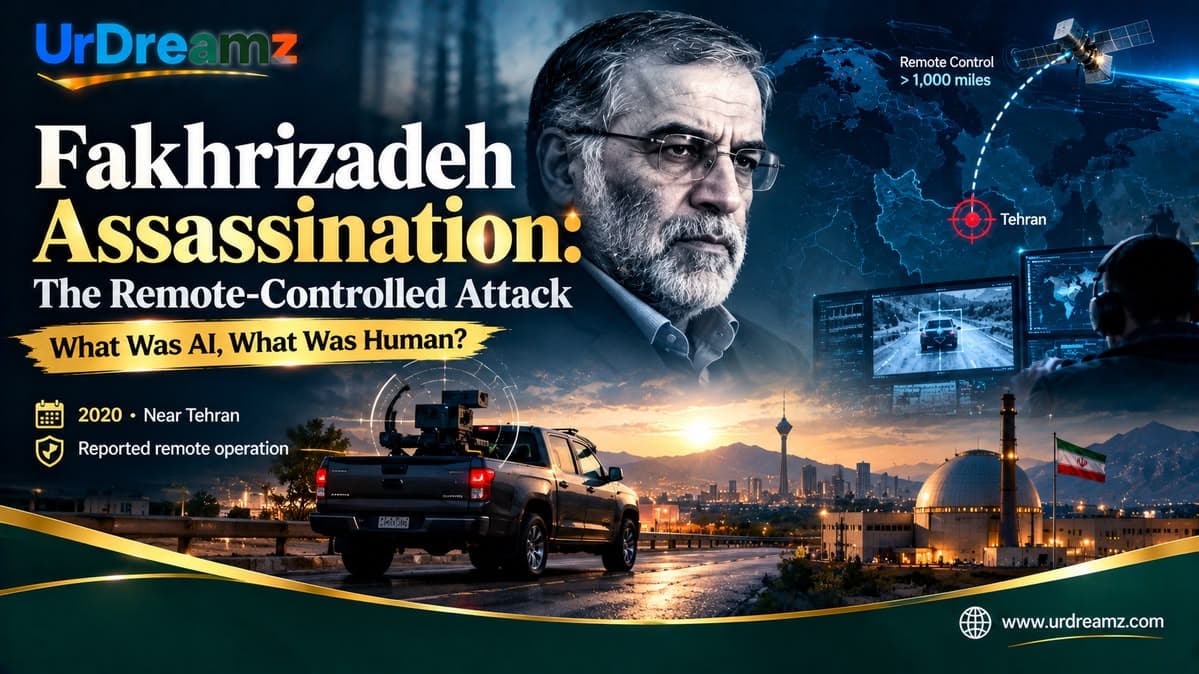
How Mossad Killed Iran's Nuclear Chief in 60 Seconds With No Shooter on the Ground
On a quiet highway east of Tehran, a physicist driving his own car with his wife beside him was shot dead by a machine gun that no human being was standing behind. The weapon sat hidden in an abandoned-looking pickup truck. The person controlling it was, according to the most detailed investigation published, more than a thousand miles away. The entire shooting lasted under a minute. This is the verified story of how Mohsen Fakhrizadeh, the man Israel considered the father of Iran's military nuclear program, was killed, what was genuinely artificial intelligence and what was a human being pulling a trigger from a distance, and why it took nearly a year, not six, for the full picture to become public.
Disclaimer: This article is for general information and education only, based on public reporting from the New York Times, Reuters, the Associated Press, the Times of Israel, the Jerusalem Post and Iranian state media, rewritten in our own words, current as of September 2026. Israel has never officially confirmed or denied involvement in this operation. Where accounts conflict, this article says so explicitly rather than presenting one version as settled fact. This is a factual historical account, not an endorsement or a technical guide. Last updated: .
What Actually Happened, in Short
In short: on November 27, 2020, Mohsen Fakhrizadeh, the head of Iran's military nuclear research programme, was killed near the town of Absard, east of Tehran, by a specially modified, remote-controlled machine gun hidden inside a parked pickup truck. According to a detailed investigation published by the New York Times in September 2021, based on interviews with intelligence officials, the weapon was fitted with robotics, multiple cameras and facial recognition software, and was fired by an operative controlling it from outside Iran while watching a video feed, reportedly using a satellite link. Fakhrizadeh was hit; his wife, seated beside him, was not. No Israeli operative was physically present at the scene during the shooting itself, and the truck later exploded, apparently in an attempt to destroy evidence.
The full picture did not emerge instantly. For about ten days after the killing, Iranian officials gave three different, partly contradictory accounts before settling on the version closest to what the New York Times later confirmed. And contrary to a claim that has circulated online, the world did not wait six years to learn what happened. The New York Times report was published in September 2021, roughly ten months after the assassination, not six years later.
Who Was Mohsen Fakhrizadeh?
Mohsen Fakhrizadeh was a 59-year-old physicist, a brigadier general in Iran's Islamic Revolutionary Guard Corps, and a professor at Imam Hussein University in Tehran. Western intelligence agencies, including Israel's, regarded him as the central figure behind Iran's historical effort to develop nuclear weapons capability, a programme Iran has always maintained was purely peaceful. At the time of his death, he headed Iran's Defence Research and Innovation Organisation, an arm of the defence ministry that Western officials believed continued nuclear-weapons-relevant research even after Iran's formally acknowledged weapons programme was said to have ended in the early 2000s.
He was, in the words later used by Israeli and Western officials, the closest thing Iran had to a single individual holding the technical knowledge to weaponise its nuclear programme. That singular status is precisely what made him, according to multiple intelligence sources cited in Western reporting, Mossad's most enduring target for well over a decade before his death.
Why Israel Considered Him a Top Target
Israel has never publicly confirmed responsibility for the killing, a standard practice for operations attributed to Mossad. However, Israeli and Western officials speaking to the New York Times described the assassination's timing as deliberate: it took place in the final weeks of Donald Trump's presidency, shortly before Joe Biden was due to take office having signalled interest in reviving the 2015 nuclear agreement with Iran that Trump had abandoned. According to the Times report, removing Fakhrizadeh was intended, in one Israeli official's framing, to derail any realistic path back to that agreement regardless of who occupied the White House, by eliminating the person Israel considered irreplaceable to Iran's technical capability.
This motive sits alongside a much longer-running Israeli strategic objective, pursued through sabotage, cyberattacks and previous assassinations, of slowing Iran's nuclear progress by any means short of open war. Fakhrizadeh had reportedly topped Mossad's list of individuals to eliminate for well over a decade before the operation finally succeeded.
The Confusing First Ten Days: Three Different Official Stories
What makes this case unusually well-documented, compared with most assassinations attributed to intelligence agencies, is that Iran's own account of events changed publicly, in stages, over the ten days following the killing, giving outside observers an unusually clear window into how the story evolved before settling into its final form. On the day of the attack, Iran's defence ministry initially described a firefight between Fakhrizadeh's bodyguards and a group of gunmen. Separately, witnesses told Iranian state television that a truck had exploded moments before gunmen opened fire, and the semi-official Fars news agency claimed, without citing sources, that a remote-controlled automatic machine gun had been used.
Days later, at Fakhrizadeh's funeral, the secretary of Iran's Supreme National Security Council, Ali Shamkhani, offered a vaguer description, saying the killing had used "special methods" and "electronic equipment," without elaborating further. It was only on December 6, roughly ten days after the killing, that Brigadier General Ali Fadavi, deputy commander of Iran's Revolutionary Guards, gave the specific, detailed account that most closely matches what the New York Times later confirmed: a satellite-controlled machine gun, equipped with an advanced camera and artificial intelligence, mounted on a Nissan pickup truck, which fired 13 rounds after zooming in specifically on Fakhrizadeh's face, while his wife, only 25 centimetres away, was left completely untouched.
| Date | Source | Account given |
|---|---|---|
| November 27, 2020 (day of attack) | Defence ministry | A firefight between bodyguards and a group of gunmen |
| November 27, 2020 | State TV witnesses, Fars news agency | A truck exploded, then gunmen opened fire; a remote-controlled gun, unsourced |
| Around November 30, 2020 (funeral) | Ali Shamkhani, Supreme National Security Council | Vague reference to "special methods" and "electronic equipment" |
| December 6, 2020 | Brig. Gen. Ali Fadavi, Revolutionary Guards | Satellite-controlled, AI-equipped machine gun on a Nissan pickup, 13 rounds fired |
| September 18, 2021 | New York Times investigation | Modified FN MAG with robotics and AI, remotely fired by an operative outside Iran |
Notably, when the remote-gun version first circulated through a pro-government documentary filmmaker's account days after the killing, it was initially mocked by some of Iran's own hardliners as an implausible, almost science-fiction cover story designed to disguise embarrassing security failures. The New York Times investigation, published nine months later, effectively vindicated that account as substantially accurate.
The Weapon: A Modified Belgian Machine Gun
According to the New York Times investigation, the weapon at the centre of the operation was a modified FN MAG, a Belgian-made general-purpose machine gun originally designed for conventional military use, capable in its standard form of firing up to 600 rounds per minute. For this operation, it was fitted into an elaborate robotic mount that allowed it to be aimed and fired remotely, paired with multiple cameras and, according to intelligence officials who spoke to the Times, artificial intelligence software designed to help identify and track a target's face even as the vehicle carrying it moved and adjusted position. The complete apparatus, gun, robotic mount, cameras and supporting equipment, weighed approximately one ton.
It is worth being precise about what this means and does not mean. Publicly available reporting describes the weapon's general capability, remote operation, camera-assisted targeting, and does not detail the specific technical engineering behind it, which has never been published and is not something responsible reporting on this topic should attempt to reconstruct. What is confirmed is the outcome: extraordinary precision at close range under real-world conditions, hitting a moving target while missing a person seated immediately beside him.
| Detail | Status |
|---|---|
| Base weapon was a modified Belgian FN MAG machine gun | Confirmed by New York Times investigation and consistent with Iranian accounts |
| Total apparatus weighed approximately one ton | Reported by New York Times, based on intelligence sourcing |
| Fitted with cameras and facial recognition software | Confirmed by both Iranian officials and New York Times sourcing |
| Rate of fire up to 600 rounds per minute (standard FN MAG spec) | Manufacturer specification for the base weapon, not the number of shots actually fired |
| Number of rounds actually fired at Fakhrizadeh | Disputed: Iranian officials said 13; some Western reports say around 15 |
| Exact software architecture and targeting algorithm | Never publicly disclosed by any government or verified source |
How a One-Ton Weapon Entered Iran in Pieces
Assembling a one-ton weapons system inside a country with extensive counter-intelligence capability presented an obvious logistical problem, and the solution described in the New York Times report was patience rather than speed. The weapon and its supporting robotic and camera equipment were smuggled into Iran in separate, disassembled pieces over a period of months, then reassembled once safely inside the country. This piecemeal approach was reportedly chosen precisely to avoid detection at any single border crossing or inspection point, since no individual component, on its own, would necessarily register as suspicious.
Once inside Iran, the assembled system was mounted inside a Nissan Zamyad pickup truck, positioned to look like an ordinary, unremarkable vehicle parked along the specific stretch of highway Fakhrizadeh was expected to travel on his way from his family's vacation home near the Caspian Sea to their country house in Absard. The operation's planners had, according to the Times, tracked his routine closely enough to anticipate this specific route and timing.
The robotic mount, cameras, stabilisation and supporting hardware accounted for the vast majority of the system's total weight.
The Decoy Car That Checked His Face First
One detail that emerged clearly in the New York Times account, and is often left out of shorter retellings, is that the operation included a verification step before the truck was authorised to fire. A separate car, positioned earlier along the convoy's route, carried a camera specifically intended to confirm the identity of the vehicle's occupants as they approached, ensuring that the person actually driving was Fakhrizadeh himself and not, for instance, a decoy or a different family member using the same car on a different day.
Only once this identity check was confirmed was the truck carrying the remote-operated machine gun cleared to engage as the convoy reached its position. This two-stage verification process, confirm identity first, then authorise the weapon, reflects a deliberate design choice to minimise the risk of misidentifying the target, a risk that would have been catastrophic both morally and operationally for an operation this complex and difficult to repeat.
The Under-a-Minute Shooting
Around 1 p.m. on November 27, 2020, the operation's team received word that Fakhrizadeh, his wife and an escort of armed bodyguards in separate vehicles were on the move toward Absard. Fakhrizadeh was driving his own vehicle, a black Nissan Teana sedan, with his wife seated in the passenger seat directly beside him. As the convoy approached the parked pickup truck, the machine gun opened fire, striking Fakhrizadeh multiple times while, according to every account including Iran's own official version, leaving his wife completely physically unharmed despite being seated only centimetres away.
Accounts differ slightly on the exact sequence in the final seconds: some reports describe Fakhrizadeh's car slowing or stopping, with the scientist attempting to get out or take cover before being struck again; Iran's official account describes his head of security bodyguard being wounded as he threw himself toward the scientist in an attempt to shield him. What is consistent across every account, including the New York Times investigation, is the overall duration: the entire engagement, from the first shots to the vehicle coming to a stop, took less than a minute, and no armed assailant was ever seen or apprehended at the scene.
Did AI Actually Pull the Trigger?
This is the single most important nuance that gets lost in retellings of this story, including some of the earliest viral summaries. The New York Times investigation, drawing on interviews with intelligence officials directly familiar with the operation's planning, describes a human operative, referred to in the report as a skilled marksman, who watched a video feed transmitted from the truck's cameras and pulled the trigger remotely, reportedly via a satellite link from outside Iran. Artificial intelligence and facial recognition assisted this operative by helping to identify, track and lock onto Fakhrizadeh's face specifically, compensating for a roughly 1.6-second transmission delay in the video feed and helping the weapon's aim account for the vehicle's recoil and vibration as it fired.
In other words, based on the most detailed reporting available, this was not a fully autonomous weapon that identified a target and decided on its own to fire without any human involved in that final decision. It was a human-operated weapon with AI-assisted targeting, precision and stabilisation, a meaningful and important distinction. The popular framing of "AI killed him with zero human decision" overstates what has actually been confirmed; the more accurate description is that AI made an extraordinarily difficult remote shot achievable and repeatable for a human operator who still made the final call to fire.
Based on the New York Times investigation's description of the operation, September 2021.
Why the Truck Exploded Afterward
After the shooting, the pickup truck carrying the weapon exploded, an event witnesses on the scene reported and which multiple early Iranian accounts described, in some cases confusingly presenting the explosion as happening before the gunfire rather than after it. According to the New York Times investigation, this explosion was a deliberate, planned part of the operation, intended to destroy the physical evidence of the remote-controlled weapon system and prevent Iranian investigators from recovering the sophisticated equipment used.
The plan to destroy the evidence was, notably, not entirely successful. Enough physical remnants of the weapon and its robotic mounting survived the explosion for Iranian investigators, and later independent analysts and journalists, to piece together the true nature of what had been used, which is precisely how detailed technical descriptions of the weapon eventually became part of the public record rather than remaining permanently unknown.
How the World Actually Found Out, and When
It is worth correcting a specific factual error that circulates in popular retellings of this story: the claim that the world only learned the truth about this operation six years after it happened. That is not accurate. The New York Times published its detailed investigation on September 18, 2021, based on interviews with two intelligence officials directly familiar with the operation's planning and execution. That is approximately ten months after the November 27, 2020 assassination, not six years.
What is true, and perhaps the source of the confusion, is that the full, detailed picture did not emerge all at once. As covered earlier in this article, Iran's own account evolved in stages over the first ten days. Israel, consistent with its long-standing policy on Mossad operations, has still never officially confirmed or denied its role, even after the New York Times report was published, meaning some specific details remain sourced to unnamed officials rather than to any government's on-the-record acknowledgement, even five years after the event.
Approximately 10 months, not 6 years, separated the killing from the detailed New York Times account.
Mossad's Long Campaign Against Iran's Nuclear Scientists
Fakhrizadeh's assassination did not happen in isolation. According to multiple Western intelligence assessments and investigative reports, Mossad has been linked to the killing of at least five Iranian nuclear scientists since 2007, using methods considerably less exotic than the remote-controlled gun: motorcycle-mounted assassins attaching magnetic bombs to moving cars, and similar close-range attacks, were the more common method in earlier killings attributed to the same broader campaign.
| Name | Year | Method reported |
|---|---|---|
| Masoud Alimohammadi | 2010 | Remote-detonated motorcycle bomb outside his home |
| Majid Shahriari | 2010 | Magnetic bomb attached to his car by a motorcyclist |
| Darioush Rezaeinejad | 2011 | Shot by gunmen on a motorcycle |
| Mostafa Ahmadi-Roshan | 2012 | Magnetic bomb attached to his car by a motorcyclist |
| Mohsen Fakhrizadeh | 2020 | Remote-controlled, AI-assisted machine gun; no attacker present |
Read across this list, the 2020 operation represents a clear technological escalation from the earlier pattern of close-range, human-delivered bombs to a remote system requiring no attacker's physical presence at the moment of the killing itself, even though extensive on-the-ground preparation, planting a decoy car, smuggling and assembling the weapon, was still required in the weeks and months beforehand.
Based on Western intelligence reporting on attacks widely attributed to Mossad, 2010 to 2020.
The Failed 2009 Attempt on His Life
Fakhrizadeh was not a target Mossad discovered only shortly before his death. According to reporting on the broader campaign against Iran's nuclear scientists, Mossad made an earlier attempt on his life in 2009 that failed, more than a decade before the operation that finally succeeded. The specific details of that earlier failed attempt have not been as extensively documented in public reporting as the 2020 operation, but its existence, confirmed across multiple intelligence-focused publications, establishes that Fakhrizadeh had been a live, active target for well over a decade.
This extended timeline matters for understanding the scale of the eventual operation. A target who survives one attempt typically increases their own security precautions and becomes harder to reach through conventional means, which is part of why intelligence analysts have suggested the eventual shift toward a remote, technologically sophisticated method may have been driven partly by the increasing difficulty of getting a human operative close enough to repeat an earlier, more conventional style of attack.
How Long Mossad Had Been Watching Him
Beyond the failed 2009 attempt, multiple reports describing the broader campaign indicate that Israeli intelligence had maintained some level of surveillance interest in Fakhrizadeh going back to at least 2007, when the wider campaign against Iran's nuclear scientists is generally understood to have begun. Over more than a decade, this kind of sustained intelligence effort typically involves tracking a target's routines, family life, travel patterns and security arrangements, the kind of granular pattern-of-life knowledge that made it possible, in 2020, to correctly anticipate exactly which road Fakhrizadeh would travel and roughly when, precisely enough to position a one-ton weapon along that route in advance.
This long timeline is a useful corrective to any framing of the 2020 operation as a sudden, spontaneous technological leap. It was, based on the public record, the culmination of well over a decade of accumulated intelligence work, not a single dramatic breakthrough that appeared out of nowhere.
It is also worth noting what this kind of sustained, years-long surveillance effort typically requires in practice: monitoring communications, tracking movement patterns, understanding family relationships and vacation habits, and identifying recurring routines predictable enough to plan around, all while avoiding detection by the target's own country's counter-intelligence services for well over a decade. Intelligence historians studying Mossad's operations have generally described this kind of patient, long-horizon intelligence gathering, rather than any single technological breakthrough, as the agency's most consistent operational advantage across its history of high-profile targeted operations.
Full Timeline of the Operation
| Date | Event |
|---|---|
| 2007 | Broader Mossad campaign against Iran's nuclear scientists reportedly begins |
| 2009 | An earlier assassination attempt on Fakhrizadeh reportedly fails |
| 2010 to 2012 | Four other Iranian nuclear scientists killed in separate attacks widely attributed to Mossad |
| Months before Nov 2020 | Weapon components smuggled into Iran piece by piece and later reassembled |
| November 27, 2020 | Fakhrizadeh killed near Absard; entire shooting takes under a minute |
| November 27 to December 6, 2020 | Iran gives three shifting official accounts of the killing |
| September 18, 2021 | New York Times publishes detailed investigation confirming most key claims |
What Happened to Iran's Nuclear Program Afterward
Assessments of the operation's practical impact vary. In the immediate aftermath, several intelligence sources described Fakhrizadeh's death as a significant setback, potentially comparable in disruptive effect to the earlier sabotage of Iran's Natanz nuclear facility in July 2020, given his singular technical role. Iranian authorities reportedly moved quickly to identify a successor, with later reporting identifying a previously unknown figure to continue his work, though experts widely agreed that no single replacement could fully substitute for Fakhrizadeh's accumulated expertise and institutional knowledge.
Longer-term assessments have been more mixed. Some analysts argue the killing genuinely threw Iran's most sensitive nuclear research into disarray for a period of months. Others point out that Iran's broader nuclear program, including uranium enrichment levels, continued to advance in the years following the assassination, suggesting the institutional and scientific base supporting the program proved more resilient than the loss of any single individual, however senior. Separately, experts note that reaching weapons-grade enrichment levels is only one component of an actual weapons capability; assembling a deliverable nuclear weapon also requires solving detonation engineering and missile delivery challenges that a single scientist's death does not, on its own, resolve or prevent.
| View | Core argument |
|---|---|
| Significant setback | Fakhrizadeh's singular technical role meant his loss disrupted the most sensitive research for months, comparable to the earlier Natanz sabotage |
| Limited long-term effect | Iran's institutional base and enrichment programme continued advancing afterward, showing resilience beyond any one individual |
The Security Failures Iran Later Admitted
Beyond the technical sophistication of the weapon itself, the New York Times investigation and subsequent reporting highlighted a separate, arguably more damaging admission: Iranian intelligence reportedly had specific warning that an attack against Fakhrizadeh was likely, yet significant breaches in his security protocol occurred regardless. According to sources cited in the Times report, Fakhrizadeh insisted on personally driving his own car on the day of the attack, along a route and schedule that had apparently become predictable enough for the operation's planners to anticipate precisely.
This detail matters because it shifts part of the story away from a narrative purely about extraordinary Israeli technological capability, and toward a more familiar intelligence and security failure story: a high-value target's own routine, personal habits and security compliance created the specific window of opportunity that a sophisticated weapon then exploited. Both factors, the technology and the predictability, were necessary; neither alone would likely have been sufficient.
The Ethics and Legality of a Remote-Controlled Killing
The Fakhrizadeh assassination reignited a long-running debate about the ethics and legality of targeted killings carried out by states against individuals outside a formal battlefield, a practice both Israel and the United States have used, through Mossad and the CIA respectively, for decades, generally without public acknowledgment. What made this specific case notable to commentators was less the killing itself than the manner of its public disclosure: a detailed, front-page account, sourced to intelligence officials speaking with apparent institutional sanction, describing the operation's planning and execution in unusually specific terms.
Critics, including commentary published in outlets critical of both Israeli and American foreign policy, argued that such detailed, seemingly sanctioned public disclosure represented a further normalisation of targeted assassination as an openly acknowledged instrument of state policy, rather than the officially deniable, unconfirmed operations of earlier decades. Defenders of the operation, and of targeted killing as a broader counter-proliferation tool, argue that removing individuals central to weapons programmes is a more precise and arguably less destructive alternative to conventional military strikes or war, which would risk far greater civilian casualties. Both positions represent genuine, actively debated views in international law and foreign policy circles, rather than a settled consensus in either direction.
International law on targeted killing outside armed conflict remains contested and unsettled. Some legal scholars argue that a state assassinating a foreign scientist on another country's soil, outside any declared war, constitutes an act of aggression or a violation of that country's sovereignty regardless of the target's alleged activities. Others argue that when a state is credibly working toward weapons capable of mass casualties, a narrowly targeted operation against the specific individual most responsible represents a legitimate exercise of self-defence under a broader, if disputed, reading of international law. Neither position has achieved anything close to universal acceptance among international law scholars or governments, and no international court has issued a binding ruling directly addressing this specific case.
What This Means for the Future of Remote and AI-Assisted Weapons
Regardless of where one stands on the ethics of this specific operation, the Fakhrizadeh case is widely cited by weapons policy researchers as an early, concrete example of AI-assisted lethal targeting moving from theoretical concern into confirmed, real-world use. As established earlier in this article, the operation was not a fully autonomous weapon making an independent decision to kill without human involvement; a human operative made the final decision to fire. But the AI-assisted facial recognition, target tracking and aim stabilisation described in the New York Times account represent exactly the kind of capability that international discussions on lethal autonomous weapons systems, ongoing at the United Nations and elsewhere, have been trying to establish norms and rules around, generally with limited progress to date.
Researchers studying this case have noted that the core technological building blocks used, facial recognition, remote operation over satellite links, robotic weapon mounts, are not exotic or limited to state intelligence agencies with billion-dollar budgets; simplified, less precise versions of similar capability have become increasingly accessible in the years since 2020, a trend that has fed directly into the broader debate covered in other analyses of AI-enabled security risk, about how quickly capabilities once confined to well-resourced states can spread to smaller groups or individual actors.
Sceptics and Unanswered Questions
Not every technical detail of the operation has been independently verified beyond the New York Times' sourcing to intelligence officials, and some independent analysts have raised specific questions. A technical analysis published by a defence journalist for Forbes used 3D modelling of publicly available photographs from the scene to examine the physical evidence, and raised some questions about elements of the publicly circulated account, illustrating that even a well-sourced investigative report does not resolve every technical detail with certainty, particularly for an operation where the physical evidence was deliberately destroyed.
It is also worth noting that Israel has never officially confirmed the operation or any of its specific technical details, meaning the entire account, however well-sourced to unnamed intelligence officials, remains formally unconfirmed by the government most directly implicated. Responsible readers should hold the core, well-corroborated facts, the killing itself, its location, timing and the broad remote-weapon method, as highly credible, while treating some of the more granular technical specifics as reported rather than definitively proven beyond dispute.
Author's assessment of source corroboration across Iranian official statements, New York Times sourcing, and independent analysis.
So, What Do We Actually Know for Certain?
Pulling together everything reported across Iranian official statements, Israeli and Western intelligence sourcing, and independent investigation: Mohsen Fakhrizadeh was killed on November 27, 2020, by a weapon mounted in a parked pickup truck that required no attacker present at the scene during the shooting itself. That weapon was remotely operated by a human being, using artificial intelligence to assist with facial recognition, target tracking and aim stabilisation, most likely over a satellite link from outside Iran. The entire shooting lasted under a minute. His wife, seated beside him, was untouched. The truck exploded afterward in an apparent attempt to destroy evidence, an attempt that only partially succeeded. And the world learned the detailed version of this account approximately ten months later, not six years later, through a New York Times investigation published in September 2021.
What remains genuinely uncertain, and likely to stay that way given Israel's standing policy of neither confirming nor denying Mossad operations, are some of the more granular technical specifics of exactly how the AI-assisted targeting system functioned, and precisely how much independent decision-making, if any beyond target tracking, the software itself performed. The core facts of what happened are about as well-established as any unacknowledged intelligence operation is ever likely to be; the finest technical details remain, appropriately, still somewhat obscured.
Frequently Asked Questions
- Who killed Mohsen Fakhrizadeh?
- According to a detailed New York Times investigation, Fakhrizadeh was killed by Israel's Mossad using a remote-controlled, AI-assisted machine gun. Israel has never officially confirmed or denied involvement, which is standard practice for operations attributed to the agency.
- Was the gun that killed Fakhrizadeh fully autonomous AI?
- No. According to the New York Times report, a human operative watched a video feed and pulled the trigger remotely, most likely via satellite from outside Iran. Artificial intelligence assisted by identifying and tracking Fakhrizadeh's face and helping stabilise the weapon's aim, but a human made the final decision to fire.
- How long did the assassination actually take?
- According to multiple accounts, including Iran's own official version and the New York Times investigation, the entire shooting took less than a minute from the first shots to the vehicle coming to a stop.
- Did it really take 6 years for the truth to come out?
- No, this is a common misconception. The New York Times published its detailed investigation on September 18, 2021, approximately 10 months after the November 27, 2020 assassination, not 6 years later.
- What weapon was used to kill Fakhrizadeh?
- According to the New York Times, a modified Belgian-made FN MAG general-purpose machine gun, fitted with a robotic mount, multiple cameras and AI-assisted facial recognition software, weighing approximately one ton in total, mounted inside a Nissan pickup truck.
- Why wasn't Fakhrizadeh's wife hit, sitting right beside him?
- Both Iran's official account and the New York Times investigation describe the weapon's AI-assisted targeting system as specifically identifying and tracking Fakhrizadeh's face, allowing the human operator to fire precisely at him while his wife, seated only about 25 centimetres away, remained completely unharmed.
- How did the weapon get into Iran?
- According to the New York Times, the roughly one-ton weapon system was smuggled into Iran in separate, disassembled pieces over a period of months, then reassembled inside the country before being mounted in a pickup truck positioned along Fakhrizadeh's anticipated travel route.
- Has Mossad killed other Iranian nuclear scientists?
- Yes. According to Western intelligence reporting, at least four other Iranian nuclear scientists, including Masoud Alimohammadi, Majid Shahriari, Darioush Rezaeinejad and Mostafa Ahmadi-Roshan, were killed between 2010 and 2012 in attacks widely attributed to Mossad, typically using motorcycle-delivered bombs rather than remote weapons.
- Was there an earlier attempt to kill Fakhrizadeh?
- Yes. Reporting on the broader Israeli campaign against Iran's nuclear scientists indicates Mossad made an earlier assassination attempt on Fakhrizadeh in 2009 that failed, more than a decade before the operation that ultimately succeeded in 2020.
- Is this considered the first AI-assisted assassination?
- It is widely cited by weapons policy researchers as one of the earliest confirmed real-world examples of AI-assisted lethal targeting, combining facial recognition, remote operation and robotic weapon control, though it involved a human making the final decision to fire rather than a fully autonomous weapon.
Conclusion
The killing of Mohsen Fakhrizadeh sits at an unusual intersection of confirmed fact and enduring mystery. The broad outline, a remote-controlled, AI-assisted weapon, a human operator pulling the trigger from a distance, a truck destroyed to hide the evidence, is about as well-documented as any unacknowledged intelligence operation gets, thanks to Iran's own shifting public statements and a detailed New York Times investigation published under a year after the event. What remains carefully guarded, likely permanently, are the finer technical details, and any formal Israeli acknowledgment of the operation at all.
What this case demonstrates clearly, independent of the specific politics involved, is that AI-assisted lethal targeting has already moved from a hypothetical future concern into a documented, real-world capability, deployed by a state actor with over a decade of patient planning behind it. Whether that capability continues to require a human pulling the final trigger, as it did here, or moves toward greater autonomy in future operations, is precisely the question that international weapons policy discussions are still, years later, struggling to answer.