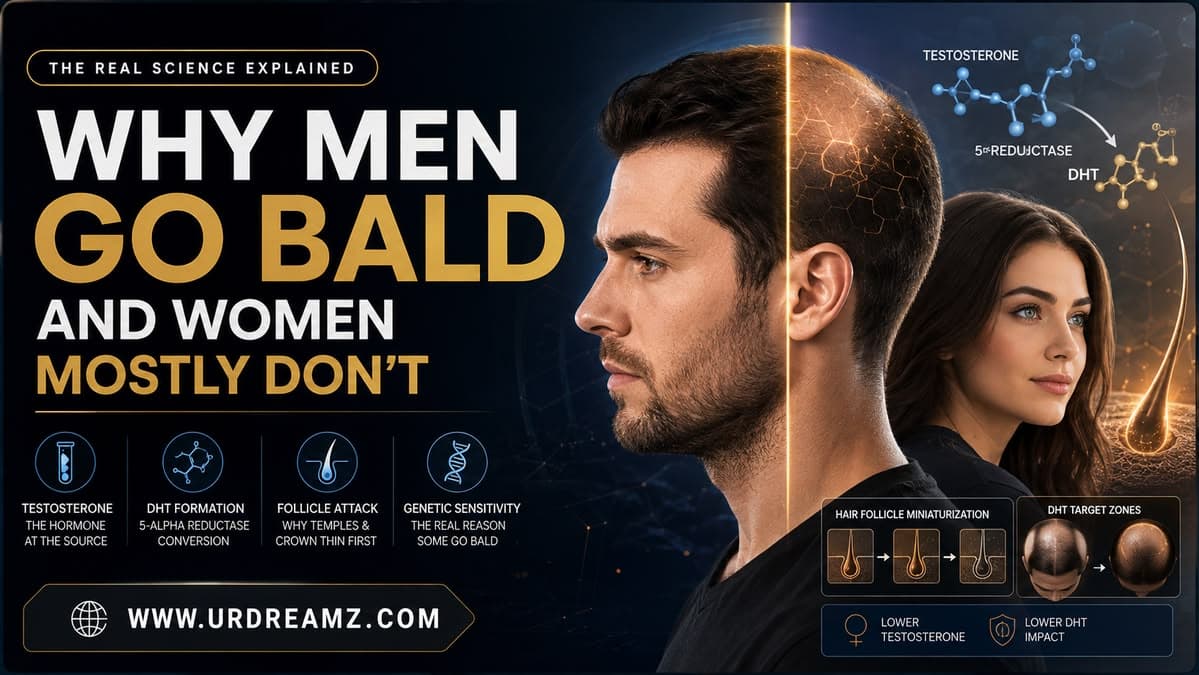
Why Men Go Bald and Women Mostly Don't: The Real Testosterone-to-DHT Story Behind Hair Loss
Ask most people why men go bald and you'll get a shrug and maybe "genetics" or "it runs in the family." That's not wrong, exactly, but it skips over one of the most interesting hormonal stories in the human body — a chain reaction that starts in the testes, travels through the bloodstream, gets transformed by a single enzyme sitting quietly at the base of every hair follicle, and ends with a specific pattern of hair loss that almost never shows up the same way in women.
This guide walks through that entire chain, step by step: what testosterone actually does once it enters the blood, why only a tiny fraction of it is ever "active," how it becomes the far more powerful hormone DHT, why DHT specifically targets certain parts of the scalp and not others, why women are largely protected from this process, and why some people with sky-high DHT never lose a strand of hair while others with relatively low DHT go bald in their twenties.
1. Why Hair Loss Overwhelmingly Affects Men
Male pattern baldness is by far the most common form of hair loss worldwide, affecting a large share of men at some point in their lives, while comparable hair thinning in women is both less common and tends to look, and behave, quite differently. This isn't random — it traces back to a specific hormone that men simply have in far greater supply than women.
2. Where This Story Begins: The Testes
In men, the testes are the primary site of testosterone production, continuously releasing this hormone into the bloodstream. This single anatomical difference — having testes at all — is the starting point for nearly everything discussed in this guide, since women, lacking testes, never generate testosterone at anywhere near the same volume.
3. What Testosterone Actually Is
Testosterone is the primary male sex hormone, though it's present in smaller amounts in women too, and it plays a role in a wide range of bodily functions including muscle development, bone density, mood, and sexual function. For the purposes of this guide, its most relevant role is as the raw material for a much more potent hormone that develops further down the line.
4. How Testosterone Travels Through the Blood
Once released into the bloodstream, testosterone doesn't simply float around freely on its own. The large majority of it immediately becomes bound to specific carrier proteins produced by the liver, which transport it throughout the body while also, in effect, keeping it inactive.
5. SHBG Explained
SHBG, or Sex Hormone-Binding Globulin, is one of the two main proteins responsible for binding to circulating testosterone in the blood. Once testosterone is bound to SHBG, it's held tightly and is not available for the body's tissues to actually use.
6. Albumin Explained
Albumin is the second major protein that binds to testosterone in the bloodstream, though its grip is looser than SHBG's, meaning albumin-bound testosterone can become available for use somewhat more easily than the SHBG-bound portion, even though it's still not considered fully "free."
7. Why 97 to 99% of Testosterone Is "Locked Away"
Between SHBG and albumin combined, roughly 97 to 99% of all circulating testosterone in the blood is bound to one of these two proteins at any given moment, leaving only a small remaining fraction genuinely free and immediately active. This bound majority plays other important roles in the body, including reproductive functions, but it isn't the portion responsible for what happens at the hair follicle.
8. Free Testosterone Explained
Free testosterone refers to the small, unbound portion of total testosterone circulating in the blood — typically only around 1 to 3% of the total amount. Despite being such a small fraction, this is the portion that's actually biologically active and able to interact directly with tissues throughout the body, including hair follicles.
9. Why Free Testosterone Is the Form That Actually Matters
Because bound testosterone is essentially locked in transit, unable to interact with tissue receptors, it's specifically the free testosterone fraction that becomes relevant to hair loss. This small percentage is what eventually makes its way to the hair follicle and undergoes the transformation responsible for pattern baldness.
10. The Journey to the Hair Follicle
Free testosterone circulating in the bloodstream eventually reaches small blood vessels supplying the scalp, including the tiny vessels that feed each individual hair follicle at its root, delivering it directly to the site where the next stage of this process takes place.
11. Blood Vessels at the Root of Each Hair
Each hair follicle is supplied by its own small blood vessel, delivering oxygen, nutrients, and — relevantly here — circulating hormones directly to the base of the follicle, where the cells responsible for hair growth are located.
12. 5-Alpha-Reductase Explained
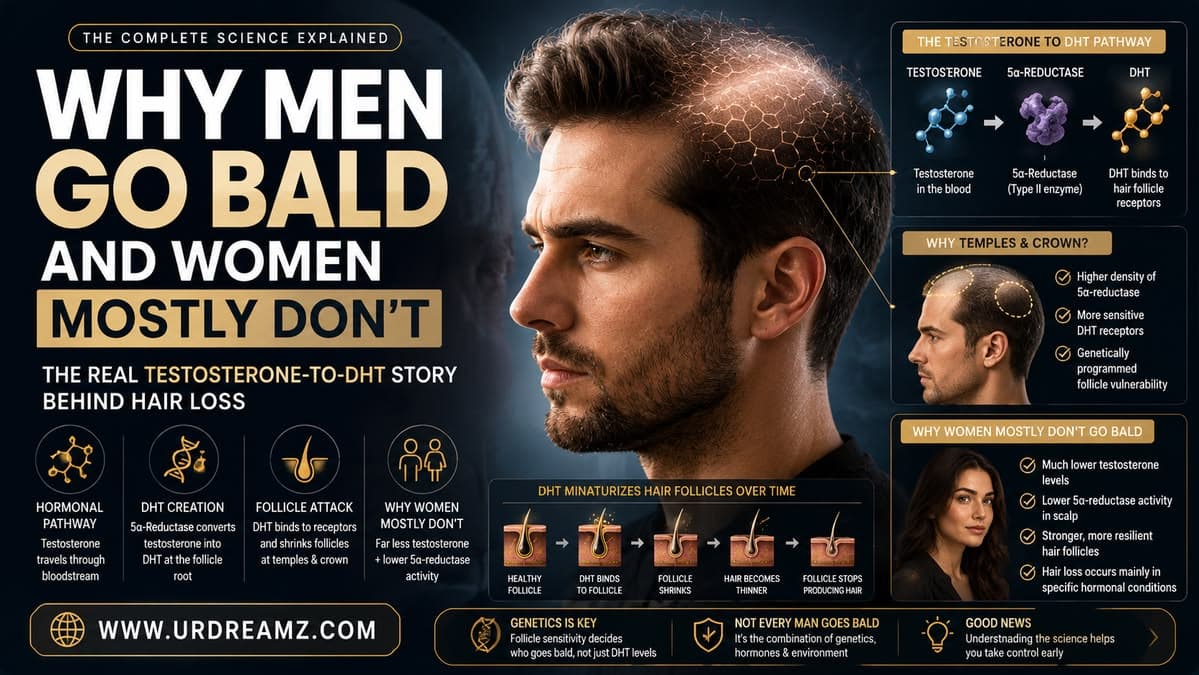
5-Alpha-Reductase is an enzyme present at the base of hair follicles, among other locations in the body, including the prostate and skin. Its specific job is converting free testosterone into a different, significantly more potent hormone.
13. How Free Testosterone Becomes DHT
When free testosterone reaches a hair follicle where 5-alpha-reductase is present, the enzyme chemically converts it into dihydrotestosterone, commonly known as DHT. This conversion happens locally, right at the follicle itself, rather than somewhere else in the body and then being transported in already-converted form.
14. DHT Explained
DHT, or dihydrotestosterone, is the hormone directly responsible for pattern hair loss. It's derived from testosterone but behaves quite differently once formed, particularly in how strongly it interacts with receptors on hair follicle cells.
15. Why DHT Is So Much More Potent Than Testosterone
DHT binds to androgen receptors with significantly greater strength and affinity than testosterone itself, meaning it produces a much stronger biological effect at those receptor sites, even in relatively small quantities. This heightened potency is exactly what makes DHT, rather than testosterone directly, the primary driver of hair follicle changes.
16. How DHT Actually Attacks the Hair Follicle
Once formed at the follicle, DHT binds to androgen receptors within genetically susceptible follicles and triggers a gradual shortening of the hair growth cycle, along with a slow shrinking of the follicle itself over repeated growth cycles.
17. Follicle Miniaturization Explained
This gradual shrinking process is known as follicle miniaturization. Over successive hair growth cycles, an affected follicle produces progressively thinner, shorter, and less pigmented hairs, until eventually it may stop producing visible hair altogether, even though the follicle itself often remains present beneath the skin for some time.
18. Why Temple and Crown Follicles Go First
Not all hair follicles carry the same genetic sensitivity to DHT. Follicles located at the temples and crown of the scalp generally carry a significantly higher genetic sensitivity to DHT's effects compared to follicles at the back and sides of the head, which is why hair loss in men so predictably begins in these specific areas rather than affecting the whole scalp evenly.
19. The Receding Hairline and "M" Shape Pattern Explained
As temple-area follicles progressively miniaturize under DHT's influence, the hairline gradually recedes from both sides, often forming the recognizable "M" shaped pattern, while crown-area thinning frequently develops simultaneously or somewhat later, eventually meeting in the middle in more advanced cases.
20. Does DHT Exist in Women Too?
Yes, DHT is present in women as well, though in considerably smaller amounts than in men, since the underlying source hormone — testosterone — exists at much lower baseline levels in the female body to begin with.
21. Where Female DHT Actually Comes From
Since women lack testes, their testosterone, and by extension their DHT, is produced primarily by the ovaries and the adrenal glands instead. This alternate, more limited source is a major reason female DHT levels remain considerably lower than male levels throughout most of adult life.
22. Correcting the Numbers: Male vs Female Testosterone Levels
| Group | Typical Total Testosterone Range |
|---|---|
| Adult Men | Roughly 300 to 1000 ng/dL |
| Adult Women | Roughly 9 to 70 ng/dL |
It's worth being precise here, since this detail is easy to get backwards: men have dramatically higher circulating testosterone than women — generally somewhere around ten to fifteen times more — not the other way around. This gap is exactly why men have so much more raw material available for 5-alpha-reductase to convert into DHT in the first place.
23. Why This Gap Matters So Much for Hair Loss
Since DHT production depends directly on how much free testosterone is available for 5-alpha-reductase to convert, the enormous testosterone gap between men and women translates directly into an enormous DHT gap as well. More starting material simply means more of the potent hormone actually responsible for attacking hair follicles.
24. Estrogen's Protective Role in Women
Beyond simply having less testosterone to begin with, women also benefit from significantly higher estrogen levels throughout most of their reproductive years. Estrogen is generally understood to support healthy hair growth cycles and offers a degree of protection against the kind of follicle miniaturization DHT causes.
25. Why Female Hair Loss Often Starts After Menopause
As women approach and pass through menopause, typically somewhere around 45 to 50 years of age, estrogen levels drop substantially, reducing this protective effect. At the same time, the relative influence of androgens like DHT becomes more pronounced by comparison, which is a major reason noticeable hair thinning in women often becomes more common specifically after menopause, rather than earlier in life.
26. DHT Isn't All Bad: Its Role in Libido
Despite its reputation as the hormone behind hair loss, DHT isn't simply a problem to be eliminated. It plays a genuinely important role in male sexual desire, commonly referred to as libido, and is considered a normal, necessary part of healthy male hormonal function.
27. DHT's Broader Role in Male Development
Beyond libido, DHT plays a significant role in male fetal development and puberty, contributing to the development of male reproductive organs and secondary sexual characteristics. It remains biologically important well into adulthood, not just during early development.
28. Why You Can't Just "Remove" DHT From the Body
Because DHT serves genuinely important functions beyond hair growth, treatments don't attempt to eliminate it entirely — doing so would carry meaningful consequences for sexual function and other aspects of health. Instead, hair loss treatments generally aim to reduce DHT production to a more moderate level, rather than removing it altogether.
29. Finasteride Explained
Finasteride is an oral medication widely used to treat pattern hair loss, and is also prescribed for an entirely different condition: benign prostatic hyperplasia, a non-cancerous enlargement of the prostate gland.
30. How Finasteride Actually Works
Finasteride works by blocking the activity of the 5-alpha-reductase enzyme, directly reducing how much free testosterone gets converted into DHT throughout the body. With less DHT being produced, DHT-sensitive hair follicles are exposed to less of the hormone responsible for their miniaturization, which can slow further hair loss and, in some cases, support partial regrowth over time.
31. Finasteride and Prostate Health
An enlarged prostate can press on the urethra, leading to difficulty or interruption during urination, and DHT is understood to contribute to this kind of prostate tissue growth over time. By reducing DHT production, Finasteride can also help ease these urinary symptoms, which is why it's prescribed for prostate issues as well as hair loss, generally at different dosages for each condition.
32. Why the Same Drug Treats Two Very Different Conditions
It might seem strange that one medication treats both hair loss and prostate enlargement, but both conditions share the same underlying driver: DHT acting on genetically sensitive tissue, whether that's a hair follicle or prostate tissue. Blocking DHT's formation addresses both problems at their shared hormonal root.
33. Side Effects and Why Finasteride Isn't Right for Everyone
Because Finasteride affects DHT levels throughout the body, not just at the scalp, some users report side effects related to sexual function or mood, and it isn't considered appropriate for use by women who are pregnant or may become pregnant, due to potential risks to fetal development. Anyone considering Finasteride should discuss it thoroughly with a doctor rather than starting it independently.
34. The Real Reason Some High-DHT Men Never Go Bald
Here's the piece that surprises a lot of people: DHT level alone doesn't determine who goes bald. Some men with relatively high DHT levels never experience meaningful hair loss, while others with comparatively lower DHT levels go bald quite early. The missing piece isn't the hormone itself — it's how sensitive that individual's specific hair follicles are to it.
35. Androgen Receptor Sensitivity Explained
Hair follicles contain androgen receptors, and it's DHT binding to these receptors that actually triggers the miniaturization process. The number and sensitivity of these receptors varies significantly from person to person, and even from one area of the scalp to another within the same individual, largely due to inherited genetic differences.
36. Why This Is Genetic, Not Just About DHT Levels
Two men can have similar circulating DHT levels and experience completely different outcomes, simply because their hair follicles carry different degrees of inherited receptor sensitivity. This is why pattern baldness is more accurately described as a combination of hormone availability and genetic follicle sensitivity working together, rather than DHT quantity alone.
37. Where This Genetic Sensitivity Actually Comes From
Androgenetic alopecia is understood to be influenced by multiple genes inherited from both parents, not just one side of the family, contrary to the popular myth that baldness is passed down exclusively through the mother's side. That said, one specific and well-studied androgen receptor gene does sit on the X chromosome, which sons always inherit from their mother, contributing to why this particular myth developed in the first place, even though it's an oversimplification of the full genetic picture.
38. Why Some Low-DHT Men Still Go Bald Early
For a man whose temple and crown follicles happen to carry unusually high genetic sensitivity to DHT, even a relatively modest amount of the hormone can be enough to trigger noticeable miniaturization at a young age. This explains cases of early-onset baldness in men who don't necessarily have unusually high hormone levels overall.
39. Putting the Full Pathway Together
| Step | What Happens |
|---|---|
| 1 | Testes produce testosterone, released into the bloodstream |
| 2 | 97–99% binds to SHBG and albumin; 1–3% remains free |
| 3 | Free testosterone reaches small blood vessels at the hair follicle root |
| 4 | 5-alpha-reductase converts free testosterone into DHT locally |
| 5 | DHT binds to androgen receptors in genetically sensitive follicles |
| 6 | Affected follicles gradually miniaturize over successive growth cycles |
| 7 | Visible hair thinning and eventual hair loss occurs in affected areas |
40. Other Common Causes of Hair Fall Beyond DHT
| Cause | How It Contributes |
|---|---|
| Nutritional deficiencies | Low iron, zinc, or protein intake can weaken hair growth |
| Chronic stress | Can push more follicles into a resting, shedding phase |
| Thyroid disorders | Both underactive and overactive thyroid can affect hair growth |
| Certain medications | Some drugs list hair thinning as a known side effect |
| Harsh styling and heat damage | Contributes to breakage, distinct from hormone-driven follicle loss |
Not all hair fall is DHT-related, which is why an accurate diagnosis matters before assuming any case of hair thinning is necessarily hormonal in origin.
41. Early Symptoms of DHT-Driven Hair Fall
Early signs typically include a gradually receding hairline at the temples, visible thinning specifically at the crown, an increase in daily shedding, and individual strands becoming progressively finer, shorter, and less pigmented over time, well before any fully bald patch becomes obvious.
42. Hair Fall Treatment Options Overview
| Treatment | How It Helps |
|---|---|
| Finasteride / Dutasteride | Reduces DHT production by blocking 5-alpha-reductase |
| Minoxidil | Improves blood flow to follicles and extends the growth phase |
| PRP / PRF | Uses growth factors from the patient's own blood to stimulate weakened follicles |
| Low-Level Laser Therapy | Uses light therapy to support follicle activity |
| Hair Transplant Surgery | Relocates DHT-resistant follicles to thinning areas |
43. Home Care and Everyday Hair Fall Solutions
Alongside medical treatments, gentle hair care habits genuinely help support overall hair health: a balanced diet with adequate protein and iron, reducing harsh heat styling, using a mild shampoo suited to your scalp type, managing stress, and avoiding excessively tight hairstyles that add unnecessary tension to the hair shaft.
44. Myths vs Facts
| Myth | Fact |
|---|---|
| Women have more testosterone than men | Men have roughly ten to fifteen times more circulating testosterone than women |
| Higher DHT always means more hair loss | Follicle sensitivity to DHT matters just as much as DHT level itself |
| Baldness only comes from the mother's side | It's influenced by genes from both parents, though one specific gene does come via the X chromosome from the mother |
| DHT is a completely harmful hormone | DHT plays an important role in male development and libido, alongside its role in hair loss |
| Finasteride removes DHT completely | It reduces DHT production; it does not eliminate it entirely |
45. Quick Glossary
| Term | Meaning |
|---|---|
| SHBG | Sex Hormone-Binding Globulin; binds most circulating testosterone, keeping it inactive |
| Free Testosterone | The small, unbound, biologically active fraction of total testosterone |
| 5-Alpha-Reductase | The enzyme that converts free testosterone into DHT |
| DHT | Dihydrotestosterone; the potent hormone directly responsible for follicle miniaturization |
| Follicle Miniaturization | The gradual shrinking of hair follicles under DHT's influence |
| Androgen Receptor | The receptor on follicle cells that DHT binds to, triggering hair loss in sensitive follicles |
46. Frequently Asked Questions
Why does hair loss mostly affect men and not women?
Men produce dramatically more testosterone than women, giving 5-alpha-reductase far more raw material to convert into DHT, the hormone directly responsible for shrinking hair follicles. Women also have higher estrogen levels, which helps protect hair growth.
What is DHT and how is it made?
DHT, or dihydrotestosterone, is formed when free testosterone is converted by an enzyme called 5-alpha-reductase, primarily at the base of hair follicles. DHT is significantly more potent than testosterone itself at binding to hair follicle receptors.
What is free testosterone and why does it matter for hair loss?
Free testosterone is the small, unbound portion of testosterone in the blood, typically only 1 to 3 percent, since the rest is bound to SHBG and albumin. Only free testosterone is available to be converted into DHT at the hair follicle.
Do women have DHT too?
Yes, women produce DHT through their ovaries and adrenal glands, but in much smaller amounts than men, since women lack testes and have significantly lower baseline testosterone levels.
What are normal testosterone levels in men versus women?
Adult men typically have total testosterone levels around 300 to 1000 ng/dL, while adult women typically range from about 9 to 70 ng/dL, meaning men generally have roughly ten to fifteen times more circulating testosterone than women.
Why do some men with high DHT never go bald?
Hair loss depends not just on DHT levels but on how sensitive an individual's hair follicles are to DHT, which is largely determined by inherited androgen receptor genetics. Some men have naturally low-sensitivity follicles and remain unaffected even with high DHT levels.
Why do the temples and crown go bald first in men?
Hair follicles in the temple and crown regions of the scalp generally carry a higher genetic sensitivity to DHT compared to follicles at the back and sides of the head, which is why male pattern baldness typically follows a receding hairline and crown-thinning pattern.
How does Finasteride treat hair loss?
Finasteride works by blocking the 5-alpha-reductase enzyme, reducing the conversion of testosterone into DHT, which can slow or partially reverse DHT-driven hair thinning over time.
Why is Finasteride also used for prostate problems?
DHT also contributes to prostate tissue growth, so blocking its production with Finasteride can help reduce symptoms of an enlarged prostate (benign prostatic hyperplasia), which is why the same drug is prescribed for both conditions, often at different doses.
Is DHT completely bad for the body?
No, DHT plays an important role in male sexual development and libido, and is considered essential for normal male reproductive health, even though it also happens to be the primary driver of pattern hair loss.
Why does female hair loss often start after menopause?
Estrogen levels drop significantly after menopause, reducing its protective effect on hair follicles, while the relative influence of androgens like DHT becomes more noticeable, which is why female pattern hair thinning often becomes more visible after age 45 to 50.
Is male pattern baldness inherited from the mother's side only?
No, this is a common myth. Androgenetic alopecia is influenced by multiple genes inherited from both parents, not solely from the mother's side, even though one specific androgen receptor gene is located on the X chromosome, which comes from the mother.
What are common early symptoms of DHT-related hair fall?
Early signs often include a gradually receding hairline at the temples, visible thinning at the crown, increased shedding, and hair strands becoming progressively finer and shorter before eventually stopping growth altogether in affected follicles.
Can hair fall be reversed once it starts?
Hair fall can often be slowed or partially reversed if treated while follicles are still miniaturized but alive; once a follicle has been fully inactive for a long period, regrowth becomes far less likely regardless of treatment.
What hair fall treatments are available besides medication?
Beyond oral and topical medications like Finasteride and Minoxidil, options include injectable treatments such as PRP and PRF, low-level laser therapy, and in more advanced cases, surgical hair transplantation.
47. Conclusion
Hair loss in men isn't just "genetics" in some vague, unexplainable sense — it's a specific, traceable hormonal chain reaction: testosterone made in the testes, mostly locked away by SHBG and albumin, with a small free fraction reaching the hair follicle, where a single enzyme converts it into the far more potent DHT, which then binds to genetically sensitive receptors and slowly shrinks the follicle over years of growth cycles. Women largely avoid this fate not because they're immune to the mechanism itself, but because they simply start with dramatically less testosterone, and benefit from estrogen's protective effect on top of that.
And within that whole story sits the detail that actually explains why hair loss looks so different from person to person: it was never really just about how much DHT someone has. It's about how sensitive their specific follicles were always going to be to it, something written into their genes long before any hormone levels were ever measured. Understanding that distinction is exactly what separates real, useful knowledge about hair loss from the vague "it's genetic" shrug most people settle for — and it's exactly why treatments like Finasteride, which target the hormone conversion step directly, can make a genuine difference for the people whose follicles were always going to be listening.