Why Fear Stops Your Digestion: The Real Science Behind Stress, the Nervous System, and Lifestyle Disease
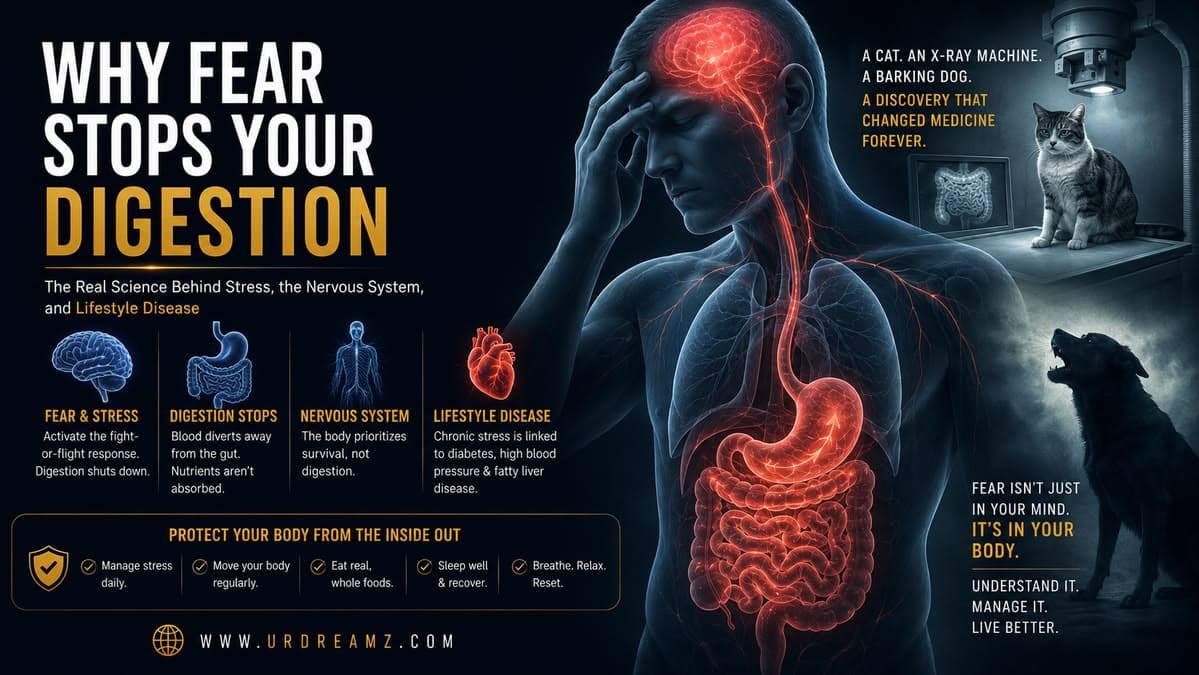
A cat, a barking dog, and an X-ray machine changed how medicine understands the human body forever. Here's the real story, and what it means for your health today.
Introduction: 8.5 Billion People Turning Into Cats and Dogs
There are more than eight billion people alive on Earth right now, and if you look closely at how most of us are actually living — glued to screens, sleeping badly, eating on the run, carrying around a low hum of anxiety about money, work, relationships, and the news — a strange thought starts to feel less strange the more you sit with it: we are, in a very real physiological sense, living the same experiment day after day that scientists once ran deliberately on animals in a laboratory.
That experiment is real, and it happened over a century ago, though the way it gets told today on social media has picked up some extra dramatic flourishes along the way. Understanding both the real science and the exaggerated version matters, because the real version is genuinely one of the most important discoveries in the history of medicine — and it explains, in hard biological terms, exactly why chronic stress isn't just an unpleasant feeling, but a measurable, physical process that can quietly reshape your digestion, your blood sugar, your blood pressure, and your long-term health.
What makes this topic worth genuinely understanding, rather than just nodding along to as a piece of trivia, is how directly it connects an old laboratory discovery to something happening in your own body right now, today, whether you notice it or not. Every time you feel a knot in your stomach before a difficult conversation, lose your appetite during a stressful week, or feel your heart race before checking a worrying message, you are experiencing a smaller, everyday version of exactly the mechanism a Harvard scientist first documented using a cat, an X-ray machine, and a barking dog more than a hundred years ago.
The Real Experiment Behind the Story
The scientist behind this discovery was Walter Bradford Cannon, a Harvard physiologist working in the early 1900s, just a year after X-rays themselves had been discovered. Cannon was originally studying something fairly mundane: how food physically moves through the digestive tract. To do this, he used a fluoroscope — an early X-ray device that let him watch, in real time, the movement of food through a cat's stomach and intestines.
| Detail | Fact |
|---|---|
| Researcher | Walter Bradford Cannon, Harvard physiologist |
| Time period | Beginning around 1896, with key discoveries following in the early 1900s |
| Tool used | A fluoroscope, an early X-ray imaging device — not an MRI, which did not exist yet |
| Original research goal | Studying the mechanics of digestion — how food and waste move through the gastrointestinal tract |
| The accidental discovery | Digestive movement in the cats completely stopped whenever the animal showed fear, anger, or distress |
Here's the part that makes this a genuinely great scientific story: Cannon wasn't trying to study stress or fear at all when he found this. He kept getting frustrated because his digestion experiments would randomly stop working — the fluoroscope would show the cat's stomach and intestines simply freezing in place, ruining his data. It took him a while to realize that this "interruption" wasn't a technical failure at all — it was the actual discovery. Every single time it happened, the cat had become anxious, agitated, or afraid about something in its environment. Once he noticed that pattern, he switched his entire research focus, deliberately exposing cats to something frightening — most famously, a barking dog — while watching what happened to their digestion on the fluoroscope screen in real time.
Separating Fact From Embellishment
The version of this story that circulates widely online today — a glass room, an MRI machine, a precisely timed four-day repeated protocol, a dog let in for exactly one or two minutes — has clearly been dramatized somewhat for retelling, and it's worth being honest about which parts are solid history and which parts are likely embellishment added over a century of retelling.
| Popular Version Claims | What the Historical Record Actually Shows |
|---|---|
| Conducted in England | Actually conducted at Harvard University in the United States |
| Used an MRI machine | MRI technology didn't exist until the 1970s; Cannon used a fluoroscope, an early X-ray device |
| A precise 4-day repeated protocol with exact 2-hour digestion windows | Cannon's actual research involved a long series of experiments over years, not a single tidy 4-day trial |
| Cat sealed in a literal glass room | Cats were generally restrained for imaging purposes, not housed in a separate glass chamber |
| Core finding: fear stops digestion | This part is completely accurate and extremely well documented — this is the real, foundational discovery |
This distinction matters for a simple reason: the real science here is impressive enough on its own that it doesn't need embellishment to be worth sharing. If anything, knowing the real story — an accidental discovery made by a frustrated scientist whose experiments kept "failing," who was curious enough to investigate why instead of just working around the problem — is arguably a better story than the dramatized version, because it shows how real scientific breakthroughs actually tend to happen: not through a single dramatic staged demonstration, but through years of patient observation and a willingness to follow an unexpected result wherever it leads.
What Actually Happens Inside Your Body During Fear
Cannon's continued research after this discovery led him to coin one of the most famous phrases in all of physiology: "fight or flight." He found that when an animal — or a human — perceives a threat, the body undergoes a rapid, coordinated set of internal changes, all designed for one purpose: preparing to either fight the threat or run from it, as fast and effectively as possible.
| Change During the Stress Response | Purpose |
|---|---|
| Heart rate and blood pressure rise | Pumps more oxygen and nutrients quickly to muscles |
| Blood sugar (glucose) rises rapidly | Provides immediate fuel for emergency muscle activity |
| Blood clotting speeds up | Reduces blood loss risk in case of injury during a fight |
| Digestion slows or stops almost entirely | Diverts blood flow and energy away from a "non-essential" process during an emergency |
| Adrenaline and other stress hormones surge | Coordinates and sustains all of the above changes throughout the body |
Notice the logic here: from your body's perspective, digesting your lunch is simply not a priority when it thinks you might be about to be eaten by something. Every one of these changes makes complete sense for a genuine short-term emergency — a real predator, a real physical danger. The problem, which we'll get to shortly, is that the modern human nervous system frequently can't tell the difference between "a lion is chasing me" and "I have an unpaid bill and a difficult email waiting for me," and reacts to both with roughly the same internal alarm system.
Meet Your Two Nervous Systems
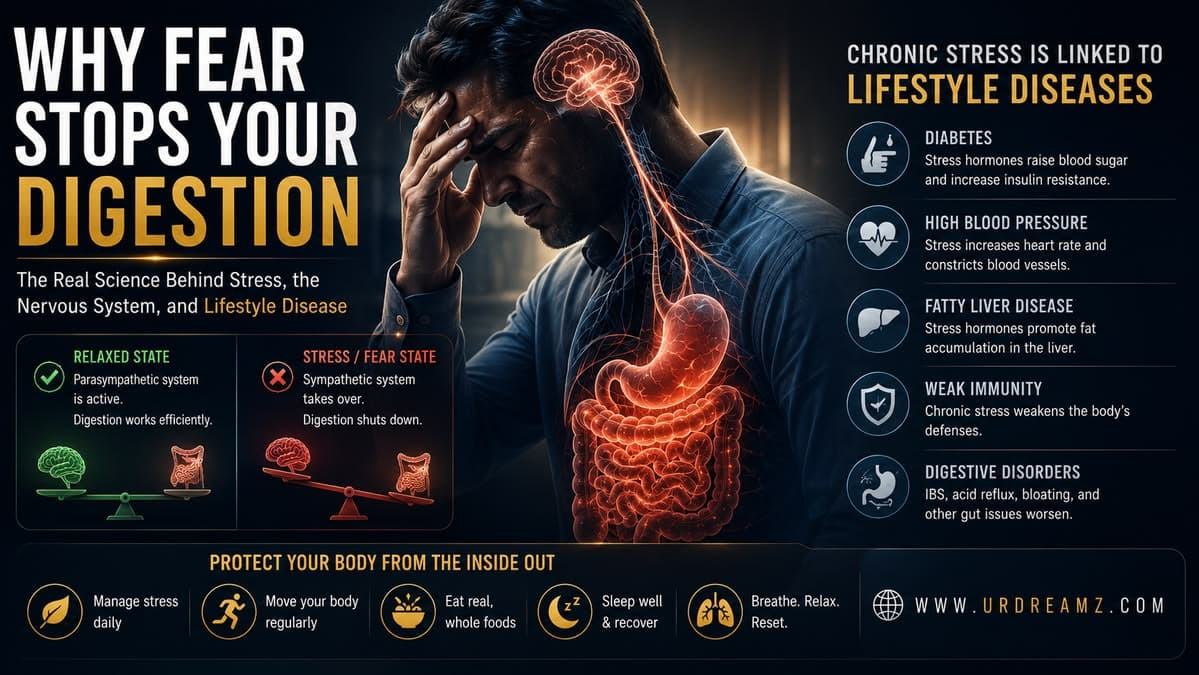
To understand why this happens, it helps to know that your autonomic nervous system — the part that runs automatically, without you consciously thinking about it — is actually split into two opposing branches that constantly compete for control of your internal organs.
| System | Nickname | What It Does |
|---|---|---|
| Sympathetic nervous system | "Fight or flight" system | Activates during stress or danger; speeds up heart rate, redirects blood away from digestion, sharpens alertness |
| Parasympathetic nervous system | "Rest and digest" system | Activates during calm, safe states; slows heart rate, promotes digestion, supports repair and recovery |
These two systems are essentially a seesaw — when one is strongly active, the other gets suppressed. This is precisely why Cannon's cats stopped digesting the moment the dog appeared: the sudden fear switched the animal's nervous system sharply toward the sympathetic ("fight or flight") side, which automatically dialed the parasympathetic ("rest and digest") side down, taking active digestion with it. The same seesaw operates inside you, every single day, usually without you noticing it happening at all.
Why the Body Shuts Down Digestion During Stress
Digestion is, biologically speaking, an expensive and relatively slow process. It requires significant blood flow to the stomach and intestines, a steady release of digestive enzymes and acids, and coordinated muscle contractions to move food along — all processes that take real time and real energy to run properly.
During a genuine emergency, none of that is useful. Blood that would normally go toward digesting your last meal instead gets redirected toward your skeletal muscles, heart, and brain — the systems you'd actually need to survive an immediate physical threat. This is not a vague or approximate effect; it's been measured directly, the same way Cannon measured it, by watching gastrointestinal movement essentially freeze on imaging the instant an animal becomes afraid. In humans, this same mechanism explains a very familiar feeling: the "knot in your stomach" or sudden loss of appetite that shows up before a stressful event like a big exam, a difficult conversation, or a public speech — that sensation is your sympathetic nervous system doing exactly what Cannon's cats experienced, just usually at a less extreme intensity.
The Gut-Brain Connection Is More Real Than You Think
Modern research has taken Cannon's original discovery much further than he could have imagined, revealing what scientists now call the gut-brain axis — a genuine, two-way communication network connecting your digestive system and your brain, running largely through a structure called the vagus nerve.
| Concept | What It Means |
|---|---|
| The vagus nerve | A major nerve pathway that carries constant two-way signals between the brain and the gut |
| The gut-brain axis | The broader communication system linking emotional and cognitive brain centers with intestinal function |
| The "second brain" | A term sometimes used to describe the gut's own extensive network of neurons, called the enteric nervous system |
| Gut microbiome influence | Emerging research suggests gut bacteria may even influence mood and stress responses through this same communication pathway |
This is exactly why stress doesn't just theoretically affect digestion — it explains, in measurable biological terms, why so many people experience real physical stomach problems, from mild indigestion to genuine conditions like irritable bowel syndrome, that flare up specifically during periods of high emotional stress. Your gut is not a passive, disconnected organ quietly doing its own thing in the background; it is in constant, active conversation with your brain, and that conversation changes measurably depending on whether your nervous system currently believes you are safe or in danger.
From Short-Term Stress to Long-Term Disease
Here's where the story shifts from "interesting laboratory finding from a century ago" to "genuinely important for your everyday life." The fight-or-flight response was designed by evolution for short, intense bursts — a predator encounter lasting minutes, not a stressful life situation lasting months or years. The problem with modern life is that many of us experience low-grade psychological stress almost continuously — financial pressure, work demands, relationship strain, constant digital notifications — keeping the sympathetic nervous system activated far more often, and for far longer, than it was ever designed to handle.
| Short-Term Stress (Helpful) | Chronic Stress (Harmful) |
|---|---|
| Lasts minutes to hours | Persists for weeks, months, or years |
| Digestion pauses temporarily, then resumes normally | Digestion is repeatedly disrupted, contributing to ongoing gut issues |
| Blood sugar spikes briefly for emergency energy, then returns to normal | Repeated blood sugar spikes contribute to long-term insulin resistance |
| Blood pressure rises temporarily, then settles | Frequently elevated blood pressure contributes to long-term cardiovascular strain |
| The body fully recovers afterward | The body never gets a full chance to return to its baseline "rest and digest" state |
This is the real, evidence-based foundation behind the popular idea that stress contributes to "lifestyle diseases." It's not a vague, feel-good wellness slogan — it's a fairly direct extension of exactly the mechanism Cannon discovered by accident with his cats, just stretched out over months and years instead of a single dramatic moment involving a barking dog.
Researchers studying chronic stress often describe this as the body's "allostatic load" — essentially, the cumulative wear and tear that builds up when the stress response gets activated too often, for too long, without adequate recovery time in between. A single stressful event is like briefly revving a car engine hard before returning to a normal cruising speed; the engine handles that fine. Chronic stress is closer to driving that same engine constantly redlined for months at a time — nothing catastrophic happens in any single moment, but the cumulative strain on every system involved adds up in ways that eventually show up as measurable damage, whether that's elevated blood sugar, stiffened blood vessels, or a liver quietly accumulating more fat than it should.
Stress and Blood Sugar: The Diabetes Connection
When your body enters fight-or-flight mode, it deliberately raises blood sugar levels, releasing stored glucose to fuel an emergency response. This is healthy and useful for a single short burst. Under chronic stress, though, this same mechanism repeats itself constantly, and the body's cells can gradually become less responsive to insulin — the hormone responsible for helping glucose move out of the bloodstream and into cells for use as energy.
Over time, this reduced insulin sensitivity, driven partly by chronically elevated stress hormones like cortisol, is a well-documented contributing factor in the development of type 2 diabetes, alongside other major factors like diet, physical activity levels, and genetics. It's important to be precise here: stress alone does not single-handedly cause diabetes in an otherwise low-risk person — but it is a genuine, scientifically recognized contributing factor that can meaningfully worsen blood sugar control, particularly in people who already carry other risk factors.
Stress and Blood Pressure
The connection between stress and blood pressure is one of the most direct and well-established in this entire topic. Every time your sympathetic nervous system activates, your heart rate increases and your blood vessels constrict — both of which directly raise blood pressure in the moment.
A single stressful event causes only a temporary spike, which is generally not harmful on its own. Chronic, repeated activation, however, is associated with sustained hypertension over time, according to substantial cardiovascular research. This matters enormously because high blood pressure is itself one of the leading risk factors for heart attack, stroke, and kidney disease worldwide — meaning the pathway from "constant daily stress" to "serious cardiovascular illness" is not some vague, mystical mind-body connection, but a fairly direct, measurable physiological chain of cause and effect.
Stress and Fatty Liver Disease
The liver plays a central role in regulating blood sugar and fat metabolism, and it is directly affected by the same stress hormones involved in the fight-or-flight response. Chronically elevated cortisol has been linked in research to increased fat accumulation in the liver, along with changes in how the body processes and stores fat more broadly.
Combined with the fact that people under chronic stress often also experience disrupted sleep, poor dietary choices, and reduced physical activity — all of which independently contribute to fatty liver risk — it becomes clear why stress is increasingly recognized by researchers as one contributing thread among several in the broader rise of non-alcoholic fatty liver disease, particularly in populations experiencing high, sustained psychological and lifestyle stress.
Does Stress Actually Cause Cancer? Being Careful With This Claim
This is a claim worth handling with real care, because it's one of the most commonly repeated stress-related health claims online, and the actual scientific evidence is more nuanced than the confident, simple version usually presented.
| What's Well Supported | What's Less Certain |
|---|---|
| Chronic stress can weaken immune function over time | Whether stress directly causes cancer cells to form in an otherwise healthy person |
| Stress hormones can influence inflammation levels in the body | The exact size and consistency of any stress-cancer link across different cancer types |
| Chronic stress is linked to behaviors that raise cancer risk (poor diet, smoking, alcohol use, disrupted sleep) | Whether stress alone, independent of these behavioral factors, meaningfully raises cancer risk |
Major cancer research organizations, including the American Cancer Society and the National Cancer Institute, have generally concluded that current evidence does not clearly establish that psychological stress directly causes cancer on its own. What the evidence does support more clearly is an indirect pathway: chronic stress can weaken immune surveillance, increase inflammation, and — very significantly — drive unhealthy coping behaviors like smoking, overeating, alcohol use, and poor sleep, all of which are independently and much more strongly linked to increased cancer risk. So rather than saying "stress causes cancer" as a direct, simple fact, the more scientifically accurate and honest framing is: chronic stress can meaningfully worsen several of the underlying conditions and behaviors that are established cancer risk factors, making stress management a genuinely worthwhile part of cancer prevention, even though it isn't accurate to describe stress itself as a proven direct cause the same way, for example, tobacco smoke is.
This distinction matters for a reason beyond scientific pedantry: overstating a claim like "stress causes cancer" can actually cause real harm to people already dealing with a cancer diagnosis, sometimes leading to unnecessary guilt or self-blame about their own emotional state having somehow caused their illness — a burden with no solid scientific basis. The more accurate, nuanced picture allows for genuine, useful stress management as part of a comprehensive health and treatment approach, without adding unfounded guilt on top of an already difficult situation.
Why Laughter and Joy Genuinely Help
If chronic activation of the sympathetic "fight or flight" system is the problem, then it follows logically that anything genuinely activating the parasympathetic "rest and digest" system should help counterbalance it — and this is exactly where the popular advice to "find your happiness" and "laugh more" actually earns real scientific support, rather than being just a feel-good platitude.
| Activity | How It Helps |
|---|---|
| Genuine laughter | Associated with reduced stress hormone levels and increased activity in the parasympathetic nervous system |
| Deep, slow breathing | Directly stimulates the vagus nerve, actively shifting the body toward "rest and digest" mode |
| Time in nature | Linked in multiple studies to measurably reduced cortisol levels |
| Social connection and support | Associated with lower baseline stress reactivity over time |
| Regular physical activity | Helps metabolize stress hormones and improves long-term stress resilience |
None of this means laughter alone will cure diabetes, hypertension, or fatty liver disease on its own — that would be overstating the science just as much as claiming stress directly causes cancer. What it does mean is that genuinely reducing chronic stress, through whatever combination of these evidence-supported methods works for your own life, is a real, physiologically meaningful piece of protecting your long-term health, sitting alongside — not instead of — proper medical care, a reasonable diet, and regular movement.
Practical Ways to Support Your Nervous System
Bringing all of this together, here are specific, evidence-grounded steps worth considering if you want to actively support your body's ability to shift out of chronic "fight or flight" mode.
| Step | Why It Helps |
|---|---|
| Practice slow, deep breathing during stressful moments | Directly signals the vagus nerve to activate the calming parasympathetic response |
| Eat meals in a calm, unhurried setting when possible | Supports the parasympathetic state your digestive system actually needs to function well |
| Prioritize consistent, adequate sleep | Sleep is when much of the body's stress-hormone regulation and repair takes place |
| Build in regular physical activity | Helps process and clear stress hormones from the body |
| Limit constant digital stimulation and notifications | Reduces the frequency of small, repeated stress-response triggers throughout the day |
| Seek professional support for persistent anxiety or stress | Chronic stress that feels unmanageable alone often responds well to therapy or counseling support |
None of these steps require dramatic life changes overnight — the same way Cannon's discovery came from noticing a small, repeated pattern rather than a single dramatic event, meaningful improvement in how your nervous system handles stress tends to come from small, consistent daily habits rather than one big transformation.
Frequently Asked Questions
Is the cat and dog digestion experiment a real scientific study?
Yes — the core finding, that fear and stress halt digestion, comes from real, well-documented research by Harvard physiologist Walter Cannon in the early 1900s, though some popularized retellings online have added dramatized details not found in the historical record.
What is the "fight or flight" response?
It's the body's rapid, coordinated physiological response to perceived danger, first described by Walter Cannon, involving increased heart rate, elevated blood sugar, and suppressed digestion to prepare the body for immediate physical action.
Why does digestion stop when we're scared or stressed?
Because the sympathetic nervous system redirects blood flow and energy away from digestion toward muscles and organs needed for an immediate physical response, suppressing the parasympathetic "rest and digest" system.
What is the sympathetic nervous system?
The branch of the autonomic nervous system responsible for the "fight or flight" stress response, activating during perceived danger or stress.
What is the parasympathetic nervous system?
The branch of the autonomic nervous system responsible for "rest and digest" functions, active during calm, safe states and supporting digestion and recovery.
Can chronic stress really cause diabetes?
Chronic stress is a recognized contributing factor to insulin resistance and blood sugar dysregulation, though it works alongside other factors like diet and genetics rather than being a sole, standalone cause.
Does stress really raise blood pressure long-term?
Yes — repeated activation of the stress response is associated with sustained hypertension over time, a well-established finding in cardiovascular research.
Can stress cause fatty liver disease?
Chronic stress and elevated cortisol are linked to increased fat accumulation in the liver, contributing to fatty liver disease risk alongside diet, sleep, and activity level factors.
Does stress directly cause cancer?
Major cancer research bodies have not established that stress directly causes cancer; the clearer evidence points to stress worsening behaviors and immune function in ways that indirectly raise cancer risk.
What is the gut-brain axis?
It's the two-way communication network, running largely through the vagus nerve, connecting the brain and the digestive system, explaining why emotional states can directly affect digestive function.
Does laughter actually reduce stress hormones?
Yes — genuine laughter is associated with reduced stress hormone levels and increased activation of the calming parasympathetic nervous system.
How can I calm my nervous system quickly during a stressful moment?
Slow, deep breathing is one of the fastest evidence-supported ways to stimulate the vagus nerve and shift the body toward a calmer parasympathetic state.
Is it bad to eat while stressed or upset?
Eating during high stress can impair digestion since the body's resources are diverted away from digestive function, so eating in a calmer state generally supports better digestion.
What happened to Walter Cannon's cats after the experiments?
Available historical accounts focus mainly on the scientific findings themselves rather than detailed individual animal outcomes; the broader research contributed foundational knowledge to modern physiology.
Is stress management considered part of real medical treatment today?
Yes — stress management, including therapy, lifestyle changes, and relaxation techniques, is increasingly recognized as a meaningful complementary component alongside standard medical treatment for many chronic conditions.
Conclusion
A frustrated Harvard scientist, over a hundred years ago, kept losing his digestion data to a mysterious pattern he almost dismissed as a technical nuisance — until he noticed that pattern was actually the discovery. Every time his research cats became afraid, their digestion simply stopped, visible in real time on his X-ray screen. That accidental finding gave the world the term "fight or flight" and laid the foundation for everything modern medicine now understands about how stress physically reshapes the body.
A century later, the lesson has only become more relevant, not less. Most of us are not being chased by predators, but many of us are living in a near-constant, low-grade state of the same physiological alarm Cannon's cats experienced — and the honest, evidence-based science says that state genuinely does affect digestion, blood sugar, blood pressure, and liver health over time, even if some of the more dramatic claims about stress and disease need to be stated with appropriate scientific care rather than absolute certainty. The practical takeaway is refreshingly simple and doesn't require exaggeration to be worth taking seriously: protecting your nervous system's ability to shift out of "fight or flight" and into "rest and digest" — through sleep, movement, breath, connection, and yes, genuine laughter — is not just pleasant advice. It's a direct, physiologically grounded investment in how well your body functions for decades to come.