PRP vs PRF for Hair Fall: Which Injectable Hair Loss Treatment Actually Works Better?
Roughly a third of people will deal with noticeable hair fall at some point in their lives, and if you've spent any time researching solutions, you've probably run into two very similar-sounding acronyms: PRP and PRF. Both involve drawing your own blood, spinning it in a machine, and injecting something back into your scalp. Both promise to wake up struggling hair follicles. And on the surface, they can look almost identical.
They're not identical, though, and the difference between them comes down to a fairly specific piece of laboratory chemistry that most clinics never actually explain to patients. This guide walks through exactly how each treatment is made, what's biologically happening when it's injected into your scalp, why one tends to last longer than the other, and — just as importantly — when neither of them will help at all, no matter how many sessions you get.
1. Hair Fall: How Common Is It, Really?
Hair fall affects an estimated 33% of people at some point, making it one of the most common cosmetic and dermatological concerns worldwide, cutting across age, gender, and background. That scale is exactly why the market for hair loss treatments has grown so large, and why so many different approaches — from decades-old medications to newer injectable therapies — now exist side by side.
2. The Two Broad Categories of Hair Loss Treatment
Modern hair fall treatment generally falls into two broad categories: medication-based treatments, taken orally or applied topically, and injection-based treatments, which work more directly at the scalp and follicle level. PRP and PRF, the focus of this guide, both belong to the second category.
3. Medication-Based Treatments: A Quick Overview
Before getting into the injectable treatments, it's worth understanding the medication-based options they're often used alongside, since combining approaches is extremely common in real-world hair loss treatment plans.
4. Minoxidil Explained
Minoxidil is available as a topical lotion or foam, and in some regions as an oral tablet, and works primarily by improving blood flow to hair follicles and extending the active growth phase of the hair cycle. It's one of the most widely used and longest-established hair loss treatments available without a specialist prescription in many countries.
5. Finasteride Explained
Finasteride is an oral medication that works by blocking the conversion of testosterone into DHT (dihydrotestosterone), a hormone closely linked to genetic, pattern-based hair loss in men. By reducing DHT levels, Finasteride can slow or, in some cases, partially reverse hormone-driven hair thinning.
6. Dutasteride Explained
Dutasteride works through a similar mechanism to Finasteride, blocking DHT production, but does so more comprehensively by inhibiting a broader range of the enzyme responsible for that conversion. It's sometimes used as an alternative for people who don't respond as well to Finasteride alone.
7. Injection-Based Treatments: A Quick Overview
Beyond medication, several injection-based treatments have become increasingly popular for hair fall, including PRP (Platelet-Rich Plasma), PRF (Platelet-Rich Fibrin), Exosome therapy, and Mesotherapy — each working through a different biological mechanism, though PRP and PRF specifically share the same starting material: a person's own blood.
8. Where PRP Actually Came From
PRP wasn't originally developed for hair loss at all. Its first significant medical use was in cardiac surgery, where it was used to support tissue healing after heart procedures. From there, it gradually expanded into other fields entirely unrelated to hair.
9. From Heart Surgery to Hair Clinics
After cardiac surgery, PRP found its way into dentistry, where it supported healing after oral surgery, then into sports medicine, where it became a well-known treatment for athletes recovering from soft tissue and joint injuries, and later into orthopedics for bone-related healing. It was only after this long journey through other specialties that dermatologists began exploring whether the same growth-factor-rich plasma could stimulate hair follicles when injected into the scalp — and that's how PRP eventually became a hair loss treatment.
10. How PRP Is Actually Prepared: Step One
The process begins simply: a small sample of the patient's own blood is drawn, generally from the arm, the same way blood would be drawn for a routine lab test.
11. What's Inside a Tube of Drawn Blood
Whole blood is made up of several distinct components: plasma (the liquid portion, mostly water), red blood cells, white blood cells, and platelets. For PRP, the entire goal of the preparation process is isolating and concentrating just one of these components — the platelets — while separating out the rest.
12. The First Centrifuge Spin
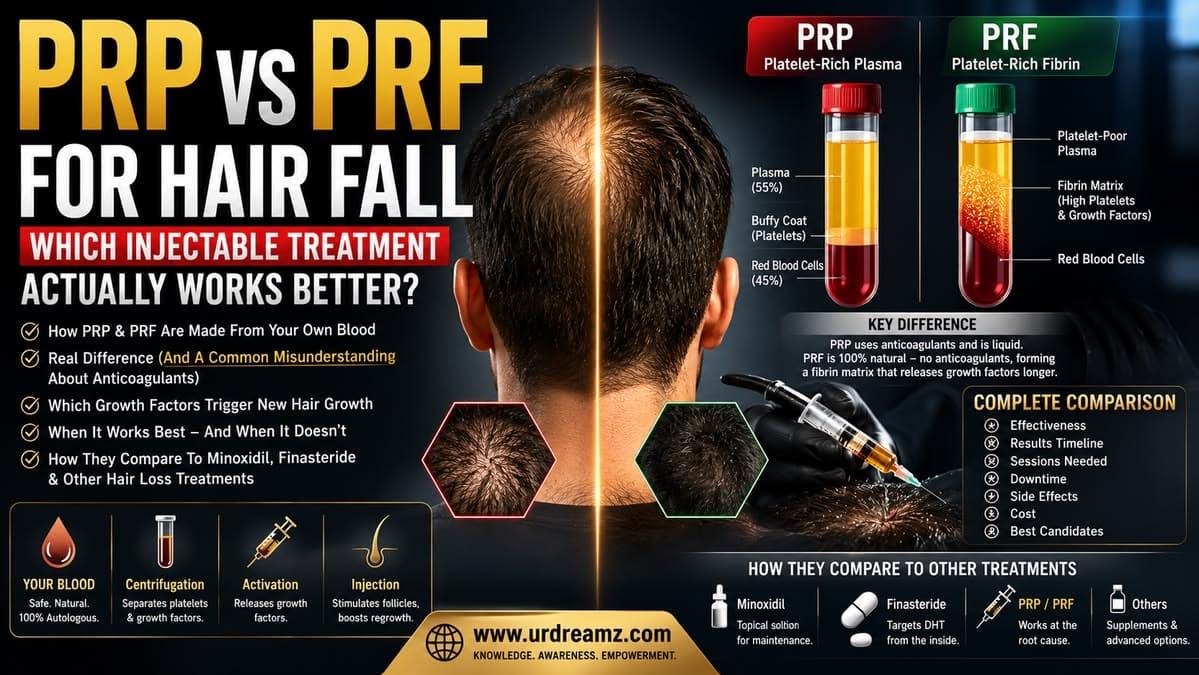
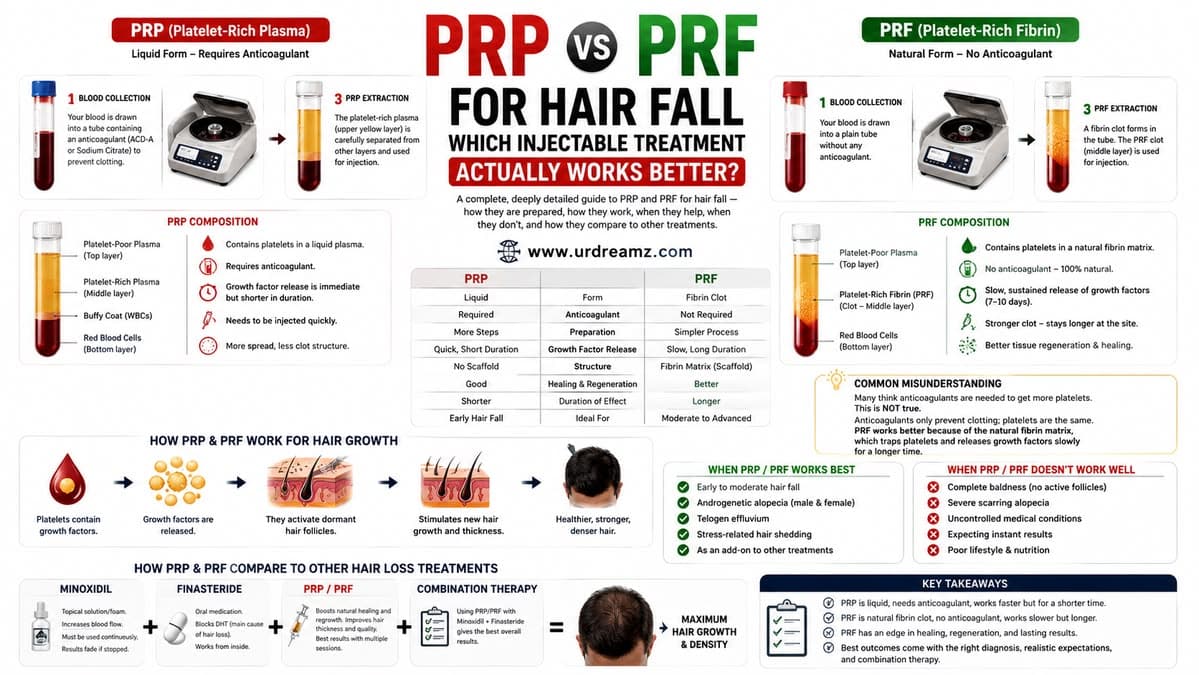
The drawn blood is placed into a centrifuge, a machine that spins tubes at high speed, using centrifugal force to separate blood components by density. In the first spin, the denser red blood cells settle toward the bottom of the tube, while the lighter plasma, white blood cells, and platelets remain higher up.
13. The Second Centrifuge Spin
After removing the red blood cell layer, the remaining plasma is often spun a second time, at a different speed, to further concentrate the platelets into a smaller volume of plasma, pushing the platelet concentration significantly higher than what's found in ordinary whole blood.
14. What "Platelet-Rich Plasma" Actually Means
The final product — plasma with a platelet concentration significantly above normal levels — is what's actually referred to as Platelet-Rich Plasma, or PRP. It's this concentrated platelet content that gives the treatment its name and its therapeutic value.
15. What's Actually Inside a Platelet
Platelets are best known for their role in blood clotting, but they also contain small internal storage structures called alpha granules, packed with a variety of proteins known as growth factors. These growth factors are the actual active ingredients responsible for PRP's effect on tissue, including hair follicles.
16. PDGF Explained
PDGF, or Platelet-Derived Growth Factor, plays a central role in stimulating cell growth and division, and is heavily involved in the earliest stages of tissue repair, encouraging relevant cells to begin multiplying.
17. VEGF Explained
VEGF, or Vascular Endothelial Growth Factor, promotes the formation of new blood vessels, a process called angiogenesis. For hair follicles specifically, better local blood supply means better delivery of oxygen and nutrients to support active growth.
18. TGF-Beta Explained
TGF-Beta, or Transforming Growth Factor Beta, plays a broad role in cell signaling and tissue repair, helping regulate how cells grow, differentiate, and respond to injury or stress within the surrounding tissue.
19. IGF-1 Explained
IGF-1, or Insulin-like Growth Factor 1, supports cell survival and growth, helping protect and sustain the activity of cells — including hair follicle-related cells — that might otherwise weaken or become inactive.
20. How These Growth Factors Reach the Hair Follicle
Once the concentrated PRP is injected into the scalp, these growth factors are released directly into the tissue surrounding each hair follicle, forming a kind of direct biochemical connection with the follicle opening the hair naturally grows from.
21. Hair Follicle Stem Cells Explained
Deep within each hair follicle sits a small population of stem cells responsible for regenerating and sustaining hair growth over a person's lifetime. PRP's growth factors are believed to specifically stimulate these stem cells, encouraging weakened but still-living follicles to become more active again.
22. Why PRP Works Best in Early-Stage Hair Loss
PRP tends to produce its best results when used relatively early in the hair loss process, while follicles are thinning or becoming less active but their stem cells are still alive and simply under-stimulated. In this scenario, the added growth factors genuinely have living cellular material to work with and encourage back into activity.
23. Why PRP Fails on Completely Dead Follicles
Once a follicle's stem cells have fully died off — which typically happens after prolonged, advanced hair loss, particularly in long-standing bald areas — no amount of growth factor stimulation can bring them back. PRP cannot create new stem cells or reverse this kind of permanent follicle loss; it can only support and stimulate follicles that still have living cellular structure left to work with.
24. Other Conditions That Limit PRP's Effectiveness
Certain underlying conditions — including some genetic hair loss patterns, hormonal imbalances, and other systemic health conditions — can continue driving hair loss regardless of PRP treatment, which is why a proper diagnosis of the underlying cause matters just as much as the treatment itself.
25. Now, PRF: What Actually Makes It Different
PRF, or Platelet-Rich Fibrin, is generally considered a more advanced evolution of PRP, and is often described as producing longer-lasting results. The core difference between the two comes down entirely to how each one is actually prepared in the lab.
26. Clearing Up a Common Misunderstanding About Anticoagulants
It's worth being precise here, since this detail is easy to get backwards: PRP preparation uses an anticoagulant, while PRF preparation deliberately avoids one entirely. The anticoagulant is what allows PRP's blood sample to stay in liquid form throughout the spinning and separation process; PRF, by contrast, is prepared specifically without any anticoagulant, allowing the blood to clot naturally as part of how the treatment is made.
27. Why PRP Needs an Anticoagulant
Without an anticoagulant, drawn blood would begin clotting almost immediately, which would make it impossible to cleanly separate plasma, platelets, and red blood cells into distinct layers during centrifugation. The anticoagulant keeps everything in a liquid state long enough for the multi-step separation process PRP requires.
28. Why PRF Deliberately Avoids One
PRF works the opposite way on purpose. Blood is drawn into a plain tube with no anticoagulant and spun almost immediately, at a slower speed than typical PRP protocols. Because clotting isn't being prevented, the blood begins its natural clotting process during the spin itself, forming a solid fibrin structure that physically traps platelets, white blood cells, and growth factors inside it as it forms.
29. What EDTA Actually Does (and Where It Fits)
EDTA is indeed a real anticoagulant used in some blood collection tubes, commonly for routine lab testing where blood needs to stay liquid for analysis. In the context of PRP versus PRF specifically, though, it's PRP that relies on an anticoagulant (commonly one called ACD-A in clinical PRP kits) to stay liquid, while PRF's defining feature is the deliberate absence of any anticoagulant at all, allowing natural clot formation to happen instead.
30. How the PRF Centrifuge Spin Actually Works
PRF is generally processed using a single, lower-speed centrifuge spin, compared to PRP's often higher-speed, sometimes double-spin process. This gentler, slower spin plays a direct role in how the fibrin matrix eventually forms and how evenly platelets end up distributed throughout it.
31. The Fibrin Matrix Explained
As PRF's blood sample clots during the spin, it forms a solid, gel-like fibrin structure — essentially a natural scaffold — with platelets, growth factors, and some white blood cells physically woven into it, rather than floating freely in liquid plasma the way they do in PRP.
32. Why PRF Is Often Called "Slow-Release"
Because PRF's growth factors are physically embedded inside a solid fibrin matrix rather than sitting in liquid plasma, they can't all release into surrounding tissue immediately after injection. Instead, they release gradually as the fibrin matrix itself naturally breaks down over roughly one to two weeks.
33. Why Slow-Release Can Mean Longer-Lasting Results
PRP tends to release the large majority of its growth factors very quickly — often within the first hour after activation — delivering a strong but relatively short-lived biochemical signal. PRF's gradual, extended release over one to two weeks means hair follicles are exposed to a steadier, more sustained growth-factor signal over a longer period, which many clinicians believe contributes to PRF's reputation for more durable results.
34. PRP vs PRF: Side-by-Side Comparison
| Feature | PRP | PRF |
|---|---|---|
| Anticoagulant Used | Yes | No |
| Final Form | Liquid plasma | Solid fibrin matrix (gel-like) |
| Centrifuge Process | Often two spins, higher speed | Single spin, lower speed |
| Growth Factor Release | Fast (majority within about an hour) | Slow, sustained (over 1–2 weeks) |
| General Reputation | Faster initial response | Longer-lasting effect |
35. Which One Should You Actually Choose?
Neither treatment is universally "better" — the right choice depends on individual hair loss severity, how a person's scalp responds, and what a qualified dermatologist recommends after a proper assessment. Some clinics even combine both approaches within a single treatment plan, using each for what it does best.
36. Exosome Therapy Explained
Exosome therapy is a newer injectable hair loss treatment that uses tiny, naturally occurring cell-signaling particles called exosomes, rather than a patient's own blood-derived platelets. These particles carry their own set of growth signals and are sometimes used alongside or as an alternative to PRP and PRF, though it remains a more specialized and, in many regions, newer treatment category.
37. Mesotherapy Explained
Mesotherapy involves injecting a custom mixture of vitamins, minerals, and other active ingredients directly into the scalp, aiming to nourish hair follicles and improve the local scalp environment, rather than relying on the patient's own blood components the way PRP and PRF do.
38. How PRP/PRF Compare to Medication-Based Treatment
Medications like Minoxidil and Finasteride work continuously, every day, through ongoing use, addressing blood flow and hormonal factors respectively. PRP and PRF work differently — through periodic in-clinic sessions that directly stimulate follicle activity — making them a fundamentally different kind of intervention rather than a direct substitute for daily medication.
39. Why Combining Treatments Often Works Best
Because PRP, PRF, Minoxidil, and Finasteride each work through different biological mechanisms — direct follicle stimulation, improved blood flow, and hormonal regulation respectively — many dermatologists recommend combining approaches rather than relying on any single treatment alone, addressing hair loss from multiple angles simultaneously.
40. What a Typical Treatment Schedule Looks Like
| Phase | General Pattern |
|---|---|
| Initial Sessions | Several sessions spaced a few weeks apart |
| Maintenance Sessions | Periodic follow-up sessions, often every few months, to sustain results |
Exact schedules vary meaningfully by clinic, treatment type, and individual response, so this table reflects a general pattern rather than a fixed protocol.
41. Who Should Avoid These Treatments
People with certain blood disorders, active scalp infections, or specific underlying medical conditions should consult a doctor before considering PRP or PRF, and a proper scalp assessment should always precede treatment to confirm suitability.
42. What to Expect During a Session
A typical session involves a blood draw, a period of processing time while the sample is centrifuged, and then a series of small injections across the treatment area of the scalp, often following a topical numbing cream to reduce discomfort. Sessions are generally completed within about an hour from start to finish.
43. Realistic Expectations: What Results Actually Look Like
Because hair growth is naturally a slow biological process, visible improvement typically isn't noticeable until at least a few months into a consistent treatment schedule, generally after completing several sessions. Results also tend to appear gradually — reduced shedding first, followed by improved thickness over time — rather than as a sudden, dramatic change.
44. Myths vs Facts
| Myth | Fact |
|---|---|
| PRP and PRF can regrow hair on a completely bald scalp | Both require living hair follicle stem cells to stimulate; fully dead follicles cannot be revived by either treatment |
| PRF uses an anticoagulant and PRP doesn't | It's the reverse — PRP uses an anticoagulant to stay liquid, while PRF is prepared without one, allowing natural clotting |
| PRP and PRF results are immediate | Visible results generally take several months and multiple sessions to appear |
| One session is enough | Most protocols involve several initial sessions plus ongoing maintenance for sustained results |
| These treatments replace the need for other hair loss treatments | They're often most effective when combined with medication-based treatments addressing different underlying causes |
45. Quick Glossary
| Term | Meaning |
|---|---|
| Centrifuge | A machine that spins blood samples at high speed to separate components by density |
| Platelets | Blood components containing growth factors that support tissue repair and regeneration |
| Fibrin Matrix | A solid, natural clot structure that forms during PRF preparation, trapping platelets inside it |
| Anticoagulant | A substance that prevents blood from clotting, used in PRP but deliberately avoided in PRF |
| Hair Follicle Stem Cells | Cells within the follicle responsible for sustaining and regenerating hair growth over time |
46. Frequently Asked Questions
Is PRP or PRF painful?
Both involve multiple small injections into the scalp, so some discomfort is expected. Most clinics apply a topical numbing cream beforehand to minimize pain during the procedure.
How many sessions are typically needed?
This varies by clinic, individual hair loss severity, and treatment response, but both PRP and PRF are generally administered as a series of initial sessions spaced weeks apart, followed by periodic maintenance sessions to sustain results over time.
Are the results permanent?
No hair fall treatment, including PRP and PRF, offers guaranteed permanent results on its own. Ongoing maintenance sessions, and often combining with medical treatments like Minoxidil or Finasteride, tend to produce more lasting, sustained results.
Can anyone get PRP or PRF treatment?
Not everyone is a suitable candidate. People with certain blood disorders, active scalp infections, or specific medical conditions should consult a doctor before considering either treatment, and a proper scalp assessment should always precede treatment.
Does PRP or PRF hurt more than the other?
Pain levels are generally similar between the two, since both involve comparable injection techniques. Individual pain tolerance and the numbing method used by the clinic tend to matter more than which treatment is chosen.
Can PRP or PRF be combined with Minoxidil or Finasteride?
Yes, and many dermatologists recommend exactly this kind of combined approach, since each treatment works through a different mechanism, addressing hormonal causes, blood flow, and direct follicle stimulation together, rather than relying on just one method.
How soon can results be expected?
Because hair growth is inherently slow, most people don't notice visible improvement until at least a few months into a consistent treatment schedule, after completing several sessions.
What is the main difference between how PRP and PRF are prepared?
PRP is prepared using an anticoagulant to keep the drawn blood in liquid form so it can be separated by centrifugation into distinct layers. PRF is prepared without any anticoagulant, allowing the blood to clot naturally during a slower spin, which forms a fibrin matrix that traps the platelets inside it.
Does PRP or PRF work on completely bald areas?
Generally no. Both treatments rely on stimulating hair follicle stem cells that are weakened but still alive. If a follicle has been dead or scarred over for a long time, neither PRP nor PRF can restore it, since there is no living structure left to stimulate.
Which one lasts longer, PRP or PRF?
PRF is generally considered longer-lasting because its fibrin matrix releases growth factors slowly over roughly one to two weeks, compared to PRP, which releases most of its growth factors within the first hour after activation.
What are PDGF, VEGF, TGF-B, and IGF-1?
These are growth factors naturally stored inside platelets. PDGF supports cell growth and division, VEGF promotes new blood vessel formation, TGF-B supports tissue repair and cell signaling, and IGF-1 supports cell survival and growth, and together they help stimulate weakened hair follicle activity.
Is PRP or PRF effective for genetic hair loss?
Both can help slow progression and improve hair thickness in genetic (androgenetic) hair loss when follicles are still active, but neither treatment addresses the underlying hormonal cause, which is why they are often combined with medications like Finasteride for genetic hair loss specifically.
What is Exosome therapy and how does it relate to PRP and PRF?
Exosome therapy is a newer injectable hair loss treatment using tiny cell-signaling particles rather than a patient's own blood-derived platelets, and is sometimes used alongside or as an alternative to PRP and PRF, though it is generally considered a separate, more specialized category of treatment.
Do PRP and PRF have side effects?
Because both use a person's own blood, serious side effects are uncommon, but mild swelling, tenderness, or minor bruising at injection sites is common and typically resolves within a few days.
47. Conclusion
PRP and PRF start from the exact same place — a small sample of your own blood — and end up as two genuinely different treatments because of one deliberate choice made early in the lab process: whether or not to stop that blood from clotting. Skip the anticoagulant, and natural clotting builds a slow-release fibrin scaffold. Add it, and you get a fast-acting liquid concentrate instead. That single fork in the process explains nearly every practical difference between how these two treatments feel, how long they last, and why some clinics prefer one over the other.
What neither of them can do is bring a truly dead hair follicle back to life. Both PRP and PRF work by waking up stem cells that are still there, just underperforming — which is exactly why timing matters so much with either treatment, and why a proper scalp assessment before starting treatment matters more than which acronym ends up on the consent form. Used at the right stage, ideally alongside a broader plan that might include Minoxidil, Finasteride, or simply addressing whatever's driving the hair loss in the first place, both treatments can be a genuinely useful part of a serious approach to hair fall — not a miracle cure on their own, but a real, evidence-based tool with real, evidence-based limits.