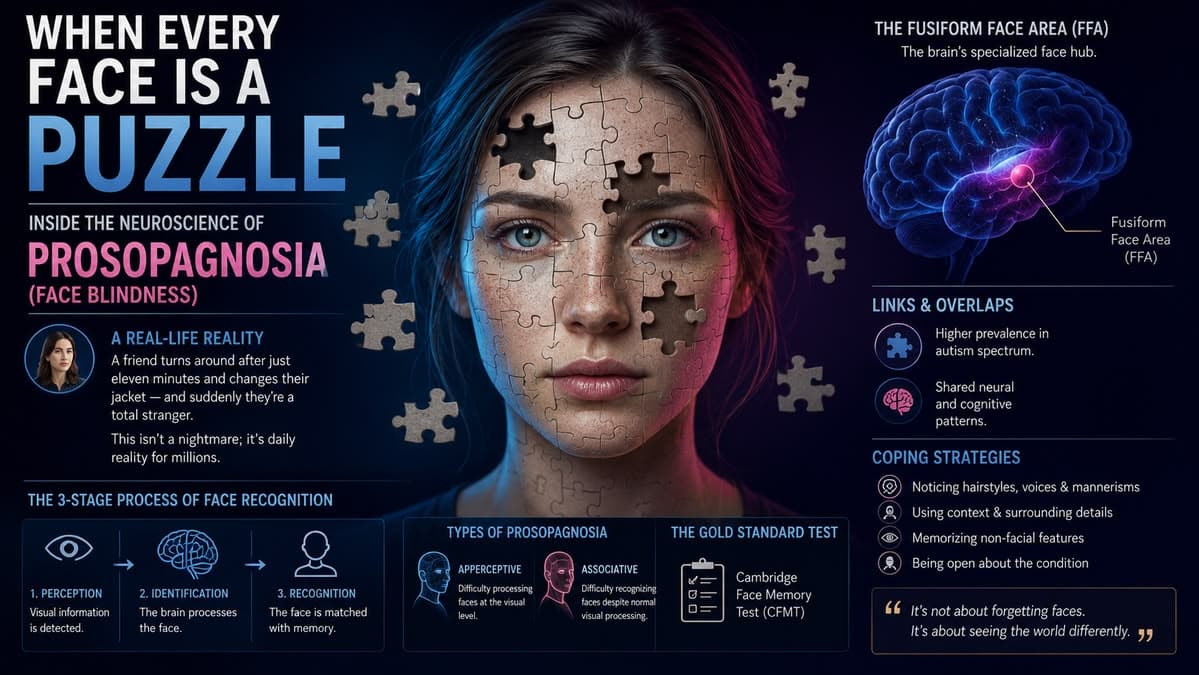
When Every Face Is a Puzzle: Inside the Neuroscience of Prosopagnosia (Face Blindness)
Try to imagine this moment for a second: a close friend or relative is talking to you, warm and familiar, and then turns away for just eleven minutes to answer a call in another room. When they walk back into the room, they've changed their jacket. And in that instant, they are a complete stranger to you. Not "hard to place." Not "on the tip of your tongue." A stranger, fully and immediately. For most people, this sounds like the premise of an unsettling short film. For a genuinely significant number of people, it is simply an ordinary Tuesday.
This article is a deep, honest dive into the neurology behind that experience — a condition called prosopagnosia, more commonly known as face blindness. We'll walk through the brain anatomy responsible for facial recognition, the specific point in that anatomy where things quietly stop working, the different forms this condition can take, how it's diagnosed, how people build entire alternative systems just to move through ordinary social life, and why understanding this condition properly matters for how we treat the people living with it — including, as we'll see, several public figures who have spoken openly about it.
Quick Answer
Last updated: September 2026
Prosopagnosia (pronounced pross-oh-pag-NO-zhuh), commonly called face blindness, is a neurological condition in which a person cannot recognize faces — including sometimes their own — despite having normal eyesight and normal memory for everything else about a person, such as their name, their voice, or shared experiences. It stems from dysfunction in a specific brain region called the Fusiform Face Area (FFA), located in the fusiform gyrus of the temporal lobe. It can be congenital (present from birth, often genetic) or acquired (caused by stroke, brain injury, or neurodegenerative disease). Research estimates it affects roughly 2 to 2.5 percent of the population. There is currently no cure, but people affected by it develop effective coping strategies built around voice, gait, hairstyle, and clothing to identify the people in their lives.
1. Aiema's Morning: A Composite Case That Feels Like Fiction, But Isn't
To understand what this condition actually feels like from the inside, it helps to follow one illustrative story — a composite case, built from patterns reported again and again in real documented experiences of people living with face blindness. We'll call her Aiema.
Aiema is known among her friends for being unusually warm. She greets almost everyone as though she's meeting them for the very first time — enthusiastic, a little over-the-top, endlessly friendly. What her friends don't know is that this warmth is, in large part, a survival strategy. It is Aiema's way of avoiding the paralyzing fear of looking a familiar face directly in the eyes and drawing a complete blank. It isn't a personality quirk. It's a shield she built, without ever being taught how, to protect herself from a very specific kind of quiet humiliation that happens to her constantly, and that almost nobody around her understands.
This difficulty doesn't stop at friends and distant acquaintances, either — and this is the detail that tends to shock people the most. Aiema has described mornings where she wakes up next to her own boyfriend and feels a genuine flicker of alarm, because for a split second, the face beside her doesn't register as anyone she knows. In more severe cases like this, even a person's own reflection in a mirror can look like a stranger looking back. For someone living with this, that particular moment carries a very specific kind of psychological weight — a small, repeated loss of the sense of being fully known, even by yourself.
This condition has a proper clinical name: prosopagnosia, more commonly known in everyday language as face blindness. It is not an obscure curiosity confined to medical textbooks — several well-known public figures have spoken openly about suspecting or being diagnosed with it, which we'll come back to later in this article. And because it's so poorly understood, people affected by it are very often misread as arrogant, distracted, or simply rude — which, as we'll see, is almost exactly backward.
2. What Prosopagnosia Actually Is (And What It Is Not)
The single most important misconception to clear up immediately is this: prosopagnosia is not a memory disorder. A person with this condition typically remembers everything about a friend — their name, the conversations they've shared, inside jokes, personal history — with complete clarity. The failure sits at one very specific, narrow point: the brain simply cannot register or "file" a face in a way that connects it to that stored identity. In other words, the person can remember their friend perfectly. They just cannot look at that friend's face and recognize it as belonging to them.
This distinction matters enormously, because it reframes the entire condition. It isn't about a "bad memory" or a lack of attention to people. It's a highly specific breakdown in one particular kind of visual processing, while every other cognitive function — intelligence, memory, emotional understanding, language — remains completely intact.
3. Pronunciation and the Meaning Behind the Word
Prosopagnosia is pronounced pross-oh-pag-NO-zhuh (or NO-zee-ah, depending on regional accent). The word comes from Greek roots: "prosopon," meaning face, and "agnosia," meaning a lack of knowledge or an inability to recognize. Put together, it literally translates to something close to "not knowing a face." The term was first formally used in medical literature in the late 1940s to describe patients who had lost the ability to recognize faces following brain injury, and it has since expanded to include the developmental, lifelong form as well.
4. The Two Root Causes: Acquired vs. Congenital Prosopagnosia
Prosopagnosia generally develops through one of two very different pathways, and the distinction matters both medically and personally.
| Type | How It Develops | Key Characteristic |
|---|---|---|
| Acquired Prosopagnosia | Develops later in life, usually after a stroke, traumatic brain injury, tumor, or certain neurodegenerative conditions such as Alzheimer's disease | The person previously had normal face recognition and can often describe exactly when and how the ability was lost |
| Congenital / Developmental Prosopagnosia | Present from birth, without any identifiable brain injury; often runs in families, suggesting a genetic component | The person has never known any other way of navigating the world and often doesn't realize, sometimes for decades, that their experience is unusual |
Aiema's case, as described in her own account, falls into the acquired category — her difficulty began after a specific neurological event. This is an important detail, because it illustrates that face blindness is not always something a person is simply "born being bad at." For a significant number of people, it is the direct, lasting consequence of an injury to a very particular, specialized part of the brain.
5. Apperceptive vs. Associative Prosopagnosia: The Two Clinical Types
Beyond the question of cause, clinicians also classify prosopagnosia by exactly where in the visual-processing chain the breakdown occurs.
| Type | What Happens | Everyday Analogy |
|---|---|---|
| Apperceptive Prosopagnosia | The person struggles to even perceive the basic structure of a face — telling one face apart from another, or reading facial expressions, can be genuinely difficult at a purely visual level | Like trying to read text through heavily frosted glass — the basic shapes themselves are hard to make out |
| Associative Prosopagnosia | The person can perceive a face clearly and accurately, including noticing that two faces are different, but cannot connect that face to a stored identity, name, or memory | Like reading a sentence perfectly but being unable to recall what the words mean or who wrote them |
Most people with developmental prosopagnosia, including composite cases like Aiema's, fall closer to the associative end of this spectrum — they can see a face just fine; they simply cannot connect it to "this is my friend."
6. Prosopamnesia: When You Can't Learn New Faces, But Keep the Old Ones
A particularly specific and less commonly discussed variant is sometimes referred to as prosopamnesia — a pattern where a person retains the ability to recognize faces they already knew well before a brain injury occurred, but loses the ability to learn and register any new face going forward. This distinction matters clinically because it shows that "recognizing a face" and "learning a new face" may rely on at least partially separate neural processes — someone can retain years of old facial memories perfectly intact while being functionally unable to add a single new face to that mental catalogue ever again.
7. How Common Is Face Blindness, Really?
Research into developmental prosopagnosia suggests it affects roughly 2 to 2.5 percent of the general population — a figure significant enough that most people, without realizing it, likely know at least one person living with some degree of it.
*Based on commonly cited research estimates for developmental prosopagnosia prevalence; individual studies vary.
To put that another way: in a typical room of 40 people, statistically, at least one of them may be quietly living with this exact condition — smiling, greeting everyone warmly, and hoping nobody notices they have no idea who most of the room actually is.
8. The Silent Cost: Why So Many People Are Never Diagnosed
Because prosopagnosia is so poorly known outside of neuroscience circles, the overwhelming majority of people living with it are never formally diagnosed at all. Many spend their entire lives quietly assuming they are simply "bad with faces," socially awkward, forgetful, or careless — labels that chip away steadily at self-esteem over years and decades. Without a name for what's actually happening, there's no framework for self-compassion, and the constant small failures of recognition get absorbed instead as personal character flaws rather than a specific, well-documented neurological difference.
9. How the Brain Normally Recognizes a Face: The Three-Stage Model
For the vast majority of people, recognizing a familiar face happens instantly and effortlessly — so effortlessly that it's rarely something we consciously think about at all. Yet underneath that instant recognition, neuroscientists describe a genuinely sophisticated multi-stage process. A simplified version breaks it into three broad stages.
| Stage | What the Brain Does |
|---|---|
| 1. Detection | The brain first determines: "This is a face" — distinguishing it from other visual objects in the scene |
| 2. Structural Measurement | The brain maps the specific proportions and geometry of that face — the spacing of the eyes, the shape of the nose, the width of the jawline — essentially building a structural "blueprint" |
| 3. Categorization / Identification | The brain compares that structural blueprint against stored facial memories to determine whose face it actually is, linking it to a name, a relationship, and a history |
"This is a face"
(mapping features)
(matching identity)
"That's my friend"
In someone with prosopagnosia, the first stage — detecting that something is a face at all — is almost always intact. The breakdown typically happens at the second or third stage, where the specific structural blueprint either isn't built properly, or isn't successfully matched against stored memory.
10. Meet the Fusiform Face Area (FFA): Your Brain's Face-Detecting Hardware
The region primarily responsible for carrying out this three-stage process is a small but highly specialized area located predominantly on the underside of the brain's temporal lobe, called the Fusiform Face Area, or FFA. Think of it as a piece of dedicated hardware — much like a graphics card built specifically for one specialized task — that exists almost solely to process facial identity, separately from how the brain processes other visual objects like furniture, animals, or landscapes.
In someone with prosopagnosia, this specific system either never developed typical functioning (as in the congenital form) or was damaged (as in the acquired form). As Aiema describes it, the experience is like having a genuinely broken piece of internal machinery — every single encounter with a familiar face becomes something closer to an unplanned test, demanding constant mental effort and always carrying a background hum of anxiety about getting it wrong.
11. Where Exactly Is the Damage? Lesion Location in Acquired Cases
In acquired prosopagnosia, brain imaging studies consistently point to damage in the occipitotemporal region — the area where the occipital lobe (responsible for basic visual processing) meets the temporal lobe, specifically around the fusiform gyrus. Research has repeatedly found that the right hemisphere plays a dominant role in face processing, meaning lesions affecting the right fusiform gyrus alone can be sufficient to cause significant face-recognition difficulty, although damage affecting both hemispheres tends to produce more severe and lasting impairment. This is distinct from the medial temporal lobe structures such as the hippocampus, which are associated with general memory formation — an important distinction, since it reinforces that prosopagnosia is fundamentally a face-specific visual processing disorder, not a general memory disorder.
12. Holistic Processing vs. Feature-by-Feature Processing
One of the more fascinating discoveries in this field is how differently a typical brain and a prosopagnosic brain approach the same face. Most people process faces holistically — meaning the brain takes in the entire face as one unified, instantly recognizable whole, the same way most people recognize a familiar song within the first two or three notes rather than analyzing each note individually. People with prosopagnosia typically cannot do this. Instead, they shift toward feature-based processing — consciously or semi-consciously cataloguing individual features one at a time: does this person have a mole, a particular eyebrow shape, a certain nose. This shift from holistic to feature-based processing is itself one of the primary coping mechanisms the brain adopts, even though it is far slower, far more effortful, and far less reliable than the holistic system most people rely on without ever noticing they're doing it.
13. What Does a Face Actually Look Like to Someone With Prosopagnosia?
This is one of the most common questions people ask, and the honest answer often surprises people: in most cases, the face itself looks completely normal. Eyes, nose, mouth, skin texture — all of it is seen with total visual clarity, assuming no separate vision problem is present. What's missing isn't the image; it's the identity attached to it. Rather than instantly recognizing a whole face as "my sister," the brain perceives something closer to a generic collection of separate features that simply don't carry any built-in sense of who this person is — like being handed a puzzle with all the correct pieces, but no picture on the box to guide how they fit together into a specific, familiar person. In the rarer apperceptive form, some individuals describe an even more basic difficulty, where the shapes and structure of a face itself can appear blurred, distorted, or hard to parse at all.
14. Not Recognizing Your Own Reflection
Perhaps the most psychologically disorienting symptom, reported by a meaningful subset of people with more severe prosopagnosia, is failing to immediately recognize their own reflection in a mirror. Since the FFA processes all faces using the same specialized system — including one's own — a severely affected system can fail to register a person's own face as "self" in exactly the same way it fails to register a friend's face as "known." This particular symptom is often described as carrying a uniquely unsettling weight, tied closely to a broader, harder-to-articulate sense of losing part of one's grounded identity in the world.
15. The Detective Work: Alternative Cues People Rely On Instead
Since the brain's default face-detecting hardware isn't reliably available, people living with prosopagnosia become, in a very real sense, lifelong detectives — constantly and often unconsciously gathering small pieces of identifying evidence about everyone around them. This isn't a hobby or a quirky personality trait; it's a genuine cognitive necessity, built and refined over years of trial and error.
| Alternative Identification Cue | Why It Works |
|---|---|
| Voice | Vocal tone, pitch, and speech patterns are processed through an entirely separate auditory system, unaffected by facial-processing deficits |
| Gait / Way of Walking | Individual walking patterns are often distinctive and don't require the same specialized facial processing |
| Hairstyle | A quick, stable visual marker — though it becomes unreliable the moment someone changes their hairstyle |
| Distinctive marks (tattoos, scars, glasses) | Fixed, easily catalogued visual details that don't rely on holistic face processing |
| Clothing / Personal Style | Often the fastest available cue in the moment — but also the most fragile, since changing clothes instantly removes it |
| Context (location, time, who else is present) | Helps narrow down likely identity even before any visual cue is confirmed |
This is precisely why something as small as a friend changing their jacket during a short break — as described in Aiema's experience — can be enough to completely undo a person's ability to recognize them just minutes later. When clothing is the primary anchor being relied on, and that anchor changes, the entire identification system can collapse instantly, with no built-in backup to fall back on in that moment.
What makes this detective work particularly demanding is that it has to happen continuously, in real time, without any visible pause that might reveal the struggle taking place internally. A typical brain performs face recognition instantly and unconsciously; a brain relying on this alternative system has to actively, consciously piece together several separate observations — voice, build, walk, clothing, context — within the same few seconds most people spend simply glancing at a face and knowing immediately who it belongs to. Over years of practice, many people become remarkably fast and accurate at this process, to the point where friends and family may never suspect anything unusual is happening at all — which is, in its own way, a genuinely impressive cognitive adaptation, even though it was never a system anyone chose to build.
16. Social Survival Tactics: Arriving Early, Generic Openers, and Warm Hellos
Beyond simply gathering visual clues, many people with prosopagnosia develop entire behavioral strategies specifically designed to minimize the risk of an awkward or hurtful moment of non-recognition.
- Arriving early to gatherings so that others arrive and approach them, rather than having to scan a crowded room and risk failing to spot someone they know
- Opening conversations with open-ended questions ("How have you been? What's new with you?") that don't require confirming a specific name or relationship upfront
- Proactively explaining the condition to close friends and colleagues, so misunderstandings are prevented before they happen
- Greeting everyone with the same warm, enthusiastic energy regardless of whether the person is a total stranger or a close friend of many years — precisely the strategy Aiema describes using every single day
These aren't quirks of an outgoing personality. They are carefully built protective habits, refined through repeated real social discomfort, designed specifically to avoid the sinking, embarrassing moment of realizing — often visibly, in front of the very person involved — that recognition has failed once again.
17. The Emotional Weight: Shame, Self-Blame, and Being Called "Arrogant"
Perhaps the cruelest irony of living with undiagnosed prosopagnosia is how the condition is so often misread by others. Someone who fails to recognize a familiar face is frequently assumed to be distracted, self-absorbed, stuck-up, or simply rude — when in reality, the opposite is usually far closer to the truth. Many people with this condition report going out of their way to be unusually warm and attentive specifically to compensate for a fear that they'll otherwise come across as cold or dismissive. Over years of these repeated, painful misreadings, many people internalize the blame entirely, quietly concluding that something is simply wrong with their character, rather than recognizing that a specific, well-documented neurological process is at play. This is precisely why proper diagnosis and public awareness matter so much — not as an abstract medical detail, but as something that can meaningfully restore a person's sense of self-worth after years of unwarranted self-blame.
17b. Building Resilience: What Helps People Thrive Despite Face Blindness
Despite everything described so far, it's important to end this part of the discussion on a genuinely hopeful note, because the overwhelming majority of people living with prosopagnosia go on to build full, successful, socially rich lives. What tends to make the biggest difference isn't eliminating the underlying neurological difference — since, as discussed, that generally isn't possible — but rather building a small circle of people who understand the condition and don't take a moment of non-recognition personally. Many people describe a specific turning point after finally learning the name of what they'd been experiencing their whole lives: a shift from quiet, chronic self-blame toward a much more accurate, compassionate understanding of their own brain. Practical routines also help enormously — consistently reviewing who will be present before a gathering, deliberately noting one or two distinguishing details about new acquaintances immediately upon meeting them, and giving themselves permission to ask, without shame, "I'm sorry, can you remind me who you are?" when needed, rather than bluffing through an interaction and risking a more awkward mistake later. Over time, many people report that this condition, while never fully disappearing, becomes something they've built genuinely effective systems around — no longer a constant source of anxiety, but simply one more known variable they've learned to navigate.
18. Public Figures Who Have Spoken Openly About Face Blindness
Prosopagnosia is far from a fringe curiosity, and a number of well-known public figures have spoken candidly about living with it, which has done a great deal to bring the condition into mainstream awareness.
| Public Figure | What They've Shared |
|---|---|
| Brad Pitt (actor) | Has spoken in multiple interviews about suspecting he has undiagnosed face blindness, describing how it has led people to assume he's aloof or self-absorbed when he simply fails to recognize them |
| Shenaz Treasury (actress) | Publicly shared her diagnosis, describing how she used to feel ashamed and not "smart enough," and explaining that her coping method is simply to smile and say hello to everyone |
| Ushna Shah (actress) | Has discussed how the condition has affected her professional life, including moments of failing to recognize co-stars and colleagues she frequently interacts with |
These accounts matter because they show, in very human terms, exactly the pattern this article has described: the shame, the fear of being misjudged, and the quiet, effective coping strategy of simply greeting everyone with warmth rather than risking the discomfort of visibly failing to place a familiar face — a strategy that, once understood, looks less like an eccentric personality trait and more like a small, ongoing act of quiet courage.
19. The Surprising Link Between Prosopagnosia and Autism
One particularly interesting pattern researchers have observed is that difficulties with face processing appear notably more common among autistic individuals compared to the general population, although this overlap is not universal and not every autistic person experiences face-recognition difficulties. This connection has, in a genuinely encouraging way, led many people with developmental prosopagnosia to find a strong sense of belonging within autistic and neurodivergent communities, where differences in how the world is visually and socially processed are met with understanding rather than judgment, and where nobody is expected to explain or justify why a familiar face wasn't immediately recognized.
20. How Prosopagnosia Is Diagnosed: The Cambridge Face Memory Test
Formal diagnosis typically involves a combination of a detailed clinical history, a neurological examination, and in acquired cases, brain imaging such as an MRI to check for lesions in the fusiform gyrus region. The most widely used behavioral tool, however, is the Cambridge Face Memory Test, which asks participants to memorize a set of unfamiliar faces and then correctly identify them again among distractor faces shown under varying lighting, angles, and conditions. Performance significantly below average on this test, combined with a consistent real-world history of face-recognition difficulty, supports a diagnosis of prosopagnosia. For many adults, taking this kind of formal test for the first time — after years of assuming they were simply careless or forgetful — can be a genuinely emotional experience, finally putting a clear, validating name to a lifelong pattern.
21. Face Processing and the Brain: Related Areas Beyond the FFA
While the Fusiform Face Area is the central hub most closely associated with facial identity, face processing more broadly involves a wider network of interconnected brain regions — including areas responsible for reading facial expressions, areas involved in processing eye gaze direction, and regions that link a recognized face to associated personal knowledge such as a name or a memory of past interactions. This is why some individuals with prosopagnosia can still accurately read emotional expressions on a face, such as recognizing that someone looks upset or happy, even while remaining completely unable to identify whose face it is — a clear demonstration that "processing a face" is not one single unified brain function, but a network of specialized, at least partially separable components working together.
21b. A Brief History: How This Condition Was First Identified
The term prosopagnosia was formally introduced into medical literature in 1947 by the German neurologist Joachim Bodamer, who documented the case of a young soldier who suffered a brain injury from a gunshot wound and subsequently lost the ability to recognize even his closest family members by sight, despite his vision otherwise being intact. Bodamer's paper described several similar cases and laid the groundwork for recognizing face processing as a distinct, specialized cognitive function, separate from general vision or general memory — a genuinely radical idea at the time, since most neurologists had simply assumed that recognizing a face was just one more ordinary visual task, no different from recognizing a chair or a car. It would take several more decades of brain imaging research, particularly advances made from the 1990s onward, before the specific role of the fusiform gyrus and the Fusiform Face Area was properly mapped and confirmed.
21c. The Face Inversion Effect: A Clue From Everyday Neuroscience
One of the cleverest pieces of evidence supporting the idea that faces are processed by a dedicated, specialized brain system comes from something called the face inversion effect, which anyone can actually notice in their own experience. Turn a photograph of a familiar face upside down, and recognizing it — along with noticing subtle distortions to individual features — suddenly becomes dramatically harder for almost everyone, far more so than turning a photograph of a house or a car upside down. This happens because holistic face processing depends heavily on the typical upright spatial arrangement of features, and flipping that arrangement disrupts the specialized system almost entirely, forcing the brain back into slower, feature-by-feature analysis. Interestingly, researchers have found that people with prosopagnosia often show a reduced inversion effect compared to typical individuals — because they are already relying on feature-by-feature processing for upright faces in daily life, turning a face upside down doesn't disrupt their approach nearly as much, since there was no holistic "shortcut" being used in the first place to disrupt.
21d. Is Prosopagnosia Genetic? What Family Patterns Suggest
Developmental prosopagnosia has been observed to run in families with notable consistency, and several research groups studying this pattern have proposed that it may follow an autosomal dominant inheritance pattern in at least some families, meaning a single copy of a particular gene variant inherited from one parent could be sufficient to produce the condition. Studies involving twins and multi-generational families have found that when one close relative has developmental prosopagnosia, other family members frequently report similar lifelong difficulty recognizing faces, even without any shared brain injury to explain it. This genetic angle is part of what distinguishes congenital prosopagnosia so clearly from the acquired form — it appears to reflect a difference in how certain brains are wired from birth, rather than damage sustained afterward, and researchers continue to investigate exactly which genes may be involved. Interestingly, this also means that within a single family, one sibling might struggle significantly with face recognition their entire life while another sibling, raised in the same household with the same upbringing, experiences no difficulty at all — a reminder that this condition has far more to do with underlying brain wiring than with attention, upbringing, or effort.
21e. The Everyday Impact: Work, Dating, and Family Gatherings
Beyond the neuroscience, it's worth spelling out plainly how this condition actually plays out across ordinary daily situations, because the cumulative toll is often far larger than any single anecdote conveys. At work, failing to recognize a colleague in the elevator or a client at a follow-up meeting can create lasting impressions of aloofness or disorganization, regardless of how skilled or attentive that person actually is at their job. In dating and early relationships, the fear of failing to recognize a new partner in an unexpected setting — a coffee shop instead of the restaurant where they first met, for instance — can create a persistent, quiet anxiety around any spontaneous meetup. At family gatherings, particularly large ones involving extended relatives seen only once or twice a year, the difficulty can multiply dramatically, since the number of unfamiliar-feeling faces to track in a single afternoon can be genuinely overwhelming, even when every single person in the room is, on paper, a close relative.
Even seemingly small logistical moments can become quietly exhausting. Picking someone up from an airport arrivals hall, meeting a new colleague's spouse at an office party, or trying to spot a friend in a crowded wedding hall full of similarly dressed guests can all turn into genuine sources of stress that most people never have to think twice about. Over time, many people with prosopagnosia describe developing a kind of constant low-level vigilance in any group setting — quietly scanning for voices, walking patterns, or previously noted details, well before anyone else in the room has even considered that recognizing a familiar face might be anything other than effortless.
21f. Coping in the Digital Age: Photos, Contact Cards, and Emerging Tools
Modern technology has, in some genuinely helpful ways, made daily life somewhat easier for people with prosopagnosia, even though it wasn't designed with this condition specifically in mind. Saving a contact's photo directly to a phone's address book means an incoming call or message can display a visual reminder alongside a name, offering a small but meaningful confirmation. Social media profiles, tagged photos, and shared photo albums can serve as a kind of personal reference library that can be quietly reviewed before an event where a specific person is expected to be present. Some researchers and technologists have also begun exploring more experimental tools, including wearable devices designed to provide subtle identification cues in real time, though these remain largely in research and prototype stages rather than being widely available consumer products. For now, the most consistently reliable tools remain the same ones people with this condition have always relied on: attentiveness to voice, context, and the small, distinguishing details that make each person recognizably themselves, even when their face alone doesn't offer that information directly.
19b. Common Myths About Face Blindness
A number of persistent misconceptions make life harder for people living with this condition, and it's worth addressing them directly. One common myth is that prosopagnosia means someone "just isn't paying attention" — in reality, people with this condition are often paying unusually close attention, actively working through a mental checklist of alternative clues that most people never have to think about at all. Another myth is that it only affects distant acquaintances and strangers — as Aiema's experience with her own reflection and her partner illustrates, severe cases can affect recognition of even the closest, most familiar people in a person's life. A third myth is that face blindness is extremely rare and therefore unlikely to affect anyone a given person actually knows — yet at an estimated 2 to 2.5 percent of the population, it's considerably more common than many well-known conditions that receive far more public attention and accommodation. Finally, there's a persistent myth that the condition can simply be "practiced away" with enough effort or attention — while feature-based coping strategies can genuinely improve functional recognition over time, they remain a fundamentally different, slower, and more effortful process than the holistic recognition most people rely on instinctively, and this gap does not close through willpower alone.
19c. Distinguishing Face Blindness From Shyness, Social Anxiety, and Simple Forgetfulness
Because the outward behavior can look similar, prosopagnosia is very often confused with shyness, general social anxiety, or ordinary forgetfulness — and the distinction matters both for accurate self-understanding and for getting appropriate support. Social anxiety typically involves a fear of social judgment or evaluation that exists independently of whether a face is actually recognized; someone with social anxiety may recognize a person perfectly well and still feel intensely nervous about the interaction itself. Ordinary forgetfulness with names and faces, which nearly everyone experiences occasionally, tends to improve significantly with repeated exposure to the same person over time, and doesn't typically extend to close family members or one's own reflection. Prosopagnosia, by contrast, persists regardless of how many times a person has met someone, often does not improve meaningfully with repetition alone, and in more severe cases extends to people who should, by any ordinary measure, be instantly and effortlessly recognizable. A useful, simple self-check some clinicians suggest is asking whether the difficulty is specific to faces themselves, or whether it reflects a broader pattern of social discomfort unrelated to actual visual recognition — the former points toward prosopagnosia, while the latter points toward anxiety or other explanations entirely.
22b. Related Visual Agnosias: Understanding the Broader Family of Conditions
Prosopagnosia belongs to a broader category of neurological conditions known as visual agnosias, all of which involve a specific failure to recognize or interpret visual information despite otherwise intact eyesight. Object agnosia, for instance, involves difficulty recognizing everyday objects rather than faces specifically, while a related but distinct condition, sometimes called topographical agnosia, involves difficulty recognizing familiar places or navigating previously well-known routes. Understanding prosopagnosia within this wider family of conditions helps reinforce an important point made earlier in this article: the brain does not have one single, generic "recognition system" that handles everything equally. Instead, it relies on multiple specialized systems, each capable of being selectively affected on its own, which is precisely why someone can lose the ability to recognize faces while their ability to recognize objects, places, and even facial expressions of emotion remains completely intact.
22. Is There a Cure? What Treatment and Support Actually Look Like
At present, there is no medical cure that restores typical facial recognition ability in either congenital or acquired prosopagnosia. Management instead focuses on structured compensatory training — deliberately strengthening the alternative identification strategies described earlier, such as systematically noting distinguishing features, voice patterns, and context — often guided by an occupational therapist or neuropsychologist, particularly in cases following stroke or brain injury. For developmental cases, awareness and self-acceptance often make the single biggest practical difference, since so much of the associated distress stems not from the condition itself, but from years of unexplained social friction and internalized shame prior to diagnosis.
23. How to Support Someone With Face Blindness
If someone in your life has shared that they experience prosopagnosia, a few simple adjustments can make a meaningful difference. Introducing yourself by name each time you meet in a new context, rather than assuming automatic recognition, removes pressure without any awkwardness. Mentioning identifying context upfront — "Hi, it's Sarah from the office" — is genuinely helpful rather than patronizing. Avoiding taking a moment of non-recognition personally is essential, since it reflects a specific neurological difference and nothing about how much the person values the relationship. And simply believing someone the first time they explain their condition, rather than assuming it's an exaggeration or an excuse, can meaningfully reduce the isolation so many people with this condition describe feeling.
23b. A Final Word: What This Condition Teaches Us About How We See Each Other
There's something genuinely worth sitting with in everything this article has covered. Most of us move through the world assuming that recognizing a familiar face is simply automatic — so automatic that we rarely consider it a skill at all, let alone one that could be missing. For someone with prosopagnosia, every single social interaction carries a layer of quiet, ongoing work that most people never have to think about even once. And yet, as Aiema's story and the accounts of public figures like Brad Pitt, Shenaz Treasury, and Ushna Shah all demonstrate, this hidden effort so often gets misread as coldness, distraction, or arrogance — precisely the opposite of what's actually happening beneath the surface. Perhaps the most useful thing anyone can take from an article like this isn't a list of neuroscience facts, though those matter too, but a small shift in instinct: the next time someone seems to hesitate before greeting you, or fails to place your face in an unexpected setting, there's a real possibility that what looks like indifference is, in fact, someone working very hard, in real time, simply to know you.
24. Frequently Asked Questions
What is prosopagnosia, in simple terms?
Prosopagnosia, or face blindness, is a neurological condition where a person cannot recognize faces — even of close friends, family, or themselves — despite having normal vision and normal memory for everything else about that person.
How do you pronounce prosopagnosia?
It's pronounced pross-oh-pag-NO-zhuh (or NO-zee-ah), derived from the Greek words for "face" and "lack of knowledge."
What part of the brain is responsible for face recognition?
The Fusiform Face Area (FFA), located in the fusiform gyrus of the temporal lobe, is the primary brain region specialized for processing facial identity.
Where is the lesion typically located in acquired prosopagnosia?
Damage is usually found in the occipitotemporal region, particularly the fusiform gyrus, with the right hemisphere playing a dominant role in most documented cases.
Is prosopagnosia the same as a memory problem?
No. People with prosopagnosia typically remember everything about a person — their name, personality, and shared history — perfectly. The specific failure is in visually recognizing and matching their face to that stored identity.
How common is face blindness?
Research estimates that developmental prosopagnosia affects roughly 2 to 2.5 percent of the population, meaning it's more common than most people realize.
What is the difference between apperceptive and associative prosopagnosia?
Apperceptive prosopagnosia involves difficulty even perceiving basic facial structure, while associative prosopagnosia involves seeing a face clearly but being unable to connect it to a known identity.
Can people with prosopagnosia recognize their own face in a mirror?
Not always. In more severe cases, a person's own reflection can fail to register as familiar, since the same facial-processing system is used for all faces, including one's own.
How is prosopagnosia tested and diagnosed?
The Cambridge Face Memory Test is the most widely used tool, alongside a detailed clinical history and, in acquired cases, brain imaging such as an MRI to check for lesions in the fusiform gyrus.
Is there a cure for prosopagnosia?
There is currently no cure. Management focuses on compensatory strategies — relying on voice, gait, hairstyle, and context — often supported by neuropsychological guidance in acquired cases.
Is prosopagnosia linked to autism?
Research suggests face-processing difficulties are somewhat more common among autistic individuals compared to the general population, though the overlap is not universal.
Which celebrities have spoken about having face blindness?
Actor Brad Pitt has spoken about suspecting he has undiagnosed face blindness, and actresses Shenaz Treasury and Ushna Shah have both publicly shared their diagnoses and how it affects their daily and professional lives.
Is prosopagnosia the same as being socially anxious or shy?
No. Social anxiety involves fear of judgment even when a person is recognized normally, while prosopagnosia is a specific failure to visually recognize a face regardless of how comfortable someone feels socially.
Can prosopagnosia get better over time on its own?
Developmental prosopagnosia generally remains stable across a lifetime, though people often become more skilled at using compensatory strategies as they get older. Acquired cases occasionally show partial improvement depending on the extent and location of the original brain injury.
Is prosopagnosia considered a disability?
It can be recognized as an invisible or hidden disability, particularly when it significantly affects work, relationships, or daily functioning, though formal classification can vary depending on the country and context.
Does prosopagnosia affect recognizing facial expressions too?
Not necessarily. Many people with prosopagnosia can still accurately read emotional expressions like happiness or anger on a face, even though they cannot identify whose face it is, showing that identity recognition and expression reading rely on at least partly separate brain processes.