Prolactin Hormone: Brain Control of Milk Production & Its Disorders
Most people know prolactin simply as "the breastfeeding hormone" — but that single label barely scratches the surface. Prolactin is a genuine multitasker, involved in metabolism, immune function, and reproduction, and it is controlled by the brain in a way that is almost the exact opposite of how every other pituitary hormone works. While most hormones need an active "go" signal to be released, prolactin needs the brain to actively hold it back — constantly. This guide walks through prolactin's full story: where it's made, the unusual dopamine-based brake system controlling it, the precise molecular chain of events that actually builds milk inside breast tissue, and what happens when this entire system malfunctions.
1. What Is Prolactin?
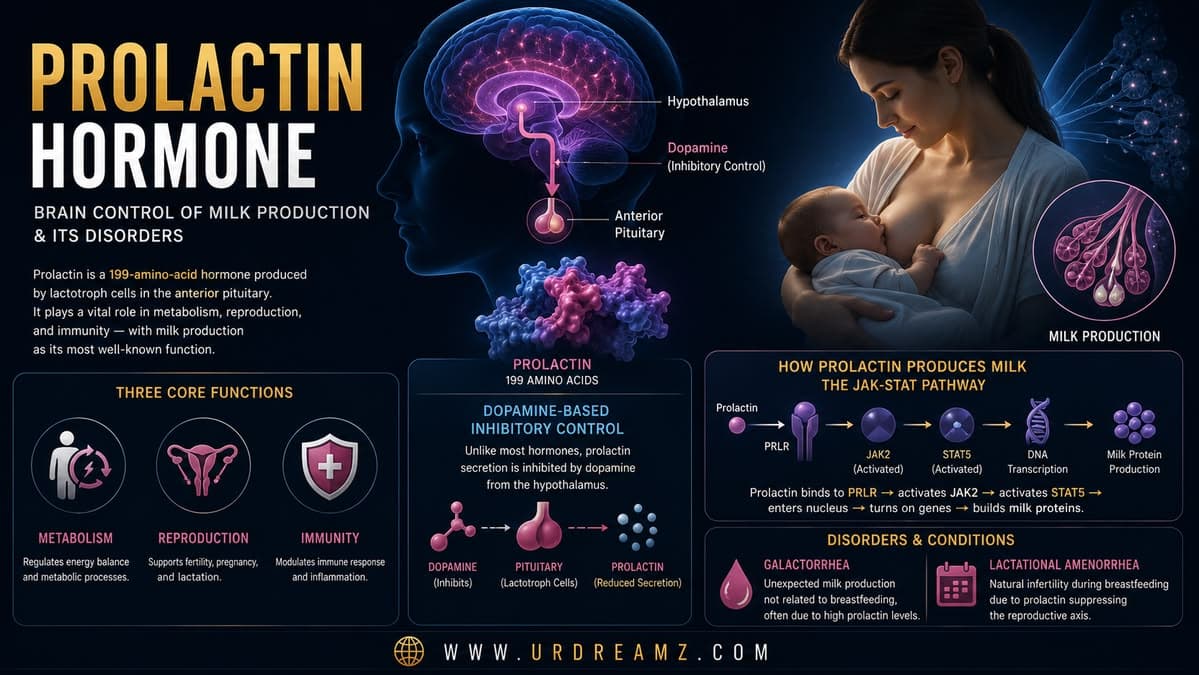
Prolactin is a peptide hormone built from a chain of 199 amino acids. While it is most widely recognized for its role in stimulating milk production in the female breast, this represents only one part of its overall function in the body. It is worth stating clearly upfront: no hormone can be strictly labeled as belonging exclusively to males or exclusively to females — prolactin exists and performs genuine biological functions in both sexes, even though its most visible, dramatic effect is specific to female reproductive biology.
2. Where Prolactin Is Actually Made
Prolactin is manufactured by a specific population of specialized cells called lactotrophs, located within the anterior pituitary gland. These cells make up a meaningful portion of the anterior pituitary's total cell population and represent the primary source of circulating prolactin throughout the body.
3. Beyond the Pituitary: Other Prolactin Sources
Interestingly, the anterior pituitary is not the only site of prolactin production in the body. Prolactin is also produced directly within breast tissue itself, and within the myometrium — the muscular wall of the uterus — along with several other more minor production sites throughout the body. This means prolactin can exert local effects in these tissues independent of, or alongside, the prolactin arriving through general blood circulation from the pituitary gland.
4. The Three Core Functions of Prolactin
Prolactin's overall biological role can be organized into three major functional branches: metabolism, reproduction, and the immune system. Nearly every specific effect prolactin produces throughout the body can be traced back to one of these three broad categories, even though the reproductive branch — specifically milk production — tends to receive the most public attention.
| Functional Branch | Example Effects |
|---|---|
| Metabolism | Influences insulin production and energy regulation |
| Reproduction | Stimulates milk production; suppresses ovulation during lactation |
| Immune System | Increases lymphocyte activity and overall immune responsiveness |
5. Normal Prolactin Levels: Men, Women, and Pregnancy
Prolactin levels vary considerably depending on sex and reproductive status. In males, typical prolactin levels remain under approximately 20 ng/mL. In non-pregnant females, typical levels remain under approximately 25 ng/mL. During pregnancy, however, levels rise dramatically — climbing anywhere from roughly 25 ng/mL up to 400 ng/mL over the course of the nine-month pregnancy, reflecting the substantial hormonal shift needed to prepare the body for breastfeeding.
6. The Five Major Changes During Pregnancy
This dramatic rise in prolactin during pregnancy drives five major physiological changes throughout the body, each discussed individually below: breast enlargement, milk production, suppression of the menstrual cycle, heightened immune activity, and accelerated insulin production.
7. Change 1: Breast Enlargement
The first major change driven by rising prolactin during pregnancy is a noticeable enlargement of breast tissue. This growth reflects the mammary gland actively preparing its internal structure — expanding the glandular tissue that will eventually be responsible for producing milk once the baby is born.
8. Change 2: Milk Production Begins
The second major change is the actual initiation of milk production itself, which represents prolactin's most well-known and defining biological function. This is the culmination of the breast tissue development described above, transforming enlarged mammary tissue into a genuinely functional milk-producing organ.
9. Change 3: Why Periods Stop During This Time
The third major change involves the menstrual cycle, which halts during this period specifically because of elevated prolactin levels. High prolactin directly suppresses the release of GnRH (Gonadotropin-Releasing Hormone) from the hypothalamus. Since GnRH normally drives the release of FSH and LH — the two hormones responsible for driving the ovarian cycle and menstruation — suppressing GnRH effectively halts the entire downstream reproductive cycle, which is precisely why menstruation pauses during this period of elevated prolactin.
10. Change 4: A More Active Immune System
The fourth major change involves the immune system, which becomes noticeably more active during this period of elevated prolactin. Specifically, lymphocytes — a key category of white blood cell central to immune defense — become significantly more active and responsive under prolactin's influence.
11. Change 5: Faster Insulin Production
The fifth and final major change involves insulin production, which also accelerates under elevated prolactin levels. This reflects prolactin's broader metabolic role, helping adjust the body's energy regulation systems to support the increased physiological demands of pregnancy and, later, breastfeeding.
12. Meet the Lactotrophs
To understand exactly how prolactin production is controlled, it helps to look more closely at the hypothalamus-pituitary relationship discussed in earlier guides. The hypothalamus sends a signal downward to the pituitary gland, where prolactin is manufactured specifically within the anterior lobe, by the specialized lactotroph cells introduced earlier. Once manufactured, lactotrophs release prolactin directly into the bloodstream.
13. The Strange Exception: Why Prolactin Needs a Brake
Here is where prolactin's control system becomes genuinely unusual compared to every other hormone produced in the anterior pituitary. Not every woman is constantly producing and releasing breast milk — obviously, this needs to be tightly controlled. For nearly every other anterior pituitary hormone, the hypothalamus sends an active "releasing" signal specifically to trigger hormone release. Prolactin works in reverse: lactotrophs naturally and continuously tend to produce and release prolactin on their own, without needing to be actively told to do so, which means the hypothalamus's job with prolactin is not to trigger release, but to continuously hold it back.
14. Dopamine: The Prolactin-Inhibiting Factor
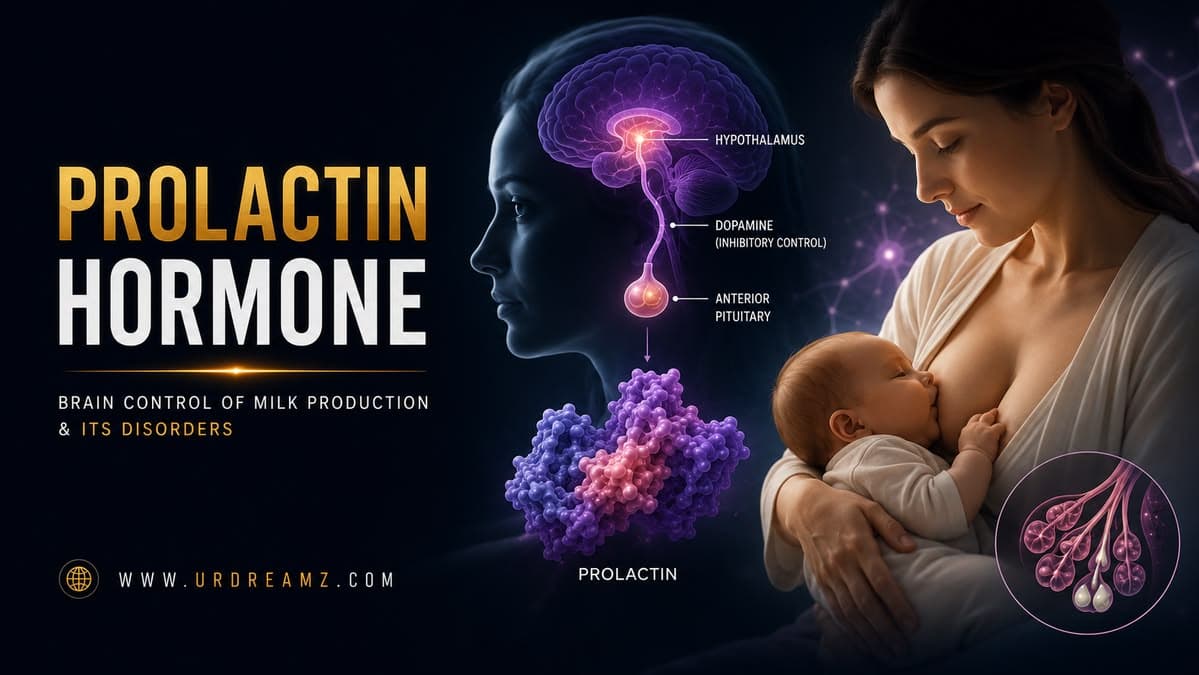
The specific hormone responsible for this ongoing inhibitory braking effect is Dopamine. The hypothalamus continuously releases dopamine specifically to suppress prolactin release from the lactotrophs, meaning dopamine functions here as what is formally called a Prolactin-Inhibiting Factor — a genuinely unique arrangement among the hormones covered throughout this broader series on the hypothalamus-pituitary axis.
15. The Tuberoinfundibular Dopamine (TIDA) Pathway
The specific route through which this inhibitory dopamine signal travels is called the Tuberoinfundibular Dopamine pathway, often abbreviated as the TIDA pathway (sometimes referred to using the shorthand "TIDN" in casual discussion). This pathway runs from a specific region of the hypothalamus down toward the pituitary stalk, delivering dopamine directly to the lactotrophs waiting in the anterior pituitary below, effectively communicating a constant, ongoing message: "stop releasing prolactin."
16. Dopamine's Other Job: The Mesolimbic Reward Pathway
Interestingly, this same chemical, dopamine, also plays an entirely separate role elsewhere in the brain, in a region called the mesolimbic pathway, closely associated with the brain's system for processing reward and pleasure. Within this separate pathway, dopamine originates in a region called the VTA (Ventral Tegmental Area), functioning there as a genuine neurotransmitter involved in motivation and reward processing, entirely distinct from its separate, specific inhibitory role in the TIDA pathway controlling prolactin.
This dual role — the same molecule acting as both a classical neurotransmitter in one brain circuit and as a hormone-like inhibitory signal in another — is a genuinely elegant example of biological efficiency, reusing the same basic chemical messenger for two entirely different regulatory purposes in two anatomically and functionally distinct brain systems.
17. How Dopamine Actually Locks Down the Lactotrophs
When dopamine, delivered via the TIDA pathway, reaches and binds to the lactotroph cells in the anterior pituitary, it produces two simultaneous inhibitory effects. First, it acts at the level of the lactotroph's own nucleus and DNA, directly suppressing the ongoing production of new prolactin protein. Second, it also prevents any already-manufactured, "ready-made" prolactin sitting within the lactotroph from being released into the bloodstream. Dopamine essentially functions as a lock placed on the lactotrophs by the hypothalamus, simultaneously restricting both new production and the release of existing stored hormone.
18. What It Takes to Overcome the Brake: Factor 1, Estrogen
Given this constant dopamine-driven inhibition, specific factors are needed to actually overcome the brake and allow prolactin levels to rise when genuinely needed. The first such factor is estrogen. Rising estrogen levels, such as those occurring naturally during pregnancy, help counteract dopamine's inhibitory effect, allowing prolactin production and release to increase.
19. Factor 2: TRH (Thyrotropin-Releasing Hormone)
The second factor capable of overcoming dopamine's inhibitory brake is TRH (Thyrotropin-Releasing Hormone) — the same hypothalamic hormone discussed in earlier guides as the trigger for TSH release and downstream thyroid hormone production. TRH also happens to stimulate prolactin release directly, representing a genuine overlap between the thyroid-regulating and prolactin-regulating hormonal systems.
20. Factor 3: Nipple Stimulation and the Afferent Signal
The third, and perhaps most physiologically important, factor is nipple stimulation — specifically, the physical act of a baby suckling at the breast. This mechanical stimulation triggers a nerve signal, referred to as an afferent signal, that travels up from the nipple to the brain, specifically instructing the hypothalamus to reduce its ongoing dopamine release. With dopamine's inhibitory brake temporarily lifted, prolactin release from the lactotrophs increases correspondingly, sustaining and reinforcing milk production for as long as breastfeeding continues.
21. Factor 4: Antipsychotic Medications and D2 Blockers
The fourth factor capable of raising prolactin levels involves certain medications — specifically, a category of antipsychotic drugs that work by blocking D2 receptors, the specific receptor type dopamine normally binds to in order to exert its inhibitory effect. When these medications block D2 receptors on the lactotrophs, dopamine can no longer effectively suppress prolactin release, even though the hypothalamus may still be releasing dopamine normally — the receiving end of the signal has simply been chemically blocked, resulting in elevated prolactin levels as an often-unintended medication side effect.
22. The Journey to the Breast: Meet the Mammary Gland
Once released into the bloodstream, prolactin travels to the mammary glands — the breast tissue itself. Within the breast, prolactin's target destination is a structure called the alveolus, a small, cluster-shaped functional unit within the mammary gland responsible for actually producing milk.
23. The PRLR Receptor and Receptor Dimerization
Within the alveolus, the cells lining its interior — called epithelial cells — carry a specific docking site on their surface called the PRLR (Prolactin Receptor). When circulating prolactin binds to this receptor, it triggers a process called receptor dimerization, in which a single prolactin molecule effectively brings together and binds two separate PRLR receptor molecules simultaneously, forming a paired unit. This dimerization event is the critical trigger that sets the internal cellular signaling cascade into motion, a process referred to as signal transduction.
24. The JAK-STAT Signaling Pathway
Once this receptor dimerization occurs, it activates a specific internal signaling route called the JAK-STAT pathway. This pathway carries the prolactin signal from the cell's outer surface receptor all the way down into the cell's nucleus, ultimately reaching the epithelial cell's own DNA. This represents one of the most direct hormone-to-gene signaling pathways found anywhere in human physiology, translating an external hormonal signal into a specific, targeted instruction acting directly at the genetic level.
25. Reaching the DNA: Casein and Lactalbumin Genes
Once the JAK-STAT signal reaches the epithelial cell's nucleus, it specifically targets two categories of genes responsible for producing the key proteins found in breast milk: casein genes and lactalbumin genes. These genes encode the specific milk proteins that will ultimately be manufactured and secreted as part of breast milk itself.
26. The Promoter Region: Switching the Genes On
Both the casein and lactalbumin genes have an associated promoter region — a specific stretch of DNA responsible for controlling whether that gene is actively switched on or left inactive. When the dimerized signal arriving through the JAK-STAT pathway reaches this promoter region, it binds directly to it, effectively activating the gene and triggering the processes of gene expression, transcription, and translation — the full biological sequence through which a gene's genetic instructions are converted into an actual, physical protein product.
27. From Gene to Actual Milk Protein
Once this activation occurs, the epithelial cell begins actively manufacturing casein — one of the primary milk proteins — while simultaneously accelerating lactalbumin production as well. This is the precise cellular and molecular endpoint of prolactin's entire signaling journey: a hormone released from the pituitary gland ultimately reaching down into individual breast cells and directly switching on the specific genes responsible for manufacturing the proteins that make up breast milk.
28. Prolactin Makes the Milk, Oxytocin Delivers It
It is worth clarifying an important distinction here: while prolactin is responsible for the cellular and molecular process of actually manufacturing milk within the breast, the separate act of physically ejecting that milk out of the breast during nursing is driven by a different hormone entirely — oxytocin, discussed in earlier guides regarding its role in childbirth. At the cellular and molecular level covered throughout this guide, however, prolactin remains the singular driving force behind milk production itself.
29. What Happens When the Hypothalamus-Pituitary Signal Is Interrupted
An interesting and clinically relevant question arises: what happens if the connecting pathway between the hypothalamus and pituitary gland is physically interrupted — for example, due to injury, surgery, or a tumor pressing on the pituitary stalk? In this scenario, every other anterior pituitary hormone that depends on an active "releasing" signal from the hypothalamus would stop being produced, since that necessary trigger signal can no longer reach the pituitary. Prolactin, however, behaves in the opposite way: since its default state is to be continuously produced and released unless actively inhibited by dopamine, interrupting the hypothalamus-pituitary connection actually removes the inhibitory brake, resulting in elevated, rather than reduced, prolactin levels — even as every other pituitary hormone drops toward zero.
30. Prolactinoma: When a Tumor Drives the Imbalance
Beyond simple pituitary stalk interruption, a specific type of tumor affecting the pituitary gland — called a prolactinoma — can also drive prolactin levels significantly higher than normal, whether by disrupting the normal dopamine-based inhibitory signal or by directly consisting of prolactin-producing lactotroph cells that continue producing hormone independent of normal regulatory control.
31. Galactorrhea: Milk Without Pregnancy
When prolactin levels rise abnormally due to a pituitary stalk interruption, a prolactinoma, or a broader hormonal imbalance, a condition called Galactorrhea can occur — the production and leakage of breast milk in a woman who is not pregnant or breastfeeding. This condition serves as a genuinely useful clinical clue, often prompting further investigation into the underlying cause of the elevated prolactin driving it.
32. Lactational Amenorrhea Explained
A separate but related phenomenon occurs specifically in women who have recently given birth and are actively breastfeeding: a temporary absence of the menstrual cycle, referred to as Lactational Amenorrhea. This occurs naturally as a direct consequence of the same prolactin-driven GnRH suppression discussed earlier in this guide.
33. Primary vs Secondary Amenorrhea
It is worth distinguishing between two broader categories of amenorrhea (absence of menstruation) in general clinical terminology. Primary amenorrhea refers to a young woman who has never begun menstruating at all by the expected age of puberty. Secondary amenorrhea, by contrast, refers to a cessation of periods in a woman who has previously menstruated normally — and it is this second category, secondary amenorrhea, that lactational amenorrhea falls under, since it involves a temporary pause in an already-established menstrual pattern, directly caused by breastfeeding-related prolactin elevation, rather than a failure of menstruation to ever begin in the first place.
34. Why Lactational Amenorrhea Happens: The Full Hormonal Chain
The complete hormonal explanation for lactational amenorrhea traces back through the entire chain discussed throughout this guide: elevated prolactin during breastfeeding suppresses GnRH release from the hypothalamus. Since GnRH normally drives the release of both LH and FSH — with FSH specifically responsible for maturing developing eggs within the ovary — suppressing GnRH means eggs are not properly matured or released during this period. Without ongoing egg maturation and release, the hormonal cycle that would otherwise trigger menstruation simply does not occur, resulting in the temporary absence of periods for as long as prolactin levels remain sufficiently elevated through continued, frequent breastfeeding.
| Step | Event |
|---|---|
| 1 | Frequent breastfeeding maintains elevated prolactin |
| 2 | Elevated prolactin suppresses hypothalamic GnRH release |
| 3 | Reduced GnRH means reduced LH and FSH release |
| 4 | Without FSH, eggs are not matured; ovulation does not occur |
| 5 | Without ovulation, the menstrual cycle does not proceed — resulting in lactational amenorrhea |
35. Summary Table: Prolactin's Complete Control System
| Component | Role |
|---|---|
| Lactotrophs (Anterior Pituitary) | Manufacture and release prolactin |
| Dopamine (TIDA pathway) | Continuously inhibits prolactin production and release |
| Estrogen, TRH, Nipple Stimulation, D2 Blockers | Overcome or bypass the dopamine brake, raising prolactin |
| PRLR Receptor + Dimerization | Receives prolactin signal at the breast's epithelial cells |
| JAK-STAT Pathway | Carries the signal to the cell nucleus and DNA |
| Casein / Lactalbumin Genes | Activated to produce actual milk proteins |
| Oxytocin | Handles physical milk ejection, separate from prolactin's production role |
36. Frequently Asked Questions
- Q1: What is prolactin, and where is it made?
- Prolactin is a 199-amino-acid peptide hormone primarily made by lactotroph cells in the anterior pituitary gland, though it is also produced in breast tissue and the myometrium.
- Q2: What are the three main functions of prolactin?
- Prolactin's functions span metabolism (insulin regulation), reproduction (milk production, suppressing ovulation), and the immune system (increasing lymphocyte activity).
- Q3: What are normal prolactin levels?
- Typical levels are under 20 ng/mL in men, under 25 ng/mL in non-pregnant women, and 25-400 ng/mL in pregnant women.
- Q4: Why does the menstrual cycle stop during high prolactin periods?
- High prolactin suppresses GnRH release from the hypothalamus, which in turn reduces LH and FSH release, halting the ovarian cycle responsible for menstruation.
- Q5: What makes prolactin's regulation different from other pituitary hormones?
- Unlike most pituitary hormones that require an active releasing signal, prolactin is naturally released continuously by lactotrophs and must instead be actively inhibited by dopamine.
- Q6: What is the Prolactin-Inhibiting Factor?
- Dopamine, delivered via the Tuberoinfundibular Dopamine (TIDA) pathway, functions as the Prolactin-Inhibiting Factor, continuously suppressing prolactin release.
- Q7: What factors can raise prolactin levels?
- Estrogen, TRH (Thyrotropin-Releasing Hormone), nipple stimulation during breastfeeding, and certain antipsychotic medications that block D2 dopamine receptors can all raise prolactin.
- Q8: What is the JAK-STAT pathway's role in milk production?
- The JAK-STAT pathway carries the signal from prolactin binding its receptor (PRLR) on breast epithelial cells down to the cell's DNA, activating casein and lactalbumin genes.
- Q9: What is the difference between prolactin's role and oxytocin's role in breastfeeding?
- Prolactin drives the actual production of milk within breast cells, while oxytocin is responsible for the physical ejection of milk during nursing.
- Q10: What happens to prolactin if the pituitary stalk is interrupted?
- Unlike other pituitary hormones which would decrease, prolactin levels would actually rise, since interrupting the connection removes the dopamine-based inhibitory signal.
- Q11: What is a prolactinoma?
- A prolactinoma is a pituitary tumor that causes abnormally elevated prolactin levels, often disrupting normal hormone regulation.
- Q12: What is Galactorrhea?
- Galactorrhea is the production and leakage of breast milk in someone who is not pregnant or breastfeeding, often caused by elevated prolactin.
- Q13: What is Lactational Amenorrhea?
- Lactational Amenorrhea is the temporary absence of menstrual periods in a breastfeeding woman, caused by prolactin-driven suppression of GnRH, LH, and FSH.
- Q14: What is the difference between primary and secondary amenorrhea?
- Primary amenorrhea means menstruation never began by the expected age; secondary amenorrhea means periods stopped after previously occurring normally, which is the category lactational amenorrhea falls under.
- Q15: Can medications cause elevated prolactin?
- Yes. Certain antipsychotic medications that block D2 dopamine receptors can prevent dopamine from suppressing prolactin, leading to elevated levels as a side effect.
37. Conclusion
Prolactin stands apart from nearly every other hormone controlled by the hypothalamus-pituitary partnership, precisely because of its unusual default-on, brake-based regulation system — a continuous dopamine signal holding back a hormone that would otherwise be released freely and constantly. From the lactotrophs manufacturing it in the anterior pituitary, to the TIDA pathway's ongoing inhibitory signal, to the specific factors capable of lifting that brake — estrogen, TRH, nipple stimulation, and certain medications — prolactin's story is really a story about restraint and release. And once that restraint is lifted, the resulting molecular cascade is remarkably precise: a single hormone binding a receptor, triggering receptor dimerization, activating the JAK-STAT pathway, and ultimately switching on the exact genes responsible for manufacturing the proteins found in breast milk. Understanding this complete picture — from brain chemistry down to individual genes — transforms prolactin from a simple "breastfeeding hormone" into one of the more genuinely sophisticated, multi-functional hormonal systems in the entire human body.