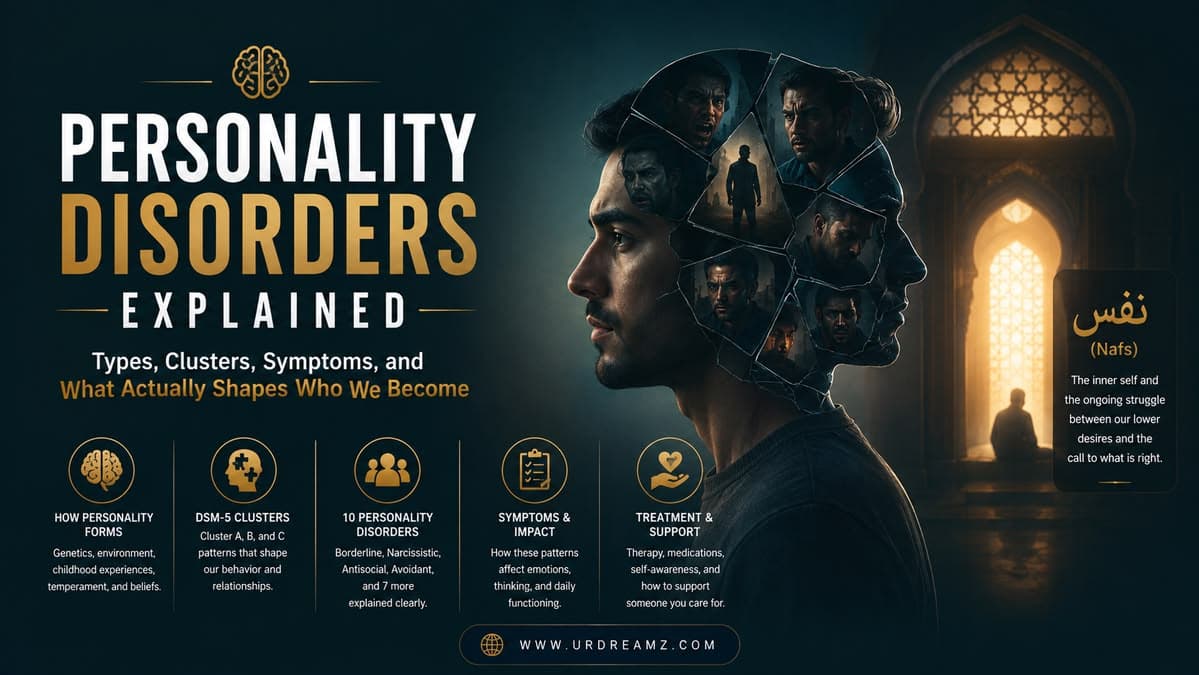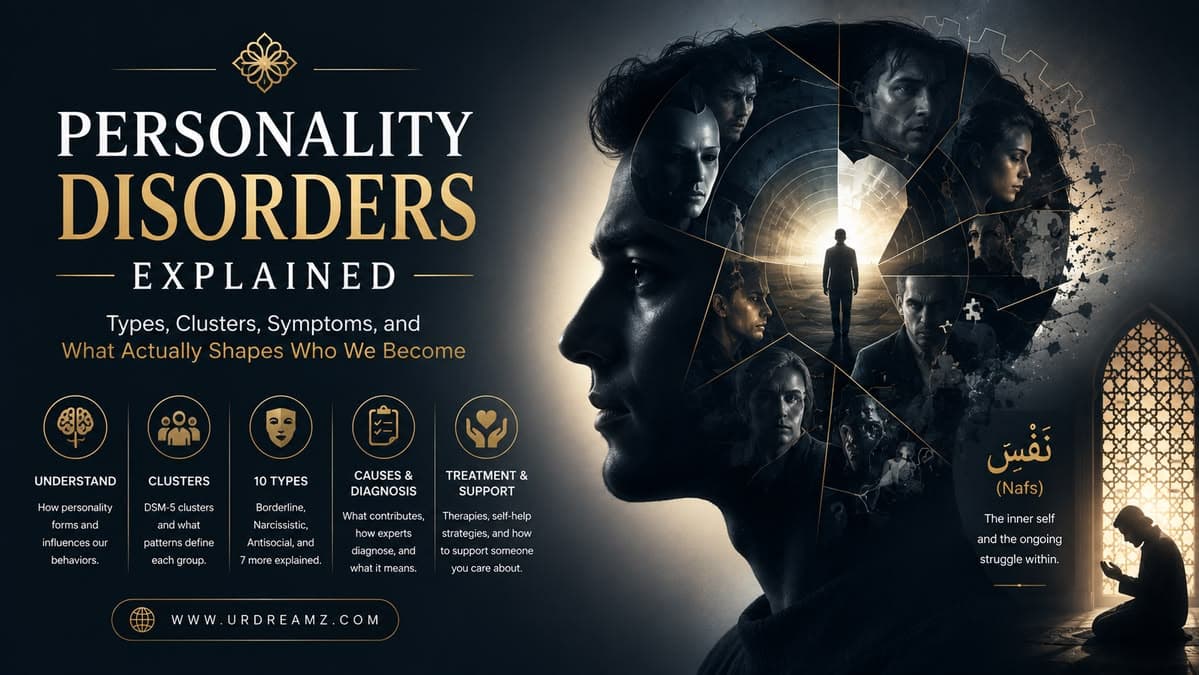
Personality Disorders Explained: Types, Clusters, Symptoms, and What Actually Shapes Who We Become
Picture someone who goes to the hospital, runs every test imaginable — kidneys, heart, liver, blood, bones, brain scans, everything — and every single result comes back completely normal. And yet, this person is still struggling. Still in real pain. Still unable to hold down relationships, or a job, or a stable sense of who they are. Medically, there's nothing wrong. Psychologically, there very much can be. This is the space personality disorders occupy — conditions that live entirely in how a person consistently thinks, feels, relates to others, and sees themselves, rather than in any single organ or lab result.
This guide covers the full picture: first, a respectful look at how Islamic spiritual tradition frames the inner human struggle through the concept of Nafs, and then a complete, clinical walkthrough of personality disorders as understood in modern psychology — how personality actually forms, what separates an ordinary quirk from a diagnosable disorder, all three DSM-5 clusters and the ten specific disorders within them, causes, diagnosis, treatment, and how to support someone living with one. This is educational content, not a diagnostic tool — an actual diagnosis can only come from a qualified mental health professional.
1. A Person Who Is "Healthy" and Still Struggling
Imagine someone whose kidneys, heart, brain, blood, bones, and liver all check out completely fine, whose scans are clear and whose lab work comes back normal — and yet who is still genuinely suffering, still struggling to hold relationships together, still battling something real that no blood test will ever catch. This is exactly the territory personality disorders occupy: real, diagnosable conditions that live in the enduring pattern of a person's thinking, feeling, and relating, not in any organ a hospital test can check.
2. Where the Word "Personality Disorder" Actually Points
The clinical term itself, sometimes translated more literally as a disorder of "shakhsiyat" or selfhood, points to the core of who a person consistently is — their character, temperament, and habitual way of engaging with the world — rather than to any single symptom or episode.
3. A Spiritual Lens First: The Concept of Nafs
Before getting into the full clinical picture, it's worth acknowledging a much older framework for understanding inner human struggle: the Islamic concept of Nafs, often translated as the self or the inner ego. In Islamic thought, the Nafs represents an ongoing internal struggle within every person, between impulses, desires, conscience, and higher purpose — a struggle the Quran describes in three distinct states.
4. Nafs-ul-Ammarah Explained
Nafs-ul-Ammarah, referenced in Surah Yusuf, describes the self that commands toward wrongdoing — the state in which a person's base impulses and desires tend to dominate, pulling them toward whatever satisfies immediate want, whether or not it aligns with what's right.
5. Nafs-ul-Lawwamah Explained
Nafs-ul-Lawwamah, referenced in Surah Al-Qiyamah, describes the self-reproaching soul — a state in which a person still makes mistakes, but afterward genuinely feels remorse, privately reflecting on their wrongdoing even if no one else ever witnessed it. This surah is also where the Quran includes a striking oath about God's power to resurrect and even reconstruct something as precise as human fingertips.
6. Nafs-ul-Mutmainnah Explained
Nafs-ul-Mutmainnah, referenced in Surah Al-Fajr, describes the soul at peace — a state of genuine contentment and inner steadiness, largely free from the pull toward wrongdoing. In Islamic tradition, striving toward this state, disciplining the self against its lower impulses, is considered one of the most demanding forms of spiritual struggle a person can undertake.
7. Why This Framework Is Spiritual, Not Clinical
It's worth being clear about something here: the Nafs framework is a spiritual and theological lens for understanding moral struggle and inner discipline, not a clinical diagnostic system, and any specific numbers sometimes attached to "how many people fall into each category" should be understood as illustrative rather than measured, verified statistics. With that context in place, the rest of this guide shifts fully into the clinical, psychological understanding of personality and personality disorders.
8. Now, the Clinical Lens: What Is Personality?
In psychology, personality refers to the relatively stable, enduring pattern of thoughts, feelings, and behaviors that makes each person distinctly who they are, shaping how they perceive situations, relate to others, and respond to life's demands over time.
9. How Personality Actually Forms
A baby is born with a certain temperament — a raw starting point — but personality itself develops gradually, shaped by upbringing, environment, relationships, and repeated experience over years of childhood and adolescence, well before it settles into the relatively stable pattern recognizable in adulthood.
10. Nature and Nurture Working Together
Personality development isn't a matter of nature or nurture alone — it emerges from the interaction between a person's inherited temperament and the environment, relationships, and experiences that shape how that temperament gets expressed and reinforced over time.
11. Thoughts, Feelings, Views, and Habits: The Building Blocks
Personality is generally understood as being made up of several interconnected components: characteristic thoughts, emotional patterns, views or beliefs about the world, and habitual behaviors — all of which combine and reinforce each other to form a person's overall, recognizable way of being.
12. Why Personality Can't Be Judged in a Single Day
A single interaction, a single reaction under stress, or a single bad day doesn't reveal someone's personality — genuine personality assessment requires observing consistent patterns across many different situations and over meaningful stretches of time, since anyone can have an atypical moment that doesn't reflect their broader character.
13. "Habits Take Long to Depart"
There's real wisdom in the old saying that habits take long to depart. Just as personality forms gradually over years, changing an established pattern of thinking or behaving — especially one someone genuinely wants to change — is a long-term process, not something accomplished through a single moment of willpower or insight.
14. What Makes a Personality "Disordered"?
A personality disorder develops when a person's enduring pattern of thinking, feeling, and relating to others becomes significantly rigid, deviates markedly from what's culturally expected, and causes genuine distress or impairment in relationships, work, or daily functioning — not simply because someone has an unusual or strong personality trait.
15. The General DSM-5 Definition
The DSM-5, the primary diagnostic manual used in psychiatry, defines a personality disorder as an enduring pattern of inner experience and behavior that deviates markedly from the expectations of a person's culture, is pervasive and inflexible, has an onset traceable back to adolescence or early adulthood, remains stable over time, and leads to distress or impairment.
16. The Official Diagnostic Criteria, Simplified
| Criterion | What It Means |
|---|---|
| Deviates from cultural expectations | The pattern is noticeably different from what's generally considered typical within a person's cultural context |
| Pervasive | Shows up across many different situations, not just one specific context |
| Inflexible | The person struggles to adapt the pattern even when it's clearly causing problems |
| Stable and long-standing | The pattern has been consistent since adolescence or early adulthood, not a recent change |
| Causes distress or impairment | It genuinely interferes with relationships, work, or daily life |
17. Why Onset Typically Begins in Adolescence
Because personality itself develops throughout childhood and settles into a more stable form by late adolescence or early adulthood, personality disorders are generally understood to have roots tracing back to this same developmental window, even if a formal diagnosis doesn't happen until later in life.
18. Why These Patterns Are Pervasive and Inflexible
What distinguishes a personality disorder from an ordinary personal quirk is precisely this pervasiveness and inflexibility — the pattern shows up consistently across work, relationships, and personal life, and the person struggles to adjust it even when the consequences are clearly negative and repeatedly pointed out to them.
19. The Three Clusters: An Overview
The DSM-5 organizes the ten recognized personality disorders into three broad clusters, grouped by shared, overlapping characteristics, making the wide range of presentations somewhat easier to understand and categorize.
20. Cluster A Overview: Odd or Eccentric
Cluster A disorders are broadly characterized by unusual, odd, or eccentric thinking and behavior, often involving social withdrawal or suspicion of others. This cluster includes paranoid, schizoid, and schizotypal personality disorder.
21. Paranoid Personality Disorder
Paranoid personality disorder involves a pervasive, longstanding pattern of distrust and suspicion toward others, often interpreting others' motives as malicious even without clear evidence, which can make forming and maintaining close relationships genuinely difficult.
22. Schizoid Personality Disorder
Schizoid personality disorder involves a consistent pattern of detachment from social relationships and a limited range of emotional expression, with the person generally preferring solitary activities and showing little interest in close relationships, including within family.
23. Schizotypal Personality Disorder
Schizotypal personality disorder involves discomfort with close relationships, along with distorted thinking or perception and eccentric behavior, sometimes including unusual beliefs or a tendency toward odd speech patterns.
24. Cluster B Overview: Dramatic, Emotional, Erratic
Cluster B disorders are broadly characterized by intense, dramatic, or unpredictable emotions and behavior. This cluster includes antisocial, borderline, histrionic, and narcissistic personality disorder — generally the most widely discussed and researched cluster.
25. Antisocial Personality Disorder
Antisocial personality disorder involves a persistent disregard for the rights of others, often including deceit, manipulation, impulsivity, irritability, and a lack of genuine remorse for harmful behavior toward others, typically traceable back to conduct issues beginning before age 15.
26. Borderline Personality Disorder
Borderline personality disorder involves a pattern of instability in relationships, self-image, and emotions, along with significant impulsivity. People with this condition often experience intense fear of abandonment, rapid mood swings, and genuine difficulty regulating strong emotional responses.
27. Histrionic Personality Disorder
Histrionic personality disorder involves a pattern of excessive emotionality and attention-seeking behavior, with the person often feeling uncomfortable in situations where they aren't the center of attention, and displaying rapidly shifting, sometimes shallow emotional expression.
28. Narcissistic Personality Disorder
Narcissistic personality disorder involves a pervasive pattern of grandiosity, a persistent need for admiration, and a genuine lack of empathy for others, often accompanied by a tendency to exploit relationships to serve one's own needs and goals.
29. Cluster C Overview: Anxious or Fearful
Cluster C disorders are broadly characterized by anxious or fearful thinking and behavior. This cluster includes avoidant, dependent, and obsessive-compulsive personality disorder.
30. Avoidant Personality Disorder
Avoidant personality disorder involves a pervasive pattern of social inhibition, feelings of inadequacy, and hypersensitivity to negative judgment, often leading a person to avoid relationships or activities out of a persistent fear of rejection or criticism.
31. Dependent Personality Disorder
Dependent personality disorder involves an excessive, persistent need to be taken care of, often leading to submissive, clinging behavior and significant difficulty making everyday decisions without excessive reassurance from others.
32. Obsessive-Compulsive Personality Disorder
Obsessive-compulsive personality disorder involves a preoccupation with orderliness, perfectionism, and control, often at the expense of flexibility and efficiency. It's distinct from obsessive-compulsive disorder (OCD), which involves specific intrusive thoughts and compulsions rather than a broader personality pattern.
33. How This Differs From Just Having a "Bad Habit"
Everyone has quirks, occasional bad days, or habits they'd like to change, but this alone doesn't constitute a personality disorder. What separates the two is the combination of rigidity, pervasiveness across nearly every context, and a clear, sustained pattern of genuine distress or dysfunction that a habit alone typically doesn't produce.
34. Being Physically Healthy and Still Unwell
This is exactly the paradox introduced at the start of this guide: someone can pass every physical health test with flying colors and still be genuinely unwell, because personality disorders live in a different domain entirely — enduring patterns of thought, emotion, and behavior that no scan or blood test can detect, but that are just as real and just as capable of causing suffering.
35. Conditions That Commonly Occur Alongside Personality Disorders
| Co-Occurring Condition | How Often It Overlaps |
|---|---|
| Depression | Very commonly co-occurs, particularly with borderline and avoidant personality disorder |
| Anxiety Disorders | Frequently seen alongside avoidant and dependent personality disorder |
| Substance Use Disorders | Elevated rates seen particularly with borderline and antisocial personality disorder |
| Eating Disorders | Notable overlap, particularly with borderline personality disorder |
36. How Personality Disorders Are Diagnosed
Diagnosis is made by a qualified mental health professional through a comprehensive clinical interview, review of a person's history and patterns of behavior over time, and sometimes structured diagnostic tools, rather than through any single test or quick screening alone.
37. Personality Disorder Tests and Screening Tools
Various structured screening tools and questionnaires exist to help clinicians assess personality patterns, but these are intended as part of a broader clinical evaluation process, not as standalone diagnostic instruments a person can reliably self-administer online.
38. Why Self-Diagnosis Carries Real Risk
It's genuinely common, especially with so much information available online, to read through a list of personality disorder traits and recognize pieces of yourself in several of them — this doesn't necessarily mean a disorder is present. Accurate diagnosis requires professional evaluation, since overlapping traits, temporary stress responses, and other conditions can easily resemble specific personality disorder patterns without actually being one.
39. Causes and Risk Factors
Personality disorders are generally understood to arise from a combination of genetic predisposition, temperament, and environmental factors, particularly experiences during childhood and adolescence, rather than from any single identifiable cause.
40. The Role of Childhood Environment
Early childhood experiences — including inconsistent caregiving, neglect, abuse, or chronic instability at home — are associated with an increased risk of developing certain personality disorders later in life, consistent with the broader understanding that personality itself forms gradually through childhood experience.
41. Genetics and Temperament
Alongside environment, genetic and temperamental factors also play a meaningful role, meaning two people raised in similar environments can still develop different personality patterns, and inherited temperament can make some individuals more vulnerable to developing a personality disorder than others.
42. Treatment Approaches: An Overview
Personality disorders are generally considered more challenging to treat than many other mental health conditions, given how deeply ingrained these patterns become over years of development, but meaningful improvement is genuinely achievable with sustained, appropriate treatment.
43. Psychotherapy for Personality Disorders
Psychotherapy is the primary treatment approach for personality disorders, with the specific type of therapy often tailored to the particular disorder and individual needs, generally requiring sustained, long-term engagement rather than a short-term intervention.
44. Dialectical Behavior Therapy for Borderline Personality Disorder
Dialectical Behavior Therapy, or DBT, was specifically developed for borderline personality disorder and has become one of the most well-supported treatment approaches for it, focusing on building skills in emotional regulation, distress tolerance, and interpersonal effectiveness.
45. Medication's Limited but Sometimes Useful Role
There is no medication specifically approved to treat personality disorders themselves, but medication is sometimes used to help manage co-occurring symptoms, such as depression, anxiety, or mood instability, as part of a broader treatment plan alongside psychotherapy.
46. Living With or Loving Someone With a Personality Disorder
Supporting a family member, partner, or friend with a personality disorder can be genuinely challenging, and setting healthy boundaries while still offering compassion is an important balance to strike. Family or couples therapy, alongside the individual's own treatment, can also help improve relationship dynamics over time.
47. Reducing Stigma Around Personality Disorders
Personality disorders are often unfairly stigmatized, sometimes reduced to casual insults in everyday language, which can discourage people from seeking help. Understanding these conditions as genuine, treatable mental health issues, rather than character flaws or moral failings, is an important step toward reducing that stigma.
48. When to Seek Professional Help
Anyone experiencing persistent difficulty in relationships, a consistently unstable sense of self, patterns of behavior that repeatedly cause distress to themselves or others, or who recognizes several of the patterns described in this guide as a long-standing part of their life, should consider reaching out to a mental health professional for a proper evaluation.
49. Myths vs Facts
| Myth | Fact |
|---|---|
| Personality disorders mean someone is simply "a bad person" | They are genuine mental health conditions shaped by genetics and environment, not a matter of character or moral failing |
| You can diagnose a personality disorder from a single conversation | Diagnosis requires observing enduring patterns across time and contexts, assessed by a qualified professional |
| Personality disorders can't be treated | While challenging, meaningful improvement is achievable with sustained, appropriate psychotherapy |
| Everyone who is moody or particular has a personality disorder | A diagnosis requires rigidity, pervasiveness, and genuine impairment, not just occasional strong traits |
| Physical health tests can reveal a personality disorder | These conditions exist in patterns of thought and behavior, not in blood work or imaging |
50. Quick Glossary
| Term | Meaning |
|---|---|
| Pervasive | Present across many different situations, not limited to one context |
| Cluster | A grouping of personality disorders that share broadly similar characteristics |
| DSM-5 | The primary diagnostic manual used to classify mental health conditions in the U.S. |
| Comorbidity | The presence of two or more conditions occurring together in the same person |
| DBT | Dialectical Behavior Therapy; a treatment approach developed specifically for borderline personality disorder |
51. Frequently Asked Questions
What is a personality disorder in simple words?
A personality disorder is a long-term, rigid pattern of thinking, feeling, and behaving that differs significantly from cultural expectations, causing real difficulty in relationships, work, or daily functioning, even when a person is otherwise physically healthy.
What are the three clusters of personality disorders?
Cluster A includes odd or eccentric disorders like paranoid, schizoid, and schizotypal personality disorder. Cluster B includes dramatic, emotional, or erratic disorders like antisocial, borderline, histrionic, and narcissistic personality disorder. Cluster C includes anxious or fearful disorders like avoidant, dependent, and obsessive-compulsive personality disorder.
How many personality disorders are there according to the DSM-5?
The DSM-5 recognizes ten specific personality disorders, organized into three clusters, alongside additional categories for presentations that don't fit neatly into one specific type.
Is a personality disorder a mental illness?
Yes, personality disorders are recognized mental health conditions, though they differ from many other psychiatric conditions in that they involve a person's enduring pattern of personality itself, rather than a specific episode of illness that comes and goes.
What personality disorders typically occur alongside other disorders?
Personality disorders frequently co-occur with mood disorders like depression, anxiety disorders, substance use disorders, and eating disorders, and this overlap can make diagnosis and treatment more complex.
What are the signs of borderline personality disorder?
Common signs include intense and unstable relationships, a fluctuating self-image, impulsive behavior, intense fear of abandonment, rapid mood swings, and difficulty regulating strong emotions.
What are the signs of narcissistic personality disorder?
Common signs include a grandiose sense of self-importance, a persistent need for admiration, difficulty empathizing with others, and a pattern of exploiting relationships to serve one's own needs.
What are the signs of antisocial personality disorder?
Common signs include a persistent disregard for the rights of others, repeated deceit or manipulation, impulsivity, irritability, and a lack of remorse for harmful actions toward others.
Can personality disorders be treated?
Yes, though treatment is typically long-term, primarily involving psychotherapy such as dialectical behavior therapy or cognitive behavioral therapy, with medication sometimes used to manage co-occurring symptoms like anxiety or depression rather than the personality disorder itself.
How is personality different from a personality disorder?
Personality refers to a person's general, relatively stable pattern of thoughts, feelings, and behavior. It becomes a personality disorder specifically when that pattern is rigid, pervasive across most situations, causes significant distress or impairment, and deviates markedly from cultural expectations.
52. Conclusion
Whether framed through the centuries-old spiritual lens of Nafs — the ongoing inner struggle between impulse, conscience, and peace — or through the modern clinical framework of the DSM-5's ten personality disorders across three clusters, both traditions are ultimately pointing at the same deeply human truth: what happens inside a person's mind and character is every bit as real, and every bit as capable of causing genuine suffering, as anything a blood test or scan could ever detect.
Personality disorders aren't character flaws, moral failings, or something a person simply chooses. They're patterns that form gradually, often shaped long before someone has any real say in the matter, and they can take just as long, and just as much support, to genuinely shift. If any part of this guide felt like it was describing you, or someone you care about, the right next step isn't a label pulled from an article — it's a conversation with a qualified mental health professional who can look at the full picture and help chart a way forward.