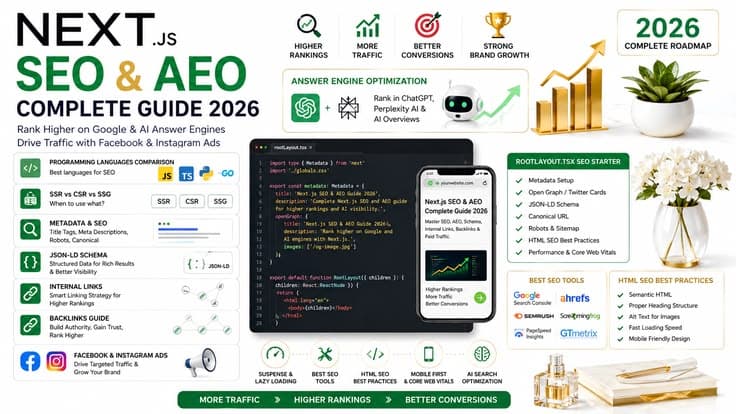
Next.js SEO & AEO Complete Beginner Guide 2026 — Programming Languages, SSR vs CSR, Metadata, JSON-LD, Answer Engine Optimization, Internal Links, Backlinks & Facebook/Instagram Ads Traffic Strategy
Whether you are building your first website or trying to grow an existing one, understanding SEO (Search Engine Optimization) and AEO (Answer Engine Optimization) in 2026 is non-negotiable. This is not just about Google anymore — it is about appearing in ChatGPT answers, Perplexity citations, Google AI Overviews, and voice search responses. This complete guide will take you from the very basics to a working, SEO-ready Next.js website — step by step, with real code examples you can use today.
Part 1: What is SEO and AEO? — A Beginner's Introduction
SEO guide. SEO basics. Search engine optimization. AEO guide. Answer engine optimization. What is AEO in SEO. AEO vs traditional SEO. Will AEO replace SEO. SEO vs AEO explained. Future of SEO and AI search.
What is SEO?
SEO (Search Engine Optimization) is the practice of making your website and its content easier for search engines like Google, Bing, and Yahoo to find, understand, and rank highly. When someone types "best restaurants in Lahore" or "how to learn Python," Google scans billions of web pages and ranks them in a specific order. SEO is everything you do to appear as high as possible in that ranking — ideally on the first page.
SEO has three main pillars: technical SEO (how fast and crawlable your website is), on-page SEO (the quality and structure of your content), and off-page SEO (how many other websites link to yours). Master all three, and Google will trust your website as an authority in your subject area.
What is AEO?
AEO (Answer Engine Optimization) is the newer evolution of SEO. It focuses on making your content easy for AI-powered tools — such as ChatGPT, Perplexity, Google AI Overviews, Microsoft Copilot, and Claude — to read, summarize, and cite as a direct answer.
Traditional SEO wanted you to appear in a list of 10 blue links. AEO wants you to be the answer — the source that the AI quotes directly in its response. As more users interact with AI search tools rather than typing into Google, AEO is becoming as important as traditional SEO — and in some industries, even more so.
The key difference: SEO measures success through clicks and rankings. AEO measures success through AI citations, brand mentions, and "zero-click" brand impressions where users see your content without visiting your site — but remember your name because the AI quoted you.
The good news: AEO does not replace SEO — it builds on top of it. Strong foundational SEO (fast site, good content, healthy backlinks) is what AI engines look for before deciding whose content to cite. You need both.
Part 2: Programming Languages for Web Development — Which is Best for SEO?
Best programming language for SEO. JavaScript SEO. Python SEO. PHP SEO. Next.js vs React SEO. Which programming language is best for website SEO. JavaScript vs PHP for SEO. TypeScript SEO. HTML SEO.
Before we dive deep into Next.js, let us understand the programming landscape and why your technology choice directly affects your SEO potential.
The 6 Main Languages/Frameworks for Web Development
HTML/CSS is the foundation of every website. HTML provides structure and content; CSS provides styling. Pure HTML is the most SEO-friendly format possible because search engine crawlers are essentially HTML readers. Every word on your page in a proper HTML tag is instantly readable by Google without any JavaScript execution.
PHP is a server-side language that generates HTML before sending it to the browser. WordPress — which powers over 40% of all websites — is built in PHP. Because PHP renders HTML on the server, it is naturally crawlable and SEO-friendly out of the box.
Python with frameworks like Django or Flask generates server-rendered HTML, similar to PHP. Python itself is often used for SEO tooling, automation, and data analysis rather than the websites themselves.
JavaScript (React) is powerful but has a fundamental SEO problem: by default, React renders content on the client side, meaning a crawler visits your site, receives an empty HTML shell, and must execute JavaScript to see your content. Many crawlers do this poorly or not at all — meaning your content may not be indexed.
TypeScript is JavaScript with type safety. It has the same SEO characteristics as JavaScript — the SEO impact depends entirely on the rendering strategy (client-side vs server-side), not TypeScript itself.
Next.js (JavaScript/TypeScript framework) was specifically designed to solve the React SEO problem. By rendering pages on the server before sending them to the browser, Next.js delivers fully-formed HTML to both users and crawlers — combining the developer experience of React with the SEO friendliness of PHP.
Programming Languages & SEO Compatibility — Complete Comparison
| Language / Framework | Rendering Type | SEO Friendliness | Google Indexing | AEO Compatibility | Best For |
|---|---|---|---|---|---|
| Pure HTML/CSS | Static | ⭐⭐⭐⭐⭐ Perfect | Instant — 100% | Excellent | Simple sites, landing pages |
| PHP (WordPress) | Server-Side | ⭐⭐⭐⭐⭐ Excellent | Near instant — 98% | Very Good | Blogs, CMS, small business sites |
| Python (Django/Flask) | Server-Side | ⭐⭐⭐⭐⭐ Excellent | Near instant — 97% | Very Good | Web apps, APIs, data-driven sites |
| React.js (CRA) | Client-Side Only (CSR) | ⭐⭐ Poor | Slow — requires JS execution | Poor | Dashboards, apps behind login |
| Vue.js (Nuxt.js) | SSR/SSG with Nuxt | ⭐⭐⭐⭐ Very Good | Good with Nuxt | Good | Medium complexity web apps |
| Next.js (React + SSR) | SSR + SSG + ISR + CSR | ⭐⭐⭐⭐⭐ Perfect | Instant — 100% | Excellent — Best choice | Blogs, e-commerce, SaaS, all sites |
| Angular (Universal) | SSR with Angular Universal | ⭐⭐⭐⭐ Very Good | Good with Universal | Good | Enterprise applications |
Why Next.js Wins for SEO — The Clear Verdict
Next.js delivers 100% SEO compatibility because it solves every technical SEO problem that other JavaScript frameworks create. It pre-renders pages as full HTML before they reach the browser, generates sitemaps and robots files automatically through code, has a built-in Metadata API for title tags and meta descriptions, optimizes images automatically through next/image, loads fonts without layout shift through next/font, and supports structured data (JSON-LD) injection directly in page components. No other modern JavaScript framework does all of this out of the box.
Part 3: Top AI & Technology Keywords for Next.js Websites
AI SEO keywords. ChatGPT SEO. AI search visibility. AI ranking systems. Generative search. AI content strategy. AI indexing. Future SEO. LLM optimization. Perplexity SEO. Google AI mode. AI overviews.
If you are building a technology or AI-focused Next.js website, these are the highest-value keyword categories to target in 2026:
In the AI Tools & Platforms category, the top keywords include: ChatGPT alternatives 2026, best AI tools for developers, Perplexity AI review, Claude vs ChatGPT comparison, Google Gemini API, AI coding assistants, and Copilot for developers. These keywords have extremely high search volume and growing AI search traffic.
In the Machine Learning & Development category: machine learning for beginners, Python ML libraries, TensorFlow vs PyTorch, AI model training, neural networks explained, deep learning tutorial, and NLP for developers are consistently high-traffic searches with strong monetization potential.
In the Web Development + AI category: AI website builder, Next.js AI integration, AI-powered search, building AI apps with Next.js, React AI components, and AI-generated content SEO are emerging rapidly as search trends.
For SEO/AEO + AI intersection keywords: AEO vs SEO 2026, how to rank in ChatGPT, AI search optimization guide, LLM optimization (LLMO), generative engine optimization (GEO), optimize for AI Overviews, and how to get cited by Perplexity are some of the fastest-growing searches in the digital marketing space.
Top Keyword Research Tools and Websites
Finding the right keywords for your Next.js website requires the right tools. Here are the most important ones a beginner must know:
Google Search Console (free) is the most important tool — it shows exactly what queries people use to find your site, your average position, and your click-through rate. Connect your Next.js site here immediately after launch at search.google.com/search-console.
Google Keyword Planner (free with Google Ads account) provides search volume estimates, competition levels, and related keyword suggestions directly from Google's own data.
Ahrefs is the industry leader for keyword research, backlink analysis, and competitor keyword gap analysis. It shows exactly what keywords your competitors rank for and where you can steal their traffic.
Semrush combines keyword research, site audits, competitor analysis, and position tracking in one platform. It is particularly strong for on-page SEO recommendations.
Surfer SEO is specifically built for content optimization — it analyzes top-ranking pages for any keyword and tells you exactly how to structure and write your article to outrank them.
Google Trends (free) shows keyword popularity over time and geographic distribution — essential for identifying trending topics before they peak.
AnswerThePublic and AlsoAsked.com are specifically designed to find question-based keywords — perfect for AEO optimization since AI engines prefer to answer questions.
Part 4: Next.js SEO Core Concepts — SSR vs CSR, Metadata, Title, Lazy Loading & Suspense
Next.js SEO. SSR vs CSR Next.js. Static site generation SSG. Incremental static regeneration ISR. Metadata API Next.js. Title tag optimization. Meta descriptions. Lazy loading Next.js. Suspense Next.js. Next image optimization. Next font SEO. Canonical tags Next.js. Sitemap Next.js. Robots.txt Next.js. JavaScript SEO. Core web vitals Next.js.
SSR vs CSR vs SSG vs ISR — Explained Simply
These four rendering strategies are the foundation of Next.js SEO. Understanding which to use for which page is the most important decision you make for search performance.
CSR (Client-Side Rendering) — Think of this as giving a visitor a blank piece of paper with instructions on how to draw the picture. The browser receives an empty HTML file, then runs JavaScript to build the page. Google's bot often struggles to execute this JavaScript correctly, meaning your content may never be indexed. CSR is only appropriate for pages behind login screens (dashboards, admin panels) where search engine indexing is not needed.
SSR (Server-Side Rendering) — Think of this as sending a visitor a fully finished painting. The server generates complete HTML for every user request and sends it already rendered. Crawlers receive full content immediately — 100% indexed every time. Use SSR for pages with frequently changing personalized data (live stock prices, user-specific feeds).
SSG (Static Site Generation) — The page is built once at deployment time and served as a static file from a CDN. Fastest possible loading speed. Perfect for blog posts, documentation, product pages, and any content that doesn't change every few minutes.
ISR (Incremental Static Regeneration) — A hybrid of SSG and SSR. Pages are statically generated but can be regenerated in the background on a schedule (e.g., every 60 seconds). Perfect for e-commerce product pages or news articles that need fresh data but can tolerate slight delays.
Next.js Rendering Strategies — Complete SEO Comparison
| Strategy | How It Works | SEO Impact | Speed | Best Use Case | Next.js Implementation |
|---|---|---|---|---|---|
| SSG Static Site Generation |
Build once at deployment — served from CDN | ⭐⭐⭐⭐⭐ Best | Fastest | Blogs, docs, marketing pages | Default in App Router (no 'use client') |
| ISR Incremental Static Regen |
Static + background regeneration on schedule | ⭐⭐⭐⭐⭐ Excellent | Very Fast | E-commerce, news, product listings | revalidate: 60 in fetch() call |
| SSR Server-Side Rendering |
Full HTML generated per request on server | ⭐⭐⭐⭐ Very Good | Good | Personalized feeds, real-time data | cache: 'no-store' in fetch() call |
| CSR Client-Side Rendering |
Empty HTML — browser runs JS to render | ⭐ Poor — avoid for public pages | Slow initial load | Dashboards, admin panels (behind login) | 'use client' directive + useEffect |
What is Meta? What is a Title Tag? — SEO Basics
The Title Tag is the blue clickable headline that appears in Google search results. It is the single most important on-page SEO element. Google reads it to understand what your page is about and shows it to users to decide whether to click. Rules: keep it under 60 characters, include your primary keyword near the beginning, make it compelling and specific. A bad title: "Home." A good title: "Next.js SEO Guide 2026 — Rank #1 on Google."
Meta Description is the grey text beneath the title in search results. Google does not use it as a direct ranking factor, but it dramatically affects click-through rates. Write it as a compelling advertisement for your page, include your keyword naturally, and keep it under 160 characters.
Open Graph (OG) Tags control how your content appears when shared on Facebook, Twitter/X, LinkedIn, and WhatsApp. The og:title, og:description, and og:image tags ensure that when someone shares your link, a beautiful, correctly formatted card appears — dramatically increasing social traffic.
Canonical Tag tells search engines which version of a URL is the "master" version to index when duplicate content exists. For example, if your blog post appears at both /blog/my-post and /blog/my-post?ref=newsletter, the canonical tag tells Google to only count the first URL.
What is Lazy Loading in Next.js?
Lazy Loading means loading content only when the user needs it rather than loading everything at once. In Next.js, there are two main types of lazy loading: component-level lazy loading using dynamic() from next/dynamic, and image lazy loading which is automatic in the next/image component.
For SEO, lazy loading is beneficial because it reduces your initial page load time (improving Core Web Vitals scores), but you must be careful: content that is lazy-loaded and not rendered in the initial HTML may not be indexed by search engines. Keep your primary text content — headings, paragraphs, key information — in server-rendered components, never in lazy-loaded components.
What is Suspense in Next.js?
Suspense is a React feature that allows you to show a loading state (a skeleton, a spinner) while waiting for asynchronous data to load. In Next.js App Router, Suspense is integrated with streaming — the server sends HTML in chunks as data becomes available rather than waiting for everything to finish.
For SEO: wrap only dynamic, non-critical UI elements in Suspense. Keep your primary page content (headings, body text, metadata) outside Suspense boundaries so they are immediately available to crawlers in the initial HTML response.
Part 5: Complete rootLayout.tsx — SEO & AEO Starter for Beginners
Next.js rootLayout.tsx SEO. Next.js metadata setup. JSON-LD Next.js. Open Graph Next.js. Next.js AEO setup. Next.js SEO starter code. How to add SEO to Next.js. Next.js app router SEO example.
Here is a complete, production-ready rootLayout.tsx file that sets up both SEO and AEO foundations for any Next.js 15 App Router project. Copy this directly into your app/layout.tsx file and replace the placeholder values with your own information:
// app/layout.tsx — Complete SEO + AEO Root Layout for Next.js 15

import type { Metadata } from 'next';
import { Inter } from 'next/font/google';
import './globals.css';

// ✅ STEP 1: Load font with next/font (no layout shift, faster load)
const inter = Inter({
  subsets: ['latin'],
  display: 'swap',
  variable: '--font-inter',
});

// ✅ STEP 2: Static Metadata — Fills <head> automatically
export const metadata: Metadata = {
  // --- Core SEO ---
  metadataBase: new URL('https://yourwebsite.com'),
  title: {
    default: 'YourSite — Professional Web Solutions 2026',
    template: '%s | YourSite',  // Dynamic: "Blog Post Title | YourSite"
  },
  description: 'Clear, keyword-rich description under 160 characters. What your site does and who it helps.',

  // --- Canonical & Robots ---
  alternates: {
    canonical: 'https://yourwebsite.com',
  },
  robots: {
    index: true,
    follow: true,
    googleBot: {
      index: true,
      follow: true,
      'max-video-preview': -1,
      'max-image-preview': 'large',
      'max-snippet': -1,
    },
  },

  // --- Open Graph (Facebook, LinkedIn, WhatsApp) ---
  openGraph: {
    type: 'website',
    locale: 'en_US',
    url: 'https://yourwebsite.com',
    siteName: 'YourSite',
    title: 'YourSite — Professional Web Solutions 2026',
    description: 'Clear engaging social preview text. Make people want to click.',
    images: [
      {
        url: '/og-image.jpg',    // 1200x630px image
        width: 1200,
        height: 630,
        alt: 'YourSite — Professional Web Solutions',
      },
    ],
  },

  // --- Twitter / X Card ---
  twitter: {
    card: 'summary_large_image',
    title: 'YourSite — Professional Web Solutions 2026',
    description: 'Clear engaging social preview text for Twitter.',
    images: ['/og-image.jpg'],
  },

  // --- Author & Publisher ---
  authors: [{ name: 'Your Name', url: 'https://yourwebsite.com' }],
  creator: 'Your Name',
  publisher: 'YourSite',

  // --- Keywords (less important now but still useful) ---
  keywords: ['next.js', 'web development', 'seo', 'pakistan', 'your keywords here'],

  // --- Icons ---
  icons: {
    icon: '/favicon.ico',
    shortcut: '/favicon-16x16.png',
    apple: '/apple-touch-icon.png',
  },
};

// ✅ STEP 3: JSON-LD Structured Data for AEO
// This is what ChatGPT, Perplexity and Google AI Overviews read
const jsonLd = {
  '@context': 'https://schema.org',
  '@type': 'WebSite',
  name: 'YourSite',
  url: 'https://yourwebsite.com',
  description: 'Professional web solutions and digital services.',
  author: {
    '@type': 'Person',
    name: 'Your Name',
    url: 'https://yourwebsite.com/about',
  },
  potentialAction: {
    '@type': 'SearchAction',
    target: {
      '@type': 'EntryPoint',
      urlTemplate: 'https://yourwebsite.com/search?q={search_term_string}',
    },
    'query-input': 'required name=search_term_string',
  },
};

// ✅ STEP 4: Root Layout Component
export default function RootLayout({
  children,
}: {
  children: React.ReactNode;
}) {
  return (
    <html lang="en" className={inter.variable}>
      <head>
        {/* JSON-LD Structured Data — Critical for AEO */}
        <script
          type="application/ld+json"
          dangerouslySetInnerHTML={{ __html: JSON.stringify(jsonLd) }}
        />
        {/* Preconnect for faster external resources */}
        <link rel="preconnect" href="https://fonts.googleapis.com" />
      </head>
      <body className={inter.className}>
        {children}
      </body>
    </html>
  );
}
What is JSON-LD and Why Does it Matter for AEO?
JSON-LD (JavaScript Object Notation for Linked Data) is structured data code that you embed in your page's HTML to explicitly tell search engines and AI tools what your content means — not just what it says.
Without JSON-LD: Google reads "The event starts at 7 PM" and guesses it is an event. With JSON-LD: you declare "@type": "Event", "startDate": "2026-06-20T19:00" and Google knows with certainty it is an event with a specific start time and can display it as a rich result in search.
For AEO, JSON-LD is even more critical. AI engines like ChatGPT and Perplexity use structured data as a signal of trustworthiness and factual accuracy. A page with proper FAQPage, Article, or Product schema is significantly more likely to be cited in AI-generated answers than an identical page without it.
The most important schema types to implement for most websites are: WebSite (root level), Article (for blog posts), FAQPage (for FAQ sections — most powerful for AEO), BreadcrumbList (for navigation structure), and Organization or Person (for author credibility signals).
Part 6: HTML Format for SEO, Internal Links & Backlinks — Complete Explanation
HTML SEO. Heading H1 H2 H3 SEO. Internal linking strategy. Backlinks explained. Internal links vs backlinks. Link building SEO. SEO HTML structure. Content SEO writing. URL structure SEO. Alt text SEO. Image SEO. Paragraph SEO.
Why HTML Format is Critical for SEO
Search engines are, at their core, HTML readers. The way you structure your HTML document directly signals to Google what your page is about, what is most important, and how its different parts relate to each other. Good HTML structure is not just for accessibility — it is fundamental to SEO performance.
The H1 tag is the most important heading on your page. Use exactly one H1 per page — it should contain your primary keyword and describe the entire page in a single line. Think of it as the title of a book.
H2 tags are your chapter titles — major sections of your content. They should include secondary keywords and related terms. Each major topic your page covers should have its own H2.
H3 tags are subsections within H2 sections — sub-chapters. Use them for specific points, examples, or steps within a broader section.
Paragraph tags (P) contain your body content. For SEO, keep paragraphs short (3–5 sentences maximum), include your keywords naturally — not forced, and write in a way that directly answers user questions.
Alt text on images serves two purposes: it describes the image to visually impaired users (accessibility) and tells search engines what the image shows (SEO). Never leave alt text empty. Never use keyword-stuffed alt text. Write what the image actually shows: "Next.js App Router folder structure screenshot" is perfect.
URL structure should be clean, short, and descriptive. Bad URL: /page?id=12345&cat=3. Good URL: /blog/nextjs-seo-guide. Keywords in URLs are a mild but consistent SEO signal.
HTML Elements & Their SEO Importance
| HTML Element | SEO Importance | AEO Importance | Best Practice | Common Mistake |
|---|---|---|---|---|
| <title> | ⭐⭐⭐⭐⭐ Critical | High | Primary keyword near start; under 60 chars | Generic titles like "Home" or "Page" |
| <meta description> | ⭐⭐⭐⭐ High (CTR) | Medium | Under 160 chars; compelling, keyword-natural | Missing or duplicated across pages |
| <h1> | ⭐⭐⭐⭐⭐ Critical | Very High | Exactly one per page; includes primary keyword | Multiple H1 tags; no keyword |
| <h2> <h3> | ⭐⭐⭐⭐ High | Very High (AI reads these) | Question-format H2s for AEO; include related keywords | Skipping hierarchy (H1 to H4) |
| <p> | ⭐⭐⭐⭐ High | High | Short paragraphs; answer questions directly in first 50 words after heading | Walls of text; no keyword variation |
| <img alt=""> | ⭐⭐⭐ Medium | Medium | Descriptive alt text; use next/image for optimization | Empty alt, keyword stuffed alt |
| <a href> | ⭐⭐⭐⭐⭐ Critical | High | Descriptive anchor text; use Next.js Link component | "Click here" and "read more" anchor text |
| JSON-LD <script> | ⭐⭐⭐⭐ High | ⭐⭐⭐⭐⭐ Critical for AI | FAQPage, Article, WebSite, BreadcrumbList schemas | Missing structured data entirely |
Internal Links — What They Are and Why They Matter
Internal links are links from one page on your website to another page on the same website. For example, this sentence links to another article on the same site.
Internal links serve three purposes for SEO. First, they help search engines discover your pages — if a page has no internal links pointing to it, crawlers may never find it. Second, they distribute page authority (also called "link juice") from high-authority pages to newer or lower-traffic pages. Third, they keep users on your site longer by providing relevant related content — reducing bounce rate, which is a positive user engagement signal.
In Next.js, always use the <Link> component from next/link instead of raw <a> tags for internal navigation. This enables client-side transitions for speed while maintaining proper HTML anchor tags for crawler discovery.
The anchor text (the visible clickable text) of your internal links should be descriptive and keyword-rich. "Read more about our SEO services" is far better than "click here" because it tells both the user and the search engine what the destination page is about.
Backlinks — The Most Powerful Off-Page SEO Signal
Backlinks are links from other websites pointing to your website. They are the single most powerful off-page SEO ranking factor. Think of every backlink as a vote of confidence from one website to another. Google's algorithm was originally built on this concept — the more reputable websites link to you, the more reputable Google considers your site.
Not all backlinks are equal. A single link from a high-authority site like Forbes, BBC, or Dawn (Pakistan) is worth hundreds of links from random low-quality blogs. Focus on quality over quantity. The best strategies for earning backlinks include: creating genuinely useful content people want to reference, writing guest posts on established blogs in your niche, getting your business listed in reputable directories, being mentioned in news articles, and building relationships with other content creators in your field.
For AEO: backlinks matter for AI citations too. AI engines look for content that is already widely referenced across the web before deciding to cite it as a trusted source. Earning backlinks from authoritative sites dramatically increases your chances of appearing in AI-generated answers.
Part 7: AEO Deep Dive — How to Rank in ChatGPT, Perplexity & Google AI Overviews
How to rank in ChatGPT search results. How to appear in Perplexity AI answers. Google AI Overview ranking factors. How to get cited by ChatGPT. AEO best practices 2026. LLM optimization guide. Generative engine optimization GEO. AI search ranking guide. ChatGPT citation optimization. Optimize for AI search. AI content strategy. AI discoverability.
How ChatGPT Chooses What to Cite
ChatGPT's search mode (powered by Bing and web plugins) selects sources based on several factors: domain authority and trustworthiness, content freshness and accuracy, how directly the content answers the specific question being asked, whether the content is structured in a way that allows clean text extraction, and whether the site has consistent entity information across the web.
To maximize ChatGPT citations: structure every important page with a clear question in the heading (H2 or H3), provide a concise direct answer in the first 40–60 words beneath that heading, ensure your site loads fast and is fully server-rendered (never rely on JavaScript for critical content), and build consistent brand mentions across Wikipedia, social profiles, news mentions, and industry directories.
How Perplexity AI Selects Sources
Perplexity uses a combination of Bing web search results and its own indexing to find sources. Sites that appear consistently in top positions for their subject area are most likely to be cited. Perplexity also heavily favors sites with structured data (schema markup), clear factual statements, and content written in a neutral, informative tone.
AEO Optimization Strategy for Next.js
In your Next.js App Router, follow these AEO-specific practices: keep all core text content in React Server Components (not wrapped in 'use client') so AI crawlers can extract it without executing JavaScript; structure headings as questions ("What is Next.js SEO?" rather than "Next.js SEO Overview"); implement FAQPage schema on every content page; add a public/llms.txt file that describes your site's content structure for AI crawlers; and ensure your content provides definitive answers rather than just discussing a topic.
SEO vs AEO — Complete Strategy Comparison 2026
| Aspect | Traditional SEO | AEO (Answer Engine Optimization) |
|---|---|---|
| Primary Goal | Rank #1 in Google SERPs — get users to click your link | Be cited as the source in AI-generated answers |
| Success Metric | Rankings, organic traffic, click-through rate (CTR) | AI citations, brand mentions, zero-click visibility |
| Content Format | Long-form comprehensive articles with keyword density | Answer-first format: question heading → 40-60 word answer → detail |
| Technical Priority | Core Web Vitals, sitemap, robots.txt, canonical tags | Server-rendered HTML, JSON-LD schema, llms.txt, clean text extraction |
| Keyword Strategy | Target keywords by search volume and competition | Target question-format queries ("How to...", "What is...", "Why does...") |
| Authority Building | Domain authority through backlinks | Entity authority through consistent brand mentions + schema |
| Next.js Asset | Sitemap, OpenGraph, fast Core Web Vitals, SSG/ISR | Server Components, JSON-LD, FAQPage schema, llms.txt |
Part 8: Best SEO Audit Tools — Check and Fix Your Next.js Website's SEO
SEO audit tools. SEO check tools. Best SEO tools. Google Search Console SEO. Screaming Frog SEO. Ahrefs site audit. Semrush site audit. Lighthouse SEO. GTmetrix speed test. PageSpeed Insights. Schema validation tool. Rich results test Google. SEO checker websites.
Best SEO Audit Tools — Free & Paid 2026
| Tool | Cost | Primary Function | Best For | How to Access |
|---|---|---|---|---|
| Google Search Console | Free | Indexing status, search queries, click data, Core Web Vitals | All websites — mandatory first step | search.google.com/search-console |
| Google PageSpeed Insights | Free | Core Web Vitals score, speed diagnosis, specific fixes | Site speed optimization | pagespeed.web.dev |
| Google Rich Results Test | Free | Validates JSON-LD structured data — checks for rich snippet eligibility | Schema markup validation | search.google.com/test/rich-results |
| Screaming Frog SEO Spider | Free (500 URLs) / £259/year | Full site crawl — finds broken links, missing meta tags, duplicate content | Technical SEO audit | screamingfrog.co.uk |
| Ahrefs | From $129/month | Keyword research, backlink analysis, competitor gap, content audit | Professional SEO strategy | ahrefs.com |
| Semrush | From $139/month | Site audit, keyword tracking, competitor analysis, on-page checker | All-in-one SEO platform | semrush.com |
| Surfer SEO | From $99/month | Content optimization against top-ranking competitors for any keyword | Content writers and bloggers | surferseo.com |
| Schema.org Validator | Free | Validates JSON-LD code against official schema.org specifications | JSON-LD / schema validation | validator.schema.org |
| GTmetrix | Free / $14.67/month | Website speed analysis, waterfall chart, optimization recommendations | Speed and performance auditing | gtmetrix.com |
Part 10: Complete Next.js SEO & AEO Launch Checklist 2026
Next.js SEO & AEO Complete Launch Checklist
| Category | Task | Priority | Status |
|---|---|---|---|
| Metadata | Set unique title tag (under 60 chars) for every page | Critical | ✅ / ❌ |
| Metadata | Set unique meta description (under 160 chars) for every page | Critical | ✅ / ❌ |
| Metadata | Set metadataBase URL in root layout | Critical | ✅ / ❌ |
| Metadata | Add Open Graph title, description, image (1200×630px) | High | ✅ / ❌ |
| Metadata | Set canonical URLs for every page via alternates.canonical | High | ✅ / ❌ |
| Technical | Generate sitemap.ts in /app directory | Critical | ✅ / ❌ |
| Technical | Generate robots.ts — allow public pages, block /admin | Critical | ✅ / ❌ |
| Technical | Add lang="en" to <html> tag in root layout | Critical | ✅ / ❌ |
| Technical | Replace all <img> with <Image> from next/image | Critical | ✅ / ❌ |
| Technical | Implement next/font for all web fonts | High | ✅ / ❌ |
| Technical | Use <Link> from next/link for all internal navigation | Critical | ✅ / ❌ |
| Content | Every page has exactly one H1 tag with primary keyword | Critical | ✅ / ❌ |
| Content | All images have descriptive alt text attributes | High | ✅ / ❌ |
| Content | Internal links between related pages with descriptive anchor text | High | ✅ / ❌ |
| Schema / AEO | Add WebSite JSON-LD in root layout | Critical (AEO) | ✅ / ❌ |
| Schema / AEO | Add Article JSON-LD on blog/content pages | Critical (AEO) | ✅ / ❌ |
| Schema / AEO | Add FAQPage JSON-LD on pages with FAQ sections | Critical (AEO) | ✅ / ❌ |
| Schema / AEO | Create public/llms.txt describing site content for AI crawlers | High (AEO) | ✅ / ❌ |
| Monitoring | Connect site to Google Search Console | Critical | ✅ / ❌ |
| Monitoring | Submit sitemap URL to Google Search Console | Critical | ✅ / ❌ |
| Monitoring | Run Google Rich Results Test on all structured data pages | High | ✅ / ❌ |
| Monitoring | Run PageSpeed Insights — target 90+ score on mobile | High | ✅ / ❌ |
Frequently Asked Questions — Next.js SEO & AEO 2026
Is Next.js good for SEO?
Yes — Next.js is the best JavaScript framework for SEO. Unlike standard React which renders on the client side (making it difficult for search engines to index), Next.js pre-renders pages as full HTML on the server. This means crawlers receive complete, indexable content immediately. Next.js also has a built-in Metadata API for title tags and meta descriptions, automatic image optimization via next/image, font optimization via next/font, and native support for sitemap.xml and robots.txt generation. For AEO, React Server Components ensure all text content is available for AI crawlers without JavaScript execution.
What is the difference between SSR and CSR in Next.js for SEO?
SSR (Server-Side Rendering) generates full HTML on the server for every request — crawlers receive complete content immediately, giving excellent SEO. CSR (Client-Side Rendering) sends an empty HTML shell and relies on the browser's JavaScript to render content — crawlers often miss this content, resulting in poor SEO. For public-facing pages that need to rank in Google, always use SSG (Static Site Generation) or SSR in Next.js. Reserve CSR only for pages behind authentication (dashboards, admin panels) where search engine indexing is not needed or desired.
What is JSON-LD and why is it critical for AEO?
JSON-LD (JavaScript Object Notation for Linked Data) is structured data code embedded in your page HTML that explicitly tells search engines and AI tools what your content means — not just what it says. For traditional SEO, it enables rich results (FAQ dropdowns, article dates, product ratings) in Google. For AEO, it is critical because AI engines like ChatGPT, Perplexity, and Google AI Overviews use structured data as a trust signal. A page with proper FAQPage, Article, or WebSite schema is significantly more likely to be cited in AI-generated answers than identical content without schema. In Next.js, inject JSON-LD via a script tag in your page components using dangerouslySetInnerHTML.
What is the difference between internal links and backlinks?
Internal links connect pages within your own website (e.g., a blog post linking to another blog post on the same site). They help search engines discover all your pages, distribute page authority throughout your site, and keep users engaged longer. Backlinks are links from other websites pointing to your website. They are the most powerful off-page SEO factor — Google treats them as votes of credibility and authority. A high-quality backlink from a reputable site like Dawn, TechCrunch, or industry publications signals to Google that your content is trustworthy. Both types are essential: internal links build site architecture and user experience, while backlinks build domain authority and search rankings.
Will AEO replace SEO in the future?
No — AEO will not replace SEO. AEO is an evolution built on top of SEO, not a replacement. AI engines cannot cite content that has not been crawled and indexed — which requires good technical SEO. Strong domain authority from backlinks, fast page speeds, and proper site structure (all traditional SEO practices) are prerequisites for AI engines to even consider your content for citation. The relationship is symbiotic: good SEO makes your content discoverable; good AEO (answer-first content format, JSON-LD schema, question-based headings) makes it citable. You need both to thrive in 2026 and beyond.
Conclusion: Your SEO & AEO Journey Starts Now
Building a website that ranks on Google in 2026 and gets cited by ChatGPT requires combining technical excellence with genuinely helpful content. The good news is that Next.js gives you almost everything you need out of the box — the Metadata API, Server Components for AI crawlers, image and font optimization, automatic sitemap generation, and the rendering strategies that guarantee your content is indexed.
Start simple: get the rootLayout.tsx right, add proper metadata to every page, use SSG for content pages, add JSON-LD schema wherever possible, and write every important section as a direct answer to a specific question. Then build your content systematically, earn quality backlinks, and use Facebook and Instagram ads to accelerate traffic while your organic rankings build.
The combination of SEO (for long-term organic traffic) + AEO (for AI citation visibility) + paid social ads (for immediate traffic) is the most complete digital growth strategy available in 2026.
💡 Koi bhi SEO ya AEO issue aa raha hai? Next.js website banana chahte hain ya existing site ko optimize karna hai?
Hum se seedha WhatsApp per rabta karein — beginner se advanced tak saari guidance denge.
📱 WhatsApp: +923471936923

Part 9: How to Use Facebook & Instagram Ads to Drive Traffic to Your Website
Facebook ads for website traffic. Instagram ads website traffic. Social media ads digital marketing. Facebook ads 2026. Instagram marketing strategy. Paid traffic for website. Meta ads website traffic. Facebook pixel. Ad targeting strategy. Cost per click Facebook. Instagram traffic strategy.
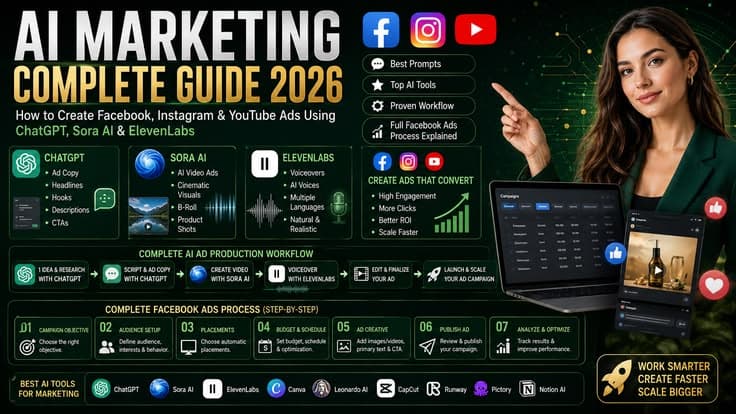
SEO and AEO generate organic traffic over time. But if you want traffic fast — while your SEO builds up — paid social media advertising through Facebook and Instagram (both owned by Meta) is the most accessible and cost-effective paid traffic source for most websites, especially in Pakistan.
Step 1: Set Up Facebook Pixel on Your Next.js Site
The Facebook Pixel is a small piece of tracking code that you add to your website. It tracks which pages visitors view, how long they stay, and whether they take actions (contact form submission, purchase). This data allows Facebook to find more people similar to your existing visitors — dramatically improving ad performance over time.
In Next.js, add the Pixel code in your
rootLayout.tsxinside the <head> section using a Script component from next/script with strategy="afterInteractive" to avoid slowing your initial page load.Step 2: Choose Your Campaign Objective
Facebook and Instagram campaigns are organized around objectives. For website traffic, choose either the Traffic objective (optimizes for link clicks to your website) or the Engagement objective (optimizes for people who interact with your content). For conversions (contact form submissions, sales), choose the Conversions or Leads objective.
Step 3: Define Your Audience
Meta's audience targeting is its greatest advantage. You can target people by: location (city, country, radius around a point), age and gender, interests (technology, digital marketing, cooking — whatever matches your content), behaviors (online shoppers, frequent travelers), and custom audiences (people who have already visited your website via Pixel data). For Pakistan-focused websites, the most effective approach is targeting by city (Karachi, Lahore, Islamabad), age group relevant to your content, and relevant interest categories.
Step 4: Create High-Converting Ad Creative
The ad creative (image/video + headline + description) is what users actually see. Best practices: use a compelling, high-contrast image or short video (under 15 seconds performs best); write a headline that states a clear benefit or asks a question your audience cares about; include a call-to-action button (Learn More, Visit Website, Get Quote); keep your primary text under 125 characters to avoid being cut off on mobile.
Step 5: Set Budget and Monitor Results
For beginners in Pakistan, start with a daily budget of Rs 500–1,000 per day to test what works before scaling. Monitor these key metrics: CPC (Cost Per Click — how much you pay per visit), CTR (Click-Through Rate — percentage of people who click), Reach (unique people who saw your ad), and Link Clicks (total visits to your website). After 3–5 days, identify which ad creative generates the lowest CPC and highest CTR, then scale the budget on that winning ad.
Facebook vs Instagram Ads — Website Traffic Strategy