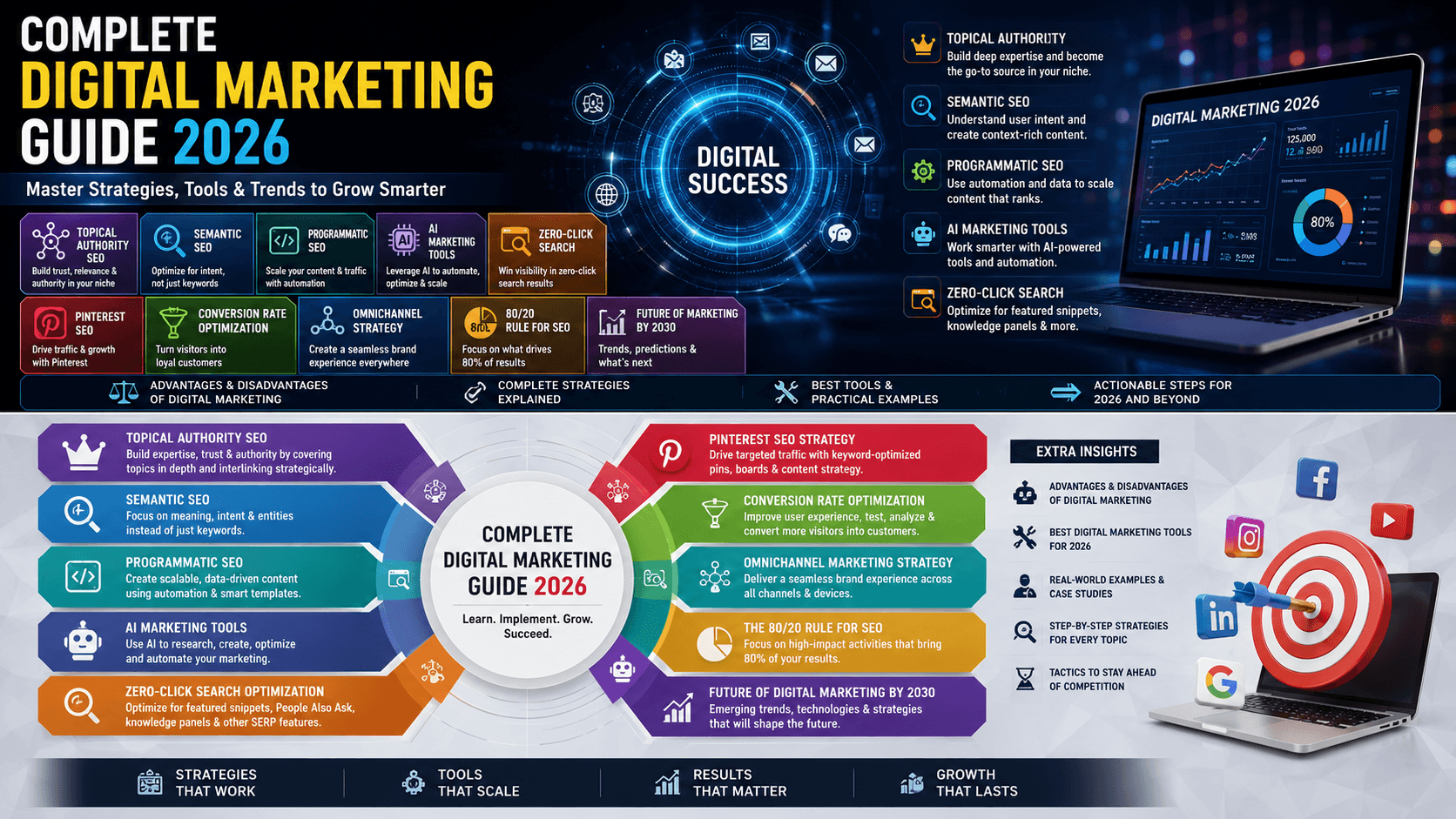
Complete Digital Marketing Mastery Guide 2026 — Landing Pages, Analytics, Conversion Optimization, YouTube Growth, Personal Branding, ROI, Customer Journey Mapping, AI Search, Voice Search & More
Welcome to the most comprehensive digital marketing guide of 2026 — covering every major strategy, channel, and framework you need to grow your business online. Whether you are searching for how to optimize landing pages for conversion, learning website analytics from scratch, figuring out how to improve website conversion rates, building a YouTube channel growth strategy, developing your personal brand, mastering how to measure marketing ROI, understanding customer journey mapping, dominating AI search optimization, leveraging voice search marketing, capitalizing on the creator economy, or implementing marketing automation workflows — this single guide covers all 17 essential digital marketing disciplines with actionable, evidence-backed strategies.
Part 1: How to Optimize Landing Pages for Conversion — The 7 Principles of Conversion-Centered Design
How to optimize landing pages for conversion? What is landing page optimization? How to optimize a website for conversions? What are the 7 principles of conversion? What is the best practice for landing pages? What are the 7 C's of web design? How to create a landing page for beginners? What are 5 examples of conversion?
Landing page optimization is the process of improving every element of a standalone web page to maximize the percentage of visitors who take a desired action — whether that is signing up, purchasing, downloading, or booking. The difference between a landing page that converts at 2% and one that converts at 12% is not luck — it is a systematic application of conversion science. The most influential framework for this is the 7 Principles of Conversion-Centered Design (CCD), coined by Oli Gardner, co-founder of Unbounce. These principles guide visitor attention and minimize friction at every step of the user's journey.
Table 1: The 7 Principles of Conversion-Centered Design — Complete Guide
| # | Principle | Core Concept | Practical Application | Common Mistake to Avoid |
|---|---|---|---|---|
| 1 | Attention | Capture and maintain focus — aim for 1:1 attention ratio (one link per page = the CTA) | Use white space, contrasting CTA button color, directional cues (arrows, eye-gaze images) pointing toward CTA | Including navigation bars, multiple links, and competing CTAs that pull visitors away |
| 2 | Context | Deliver exactly what was promised in the ad, email, or search result that brought the user to your page (message match) | Match headline, imagery, and tone of your traffic source to the landing page — if ad says "50% Off," page must say "50% Off" | Sending all ad traffic to the homepage instead of a dedicated landing page — message-match failure |
| 3 | Clarity | Communicate your unique value proposition clearly within 5 seconds of arrival | Remove jargon, use bullet points, ensure headline immediately communicates what you do and for whom | Clever but vague headlines that prioritize creativity over clarity ("We Transform Businesses" means nothing) |
| 4 | Congruence | Every page element must align with your singular campaign goal — nothing unrelated | Remove navigation bars, unrelated images, off-topic text blocks, and any element that does not directly support conversion | Including "related posts," social media feeds, or footer links that give visitors an exit route |
| 5 | Credibility | Build trust so visitors feel safe converting — trust is the conversion killer when missing | Customer testimonials with photos and names, client logos, security badges, review stars, privacy policy link near form | No social proof, anonymous testimonials, or fake-looking stock photos instead of real customer images |
| 6 | Closing | Make the conversion action as simple and frictionless as possible | Keep forms to 3 fields max for top-of-funnel; make CTA button copy action-oriented ("Get My Free Guide" not "Submit"); use urgency and scarcity ethically | Asking for too much information (phone, company, job title) when only name and email are needed |
| 7 | Continuance | Encourage ongoing engagement after conversion happens — replace generic "Thank You" pages | Direct converted users to: a related blog article, your social channels, a secondary low-friction offer, or a video that deepens engagement | A dead-end "Thank You, your submission has been received" page with no next step |
Best Landing Page Practices — Advanced Tips
Best landing page practices for beginners free. Landing page best practices examples. Landing page best practices 2025. High converting landing page structure. Landing page strategy. Convert landing page. Simple landing page examples. Video landing page examples.
- Above-the-fold test: Everything critical (headline, subheadline, CTA, hero image) must be visible without scrolling on mobile and desktop. 80% of visitors never scroll below the fold
- Single goal architecture: Every high-converting landing page has exactly ONE goal. Multiple goals = zero conversions
- A/B test continuously: Test headline first (highest impact), then CTA copy, then hero image, then form length — test one element at a time only
- Mobile-first design: Over 60% of landing page traffic globally is mobile. Design for mobile first, scale up to desktop
- Page speed: Every additional second of load time reduces conversions by 4.42% (Portent research). Compress images, minimize scripts, use a CDN
- Video landing pages: Explainer videos can increase conversion rates by up to 80% when placed in the hero section. Keep videos under 90 seconds for maximum completion rates
What Is a Good Website Conversion Rate?
What is a good website conversion rate? Average website conversion rate. How to increase website conversion. Website conversion means. The average landing page conversion rate across industries is 2.35%. A "good" conversion rate is 5%+. The top 10% of landing pages convert at 11.45% or higher. These top performers share common traits: hyper-specific audiences, strong message match, minimal friction, compelling social proof, and relentless A/B testing.
Shopping Cart Abandonment — The Conversion Crisis
Why is shopping cart abandonment a problem? Cart abandonment meaning. Shopify cart abandonment. Abandoned cart recovery. Top reasons for cart abandonment. Abandoned cart email. Abandoned cart WooCommerce. BigCommerce abandoned cart emails.
The global average shopping cart abandonment rate is approximately 70% — meaning 7 out of every 10 shoppers who add items to cart leave without purchasing. The top reasons: unexpected shipping costs revealed at checkout, forced account creation, complex checkout process, security concerns, and payment method not being available. Abandoned cart email sequences (sent at 1 hour, 24 hours, and 72 hours after abandonment) recover an average of 5–15% of abandoned revenue. On Shopify and WooCommerce, these sequences are automated and among the highest-ROI email campaigns any ecommerce business can run.
Part 2: Website Analytics Guide for Beginners — Google Analytics, Free Tools & Key Metrics
Website analytics guide. Google analytics website traffic check. Website analytics free. Google web analytics. Google analytics 4 login. Is Google Analytics free? Web analytics tools. How to add Google Analytics to website. Universal analytics.
Website analytics is the collection, measurement, and analysis of website data to understand visitor behavior and improve performance. In 2026, Google Analytics 4 (GA4) is the standard — replacing Universal Analytics which was sunset in 2023. GA4 is free, event-based (rather than session-based), and provides cross-platform tracking across websites and apps simultaneously. To access: go to analytics.google.com → create account → add your website → install the GA4 tracking code or use Google Tag Manager.
Key Website Analytics Metrics You Must Track
- Sessions: Individual visits to your website — one user can create multiple sessions
- Users: Unique visitors in a given time period
- Bounce Rate: Percentage of visitors who leave without interacting — high bounce rate on landing pages indicates message mismatch or poor UX
- Pages Per Session: How many pages visitors view on average — indicates engagement depth
- Average Session Duration: How long visitors spend on your site
- Conversion Rate: Percentage of visitors who complete your desired goal
- Traffic Source Breakdown: Where visitors come from — organic search, social, direct, referral, paid
- Core Web Vitals: Google's user experience metrics — LCP (loading), FID (interactivity), CLS (visual stability) — directly affect SEO rankings
Free Web Analytics Tools (Beyond Google Analytics)
- Google Search Console: Shows which keywords drive organic traffic, click-through rates, and indexing issues — essential for SEO
- Hotjar (free tier): Heatmaps and session recordings showing exactly where users click and scroll
- Microsoft Clarity: Free heatmaps and recordings — no data limits on free plan
- Matomo: Open-source GA alternative — self-hosted for complete data privacy
- Semrush / Ahrefs (limited free): Competitor traffic analysis and keyword research
Part 3: Marketing Performance Tracking — KPIs, Metrics & Dashboards
Marketing performance tracking. Performance marketing tracking tools. Marketing performance tracker. Marketing performance tracker template. Marketing performance management. Marketing performance measurement. Marketing performance measurement metrics. Marketing measurement framework. How to measure marketing performance. Marketing measurement tools. Marketing effectiveness examples. Metrics to measure success of marketing campaign. Marketing analytics for beginners. What are the 4 types of marketing analytics? What are the 5 C's of marketing analysis?
Marketing performance tracking is the systematic process of monitoring the right metrics to understand whether your marketing investments are producing results. The critical skill is distinguishing between vanity metrics (likes, impressions, follower counts — numbers that feel good but don't correlate with revenue) and performance metrics (conversion rate, cost per acquisition, return on ad spend, customer lifetime value — metrics that directly connect to business outcomes).
The 4 Types of Marketing Analytics
- Descriptive Analytics: What happened? (Traffic reports, campaign summaries, sales data)
- Diagnostic Analytics: Why did it happen? (Identifying which channel drove a spike, why conversions dropped)
- Predictive Analytics: What will happen? (Forecasting future performance based on historical trends)
- Prescriptive Analytics: What should we do? (AI-driven recommendations for budget allocation, targeting, content)
Essential Marketing KPIs Dashboard
- Customer Acquisition Cost (CAC): Total marketing spend ÷ new customers acquired
- Customer Lifetime Value (CLV): Average purchase value × purchase frequency × customer lifespan
- CLV:CAC Ratio: Should be at least 3:1 for a sustainable business — if CLV is 3x your acquisition cost, the business model works
- Return on Ad Spend (ROAS): Revenue generated ÷ ad spend — target 4:1 minimum for most businesses
- Marketing Qualified Leads (MQLs): Leads that meet your ideal customer profile criteria
- Email Open Rate, Click Rate, Conversion Rate: The three-funnel metrics for every email campaign
Part 4: YouTube Channel Growth Strategy 2026 — 15 Proven Ways to Grow Fast
YouTube channel growth strategy. YouTube channel growth plan. TikTok YouTube channel growth strategy. How to make my YouTube channel grow faster. How do I make my YouTube channel grow? YouTube channel growth tips. YouTube channel growth tools. YouTube channel growth software. How to grow a YouTube channel fast. How to grow YouTube channel subscribers. 8 secrets to grow your YouTube channel. YouTube channel growth analytics. How to grow a YouTube channel fast for free. Grow with YouTube monetization. YouTube channel grow free. How to grow YouTube channel in 1 month. YouTube channel growth without ads. What is the YouTube 7 second rule? How many views to make $10,000 a month on YouTube? How to quickly get 1000 subscribers on YouTube? Will YouTube pay for 500 subscribers? How to get 100 subs in 1 day? How much money is 1000 views on YouTube without ads? Is 100 views a day good? Do YouTube channels without ads make money? Can 500 subscribers make money?
YouTube is the second largest search engine in the world with over 2 billion logged-in users monthly — and in 2026, it remains the most powerful long-form video platform for building an audience, establishing authority, and generating revenue. But most channels fail not because of poor content — they fail because of poor strategy, consistency, and algorithm understanding. Here are the 15 proven ways to grow your YouTube channel:
Table 2: YouTube Channel Growth Strategy — 15 Methods Ranked by Impact
| # | Growth Strategy | Impact Level | Time to Results | Key Action |
|---|---|---|---|---|
| 1 | Understand the YouTube Algorithm | ★★★★★ Critical | Ongoing | Optimize for watch time and click-through rate (CTR) — the algorithm's two primary signals |
| 2 | Build Videos Around Keywords/Topics | ★★★★★ Critical | 2–8 weeks | Research with TubeBuddy, VidIQ, or YouTube's autocomplete before filming — title must contain target keyword |
| 3 | Post Great Thumbnails | ★★★★★ Critical | Immediate | Thumbnail drives CTR — bright colors, human face with emotion, large readable text, consistent style across channel |
| 4 | Leverage YouTube Shorts | ★★★★★ Critical | Days to weeks | YouTube aggressively promotes Shorts — vertical videos under 60 seconds drive massive subscriber discovery |
| 5 | The YouTube 7-Second Rule | ★★★★★ Critical | Immediate | Hook viewers in the first 7 seconds — state the value/promise immediately; never start with intros or channel bumpers |
| 6 | Optimal Video Length | ★★★★ High | Ongoing | 8–15 minutes for maximum ad revenue + watch time. Shorts for discovery. Longer for loyal subscribers who finish videos |
| 7 | Engage With Your Audience | ★★★★ High | 1–3 months | Reply to every comment in first 24 hours — comment engagement signals algorithm that video sparks discussion |
| 8 | Rank in Google Video Search | ★★★★ High | 2–6 weeks | Certain searches (how-to, tutorials, reviews) trigger video results on Google — optimize title and description for these keywords |
| 9 | Upload Consistently | ★★★★ High | 2–4 months | Consistency beats perfection — 1 video per week reliably outperforms 4 videos in one week then nothing for a month |
| 10 | Repurpose Content Across Platforms | ★★★★ High | 1–3 months | Publish YouTube video → cut into Shorts → share clips on Instagram Reels + TikTok → blog post + podcast episode |
| 11 | Get Branded and Be Memorable | ★★★ Medium | 3–6 months | Consistent channel art, color palette, thumbnail style, intro music, and personality create recognizable brand identity |
| 12 | Promote on Other Social Channels | ★★★ Medium | Immediate | Share every video across Instagram, LinkedIn, Twitter, Facebook, WhatsApp communities — cross-promotion drives early views which signal algorithm |
| 13 | Use YouTube Cards and End Screens | ★★★ Medium | Immediate | Add end screens (subscribe button + related video) in last 20 seconds; cards mid-video link to related content — reduces drop-off |
| 14 | Push for Subscriptions Actively | ★★★ Medium | Ongoing | Ask for subscription at exactly the right moment — after delivering the key value in the video, not at the beginning |
| 15 | Experiment with AI on YouTube | ★★★★ High | 1–3 months | Use AI for script writing, thumbnail generation, auto-dubbing in multiple languages, comment sentiment analysis, and topic ideation |
YouTube Monetization — What You Need to Know
YouTube Partner Program requirements in 2026: 1,000 subscribers + 4,000 watch hours in the past 12 months for standard monetization. With 500 subscribers + 3,000 watch hours, you qualify for YouTube's lower-tier monetization (channel memberships, Super Thanks). How many views to make $10,000 a month on YouTube? With an average YouTube CPM of $3–$10 per 1,000 views, you would need approximately 1–3 million views per month to generate $10,000 from ad revenue alone — which is why successful creators combine AdSense with sponsorships, merchandise, courses, and affiliate marketing.
Part 5: Personal Branding for Freelancers & Beginners — Complete Strategy Guide
Personal branding for freelancers. Personal logo for free. Personal branding for dummies free PDF. Personal branding free course. Personal branding freepik. Personal branding free online course. Personal branding free images. Personal branding template free. Personal branding for beginners PDF. Personal branding for beginners book. Personal branding examples. Personal branding consultant. Personal branding strategy. Personal branding course. Personal branding book. Personal branding ideas. What are the 7 pillars of personal branding? What are the 5 C's of personal branding? What are the 5 P's of personal branding? How do I brand myself? What is the 3 7 27 rule in branding? What are the 3 C's of a brand? How to do personal branding? How to start personal branding? How to establish brand authority?
Personal branding is the intentional process of defining and consistently communicating your unique value, expertise, and personality to your target audience. In 2026, personal branding is no longer optional for freelancers, entrepreneurs, and professionals — it is the primary differentiator in a crowded digital marketplace. Your personal brand answers the question: Why should someone choose you over everyone else offering the same service?
The 7 Pillars of Personal Branding
- Clarity: Define who you are, who you serve, what problem you solve, and what makes you different — if you cannot explain this in one sentence, your brand is not clear enough
- Consistency: Use the same profile photo, color palette, tone of voice, and message across every platform — inconsistency creates confusion and erodes trust
- Content: Regular, valuable content publication is the engine of personal brand growth — the 3-3-3 rule for marketing suggests educate, entertain, and convert in equal measure
- Credibility: Build authority through case studies, testimonials, media features, speaking engagements, and consistently delivering results
- Community: Build around yourself — respond to comments, participate in conversations, create a private community
- Collaboration: Partner with complementary personal brands — podcast guest appearances, joint webinars, co-created content
- Conversion: Your brand must ultimately drive business results — clear calls to action, a lead magnet, and a defined path from follower to client
The 3-7-27 Rule in Branding
What is the 3 7 27 rule in branding? This rule describes how many impressions are needed to build different levels of brand recognition: 3 impressions for a person to be aware of your brand; 7 impressions to actually remember it; 27 impressions to actually trust you enough to take action. This is why consistency and frequency of content matter so much — you need repeated touchpoints before most potential clients will make a move.
Brand Authority — How to Establish It
How to establish brand authority? What is brand authority? Brand authority meaning. Brand authority checker. How to increase domain authority. What is website authority? Moz brand authority. How to build brand authority online. Brand authority is the degree to which your target audience sees you as a trusted, credible expert in your field. It is built through consistent high-quality content, third-party validation (press coverage, industry awards, guest contributions), demonstrated results, and longevity. Domain authority (DA) — a Moz metric ranging from 1–100 — is a search engine indicator of website credibility. Increase it through earning high-quality backlinks, publishing comprehensive content, and technical SEO health.
Part 6: How to Measure Marketing ROI — Formulas, Tools & Methods
How to measure marketing ROI. How to calculate marketing ROI. How to calculate marketing ROI in Excel. How to determine marketing ROI. How to measure marketing performance. How to measure influencer marketing ROI. How to measure digital marketing ROI. How to measure marketing campaign ROI. How to measure content marketing ROI. How to calculate ROI marketing campaign. What is the 40-40-20 rule in marketing? What are the 5 C's of marketing strategy? What are the 5 pillars of marketing? What are the 7Ps of marketing? What is the 3-3-3 rule for marketing? What is the 70/20/10 rule in marketing?
Table 3: Marketing ROI — Formulas, Methods & Benchmarks by Channel
| Marketing Channel | ROI Formula | How to Calculate | Industry Benchmark ROI | Key Tool |
|---|---|---|---|---|
| Overall Marketing ROI | (Revenue - Marketing Cost) ÷ Marketing Cost × 100 | If you spent $1,000 and generated $5,000: ($5,000 - $1,000) ÷ $1,000 × 100 = 400% ROI | 5:1 ratio (500%) = strong marketing ROI | Google Analytics, CRM |
| Email Marketing ROI | (Revenue from emails - Email cost) ÷ Email cost | Track email-attributed revenue via UTM parameters + Analytics goals | $36 return per $1 spent (3,600% ROI) — highest of all channels | Mailchimp, Klaviyo, ActiveCampaign |
| Paid Ads ROI (ROAS) | Revenue ÷ Ad Spend | $10,000 revenue from $2,500 ads = 4:1 ROAS = 400% return | 4:1 ROAS minimum; e-commerce targets 6:1–10:1 | Google Ads, Meta Ads Manager |
| Content Marketing ROI | (Organic traffic value + Leads generated) ÷ Content creation cost | Assign monetary value to organic rankings using Ahrefs traffic value metric | Content marketing generates 3x more leads than paid for same cost long-term | Ahrefs, Semrush, GA4 |
| Influencer Marketing ROI | (Earned Media Value + Sales) ÷ Influencer cost | Track via unique discount codes, UTM links, and affiliate tracking | $5.20 return per $1 spent on influencer marketing on average | Aspire, Creator.co, unique tracking links |
| Social Media ROI | (Revenue from social + Brand value) ÷ Social media cost | Use UTM parameters on all social links; track assisted conversions in GA4 | Highly variable — social often drives assisted rather than direct conversions | Sprout Social, Hootsuite Analytics |
| SEO ROI | (Organic traffic value + Lead value) ÷ SEO investment | Calculate what equivalent PPC traffic would cost using Google Keyword Planner CPCs | SEO delivers 12.2x ROI compared to traditional outbound marketing over 3+ years | Google Search Console, Ahrefs |
Marketing Budget Rules
- 70/20/10 Rule: 70% of budget on proven strategies (what's working), 20% on emerging channels (promising new platforms), 10% on experimental innovations (testing new ideas)
- 40-40-20 Rule (Direct Marketing): 40% success depends on your audience (list quality), 40% on your offer (what you're selling and at what price), 20% on your creative (copy and design)
- The 3-3-3 Rule for Marketing: 3 second to grab attention (visual hook), 3 minutes to deliver core value (engagement window), 3 calls to action per content piece (primary, secondary, tertiary)
Part 7: Customer Journey Mapping Explained — Definition, Tutorial & 5 Stages
Customer journey mapping explained. Customer journey mapping meaning. Customer journey mapping definition. Customer journey mapping tutorial. Customer journey mapping analysis. Customer experience mapping meaning. Customer journey mapping business analysis. What is customer journey mapping? Customer journey mapping will help you. What are the 5 stages of customer journey mapping? What are the 7 steps to map the customer journey? How does customer journey mapping work? What are the 5 main points of a customer journey? What are the 4 types of customers? What are the 7 touch points? What are the 5 A's of the customer journey? What are the 4 pillars of customer success? What are the 3 C's of customer satisfaction? Customer journey map template. Customer journey map example. 7 stages of customer journey. Importance of customer journey mapping. What is customer journey in marketing?
Customer Journey Mapping is the process of creating a visual representation of every interaction a customer has with your brand — from first hearing about you to becoming a loyal advocate. It forces you to see your business from the customer's perspective rather than the company's internal processes. It reveals gaps, friction points, and emotional pain points that quantitative data alone never shows.
Table 4: Customer Journey Mapping — 5 Stages, Touchpoints, Customer Questions & Marketing Strategy
| Stage | Customer Mindset | Key Touchpoints | Customer Question | Marketing Strategy | Content Type |
|---|---|---|---|---|---|
| 1. Awareness | I have a problem but don't know solutions exist | Social media, Google Search, YouTube, word-of-mouth, blog articles | "Why is this happening to me?" / "How do I solve X?" | SEO content, social ads, PR, influencer reach — cast wide net | Blog posts, explainer videos, infographics, short-form social content |
| 2. Consideration | I know solutions exist, comparing options | Comparison websites, reviews (Google, Trustpilot), YouTube reviews, email sequences | "Which option is right for me?" / "Why you vs competitor?" | Email nurture sequences, case studies, comparison content, retargeting ads | Comparison guides, webinars, demo videos, testimonials, email drip campaigns |
| 3. Decision | Ready to buy — need final confidence push | Product pages, pricing pages, live chat, sales calls, checkout process | "Is this safe?" / "What if it doesn't work?" / "Is this the best price?" | Conversion optimization, urgency/scarcity, guarantees, live chat support | Free trials, demos, guarantees, risk-reversal offers, limited-time discounts |
| 4. Retention | Post-purchase — evaluating if decision was right | Onboarding emails, customer support, account management, loyalty programs | "Did I make the right choice?" / "How do I get maximum value?" | Exceptional onboarding, proactive support, loyalty programs, upsell sequences | Welcome sequences, tutorials, FAQs, check-in emails, loyalty rewards |
| 5. Advocacy | Delighted customer willing to recommend | Review requests, referral programs, community, social sharing | "How do I share this with others?" / "Can I be part of something bigger?" | Review generation, referral programs, user-generated content campaigns, ambassador programs | Case studies with their story, referral incentives, community invitations, UGC campaigns |
Customer Retention — The Hidden Revenue Driver
How to improve customer retention in marketing. Customer retention examples. Benefits of customer retention. Customer retention strategies PDF. Customer retention rate formula. Customer retention programs. What are the 8 C's of customer retention? What is the 80/20 rule in customer retention? What are the 4 C's of customer loyalty?
Acquiring a new customer costs 5–7x more than retaining an existing one. The 80/20 rule in customer retention states that 80% of your future revenue typically comes from 20% of your existing customers. Customer retention rate formula: ((Customers at end of period - New customers acquired) ÷ Customers at start) × 100. A healthy retention rate is 85%+ for SaaS, 60–70%+ for ecommerce. The 4 C's of customer loyalty: Continuity (consistent experience), Connection (emotional bond), Convenience (ease of doing business), and Community (belonging to something larger).
Part 8: AI Search Optimization, Voice Search Marketing & Zero-Click Search 2026
AI search optimization. AI search optimization tools. AI search optimization services. AI search optimization course. AI search optimization agency. AI search optimization techniques. AI search optimization masterclass. AI search optimization platform. AI search optimization GEO. AI search optimization with top historical data. What is AI search optimization called? Optimize website for AI search. AI search optimization examples. AI search optimization ASO. How to do AI search optimization? What are the 4 types of SEO? How can I start SEO as a beginner? What are the 4 pillars of SEO? What are the 3 C's of SEO? What are the 5 important concepts of SEO? Voice search marketing. Voice search marketing examples. Voice search marketing meaning. Voice search marketing trends. Voice search marketing campaign. Voice digital marketing. Voice recognition marketing. Voice search advertising. Voice search engine optimization. Voice search digital marketing. Voice search marketing strategy. Voice search optimization in digital marketing. Voice search optimization tools. Voice search keyword research. How does voice search work? Voice search website. Voice search keywords. Is PPC better than SEO? Zero click search optimization. Zero click search AI. Zero-click marketing. What is an example of a zero-click search? Zero-click internet. Google zero click searches. Sparktoro zero click.
Table 5: Search Optimization in 2026 — SEO vs AEO vs GEO vs Voice Search vs Zero-Click Comparison
| Search Type | Full Name | Definition | Primary Goal | Key Strategy | Content Format |
|---|---|---|---|---|---|
| SEO | Search Engine Optimization | Optimizing content to rank in traditional search engine results pages (SERPs) | Drive organic clicks to your website | Keyword research, backlinks, technical SEO, on-page optimization, Core Web Vitals | Long-form blog posts, landing pages, product pages |
| AEO | Answer Engine Optimization | Optimizing to appear in AI-generated answers (ChatGPT, Perplexity, Google AI Overviews) rather than just traditional results | Be cited as a source in AI answers — brand visibility even without clicks | FAQ-structured content, direct question-answer format, schema markup (FAQ, HowTo), comprehensive topical authority | FAQ pages, structured how-to guides, definition articles, Q&A content |
| GEO | Generative Engine Optimization | The newest discipline — optimizing content so generative AI models (Claude, ChatGPT, Gemini) include your brand/content in generated responses | Ensure AI models recommend your brand, products, and content when users ask relevant questions | Build brand mentions across authoritative sources, structured data, consistent NAP (Name-Address-Phone), authority-building content | Comprehensive guides, original research, data-backed content, expert interviews |
| Voice Search | Voice Search Optimization (VSO) | Optimizing for queries made by speaking to Siri, Alexa, Google Assistant, and voice-enabled devices | Appear as the spoken answer when someone asks a voice query — typically only one result is read aloud | Conversational long-tail keywords, question-format content, local SEO (voice searches are 3x more likely to be local), featured snippets optimization | Conversational blog posts, local business content, FAQ sections with natural language answers |
| Zero-Click SEO | Zero-Click Search Optimization | Over 60% of Google searches now end without a click to any website — Google answers the query directly via Featured Snippets, Knowledge Panels, and AI Overviews | Win the zero-click result (Featured Snippet / AI Overview) so your brand appears even when no one clicks | Structure content to directly answer target questions, use numbered lists and tables (algorithm favors these for snippets), aim for position 0 | Definition articles ("What is X?"), numbered step guides ("How to X in 5 steps"), comparison tables |
How to Win in a Zero-Click Search Market
How to win in a zero-click search market? Zero click search optimization example. Zero click search optimization strategy. Zero click searches example.
The strategic shift required: stop optimizing purely for website clicks and start optimizing for brand visibility and authority across all surfaces. Even if users don't click, seeing your brand name consistently in AI answers, featured snippets, and knowledge panels builds awareness and trust over time. Practical tactics: structure every article with a direct 40–60 word answer to the target question immediately after the H2 heading; use numbered steps, bulleted lists, and tables (these are extracted most often for snippets); target question-based keywords; build a robust FAQ section; earn citations from high-authority sites so AI models pull your data as a trusted source.
Part 9: Creator Economy Marketing 2026, Community-Led Growth & Micro-Influencer Campaigns
Creator economy marketing. Creator economy market size. Creator economy market size India. Creator economy market map. Creator economy market size 2025. Creator economy market cap. Creator economy market size 2030. Creator economy market growth projections. Creator economy market report. Creator economy market size 2026. Creator economy marketing PDF. Creator economy marketing strategy. Creator economy marketing review. Creator economy report. Creator economy platforms. What is the creator economy in marketing? What is a creator economy? What is an example of a creator economy? What does creator marketing mean? What are the 4 types of creators?
The Creator Economy refers to the ecosystem of independent content creators — YouTubers, TikTokers, podcasters, newsletter writers, course creators — who build audiences and monetize directly through brand partnerships, subscriptions, digital products, and communities. In 2026, the global creator economy is valued at over $500 billion and is projected to reach $1 trillion by 2030. For marketers, this represents a fundamental shift from advertising on traditional media to partnering with creators who have built deep, trust-based relationships with niche audiences.
Table 6: Influencer Marketing Tiers — Nano vs Micro vs Macro vs Mega
| Tier | Follower Range | Engagement Rate | Cost Per Post (Est.) | Best For | ROI Potential |
|---|---|---|---|---|---|
| Nano Influencers | 1,000 – 10,000 | 7–10% (highest of all tiers) | $10–$100 | Hyper-local campaigns, product gifting, community building, niche B2B products | ★★★★★ Highest ROI per dollar — most authentic, highest trust with audience |
| Micro Influencers | 10,000 – 100,000 | 3–7% | $100–$1,500 | Brand awareness in specific niches, product launches, affiliate campaigns | ★★★★★ Excellent ROI — best balance of reach, engagement, cost, and authenticity |
| Macro Influencers | 100,000 – 1,000,000 | 1.5–3% | $1,500–$20,000 | Mass awareness campaigns, national brand launches, broad demographic reach | ★★★ Good — high reach but lower engagement rate; use for awareness not conversion |
| Mega / Celebrity | 1,000,000+ | 0.5–1.5% | $20,000–$1,000,000+ | Global brand campaigns, luxury products, mass market consumer goods | ★★ Lowest ROI per dollar — best for brand prestige not performance marketing |
Best Micro-Influencer Campaign Examples
Micro influencer campaigns examples. Best micro influencer campaigns. Micro influencer program. Examples of micro influencers. Micro influencer follower count. Micro influencer agencies. Macro influencers. Micro influencer vs influencer.
The most effective micro-influencer campaign structure: (1) Identity alignment — select creators whose personal values and content naturally align with your brand, not just creators with large followings; (2) Unique discount codes — give each creator a unique code for tracking sales attribution; (3) Creative freedom — brief the creator on message and goals but let them produce content in their own voice; (4) Long-term partnerships — 6+ post commitments outperform one-off posts dramatically because repeated exposure builds genuine credibility.
Community-Led Growth Strategy
Community-led growth. Community-led growth examples. Community led growth strategy. Community led growth course. Community led alliance. What is community-led growth? What is the meaning of community growth? What is the meaning of community-led? Is it community lead or community-led? What is a synonym for community-led? Common room community.
Community-led growth (CLG) is a business strategy where the community of users, customers, or fans becomes the primary driver of acquisition, retention, and expansion — rather than traditional sales or marketing. Examples: Reddit (communities create the content that attracts users), Notion (user-built templates and community became the best marketing), Figma (design community sharing files drove viral adoption). For smaller businesses, CLG means: creating a private Facebook Group, Discord, or WhatsApp community around your niche; producing exclusive content for community members; encouraging members to share your products organically; and making community membership a valued benefit of your product or service.
Part 10: Video-First Marketing Strategy & Marketing Automation Workflows 2026
Video first strategy. What does video marketing mean? Video first marketing strategy. Video first marketing example. Marketing automation workflows. Marketing automation workflows examples. Best marketing automation workflows. Free marketing automation workflows. N8n marketing automation. N8n marketing templates. N8n marketing workflow. Marketing workflows. N8n marketing automation template. Which marketing automation workflow is most common? What are the 4 types of automation? What is the 3 3 3 rule in marketing? What is an automation workflow?
Video-First Strategy
A video-first marketing strategy means video is your primary content format — not an afterthought. In 2026, video drives higher engagement, better SEO rankings, stronger emotional connection, and superior conversion rates compared to static content across every platform. The video-first approach: create your core content as video first, then extract blog posts from transcripts, pull quotes for social graphics, convert key moments to Shorts/Reels, and repurpose audio as podcast episodes. One video shoot = 10+ pieces of content.
Table 7: Marketing Automation Workflows — Types, Triggers & Examples
| Workflow Type | Trigger | Sequence | Goal | Platform |
|---|---|---|---|---|
| Welcome Series | User subscribes to email list | Email 1 (immediate): Welcome + value delivery → Email 2 (Day 3): Best content → Email 3 (Day 7): Social proof → Email 4 (Day 10): Soft offer | Onboard, educate, build trust, first conversion | Mailchimp, Klaviyo, ActiveCampaign |
| Abandoned Cart Recovery | User adds to cart then leaves without purchasing | Email 1 (1 hour): Gentle reminder → Email 2 (24 hours): Address objections + testimonials → Email 3 (72 hours): Discount offer + urgency | Recover 5–15% of abandoned revenue | Klaviyo, Shopify Email, WooCommerce |
| Lead Nurture Sequence | User downloads lead magnet (PDF, webinar, free tool) | Weekly educational emails delivering value → Case study email → Product/service introduction → Demo request or sales call CTA | Convert marketing-qualified leads to sales-qualified leads | HubSpot, ActiveCampaign, Drip |
| Post-Purchase Upsell | Customer completes purchase | Email 1: Order confirmation + what to expect → Email 2 (Day 3): How to get maximum value → Email 3 (Day 7): Related product recommendation → Email 4 (Day 14): Review request | Increase customer lifetime value, generate reviews | Klaviyo, Omnisend, Shopify |
| Re-engagement Campaign | Subscriber inactive for 60–90 days | Email 1: "We miss you" + best content → Email 2 (3 days): Exclusive offer for returning → Email 3 (7 days): Last chance + unsubscribe option if not interested | Re-activate dormant subscribers or clean list | Any email platform with segmentation |
| Webinar/Event Automation | User registers for event | Registration confirmation → Reminder (1 week before) → Reminder (1 day before) → Reminder (1 hour before) → Replay email (next day) | Maximize attendance and post-event conversion | Zoom + Zapier, N8n, GoHighLevel |
| Birthday / Anniversary | Subscriber's birthday or customer anniversary date | Single email with personalized discount or gift voucher on the day | Drive purchase and emotional brand connection | Klaviyo, Mailchimp, Zoho |
N8n — The Free Marketing Automation Tool
N8n marketing automation. N8n marketing templates. N8n marketing workflow. N8n is a free, open-source workflow automation platform that connects marketing tools without code. Marketers use it to: automatically post new blog content to all social platforms; sync leads between CRM and email platform; create workflows that trigger personalized emails based on user behavior; and build marketing dashboards that pull data from multiple tools automatically. It competes with Zapier and Make (Integromat) but with no per-task limits on the self-hosted version.
Part 11: First-Party Data Strategy — The Future of Marketing in a Cookie-Free World
First-party data marketing examples. First-party data in digital marketing. First-party data marketing PDF. First-party data marketing strategy. First-party data examples. Second-party data. Zero-party data. First-party data strategy. What is first-party data in marketing? What is 1st party, 2nd party, and 3rd party data? What is the first-party data approach? What is an example of first-party data? What are the 4 types of data? What is the 3-3-3 rule for marketing?
With third-party cookies deprecated by Chrome and increasing global privacy regulations (GDPR, CCPA, and expanding legislation), the first-party data strategy has become the most critical marketing capability to develop in 2026. Understanding the data hierarchy:
- Zero-party data: Data customers proactively and intentionally share with you — quiz answers, preference surveys, product interests they explicitly state. Most valuable because it is accurate and consensual
- First-party data: Data your brand collects directly through your own channels — email list, website behavior (GA4), purchase history, CRM records, app usage, customer support interactions. Owned, accurate, and privacy-compliant
- Second-party data: Another company's first-party data that you purchase or access through a partnership — for example, a travel brand accessing an airline's customer data through a co-marketing deal
- Third-party data: Data aggregated from multiple sources and sold by data brokers — increasingly restricted by privacy laws and browser changes. Still used but declining in reliability and legal compliance
How to Build a First-Party Data Strategy
- Create value exchange: Offer genuine incentives for customers to share data — discount codes for email signup, exclusive content for preference surveys, loyalty points for app engagement
- Build owned audience channels: Email list (primary — you own it), SMS list, podcast subscribers, YouTube channel, WhatsApp broadcast list — channels where platform algorithm changes cannot eliminate your reach
- Implement proper tracking: GA4 with server-side tracking, CRM integration, customer data platforms (CDPs) that unify data from all sources into single customer profiles
- Segment and personalise: First-party data is only valuable when used — segment email lists by purchase history, behavior, preferences and send targeted campaigns rather than one-size-fits-all broadcasts
- Consent-first architecture: Every data collection point must have explicit consent and clear privacy policy — not just legally required but builds trust that improves data quality and customer loyalty
Part 12: Local SEO for Small Businesses & eCommerce Product Page Optimization
Local SEO for small businesses PDF. Best local SEO for small businesses. Local SEO checklist. How to start a local SEO business. SEO for local business. Why local SEO is important for small business. Why does my business need local SEO services. Local SEO website. How to optimize an eCommerce product page for SEO? What are the 7 C's of e-commerce? What are the 3 C's of SEO? What are the 4 types of SEO? Can ChatGPT do SEO? What are the 4 pillars of SEO?
Local SEO is critical for any business serving a geographic area. The 4 pillars of local SEO: (1) Google Business Profile optimization — complete profile with photos, hours, services, and weekly posts; (2) Local citations — consistent Name, Address, Phone (NAP) across all online directories; (3) Review generation — Google reviews are the #1 local ranking factor after proximity; (4) Local content — blog posts targeting location-specific keywords ("best digital marketing agency Rawalpindi," "website development Islamabad"). For eCommerce: optimize product pages with unique descriptions (never manufacturer copy), customer reviews, high-quality images with alt text, product schema markup, and fast page load speeds.
Brand Storytelling — The Emotional Engine of Marketing
What are the 5 C's of storytelling? What is brand storytelling? What are the four pillars of brand storytelling? What are the 4 C's of good storytelling? What are the 7 elements of StoryBrand? Brand storytelling examples in business. Creative brand storytelling examples. Brand storytelling template.
The 7 elements of StoryBrand (Donald Miller's framework): the hero (your customer), the problem (what they face), the guide (your brand), the plan (how you help), the call to action (what they should do), the avoidance of failure (what happens without you), and success (what their life looks like after). The most powerful brand storytelling positions the customer as the hero — not your brand. Your brand is Yoda. Your customer is Luke Skywalker.
Part 13: Conversion Tracking Setup — Google Ads, GA4 & GTM
How to setup conversion tracking? What is CTR and CVR? What are the 8 types of Google Ads? What is conversion tracking in marketing? What are the 7 stages of conversion? What is the 3 3 3 rule in sales? Conversion tracking setup guide Google Ads. Google Ads conversion tracking setup. How to set up Google Ads conversion tracking in Google Tag Manager. GA4 conversion tracking setup. Google Ads conversion tracking extension. Google Ads conversion tracking tag. What is conversion tracking in Google Ads? How to check conversion tracking in Google Ads?
Conversion tracking is the foundation of performance marketing — without it, you are flying blind. CVR (Conversion Rate) = Conversions ÷ Total Visitors × 100. CTR (Click-Through Rate) = Clicks ÷ Impressions × 100 — measures ad or email performance. Setup process: (1) Define your conversion events (purchase, form submission, phone call, page visit); (2) Create conversion actions in Google Ads; (3) Install Google Tag Manager (GTM) on your website; (4) Create tags in GTM that fire on your conversion triggers; (5) Connect GA4 goals to Google Ads for full funnel visibility; (6) Test all conversions in real-time using GTM Preview mode before going live.
Frequently Asked Questions — Digital Marketing 2026
What is the best practice for landing pages in 2026?
The best landing page practices in 2026: (1) Single goal per page with 1:1 attention ratio — no navigation, no competing CTAs; (2) Message match between your ad and landing page headline; (3) Clear value proposition visible within 5 seconds above the fold; (4) Social proof — real testimonials with photos, review stars, client logos; (5) Short forms — 3 fields maximum for top-of-funnel; (6) Mobile-first design — test on mobile before desktop; (7) Page speed under 3 seconds; (8) CTA button in contrasting color with action-oriented copy ("Get My Free Guide" not "Submit"); (9) Video in hero section if explaining a complex product; (10) A/B test continuously — headline first, then CTA, then hero image.
How do I start personal branding for free?
Start personal branding for free: (1) Define your niche and target audience clearly — pick one platform to master first; (2) Optimize your LinkedIn or Instagram profile with a professional photo, clear bio stating what you do and for whom, and a link to your work; (3) Start creating content consistently — 3 posts per week minimum; (4) Use free tools: Canva for graphics (free tier), Freepik for images, Buffer or Meta Business Suite for scheduling; (5) Engage with others in your niche — comment thoughtfully on industry leaders' posts; (6) Build your email list from day one — even a simple Mailchimp free account works; (7) Document your journey — share what you are learning in real time, not just expertise you already have.
How to measure marketing ROI correctly?
Measure marketing ROI correctly by: (1) Defining what "conversion" means for each campaign before it launches; (2) Installing proper tracking — GA4 with UTM parameters on all links; (3) Using the formula: (Revenue generated - Marketing cost) ÷ Marketing cost × 100; (4) Tracking multi-touch attribution — most conversions involve 4–8 touchpoints, so look at assisted conversions not just last-click; (5) Calculating Customer Lifetime Value not just single purchase value — a customer worth $500/year is worth acquiring at higher cost than one worth $50; (6) Setting different ROI benchmarks for awareness vs conversion campaigns; (7) Reporting on a consistent time frame — month-over-month and year-over-year comparisons reveal true trends.
What is AI search optimization and how is it different from SEO?
AI search optimization — also called AEO (Answer Engine Optimization) or GEO (Generative Engine Optimization) — is the practice of optimizing content to appear within AI-generated responses from ChatGPT, Perplexity, Google AI Overviews, Claude, and other AI assistants. Unlike traditional SEO which targets ranking in a list of blue links, AEO and GEO aim to be cited or quoted as a source within the AI's generated answer — or to have the AI recommend your brand directly. Key differences: SEO targets keyword ranking; AEO targets being the direct answer; GEO targets being recommended by AI. All three are necessary in 2026 — a comprehensive strategy covers all three simultaneously.
What are the 4 types of creators in the creator economy?
The 4 types of creators: (1) Educators — create tutorials, how-to content, courses, and informational content (most scalable income through courses and memberships); (2) Entertainers — create content primarily for enjoyment — comedy, gaming, lifestyle (monetize through sponsorships and merchandise); (3) Curators — gather and organize the best information in a niche (newsletters, podcast roundups — monetize through sponsorships and affiliate); (4) Community Builders — create belonging and connection rather than just content (Discord servers, membership communities — monetize through subscriptions). The most successful creators combine 2–3 of these types.
Conclusion: Your Digital Marketing Mastery Action Plan for 2026
Digital marketing in 2026 is not about doing everything — it is about doing the right things, in the right order, with the right understanding of why they work. The businesses that will dominate their markets are not those spending the most on ads — they are those that have built a solid foundation of owned audience (email list, YouTube channel, community), genuine brand authority, optimized conversion systems, and a first-party data strategy that makes them resilient to platform changes, algorithm updates, and privacy regulation shifts.
Start with the fundamentals: know your customer journey, build a high-converting landing page, measure what matters, and create content consistently. Layer in YouTube growth for long-term organic reach, personal branding for authority, and marketing automation for scalability. Then embrace the emerging opportunities: AI search optimization, voice search, creator partnerships, and community-led growth. Every major breakthrough in marketing over the last decade came from brands that adopted new channels early. The brands winning with AI search, zero-click optimization, and creator economy partnerships today are getting a 2–3 year head start on their competitors.
The most important principle of all: marketing without measurement is just spending money and hoping. Every strategy in this guide comes with clear metrics — track them from day one.
Need a Professional Website for Your Business? We Can Help.
Implementing the digital marketing strategies in this guide starts with one foundation: a fast, professional, SEO-optimized website that converts visitors into customers. If you or your business needs a website built from scratch — complete with live domain, professional hosting, mobile-responsive design, SEO setup, contact forms, and everything you need to get online and growing — we build exactly that.
Whether you need a business website, portfolio, eCommerce store, landing page, or blog — we handle everything from design to launch. Our websites are built for performance: fast loading, search-engine-friendly, and conversion-optimized using the same principles covered in this guide.
Contact us on WhatsApp to discuss your project:
Send us a message with your business type, what kind of website you need, and your budget — and we will get back to you with a plan. Professional websites with live domain included. Fast turnaround. Competitive pricing.