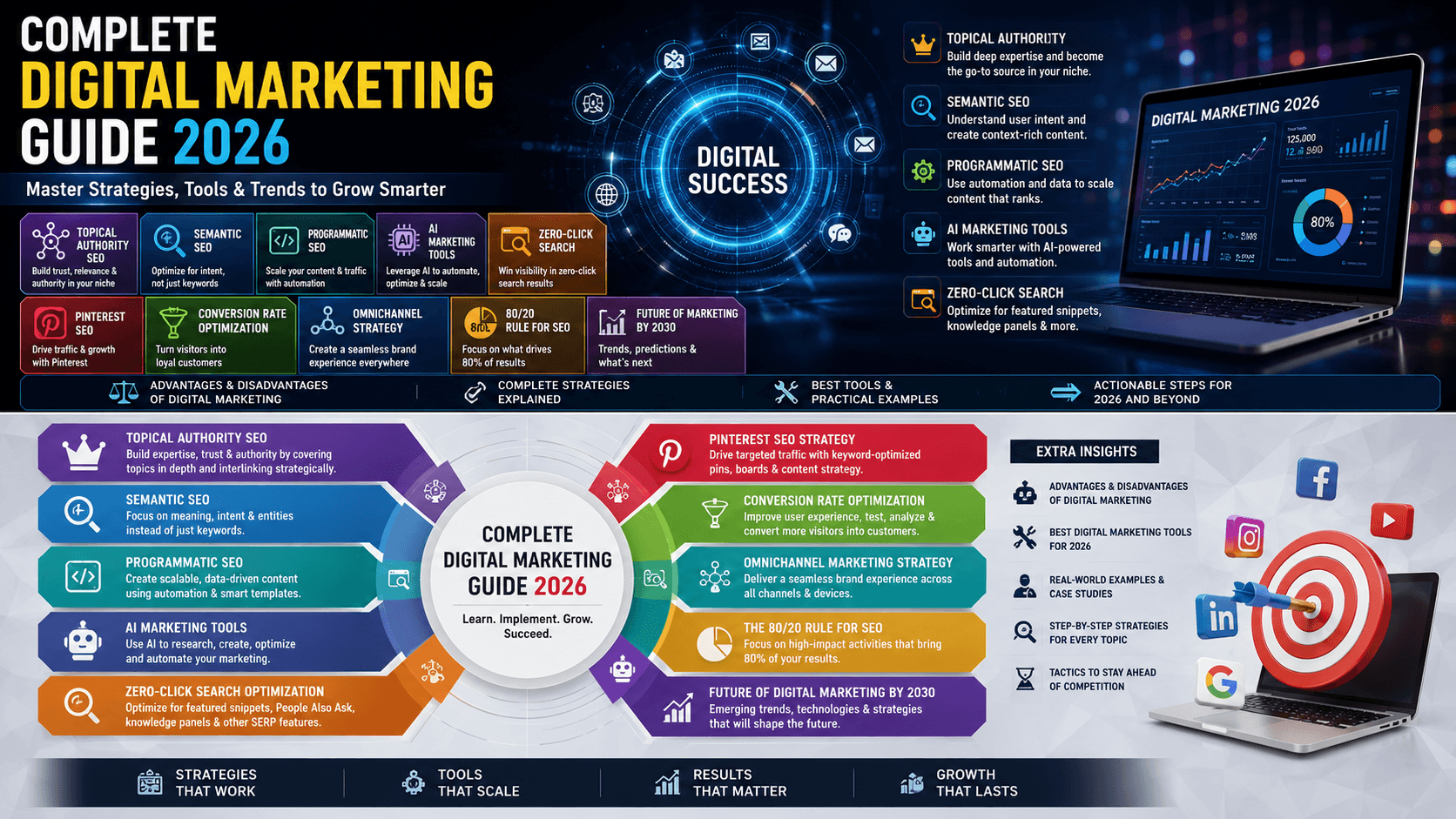
Complete Digital Marketing Guide 2026 — Topical Authority SEO, Semantic SEO, Programmatic SEO, AI Marketing, Zero-Click Search, Pinterest SEO, Conversion Rate Optimization & Omnichannel Strategy
Your comprehensive digital marketing reference for 2026 covering how to build topical authority in SEO, semantic SEO strategy for beginners, programmatic SEO examples explained, how AI is changing digital marketing, best AI tools for digital marketers, zero-click search optimization, best Pinterest SEO strategy 2026, how to improve conversion rate, omnichannel marketing strategy, and the future of digital marketing by 2030.
Introduction: Why Digital Marketing Mastery Matters More Than Ever in 2026
Digital marketing has undergone more transformation in the past three years than in the previous decade combined. The arrival of AI-powered search engines, the rise of zero-click search behavior, the shift from keyword-based to entity-based SEO, and the emergence of generative AI content tools have fundamentally changed how websites rank, how brands reach audiences, and how customers make purchasing decisions.
What are 7 types of digital marketing? Is digital marketing a good career in 2030? Will digital marketing be replaced by AI? What is the future of digital marketing? This guide answers all of these questions while walking through every major discipline of modern digital marketing — from foundational SEO concepts like topical authority and semantic SEO, to cutting-edge strategies for AI marketing, zero-click optimization, and omnichannel customer journeys.
What are the advantages and disadvantages of digital marketing? At a foundational level, digital marketing's greatest advantages are global reach, measurability, low barrier to entry, and the ability to target highly specific audiences with precision. Its key disadvantages include high competition, rapid algorithm changes, short audience attention spans, and the technical expertise required to stay current. With AI now automating many routine tasks, the gap between those who understand these systems and those who do not is widening rapidly.
Part 2: Semantic SEO & Programmatic SEO — The Two Engines of Modern Search Domination
What is semantic SEO strategy? Semantic SEO strategy for beginners. What are the 3 C's of SEO? What are the 4 types of SEO? What are the 4 pillars of SEO? How does programmatic SEO work? Programmatic SEO examples explained. Programmatic SEO tools. Programmatic SEO course. What is the difference between programmatic SEO and SEO. Programmatic SEO AI. Programmatic SEO WordPress. What is the 80/20 rule for SEO. What are the 4 types of SEO. Can ChatGPT write SEO content.
Semantic SEO Strategy for Beginners
Traditional SEO focused on inserting exact-match keywords at specific densities. Semantic SEO is fundamentally different — it is the practice of optimizing content for the full meaning, context, and interconnected entities of a topic, rather than individual keyword phrases. Search engines have become remarkably sophisticated at understanding language, intent, and relationships between concepts. Semantic SEO aligns your content with how search engines actually process information.
The practical implementation of semantic SEO begins with topic-first thinking. Instead of asking "what keyword should this article target?" ask "what complete topic does this article need to address?" Use Google's "People Also Ask" section and "Related Searches" at the bottom of search results to identify semantically related questions that should be addressed as subheadings within your article. These are direct signals of what search engines consider thematically connected to your main topic.
Entity optimization is another core dimension of semantic SEO. Search engines use knowledge graphs to map entities — specific people, places, concepts, products, organizations — and understand how they relate. When you reference entities specifically (naming tools, citing authors, specifying dates) rather than vaguely ("a certain tool" versus "Google Search Console"), you help search engines correctly categorize your content within the broader knowledge graph. Schema markup is the technical implementation layer — structured data code that explicitly tells search engines what your content represents, enabling rich results like FAQ dropdowns, star ratings, and event cards in search results.
Programmatic SEO — Scaling Content Without Scaling Effort
Programmatic SEO examples explained. How does programmatic SEO work. What is the difference between programmatic SEO and SEO.
Programmatic SEO is the process of automatically generating large numbers of landing pages at scale using a template combined with a database of variable data. Instead of manually writing each individual page, the marketer creates one optimized page template, builds a structured data set, and allows a system to populate hundreds or thousands of unique pages — each targeting a specific long-tail keyword combination.
Programmatic SEO in Practice — 5 Industry Examples
| Industry | Page Template | Generated Page Example | Target Keyword | Scale Potential |
|---|---|---|---|---|
| Travel / Hospitality | [Accommodation Type] in [City] | "Pet-friendly hotels in Edinburgh" | Location-specific lodging searches | Thousands of city/type combinations |
| SaaS / B2B | Best [Software] for [Use Case] | "Best CRM for freelancers" | Software + audience combinations | Hundreds per product feature |
| E-commerce | [Product] under [Price] in [Colour] | "Running shoes under $80 in black" | Long-tail buyer-intent searches | Massive — inventory × attributes |
| Local Directories | [Business Type] in [Neighbourhood] | "Dentists in Lahore Gulberg" | Local service searches | Business types × location data |
| Data & Statistics | [Metric] in [Country] [Year] | "Literacy rate in Pakistan 2026" | Data-specific research queries | Metrics × geography combinations |
The 80/20 Rule of SEO — Where to Focus Your Energy
What is the 80/20 rule for SEO? What is the 80/20 rule of SEO.
The Pareto Principle applied to SEO states that approximately 80% of your organic traffic comes from just 20% of your pages, and 80% of your ranking improvements come from 20% of your optimization efforts. This is not just theory — most analytics dashboards confirm this distribution when analyzed honestly. Understanding where your most valuable 20% lives is the foundation of efficient SEO strategy.
In practice: identify your top-performing pages using Google Search Console (filter by clicks and impressions). These pages are already earning Google's trust — updating them, expanding their coverage, improving their internal linking, and building more backlinks to them will generate disproportionate returns compared to starting new content from scratch. Simultaneously, identify your worst-performing thin content — pages that earn no traffic and serve no user need. Consolidating or removing this content improves your site's overall quality signal to search engines.
Part 3: How AI Is Changing Digital Marketing — Tools, Trends & Strategy
How is AI changing digital marketing? How does AI work in digital marketing? How is AI used in digital marketing? AI marketing automation. AI content strategy. ChatGPT marketing. AI copywriting. AI ad creation. AI customer segmentation. AI email marketing. Predictive marketing. AI lead generation. AI personalization. AI analytics. AI content optimization. AI social media tools. Future of AI marketing. AI tools for digital marketers. Best AI tools for digital marketers. Best free AI tools for marketing. AI marketing tools for small business.
Artificial intelligence is reshaping digital marketing across every discipline simultaneously — not as a future possibility but as an active, present reality. The transformation is happening on two parallel tracks: AI as a production tool (generating content, images, video, and copy faster than humanly possible) and AI as a distribution and targeting intelligence (optimizing ad delivery, personalizing customer experiences, and predicting behavior at individual scale).
4 Areas Where AI Is Actively Transforming Marketing
- Hyper-Personalization at Scale: Traditional marketing spoke to demographic segments. AI marketing speaks to individuals. By analyzing browsing history, purchase behavior, email engagement patterns, and real-time contextual signals, AI platforms can serve dynamically generated content — different product recommendations, different email subject lines, different website headlines — to each individual user simultaneously. What once required a team of data scientists can now be configured in a marketing automation tool in an afternoon.
- Content Generation and SEO Optimization: Generative AI tools help marketers draft blog posts, write ad variations, create email sequences, generate meta descriptions, and produce social captions at unprecedented speed. The strategic shift this creates: content production is no longer the constraint. The constraint is now strategy, quality control, originality, and the human judgment that determines what gets published and what serves genuine user needs.
- Smarter Paid Advertising: Major advertising platforms — Google Ads, Meta Ads, TikTok Ads — have embedded machine learning into their optimization engines. AI bidding strategies analyze millions of signals per auction to predict which user, at which moment, on which device, with what creative, is most likely to convert. Human-defined audience segments are being supplemented (and in some cases replaced) by AI-defined audiences based on predicted intent rather than demographic profile.
- Search Engine Evolution — AI Overviews and Zero-Click: Google's AI Overviews, ChatGPT search, and Perplexity are fundamentally changing user behavior. Instead of clicking through to websites, users increasingly receive direct answers synthesized from multiple sources within the search interface. This creates both threat (reduced organic click-through rates) and opportunity (being cited as a source within AI-generated answers dramatically increases brand credibility).
Best AI Tools for Digital Marketers — Complete 2026 Reference
| Category | Tool | Primary Function | Free Tier? | Best For |
|---|---|---|---|---|
| Content Writing | ChatGPT, Claude, Jasper | Blog posts, ad copy, email sequences, social captions | Yes (limited) | Content marketers, agencies, solopreneurs |
| SEO & Content Optimization | Surfer SEO, Semrush, Ahrefs | Keyword research, content scoring, competitor gap analysis | Limited | SEO specialists, bloggers, content teams |
| Image Generation | Midjourney, Adobe Firefly, DALL-E 3 | Marketing visuals, social graphics, ad creatives | Partially | Social media managers, designers |
| Video & Repurposing | Opus Clip, HeyGen, Runway | Long-form to short-form, AI avatars, video generation | Limited | YouTube creators, brand video teams |
| Email Marketing | Mailchimp AI, HubSpot AI, ActiveCampaign | Audience segmentation, predictive sending, personalization | Yes (limited) | Email marketers, e-commerce stores |
| Social Media Management | Metricool, Buffer AI, Predis.ai | Scheduling, analytics, AI caption generation | Yes | Social media managers, small businesses |
| Analytics & Attribution | Google Analytics 4, Looker Studio, Mixpanel | Traffic analysis, conversion tracking, funnel analysis | Yes | All digital marketers |
| Chatbots & Customer Support | ManyChat, Tidio, Intercom AI | 24/7 customer service, lead qualification, FAQ automation | Yes (limited) | E-commerce, SaaS, service businesses |
Part 4: Zero-Click Search Optimization & Pinterest SEO Strategy 2026
How to optimize for zero-click searches? Zero click search optimization guide. Zero click search AI. AI overviews zero click search. Zero-click marketing. Generative search optimization. Sparktoro zero click. Similarweb zero click. Best Pinterest SEO strategy in 2026. How to be successful on Pinterest in 2026. Is Pinterest still worth it in 2026. How to get 100 followers on Pinterest. Can we earn money from Pinterest in 2026. Why does Gen Z love Pinterest. How is Pinterest attracting Gen Z users.
Zero-Click Search — The New Reality of SEO
A zero-click search occurs when a user submits a search query and receives a satisfactory answer directly within the search results page — without clicking through to any website. Research indicates that over 50% of Google searches now result in zero clicks. This percentage increases further when Google AI Overviews (formerly SGE), featured snippets, knowledge panels, local packs, and calculator tools satisfy the query in place.
The marketing response to zero-click is not to fight the trend but to engineer for it deliberately. Being the source that Google, Perplexity, or ChatGPT cites in their AI-generated answers generates enormous brand awareness — even without a click. The user sees your brand name associated with authoritative information, creating what researchers call "zero-click brand impressions" that drive direct searches and word-of-mouth later in the customer journey.
The tactical keys to zero-click optimization are: answering questions directly in the first 50–60 words beneath each heading (the "inverted pyramid" structure); using structured formats like numbered lists, comparison tables, and concise definitions that AI engines can cleanly extract; implementing FAQ and HowTo schema markup so search engines have machine-readable answers to parse; and building entity authority so search engines consistently trust your domain as a source for your specific subject area.
Pinterest SEO Strategy 2026 — The Visual Search Engine Opportunity
Pinterest is fundamentally different from other social media platforms — it operates as a visual search engine with a discovery-oriented user base. Unlike Instagram or TikTok where content has a 24–48 hour lifespan, a well-optimized Pinterest pin continues generating traffic and engagement for months or even years after publication. For content creators, bloggers, product sellers, and digital marketers, this long content lifespan creates compounding organic reach unlike any other platform.
Pinterest SEO Complete Optimization Checklist 2026
| Optimization Area | Best Practice | Why It Matters | Common Mistake |
|---|---|---|---|
| Pin Title | Lead with primary keyword in first 5 words; use natural search-friendly phrases | Title is the highest-weight SEO field on Pinterest — directly indexed | Clever or vague titles that don't include the actual keyword |
| Pin Description | Primary keyword in first sentence; 3–5 related long-tail keywords woven naturally; 2–4 hashtags at end | Descriptions provide keyword context and rank in Pinterest internal search | Keyword stuffing, no description at all, or pure hashtag lists |
| Visual Design | 2:3 aspect ratio (1000×1500px); keyword-rich text overlay; visuals matching pin topic | Pinterest's AI vision scans image content — mismatched visuals reduce distribution | Square or landscape images; text covering 50%+ of image |
| Board Strategy | Keyword-driven board titles and descriptions; niche-down boards (not generic) | Pinterest uses board context to understand pin topic and target audience | Generic board names like "Inspiration" or "Stuff I Like" |
| Fresh Pin Strategy | Create 3–5 distinct pin designs per piece of content; space out using scheduler | Pinterest algorithm rewards fresh content — same image re-pinned = reduced reach | Re-pinning the same image repeatedly or mass pinning in one session |
| Keyword Research | Use Pinterest Trends tool and search auto-suggest; seasonal and rising terms | Pinterest-specific keywords often differ from Google keywords | Applying Google keyword data directly without Pinterest-specific research |
| Posting Frequency | 1–2 high-quality optimized pins daily; consistency beats volume | Consistent signals build account-level trust with Pinterest algorithm | Burst of 50 pins in one day then silence for weeks |
Part 5: How to Improve Conversion Rate — Complete CRO Guide 2026
How do you improve the conversion rate? How to improve conversion rate. How to increase conversion rate in digital marketing. How to improve conversion rate in Google Ads. How to increase conversion rate Shopify. Landing page optimization. Conversion rate optimization. Sales funnel optimization. Lead magnet ideas. Email capture strategy. Customer journey mapping. A/B testing. Heatmap analysis. Conversion psychology. Digital sales strategy. Is a 20% conversion rate good. What are the 7 principles of conversion.
Conversion rate optimization (CRO) is the discipline of increasing the percentage of website visitors who complete a desired action — whether that is making a purchase, submitting a lead form, signing up for a newsletter, or downloading a resource. While traffic acquisition (SEO, paid ads, social media) brings visitors to your site, CRO determines how many of those visitors actually become customers or leads. Doubling your conversion rate has exactly the same revenue impact as doubling your traffic — but typically at a fraction of the cost.
7 Conversion Rate Optimization Principles for 2026
- Remove Friction Before Adding Features: The single most effective CRO principle is eliminating unnecessary steps. Every additional form field, every navigation menu distraction, every extra click between intent and action costs conversions. Audit your customer journey and ask: what is the minimum information and steps required for this conversion to happen? Remove everything else.
- Build Trust Before Asking for Action: Users who do not trust your site will not convert regardless of how good your offer is. Trust signals — customer reviews with specific details (not just star ratings), verified testimonials with real names and photos, security badges near payment buttons, money-back guarantees, and transparent return policies — should be placed immediately adjacent to your calls-to-action, not buried at the bottom of the page.
- Optimize Your Call-to-Action (CTA) Text and Design: "Submit" and "Click Here" are conversion killers. Effective CTA text is benefit-focused and specific: "Get My Free Report," "Start Saving Today," "Claim My Discount." The button color should contrast clearly with the surrounding design — users need to see it immediately without searching. Keep the primary CTA visible before the user scrolls (above the fold).
- Speed as a Conversion Factor: Site speed is directly correlated with conversion rates. Research consistently shows that a one-second delay in page load time can reduce conversions by 7%. Mobile users are particularly intolerant of slow loading — over half of all e-commerce traffic is mobile, yet mobile conversion rates remain significantly lower than desktop, largely due to speed and usability issues.
- Social Proof — Specific Beats Generic: "Great product!" is useless social proof. "I was struggling with X problem for 2 years. After using this, I achieved Y result in Z weeks" is powerful social proof. Specificity creates credibility. Include the reviewer's name, photo, location, and — wherever possible — the specific measurable result they achieved.
- Cart Abandonment Recovery: The average e-commerce cart abandonment rate exceeds 70%. A systematic abandoned cart email sequence — sent at 1 hour, 24 hours, and 72 hours after abandonment — with the first reminder being information-only (did you forget something?) and subsequent emails offering a small incentive (free shipping, 10% discount) can recover 5–15% of abandoned revenue.
- Continuous A/B Testing: Conversion optimization is never finished. Systematic A/B testing — changing one variable at a time (headline, CTA color, page layout, image choice) and measuring the impact on conversion rate — creates a compounding improvement cycle. Even 2–3% conversion improvements each month compound into major annual gains.
Part 7: Email Marketing, Omnichannel Strategy & Future of Digital Marketing 2030
Email segmentation. Automated email sequences. Newsletter growth. Welcome email series. Abandoned cart emails. Email personalization. Email deliverability. Lead nurturing. Email automation tools. Omnichannel marketing. What is an omni channel marketing strategy. What are the 4 pillars of omnichannel. Omnichannel marketing vs multichannel marketing. Amazon omnichannel strategy. Omnichannel marketing benefits. Future of digital marketing by 2030. Is digital marketing a good career in 2030. Will digital marketing be replaced by AI. Where will digital marketing be in 5 years. What are 5 disadvantages of digital marketing.
Email Marketing — Essential Automated Sequences Every Business Needs
| Sequence Type | Trigger Event | Number of Emails | Primary Goal | Avg Open Rate Impact |
|---|---|---|---|---|
| Welcome Series | New subscriber joins list | 3–5 emails over 5–7 days | Build trust, set expectations, make first offer | 50–60% (highest in any sequence) |
| Abandoned Cart | Cart left without purchase | 3 emails: 1hr, 24hr, 72hr | Recover lost revenue | 40–50% recovery open rate |
| Post-Purchase | Order completed | 2–4 emails over 14 days | Upsell, cross-sell, gather review | 40–55% |
| Re-engagement | Subscriber inactive 90+ days | 3 emails over 2 weeks | Reactivate or clean list | 15–25% (among disengaged) |
| Lead Nurture | Freebie/lead magnet downloaded | 5–10 emails over 2–4 weeks | Move lead from awareness to purchase | 25–40% |
| Broadcast Newsletter | Scheduled weekly/monthly | 1 per send | Maintain relationship, drive traffic, promote offers | 20–35% (varies by niche) |
Omnichannel Marketing — Beyond Multichannel to Seamless Experience
What is an omni channel marketing strategy? What are the 4 pillars of omnichannel? Omnichannel marketing vs multichannel marketing. Amazon omnichannel strategy. Omnichannel marketing benefits.
Most businesses operate a multichannel strategy — they are present on multiple platforms (website, social media, email, physical store) but these channels operate independently with disconnected data and inconsistent messaging. Omnichannel marketing is the next evolution: every touchpoint — digital and physical — is connected through a unified data layer, so the customer experiences a completely coherent brand regardless of which channel they use or how they move between them.
The four pillars of omnichannel strategy are: (1) Unified customer data — a single source of truth that captures every customer interaction across every channel; (2) Seamless channel integration — technical connections between CRM, e-commerce, physical POS, email, social, and advertising platforms; (3) Consistent messaging — the same brand voice, offer, and value proposition regardless of where the customer encounters the brand; and (4) Ongoing optimization — continuous measurement and improvement of cross-channel journey performance.
Future of Digital Marketing — Key Trends 2026 to 2030
| Trend | What It Means | Impact on Marketers | Timeline | Readiness Priority |
|---|---|---|---|---|
| AI Search Dominance | Google AI Overviews, ChatGPT search, Perplexity — answers delivered in search without clicks | Traditional organic CTR declines; brand citation in AI answers becomes key metric | Now — accelerating | ★★★★★ Critical |
| First-Party Data Priority | Third-party cookies phased out; brands must build direct data relationships with customers | Email list building, loyalty programs, zero-party data collection become essential | Now — ongoing | ★★★★★ Critical |
| Generative AI Content Flood | AI tools enable anyone to produce unlimited content at zero marginal cost | Generic content becomes worthless; original research, experience, and perspective become premium | Now — accelerating | ★★★★★ Critical |
| Social Commerce Maturation | TikTok Shop, Instagram Shopping, Pinterest Shopping enable in-app purchase | Customer journey shortens — discovery to purchase within one app | Now — growing | ★★★★ High |
| Hyper-Personalization at Scale | AI enables individual-level content, pricing, and offer personalization | Marketing teams shift from campaign management to AI system management | 2026–2028 | ★★★★ High |
| Voice and Multimodal Search | Search via voice, image, and video input becomes mainstream | Conversational, natural language content outperforms keyword-optimized content | 2026–2029 | ★★★ Growing |
| Autonomous AI Marketing Agents | AI agents independently manage campaigns, A/B tests, budgets, and audience targeting | Marketing roles shift to strategy, oversight, and creative direction rather than execution | 2028–2030 | ★★★ Prepare Now |
Advantages & Disadvantages of Digital Marketing — The Complete Honest Assessment
What are 5 disadvantages of digital marketing? What are 7 types of digital marketing? What is the biggest problem in digital marketing. Will AI replace digital marketers. What are the 4 C's of marketing.
Digital marketing's most significant advantages are: measurability (unlike any traditional medium, every click, conversion, and customer action is trackable and attributable); global and local reach simultaneously (a business can target international audiences through SEO and paid ads while simultaneously targeting specific neighborhoods through local SEO and geotargeted social ads); cost efficiency (content marketing and organic SEO deliver compounding returns over time at a fraction of the cost of broadcast advertising); real-time feedback and adjustment (campaigns can be modified based on performance data within hours, not weeks); and personalization at scale (AI now enables one-to-one marketing at volumes previously impossible).
The genuine disadvantages that marketers must navigate: intense competition (the accessibility of digital channels means every business is competing for the same attention); rapid algorithm changes (Google, Meta, and TikTok change their ranking and distribution algorithms frequently, requiring constant adaptation); short audience attention spans (the average user scrolls past content in seconds — capturing attention requires exceptional quality and relevance); privacy and data concerns (increasing regulation around data collection is constraining traditional targeting capabilities); and the content saturation problem (with AI enabling unlimited content production, the signal-to-noise ratio in digital channels is deteriorating, making authentic, expert, original content more valuable and generic content effectively worthless).
Is digital marketing a good career in 2030? Yes — but the nature of the career is transforming significantly. Routine execution tasks (scheduling posts, writing generic descriptions, basic ad management) are being automated. The roles with the strongest long-term outlook are those that require genuine strategic thinking, creative judgment, data interpretation, and the ability to manage and direct AI systems toward business goals. The digital marketer of 2030 will be less executor and more AI supervisor and strategic architect — which makes developing both marketing fundamentals and AI literacy the most future-proof combination available today.
Frequently Asked Questions — Digital Marketing 2026
What is topical authority in SEO and how do you build it?
Topical authority is a website's recognized expertise and comprehensiveness on a specific subject in the eyes of search engines. Unlike domain authority which measures backlink strength, topical authority measures content depth and interconnectedness within a niche. You build it by: (1) creating a topical map of your entire niche before writing; (2) building pillar pages covering broad topics supported by cluster articles on subtopics; (3) connecting all related content with descriptive internal links; (4) covering every stage of user search intent from awareness to decision; and (5) demonstrating E-E-A-T through expert authorship, cited sources, and regular content updates.
How does AI change digital marketing and will it replace marketers?
AI is transforming digital marketing by automating content production, personalizing experiences at individual scale, optimizing ad delivery in real time, and changing how users discover information through AI search engines. AI will not replace skilled marketers — it will replace marketers who refuse to adapt. Routine execution tasks are being automated while strategic roles — defining brand positioning, interpreting data insights, creative direction, managing AI systems — are growing in value and demand. The optimal digital marketer of 2026 and beyond is one who combines strong marketing fundamentals with fluency in using AI tools strategically.
What is the 80/20 rule of SEO and how do you apply it?
The 80/20 rule of SEO (Pareto Principle) states that 80% of your organic traffic comes from 20% of your pages, and 80% of your results come from 20% of your efforts. To apply it: use Google Search Console to identify your top 20% of pages by traffic and impressions; prioritize updating, expanding, and building links to these pages before creating new content; identify your lowest-performing 20% of pages and consolidate or remove thin content; focus keyword efforts on bottom-of-funnel terms that convert rather than high-volume informational terms; and direct link-building efforts toward a few high-authority publications rather than hundreds of low-quality directories.
What is the best Pinterest SEO strategy in 2026?
The best Pinterest SEO strategy in 2026 combines keyword optimization with AI visual search alignment and the "fresh pin" method. Key elements: research Pinterest-specific keywords using the Pinterest Trends tool and search auto-suggest; lead pin titles with primary keywords in natural language; front-load keyword-rich descriptions with 3–5 long-tail keywords; design vertical (1000×1500px) pins with matching visual content and readable text overlays; use specific keyword-driven board titles and descriptions; create 3–5 distinct pin designs per piece of content to signal freshness; and post 1–2 high-quality pins daily rather than mass-pinning. Pinterest pins have 3–6 month growth cycles — consistency over time produces compounding organic traffic.
How to improve conversion rate for a website or landing page?
To improve conversion rate: (1) Remove friction — shorten forms, eliminate unnecessary navigation on landing pages, enable guest checkout; (2) Build trust with specific testimonials (name, photo, measurable result) and security badges placed adjacent to CTAs; (3) Use benefit-focused, action-oriented CTA text ("Get My Free Guide" rather than "Submit"); (4) Optimize page speed — every one-second delay reduces conversions by approximately 7%; (5) Make CTAs visible above the fold on mobile; (6) Set up abandoned cart email sequences (1hr, 24hr, 72hr); and (7) Run systematic A/B tests changing one variable at a time. A 2–3% monthly improvement in conversion rate compounds into significant annual revenue gains.
Conclusion: Building a Digital Marketing Strategy That Survives Algorithm Changes and AI Disruption
The digital marketing strategies that will perform best over the next five years share a common characteristic: they are built around genuine value rather than algorithmic gaming. Topical authority wins because it serves user needs comprehensively. Semantic SEO wins because it helps search engines understand content correctly rather than tricking them with keywords. Zero-click optimization wins because it embraces how users actually search today rather than clinging to a click-centric model that is losing relevance.
AI marketing tools give forward-thinking marketers incredible leverage — but leverage amplifies both good strategy and poor strategy. The businesses that will benefit most from AI marketing are those with clear brand positioning, genuine customer understanding, and robust content fundamentals already in place. AI accelerates these advantages; it does not substitute for them.
The digital marketing landscape will continue changing at pace. New platforms will emerge. Search engines will evolve. User behavior will shift. What will not change is the underlying principle that has always governed marketing success: the business or creator that understands its audience most deeply, serves their needs most genuinely, and communicates most clearly will win — regardless of what technology mediates the connection.
Master the fundamentals. Build real topical authority. Use AI as a force multiplier. Stay consistent. The compounding effect of these principles is the most durable competitive advantage in digital marketing.

Part 6: Social Media Marketing Strategy 2026 — Platforms, Algorithms & Growth
Social commerce. Creator economy. Short form video marketing. Instagram algorithm. TikTok marketing. Pinterest SEO. LinkedIn growth. Social media funnels. Community marketing. User generated content. Influencer outreach. Social proof marketing. Brand engagement. Audience building. Viral content strategy. Content repurposing. Social media automation. Engagement rate optimization. Content distribution. Social media analytics.
Social Media Platform Strategy Guide — 2026 Comparison
Content Repurposing — The Smart Marketer's Multiplier
Creating content from scratch for every platform is the least efficient use of a marketer's time. Content repurposing — systematically adapting one piece of core content into multiple formats for multiple platforms — multiplies reach without proportionally multiplying effort. A single long-form blog post can become: a LinkedIn carousel (10 key insights), a TikTok script (one core idea as a 30-second video), a Pinterest pin series (multiple visual tip cards), an email newsletter section, a Twitter/X thread, and a YouTube Shorts script. This content atomization approach ensures consistent brand presence across channels from a single research and writing investment.