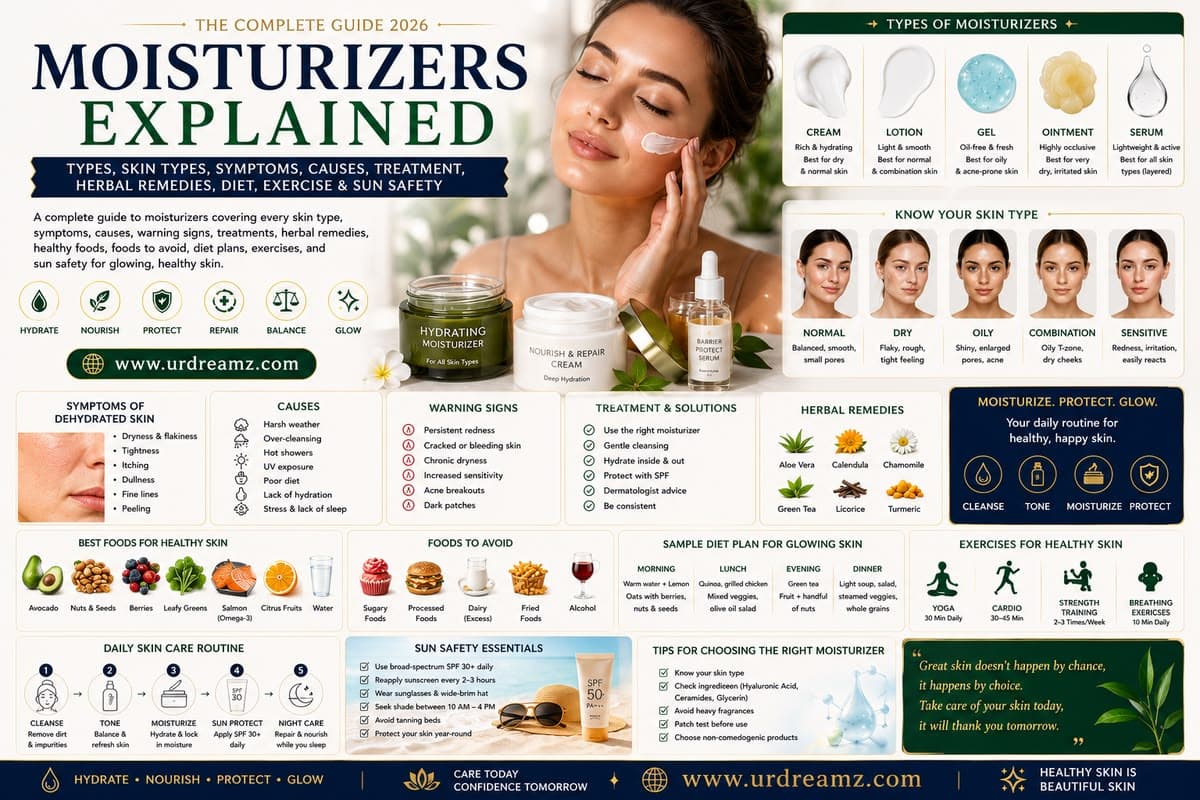
Moisturizers Explained: Types, Skin Types, Symptoms, Causes, Treatment, Herbal Remedies, Diet, Exercise & Sun Safety — The Complete Guide 2026
Moisturizer is one of the simplest skincare products, yet it is also one of the most misunderstood. Some people think it is only for dry skin, others believe it causes acne, and many skip it altogether because they do not understand how it actually works. This complete guide explains everything about moisturizers in plain language — what they are, how they work, which type suits which skin, and how food, exercise, and sun exposure connect to the health of your skin barrier.
Whether you are a complete beginner building your first skincare routine or someone who has struggled for years to find a product that actually agrees with your skin, this guide is designed to walk you through every stage of the decision-making process. We will cover the science of hydration, break down all four major skin types in detail, explain which ingredients matter and why, and go beyond the bathroom shelf to look at diet, exercise, and sun exposure — three lifestyle factors that quietly influence how your skin looks and feels every single day. By the end, you should be able to look at any moisturizer label and immediately understand whether it is right for your skin.
1. What Is a Moisturizer?
A moisturizer is a topical skincare product formulated to increase the water content of the outer layer of skin (the stratum corneum) and to reduce transepidermal water loss (TEWL), which is the natural process by which water evaporates from the skin into the air. Moisturizers are made from a combination of humectants, emollients, and occlusive agents that work together to attract water, smooth the skin surface, and seal moisture in.
Moisturizers are not a single product category — they include face creams, body lotions, gels, balms, ointments, and specialized barrier-repair formulas. Despite their different textures, all moisturizers share the same core goal: keeping the skin hydrated, soft, and protected from environmental stress.
The word "moisturizer" is sometimes used interchangeably with "emollient," but technically an emollient is only one of the three functional categories that make up a complete moisturizing formula. A well-designed moisturizer is really a small system of ingredients working together — some pulling water in, some softening the surface, and some sealing everything in place. This is why two products that both call themselves "moisturizer" can feel completely different on the skin, from a watery gel to a thick, balm-like cream.
2. Why Skin Needs Moisturizer
Skin is constantly losing water to the environment through evaporation. Factors such as hot weather, air conditioning, harsh cleansers, hot showers, wind, pollution, and aging all accelerate this water loss. When the skin loses more water than it can replace, the outer barrier becomes weak, leading to dryness, flakiness, irritation, premature fine lines, and increased sensitivity to external irritants.
Applying a moisturizer regularly helps to reinforce the skin barrier, lock in hydration, and protect against these daily stressors. A healthy, well-moisturized skin barrier also allows other skincare products such as serums and sunscreen to work more effectively, since damaged or dehydrated skin cannot properly absorb or hold onto active ingredients.
It is also worth noting that dehydration and dryness are not the same thing, even though they are often confused. Dry skin is a skin type — it lacks natural oils and tends to stay dry over the long term. Dehydrated skin, on the other hand, is a temporary condition caused by lack of water, and it can affect any skin type, including oily skin. This is exactly why oily skin can still feel tight or look dull despite producing plenty of oil; it may be dehydrated even though it is not technically dry. A good moisturizer addresses both the oil and water balance of the skin, which is why it remains essential regardless of your underlying skin type.
3. How Moisturizers Work
Moisturizers work through three main mechanisms, and understanding these helps you choose the right product for your skin.
| Mechanism | How It Works | Common Ingredients |
|---|---|---|
| Humectants | Draw water from the deeper layers of skin and from the air into the outer skin layer | Hyaluronic acid, glycerin, panthenol, honey |
| Emollients | Fill in the tiny gaps between skin cells, making the skin surface feel smooth and soft | Squalane, fatty acids, shea butter, ceramides |
| Occlusives | Form a protective film on top of the skin to slow down water evaporation | Petrolatum, mineral oil, dimethicone, beeswax |
Most well-formulated moisturizers combine all three categories so that the product hydrates, smooths, and seals the skin at the same time.
Think of the process in three simple steps: first, humectants act like tiny magnets, pulling water molecules toward the skin's surface from both the air and the deeper layers of skin. Second, emollients move into the microscopic cracks and rough patches between skin cells, smoothing the surface so it looks and feels softer almost immediately. Third, occlusives form a light film over the top of everything, acting like a lid on a jar to slow down the rate at which that hard-earned moisture escapes back into the air. Skipping any one of these three functions is usually why a moisturizer might feel hydrating for a moment but leave skin feeling dry again within an hour or two.
4. Types of Moisturizers
Moisturizers come in different textures designed for different skin needs and climates. Choosing the correct texture is often more important than the price of the product.
| Type | Texture | Best For |
|---|---|---|
| Gel Moisturizer | Lightweight, water-based, absorbs quickly | Oily and acne-prone skin, humid climates |
| Lotion Moisturizer | Medium weight, spreads easily | Normal and combination skin |
| Cream Moisturizer | Thicker, richer texture | Dry and mature skin, cold weather |
| Ointment Moisturizer | Very thick, highly occlusive | Extremely dry or cracked skin, eczema-prone skin |
| Oil-Based Moisturizer | Rich in fatty acids, heavier finish | Very dry skin, nighttime use |
| Water-Based Moisturizer | Light, hydrating, non-greasy | Oily skin, daytime use under makeup |
| Barrier Repair Moisturizer | Formulated with ceramides and fatty acids | Damaged or compromised skin barrier |
None of these formats is objectively "better" than the others — the right choice depends entirely on your skin type, the climate you live in, and the season. Someone with oily skin living in a hot, humid city will usually be happiest with a gel or water-based moisturizer that hydrates without adding extra oil, while someone with naturally dry skin in a cold, dry climate may need a rich cream or even an ointment to stay comfortable. Many people also switch textures seasonally, using a lighter lotion in summer and a heavier cream in winter, since the skin's needs change with the weather even if the underlying skin type stays the same.
4.1 Gel vs Cream vs Lotion: A Detailed Comparison
Among all moisturizer formats, gel, cream, and lotion are the three most commonly used, and people frequently ask which one is "best." The honest answer is that each format is built for a different purpose, and understanding the difference helps avoid a mismatch between product and skin.
Gel moisturizers are water-based and contain the least amount of oil, which is why they absorb almost instantly and leave no greasy residue. They are the go-to option for oily, acne-prone, and combination skin, especially in hot or humid weather, since they hydrate without adding shine. Cream moisturizers sit at the opposite end of the spectrum — they contain a higher percentage of oils and butters, giving them a thicker consistency that takes longer to absorb but provides deeper, longer-lasting hydration. This makes creams ideal for dry, very dry, or mature skin, and for cold or dry climates where the skin loses moisture quickly. Lotions fall in between the two, offering a lighter feel than cream but more richness than gel, which is why they tend to suit normal or combination skin that does not need the intensity of a cream nor the extreme lightness of a gel.
| Feature | Gel | Lotion | Cream |
|---|---|---|---|
| Oil Content | Very low | Moderate | High |
| Absorption Speed | Very fast | Fast to moderate | Slower |
| Best Season | Summer, humid climates | Spring, autumn | Winter, dry climates |
| Best Skin Type | Oily, acne-prone | Normal, combination | Dry, very dry, mature |
| Finish on Skin | Matte | Natural | Dewy or rich |
4.2 Sample Moisturizer Approach by Skin Type
To make the theory more practical, here is a general framework showing what kind of formula and key ingredients typically work well for each skin type. These are examples of the type of product to look for rather than endorsements of any single brand.
| Skin Type | Recommended Texture | Key Ingredients to Look For | Primary Benefit |
|---|---|---|---|
| Oily / Acne-Prone | Lightweight gel | Niacinamide, zinc, hyaluronic acid | Hydrates without adding shine, helps control excess oil |
| Dry / Very Dry | Rich cream | Ceramides, hyaluronic acid, glycerin, shea butter | Deep, long-lasting hydration and barrier repair |
| Combination | Balanced lotion | Hyaluronic acid, squalane, niacinamide | Balances oil and dryness without overloading either zone |
| Sensitive | Fragrance-free soothing cream | Ceramides, panthenol, madecassoside | Calms irritation and strengthens a weakened barrier |
| Normal | Lightweight daily cream | Hyaluronic acid, glycerin, aloe vera | Maintains balanced, healthy hydration |
A simple rule of thumb: always patch test a new product on a small area of skin first, and if you have particularly reactive or sensitive skin, favor fragrance-free formulas regardless of the texture you choose.
5. Understanding the Four Main Skin Types
Before choosing a moisturizer, it is essential to understand your skin type, because using the wrong product can worsen existing skin problems. Below is a detailed breakdown of the four main skin types, including their symptoms, causes, warning signs, and treatment options.
It is worth noting that skin type is not always fixed for life. Hormonal changes, age, climate, medication, and even stress levels can shift how your skin behaves over months or years. Someone who had oily, acne-prone skin as a teenager may find their skin becomes noticeably drier in their thirties or forties, which is why it helps to periodically reassess your skin type rather than assuming it will always match how it behaved in the past. Paying attention to how your skin feels through different seasons and life stages is one of the most reliable ways to keep your moisturizing routine effective over time.
5.1 Oily Skin
Definition: Oily skin produces excess sebum from overactive sebaceous glands, giving the skin a shiny appearance and larger-looking pores, particularly in the T-zone (forehead, nose, and chin).
| Category | Details |
|---|---|
| Symptoms | Persistent shine, enlarged pores, thicker skin texture, frequent blackheads and breakouts, makeup that slides off by midday |
| Causes | Genetics, hormonal fluctuations (especially androgens), humid climate, stress, using overly harsh or stripping cleansers that trigger rebound oil production |
| Warning Signs | Sudden increase in breakouts, painful cystic acne, skin that feels oily within an hour of washing, clogged pores turning into inflamed pimples |
| Treatment | Lightweight, oil-free, non-comedogenic gel or lotion moisturizers containing niacinamide and hyaluronic acid; gentle foaming or gel cleansers; avoiding over-washing which can worsen oil production |
Best Practices: People with oily skin often make the mistake of skipping moisturizer entirely, thinking it will make their skin oilier. In reality, this can backfire — when the skin senses dehydration, it can respond by producing even more oil to compensate, creating a frustrating cycle. Sticking to a consistent, lightweight moisturizing routine, along with blotting papers during the day rather than repeated washing, tends to keep oily skin far more balanced over time.
5.2 Dry Skin
Definition: Dry skin lacks sufficient natural oils and moisture, often resulting in a rough, tight, or flaky texture, especially after cleansing.
| Category | Details |
|---|---|
| Symptoms | Tightness after washing, visible flaking, rough patches, dull complexion, fine lines that appear more pronounced |
| Causes | Cold or dry weather, frequent hot showers, harsh soaps, aging skin producing less natural oil, certain medications, underlying conditions like hypothyroidism |
| Warning Signs | Cracking or bleeding skin, persistent itching, redness that does not fade, skin that feels raw or painful |
| Treatment | Rich cream or ointment moisturizers with ceramides, hyaluronic acid, and shea butter; avoiding hot water; applying moisturizer immediately after cleansing while skin is still damp |
Best Practices: Dry skin benefits enormously from the "damp skin" rule — applying moisturizer within a few minutes of washing the face, while the skin still holds some surface water, allows humectant ingredients to trap that water rather than starting from a completely dry surface. Layering a hydrating serum underneath a rich cream, and avoiding long hot showers that strip natural oils, can make a noticeable difference within just a couple of weeks.
5.3 Combination Skin
Definition: Combination skin has an oily T-zone alongside normal or dry cheeks, requiring a balanced approach to skincare.
| Category | Details |
|---|---|
| Symptoms | Shiny forehead, nose, and chin with normal or dry cheeks, occasional breakouts limited to the T-zone, uneven texture across the face |
| Causes | Genetics, uneven distribution of sebaceous glands, seasonal changes, using products formulated for only one skin type on the entire face |
| Warning Signs | Cheeks becoming increasingly flaky while T-zone remains oily, breakouts concentrated around the nose and chin |
| Treatment | Lightweight lotion moisturizers that balance hydration; multi-masking (different products for different zones); gel moisturizer on T-zone and richer cream on cheeks if needed |
Best Practices: Combination skin often confuses people because a single product rarely feels perfect everywhere. Rather than searching endlessly for one "miracle" moisturizer, many dermatologists suggest applying a lighter formula across the entire face and, if needed, layering a slightly richer product only on the drier cheek areas. This zone-based approach avoids over-hydrating the T-zone while still giving the cheeks the richness they need.
5.4 Sensitive Skin
Definition: Sensitive skin reacts easily to products, weather, or environmental triggers with redness, burning, or irritation.
| Category | Details |
|---|---|
| Symptoms | Redness, stinging or burning after product application, itchiness, visible capillaries, reactions to new products |
| Causes | Weakened skin barrier, fragrance or alcohol in products, over-exfoliation, underlying conditions such as rosacea or eczema, extreme weather changes |
| Warning Signs | Persistent burning sensation, swelling, rash that spreads, skin that reacts to almost every new product |
| Treatment | Fragrance-free, hypoallergenic moisturizers with soothing ingredients like aloe vera, oat extract, and panthenol; patch-testing new products; simplifying the skincare routine |
Best Practices: Sensitive skin generally does best with a minimal routine — fewer products, fewer active ingredients, and plenty of patch-testing before introducing anything new. Applying a small amount of a new moisturizer to the inner forearm for two to three days before using it on the face can help catch potential reactions early, before they affect a more visible area of skin.
5.5 Moisturizers for Special Groups: Men, Teenagers, and Mature Skin
Beyond the four core skin types, certain life stages and demographics have their own specific moisturizing needs.
Men's Skin: Male skin tends to be slightly thicker and oilier than female skin on average, partly due to higher testosterone levels, and it is also exposed to daily friction from shaving. Lightweight, oil-free moisturizers with soothing ingredients help calm post-shave irritation while controlling shine throughout the day.
Teenage Skin: Hormonal changes during adolescence often increase oil production, making many teenagers assume they should skip moisturizer altogether. In fact, a simple, oil-free, non-comedogenic moisturizer paired with a gentle cleanser is usually enough to keep teenage skin balanced without over-complicating the routine with too many products.
Mature Skin: As skin ages, natural oil production slows down and collagen production declines, making the skin thinner and more prone to dryness and fine lines. Richer moisturizers containing peptides, ceramides, and antioxidants like vitamin E can help support elasticity and softness in mature skin.
6. Key Moisturizing Ingredients
Reading an ingredient list can feel overwhelming, but most effective moisturizers rely on a fairly small set of well-studied ingredients. Understanding what each one does makes it much easier to compare products and predict how they will feel and perform on your specific skin.
| Ingredient | Function | Best Suited For |
|---|---|---|
| Hyaluronic Acid | Attracts and holds up to 1000 times its weight in water for a plump, dewy look | All skin types, especially dehydrated skin |
| Ceramides | Restore and reinforce the skin's natural protective barrier | Dry, sensitive, and barrier-damaged skin |
| Niacinamide | Regulates oil production, reduces redness, and strengthens the barrier | Oily, acne-prone, and sensitive skin |
| Glycerin | A powerful, affordable humectant that draws moisture into the skin | All skin types |
| Squalane | A lightweight emollient that mimics skin's natural oils | Combination and oily skin |
| Shea Butter | Rich in fatty acids, deeply nourishes and softens skin | Dry and very dry skin |
| Aloe Vera | Soothes irritation and provides light hydration | Sensitive and sun-exposed skin |
| Vitamin E | Antioxidant that supports skin repair and softness | Dry and mature skin |
| Peptides | Support collagen production and skin firmness | Mature skin |
| Panthenol (Pro-Vitamin B5) | Soothes, hydrates, and supports barrier repair | Sensitive and irritated skin |
6.1 Ingredients to Be Cautious With
Not every ingredient in a moisturizer is beneficial for every skin type. Some common additives can cause irritation, especially for sensitive or reactive skin, and it helps to know what to watch for on a label.
| Ingredient | Potential Concern | Who Should Be Cautious |
|---|---|---|
| Synthetic Fragrance | Common cause of irritation and allergic reactions | Sensitive and reactive skin |
| Denatured Alcohol | Can be drying and disrupt the skin barrier in high concentrations | Dry and sensitive skin |
| Certain Essential Oils | Can trigger irritation or photosensitivity | Sensitive skin, sun-exposed areas |
| Heavy Mineral Oils | May feel too occlusive and heavy for some skin types | Oily and acne-prone skin |
| Certain Silicones | Can create a barrier that some people feel traps sweat or oil | Acne-prone skin in humid climates |
6.2 Seasonal Moisturizing: Summer vs Winter
Skin needs are not static throughout the year. Humidity, temperature, and indoor heating or air conditioning all affect how much moisture your skin loses and how it should be replenished.
| Season | Skin Challenge | Recommended Approach |
|---|---|---|
| Summer | Increased sweat and oil production, humidity trapping heat against the skin | Lightweight gel or water-based moisturizers, oil-free formulas, daily SPF |
| Winter | Cold air, low humidity, and indoor heating strip moisture from the skin | Richer creams or ointments, barrier-repair ingredients like ceramides, lip and hand care |
| Monsoon / Humid Climates | Excess moisture in the air combined with sweat can clog pores | Non-comedogenic, lightweight formulas with oil-control ingredients like niacinamide |
| Dry, Arid Climates | Very low humidity accelerates water loss from skin | Layering a hydrating serum under a rich, occlusive moisturizer |
7. How to Choose the Right Moisturizer by Skin Type
Selecting a moisturizer is not just about brand popularity — it is about matching the formula to your skin's actual needs. Oily and acne-prone skin benefits most from oil-free, non-comedogenic gels with niacinamide. Dry and dehydrated skin needs richer creams with ceramides and hyaluronic acid. Combination skin does best with balanced, lightweight lotions, while sensitive skin requires fragrance-free, minimal-ingredient formulas. Mature skin benefits from moisturizers containing peptides and antioxidants to support elasticity, while teenage skin usually only needs a simple, oil-free daily moisturizer alongside a gentle cleanser.
Beyond skin type, it also helps to consider your specific goals. Someone primarily concerned with anti-aging might prioritize a moisturizer with peptides and antioxidants, while someone dealing with active breakouts might prioritize oil control and non-comedogenic labeling above all else. It is also perfectly reasonable to use different moisturizers for different times of day — a lighter, SPF-friendly formula in the morning and a richer, more reparative formula at night when the skin does most of its natural repair work.
7.1 Understanding Skin pH and Moisturizers
Healthy skin typically sits at a slightly acidic pH, generally between 4.5 and 5.5, which supports the skin's natural protective barrier and the beneficial bacteria that live on its surface. Harsh cleansers and some skincare products can temporarily disrupt this balance, making the skin more vulnerable to irritation and moisture loss. Choosing gentle, pH-balanced cleansers and moisturizers helps maintain this natural acidity, supporting the skin's own ability to stay hydrated and resilient over time.
7.2 Climate and Regional Skincare Considerations
Local climate plays a significant role in how your skin behaves and what kind of moisturizer it needs. In hot, humid regions, skin tends to produce more oil and sweat, which can make heavier creams feel uncomfortable and increase the likelihood of clogged pores — lightweight gels and water-based lotions with oil-control ingredients tend to work better in these conditions. In contrast, dry, dusty, or high-altitude climates strip moisture from the skin more aggressively, often requiring richer, more occlusive formulas along with extra attention to lip and hand care. Seasonal transitions, such as moving from a humid monsoon season into a drier winter, are a common time for people to notice their regular moisturizer suddenly feels either too heavy or not hydrating enough — a sign that it may be time to adjust texture rather than switch skincare brands entirely.
8. How to Apply Moisturizer Correctly
Moisturizer should generally be applied twice daily — once in the morning and once at night — on clean, slightly damp skin, which helps lock in extra hydration. The correct order in a skincare routine is: cleanser, treatment serums, moisturizer, and finally sunscreen during the day. At night, moisturizer is usually the last step unless a facial oil is used on top. A gentle upward, circular motion helps the product absorb evenly without tugging on the skin.
8.1 Step-by-Step Application Guide
| Step | Action | Purpose |
|---|---|---|
| 1 | Cleanse the face with a gentle cleanser suited to your skin type | Removes dirt, oil, and impurities without stripping the skin |
| 2 | Pat the skin partially dry, leaving it slightly damp | Prepares the skin to better absorb humectant ingredients |
| 3 | Apply any treatment serums first | Allows active ingredients to absorb directly into clean skin |
| 4 | Take a coin-sized amount of moisturizer | Provides enough product without overloading the skin |
| 5 | Warm the product between your palms briefly | Helps the product spread more evenly |
| 6 | Apply in gentle upward, outward strokes | Avoids unnecessary tugging on delicate facial skin |
| 7 | Allow a minute or two to absorb | Ensures the product settles before applying sunscreen or makeup |
| 8 | Apply sunscreen last (daytime only) | Protects the skin from UV damage on top of hydrated skin |
8.2 Layering Moisturizer with Serums and Active Ingredients
Many skincare routines today include active ingredients such as vitamin C, retinol, or exfoliating acids, and knowing where moisturizer fits in relation to these actives matters. As a general guideline, products are applied from the thinnest, most watery texture to the thickest: cleanser, toner (if used), water-based serums, treatment actives like retinol, moisturizer, and finally sunscreen during the day. Moisturizer applied after an active ingredient such as retinol can also help buffer potential irritation, which is sometimes referred to as "sandwiching" in skincare routines aimed at reducing sensitivity while still allowing the active ingredient to work.
8.3 Moisturizing for Eczema and Psoriasis-Prone Skin
Eczema (atopic dermatitis) and psoriasis are chronic skin conditions that involve a compromised skin barrier and increased water loss, making moisturizing an essential part of daily management alongside any treatment prescribed by a dermatologist. These conditions require a more careful, consistent approach than standard dry skin care.
| Condition | Key Characteristics | Moisturizing Approach |
|---|---|---|
| Eczema (Atopic Dermatitis) | Dry, itchy, inflamed patches; often triggered by allergens or irritants | Thick, fragrance-free ointments or creams with ceramides, applied immediately after bathing |
| Psoriasis | Thick, scaly patches caused by rapid skin cell turnover | Occlusive moisturizers to soften scales; avoiding fragranced or alcohol-based products |
For both conditions, moisturizer should be viewed as a supportive daily habit rather than a cure, and anyone with a diagnosed or suspected chronic skin condition should work with a dermatologist to build an appropriate, personalized treatment plan.
9. Common Moisturizer Mistakes
Even with the right product in hand, small habits around how and when moisturizer is applied can significantly affect how well it performs. The following are some of the most frequent mistakes people make, along with simple ways to correct them.
| Mistake | Why It's a Problem | Fix |
|---|---|---|
| Skipping moisturizer on oily skin | Can trigger the skin to overproduce oil to compensate | Use a lightweight, oil-free gel moisturizer daily |
| Applying to dry skin | Reduces absorption and effectiveness | Apply on slightly damp skin |
| Using the wrong texture for your climate | Heavy creams in humid weather can clog pores; light gels in dry winter may not be enough | Adjust texture seasonally |
| Over-moisturizing | Can lead to clogged pores and a greasy feel | Use an appropriate amount — a coin-sized portion is usually enough |
| Skipping sunscreen after moisturizer | Leaves skin unprotected from UV damage | Always follow daytime moisturizer with SPF |
| Using expired products | Reduced effectiveness and possible irritation | Check expiry dates and discard old products |
9.1 Skin Barrier Damage: Signs and Recovery Timeline
A damaged skin barrier is one of the most common underlying causes of persistent dryness, sensitivity, and irritation, often triggered by over-exfoliation, harsh products, excessive sun exposure, or environmental stress. Recognizing the signs early and giving the skin time to recover can prevent long-term sensitivity issues.
| Sign of Barrier Damage | What It Indicates | Recovery Approach |
|---|---|---|
| Persistent stinging with most products | Weakened barrier allowing irritants to penetrate more easily | Simplify routine to a gentle cleanser and barrier-repair moisturizer only |
| Tightness that does not improve with moisturizer | Barrier is not retaining applied moisture effectively | Switch to ceramide-rich, occlusive-heavy formulas |
| Increased redness or visible irritation | Inflammatory response to a compromised barrier | Pause active ingredients like acids and retinol temporarily |
| Rough or flaky texture despite regular moisturizing | Barrier lipids are depleted | Use fatty-acid and ceramide-based repair creams consistently |
| Breakouts alongside dryness | Barrier disruption affecting oil regulation | Avoid harsh cleansers; reintroduce actives slowly once calm |
Barrier recovery is generally not instant — most dermatologists suggest that visible improvement can take anywhere from two to six weeks of a consistent, gentle routine, depending on the severity of the damage and how well irritating products and habits are avoided during that period.
10. Herbal and Natural Remedies for Skin Hydration
Alongside commercial moisturizers, many natural ingredients have traditionally been used to support skin hydration and barrier health. These should complement, not replace, a proper skincare routine, and should always be patch-tested first, since natural does not automatically mean risk-free for every skin type.
Herbal and home-based remedies can be a helpful, low-cost addition to a routine, particularly for people who prefer simple, minimally processed ingredients or who want to soothe mild, temporary irritation. However, for ongoing skin conditions or persistent symptoms, these remedies should be used alongside — not instead of — proper skincare products and, where necessary, professional dermatological advice.
| Herbal Remedy | Traditional Use | How to Use |
|---|---|---|
| Aloe Vera Gel | Soothes irritation, provides light hydration | Apply fresh gel directly to clean skin |
| Coconut Oil | Deeply nourishes very dry skin | Apply a small amount at night on dry patches |
| Almond Oil | Softens and nourishes skin | Massage a few drops onto damp skin |
| Honey Mask | Natural humectant, soothing properties | Apply as a 10–15 minute mask, then rinse |
| Rose Water | Refreshes and mildly hydrates skin | Use as a toner before moisturizer |
| Oatmeal Paste | Calms irritated, sensitive skin | Apply as a gentle mask for 10 minutes |
| Cucumber Extract | Cooling and mildly hydrating | Apply chilled slices or juice to the skin |
| Green Tea Extract | Antioxidant support, calms redness | Use cooled tea as a facial rinse |
11. 15 Healthy Foods for Better Skin Hydration
Topical moisturizer works on the outermost layer of skin, but hydration and skin resilience also depend heavily on what you eat. A diet rich in healthy fats, antioxidants, and water-dense foods supports the skin's ability to retain moisture and repair itself from the inside out. The following foods are commonly associated with healthier, better-hydrated skin.
| # | Food | Skin Benefit |
|---|---|---|
| 1 | Avocado | Rich in healthy fats that support skin barrier function |
| 2 | Walnuts | Provide omega-3 fatty acids for skin softness |
| 3 | Cucumber | High water content supports overall hydration |
| 4 | Sweet Potatoes | Rich in beta-carotene, supports skin repair |
| 5 | Spinach | Packed with vitamins A and C for skin health |
| 6 | Oranges | High vitamin C content supports collagen production |
| 7 | Tomatoes | Contain lycopene, an antioxidant that protects skin |
| 8 | Salmon or Fish | Rich in omega-3s that strengthen the skin barrier |
| 9 | Yogurt | Probiotics support overall skin balance |
| 10 | Almonds | Vitamin E supports skin softness and repair |
| 11 | Green Tea | Antioxidants help protect against skin damage |
| 12 | Watermelon | High water content for natural hydration |
| 13 | Bell Peppers | Rich in vitamin C for a brighter complexion |
| 14 | Olive Oil | Healthy fats support skin softness |
| 15 | Chia Seeds | Omega-3s and fiber support skin health from within |
12. 15 Foods to Avoid for Healthier Skin
Just as certain foods support skin health, others may work against it, particularly when eaten in large or frequent amounts. These foods are not necessarily harmful in moderation, but consistently high intake has been associated with increased inflammation, dehydration, or breakouts in some individuals.
| # | Food | Why It May Affect Skin |
|---|---|---|
| 1 | Sugary sodas | May contribute to inflammation and breakouts |
| 2 | Deep-fried foods | Excess oil intake may worsen oily or acne-prone skin |
| 3 | White bread | High glycemic index may trigger breakouts in some people |
| 4 | Excess dairy | May trigger breakouts in acne-prone individuals |
| 5 | Processed snacks | High sodium can contribute to puffiness and dehydration |
| 6 | Candy and sweets | High sugar intake may accelerate skin aging |
| 7 | Alcohol | Dehydrates the skin and body |
| 8 | Excess caffeine | Can contribute to dehydration if not balanced with water |
| 9 | Instant noodles | High sodium and low nutrient content |
| 10 | Packaged chips | High in unhealthy fats and salt |
| 11 | Sugary cereals | High sugar content may affect skin clarity |
| 12 | Red processed meats | May contribute to inflammation when eaten in excess |
| 13 | Margarine | Contains trans fats that may affect skin health |
| 14 | Excess salt | Can lead to water retention and dull-looking skin |
| 15 | Energy drinks | High sugar and caffeine can dehydrate skin |
13. 15-Point Healthy Diet Plan for Glowing Skin
Rather than following any single extreme diet, most dermatologists and nutritionists agree that a consistent set of everyday habits does more for skin health than any short-term fix. The following fifteen points can be built gradually into a daily routine for long-term benefits.
| # | Diet Habit | Benefit |
|---|---|---|
| 1 | Drink at least 8 glasses of water daily | Supports overall skin hydration |
| 2 | Eat a variety of colorful fruits and vegetables | Provides antioxidants for skin protection |
| 3 | Include healthy fats like nuts and olive oil | Supports skin barrier strength |
| 4 | Add omega-3 rich foods weekly | Reduces inflammation, supports softness |
| 5 | Limit added sugar intake | May help reduce breakouts and premature aging |
| 6 | Choose whole grains over refined carbs | Supports stable blood sugar and skin clarity |
| 7 | Include probiotic foods like yogurt | Supports gut health, linked to skin balance |
| 8 | Eat protein with every meal | Supports collagen and tissue repair |
| 9 | Reduce processed food intake | Lowers inflammatory triggers |
| 10 | Add vitamin C rich foods daily | Supports collagen synthesis |
| 11 | Moderate caffeine and alcohol | Prevents excess dehydration |
| 12 | Include zinc-rich foods like pumpkin seeds | Supports skin healing |
| 13 | Eat green leafy vegetables regularly | Rich source of skin-supportive vitamins |
| 14 | Avoid late-night heavy meals | Supports better sleep, which aids skin repair |
| 15 | Maintain consistent meal timing | Supports overall hormonal balance affecting skin |
14. 15 Exercises That Support Healthy Skin
Physical activity benefits the skin primarily through improved blood circulation, which helps deliver oxygen and nutrients to skin cells while supporting the removal of waste products. Exercise also helps regulate stress hormones like cortisol, which, when chronically elevated, can contribute to increased oil production and breakouts. The following exercises are all accessible ways to support both general health and skin appearance.
| # | Exercise | Skin-Related Benefit |
|---|---|---|
| 1 | Brisk walking | Improves blood circulation to the skin |
| 2 | Jogging | Boosts oxygen delivery for a healthy glow |
| 3 | Yoga | Reduces stress hormones linked to breakouts |
| 4 | Cycling | Improves cardiovascular health and circulation |
| 5 | Swimming | Full-body circulation boost (rinse skin after chlorine exposure) |
| 6 | Facial yoga | May support facial muscle tone |
| 7 | Stretching routines | Reduces tension that can contribute to stress-related skin issues |
| 8 | Deep breathing exercises | Lowers cortisol, which can affect oil production |
| 9 | Strength training | Supports healthy metabolism and circulation |
| 10 | Dancing | Cardio benefit that boosts circulation and mood |
| 11 | Pilates | Improves posture and circulation |
| 12 | Hiking | Combines cardio with fresh air exposure |
| 13 | Skipping rope | Quick cardio boost for circulation |
| 14 | Meditation | Reduces stress-related skin flare-ups |
| 15 | Stair climbing | Simple daily cardio for better blood flow |
Note: After sweating from exercise, always cleanse the skin and reapply moisturizer, since sweat left on the skin for long periods can sometimes contribute to irritation or clogged pores.
15. Sun Safety and Moisturizer
Sun exposure is one of the biggest contributors to skin dehydration and premature aging. Moisturizer alone does not protect the skin from UV rays, which is why sunscreen must always be applied as a separate, final step in the daytime routine, after moisturizer has been absorbed.
Ultraviolet radiation damages collagen fibers, accelerates the breakdown of the skin's natural moisture barrier, and increases transepidermal water loss, which is why sun-exposed skin often feels drier and rougher than protected skin, even in the same climate. Consistent sun protection is, in many ways, one of the most effective long-term "anti-aging" and hydration strategies available, often more impactful than any single moisturizer ingredient.
| Sun Safety Tip | Why It Matters |
|---|---|
| Apply broad-spectrum SPF 30 or higher daily | Protects against both UVA and UVB rays, which accelerate water loss and aging |
| Reapply sunscreen every 2–3 hours outdoors | Sunscreen effectiveness decreases over time and with sweat |
| Use a hydrating moisturizer before SPF | Prevents sunscreen from settling into dry, flaky patches |
| Wear protective clothing and hats | Reduces direct UV exposure to the skin |
| Seek shade during peak sun hours | Limits cumulative UV damage |
| Moisturize after sun exposure | Helps replenish water lost through heat and UV exposure |
16. Moisturizer Myths vs Facts
| Myth | Fact |
|---|---|
| Oily skin does not need moisturizer | All skin types, including oily skin, need hydration to maintain a balanced barrier |
| Expensive moisturizers always work better | Effectiveness depends on formulation and ingredients, not price alone |
| Moisturizer causes acne | Non-comedogenic moisturizers do not clog pores; the wrong heavy formula might |
| You only need moisturizer in winter | Skin loses moisture year-round, including in air-conditioned environments |
| Natural ingredients are always safer | Natural ingredients can still cause irritation or allergic reactions |
| More product means better hydration | Using excess product can clog pores without improving hydration |
16.1 Natural vs Synthetic Moisturizing Ingredients
A common debate in skincare is whether natural or synthetic ingredients are more effective. In reality, both categories include highly effective and well-studied ingredients, and the best choice usually comes down to individual skin tolerance rather than the ingredient's origin alone.
| Aspect | Natural Ingredients | Synthetic / Lab-Made Ingredients |
|---|---|---|
| Examples | Shea butter, aloe vera, coconut oil, honey | Hyaluronic acid, glycerin, dimethicone, panthenol |
| Consistency | Can vary batch to batch depending on source | Highly consistent formulation and concentration |
| Irritation Risk | Can still trigger allergies, especially with added fragrance | Generally well-tolerated when properly formulated |
| Research Backing | Some ingredients have long traditional use but limited clinical data | Often extensively studied and clinically tested |
Ultimately, an ingredient's safety and effectiveness depend more on proper formulation and concentration than on whether it is labeled "natural" or "synthetic," and both categories can play a valuable role in a well-rounded skincare routine.
16.2 Sample Morning and Night Routine Templates
Putting everything together, here are simplified routine templates for each major skin type. These are starting points that can be adjusted based on personal preference and how your skin responds over time.
| Skin Type | Morning Routine | Night Routine |
|---|---|---|
| Oily / Acne-Prone | Gel cleanser, oil-free gel moisturizer, oil-free sunscreen | Gel cleanser, treatment serum (if used), lightweight gel moisturizer |
| Dry / Very Dry | Cream cleanser, hydrating serum, rich cream moisturizer, sunscreen | Cream cleanser, hydrating serum, rich cream or ointment moisturizer |
| Combination | Gentle cleanser, balancing lotion, sunscreen | Gentle cleanser, treatment serum, lightweight lotion moisturizer |
| Sensitive | Fragrance-free cleanser, soothing moisturizer, mineral sunscreen | Fragrance-free cleanser, soothing barrier-repair moisturizer |
Consistency matters more than complexity — a simple two-step routine followed daily will generally outperform an elaborate ten-step routine that is only followed occasionally.
16.3 Budget vs Luxury Moisturizers: Does Price Matter?
One of the most persistent questions in skincare is whether expensive moisturizers actually work better than affordable, drugstore options. The honest answer is that price is not a reliable indicator of effectiveness. What matters far more is the actual ingredient list, the concentration of active ingredients, and how well a formula suits your specific skin type.
| Factor | Budget Moisturizers | Luxury Moisturizers |
|---|---|---|
| Core Ingredients | Often use the same well-studied humectants and emollients | May include the same core ingredients plus additional specialty extracts |
| Packaging and Branding | Simpler packaging, lower marketing costs | Elevated packaging and marketing contribute significantly to price |
| Fragrance and Sensory Experience | Varies widely | Often more refined texture and scent, though not necessarily better for skin health |
| Value for Money | Frequently excellent, especially for basic hydration needs | Can be worthwhile for specific advanced actives or personal preference |
For most people, an affordable moisturizer with a well-formulated, evidence-backed ingredient list will perform just as effectively as a significantly more expensive alternative. Luxury products can still be a worthwhile personal choice for texture, scent, or specific specialty ingredients, but they are rarely a necessity for healthy, well-hydrated skin.
16.4 Quick Glossary of Moisturizer Terms
Skincare labels often use technical terms that are not always explained clearly. This quick glossary covers some of the most common terms you will encounter while shopping for a moisturizer.
| Term | Meaning |
|---|---|
| Non-comedogenic | Formulated to avoid clogging pores |
| Hypoallergenic | Formulated to minimize the risk of allergic reaction |
| Barrier Repair | Designed to restore the skin's natural protective outer layer |
| Oil-Free | Contains no added oils, often preferred for oily or acne-prone skin |
| Dermatologically Tested | Product has been evaluated by dermatologists for skin tolerance |
| Broad-Spectrum (SPF products) | Protects against both UVA and UVB rays |
| Fragrance-Free | Contains no added fragrance ingredients, including masking fragrances |
| Patch Test | Applying a small amount of product to a discreet area to check for reactions before full use |
Keeping these basic terms in mind can make it much easier to compare products at a glance, without needing to research every single brand or read lengthy ingredient breakdowns each time you shop for a new moisturizer.
17. Frequently Asked Questions (FAQs)
What is a moisturizer?
A moisturizer is a skincare product formulated to hydrate the skin and reduce water loss by combining humectants, emollients, and occlusive ingredients. It comes in many forms, from lightweight gels to rich creams, and is considered a foundational step in nearly every skincare routine.
Is moisturizer necessary every day?
Yes, daily moisturizing helps maintain a healthy skin barrier, regardless of skin type or season. Skipping it regularly can leave the skin more vulnerable to dryness, irritation, and premature signs of aging over time.
Should oily skin use moisturizer?
Yes, oily skin should use a lightweight, oil-free, non-comedogenic moisturizer to maintain balance and prevent the skin from overproducing oil. Skipping moisturizer entirely can actually make oiliness worse by triggering a compensatory increase in sebum production.
What is the best moisturizer for dry skin?
Rich cream or ointment moisturizers containing ceramides, hyaluronic acid, and shea butter work best for dry skin. Applying them immediately after cleansing, while the skin is still slightly damp, further improves how much moisture the product can lock in.
Can moisturizer cause acne?
A poorly matched, heavy, or comedogenic moisturizer can contribute to clogged pores, but a non-comedogenic formula generally does not cause acne. Choosing an oil-free, lightweight option is usually the safest approach for acne-prone skin.
Should moisturizer be applied before or after sunscreen?
Moisturizer should always be applied before sunscreen, once it has fully absorbed into the skin. Applying sunscreen last ensures it forms an even, unbroken layer of protection on top of the skin.
How often should I moisturize my face?
Most people benefit from moisturizing twice daily — once in the morning and once at night. Those with very dry skin or living in harsh climates may benefit from an additional application during the day.
Can moisturizer make skin glow?
Well-hydrated skin reflects light more evenly, which can create a natural, healthy-looking glow. This effect is temporary and depends on consistent, ongoing hydration rather than a single application.
What is a non-comedogenic moisturizer?
It is a moisturizer specifically formulated to avoid clogging pores, making it suitable for oily and acne-prone skin. Not all non-comedogenic products are labeled clearly, so checking the ingredient list for heavy oils can also help.
Is fragrance-free moisturizer better for sensitive skin?
Yes, fragrance can be irritating for sensitive or reactive skin, so fragrance-free formulas are usually recommended. This includes both synthetic fragrance and some essential oils, which can also trigger reactions in sensitive individuals.
Can I use body lotion as a face moisturizer?
It is not generally recommended, since body lotions are formulated differently and may be too heavy or contain ingredients unsuitable for facial skin. Facial skin is typically thinner and more sensitive than body skin, so it benefits from products formulated specifically for the face.
What is the correct skincare routine order?
The general order is: cleanser, treatment serums, moisturizer, and sunscreen during the day. At night, the same order applies but without the sunscreen step, since it is only needed during daylight hours.
Can moisturizer help with a damaged skin barrier?
Yes, barrier-repair moisturizers containing ceramides and fatty acids can help restore a compromised skin barrier over time. Consistency is key, since barrier repair is usually a gradual process rather than an overnight fix.
Is gel moisturizer better for oily skin?
Yes, gel moisturizers are lightweight, water-based, and absorb quickly, making them well suited for oily and acne-prone skin. They provide hydration without adding the extra oil that heavier creams might introduce.
How much moisturizer should I use?
A coin-sized amount is generally enough for the face; using more than necessary does not improve hydration and can feel greasy. Applying a thinner layer more consistently tends to work better than applying a thick layer occasionally.
Can moisturizer reduce redness?
Soothing moisturizers with ingredients like aloe vera, panthenol, or niacinamide can help calm mild redness over time. For persistent or severe redness, it is best to consult a dermatologist, since it may indicate an underlying condition.
What ingredients should sensitive skin avoid?
Sensitive skin should generally avoid added fragrance, alcohol, and harsh exfoliating acids in moisturizers. Introducing one new product at a time also makes it easier to identify the cause if irritation does occur.
Does diet affect skin hydration?
Yes, adequate water intake and a balanced diet rich in healthy fats and antioxidants support the skin's ability to retain moisture. While diet alone cannot replace topical moisturizer, the two work together to support overall skin health.
Can exercise improve skin health?
Regular exercise improves blood circulation, which helps deliver oxygen and nutrients to the skin, supporting a healthier appearance. It may also help regulate stress hormones that can otherwise contribute to breakouts and irritation.
Is sunscreen necessary if I already use moisturizer?
Yes, moisturizer does not protect against UV rays, so a separate sunscreen is essential during the day.
What is the difference between a humectant and an occlusive?
A humectant draws water into the skin, while an occlusive forms a protective layer on top of the skin to prevent that water from evaporating.
Can men and women use the same moisturizer?
Yes, the ingredients that matter are based on skin type and concern rather than gender, although some products are marketed differently for men and women.
Do teenagers need a separate moisturizer from adults?
Teenagers generally do well with a simple, lightweight, oil-free moisturizer, while adults may need additional targeted ingredients depending on their specific skin concerns.
What is the 3-minute moisturizer rule?
It refers to applying moisturizer within about three minutes of washing your face, while the skin is still slightly damp, to help lock in extra moisture.
Can diet really affect how hydrated my skin looks?
Yes, adequate water intake along with a diet rich in healthy fats and antioxidants supports the skin's natural ability to stay hydrated and resilient.
Should I change my moisturizer with the seasons?
Many people benefit from using a lighter formula in summer and a richer one in winter, since the skin's hydration needs shift with temperature and humidity.
Can over-exercising or sweating affect my skin?
Excess sweat left on the skin for long periods can sometimes contribute to irritation or clogged pores, so cleansing after a workout is recommended.
Is it normal for a new moisturizer to take time to show results?
Yes, it typically takes a few weeks of consistent use before the full benefits of a new moisturizer become noticeable.
What is transepidermal water loss (TEWL)?
TEWL is the natural process by which water evaporates from the deeper layers of skin through the outer layer into the surrounding air.
How do I know if my skin barrier is damaged?
Common signs include persistent stinging with most products, tightness that does not improve with moisturizer, ongoing redness, and rough or flaky texture despite regular moisturizing.
Is it okay to use a face moisturizer on my body?
It can generally be used, but body moisturizers are often formulated to be more cost-effective for covering larger areas, while face moisturizers are formulated for more delicate facial skin.
Why does my skin feel oily but still look dull or tight?
This is usually a sign of dehydration rather than dryness — the skin can be producing plenty of oil while still lacking sufficient water content.
Can moisturizer help with fine lines?
Well-hydrated skin can appear plumper and smoother, which may temporarily reduce the visibility of fine lines caused by dehydration, though it does not replace targeted anti-aging ingredients.
Should I apply moisturizer around my eyes?
Many people use a separate, gentler eye cream for this delicate area, since the skin around the eyes is thinner and may react differently to a regular facial moisturizer. If a dedicated eye cream is not available, a small amount of your regular moisturizer applied gently can still be better than skipping the area entirely.
Can I skip moisturizer if my skin already feels hydrated?
Even if skin feels comfortable at a given moment, regular moisturizing still helps maintain the barrier over time and prevents the gradual moisture loss that happens throughout the day due to weather, indoor air, and daily activities.
Conclusion
Moisturizer is far more than a luxury step in a skincare routine — it is a foundational tool for maintaining a healthy, functional skin barrier. Understanding your skin type, whether oily, dry, combination, or sensitive, allows you to choose the right texture and ingredients rather than relying on trial and error. Beyond topical products, hydration is also supported from within through a balanced diet rich in healthy fats and antioxidants, regular physical activity that improves circulation, and consistent sun protection that prevents unnecessary water loss and premature aging.
There is no single "best" moisturizer that works for everyone, because skin needs shift with climate, season, age, hormones, and lifestyle. The most reliable approach is to start with the basics — identify your skin type, choose a texture and set of ingredients suited to that type, and pay attention to how your skin responds over several weeks rather than expecting overnight results. Pair this with sensible daily habits: enough water, a reasonably balanced diet, some form of regular movement, and consistent sun protection.
If you ever feel unsure about a persistent skin concern, whether it is ongoing dryness, unexplained breakouts, or irritation that does not improve with a gentler routine, it is always worth consulting a dermatologist rather than relying solely on trial and error. Professional guidance, combined with the fundamentals covered in this guide, gives you the best chance of building a routine that keeps your skin comfortable, protected, and healthy for the long term.
By combining the right moisturizer with healthy daily habits, anyone can work toward softer, more resilient, and naturally healthier-looking skin over time. Skincare does not need to be complicated or expensive to be effective — consistency, patience, and choosing products suited to your actual skin type will almost always outperform an ever-changing routine built around trends alone.