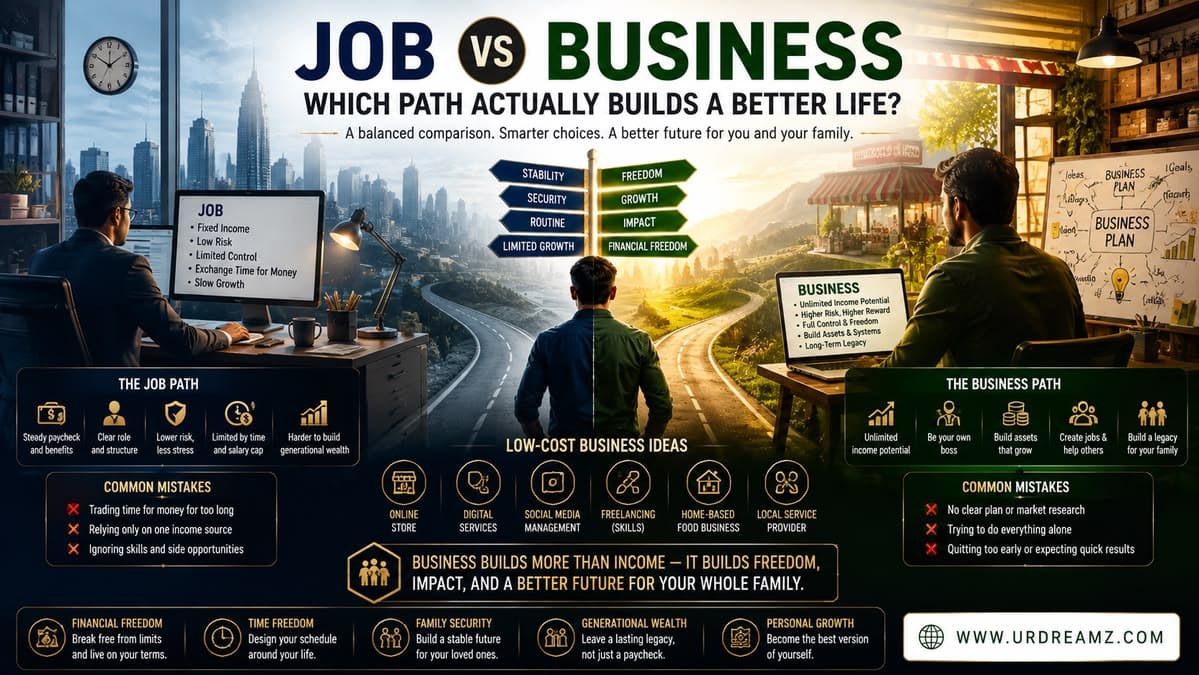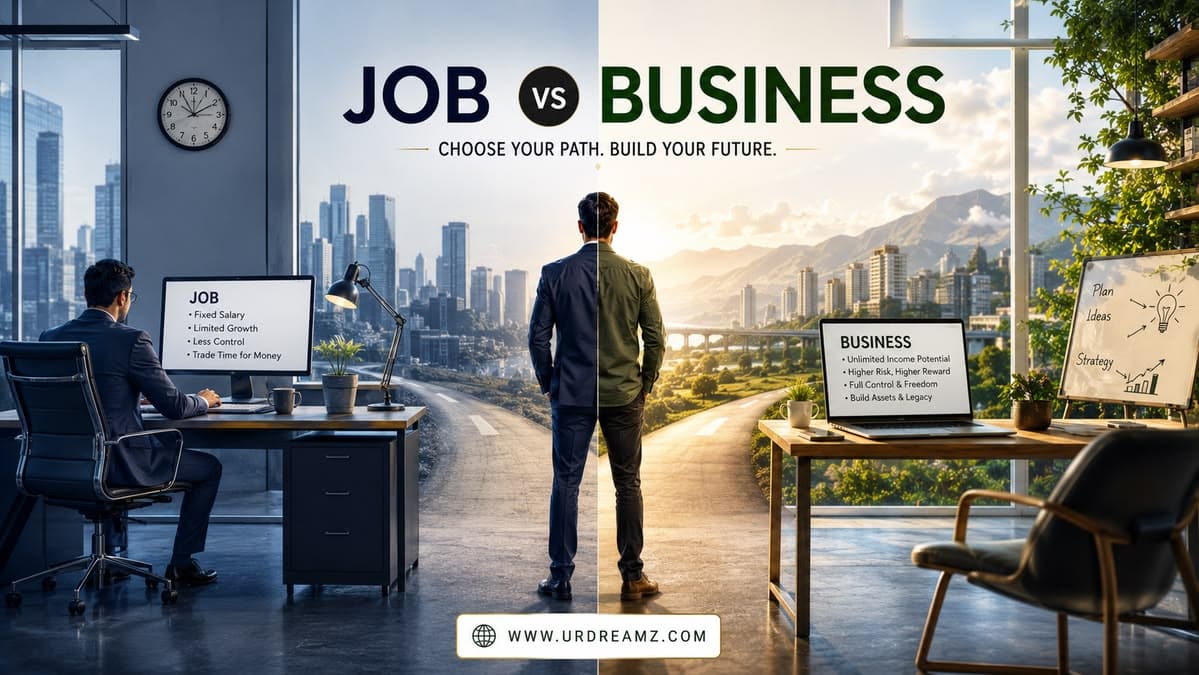
Job vs Business: Which Path Actually Builds a Better Life?
Almost everyone, at some point in their life, sits down and asks themselves the same question: should I take a job, or should I build a business? It is one of the oldest debates in the working world, and honestly, there is no single right answer that fits everyone. From what I have seen and heard over the years, opinions on this topic are split almost evenly. Roughly half the people you talk to will swear that a stable job is the smarter, safer choice, while the other half will insist that nothing beats the freedom and potential of running your own business. Both sides have valid points, and both sides have people who have proven their approach works. This article is going to walk through the entire debate in detail, but I want to be upfront about something: while I will give a fair and balanced view of jobs, I am going to spend a little extra time exploring business, because in my opinion, business tends to open doors that a job simply cannot.
The Common Belief Around Jobs
A large number of ordinary people, especially in South Asian households, grow up believing that a government job, or any stable salaried position, is the safest bet in life. The thinking usually goes something like this: if the economy takes a hit, if you fall sick, or if you grow older and less capable of working long hours, a job still keeps paying you. Government positions in particular come with pensions, medical coverage, and a fixed monthly paycheck that lands in your account whether the country is going through a boom or a recession. This sense of security is not imaginary. It is very real, and it explains why so many families push their children toward stable employment rather than risky ventures.
There is also an emotional comfort that comes with a job. You know exactly what is expected of you, you know when your shift starts and ends, and you know that at the end of the month, a certain amount of money will appear in your bank account regardless of how the broader market performed. For people who value predictability over excitement, this structure feels like a warm blanket rather than a limitation.
The Common Belief Around Business
On the other side of the debate are people who see business as the only real path to lasting financial freedom. Their argument usually centers on one key idea: a job pays you for your time, but a business pays you for the value you create, and value has no ceiling. If you are healthy, energetic, and willing to put in the work, a business can grow far beyond what any salary could ever offer. There is no manager capping your bonus, no fixed pay scale limiting your raise, and no waiting years for a promotion that may or may not come.
People who lean toward business also tend to value independence deeply. They want to be the one making decisions, choosing their own hours, and shaping their own future instead of following someone else's instructions all day. For them, the uncertainty of business is a fair trade for the control it brings.
A Fifty-Fifty Debate With No Universal Winner
Here is the honest truth: neither side is completely right, and neither side is completely wrong. If you polled a hundred working professionals, you would likely find close to fifty of them defending jobs passionately, and the other fifty defending business just as passionately. This split exists because the right choice depends heavily on a person's personality, their financial situation, their family responsibilities, their tolerance for risk, and the stage of life they are currently in. A twenty-two-year-old fresh graduate with no dependents can afford to take chances that a forty-five-year-old with three children and a mortgage simply cannot. So instead of declaring one option universally superior, it makes more sense to break down exactly what each path offers, and let the details speak for themselves.
Health, Age, and the Safety Net a Job Provides
One argument that comes up constantly in favor of jobs, especially government jobs, revolves around health and old age. If you get sick, injured, or simply grow older and less capable of intense physical or mental work, a salaried position tends to keep supporting you. Many organizations offer paid sick leave, medical insurance, and eventually, pension plans that continue paying you even after you stop actively working. This is a huge deal for people who are risk-averse or who do not have a large financial cushion to fall back on if things go wrong.
Business, by contrast, generally rewards active involvement. If you are healthy and able to put in the hours, a business can generate strong returns. But if illness or age slows you down and there is nobody else running things in your absence, the income can slow down right along with you. This is a genuine concern, and it is exactly why some business owners eventually build teams and systems specifically so the business does not collapse the moment they step back.
Why a Job Feeds One Person, But a Business Can Feed a Whole Family
This is where I want to share a thought that I believe captures the real difference between these two paths better than almost anything else. A job, at its core, pays one individual for their labor. Your salary is tied to you personally showing up, doing your assigned tasks, and putting in your hours. If you are not there, the income stops. It supports you, and through you, it supports your household, but the income generation itself begins and ends with one person.
A business works completely differently. When you build a business, you are not just creating income for yourself. You are creating an entity that can employ your spouse, involve your children as they grow older, provide work for extended family members, and eventually continue running even when you are not personally present every single day. A well-structured business becomes something bigger than any one individual. It becomes a shared family asset, a source of income for multiple people at once, and something that can be passed down to the next generation. This is, in my opinion, one of the strongest arguments in favor of business over a job. A job sustains a person. A business, done right, can sustain an entire family for generations.
Understanding What a Job Really Is
Before going further, it helps to define these two terms clearly in plain language. A job is an arrangement where you offer your time, skills, and effort to an employer, and in exchange, that employer pays you a fixed wage or salary. You typically work set hours, follow rules and procedures established by someone else, and your income does not usually change dramatically from month to month unless you get a raise or a promotion. Your responsibilities are generally limited to the specific role you were hired for, and once your shift ends, the responsibility for the overall success of the company technically shifts back to the ownership and management above you.
Understanding What a Business Really Is
A business, on the other hand, is an enterprise that you create, own, and operate with the goal of generating profit by offering a product or a service to customers. Instead of trading fixed hours for a fixed paycheck, you are taking on the responsibility of building something from the ground up, managing every moving part yourself, and earning whatever profit remains after covering all your costs. There is no guaranteed paycheck. Some months might bring incredible profit, while others might barely cover expenses. But over time, as the business grows and matures, the earning potential can far exceed what any single salary could offer.
Comparing Income and Financial Growth
When it comes to money, jobs and businesses operate on completely different systems. A job typically comes with a fixed monthly or hourly wage. You know exactly how much you are going to earn before the month even begins, and that number generally only changes through annual raises, bonuses, or a change in position. This predictability is comforting, but it also means your income growth tends to be slow and incremental, often tied to how long you have been with a company rather than how much value you personally generate.
A business, in contrast, has no built-in ceiling. Your income is directly tied to how well the business performs, how efficiently it operates, and how much value it delivers to its customers. This means a business can, in theory, generate far more income than any job ever could, especially once it scales beyond what a single person could earn through hourly labor. Of course, this also means income can dip lower than a fixed salary during slow periods, which is the trade-off that comes with unlimited upside.
Comparing Risk and Financial Exposure
Risk is one of the biggest differentiators between these two paths. With a job, your financial risk is relatively low. Even if the company you work for has a difficult month or quarter, you still receive your agreed-upon salary, as long as the company remains solvent and you remain employed. The worst-case scenario for most employees is losing their job, which is serious, but it does not typically involve losing personal savings or going into debt.
Business carries a much higher level of financial risk. You might invest your own savings, take out loans, or bring in outside investment to get started, and there is no guarantee that any of it will pay off. Markets shift, customer preferences change, and competitors emerge. A business owner can lose money, especially in the early stages, and in worst-case scenarios, can end up in significant debt if the venture fails. This is exactly why business is often described as a high-risk, high-reward path, while a job is considered comparatively low-risk with a lower, but steadier, reward.
Comparing Investment and Startup Requirements
Starting a job typically requires very little upfront financial investment. You need your education, your skills, and perhaps some money spent on interview preparation or transportation to reach your workplace. Beyond that, employers provide the tools, resources, and infrastructure needed to do your work.
Starting a business is a completely different story. Depending on the type of business, you might need capital for inventory, equipment, a physical location, licenses, marketing, and countless other startup costs. Even relatively low-cost businesses require some investment of either money, time, or both. This barrier to entry is one of the main reasons many people choose the safer route of employment instead of taking the leap into entrepreneurship, even if they secretly wish they had the resources or courage to start something of their own.
Comparing Control and Decision-Making Power
In a job, decisions are largely made above you. Your manager, your department head, or the company's leadership sets the rules, the policies, the working hours, and the overall direction of the organization. As an employee, your role is generally to execute tasks within the framework that has already been decided for you. Even in senior positions, there is almost always someone above you who has the final say.
In a business, you are the one making the decisions. You choose the direction of the company, the products or services you offer, the people you hire, the prices you set, and the overall strategy you pursue. This level of control is incredibly appealing to people who have strong opinions about how things should be done and who feel frustrated when they have to follow someone else's vision instead of their own. Of course, with that control comes full responsibility for the outcomes, good or bad.
Comparing Work Hours and Personal Time
Jobs generally come with defined working hours. Whether it is a standard nine-to-five schedule or a rotating shift pattern, employees typically know when their workday begins and ends, and once they clock out, their time belongs to them again. This makes it easier to separate professional responsibilities from personal life, plan vacations, and maintain a predictable routine.
Business ownership rarely respects such clean boundaries, especially in the early stages. Entrepreneurs often find themselves thinking about their business at all hours, handling emergencies outside of normal working hours, and sacrificing weekends or holidays to keep things running smoothly. Over time, as systems and teams are built, this can improve, but in the beginning, running a business often means your work and your personal life blend together in ways a traditional job rarely does.
Comparing Responsibility and Accountability
An employee is typically responsible for their specific role and the tasks assigned to them. If something goes wrong outside of their department or their direct responsibilities, it usually falls on someone else to address it. This narrower scope of responsibility can reduce stress, since employees are not expected to worry about every single aspect of the company's performance.
A business owner, however, is responsible for everything. Sales, marketing, staffing, finances, customer complaints, legal compliance, and every other moving part of the operation ultimately falls on the owner's shoulders. There is no passing the blame to another department when something goes wrong, because in a small or growing business, the owner often is every department at once, at least until the business grows large enough to hire specialists for each function.
Comparing Skill Development
Jobs often allow employees to specialize deeply in one particular skill set. If you are a software developer, you focus on writing and improving code. If you are an accountant, you focus on managing numbers and financial records. This specialization can make you highly skilled and valuable within your specific field, but it can also limit your exposure to other important business skills.
Running a business, on the other hand, forces you to develop a much broader range of skills almost by necessity. You need to understand marketing well enough to attract customers, finance well enough to manage cash flow, leadership well enough to manage a team, and problem-solving well enough to handle the countless unexpected challenges that come up. This constant, forced learning is one of the reasons many entrepreneurs describe running a business as one of the fastest ways to grow personally, even when it is difficult.
Comparing Benefits and Safety Nets
Traditional employment often comes with built-in safety nets that many people take for granted until they no longer have them. Paid time off, health insurance, retirement contributions, and sometimes even life insurance are commonly provided by employers, particularly at larger, more established companies. These benefits add real financial value on top of the base salary, even if they are not always immediately obvious.
Business owners have to build these safety nets themselves. There is no employer contributing to a retirement fund on your behalf, no automatic health coverage, and no guaranteed paid vacation. Everything from insurance to savings for slow periods has to be planned and funded independently, which adds another layer of responsibility that employees rarely have to think about.
Comparing Stress and Mental Wellbeing
Both paths come with their own version of stress, but the nature of that stress tends to differ. Job-related stress often comes from workplace pressures such as tight deadlines, difficult managers, office politics, or job insecurity during layoffs. However, once the workday ends, most employees can genuinely disconnect, at least to some degree.
Business-related stress tends to be more constant and pervasive. Because the success of the entire operation depends on the owner's decisions and effort, it can be difficult to fully switch off, even during time meant for rest. Financial uncertainty, especially in the early years, can weigh heavily on a business owner's mind. That said, many entrepreneurs report that once their business stabilizes and becomes profitable, this stress is often replaced by a strong sense of purpose and satisfaction that comes from building something entirely their own.
Self-Employed Versus True Business Owner
There is an important distinction that often gets overlooked in this entire conversation: the difference between being self-employed and truly owning a scalable business. A self-employed person is essentially trading their own time for money, just like an employee, except they answer to clients instead of a boss. They typically work inside the business, handling daily tasks personally, and their income is capped by how much time and effort they personally can put in. If they stop working, the income generally stops too.
A true business owner operates differently. Instead of working inside the business doing every task themselves, they work on the business, focusing on strategy, systems, and growth. They build teams, delegate responsibilities, and create processes that allow the business to function and generate income even without their constant, hands-on involvement. This is the real difference between owning a job you created for yourself and owning an actual business asset. The goal for most serious entrepreneurs is to eventually transition from being self-employed into being a true business owner, where the business runs on systems and people rather than depending entirely on one individual's daily labor.
Daily Habits That Support Long-Term Business Success
Building a successful business is rarely about one big lucky break. It usually comes down to consistent daily habits practiced over a long period of time. Successful business owners tend to start their day with a clear plan, identifying the most important tasks that will actually move the business forward rather than getting lost in busywork. They focus their energy on high-impact priorities instead of getting distracted by less important tasks that feel productive but do not actually contribute much to growth.
Time management plays a huge role as well. Business owners who manage their time wisely tend to experience less stress and higher productivity than those who let their days become chaotic and reactive. Continuous learning is another common trait among successful entrepreneurs. They make a habit of learning something new regularly, whether it is a new skill, a new industry trend, or a lesson from a mistake, because this constant learning keeps them sharp and ahead of competitors who stop improving.
Relationship building is equally important. Successful business owners understand that strong connections with clients, mentors, employees, and even competitors can open doors that skill alone cannot. Tracking progress toward goals on a regular basis, communicating clearly with teams and clients, and keeping a close eye on finances round out the daily habits that separate businesses that thrive from businesses that quietly struggle and eventually fail.
Common Mistakes That Hold Businesses Back
Just as there are habits that support success, there are recurring mistakes that tend to hold businesses back, and recognizing them early can save an enormous amount of time, money, and frustration. Many new business owners start without a clear plan, jumping straight into operations without properly thinking through their goals, target market, or financial projections. Others ignore feedback from customers, assuming they already know what their audience wants instead of actually listening to the people they are trying to serve.
Poor money management is another frequent pitfall, where owners either overspend early on unnecessary expenses or fail to track cash flow closely enough to notice problems before they become serious. Setting unrealistic prices, whether too high or too low, can also damage a business's ability to compete or to remain profitable. Neglecting marketing is a mistake many technically skilled business owners make, assuming that a great product will simply sell itself without any promotion.
Trying to do everything alone, rather than building a team or seeking help, often leads to burnout and slower growth. Failing to adapt when the market changes, offering inconsistent customer service, and not tracking key performance metrics all contribute to businesses stagnating rather than growing. Hiring the wrong people, ignoring competitors, giving up too quickly after early setbacks, overpromising to customers and then underdelivering, and refusing to invest time and money into continuous learning round out the list of mistakes that even experienced business owners have to consciously guard against.
A Practical Checklist for Starting a Business
For anyone seriously considering starting a business, having a structured checklist can make the entire process feel far less overwhelming. On the planning side, it helps to create a clear business plan, choose a strong and memorable name, research your target audience, and estimate your realistic startup and ongoing costs. Understanding your competition and researching pricing within your local market are equally important steps before you commit significant time or money.
On the branding side, choosing your brand colors, designing a logo, and crafting a clear tagline all help establish a recognizable identity from day one. Marketing preparation includes securing a domain name, building a simple website, setting up a dedicated business email, creating social media accounts, and preparing business cards so you are ready to promote yourself professionally as soon as you launch.
From a legal and financial standpoint, you will need to choose a legal structure for your business, register your business name, obtain any required tax identification numbers, secure the necessary licenses and permits, and set up a proper accounting system from the very beginning. Opening a dedicated business bank account, setting up payment processing, and organizing an order management system are practical steps that prevent financial confusion later on. Finally, on the product and service side, designating a workspace, ordering initial supplies, creating sample products if applicable, and building an inventory and pricing list ensure you are genuinely ready to serve your first customers rather than figuring things out after you have already launched.
Low-Cost Business Ideas Worth Exploring
One of the biggest myths about starting a business is that you need a huge amount of capital to get going. In reality, there are countless low-cost business ideas that require far more effort and creativity than money. Service-based businesses like being a virtual assistant, offering tutoring services, providing copywriting services, or managing social media accounts for other businesses can often be started with little more than a laptop and a reliable internet connection.
Content-based ideas such as starting a YouTube channel, launching an online course, or exploring affiliate marketing allow you to build an audience and monetize your knowledge or personality over time, without needing significant upfront investment. Dropshipping and print-on-demand businesses let you sell physical products without holding inventory yourself, reducing the financial risk typically associated with retail.
For those who prefer working locally, ideas like dog walking, house sitting, lawn care, pool cleaning, mobile car washing, junk removal, and pet sitting can all be started with minimal equipment and grow through word-of-mouth referrals within your community. Creative individuals might consider starting a photography studio, offering website or logo design services, launching a digital marketing agency, or building a personal brand as a social media influencer. Trending options like Airbnb hosting, meal prep services, notary services, candle making, furniture flipping, running an Etsy store, or offering real estate photography have all become increasingly popular ways for people to turn a specific skill or interest into a genuine source of income. The common thread across nearly all of these ideas is that they prioritize skill, effort, and creativity over large financial investment, making them accessible starting points for people who want to explore entrepreneurship without taking on excessive financial risk right away.
What Makes a Business Attractive If You Ever Want to Sell It
For business owners who eventually plan to sell their company, whether after five years or twenty, there are specific weaknesses that tend to scare away potential buyers, and understanding them early can help you build a stronger, more sellable business from the start. One major concern is revenue concentration, where a business depends too heavily on a single customer. If that one customer represents a large percentage of total revenue and could leave at any time, buyers see this as a serious risk. A healthier business spreads its revenue across a wider base of customers so that losing any single client would not be catastrophic.
Another concern is relationship concentration, where customers or vendors are loyal specifically to the founder rather than to the business itself. If clients insist on working only with the owner personally, or vendors refuse to deal with anyone else in the company, this creates a fragile situation that makes buyers nervous, since the relationships might not survive a change in ownership. Storing key relationships and communication history in proper systems, rather than only in the founder's personal phone or memory, helps address this issue.
Undocumented operations present a similar risk. If critical processes only exist in someone's head rather than being written down and repeatable, the business becomes dangerously dependent on specific individuals. Buyers want to see documented pricing, delivery processes, and decision-making procedures that any competent team member could follow. Finally, leadership depth matters enormously. If a business cannot function without the founder physically present every day, and there is no clear structure of leaders who can run things independently, this raises serious doubts about the business's long-term stability. Building at least a couple of capable leaders who can hold the business together without the founder is one of the clearest signs of a mature, sellable company.
Real-World Examples Across Different Industries
Sometimes the clearest way to understand the difference between a job and a business is through direct comparison within the same industry. Consider software development. A software engineer employed at a technology company writes code based on assigned tasks and receives a steady monthly paycheck regardless of how well the company's overall products perform. An app developer who instead launches their own software product, hires other developers, and earns money through customer subscriptions or sales is running a business, with income tied directly to the product's success in the market rather than a fixed salary.
The same comparison applies to the food industry. A chef employed at a restaurant prepares meals during scheduled shifts and receives payment regardless of how many customers walk through the door that night. A restaurant owner, on the other hand, invests money into renting a location, purchasing ingredients, and hiring staff, and either keeps the profit if the restaurant does well or absorbs the loss if it does not. Retail offers a similar contrast. A cashier working at a store receives an hourly wage set by management, while a boutique owner sources their own inventory, sets their own prices, manages every aspect of the shopping experience, and builds their own brand from the ground up. These examples make it clear that the fundamental difference between a job and a business is not the industry itself, but the structure of risk, control, and reward within that industry.
A Broader Perspective on Earning a Living
Many belief systems and cultural traditions actually encourage both honest employment and independent trade, as long as the work itself remains ethical and free from exploitation, deception, or unfair practices. Trade and entrepreneurship are frequently highlighted with particular respect in many traditions, partly because of the historical example set by respected merchants and traders, and partly because of the self-reliance and broader positive impact that successful trade can bring to a community, including opportunities for generosity and supporting others.
At the same time, working for a fixed wage under someone else is considered equally honorable, particularly when that work contributes positively to society, such as roles in teaching, healthcare, or public service. The core requirement, according to many of these perspectives, is simply that the nature of the work itself remains lawful and ethical, regardless of whether it takes the form of employment or independent business. This broader view suggests that the real measure of dignity in work is not whether you have a job or a business, but whether the work you do is honest, fair, and beneficial to those around you.
Personality Fit and Timing Also Matter
Beyond financial and logical considerations, personal timing and personality play a significant role in this decision. Some people are naturally more comfortable following established structures, working within teams, and receiving clear direction from others, which makes traditional employment a genuinely better long-term fit for them, not just a fallback option. Others are naturally restless within rigid structures, constantly generating new ideas, and feel stifled unless they have room to experiment and make their own decisions, which points more naturally toward entrepreneurship.
Life stage matters just as much as personality. Someone early in their career, without major financial responsibilities, is generally in a better position to absorb the risks that come with starting a business, since they have more time to recover from potential setbacks. Someone supporting a family, paying a mortgage, or nearing retirement may reasonably prioritize the stability a job provides, even if part of them is drawn toward entrepreneurship. Recognizing where you currently stand, both personally and financially, is often more useful than trying to determine which path is objectively better in some abstract, universal sense.
Why Business Still Deserves Extra Consideration
Having laid out both sides fairly, I want to return to the point I raised earlier, because I believe it deserves real emphasis. A job, no matter how stable or well-paying, is fundamentally built around one person's time and effort. The moment that person stops working, whether due to retirement, illness, or simply stepping away, the income tied to that job stops as well, aside from whatever pension or savings have been set aside. A business, when built thoughtfully, has the potential to become something far bigger than any single person. It can create income streams that support a spouse, children, and extended family members. It can create jobs for other people in the community. It can be passed down across generations, continuing to generate value long after the original founder has stepped back or passed away.
This does not mean business is right for everyone, or that everyone should abandon stable employment to chase entrepreneurship. Plenty of people build wonderful, secure lives through steady careers, and there is nothing wrong with choosing that path. But when people ask which option holds greater long-term potential, particularly for building something that benefits an entire family rather than just one individual, business tends to offer a structural advantage that a job, by its very nature, simply cannot replicate.
How Astrology and Traditional Belief Systems View This Choice
Interestingly, this debate is old enough that it even shows up in traditional belief systems that try to predict which path suits a person best. In some astrological traditions, a person's birth chart is examined to determine whether they are naturally suited to stable employment or independent trade. Certain planetary placements and houses are said to favor routine, structured work under someone else, while other placements are believed to favor risk-taking, negotiation, and independent enterprise. Whether or not you personally place any weight on these traditions, it is interesting that the job versus business debate has been part of human thinking for so long that entire belief systems developed frameworks just to help people figure out which direction naturally suits them. It reinforces the same point made throughout this article: this decision is deeply personal, and different people are genuinely wired differently when it comes to risk, structure, and independence.
The Emotional Side of Choosing Between Stability and Freedom
Beyond the numbers and the practical comparisons, there is an emotional dimension to this decision that often gets overlooked. Choosing a job often comes with a quiet sense of relief, knowing that your next paycheck is largely guaranteed as long as you show up and do your work. This kind of emotional stability allows many people to focus their mental energy on other parts of life, such as family, hobbies, or personal development, without constantly worrying about where their income is coming from.
Choosing business, on the other hand, often comes with a very different emotional experience. There can be moments of genuine excitement and pride when a new customer signs on, when a product finally sells out, or when a long-term goal is finally reached. But there can also be moments of real fear, especially during slow periods when expenses continue but revenue does not. Many entrepreneurs describe this as an emotional rollercoaster, one that requires a certain level of resilience and emotional maturity to handle well. Understanding this emotional reality in advance, rather than only focusing on potential profits, can help someone make a more honest decision about which path truly fits their temperament.
How Technology Has Changed This Debate
It is worth noting that the job versus business debate looks very different today than it did even a couple of decades ago, largely because of how much technology has lowered the barriers to starting a business. In the past, starting a business often required significant capital just to rent a physical location, print materials, and reach customers through expensive advertising. Today, someone with a smartphone, an internet connection, and a genuinely useful skill can start offering services online, build an audience through social media, and reach customers around the world without ever renting a physical storefront.
This shift has made business ownership accessible to a far wider range of people than ever before, including students, stay-at-home parents, and people who already hold full-time jobs but want to build something on the side. At the same time, technology has also changed traditional employment, with remote work, flexible schedules, and freelance-style arrangements blurring the line between what used to be a clear-cut job and what used to be considered independent business. This blending of models means that, for many people today, the choice is no longer strictly binary. It is entirely possible to hold a stable job while slowly building a business on evenings and weekends, gradually shifting the balance of your time and income from one side to the other as the business grows and proves itself.
Frequently Asked Questions People Search Online
Which is better, a job or a business? Neither option is universally better. The right choice depends on your financial situation, risk tolerance, family responsibilities, and personal goals. A job offers stability and predictable income, while a business offers greater control and higher earning potential along with higher risk.
What is the difference between a job and a business? A job means working for an employer in exchange for a fixed salary or wage, following rules and hours set by someone else. A business means owning and operating your own enterprise, taking on financial risk in exchange for the potential to earn unlimited profit and maintain full control.
Why do some people say business is better than a job? Supporters of business point to unlimited income potential, complete control over decisions and schedule, the ability to build a lasting asset, and the opportunity for rapid personal growth as key reasons business can outperform traditional employment over the long term.
What are the biggest risks of starting a business compared to a job? Starting a business carries a much higher financial risk than employment. You may need to invest personal savings or take on debt, and there is no guarantee of success, whereas a job provides a steady paycheck with minimal financial risk to the employee.
Can a job and a business coexist? Yes, many people start a side business while continuing to work a full-time job in order to reduce financial risk during the early stages, only transitioning fully into entrepreneurship once the business becomes stable and consistently profitable.
What skills do you need to succeed in business that a typical job does not require? Running a business generally requires a broad mix of skills including marketing, financial management, leadership, negotiation, and problem-solving, whereas a job often allows you to specialize deeply in just one specific skill set.
Lessons From People Who Have Tried Both Paths
Some of the most useful insight on this topic does not come from theory at all, but from people who have genuinely lived on both sides of the fence, first working a traditional job and later transitioning into running their own business. A common pattern among these individuals is that they describe the first year or two of business as significantly harder than any job they ever held, both financially and emotionally. Income was often lower and less predictable than their previous salary, and the sheer number of responsibilities they suddenly had to juggle alone felt overwhelming compared to the narrower focus of their old role.
However, many of these same people also describe a turning point, usually somewhere between year two and year five, where the business starts to stabilize, systems begin working more smoothly, and income eventually surpasses what they were earning as an employee, sometimes by a significant margin. What stands out most in these accounts is not that business is automatically easier or more comfortable than a job, because in the beginning it clearly is not. What stands out is that those who pushed through the difficult early phase, rather than giving up at the first sign of struggle, often ended up describing their decision to start a business as one of the best choices they ever made, both financially and in terms of personal fulfillment.
Practical Advice for Someone Still Undecided
If you are reading this and still genuinely unsure which path fits you better, there are a few practical steps that can help clarify your decision without forcing you to make an irreversible leap right away. Start by honestly assessing your current financial situation. Do you have savings that could support you for several months if income became unpredictable, or are you living paycheck to paycheck with little room for financial risk? This single factor alone often narrows the decision considerably.
Next, consider testing the waters before fully committing. Many successful entrepreneurs began by building a small side business while still working their regular job, using evenings and weekends to develop their idea, find their first customers, and figure out whether they genuinely enjoyed the process of running a business, not just the idea of it. This approach lets you gather real evidence about your own interest and aptitude before giving up the security of a steady paycheck. Finally, be honest with yourself about your tolerance for uncertainty. Some people find unpredictability energizing, while others find it genuinely distressing in a way that affects their overall wellbeing. Neither response is wrong, but knowing which one describes you is essential before choosing a path that will shape years of your working life.
At the end of the day, the debate between job and business is not really about which one is objectively superior, because both paths have produced people who are financially secure, personally fulfilled, and genuinely happy with the life they have built. What matters far more than picking a universally correct answer is understanding yourself honestly: your appetite for risk, your current financial responsibilities, your personality, and what kind of life you actually want to build, not just for yourself, but potentially for your entire family. A job can absolutely provide a stable, respectable, and comfortable life. But if you are looking for something with the potential to grow beyond a single paycheck, something that can eventually support and involve the people you love most, business remains, in my view, the path with the greater long-term ceiling. Whichever direction you choose, the most important thing is making that choice deliberately, with clear eyes about both the opportunities and the risks involved, rather than simply following whatever path feels most familiar or expected.