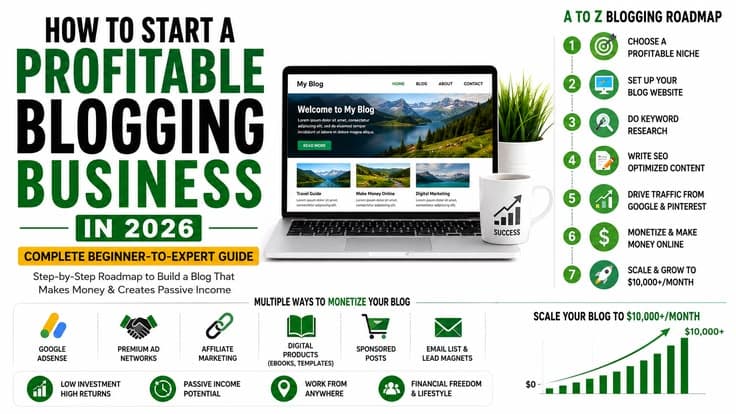
How to Start a Profitable Blogging Business in 2026: Complete Beginner-to-Expert Guide
Blogging in 2026 is not dead — it is evolving. While AI has changed how content is created and consumed, well-structured, authoritative, and human-driven blogs continue to rank on Google and generate thousands of dollars per month for their owners. The difference between blogs that succeed and blogs that fail is not writing talent or luck — it is strategy.
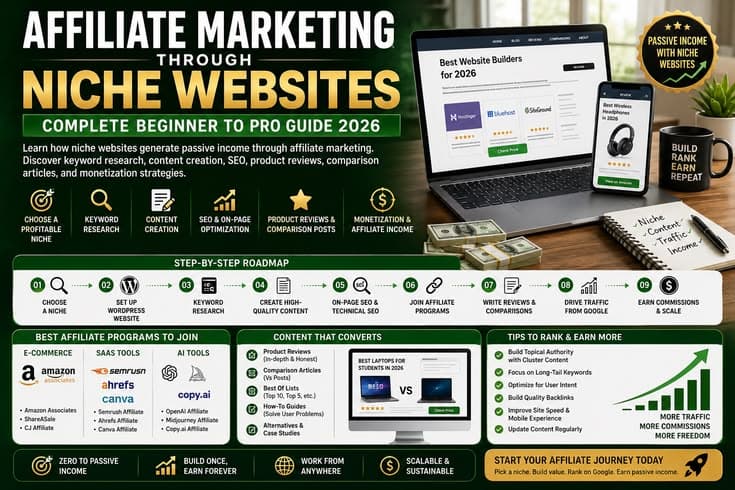
This complete A-to-Z guide will walk you through every single step of building a blogging business from scratch. Whether you are a complete beginner with zero technical knowledge or someone who already has a blog and wants to take it to the next level, this roadmap covers everything: niche selection, website setup, keyword research, content creation, SEO optimization, traffic generation, and multiple monetization streams that can scale from $0 to $10,000 per month.
What Is a Blogging Business and Why Is It Still Worth Starting in 2026?
A blogging business is a website where you publish regular articles on a specific topic and generate income through multiple monetization channels — advertising, affiliate marketing, digital products, and sponsored content. Unlike a personal blog, a blogging business treats content as an asset and audience as a customer base.
Here is why blogging remains one of the best online business models in 2026:
| Reason | Explanation |
|---|---|
| Low startup cost | A domain and hosting cost as little as $3 to $15/month to start |
| Passive income potential | Articles you write today can earn money for years without updates |
| Multiple income streams | Ads, affiliate, products, and sponsorships from one website |
| No inventory or shipping | Pure digital business with zero physical product management |
| Location independence | Manage your blog from anywhere with an internet connection |
| Scalable without linear effort | More articles equals more traffic equals more income |
| Compounds over time | Old articles continue ranking and earning as new ones are added |
The average blogger earns approximately $3,137 per month according to Blog Herald, and top earners generate over $100,000 per month. The path to those numbers starts with one decision: choosing the right niche.
Step 1: Choose a Profitable Niche
Your niche is the specific topic your blog covers. Choosing the right niche is the single most important decision you will make because it determines your traffic potential, monetization options, and long-term growth ceiling. The biggest mistake beginners make is choosing either too broad (covering everything) or too narrow (covering something nobody searches for).
The Profitable Niche Formula
A great blogging niche sits at the intersection of three things: something you can write about consistently, something people are actively searching for, and something that has monetization potential. Use this formula to find yours: Your Knowledge + Audience Demand + Monetization Potential = Profitable Niche.
| Niche | Search Demand | Monetization | Affiliate CPC | Competition |
|---|---|---|---|---|
| AI Tools and Productivity | Very High | SaaS affiliates 20-40% recurring, digital products | $3-$15 | Medium |
| Personal Finance | Extremely High | Finance affiliates, credit cards, fintech, coaching | $5-$30 | High |
| Health and Wellness | Very High | Supplement affiliates, fitness products, courses | $2-$10 | High |
| Digital Marketing | High | SEO tools, hosting affiliates, email platforms | $5-$25 | Medium |
| Make Money Online | Very High | Courses, digital products, SaaS tools | $4-$20 | High |
| Technology and AI | High | Tech products, SaaS, gadget affiliates | $3-$15 | Medium |
| Travel | High | Booking affiliates, hotel programs, travel cards | $1-$8 | Medium |
| Pet Health and Wellness | Medium-High | Pet product affiliates, vet service ads | $2-$8 | Low-Medium |
| Sustainable Living | Medium | Eco-brand affiliates, DIY guides | $2-$6 | Low |
| Remote Work Lifestyle | Medium-High | Software tools, coworking, productivity courses | $3-$12 | Low-Medium |
How to Validate Your Niche Before Committing
Before investing time and money, validate your niche using these free methods. First, search your topic on Google and check if there are multiple established websites ranking — this confirms demand exists. Second, use Google Trends and verify that search volume is stable or growing, not declining. Third, check Amazon and see if there are products in your niche — this confirms monetization potential. Fourth, look at Google AdSense CPC rates for your niche keywords using the free Google Keyword Planner. If advertisers are paying high CPC rates, your niche is financially valuable.
Step 2: Buy a Domain and Set Up Hosting
Once you have chosen your niche, the next step is setting up your website. This requires two things: a domain name (your web address like yourblog.com) and a hosting plan (the server that stores your website files and makes them accessible to visitors).
Choosing a Domain Name
Your domain name should be short, memorable, easy to spell, and ideally end in .com. It does not need to contain your exact niche keywords, though having a relevant word helps with branding. Avoid hyphens, numbers, and names that are easily confused with other brands. Buy your domain from reputable registrars like Namecheap, GoDaddy, or Cloudflare Registrar.
Hosting Plans Comparison
| Hosting Type | Best For | Monthly Cost | Recommended Providers |
|---|---|---|---|
| Shared Hosting | New bloggers with small traffic | $3-$10 | Bluehost, Hostinger, SiteGround |
| VPS Hosting | Growing blogs with moderate traffic | $15-$50 | Cloudways, DigitalOcean, Vultr |
| Cloud Hosting | High-traffic blogs needing reliability | $20-$100+ | Cloudways, Kinsta, WP Engine |
| Managed WordPress | Bloggers who want zero server management | $25-$80 | Kinsta, Flywheel, WP Engine |
For beginners, starting with Hostinger or Bluehost at $3 to $5 per month is perfectly adequate. As your traffic grows past 50,000 monthly sessions, consider upgrading to Cloudways for better performance and reliability. The critical requirements for any hosting plan you choose are fast loading speed (under 2 seconds), a free SSL certificate (HTTPS), daily automatic backups, and CDN support for global visitors.
Setting Up WordPress
WordPress powers over 43% of all websites on the internet and is the industry-standard platform for blogging businesses. It is free, highly customizable, and supported by thousands of plugins. After purchasing hosting, install WordPress through your hosting control panel — most providers offer a one-click WordPress installation. Then install a fast, lightweight theme. Kadence, Astra, and GeneratePress are the most recommended free themes for blogging because they are optimized for both speed and SEO out of the box.
Essential Pages to Create Before Publishing
Before writing your first blog post, set up these essential pages. Your Home page should showcase your best content and value proposition. Your Blog page should list all published articles in an organized format. The About page tells your story and why readers should trust your advice. The Contact page provides a form for reader inquiries and brand partnership requests. You also need a Privacy Policy (legally required if you use ads or collect emails) and Terms and Conditions page.
Must-Have WordPress Plugins
Install these essential plugins immediately after setting up WordPress: Rank Math for SEO optimization, UpdraftPlus for automatic daily backups, ShortPixel for image compression, WP Rocket for caching and speed optimization, Pretty Links for affiliate link management, and MonsterInsights for Google Analytics integration inside your WordPress dashboard.
Step 3: Keyword Research — The Foundation of Blog Traffic
Keyword research is the process of discovering what words and phrases your target audience types into Google. Every blog post you write should target a specific keyword — this is how Google knows what your article is about and who to show it to. Writing blog posts without keyword research is the equivalent of opening a store in a location where nobody walks by.
Types of Keywords Every Blogger Must Understand
Short-tail keywords are broad, high-competition phrases like "affiliate marketing" or "make money online." They have enormous search volume but are nearly impossible for new blogs to rank for against established authority sites. Long-tail keywords are specific, lower-competition phrases like "how to start affiliate marketing with a blog for beginners 2026" or "best AI tools for content creation on a budget." These are your primary targets as a new blog because they are easier to rank for, attract highly targeted readers, and convert better for monetization because the reader's intent is very specific.
Keyword Research Tools Comparison
| Tool | Type | Best For | Cost |
|---|---|---|---|
| Google Keyword Planner | Free | Finding search volumes and CPC rates | Free |
| Google Search Autocomplete | Free | Discovering long-tail keyword variations | Free |
| Google Trends | Free | Checking keyword trend direction over time | Free |
| Ubersuggest | Freemium | Competitor analysis and keyword ideas | Free / $29/month |
| KeySearch | Paid | Budget keyword research built for bloggers | $17/month |
| RankIQ | Paid | Finding low-competition topics in specific niches | $49/month |
| Ahrefs | Paid | Deep keyword research and backlink analysis | $99/month |
| Semrush | Paid | Comprehensive SEO and competitor research | $119/month |
As a beginner, start with free tools. Type your niche topic into Google and study the autocomplete suggestions, the "People Also Ask" section, and the "Related Searches" at the bottom of the results page. These are real questions real people are searching for right now — they are your keyword goldmine and they cost nothing to discover.
Step 4: Write SEO-Optimized Blog Content
Content is the engine of your blogging business. Every article you publish is a potential traffic magnet that can attract readers from Google for months or years. But not all content is created equal — Google's algorithm in 2026 heavily rewards content that demonstrates Expertise, Experience, Authoritativeness, and Trustworthiness (known as E-E-A-T).
Types of Blog Content That Perform Best
| Content Type | Example | Best For | Traffic Potential |
|---|---|---|---|
| How-To Guides | How to Start Affiliate Marketing in 2026 | Beginners searching for step-by-step instructions | Very High |
| Comparison Articles | Bluehost vs Hostinger: Which Hosting is Better? | Buyers comparing options before purchase | High — high buying intent |
| Product Reviews | Ahrefs Review 2026: Is It Worth the Price? | People researching before buying | High — high conversion rate |
| Listicles | 10 Best AI Tools for Content Creation in 2026 | Broad awareness audiences | Very High |
| Pillar Content | The Complete Guide to SEO for Beginners | Building topical authority | Extremely High long-term |
| Trending News | OpenAI GPT-5 Released: What You Need to Know | Early traffic from breaking news topics | High short-term burst |
| Future Predictions | The Future of Blogging: What to Expect in 2027 | Thought leadership and social shares | Medium |
How to Write a Blog Post That Ranks on Google — Step by Step
Research before writing: Before writing a single word, search your target keyword on Google and read the top 5 ranking articles. Understand what they cover, how long they are, what headings they use, and what questions they answer. Your goal is to write a more comprehensive, more helpful, and more current version of the best existing content.
Create a content outline: Map out your article structure using H1 for your main title, H2 for main sections, and H3 for sub-sections within each main section. Include your target keyword in the H1 and at least two H2 headings. Your outline should directly address the reader's search intent.
Write people-first content: Keep paragraphs short — two to three sentences each. Use bullet points and numbered lists to make content scannable. Include your primary keyword in the first 100 words, at least two H2 headings, and the conclusion. Avoid keyword stuffing — use the keyword naturally and include related terms (LSI keywords) throughout.
On-page SEO optimization: After writing, optimize the URL slug (keep it short and keyword-focused), meta title (60 characters max with primary keyword), meta description (150–160 characters, compelling and keyword-inclusive), image alt text (describe images using relevant keywords), and internal links (link to 3–5 related articles on your own blog).
Publish and index: After publishing, go to Google Search Console and submit your URL for indexing immediately. This tells Google your new article exists and should be crawled right away rather than waiting weeks for Google's natural crawl schedule.
Step 5: SEO Optimization — How to Rank on Google
Search Engine Optimization is the practice of optimizing your blog so Google ranks it higher in search results. More ranking positions equals more organic traffic, which equals more income. SEO for blogs has four main pillars: on-page SEO, technical SEO, off-page SEO (backlinks), and topical authority.
On-Page SEO Checklist for Every Article
| On-Page Element | Best Practice |
|---|---|
| Title Tag (H1) | Include primary keyword. Keep under 60 characters. Make it compelling to click. |
| Meta Description | 150-160 characters. Include keyword and a clear benefit or hook. |
| URL Slug | Short, keyword-focused, no stop words. Example: /start-affiliate-marketing-blog |
| First Paragraph | Include primary keyword within the first 100 words naturally. |
| H2 Headings | Use keyword variations and related terms in subheadings throughout. |
| Image Alt Text | Describe image content and naturally include keywords where relevant. |
| Internal Links | Link to 3-5 related articles on your blog using descriptive anchor text. |
| External Links | Link to 1-2 authoritative sources to support your factual claims. |
| Content Length | Aim for 1,500-3,000+ words for comprehensive, rankable content. |
| Schema Markup | Add Article, FAQ, or HowTo schema to help Google understand content type. |
Topical Authority: The Fastest Path to Google Rankings in 2026
Google increasingly rewards websites that demonstrate deep expertise in a specific subject area — this concept is called topical authority. Rather than writing random articles across many subjects, a topical authority strategy involves building clusters of content around a central topic. For example, if your niche is affiliate marketing, your content cluster might include a comprehensive pillar article on How to Start Affiliate Marketing, supported by dedicated articles on Amazon Associates Complete Guide, Best SaaS Affiliate Programs, Affiliate Marketing for Bloggers, How to Write Affiliate Product Reviews, and Affiliate Marketing Traffic Strategies. Internal links connecting all these articles signal to Google that your website is a comprehensive, trusted authority on affiliate marketing — and it will reward you with higher rankings across all articles in the cluster.
Step 6: Drive Traffic to Your Blog
Traffic is the lifeblood of a blogging business. Without readers, there is no income. The most successful bloggers in 2026 use a multi-channel traffic strategy rather than relying on any single source that could disappear overnight.
Traffic Sources Comparison
| Traffic Source | Time to Results | Effort Level | Long-Term Value | Best Niches |
|---|---|---|---|---|
| Google Organic SEO | 3-12 months | High initially | Extremely High | All niches |
| 2-8 weeks | Medium | High | Lifestyle, food, finance, travel, DIY | |
| Facebook Groups | Immediate | Medium | Medium | Niche communities, business |
| Twitter / X | 1-4 weeks | Medium | Medium | Tech, finance, news, AI |
| 2-6 weeks | Medium | High | Business, marketing, career, B2B | |
| Email Newsletter | Immediate to subscribers | Low once built | Extremely High | All niches |
| Immediate | High — community rules | Medium | Tech, finance, gaming, niche topics | |
| YouTube | 1-6 months | Very High | Very High | All niches with video content |
Pinterest: The Best Traffic Source for New Blogs
Pinterest is particularly powerful for new blogs because it functions as a visual search engine with over 500 million monthly active users. Unlike Google, Pinterest can send traffic to your blog within days of publishing, not months. For every blog post you write, create 3 to 5 vertical images (Pins) using Canva. Include your target keyword in the Pin title and description. Pin consistently — ideally 10 to 15 pins per day using a scheduler like Tailwind. Niches that perform exceptionally well on Pinterest include personal finance, blogging, food, travel, lifestyle, home decor, wellness, and DIY.
Building an Email List From Day One
Your email list is the most valuable asset your blogging business can own. Unlike social media followers or search engine rankings — both of which can disappear overnight due to algorithm changes — an email list is an audience you own and control permanently. Start building your email list from your very first day using a lead magnet: a valuable free resource (a checklist, mini-ebook, template, or cheat sheet) that you offer in exchange for a reader's email address. Use email marketing platforms like ConvertKit (now called Kit), MailerLite, or Flodesk to manage your list and send regular newsletters driving subscribers back to your latest blog posts.
Step 7: Monetize Your Blog — All Income Sources Explained
This is where your blogging business actually generates revenue. The most successful blogging businesses combine multiple income streams rather than relying on just one — this creates stability, because if one stream dips, others compensate.
Income Stream 1: Google AdSense and Display Advertising
Display advertising is the most straightforward way to start earning from a blog. You allow an ad network to place advertisements on your pages, and you earn money every time a visitor sees or clicks an ad. Google AdSense is the easiest starting point — there is no minimum traffic requirement for approval, and ads can be running within 24 to 48 hours of approval. As your traffic grows, upgrade to premium ad networks that pay significantly higher rates.
| Ad Network | Min Traffic Required | Average RPM | Best For |
|---|---|---|---|
| Google AdSense | None | $1-$5 | New bloggers just starting |
| Ezoic | 10,000 sessions/month | $5-$15 | Growing blogs needing a step up |
| Monumetric | 10,000 sessions/month | $8-$20 | Mid-sized blogs |
| Mediavine | 50,000 sessions/month | $20-$50 | Established lifestyle and content blogs |
| Raptive (AdThrive) | 100,000 pageviews/month | $30-$80 | Large authority blogs |
RPM means Revenue Per Mille — the income you earn per 1,000 pageviews. A blog on Mediavine earning $30 RPM and receiving 100,000 monthly sessions earns approximately $3,000 per month from display ads alone — completely passively, while you sleep.
Income Stream 2: Affiliate Marketing
Affiliate marketing is the process of earning commissions by recommending products and services through unique tracking links in your content. When a reader clicks your link and makes a purchase, the company pays you a commission — typically ranging from 1% to 50% of the sale value depending on the program. Affiliate marketing consistently ranks as the highest-earning income stream for most established bloggers because the commissions can be substantial, especially in software (SaaS) niches where many programs pay 20 to 40% recurring monthly commissions for the lifetime of each referred customer.
Top Affiliate Programs for Bloggers
| Affiliate Program | Niche | Commission Rate | Commission Type |
|---|---|---|---|
| Amazon Associates | All niches — physical products | 1-10% | One-time per sale |
| Hostinger Affiliate | Blogging, tech, web hosting | Up to 60% | One-time per sale |
| Bluehost Affiliate | Blogging, WordPress | $65-$130 per sale | One-time per sale |
| Semrush Affiliate | SEO, digital marketing | 40% recurring | Monthly recurring commission |
| ConvertKit Affiliate | Email marketing, blogging | 30% recurring | Monthly recurring for 24 months |
| Teachable Affiliate | Online courses, education | 30% recurring | Monthly recurring commission |
| ShareASale Network | Multi-niche marketplace | Varies by merchant | Varies by program |
| Impact Network | Multi-niche marketplace | Varies by merchant | Varies by program |
The most powerful affiliate content types are comparison articles (X vs Y), listicles (10 Best Tools for X), product reviews (honest reviews with pros and cons), and tutorial articles (How to Use X Tool Step by Step). These formats attract readers who are close to making a buying decision — the highest-converting audience in blogging.
Income Stream 3: Digital Products
Selling your own digital products is the most profitable blogging income stream because you keep nearly 100% of every sale. Once a digital product is created, it can be sold indefinitely with zero marginal cost per additional unit sold. Popular digital products for bloggers include ebooks (comprehensive guides on your niche topic priced $9 to $49), templates (Notion templates, Canva templates, spreadsheet templates priced $7 to $47), online courses (video or written courses teaching a specific skill priced $97 to $997), AI prompt packs (curated collections of prompts for specific use cases priced $9 to $29), printables (planners, worksheets, checklists priced $3 to $15), and monthly membership communities (exclusive content and community access at $9 to $49 per month).
Sell digital products through Gumroad (zero monthly fees, 10% transaction cut), Lemon Squeezy (modern alternative), Payhip (generous free plan), or directly on your WordPress site using WooCommerce.
Income Stream 4: Sponsored Content and Brand Deals
As your blog grows and establishes authority in your niche, brands will pay you to create content featuring their products and services. A sponsored post on a blog with 50,000 or more monthly readers in a targeted niche can earn $200 to $2,000 per post. The requirements for attracting sponsors are: a clearly defined niche audience, consistent monthly traffic (typically 10,000 or more sessions), and strong engagement metrics that demonstrate your readers trust your recommendations. Platforms like Mediavine Influencer, Cooperatize, and TapInfluence connect bloggers with brand sponsors.
Income Stream 5: Freelance Services
Your blog serves as a live portfolio demonstrating your expertise. As readers come to trust your writing and knowledge, a percentage will want to hire you directly. Common services bloggers offer include freelance writing at $50 to $500 per article, SEO consulting at $75 to $200 per hour, social media management at $500 to $3,000 per month on retainer, website setup and design at $300 to $2,000 per project, and content strategy consulting. Offering services while your blog is still growing provides immediate income before display ads and affiliate commissions reach significant levels.
Step 8: Realistic Income Milestones by Content Volume
| Stage | Articles Published | Timeline | Monthly Traffic (Est.) | Monthly Income (Est.) | Primary Income Source |
|---|---|---|---|---|---|
| Stage 1 | 0-100 articles | Months 1-6 | 100-5,000 visits | $0-$50 | AdSense if approved, early affiliate |
| Stage 2 | 100-300 articles | Months 6-12 | 5,000-30,000 visits | $50-$500 | AdSense plus affiliate commissions |
| Stage 3 | 300-700 articles | Year 1-2 | 30,000-150,000 visits | $500-$3,000 | Mediavine ads, affiliate, digital products |
| Stage 4 | 700-1,500 articles | Year 2-3 | 150,000-500,000 visits | $3,000-$10,000+ | All income streams combined |
| Stage 5 | 1,500+ articles | Year 3 and beyond | 500,000+ visits | $10,000-$100,000+ | Full authority website, all streams |
Step 9: Scale Your Blogging Business
Once your blog generates consistent income, the next phase is scaling — growing your output, authority, and income without proportionally increasing your personal time investment. Scaling is what separates a side income blog from a full-time business.
Build a content team: Hire freelance writers through Upwork, Fiverr, or ProBlogger Job Board to produce articles under your editorial guidance. You focus on strategy, keyword research, and editing — they focus on writing. This allows you to publish 3 to 5 articles per week instead of 1, dramatically accelerating your growth curve.
Create content clusters systematically: Rather than writing random articles, build complete topical clusters — pillar articles supported by 10 to 15 related supporting articles — to maximize topical authority in each subject area and capture entire keyword families from a single cluster investment.
Use AI writing tools strategically: AI tools like Claude, ChatGPT, and DeepSeek can assist with article outlines, research summaries, and first draft generation. However, always add human expertise, personal experience, and unique insights before publishing. Google's algorithm penalizes generic AI content while rewarding content with genuine E-E-A-T signals — expertise that comes from real human experience.
Improve your top-performing articles: Regularly audit your Google Search Console data to identify your highest-traffic articles. Update these with fresh information, additional sections, and improved internal linking to maintain and grow their rankings over time. Refreshing high-performing content is one of the highest-ROI activities in blogging.
Essential Tools for Running a Blogging Business
| Category | Tool | Purpose | Cost |
|---|---|---|---|
| SEO Plugin | Rank Math | On-page SEO optimization for WordPress | Free / $59/year Pro |
| Analytics | Google Analytics 4 | Track traffic, user behavior, and conversions | Free |
| Search Console | Google Search Console | Monitor search rankings and indexing status | Free |
| Email Marketing | ConvertKit (Kit) | Build and manage your email subscriber list | Free up to 1,000 subscribers |
| Image Optimization | ShortPixel | Compress images without quality loss | Free / Paid plans |
| Backup | UpdraftPlus | Automatic daily backups of your entire website | Free |
| Design | Canva | Create blog images, Pinterest pins, and graphics | Free / $13/month Pro |
| Keyword Research | Google Keyword Planner | Find search volume and CPC data at no cost | Free |
| Affiliate Links | Pretty Links | Cloak, manage, and track all affiliate links | Free / Paid |
| Speed and Caching | WP Rocket | Dramatically improve website loading speed | $59/year |
Common Blogging Mistakes That Kill New Blogs
Writing without keyword research: Every article should target a specific keyword with confirmed search demand. Writing about topics nobody searches for means nobody will find your articles through Google — no matter how well-written they are.
Choosing an overly broad niche: A blog covering everything builds authority in nothing. A blog laser-focused on "debt payoff strategies for millennials" or "AI productivity tools for content creators" builds deep topical authority that Google rewards with rankings and traffic.
Quitting too early: Blogging is a long-term game. Most blogs do not see significant Google traffic until 6 to 12 months after launching. The blogs that succeed are the ones that publish consistently through the initial period of zero traffic and near-zero income, trusting the process and the compounding effect of content.
Ignoring internal linking: Internal links connect your articles and distribute authority throughout your website. Every new article should link to 3 to 5 older articles, and every older article should link to newer ones when updated. This is one of the highest-impact, lowest-effort SEO tactics available to any blogger.
Waiting to monetize: Place affiliate links in your articles from day one. Apply to Google AdSense as soon as your site has 10 to 15 quality published articles. Consider launching a simple digital product within your first three months. Monetization planning from the beginning shapes the content you create and accelerates your path to income.
Frequently Asked Questions About Starting a Blogging Business
How much does it cost to start a blog? You can start a blogging business for as little as $30 to $100 per year — roughly $3 to $10 per month for hosting and $10 to $15 per year for a domain name. WordPress, basic essential plugins, and Google's analytical tools are all free.
How long does it take to make money blogging? Most bloggers see their first income within 3 to 6 months. Reaching $1,000 per month typically takes 12 to 18 months of consistent effort. Full-time income of $3,000 to $5,000 per month usually requires 2 to 3 years of building.
How many articles do I need before my blog earns money? There is no fixed number, but most bloggers start seeing meaningful AdSense income around 50 to 100 published articles. Meaningful affiliate commissions typically start appearing around 30 to 50 targeted review and comparison articles. Consistent $500 per month income usually appears around 100 to 200 well-optimized articles.
Is blogging still profitable in 2026? Yes — but the approach has changed significantly. Generic, surface-level content no longer ranks in a competitive landscape. What works in 2026 is specialized, experience-driven content that targets specific long-tail keywords, builds deep topical authority in a focused niche, and demonstrates genuine E-E-A-T to Google's increasingly sophisticated algorithm.
What is the best niche for blogging in 2026? The most profitable niches are AI tools and productivity, personal finance, digital marketing, health and wellness, and make money online. However, the best niche for you specifically is one where you have genuine knowledge or experience to share — because expertise is what Google rewards most heavily in its current algorithm.
Conclusion: Start Your Blogging Business Today
Building a profitable blogging business is one of the most rewarding and sustainable online business models available in 2026. It requires patience, consistency, and strategy — but unlike almost any other business, the work you invest today continues paying you for years into the future without requiring repeated effort. Every article you publish is a permanent digital asset that can attract readers and generate income around the clock, every day of the year.
The roadmap is clear and proven: choose a profitable niche with genuine demand, build a fast and professional website on WordPress, research and target the right long-tail keywords for every article, publish helpful SEO-optimized content consistently over months and years, drive traffic through Google organic search and Pinterest visual search, monetize through multiple income streams from display ads to affiliate commissions to your own digital products, and scale by building a content team and systematically expanding into topical content clusters.
The only obstacle between you and a profitable blogging business is taking the first step. Start today. Your future passive income starts with the first article you publish.
Need help setting up your blogging website, choosing the right niche, or getting Google AdSense approved? Contact us on WhatsApp: +923471936923 — we are here to help you build and grow your blogging business from zero to income.
Related Articles
- How to Get Google AdSense Approval Fast in 2026: Complete Guide
- Affiliate Marketing for Beginners: Complete Step-by-Step Guide 2026
- Keyword Research for Bloggers: How to Find Low Competition Keywords
- How to Get Massive Blog Traffic from Pinterest in 2026
- Best Digital Products to Sell Online for Passive Income in 2026