Affiliate Marketing Through Niche Websites: Complete Beginner to Pro Guide 2026
Affiliate marketing through niche websites remains one of the most reliable and scalable ways to build passive income online in 2026. The model is deceptively simple: you build a focused website around a specific topic, publish helpful content that targets what buyers are already searching for on Google, embed custom tracking links to relevant products, and earn a commission every time a reader purchases through your link.
What makes this model exceptional is its asymmetric effort-to-reward ratio. You write an article once. That article can rank on Google for months or years, attracting thousands of visitors and generating commissions around the clock — while you sleep, travel, or work on other projects. This is what genuine passive income actually looks like in practice.
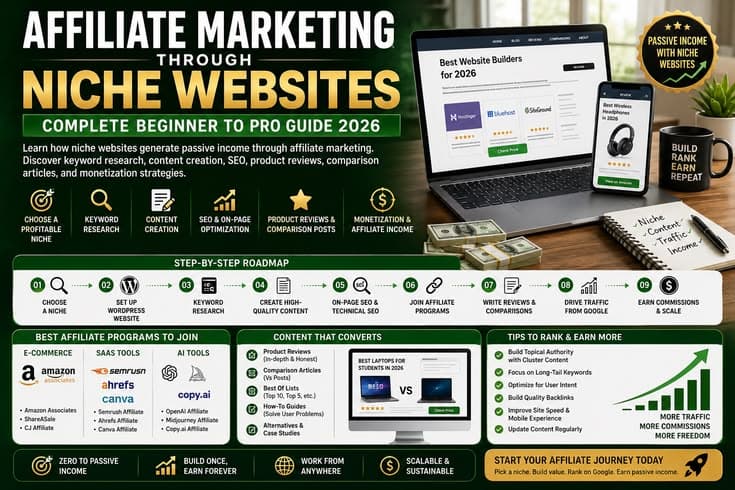
This complete guide covers every stage of the journey: choosing a profitable niche, setting up your website, doing keyword research, writing content that ranks and converts, joining the right affiliate programs, optimizing for SEO, building topical authority, and scaling your income to the level you want. Whether you are a complete beginner or someone who already has a blog and wants to monetize it more effectively, everything you need is here.
What Is Affiliate Marketing and How Does It Actually Work?
Affiliate marketing is a performance-based revenue model where you earn a commission by promoting products or services through a unique tracking link. When a reader clicks your link and completes a qualifying action — usually a purchase, but sometimes a free trial signup or form submission — the company pays you a percentage of the sale or a fixed flat fee.
The technical mechanism is straightforward. When your affiliate link is clicked, a small text file called a cookie is stored in the visitor's browser. This cookie tells the merchant's system who referred that visitor. If the visitor makes a purchase within the cookie's duration (typically 24 hours for Amazon, 30 to 90 days for most other programs, and sometimes lifetime for SaaS tools), you receive credit for the sale and your commission is recorded.
The Three Affiliate Revenue Models Explained
| Model | How It Works | Best For | Example |
|---|---|---|---|
| Pay-Per-Sale (PPS) | Earn a percentage or fixed amount when someone buys through your link | Most niches — products, software, courses | Amazon Associates: 1-10% per sale |
| Pay-Per-Lead (PPL) | Earn when a visitor signs up for a trial, form, or newsletter | Software, finance, insurance niches | HubSpot: $50-$200 per free trial signup |
| Pay-Per-Click (PPC) | Earn each time someone clicks your link, regardless of purchase | High-traffic informational sites | Less common — mostly legacy programs |
| Recurring Commission | Earn a monthly percentage as long as the referred customer stays subscribed | SaaS tools, VPN, email platforms | ConvertKit: 30% recurring for 24 months |
The recurring commission model deserves special attention. When you refer a customer to a SaaS product paying 30% recurring commission at $99 per month, you earn approximately $29.70 per month from that single referral — every month they remain subscribed. Refer 100 such customers and you earn $2,970 per month in completely passive recurring income from that one program alone. This is why SaaS and software affiliate programs are considered the highest-value opportunities in affiliate marketing.
Step 1: Choose a Profitable Affiliate Niche
Your niche choice is the single most important decision in your affiliate marketing journey. It determines your audience, your content, your affiliate programs, your traffic potential, and ultimately your income ceiling. The most common mistake beginners make is choosing either too broad a topic (impossible to establish authority) or too narrow a topic (too little search volume to generate meaningful traffic).
The Three Pillars of a Profitable Affiliate Niche
A great affiliate niche sits at the intersection of three essential qualities: search demand (people are actively searching for information and products in this space), buyer intent (those searchers want to purchase, not just browse), and affiliate product availability (there are products with affiliate programs to promote at multiple price points).
Best Affiliate Niches in 2026
| Niche | Why It Works | Typical Commission | Best Programs | Competition Level |
|---|---|---|---|---|
| SaaS and AI Tools | Recurring commissions, explosive growth in demand, high purchase intent | 20-40% recurring | Jasper, Surfer SEO, HubSpot, ConvertKit | Medium |
| Personal Finance | High CPC, high buyer willingness, massive search volume | $50-$300 per lead/sale | Credit card programs, fintech, budgeting apps | High |
| Web Hosting and WordPress | Extremely high commissions, every website needs hosting | $65-$200 per sale | Bluehost, Hostinger, WP Engine, Cloudways | High |
| Health Tech and Wearables | Growing market, high average order values, passionate audience | 5-20% per sale | Amazon, brand-specific programs | Medium |
| Online Education and Courses | High commissions, no-inventory digital products, recurring demand | 30-50% per sale | Teachable, Thinkific, Kajabi, Coursera | Medium |
| Home Office and Remote Work | Permanent lifestyle shift post-2020, sustained demand | 3-15% per sale | Amazon, brand programs | Low-Medium |
| Pet Health and Wellness | Passionate, spending audience, underserved sub-niches | 5-15% per sale | Amazon, Chewy, vet subscription programs | Low-Medium |
| Digital Marketing Tools | High-value software, professional audience willing to spend | 20-40% recurring | Semrush, Ahrefs, ClickFunnels, ActiveCampaign | Medium |
How to Validate Your Niche Before Committing
Google Trends Validation: Search your niche topic on Google Trends and verify that search interest is stable or growing over the past 5 years. Declining trends signal a dying market; growing trends signal opportunity.
Buyer Intent Check: Search your niche topic plus the words "review," "best," or "vs" on Google. If you see review-style articles and comparison content on the first page, buyer intent exists in this niche. If you only see Wikipedia-style informational pages, monetization will be harder.
Affiliate Program Check: Before choosing a niche, spend 30 minutes identifying 5 to 10 affiliate programs with products at multiple price points — some under $50, some $50 to $200, and ideally some $200 or more. This breadth gives you content flexibility and revenue diversification.
Competition Reality Check: Search your 10 most important target keywords on Google. If every first-page result is from massive authority sites like Forbes, The New York Times, or Wirecutter with thousands of backlinks, consider a sub-niche where you can realistically compete. A slightly more specific angle (e.g., "home gym equipment for small apartments" instead of "home gym equipment") can dramatically improve your ability to rank quickly.
Step 2: Set Up Your Affiliate Blog or Niche Website
For maximum control over your content, monetization options, and long-term business value, a self-hosted website on WordPress is the industry standard platform for affiliate marketers. Unlike free platforms or social media accounts — which can restrict your ability to use affiliate links or delete your content at any time — a self-hosted WordPress site is an asset you own completely.
Website Setup Checklist
| Step | Action Required | Recommended Tools | Cost |
|---|---|---|---|
| 1. Domain Registration | Choose a short, brandable .com domain relevant to your niche | Namecheap, Cloudflare Registrar | $10-$15/year |
| 2. Web Hosting | Purchase reliable shared or cloud hosting with fast load times | Hostinger, Bluehost, Cloudways | $3-$25/month |
| 3. WordPress Installation | One-click install via hosting control panel — no coding required | WordPress.org (free) | Free |
| 4. WordPress Theme | Install a fast, SEO-friendly theme optimized for affiliate sites | Kadence, Astra, GeneratePress | Free / $30-$60/year Pro |
| 5. SEO Plugin | Configure on-page SEO settings for every article you publish | Rank Math (recommended), Yoast SEO | Free / $59/year Pro |
| 6. Affiliate Link Plugin | Cloak, organize, and track all affiliate links in one place | Pretty Links, ThirstyAffiliates | Free / Paid |
| 7. Caching Plugin | Dramatically improve page loading speed for better SEO and user experience | WP Rocket, W3 Total Cache | Free / $59/year |
| 8. Backup Plugin | Automatic daily backups to protect your content investment | UpdraftPlus | Free |
| 9. Essential Pages | Create Home, Blog, About, Contact, Privacy Policy, Affiliate Disclosure | WordPress page builder | Free |
Your Affiliate Disclosure page is legally required. The FTC (Federal Trade Commission) mandates that affiliate marketers clearly disclose their financial relationships to readers. Add a visible disclosure statement near the top of every article where affiliate links appear: "This article contains affiliate links. If you purchase through these links, I may earn a commission at no additional cost to you." Failing to disclose not only risks legal penalties but also destroys reader trust when discovered.
Step 3: Keyword Research for Affiliate Sites
Keyword research is the strategic foundation of every successful affiliate website. Unlike a personal blog where you write whatever interests you, an affiliate site must target specific search queries that indicate buying intent — queries where the searcher is actively researching, comparing, or ready to purchase a product.
The Three Types of Keywords Every Affiliate Site Needs
Commercial Intent Keywords — These target buyers actively researching before a purchase decision. They generate the highest commission rates because readers are already in buying mode. Examples include "best ergonomic office chair under $300," "Jasper AI review 2026," and "Bluehost vs Hostinger which is better." These should form 60 to 70 percent of your content.
Informational Keywords — These target readers seeking to understand a topic related to your niche. While they convert at a lower rate, they build audience trust and topical authority. Examples include "how to set up a home office," "what is cloud hosting," and "affiliate marketing explained for beginners." These support your commercial content and build long-term SEO authority.
Transactional Keywords — These target readers who are essentially ready to buy and are looking for the best deal or final validation. Examples include "best price for Semrush," "Teachable coupon code 2026," and "WP Engine discount." While lower in volume, these convert extremely well.
Keyword Research Process Step by Step
Start with seed keywords: List 10 to 20 broad terms in your niche (e.g., "home gym equipment," "SEO tools," "email marketing software"). These are not keywords you will rank for directly — they are starting points.
Use Google Autocomplete: Type each seed keyword into Google and note every autocomplete suggestion. These are real searches real people are making right now. Save every suggestion that has commercial intent.
Mine the "People Also Ask" section: Every Google results page contains a "People Also Ask" box with related questions. These are keyword goldmines for informational content that supports your commercial articles.
Analyze competitor content: Find 3 to 5 established affiliate sites in your niche. Use free tools like Ubersuggest or the free version of Ahrefs to see which keywords are driving their traffic. Target the same keywords with better, more current content.
Filter for buyer intent and realistic competition: Prioritize long-tail keywords (3 or more words) that combine a product category with a qualifier ("best," "review," "vs," "for beginners," "under $X price"). These have lower competition than short keywords and attract visitors much closer to making a purchase decision.
Step 4: Join the Best Affiliate Programs
Choosing the right affiliate programs is as important as choosing the right niche. The difference between promoting a product that pays 3% one-time commission versus a SaaS tool that pays 30% recurring monthly commission can mean the difference between earning $500 per month and $5,000 per month from the same amount of traffic.
Best Affiliate Programs for Bloggers and Niche Sites in 2026
| Program | Category | Commission Rate | Cookie Duration | Payment Model | Best For |
|---|---|---|---|---|---|
| Amazon Associates | Physical Products | 1-10% per sale | 24 hours | One-time per sale | All niches — huge product selection |
| Bluehost Affiliate | Web Hosting | $65-$130 per sale | 60 days | One-time flat fee | Blogging, WordPress, tech niches |
| Hostinger Affiliate | Web Hosting | Up to 60% per sale | 30 days | One-time per sale | Blogging, online business niches |
| WP Engine Affiliate | Managed WordPress | $200 per sale | 180 days | One-time flat fee | WordPress, blogging, developer niches |
| ConvertKit (Kit) | Email Marketing | 30% recurring | 90 days | Monthly recurring | Blogging, content creator niches |
| Semrush Affiliate | SEO Software | 40% recurring | 120 days | Monthly recurring | SEO, digital marketing niches |
| Jasper AI Affiliate | AI Writing | 25-30% recurring | 60 days | Monthly recurring | AI tools, content marketing niches |
| HubSpot Affiliate | CRM and Marketing | 30% recurring for 1 year | 180 days | Monthly recurring | Business, marketing niches |
| Shopify Affiliate | Ecommerce Platform | $150 per referral | 30 days | One-time flat fee | Ecommerce, business niches |
| Teachable Affiliate | Course Platform | 30% recurring | 90 days | Monthly recurring | Education, coaching niches |
| ClickBank | Digital Products Network | Up to 75% per sale | 60 days | One-time per sale | Health, fitness, make money niches |
| ShareASale Network | Multi-niche Network | Varies by merchant | Varies | Varies | All niches |
Best AI Affiliate Programs in 2026
AI tools represent the fastest-growing and highest-converting affiliate category in 2026. Businesses and individuals are actively searching for AI solutions, adoption is accelerating, and the subscription-based pricing models mean generous recurring commissions for affiliates who refer customers.
| AI Tool | Category | Commission | Cookie | Why It Converts Well |
|---|---|---|---|---|
| Jasper AI | AI Writing Assistant | 25-30% recurring | 60 days | Market leader, strong brand, high intent searches |
| Surfer SEO | AI Content Optimization | 25% lifetime recurring | 60 days | Every blogger and SEO needs it |
| Writesonic | AI Copywriting | 30-40% recurring | 30 days | Affordable entry-level tool with massive audience |
| Synthesia | AI Video Generation | 25% recurring | 60 days | Unique product, high ticket value, growing market |
| Pictory AI | Video Repurposing | 20% lifetime recurring | 30 days | Strong use case for content creators |
| HubSpot AI Tools | Marketing AI Suite | 30% recurring for 1 year | 180 days | Enterprise reputation, long cookie, high value |
| Reclaim.ai | AI Calendar and Scheduling | Recurring | Varies | Productivity niche, B2B audience |
Step 5: Write Content That Ranks and Converts
Content is where affiliate marketing success is actually built. Every article you publish is a potential asset that can rank on Google, attract visitors, and generate commissions indefinitely. But not all content performs equally — the structure, topic selection, and quality of each article determines whether it brings in $0 or $1,000 per month.
The Five Types of High-Converting Affiliate Content
1. Product Review Articles: The backbone of every successful affiliate site. A comprehensive product review answers every question a potential buyer might have — what the product does, who it's best for, what its genuine pros and cons are, how it compares to alternatives, and whether it's worth the price. Readers searching "[Product Name] review" are close to purchasing and convert at rates of 3 to 10 percent.
2. Comparison Articles (X vs Y): Two products compared side by side, helping readers decide which is right for their specific situation. Comparison articles target extremely high-intent keywords ("Bluehost vs Hostinger," "Jasper vs ChatGPT," "Teachable vs Thinkific") and convert exceptionally well because the reader has already narrowed their choice to two options and is looking for the final push to decide.
3. Best-Of Listicles: "Best [Product Category] for [Specific Use Case]" articles attract broad traffic while allowing you to promote multiple affiliate products within a single article. A "Best Budget Mechanical Keyboards for Home Office 2026" article might recommend 8 products, each with its own affiliate link, dramatically increasing the chance that a visitor finds something to purchase.
4. Tutorial and How-To Articles: Step-by-step guides that naturally incorporate affiliate product recommendations as part of solving a problem. A "How to Start a Blog" tutorial that recommends Hostinger for hosting and Rank Math for SEO generates affiliate commissions while providing genuine value to the reader.
5. Buying Guides: Comprehensive guides that educate readers about an entire product category before helping them choose the right product. A "Complete Buying Guide to Home Espresso Machines" educates on features, brands, and price points, then recommends specific products at each tier — naturally incorporating affiliate links throughout.
Product Review Structure That Converts
| Section | Purpose | Length |
|---|---|---|
| Headline with verdict | State the product name and your overall conclusion — captures attention | 1 line |
| Affiliate disclosure | Legal requirement — place prominently near the top | 1-2 sentences |
| Quick verdict summary box | For readers who scan — give rating, pros, cons, CTA button | 100-150 words |
| Introduction and context | State the problem this product solves and why you tested it | 150-250 words |
| Key features explained | Describe each major feature and its real-world benefit to the user | 400-800 words |
| Personal experience and testing | Share your genuine first-hand experience — photos, screenshots help | 300-500 words |
| Pros and cons | Honest balanced evaluation — listing cons builds trust | 100-200 words |
| Comparison to alternatives | Compare to 2-3 similar products to help readers understand positioning | 200-400 words |
| Who should buy it | Specific recommendation for who this product is and isn't right for | 100-200 words |
| Final verdict with CTA | Clear conclusion with affiliate link button — "Check Latest Price" | 100-150 words |
Step 6: SEO Strategy for Affiliate Websites
Search Engine Optimization is what transforms your affiliate website from a hobby project into a passive income machine. Without SEO, your content has no discoverability — you might write excellent articles that nobody ever reads. With strong SEO, articles you wrote six months ago continue attracting thousands of new visitors every month, generating income while you focus on other work.
On-Page SEO Checklist for Every Affiliate Article
| Element | Best Practice |
|---|---|
| H1 Title Tag | Include primary keyword. Keep under 60 characters. Make it compelling and clear. |
| Meta Description | 150-160 characters. Include primary keyword and a strong reason to click. |
| URL Slug | Short, keyword-focused slug. E.g., /best-email-marketing-software not /post-12345 |
| First 100 Words | Include primary keyword naturally within the opening paragraph. |
| H2 and H3 Headings | Use keyword variations and related terms in subheadings throughout the article. |
| Image Alt Text | Describe each image using relevant keywords where natural. |
| Internal Links | Link to 3-5 related articles on your own site using descriptive anchor text. |
| External Links | Link to 1-2 authoritative sources to support factual claims. |
| Affiliate Link Attributes | Add rel="sponsored" or rel="nofollow" to all outbound affiliate links. |
| Schema Markup | Add Review or Product schema to help Google display rich snippets in search results. |
| Word Count | Aim for 1,500-3,000+ words for comprehensive affiliate content — more is not always better; match competitor depth. |
Building Topical Authority: The Most Powerful SEO Strategy for Affiliate Sites
Google's algorithm increasingly rewards websites that demonstrate comprehensive expertise in a specific topic area — known as topical authority. The most effective way to build this is through a pillar and cluster content architecture:
Your pillar content is a comprehensive guide on a broad niche topic — for example, "The Ultimate Guide to Email Marketing Tools 2026." This article covers the entire landscape: what email marketing is, why it matters, the main categories of tools, and brief reviews of the most important options. It targets a broad keyword but earns its authority from the depth of coverage and the volume of supporting content that links to it.
Your cluster content consists of dedicated articles on specific sub-topics: "ConvertKit Review 2026: Is It Worth the Price?", "Mailchimp vs ConvertKit: Which Is Better for Bloggers?", "Best Email Marketing Software for E-Commerce Stores," and "How to Set Up Email Automation for Beginners." Each cluster article links back to the pillar, and the pillar links to each cluster article. This interlinking structure tells Google your site has deep, comprehensive expertise on email marketing — and rewards you with rankings across the entire topic cluster.
Step 7: Drive Traffic to Your Affiliate Site
Building excellent content is necessary but not sufficient — you need a strategy for getting readers to your site, especially in the early months before Google begins ranking your articles. Successful affiliate marketers combine multiple traffic sources rather than depending on any single channel.
Traffic Sources Compared
| Traffic Source | Time to Results | Long-Term Value | Cost | Best Niches |
|---|---|---|---|---|
| Google Organic SEO | 3-12 months | Extremely High | Free (time investment) | All niches |
| 2-8 weeks | High | Free | Lifestyle, finance, food, travel, DIY | |
| Email Newsletter | Immediate to subscribers | Extremely High (owned audience) | Free to low cost | All niches |
| YouTube | 1-6 months | Very High | Free (equipment cost) | All niches with demonstrable products |
| Reddit and Forums | Immediate | Medium | Free (must add value) | Tech, finance, gaming, niche communities |
| Facebook Groups | 1-4 weeks | Medium | Free | Lifestyle, business, hobby niches |
| 2-6 weeks | High | Free | B2B, marketing, business niches | |
| Paid Ads (Google/Facebook) | Immediate | Medium (stops when you stop paying) | High | High-commission niches only |
Affiliate Marketing Without YouTube: Alternative Traffic Methods
Many successful affiliate marketers generate substantial income without ever creating a YouTube channel or any video content. Here are the most effective non-YouTube traffic strategies:
Pinterest as a Traffic Engine: Pinterest functions as a visual search engine with over 500 million monthly active users, and unlike Google, new accounts can start receiving traffic within days of publishing. Create 3 to 5 vertical pin images per blog post using Canva, include your target keyword in the pin title and description, and pin consistently using a scheduler like Tailwind. Niches that perform exceptionally on Pinterest include personal finance, blogging, food, lifestyle, home organization, and DIY.
Email List Building: Your email list is the most valuable traffic asset you can build because you own it permanently. Create a free lead magnet — a checklist, mini-guide, template, or resource list relevant to your niche — and offer it in exchange for reader email addresses. Send regular newsletters with your best new content and occasional affiliate recommendations. A list of 5,000 engaged subscribers can generate more revenue than 50,000 casual website visitors.
Online Communities and Forums: Platforms like Reddit, Quora, and niche-specific forums are full of people asking questions about topics in your niche. Provide genuinely helpful, detailed answers — and where appropriate and allowed by community rules, include a link to your article for further reading. This approach builds credibility, generates referral traffic, and can earn you backlinks from community members who share your answers.
Publishing Platform Content (Medium, LinkedIn Articles): Write condensed versions of your best articles on platforms like Medium or LinkedIn, and link to your full article for those who want more detail. These platforms have high domain authority and can rank content quickly, bringing readers to your site from search engines without requiring you to build domain authority from scratch.
Step 8: Optimize for Conversions and Scale Your Income
Getting traffic to your affiliate site is only half the battle. Conversion Rate Optimization (CRO) — the practice of improving how many visitors actually click your affiliate links and make purchases — is what separates sites earning $500 per month from sites earning $5,000 per month from the same traffic volume.
Affiliate Conversion Optimization Techniques
Place Your Primary CTA Above the Fold: Every affiliate article should have a clear call-to-action visible without scrolling — a button or text link directing readers to the product. Many readers decide quickly whether to investigate a product recommendation, so catching them at the top of the page dramatically increases click rates.
Use Comparison Tables: A well-formatted comparison table showing 3 to 5 products side by side with key specs, prices, ratings, and affiliate links is one of the highest-converting elements on any affiliate page. Readers can scan and click in seconds without reading the entire article.
Include Genuine Photos and Screenshots: Original images — your own photos of physical products, screenshots of software interfaces, personal results — signal authenticity to readers and to Google. They also fulfill Google's E-E-A-T requirements by proving genuine firsthand experience.
Test Link Placement: Affiliate links placed naturally throughout the body text, in comparison tables, in the product summary box, and at the end of the article perform better than links clustered only at the end. The more contextually appropriate opportunities readers have to click, the higher your overall click-through rate.
Update Articles Regularly: Outdated product information (wrong prices, discontinued products, old screenshots) destroys conversion rates and damages SEO. Set a calendar reminder to review and update your top 20 affiliate articles every 6 months.
Realistic Affiliate Income Milestones
| Stage | Articles Published | Monthly Visitors | Monthly Income Range | Primary Revenue Source | Timeline |
|---|---|---|---|---|---|
| Beginner | 10-30 articles | 100-1,000 | $0-$100 | First affiliate commissions | Months 1-4 |
| Early Growth | 30-80 articles | 1,000-10,000 | $100-$500 | Amazon + 1-2 SaaS programs | Months 4-9 |
| Established | 80-200 articles | 10,000-50,000 | $500-$3,000 | Multiple affiliate programs + display ads | Months 9-18 |
| Authority Site | 200-500 articles | 50,000-200,000 | $3,000-$15,000 | All streams: affiliate + ads + digital products | 18-36 months |
| Full Authority | 500+ articles | 200,000+ | $15,000-$100,000+ | Diversified: affiliate, ads, products, sponsorships | 3+ years |
Frequently Asked Questions About Affiliate Marketing
Can I do affiliate marketing without YouTube? Absolutely. The majority of successful affiliate marketers operate entirely through blog content and SEO, combined with Pinterest and email marketing for supplementary traffic. YouTube can amplify results but is not required.
How long does it take to make money from affiliate marketing? Most affiliate marketers earn their first commissions within 3 to 6 months. Reaching $1,000 per month typically takes 12 to 18 months of consistent effort. Results depend heavily on niche competitiveness, content quality, and publishing consistency.
Which affiliate programs are best for beginners? Amazon Associates is the easiest starting point due to its massive product selection and brand trust. For higher commissions, start with one or two SaaS programs in your niche — hosting affiliates and email marketing platforms consistently pay $50 to $200 per referral.
Do I need to buy the products I review? Google's guidelines strongly favor "experience" content — reviews from people who have actually used the product. While you don't always need to purchase every item, having firsthand experience with at least your main recommended products significantly improves both content quality and Google rankings.
What is the 80/20 rule in affiliate marketing? In practice, roughly 20% of your articles will drive 80% of your traffic and revenue. The key is publishing consistently until you identify your high-performers, then doubling down with supporting content, updates, and internal links pointing to those articles.
What are the best AI affiliate programs in 2026? The highest-paying AI affiliate programs include Jasper AI (25-30% recurring), Surfer SEO (25% lifetime recurring), Writesonic (30-40% recurring), Synthesia (25% recurring), and HubSpot (30% recurring for one year). These programs pay month after month for the lifetime of each referred customer.
Conclusion: Your Affiliate Marketing Roadmap
Affiliate marketing through niche websites is not a get-rich-quick scheme. It is a legitimate, scalable, and genuinely passive business model that rewards patience, strategic thinking, and consistent effort over time. The affiliate websites generating $10,000 to $100,000 per month today were started by people who committed to the process years ago — choosing a focused niche, publishing quality content consistently, and compounding their efforts month after month.
The roadmap is clear: choose a profitable niche with strong buyer intent and available affiliate programs, set up a professional self-hosted website, do keyword research to find what your audience is searching for, join programs that pay generous commissions, write reviews and guides that genuinely help people make better purchasing decisions, optimize for search engines, build topical authority through strategic content clusters, and diversify your traffic sources through SEO, Pinterest, and email marketing.
Your first affiliate commission will likely feel small — $5, $12, $30. But it proves the model works. Scale that by 100x through more content, better SEO, and higher-commission programs, and you have the foundation of a business that can replace — or far exceed — a traditional salary.